*Civil disobedience is the active, professed
refusal to obey certain laws, demands, or
commands of a government.
*Civil disobedience is sometimes, though not
always, defined as being nonviolent resistance.
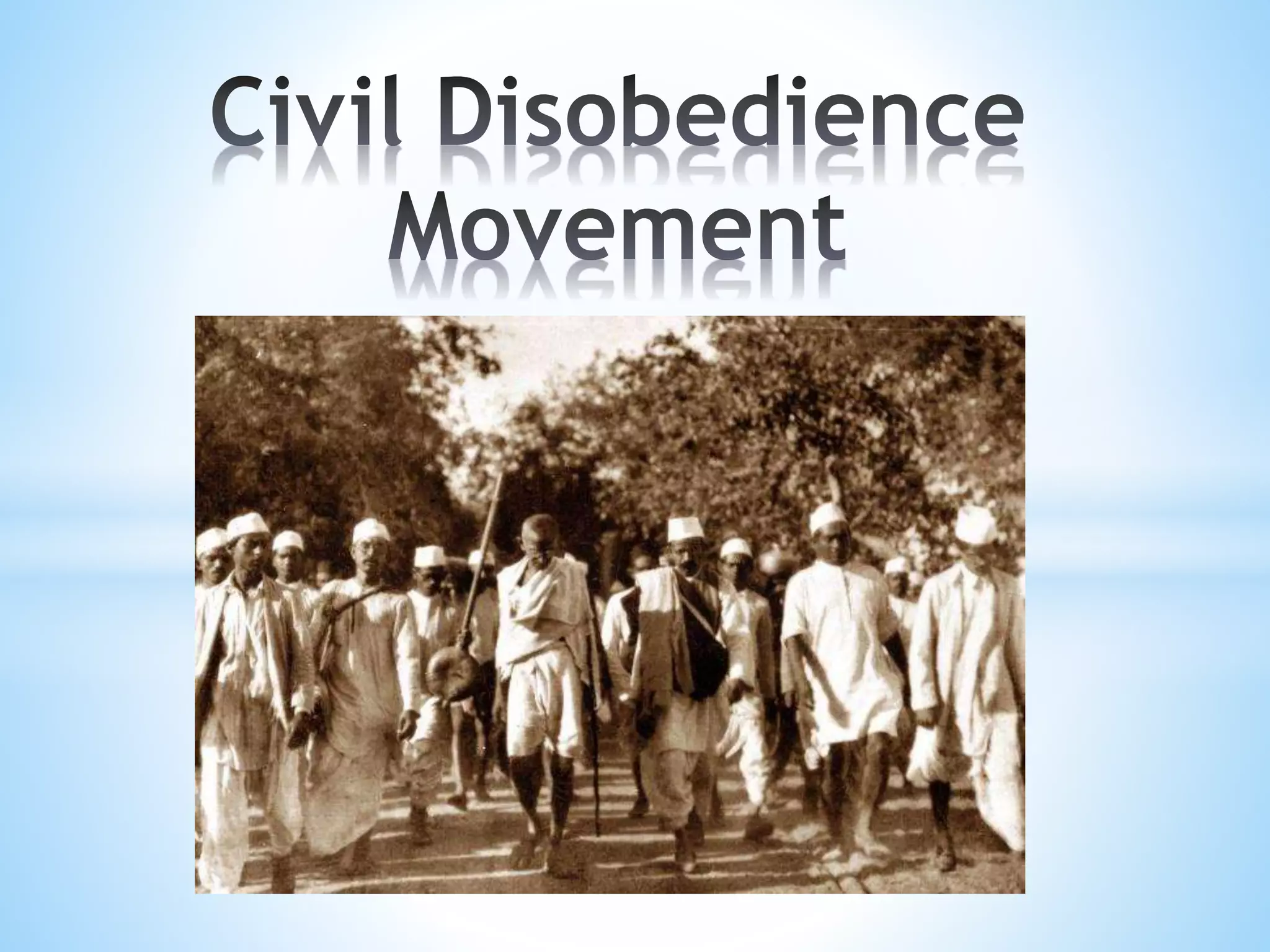
*Gandhiji led a march on foot from Sabarmati to
Dandi. He broke the Salt Law at Dandi and
inaugurated the Movement.
*Followed by an entourage of seventy nine
Ashramites.
* On 6th April 1930, Gandhi with the
accompaniment of seventy nine satyagrahis,
violated the Salt Law by picking up a fistful of
salt lying on the sea shore. They manually
made salt on the shores of Dandi.
*The program of the Civil Disobedience
Movement incorporated besides the breaking of
the Salt Laws, picketing of shops selling foreign
goods and liquor, bonfire of cloth, refusal to
pay taxes and avoidance of offices by the
public officers and schools by the students.
*Even the women joined forces against the
British.
*Rich Peasants- Depression and fall in prices
affected them badly. They demanded reduction
in land revenue.
*Poor peasants- Depression affected them badly.
They demanded reduction in rent.
*Business Class- They demanded protection
against the import of foreign goods.
*Industrial Workers- They were poorly paid.
Conditions of work were miserable.
*In the March of 1930, Gandhi met with the
Viceroy, Lord Irwin and signed an agreement
known as the Gandhi-Irwin Pact.
*The two main clauses of the pact entailed;
Congress participation in the Round Table
Conference and cessation of The Civil
Disobedience Movement.
*The Government of India
released all satyagrahis from
prison.
*Gandhi attended The Second Round Table
Conference in London accompanied by Smt.
Sarojini Naidu.
*At this Conference, it was claimed by Mahatma
Gandhi that the Congress represented more
than eighty five per cent of the Indian
population.
*Gandhi's claim was not endorsed by the British
and also the Muslim representative.
*The Congress Working Committee took the
decision to restart The Civil Disobedience
Movement, as the British government was not
prepared to relent.
*Gandhi resumed the movement in January 1932
and appealed to the entire nation to join in.
*The police was given the power to arrest any
person, even on the basis of mere suspicion.
* Sardar Patel, the President of Congress and
Gandhi were arrested, along with other
Congressmen.
*Gandhi commenced his twenty one days of fast
on May 8th, 1933, to make amends for the sins
committed against the untouchables by the
caste Hindus.
*The Civil Disobedience Movement was
suspended, when Mahatma Gandhi withdrew
mass satyagraha on July 14th 1933. The
movement ceased completely on April 7th
1934.
*Civil Disobedience Movement was the first
struggle to win Poorna Swaraj or Complete
Independence.
*It was based on non violent Satyagraha.
Gandhian ideas were widely followed.
*It was an open challenge to the British rule.
The people openly disobeyed laws.
*Although The Civil Disobedience Movement
failed to achieve any positive outcome, it was
an important juncture in the history of Indian
independence.
*Satyagraha was put on a firm footing through
its large scale usage in the movement.
*The leadership of Mahatma Gandhi had a
beneficial impact.
*The warring factions within the Congress
united under the aegis of The Civil
Disobedience Movement, led by Mahatma
Gandhi.
*Last but not the least India rediscovered its
inherent strength and confidence to crusade
against the British for its freedom.
Civil disobedience movement

Civil disobedience movement

  • 2.
    *Civil disobedience isthe active, professed refusal to obey certain laws, demands, or commands of a government. *Civil disobedience is sometimes, though not always, defined as being nonviolent resistance.
  • 3.
    *Gandhiji led amarch on foot from Sabarmati to Dandi. He broke the Salt Law at Dandi and inaugurated the Movement. *Followed by an entourage of seventy nine Ashramites. * On 6th April 1930, Gandhi with the accompaniment of seventy nine satyagrahis, violated the Salt Law by picking up a fistful of salt lying on the sea shore. They manually made salt on the shores of Dandi.
  • 4.
    *The program ofthe Civil Disobedience Movement incorporated besides the breaking of the Salt Laws, picketing of shops selling foreign goods and liquor, bonfire of cloth, refusal to pay taxes and avoidance of offices by the public officers and schools by the students. *Even the women joined forces against the British.
  • 5.
    *Rich Peasants- Depressionand fall in prices affected them badly. They demanded reduction in land revenue. *Poor peasants- Depression affected them badly. They demanded reduction in rent. *Business Class- They demanded protection against the import of foreign goods. *Industrial Workers- They were poorly paid. Conditions of work were miserable.
  • 6.
    *In the Marchof 1930, Gandhi met with the Viceroy, Lord Irwin and signed an agreement known as the Gandhi-Irwin Pact. *The two main clauses of the pact entailed; Congress participation in the Round Table Conference and cessation of The Civil Disobedience Movement. *The Government of India released all satyagrahis from prison.
  • 7.
    *Gandhi attended TheSecond Round Table Conference in London accompanied by Smt. Sarojini Naidu. *At this Conference, it was claimed by Mahatma Gandhi that the Congress represented more than eighty five per cent of the Indian population. *Gandhi's claim was not endorsed by the British and also the Muslim representative.
  • 8.
    *The Congress WorkingCommittee took the decision to restart The Civil Disobedience Movement, as the British government was not prepared to relent. *Gandhi resumed the movement in January 1932 and appealed to the entire nation to join in.
  • 9.
    *The police wasgiven the power to arrest any person, even on the basis of mere suspicion. * Sardar Patel, the President of Congress and Gandhi were arrested, along with other Congressmen. *Gandhi commenced his twenty one days of fast on May 8th, 1933, to make amends for the sins committed against the untouchables by the caste Hindus.
  • 10.
    *The Civil DisobedienceMovement was suspended, when Mahatma Gandhi withdrew mass satyagraha on July 14th 1933. The movement ceased completely on April 7th 1934.
  • 11.
    *Civil Disobedience Movementwas the first struggle to win Poorna Swaraj or Complete Independence. *It was based on non violent Satyagraha. Gandhian ideas were widely followed. *It was an open challenge to the British rule. The people openly disobeyed laws.
  • 12.
    *Although The CivilDisobedience Movement failed to achieve any positive outcome, it was an important juncture in the history of Indian independence. *Satyagraha was put on a firm footing through its large scale usage in the movement. *The leadership of Mahatma Gandhi had a beneficial impact.
  • 13.
    *The warring factionswithin the Congress united under the aegis of The Civil Disobedience Movement, led by Mahatma Gandhi. *Last but not the least India rediscovered its inherent strength and confidence to crusade against the British for its freedom.