Managing Change Syllabus points: Nature and sources of change Internal and External Structural responses to change
If you stop moving you die!
External v Internal External are outside the control of the business Internal are within the control of the business Sometimes there is overlap
Sources of Change External Changing nature of markets Economic Financial Geographic Social Legal Political Technological Internal Accelerating technology E-commerce New systems and procedures New business cultures
External Sources of Change
The changing nature of markets Globalisation:  Process of increasing the connectivity and mobility of the world's markets and businesses. Why is globalisation a concern for Australian Businesses?
The changing nature of markets Downsizing Casualisation of workforce E-commerce Dominant Retailers
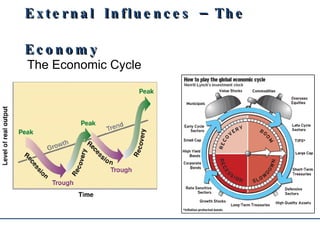
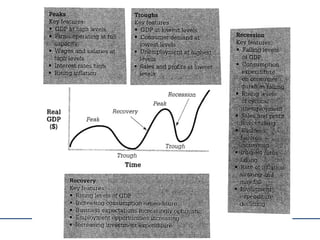
External Influences – The Economy The Economic Cycle
 
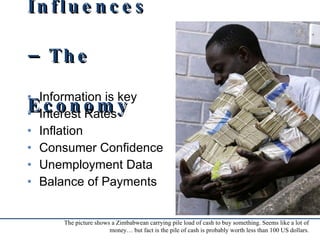
External Influences – The Economy Information is key Interest Rates Inflation Consumer Confidence Unemployment Data Balance of Payments The picture shows a Zimbabwean carrying pile load of cash to buy something. Seems like a lot of money… but fact is the pile of cash is probably worth less than 100 US dollars.
Revision – Books closed What are 3 external influences causing change for business? What are 3 indicators of change in the economy? How does the government slow inflation? How did the government stimulus package affect the cost of borrowing money?
External Influences –Financial Markets Deregulation by government – market oriented approach New banks and financial institutions International sources of finance Technology allows for new products
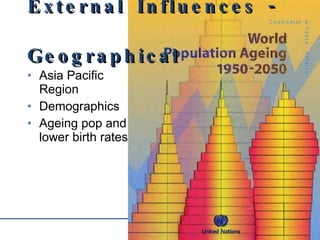
Asia Pacific Region Demographics Ageing pop and lower birth rates External Influences - Geographical
Understanding leads to greater success Family friendly programs Make up of the workforce Environmental movement Can you think of any other social influences? External Influences –  Social Influences
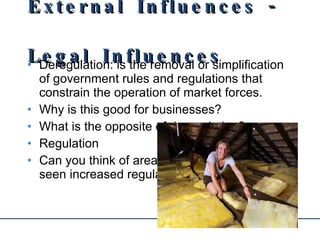
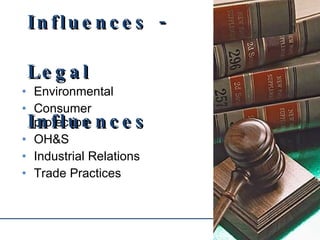
External Influences - Legal Influences Deregulation: is the removal or simplification of government rules and regulations that constrain the operation of market forces. Why is this good for businesses? What is the opposite of deregulation? Regulation Can you think of areas of business that have seen increased regulation?
Environmental Consumer protection OH&S Industrial Relations Trade Practices External Influences - Legal Influences
External Influences - Political government regulators – ACCC ASIC Political parties have different approaches to managing the economy Tax and areas of Law Floating of the Aus $ (Dec 1983) GST was a huge change in 2000 Free trade – removal of protection Government plays a major role in having a stable economy
Dollar dive: 40 US cents warning  -  November 1, 2008 - 8:29AM  SMH The Australian dollar may fall to a record low next year, possibly dipping below 40 US cents for the first time, as slowing growth in emerging markets cools demand for the raw materials exported by the nation. The currency has dropped 31% since reaching a 25-year high of 98.49 US cents on July 16, sliding as prices of crude oil, gold and nickel declined. It reached 47.75 cents in April 2001, the lowest since it started trading freely in 1983. "I can see it certainly dropping quite sharply from here," Carlin Doyle, a London-based currency strategist at State Street Global Markets said. The Australian dollar could fall "below the 40 cent level and I can see that happening in the next year or so," he added. Australia's currency rose 5.3% to 68.43 cents at 7:03pm in Sydney, from 68.43 cents late yesterday in Asia. The currency advanced to its July high as surging commodities prices and a benchmark interest rate of 7.25% helped attract investment. It has been the worst performer of the 16 most-traded currencies against the dollar and yen over the past 3 months as a seizure in credit markets fueled concern the global economy is headed for a recession. Commodities account for about 60% of Australia's exports
 
External Influences Government Macro-economic objectives: Control of inflation. RBA target = 2.0 - 3.0% Maintain full employment –  all who want a job can get one! Control of balance of payments Stability of exchange rate Maintain steady economic growth
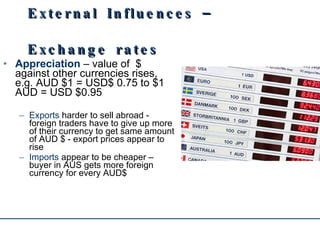
External Influences – Exchange rates Appreciation  – value of  $ against other currencies rises, e.g. AUD $1 = USD$ 0.75 to $1 AUD = USD $0.95 Exports  harder to sell abroad - foreign traders have to give up more of their currency to get same amount of AUD $ - export prices appear to rise Imports  appear to be cheaper – buyer in AUS gets more foreign currency for every AUD$
External Influences -  Government Policies: Fiscal Policy  – influencing economic and non-economic objectives through variations in public income and expenditure (tax revenue, borrowing and government spending) Affects all aspects of business activity  – regulations, infrastructure – roads, transport, etc, health and safety, support for industry, business taxation, employment laws and taxes – income tax and national insurance contributions, pension contributions, etc.
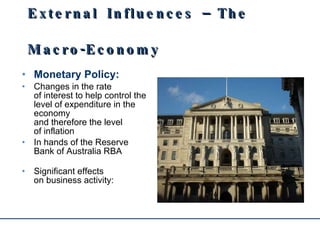
External Influences – The Macro-Economy Monetary Policy: Changes in the rate  of interest to help control the level of expenditure in the economy  and therefore the level  of inflation In hands of the Reserve Bank of Australia RBA Significant effects  on business activity:
External Influences – The Macro-Economy Rising Interest Rates: Likely to depress consumer spending Increases the cost of borrowing –  impacts on investment decisions Increases existing loan costs – the more highly geared the greater the impact Affects exchange rate – could impact  on sales abroad (exports)  or cost of imported resources Falling rates have the opposite effect
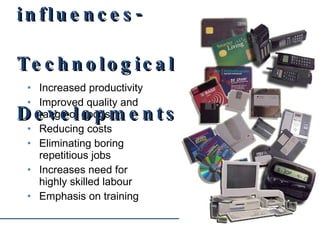
Increased productivity Improved quality and range of goods Reducing costs Eliminating boring repetitious jobs Increases need for highly skilled labour Emphasis on training External influences- Technological Developments
Activities Evaluate the accuracy of the following statement: ‘One of Australia’s main competitive advantages in terms of world trade is its geographic location within the Asia Pacific Region’ Select two demographic influences on business and explain how they lead to opportunities and threats for businesses.

External Influences on Business

  • 1.
    Managing Change Syllabuspoints: Nature and sources of change Internal and External Structural responses to change
  • 2.
    If you stopmoving you die!
  • 3.
    External v InternalExternal are outside the control of the business Internal are within the control of the business Sometimes there is overlap
  • 4.
    Sources of ChangeExternal Changing nature of markets Economic Financial Geographic Social Legal Political Technological Internal Accelerating technology E-commerce New systems and procedures New business cultures
  • 5.
  • 6.
    The changing natureof markets Globalisation: Process of increasing the connectivity and mobility of the world's markets and businesses. Why is globalisation a concern for Australian Businesses?
  • 7.
    The changing natureof markets Downsizing Casualisation of workforce E-commerce Dominant Retailers
  • 8.
    External Influences –The Economy The Economic Cycle
  • 9.
  • 10.
    External Influences –The Economy Information is key Interest Rates Inflation Consumer Confidence Unemployment Data Balance of Payments The picture shows a Zimbabwean carrying pile load of cash to buy something. Seems like a lot of money… but fact is the pile of cash is probably worth less than 100 US dollars.
  • 11.
    Revision – Booksclosed What are 3 external influences causing change for business? What are 3 indicators of change in the economy? How does the government slow inflation? How did the government stimulus package affect the cost of borrowing money?
  • 12.
    External Influences –FinancialMarkets Deregulation by government – market oriented approach New banks and financial institutions International sources of finance Technology allows for new products
  • 13.
    Asia Pacific RegionDemographics Ageing pop and lower birth rates External Influences - Geographical
  • 14.
    Understanding leads togreater success Family friendly programs Make up of the workforce Environmental movement Can you think of any other social influences? External Influences – Social Influences
  • 15.
    External Influences -Legal Influences Deregulation: is the removal or simplification of government rules and regulations that constrain the operation of market forces. Why is this good for businesses? What is the opposite of deregulation? Regulation Can you think of areas of business that have seen increased regulation?
  • 16.
    Environmental Consumer protectionOH&S Industrial Relations Trade Practices External Influences - Legal Influences
  • 17.
    External Influences -Political government regulators – ACCC ASIC Political parties have different approaches to managing the economy Tax and areas of Law Floating of the Aus $ (Dec 1983) GST was a huge change in 2000 Free trade – removal of protection Government plays a major role in having a stable economy
  • 18.
    Dollar dive: 40US cents warning - November 1, 2008 - 8:29AM SMH The Australian dollar may fall to a record low next year, possibly dipping below 40 US cents for the first time, as slowing growth in emerging markets cools demand for the raw materials exported by the nation. The currency has dropped 31% since reaching a 25-year high of 98.49 US cents on July 16, sliding as prices of crude oil, gold and nickel declined. It reached 47.75 cents in April 2001, the lowest since it started trading freely in 1983. "I can see it certainly dropping quite sharply from here," Carlin Doyle, a London-based currency strategist at State Street Global Markets said. The Australian dollar could fall "below the 40 cent level and I can see that happening in the next year or so," he added. Australia's currency rose 5.3% to 68.43 cents at 7:03pm in Sydney, from 68.43 cents late yesterday in Asia. The currency advanced to its July high as surging commodities prices and a benchmark interest rate of 7.25% helped attract investment. It has been the worst performer of the 16 most-traded currencies against the dollar and yen over the past 3 months as a seizure in credit markets fueled concern the global economy is headed for a recession. Commodities account for about 60% of Australia's exports
  • 19.
  • 20.
    External Influences GovernmentMacro-economic objectives: Control of inflation. RBA target = 2.0 - 3.0% Maintain full employment – all who want a job can get one! Control of balance of payments Stability of exchange rate Maintain steady economic growth
  • 21.
    External Influences –Exchange rates Appreciation – value of $ against other currencies rises, e.g. AUD $1 = USD$ 0.75 to $1 AUD = USD $0.95 Exports harder to sell abroad - foreign traders have to give up more of their currency to get same amount of AUD $ - export prices appear to rise Imports appear to be cheaper – buyer in AUS gets more foreign currency for every AUD$
  • 22.
    External Influences - Government Policies: Fiscal Policy – influencing economic and non-economic objectives through variations in public income and expenditure (tax revenue, borrowing and government spending) Affects all aspects of business activity – regulations, infrastructure – roads, transport, etc, health and safety, support for industry, business taxation, employment laws and taxes – income tax and national insurance contributions, pension contributions, etc.
  • 23.
    External Influences –The Macro-Economy Monetary Policy: Changes in the rate of interest to help control the level of expenditure in the economy and therefore the level of inflation In hands of the Reserve Bank of Australia RBA Significant effects on business activity:
  • 24.
    External Influences –The Macro-Economy Rising Interest Rates: Likely to depress consumer spending Increases the cost of borrowing – impacts on investment decisions Increases existing loan costs – the more highly geared the greater the impact Affects exchange rate – could impact on sales abroad (exports) or cost of imported resources Falling rates have the opposite effect
  • 25.
    Increased productivity Improvedquality and range of goods Reducing costs Eliminating boring repetitious jobs Increases need for highly skilled labour Emphasis on training External influences- Technological Developments
  • 26.
    Activities Evaluate theaccuracy of the following statement: ‘One of Australia’s main competitive advantages in terms of world trade is its geographic location within the Asia Pacific Region’ Select two demographic influences on business and explain how they lead to opportunities and threats for businesses.