Titanium and its alloysMM 207:Engineering metallurgy, IIT Bombay.
TitaniumTitanium is recognized for its high strength-to-weight ratio. It is a light, strong metal with low density , Is quite ductile when pure (especially in an oxygen-free environment),lustrous, and metallic-white in color. The relatively high melting point makes it useful as a    refractory metal.7th most abundant metal
Ti resourcesThe world production of titanium is nevertheless very small, hundreds of thousands of tonnes, which compares say with steel at 750 million tonnes per annum.
TitaniumAtomic number  = 22Atomic weight  = 47.9Electronic configuration + [Ar]4S2 d 2Atomic radius = 144.2Melting point  = 1668Boiling point  = 3287Oxidation state = 4,3,2
Pure titanium melts at 1670oC and has a density of 4.51 g cm-3. It should therefore be ideal for use in components which operate at elevated temperatures, especially where large strength to weight ratios are required.
Commercially pure titaniumUTS  = 375 MPa  upto 1.4 GPa for  Beta alloys45 lighter than steelHard anddifficult to machineLooses strength above 430 degrees CelsiusBurns in oxygen and nitrogenLow electrical and thermal conductivity
Titanium and its alloysTitanium is resistant to dilute sulphuric and hydrochloric acid, most organic acids, damp chlorine gas, and chloride solutions. Titanium metal is considered to be    physiologically inert.Good performance in sea waer environmentAround 50% of Ti used as Ti6Al4V
ProductionReduction of ore to spongeMelting of sponge to form an ingotPrimary fabrication into a billet/bar,..Secondary fabrication into finished shape
TitaniumDimorphic; hexagonal alpha form changes to high temperature Beta very slowly above 880 degree celsius
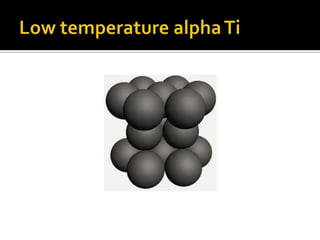
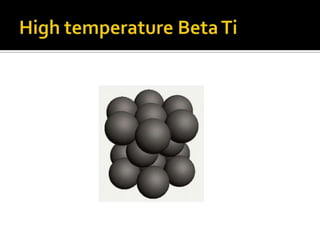
Ti lattice structureThe crystal structure of titanium at ambient temperature and pressure is close-packed hexagonal (α) with a c/a ratio of 1.587. Slip is possible on the pyramidal, prismatic and basal planes in the close-packed directions. At about 890oC, the titanium undergoes an allotropic transformation to a body-centred cubic β phase which remains stable to the melting temperature.
Crystallographic forms of Titanium  Hexagonal close-packed (hcp) or alpha (α) phase, found at room temperature   Body centered cubic (bcc) or beta (ß) phase, found above 883 °C (1621 °F)
Titanium and its alloysAlpha and near alpha alloys :   Ti-2.5Cu,            Ti-5Al-2.5Sn, Ti-8Al-1V-1Mo,Ti-6242 ,                  T i-6Al-2Nb-1Ta-0.8 Mo, Ti-5Al-5Sn-2Zr-2Mo Alpha + Beta alloys:   Ti-6Al-4V, Ti-6Al-6V-2Sn,               Ti-6Al-2Sn-2Zr-2Cr-2Mo, Ti-8Al-1Mo-1V, Ti-3Al-2.5VThe beta phase is normally in the range of 10 to 50% at room temperature. Beta alloys Ti-13V-11Cr-3Al, Ti-8Mo-8V-2Fe-3Al,            Ti-10V-2Fe-3Al, Ti-15-3  
Low temperature alpha Ti
High temperature Beta Ti
Historical backgroundPure metallic titanium (99.9%) was first prepared in 1910 by Matthew A. Hunter by heating TiCl4 with sodium in a steel bomb at 700 – 800 °C in the Hunter process.[2] Titanium metal was not used outside the laboratory until 1946 when William Justin Kroll proved that it could be commercially produced by reducing titanium tetrachloride with magnesium in what came to be known as the Kroll process
Ti alloysAll elements which are within the range 0.85-1.15 of the atomic radius of titanium alloy substitutionally and have a significant solubility in titanium. Elements with an atomic radius less than 0.59 that of Ti occupy interstitial sites and also have substantial solubility (e.g. H, N, O, C). The ease with which solutes dissolve in titanium makes it difficult to design precipitation-hardened alloys. Boron has a similar but larger radius than C, O, N and H; it is therefore possible to induce titanium boride precipitation. Copper precipitation is also possible in appropriate alloys.
Role of alloying additionsMolybdenum and vanadium have the largest influence on β stability and are common alloying elements. Tungsten is rarely added due to its high density. Cu forms TiCu2 which makes the alloys age-hardening and heat treatable; such alloys are used as sheet materials. It is typically added in concentrations less than 2.5 wt% in commercial alloys.Zr, Sn and Si are neutral elements.These do not fit properly and cause changes in the lattice parameters. Hydrogen is the most important interstitial. Body-centred cubic Ti has three octahedral interstices per atom whereas c.p.h. Ti has one per atom. The latter are therefore larger, so that the solubility of O, N, and C is much higher in the α phase.
Hume Rothery’s principlesIf a solute differs in its atomic size by more than about 15% from the host, then it is likely to have a low solubility in that metal. The size factor is said to be unfavourable. If a solute has a large difference in electronegativity (or electropositivity) when compared with the host, then it is more likely to form a compound. Its solibility in the host would therefore be limited. A metal with a lower valency is more likely to dissolve in one which has a higher valency, than vice versa.
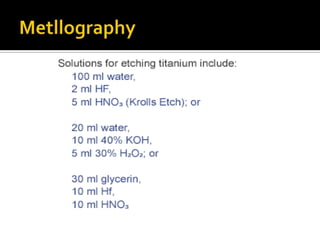
Metllography
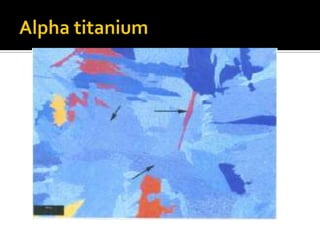
Alpha titanium
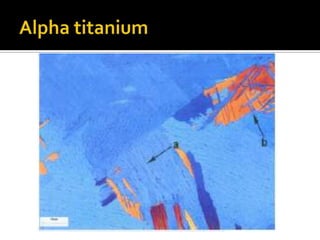
Alpha titanium
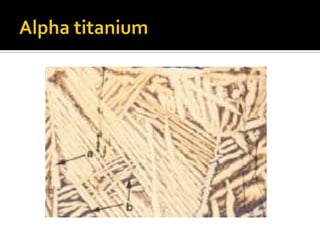
Alpha titanium
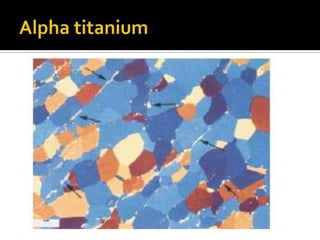
Alpha titanium
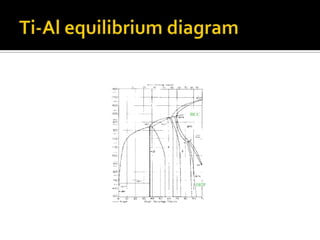
Ti-Al equilibrium diagram
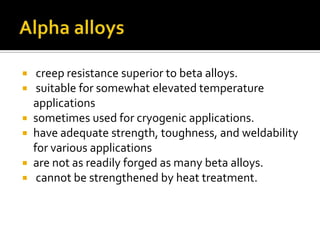
Alpha alloys creep resistance superior to beta alloys.   suitable for somewhat elevated temperature applicationssometimes used for cryogenic applications.  have adequate strength, toughness, and weldability for various applicationsare not as readily forged as many beta alloys.   cannot be strengthened by heat treatment.
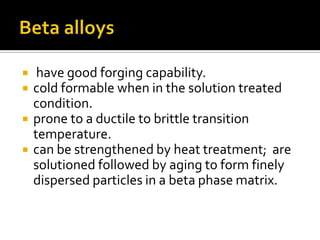
Beta alloys have good forging capability.   cold formable when in the solution treated condition. prone to a ductile to brittle transition temperature.  can be strengthened by heat treatment;  are solutioned followed by aging to form finely dispersed particles in a beta phase matrix.
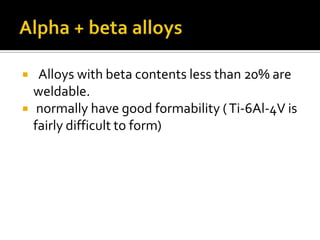
Alpha + beta alloys  Alloys with beta contents less than 20% are weldable.   normally have good formability ( Ti-6Al-4V is fairly difficult to form)
Heat Treatment of Alpha + Beta alloys Solution treatment : components are  quickly cooled from a temperature high in the alpha-beta range or even above the beta transus.  Aging : generates a mixture of alpha and transformed beta.  Microstructure  depends on the cooling rate from the solution temperature.
ApplicationsTitanium can catch fire and cause severe damage in circumstances where it rubs against other metals at elevated temperatures. This is what limits its application in the harsh environment of aeroengines, to regions where the temperature does not exceed 400oC.
Applications80% of all the titanium produced is used in the aerospace industries. Car suspension springs could easily be made of titanium with a great reduction in weight but titanium is not available in the large quantities needed and certainly not at the price required for automobile applications. The target price for titatnium needs to be reduced to about 30% of its current value for serious application in mass-market cars.
ApplicationsPure titanium has excellent resistance to corrosion and is used widely in the chemical industries. There is a passive oxide film which makes it particularly resistant to corrosion in oxidising solutions. The corrosion resistance can be further improved by adding palladium (0.15 wt%), which makes hydrogen evolution easier at cathodic sites so that the anodic and cathodic reactions balance in the passive region
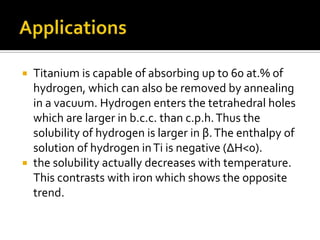
ApplicationsTitanium is capable of absorbing up to 60 at.% of hydrogen, which can also be removed by annealing in a vacuum. Hydrogen enters the tetrahedral holes which are larger in b.c.c. than c.p.h. Thus the solubility of hydrogen is larger in β. The enthalpy of solution of hydrogen in Ti is negative (ΔH<0).the solubility actually decreases with temperature. This contrasts with iron which shows the opposite trend.
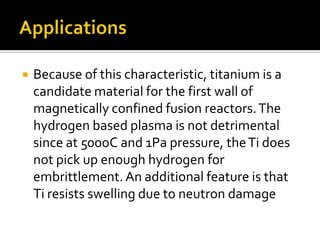
ApplicationsBecause of this characteristic, titanium is a candidate material for the first wall of magnetically confined fusion reactors. The hydrogen based plasma is not detrimental since at 500oC and 1Pa pressure, the Ti does not pick up enough hydrogen for embrittlement. An additional feature is that Ti resists swelling due to neutron damage
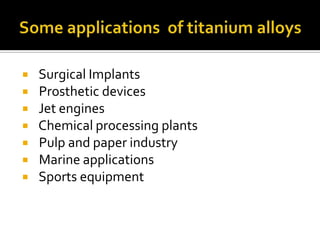
Some applications  of titanium alloys  Surgical Implants   Prosthetic devices   Jet engines   Chemical processing plants   Pulp and paper industry   Marine applications   Sports equipment
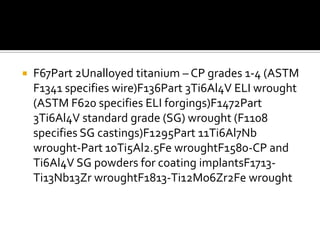
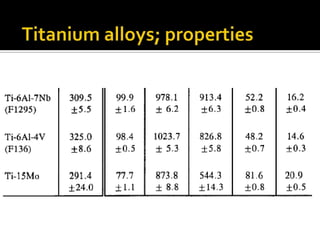
F67Part 2Unalloyed titanium – CP grades 1-4 (ASTM F1341 specifies wire)F136Part 3Ti6Al4V ELI wrought (ASTM F620 specifies ELI forgings)F1472Part 3Ti6Al4V standard grade (SG) wrought (F1108 specifies SG castings)F1295Part 11Ti6Al7Nb wrought-Part 10Ti5Al2.5Fe wroughtF1580-CP and Ti6Al4V SG powders for coating implantsF1713-Ti13Nb13Zr wroughtF1813-Ti12Mo6Zr2Fe wrought
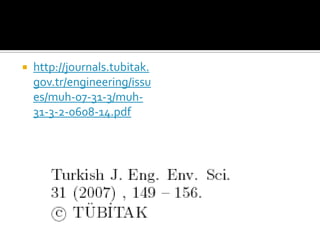
http://journals.tubitak.gov.tr/engineering/issues/muh-07-31-3/muh-31-3-2-0608-14.pdf
Titanium alloys; properties

Titanium and its alloys ppt show

  • 1.
    Titanium and itsalloysMM 207:Engineering metallurgy, IIT Bombay.
  • 2.
    TitaniumTitanium is recognizedfor its high strength-to-weight ratio. It is a light, strong metal with low density , Is quite ductile when pure (especially in an oxygen-free environment),lustrous, and metallic-white in color. The relatively high melting point makes it useful as a refractory metal.7th most abundant metal
  • 3.
    Ti resourcesThe worldproduction of titanium is nevertheless very small, hundreds of thousands of tonnes, which compares say with steel at 750 million tonnes per annum.
  • 4.
    TitaniumAtomic number = 22Atomic weight = 47.9Electronic configuration + [Ar]4S2 d 2Atomic radius = 144.2Melting point = 1668Boiling point = 3287Oxidation state = 4,3,2
  • 5.
    Pure titanium meltsat 1670oC and has a density of 4.51 g cm-3. It should therefore be ideal for use in components which operate at elevated temperatures, especially where large strength to weight ratios are required.
  • 6.
    Commercially pure titaniumUTS = 375 MPa upto 1.4 GPa for Beta alloys45 lighter than steelHard anddifficult to machineLooses strength above 430 degrees CelsiusBurns in oxygen and nitrogenLow electrical and thermal conductivity
  • 7.
    Titanium and itsalloysTitanium is resistant to dilute sulphuric and hydrochloric acid, most organic acids, damp chlorine gas, and chloride solutions. Titanium metal is considered to be physiologically inert.Good performance in sea waer environmentAround 50% of Ti used as Ti6Al4V
  • 8.
    ProductionReduction of oreto spongeMelting of sponge to form an ingotPrimary fabrication into a billet/bar,..Secondary fabrication into finished shape
  • 9.
    TitaniumDimorphic; hexagonal alphaform changes to high temperature Beta very slowly above 880 degree celsius
  • 10.
    Ti lattice structureThecrystal structure of titanium at ambient temperature and pressure is close-packed hexagonal (α) with a c/a ratio of 1.587. Slip is possible on the pyramidal, prismatic and basal planes in the close-packed directions. At about 890oC, the titanium undergoes an allotropic transformation to a body-centred cubic β phase which remains stable to the melting temperature.
  • 11.
    Crystallographic forms ofTitanium  Hexagonal close-packed (hcp) or alpha (α) phase, found at room temperature   Body centered cubic (bcc) or beta (ß) phase, found above 883 °C (1621 °F)
  • 12.
    Titanium and itsalloysAlpha and near alpha alloys : Ti-2.5Cu, Ti-5Al-2.5Sn, Ti-8Al-1V-1Mo,Ti-6242 , T i-6Al-2Nb-1Ta-0.8 Mo, Ti-5Al-5Sn-2Zr-2Mo Alpha + Beta alloys: Ti-6Al-4V, Ti-6Al-6V-2Sn, Ti-6Al-2Sn-2Zr-2Cr-2Mo, Ti-8Al-1Mo-1V, Ti-3Al-2.5VThe beta phase is normally in the range of 10 to 50% at room temperature. Beta alloys Ti-13V-11Cr-3Al, Ti-8Mo-8V-2Fe-3Al, Ti-10V-2Fe-3Al, Ti-15-3  
  • 13.
  • 14.
  • 15.
    Historical backgroundPure metallictitanium (99.9%) was first prepared in 1910 by Matthew A. Hunter by heating TiCl4 with sodium in a steel bomb at 700 – 800 °C in the Hunter process.[2] Titanium metal was not used outside the laboratory until 1946 when William Justin Kroll proved that it could be commercially produced by reducing titanium tetrachloride with magnesium in what came to be known as the Kroll process
  • 16.
    Ti alloysAll elementswhich are within the range 0.85-1.15 of the atomic radius of titanium alloy substitutionally and have a significant solubility in titanium. Elements with an atomic radius less than 0.59 that of Ti occupy interstitial sites and also have substantial solubility (e.g. H, N, O, C). The ease with which solutes dissolve in titanium makes it difficult to design precipitation-hardened alloys. Boron has a similar but larger radius than C, O, N and H; it is therefore possible to induce titanium boride precipitation. Copper precipitation is also possible in appropriate alloys.
  • 17.
    Role of alloyingadditionsMolybdenum and vanadium have the largest influence on β stability and are common alloying elements. Tungsten is rarely added due to its high density. Cu forms TiCu2 which makes the alloys age-hardening and heat treatable; such alloys are used as sheet materials. It is typically added in concentrations less than 2.5 wt% in commercial alloys.Zr, Sn and Si are neutral elements.These do not fit properly and cause changes in the lattice parameters. Hydrogen is the most important interstitial. Body-centred cubic Ti has three octahedral interstices per atom whereas c.p.h. Ti has one per atom. The latter are therefore larger, so that the solubility of O, N, and C is much higher in the α phase.
  • 18.
    Hume Rothery’s principlesIfa solute differs in its atomic size by more than about 15% from the host, then it is likely to have a low solubility in that metal. The size factor is said to be unfavourable. If a solute has a large difference in electronegativity (or electropositivity) when compared with the host, then it is more likely to form a compound. Its solibility in the host would therefore be limited. A metal with a lower valency is more likely to dissolve in one which has a higher valency, than vice versa.
  • 19.
  • 20.
  • 21.
  • 22.
  • 23.
  • 24.
  • 25.
    Alpha alloys creepresistance superior to beta alloys.  suitable for somewhat elevated temperature applicationssometimes used for cryogenic applications.  have adequate strength, toughness, and weldability for various applicationsare not as readily forged as many beta alloys.  cannot be strengthened by heat treatment.
  • 26.
    Beta alloys have goodforging capability.   cold formable when in the solution treated condition. prone to a ductile to brittle transition temperature.  can be strengthened by heat treatment; are solutioned followed by aging to form finely dispersed particles in a beta phase matrix.
  • 27.
    Alpha + betaalloys  Alloys with beta contents less than 20% are weldable.  normally have good formability ( Ti-6Al-4V is fairly difficult to form)
  • 28.
    Heat Treatment ofAlpha + Beta alloys Solution treatment : components are quickly cooled from a temperature high in the alpha-beta range or even above the beta transus.  Aging : generates a mixture of alpha and transformed beta.  Microstructure depends on the cooling rate from the solution temperature.
  • 29.
    ApplicationsTitanium can catchfire and cause severe damage in circumstances where it rubs against other metals at elevated temperatures. This is what limits its application in the harsh environment of aeroengines, to regions where the temperature does not exceed 400oC.
  • 30.
    Applications80% of allthe titanium produced is used in the aerospace industries. Car suspension springs could easily be made of titanium with a great reduction in weight but titanium is not available in the large quantities needed and certainly not at the price required for automobile applications. The target price for titatnium needs to be reduced to about 30% of its current value for serious application in mass-market cars.
  • 31.
    ApplicationsPure titanium hasexcellent resistance to corrosion and is used widely in the chemical industries. There is a passive oxide film which makes it particularly resistant to corrosion in oxidising solutions. The corrosion resistance can be further improved by adding palladium (0.15 wt%), which makes hydrogen evolution easier at cathodic sites so that the anodic and cathodic reactions balance in the passive region
  • 32.
    ApplicationsTitanium is capableof absorbing up to 60 at.% of hydrogen, which can also be removed by annealing in a vacuum. Hydrogen enters the tetrahedral holes which are larger in b.c.c. than c.p.h. Thus the solubility of hydrogen is larger in β. The enthalpy of solution of hydrogen in Ti is negative (ΔH<0).the solubility actually decreases with temperature. This contrasts with iron which shows the opposite trend.
  • 33.
    ApplicationsBecause of thischaracteristic, titanium is a candidate material for the first wall of magnetically confined fusion reactors. The hydrogen based plasma is not detrimental since at 500oC and 1Pa pressure, the Ti does not pick up enough hydrogen for embrittlement. An additional feature is that Ti resists swelling due to neutron damage
  • 34.
    Some applications of titanium alloys  Surgical Implants   Prosthetic devices   Jet engines   Chemical processing plants   Pulp and paper industry   Marine applications   Sports equipment
  • 35.
    F67Part 2Unalloyed titanium– CP grades 1-4 (ASTM F1341 specifies wire)F136Part 3Ti6Al4V ELI wrought (ASTM F620 specifies ELI forgings)F1472Part 3Ti6Al4V standard grade (SG) wrought (F1108 specifies SG castings)F1295Part 11Ti6Al7Nb wrought-Part 10Ti5Al2.5Fe wroughtF1580-CP and Ti6Al4V SG powders for coating implantsF1713-Ti13Nb13Zr wroughtF1813-Ti12Mo6Zr2Fe wrought
  • 36.
  • 37.