BI CAPABILITY & MATURITY MODEL
Yiwei	
  Chen	
  
Updated	
  on	
  2010	
  
yiwei_chen@yahoo.com	
  
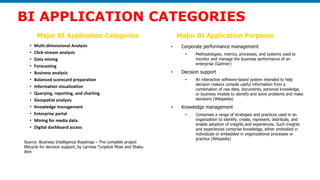
BI APPLICATION CATEGORIES
•  Mul$-­‐dimensional	
  Analysis	
  
•  Click-­‐stream	
  analysis	
  
•  Data	
  mining	
  
•  Forecas$ng	
  
•  Business	
  analysis	
  
•  Balanced	
  scorecard	
  prepara$on	
  
•  Informa$on	
  visualiza$on	
  
•  Querying,	
  repor$ng,	
  and	
  char$ng	
  
•  Geospa$al	
  analysis	
  
•  Knowledge	
  management	
  
•  Enterprise	
  portal	
  
•  Mining	
  for	
  media	
  data	
  
•  Digital	
  dashboard	
  access	


Source: Business Intelligence Roadmap – The complete project
lifecycle for decision support, by Larrissa Turpeluk Moss and Shaku
Atre
Major BI Application Categories
•  Corporate performance management
•  Methodologies, metrics, processes, and systems used to
monitor and manage the business performance of an
enterprise (Gartner)
•  Decision support
•  An interactive software-based system intended to help
decision makers compile useful information from a
combination of raw data, documents, personal knowledge,
or business models to identify and solve problems and
make decisions (Wikipedia)
•  Knowledge management
•  Comprises a range of strategies and practices used in an
organization to identify, create, represent, distribute, and
enable adoption of insights and experiences. Such insights
and experiences comprise knowledge, either embodied in
individuals or embedded in organizational processes or
practice (Wikipedia)
Major BI Application Purposes
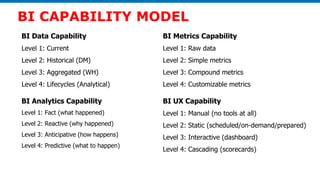
BI CAPABILITY MODEL
3	
  
BI Metrics Capability
Level 1: Raw data
Level 2: Simple metrics
Level 3: Compound metrics
Level 4: Customizable metrics
BI UX Capability
Level 1: Manual (no tools at all)
Level 2: Static (scheduled/on-demand/prepared)
Level 3: Interactive (dashboard)
Level 4: Cascading (scorecards)
BI Data Capability
Level 1: Current
Level 2: Historical (DM)
Level 3: Aggregated (WH)
Level 4: Lifecycles (Analytical)
BI Analytics Capability
Level 1: Fact (what happened)
Level 2: Reactive (why happened)
Level 3: Anticipative (how happens)
Level 4: Predictive (what to happen)
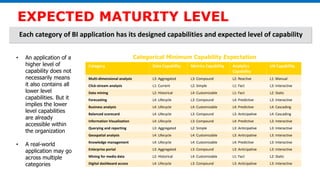
EXPECTED MATURITY LEVEL
4	
  
Category	
   Data	
  Capability	
   Metrics	
  Capability	
   Analy$cs	
  
Capability	
  
UX	
  Capability	
  
Mul$-­‐dimensional	
  analysis	
   L3:	
  Aggregated	
   L3:	
  Compound	
   L2:	
  ReacAve	
   L1:	
  Manual	
  
Click-­‐stream	
  analysis	
   L1:	
  Current	
   L2:	
  Simple	
   L1:	
  Fact	
   L3:	
  InteracAve	
  	
  
Data	
  mining	
   L2:	
  Historical	
   L4:	
  Customizable	
   L1:	
  Fact	
   L2:	
  StaAc	
  
Forecas$ng	
   L4:	
  Lifecycle	
   L3:	
  Compound	
   L4:	
  PredicAve	
   L3:	
  InteracAve	
  	
  
Business	
  analysis	
   L4:	
  Lifecycle	
   L4:	
  Customizable	
   L4:	
  PredicAve	
   L4:	
  Cascading	
  
Balanced	
  scorecard	
   L4:	
  Lifecycle	
   L3:	
  Compound	
   L3:	
  AnAcipaAve	
   L4:	
  Cascading	
  
Informa$on	
  Visualiza$on	
   L4:	
  Lifecycle	
   L3:	
  Compound	
   L4:	
  PredicAve	
   L3:	
  InteracAve	
  	
  
Querying	
  and	
  repor$ng	
   L3:	
  Aggregated	
   L2:	
  Simple	
   L3:	
  AnAcipaAve	
   L3:	
  InteracAve	
  	
  
Geospa$al	
  analysis	
   L4:	
  Lifecycle	
   L4:	
  Customizable	
   L3:	
  AnAcipaAve	
   L3:	
  InteracAve	
  	
  
Knowledge	
  management	
   L4:	
  Lifecycle	
   L4:	
  Customizable	
   L4:	
  PredicAve	
   L3:	
  InteracAve	
  	
  
Enterprise	
  portal	
   L3:	
  Aggregated	
   L3:	
  Compound	
   L3:	
  AnAcipaAve	
   L3:	
  InteracAve	
  	
  
Mining	
  for	
  media	
  data	
   L2:	
  Historical	
   L4:	
  Customizable	
   L1:	
  Fact	
   L2:	
  StaAc	
  
Digital	
  dashboard	
  access	
   L4:	
  Lifecycle	
   L3:	
  Compound	
   L3:	
  AnAcipaAve	
   L3:	
  InteracAve	
  	
  
Each	
  category	
  of	
  BI	
  applica$on	
  has	
  its	
  designed	
  capabili$es	
  and	
  expected	
  level	
  of	
  capability	
  
An application of a
higher level of
capability does not
necessarily means it
also contains all
lower level
capabilities. But it
implies the lower
level capabilities are
already accessible
within the
organization
A real-world
application may go
across multiple
categories
Categorical Minimum Capability Expectation
DECISION MAKING SUPPORT ANALYSIS FRAMEWORK!


  Type	
  
Category	
  
Predic$ve/	
  
Forecast	
  
An$cipate/
Monitoring	
  
Reac$ve/	
  
Postmortem	
  
Facts/	
  
Raw	
  Data	
  
Market Analysis Top prospects;
Competitive;
Coverage;
Inventory;
Competitive;
Market share;
User conversion;
Competitor event correlation;
Competitor traffic;
Competitor intelligence;
Scenario
Analysis
Product offering;
Solution offering;
Partner performance forecast;
Renewal assessment;
Optimization opportunity
analysis;
Comparative analysis;
Purchase
Analysis
Deal model;
Budget allocation;
Overall profitability analysis;
Budget allocation;
Overall profitability analysis;
Cost-benefit
Analysis
Deal model;
Profitability analysis;
ROI analysis;
Strategic performance
analysis;
ROI analysis
Cross product/geo
performance comparison;
Payout-ratio;
Partner traffic;
Causal Analysis Opportunity publication;
Opportunity subscription;
Alert drill-down;
Event impact
monitoring;
Trend analysis;
Event publication;
Event subscription;
Event annotation;
Event correlation;
A	
  way	
  to	
  organize	
  all	
  current	
  and	
  upcoming	
  decision	
  support	
  analysis	
  and	
  repor$ng	
  work	
  
to	
  facilitate	
  the	
  BI	
  requirement	
  analysis	
  and	
  knowledge	
  organiza$on	
  
Main BI activities
are decision
making analysis
and reporting
Along with the
sales lifecycle and
types of the data
in need, we can
group the
analysis and
reports into 5
major categories.
Decision Making
Analysis Framework
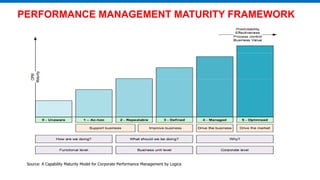
PERFORMANCE MANAGEMENT MATURITY FRAMEWORK!
Source: A Capability Maturity Model for Corporate Performance Management by Logica
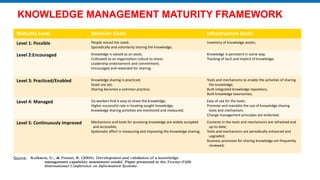
KNOWLEDGE MANAGEMENT MATURITY FRAMEWORK
7	
  
Maturity	
  Level	
   Behavior	
  Goals	
   Infrastructure	
  Goals	
  	
  
Level	
  1:	
  Possible	
   People	
  voiced	
  the	
  need;	
  
Sporadically	
  and	
  voluntarily	
  sharing	
  the	
  knowledge;	
  
Inventory	
  of	
  knowledge	
  assets;	
  
Level	
  2:Encouraged	
  	
   Knowledge	
  is	
  valued	
  as	
  an	
  asset;	
  
CulAvated	
  as	
  an	
  organizaAon	
  culture	
  to	
  share;	
  
Leadership	
  endorsement	
  and	
  commitment;	
  
Encouraged	
  and	
  rewarded	
  for	
  sharing;	


Knowledge	
  is	
  persistent	
  in	
  some	
  way;	
  
Tracking	
  of	
  tacit	
  and	
  implicit	
  of	
  knowledge;	
  
Level	
  3:	
  Prac$ced/Enabled	
   Knowledge	
  sharing	
  is	
  pracAced;	
  
Goals	
  are	
  set;	
  
Sharing	
  becomes	
  a	
  common	
  pracAce;	
  	
  
Tools	
  and	
  mechanisms	
  to	
  enable	
  the	
  acAviAes	
  of	
  sharing	
  the	
  
knowledge;	
  
Built	
  integrated	
  knowledge	
  repository;	
  
Built	
  knowledge	
  taxonomies;	
  
Level	
  4:	
  Managed	
   Co-­‐workers	
  find	
  it	
  easy	
  to	
  share	
  the	
  knowledge;	
  
Higher	
  successful	
  rate	
  in	
  locaAng	
  sought	
  knowledge;	
  
Knowledge	
  sharing	
  acAviAes	
  are	
  monitored	
  and	
  measured;	


Easy	
  of	
  use	
  for	
  the	
  tools;	
  
Promote	
  and	
  mandate	
  the	
  use	
  of	
  knowledge	
  sharing	
  tools	
  and	
  
mechanism;	
  
Change	
  management	
  principles	
  are	
  endorsed;	
  
Level	
  5:	
  Con$nuously	
  improved	
   Mechanisms	
  and	
  tools	
  for	
  accessing	
  knowledge	
  are	
  widely	
  accepted	
  and	
  
accessible;	
  
SystemaAc	
  effort	
  in	
  measuring	
  and	
  improving	
  the	
  knowledge	
  sharing;	
  
Contents	
  in	
  the	
  tools	
  and	
  mechanisms	
  are	
  refreshed	
  and	
  up-­‐to-­‐
date;	
  
Tools	
  and	
  mechanisms	
  are	
  periodically	
  enhanced	
  and	
  upgraded;	
  
Business	
  processes	
  for	
  sharing	
  knowledge	
  are	
  frequently	
  reviewed;	


Source:
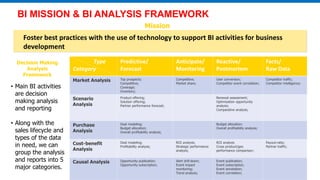
BI MISSION & BI ANALYSIS FRAMEWORK!
Type
Category
Predictive/
Forecast
Anticipate/
Monitoring
Reactive/
Postmortem
Facts/Raw Data
Market Analysis Top prospects;
Competitive;
Coverage;
Inventory;
Competitive;
Market share;
User conversion;
Competitor event correlation;
Competitor traffic;
Competitor intelligence;
Scenario Analysis Product offering;
Solution offering;
Partner performance
forecast;
Renewal assessment;
Optimization opportunity
analysis;
Comparative analysis;
Purchase
Analysis
Deal model;
Budget allocation;
Overall profitability analysis;
Budget allocation;
Overall profitability analysis;
Cost-benefit
Analysis
Deal model;
Profitability analysis;
ROI;
Strategic performance
analysis;
ROI;
Cross product/geo
performance comparison;
Payout-ratio;
Partner traffic;
Causal Analysis Opportunity publication;
Opportunity subscription;
Alert drill-down;
Event impact monitoring;
Trend analysis;
Event publication;
Event subscription;
Event annotation;
Event correlation;
Foster	
  best	
  prac$ces	
  with	
  the	
  use	
  of	
  technology	
  to	
  support	
  BI	
  ac$vi$es	
  regarding	
  direct	
  
partnerships	
  
Mission
Main BI activities
are decision making
analysis and
reporting
Along with the
sales lifecycle and
types of the data in
need, we can group
the analysis and
reports into 5
major categories
Decision Making
Analysis
Framework
BI SCOPE!
Only limited to the strategic business at the current stage
Focus mainly on BI tools development and roll-out
Mainly focus on strategic reporting needs
Strategic Reporting
Operational Reporting
Executives
Regional Lead
Vertical Lead
BDs
Pre-sales
Account Managers
Product
Category
Display Ads AFS AFC Text AFD
Market Analysis High Priority Medium Priority Low Priority Low Priority
Scenario Analysis High Priority Low Priority Low Priority Low Priority
Purchase Analysis Low Priority Low Priority Low Priority Low Priority
Cost-benefit Analysis Medium Priority Medium Priority Medium Priority Medium Priority
Causal Analysis Medium Priority Medium Priority Medium Priority Medium Priority
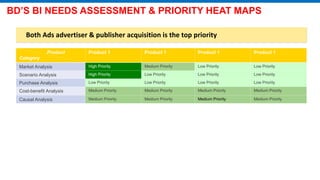
BD’S BI NEEDS ASSESSMENT & PRIORITY HEAT MAPS!
Adver$ser	
  &	
  publisher	
  acquisi$on	
  is	
  the	
  top	
  priority	
  
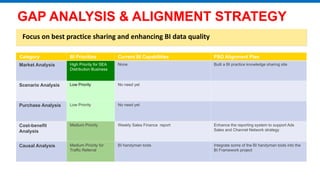
GAP ANALYSIS & ALIGNMENT STRATEGY!
Category BI Priorities Current BI Capabilities PSO Alignment Plan
Market Analysis High Priority for
Distribution Business
None Built a BI practice knowledge sharing site
Scenario Analysis Low Priority No need yet
Purchase Analysis Low Priority No need yet
Cost-benefit
Analysis
Medium Priority Weekly distribution report Enhance reporting system to support Sales
Finance and Channel Strategy
Causal Analysis Medium Priority for
Referral deals
BI handyman tool Integrate some of the BI handyman tool
features into the Magellan project
Focus	
  on	
  best	
  prac$ce	
  sharing	
  and	
  enhancing	
  BI	
  data	
  quality	
  
THE END
yiwei_chen@yahoo.com	
  

BI Maturity Model ppt

  • 1.
    BI CAPABILITY &MATURITY MODEL Yiwei  Chen   Updated  on  2010   yiwei_chen@yahoo.com  
  • 2.
    BI APPLICATION CATEGORIES • Mul$-­‐dimensional  Analysis   •  Click-­‐stream  analysis   •  Data  mining   •  Forecas$ng   •  Business  analysis   •  Balanced  scorecard  prepara$on   •  Informa$on  visualiza$on   •  Querying,  repor$ng,  and  char$ng   •  Geospa$al  analysis   •  Knowledge  management   •  Enterprise  portal   •  Mining  for  media  data   •  Digital  dashboard  access       Source: Business Intelligence Roadmap – The complete project lifecycle for decision support, by Larrissa Turpeluk Moss and Shaku Atre Major BI Application Categories •  Corporate performance management •  Methodologies, metrics, processes, and systems used to monitor and manage the business performance of an enterprise (Gartner) •  Decision support •  An interactive software-based system intended to help decision makers compile useful information from a combination of raw data, documents, personal knowledge, or business models to identify and solve problems and make decisions (Wikipedia) •  Knowledge management •  Comprises a range of strategies and practices used in an organization to identify, create, represent, distribute, and enable adoption of insights and experiences. Such insights and experiences comprise knowledge, either embodied in individuals or embedded in organizational processes or practice (Wikipedia) Major BI Application Purposes
  • 3.
    BI CAPABILITY MODEL 3   BI Metrics Capability Level 1: Raw data Level 2: Simple metrics Level 3: Compound metrics Level 4: Customizable metrics BI UX Capability Level 1: Manual (no tools at all) Level 2: Static (scheduled/on-demand/prepared) Level 3: Interactive (dashboard) Level 4: Cascading (scorecards) BI Data Capability Level 1: Current Level 2: Historical (DM) Level 3: Aggregated (WH) Level 4: Lifecycles (Analytical) BI Analytics Capability Level 1: Fact (what happened) Level 2: Reactive (why happened) Level 3: Anticipative (how happens) Level 4: Predictive (what to happen)
  • 4.
    EXPECTED MATURITY LEVEL 4   Category   Data  Capability   Metrics  Capability   Analy$cs   Capability   UX  Capability   Mul$-­‐dimensional  analysis   L3:  Aggregated   L3:  Compound   L2:  ReacAve   L1:  Manual   Click-­‐stream  analysis   L1:  Current   L2:  Simple   L1:  Fact   L3:  InteracAve     Data  mining   L2:  Historical   L4:  Customizable   L1:  Fact   L2:  StaAc   Forecas$ng   L4:  Lifecycle   L3:  Compound   L4:  PredicAve   L3:  InteracAve     Business  analysis   L4:  Lifecycle   L4:  Customizable   L4:  PredicAve   L4:  Cascading   Balanced  scorecard   L4:  Lifecycle   L3:  Compound   L3:  AnAcipaAve   L4:  Cascading   Informa$on  Visualiza$on   L4:  Lifecycle   L3:  Compound   L4:  PredicAve   L3:  InteracAve     Querying  and  repor$ng   L3:  Aggregated   L2:  Simple   L3:  AnAcipaAve   L3:  InteracAve     Geospa$al  analysis   L4:  Lifecycle   L4:  Customizable   L3:  AnAcipaAve   L3:  InteracAve     Knowledge  management   L4:  Lifecycle   L4:  Customizable   L4:  PredicAve   L3:  InteracAve     Enterprise  portal   L3:  Aggregated   L3:  Compound   L3:  AnAcipaAve   L3:  InteracAve     Mining  for  media  data   L2:  Historical   L4:  Customizable   L1:  Fact   L2:  StaAc   Digital  dashboard  access   L4:  Lifecycle   L3:  Compound   L3:  AnAcipaAve   L3:  InteracAve     Each  category  of  BI  applica$on  has  its  designed  capabili$es  and  expected  level  of  capability   An application of a higher level of capability does not necessarily means it also contains all lower level capabilities. But it implies the lower level capabilities are already accessible within the organization A real-world application may go across multiple categories Categorical Minimum Capability Expectation
  • 5.
    DECISION MAKING SUPPORTANALYSIS FRAMEWORK!                              Type   Category   Predic$ve/   Forecast   An$cipate/ Monitoring   Reac$ve/   Postmortem   Facts/   Raw  Data   Market Analysis Top prospects; Competitive; Coverage; Inventory; Competitive; Market share; User conversion; Competitor event correlation; Competitor traffic; Competitor intelligence; Scenario Analysis Product offering; Solution offering; Partner performance forecast; Renewal assessment; Optimization opportunity analysis; Comparative analysis; Purchase Analysis Deal model; Budget allocation; Overall profitability analysis; Budget allocation; Overall profitability analysis; Cost-benefit Analysis Deal model; Profitability analysis; ROI analysis; Strategic performance analysis; ROI analysis Cross product/geo performance comparison; Payout-ratio; Partner traffic; Causal Analysis Opportunity publication; Opportunity subscription; Alert drill-down; Event impact monitoring; Trend analysis; Event publication; Event subscription; Event annotation; Event correlation; A  way  to  organize  all  current  and  upcoming  decision  support  analysis  and  repor$ng  work   to  facilitate  the  BI  requirement  analysis  and  knowledge  organiza$on   Main BI activities are decision making analysis and reporting Along with the sales lifecycle and types of the data in need, we can group the analysis and reports into 5 major categories. Decision Making Analysis Framework
  • 6.
    PERFORMANCE MANAGEMENT MATURITYFRAMEWORK! Source: A Capability Maturity Model for Corporate Performance Management by Logica
  • 7.
    KNOWLEDGE MANAGEMENT MATURITYFRAMEWORK 7   Maturity  Level   Behavior  Goals   Infrastructure  Goals     Level  1:  Possible   People  voiced  the  need;   Sporadically  and  voluntarily  sharing  the  knowledge;   Inventory  of  knowledge  assets;   Level  2:Encouraged     Knowledge  is  valued  as  an  asset;   CulAvated  as  an  organizaAon  culture  to  share;   Leadership  endorsement  and  commitment;   Encouraged  and  rewarded  for  sharing;     Knowledge  is  persistent  in  some  way;   Tracking  of  tacit  and  implicit  of  knowledge;   Level  3:  Prac$ced/Enabled   Knowledge  sharing  is  pracAced;   Goals  are  set;   Sharing  becomes  a  common  pracAce;     Tools  and  mechanisms  to  enable  the  acAviAes  of  sharing  the   knowledge;   Built  integrated  knowledge  repository;   Built  knowledge  taxonomies;   Level  4:  Managed   Co-­‐workers  find  it  easy  to  share  the  knowledge;   Higher  successful  rate  in  locaAng  sought  knowledge;   Knowledge  sharing  acAviAes  are  monitored  and  measured;         Easy  of  use  for  the  tools;   Promote  and  mandate  the  use  of  knowledge  sharing  tools  and   mechanism;   Change  management  principles  are  endorsed;   Level  5:  Con$nuously  improved   Mechanisms  and  tools  for  accessing  knowledge  are  widely  accepted  and   accessible;   SystemaAc  effort  in  measuring  and  improving  the  knowledge  sharing;   Contents  in  the  tools  and  mechanisms  are  refreshed  and  up-­‐to-­‐ date;   Tools  and  mechanisms  are  periodically  enhanced  and  upgraded;   Business  processes  for  sharing  knowledge  are  frequently  reviewed;       Source:
  • 8.
    BI MISSION &BI ANALYSIS FRAMEWORK! Type Category Predictive/ Forecast Anticipate/ Monitoring Reactive/ Postmortem Facts/Raw Data Market Analysis Top prospects; Competitive; Coverage; Inventory; Competitive; Market share; User conversion; Competitor event correlation; Competitor traffic; Competitor intelligence; Scenario Analysis Product offering; Solution offering; Partner performance forecast; Renewal assessment; Optimization opportunity analysis; Comparative analysis; Purchase Analysis Deal model; Budget allocation; Overall profitability analysis; Budget allocation; Overall profitability analysis; Cost-benefit Analysis Deal model; Profitability analysis; ROI; Strategic performance analysis; ROI; Cross product/geo performance comparison; Payout-ratio; Partner traffic; Causal Analysis Opportunity publication; Opportunity subscription; Alert drill-down; Event impact monitoring; Trend analysis; Event publication; Event subscription; Event annotation; Event correlation; Foster  best  prac$ces  with  the  use  of  technology  to  support  BI  ac$vi$es  regarding  direct   partnerships   Mission Main BI activities are decision making analysis and reporting Along with the sales lifecycle and types of the data in need, we can group the analysis and reports into 5 major categories Decision Making Analysis Framework
  • 9.
    BI SCOPE! Only limitedto the strategic business at the current stage Focus mainly on BI tools development and roll-out Mainly focus on strategic reporting needs Strategic Reporting Operational Reporting Executives Regional Lead Vertical Lead BDs Pre-sales Account Managers
  • 10.
    Product Category Display Ads AFSAFC Text AFD Market Analysis High Priority Medium Priority Low Priority Low Priority Scenario Analysis High Priority Low Priority Low Priority Low Priority Purchase Analysis Low Priority Low Priority Low Priority Low Priority Cost-benefit Analysis Medium Priority Medium Priority Medium Priority Medium Priority Causal Analysis Medium Priority Medium Priority Medium Priority Medium Priority BD’S BI NEEDS ASSESSMENT & PRIORITY HEAT MAPS! Adver$ser  &  publisher  acquisi$on  is  the  top  priority  
  • 11.
    GAP ANALYSIS &ALIGNMENT STRATEGY! Category BI Priorities Current BI Capabilities PSO Alignment Plan Market Analysis High Priority for Distribution Business None Built a BI practice knowledge sharing site Scenario Analysis Low Priority No need yet Purchase Analysis Low Priority No need yet Cost-benefit Analysis Medium Priority Weekly distribution report Enhance reporting system to support Sales Finance and Channel Strategy Causal Analysis Medium Priority for Referral deals BI handyman tool Integrate some of the BI handyman tool features into the Magellan project Focus  on  best  prac$ce  sharing  and  enhancing  BI  data  quality  
  • 12.