Smarter Business Intelligence:
Advanced Analytics In Practice


         Sponsored by:
Webcast Logistics
Today’s Presenters

Chris Murphy
Editor, InformationWeek


David Stodder
Analyst, Research and Writer
Perceptive Information Strategies
Agenda

Setting the stage
• Analytics defined
• Momentum
• The business imperative

Advanced Analytics Strategy
Analytics Defined

Analytics: Prediction, statistical analysis,
Optimization


BI: Reporting


Which sounds more exciting?
Analytics Momentum

• Democratize Analytics
  Not just PhDs
• Embedded Analytics
  Oracle, SAP, IBM, etc.
• Analytics Templates
• Real-Time Data
• Competitive Advantage?
Analytics: Business Imperative

• No. 1 among BI capabilities
• Real-time insight, predictive demand
• Real-Time Data
Poll Question 1

 Q: We’re most interested in advanced analytics for:

 •Analyzing customer data

 •Finding new product opportunities

 •Understanding our risk

 •Predicting revenue

 •Analyzing supply chains

 •Other
Smarter Business Intelligence
Advanced Analytics In Practice


                       David Stodder
                       Contributing Editor, TechWeb
                       Perceptive Information Strategies
                       dstodder@gmail.com
Today’s Webcast Discussion
   Agility: business context for analytics
   Business intelligence and data warehouse key
    trends and directions for analytics
   Analytics, information management and data
    warehousing
   Making analytics affordable: templates and pre-
    configured systems
   Analytics: predictive analytics and data mining
   Best practices and conclusion


                         12/7/2010   Copyright (c) David Stodder
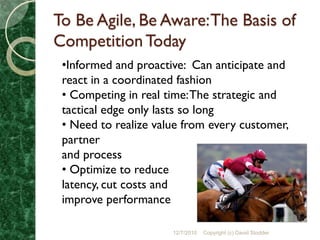
To Be Agile, Be Aware: The Basis of
Competition Today
 •Informed and proactive: Can anticipate and
 react in a coordinated fashion
 • Competing in real time: The strategic and
 tactical edge only lasts so long
 • Need to realize value from every customer,
 partner
 and process
 • Optimize to reduce
 latency, cut costs and
 improve performance

                      12/7/2010   Copyright (c) David Stodder
Agility and Awareness: Information
Systems Support – or Thwart?
 Danger that traditional information systems can
  thwart agility
 Standard, siloed reports can deliver incomplete
  and inaccurate views of a multi-channel world
 Known problems, known solutions: What about
  the unknown?
 Smart devices, smarter customers: Keeping pace
  with rising intelligence


                      12/7/2010   Copyright (c) David Stodder
Business Intelligence and Data
Warehouse: Success Factors
How good is the information?
 - Accuracy and quality; need it now, but need it right
 - Comprehensiveness; all relevant sources included? In search
of the single view

What can I do with the information?
 - Timely data is good, but do users understand it?
 - Think dynamically: Continuous people and process
improvement

How can I profit from (or protect myself with) this
information?
 - Operational intelligence is about business innovation
 - Risk and regulatory compliance are major drivers


                             12/7/2010   Copyright (c) David Stodder
Data Scarcity: Not the Problem
 Many organizations already swimming in an
  abundance of data
 Focus on gaining higher value from data
 Data is already big: “Big Data” focus on
  dynamic behavior and velocity of information
  (data at rest, in motion)
 Info management
challenge: integrating
access to internal and
external data sources
                      12/7/2010   Copyright (c) David Stodder
Business Analytics: Sharpening Focus
On Desired Business Outcome
 • When outcome, and course are unknown: Use
 information to iterate toward clarity
 • Optimization: Use information to ensure no
 steps are wasted
 • Monitor and measure progress using BI and
 performance
 management
 • Example: customer
 loyalty tracking


                    12/7/2010   Copyright (c) David Stodder
Business Intelligence: Can it Take Us
Where We Want to Go?
   BI systems primarily provide
    quantitative data and tools to
    manipulate it for analysis and
    to support decision-making
   Goal is to deliver
    comprehensive views of
    business states and directions
   Broadening out from
    traditional base of analysts
    and power users working
    with limited data and updating


                                 12/7/2010   Copyright (c) David Stodder
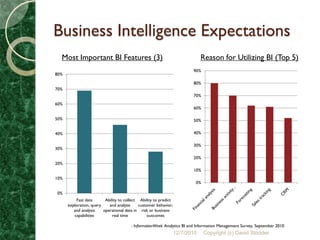
Business Intelligence Expectations
  Most Important BI Features (3)                                              Reason for Utilizing BI (Top 5)
                                                                         90%
80%

                                                                         80%
70%
                                                                         70%
60%
                                                                         60%

50%                                                                      50%

40%                                                                      40%

                                                                         30%
30%

                                                                         20%
20%
                                                                         10%
10%
                                                                          0%

0%
          Fast data       Ability to collect Ability to predict
      exploration, query    and analyze      customer behavior,
         and analysis    operational data in risk or business
         capabilities         real time          outcomes

                                        - InformationWeek Analytics BI and Information Management Survey, September 2010
                                                                  12/7/2010    Copyright (c) David Stodder
Business Intelligence Technology:
Pushing Past Limitations
   Historical data is vital, but can limit perspective
    and “actionability” of data
   Focus on exceptions, not “data dumps”
   User requirements always change: Self-service
    necessary to free users – and IT – of long, often
    unsatisfying development
   Search can’t be a stranger: How most people
    find information
   Collaboration: Decisions made by teams, not
    individuals; embed in applications, services
                          12/7/2010   Copyright (c) David Stodder
“Smarter” BI: Collaborative,
Current, Easier to Use and Trusted
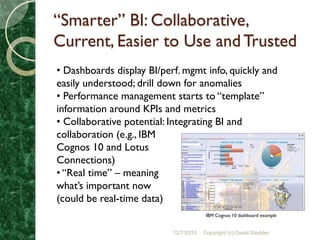
• Dashboards display BI/perf. mgmt info, quickly and
easily understood; drill down for anomalies
• Performance management starts to “template”
information around KPIs and metrics
• Collaborative potential: Integrating BI and
collaboration (e.g., IBM
Cognos 10 and Lotus
Connections)
• “Real time” – meaning
what’s important now
(could be real-time data)
                                        IBM Cognos 10 dashboard example


                           12/7/2010   Copyright (c) David Stodder
But Can BI Do Analytics?
 Getting beyond reporting: Spreadsheets still most
  widely used tool for analysis
 Financial analysis #1 reason for utilizing BI: Critical to
  expand beyond accounting to support strategic and
  operational analysis (including activity-based costing)
 Implementation goals for BI (IWK Survey):
   ◦ Monitor/share metrics: 72%
   ◦ Analyze customer data to increase sales: 56%
   ◦ Analyze customer data to retain customers: 53%


                             12/7/2010   Copyright (c) David Stodder
Polling Question #2
Q. What is your top priority with business
  intelligence?
- Giving users self-service capabilities for
  visualization and drill-down analysis
- Accessing real-time data
- Using BI to improve data quality and
  consistency
- Enabling performance management KPIs and
  metrics
- Financial reporting and analysis

                    12/7/2010   Copyright (c) David Stodder
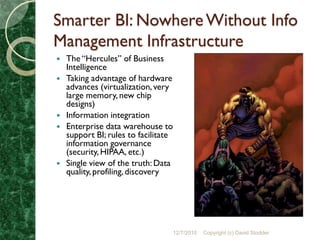
Smarter BI: Nowhere Without Info
Management Infrastructure
   The “Hercules” of Business
    Intelligence
   Taking advantage of hardware
    advances (virtualization, very
    large memory, new chip
    designs)
   Information integration
   Enterprise data warehouse to
    support BI; rules to facilitate
    information governance
    (security, HIPAA, etc.)
   Single view of the truth: Data
    quality, profiling, discovery


                                      12/7/2010   Copyright (c) David Stodder
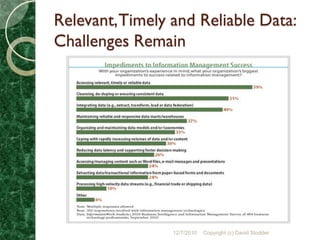
Relevant, Timely and Reliable Data:
Challenges Remain


                 12/7/2010   Copyright (c) David Stodder
From Traditional to Next-
Generation Data Warehousing
•   Serving small, internal user              Real-time analytics to improve
    communities                                customer, partner service;
•   Built around extraction,                   real-time event alerting
    transformation and loading                ETL, MDM and federated
    (ETL)                                      information integration
•   Historical analysis and                   Support for performance
    reporting                                  management KPIs and
•   Batch loading at off hours                 metrics, dashboards and
•   Different systems for simple               scorecards
    & complex queries (e.g., ODS              Continuous updating
    and DW)‫‏‬                                  Deployment of appliances in-
•   Info delivery not                          memory analytic apps and
    synchronized with processes                pre-configured systems
   Little external data                      “Cloud” data services


                                   12/7/2010   Copyright (c) David Stodder
Critical Trends in Information
Management: Templates
 Rapid development: Using pre-built data
  warehouse models, often specific to industry or
  application
 Models and templates to improve consistency
  of implementation
 Example: IBM Delivery Accelerators: e.g., retail-
  specific template, dashboard and workbench
  accelerators, data models, development tools,
  processes, predictive modeling


                       12/7/2010   Copyright (c) David Stodder
Critical IM Trend: “Semantic”
Integration Managed Centrally
 Relieve BI/analytics tools and users of having to
  define data types; reduce “what is a customer?”
  chaos
 Develop coordinated, accurate and stable
  business definitions and semantic meaning:
  Master data management
 Managing ETL processes more effectively to
  reduce cost and delay
 Improving data quality: BI fails without it!


                        12/7/2010   Copyright (c) David Stodder
Critical IM Trend: Pre-Configured
Systems and Appliances
   “Complex queries” – analytics – the most
    frequent reason organizations purchasing
    appliances and specialized databases (e.g.,
    column-oriented)
   Pre-configured to speed deployment
   Tight integration
   Specialized for analytics
   Scalability

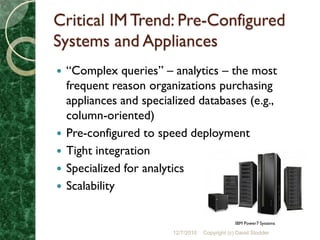
                                                  IBM Power7 Systems

                         12/7/2010   Copyright (c) David Stodder
In-Memory, In-Database Analytics:
Feeding the Need for Speed
 In-memory analytics: Bringing more power and
  flexibility to the user’s workstation
 In-database analytics: Using the database
  system to power analytics; e.g., SAS relationship
  with IBM
 Real-time “trickle” data feeds and analytics;
  “ELT” processing
 Embedding BI/analytics with processes


                       12/7/2010   Copyright (c) David Stodder
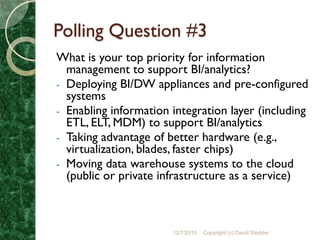
Polling Question #3
What is your top priority for information
  management to support BI/analytics?
- Deploying BI/DW appliances and pre-configured
  systems
- Enabling information integration layer (including
  ETL, ELT, MDM) to support BI/analytics
- Taking advantage of better hardware (e.g.,
  virtualization, blades, faster chips)
- Moving data warehouse systems to the cloud
  (public or private infrastructure as a service)


                       12/7/2010   Copyright (c) David Stodder
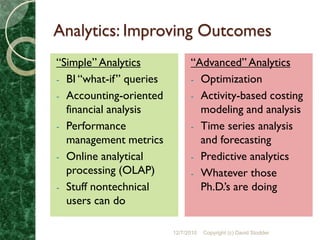
Analytics: Improving Outcomes
“Simple” Analytics             “Advanced” Analytics
- BI “what-if” queries         - Optimization
- Accounting-oriented          - Activity-based costing
  financial analysis             modeling and analysis
- Performance                  - Time series analysis
  management metrics             and forecasting
- Online analytical            - Predictive analytics
  processing (OLAP)            - Whatever those
- Stuff nontechnical             Ph.D.’s are doing
  users can do

                         12/7/2010   Copyright (c) David Stodder
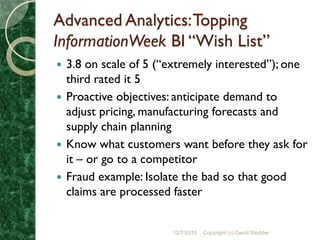
Advanced Analytics: Topping
InformationWeek BI “Wish List”
 3.8 on scale of 5 (“extremely interested”); one
  third rated it 5
 Proactive objectives: anticipate demand to
  adjust pricing, manufacturing forecasts and
  supply chain planning
 Know what customers want before they ask for
  it – or go to a competitor
 Fraud example: Isolate the bad so that good
  claims are processed faster


                      12/7/2010   Copyright (c) David Stodder
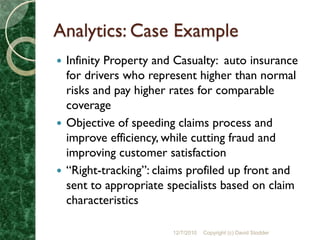
Analytics: Case Example
 Infinity Property and Casualty: auto insurance
  for drivers who represent higher than normal
  risks and pay higher rates for comparable
  coverage
 Objective of speeding claims process and
  improve efficiency, while cutting fraud and
  improving customer satisfaction
 “Right-tracking”: claims profiled up front and
  sent to appropriate specialists based on claim
  characteristics

                       12/7/2010   Copyright (c) David Stodder
Infinity Property & Casualty
Example, Continued
   Predictive traits in claims modeled using IBM SPSS
   Able to address concerns beyond just fraud
   Six months to develop models and rules to
    integrate predictions into Infinity’s claim system
   Benefits: Used to take 40 days for claims to reach
    specialists; now takes 48 hours
   Success rate in proving fraud now 87%; company
    able to discontinue using third-party firm to
    handle collections ($12 mill/yr)


                          12/7/2010   Copyright (c) David Stodder
Predictive Analytics Objectives
 Data mining: discovery of previously undetected
  patterns and relationships in data
 Predictive analytics: applying historical patterns
  to predict future outcomes
 Statistics (e.g., regression); AI (e.g., neural nets);
  hybrid (e.g., decision trees); optimization (e.g.,
  Monte Carlo simulation)


                                      Acknowledgements to Eric Siegel, Prediction Impact

                          12/7/2010   Copyright (c) David Stodder
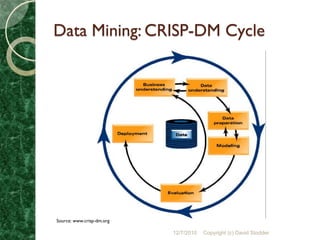
Data Mining: CRISP-DM Cycle


Source: www.crisp-dm.org

                           12/7/2010   Copyright (c) David Stodder
Customer Analytics: Priority Use of
Predictive Analytics
 How to increase margin, not just sheer number
  of customers?
 What are the most effective metrics and
  indicators of customer attrition and acquisition?
 Predictors are linked directly to business
  strategy – to desired business outcomes
 Development of incentives programs aimed at
  the right customers


                       12/7/2010   Copyright (c) David Stodder
Analytics: Challenges
 People and politics: Will they trust the results,
  or go with the gut?
 Model development – combining predictors –
  can be slow, trial-and-error process; models
  must be kept up to date
 Structured data only half the story: Adding text
  analytics and mining to apply quantitative and
  linguistic analysis to words and sentiment


                        12/7/2010   Copyright (c) David Stodder
Proactive and Focused on Business
Outcomes: BI and Analytics Together
  Anticipate the future, plan how to act with
   consistency rather than case-by-case
  BI: visualization, alerting and “simple” analytics –
   backed by more advanced analytics – to make
   information actionable
  Linking performance management to analytics
  Spreadsheets: Either making them more useful,
   or replacing them with better tools


                          12/7/2010   Copyright (c) David Stodder
Making Analytics Affordable: Key
Trends to Watch
   Labor and expertise are huge costs: Using
    templates for analytics and information
    management
   Industry models for rapid development
   Pre-configured appliances and scalable systems
    enable organizations to reduce time and cost
   Data services: Analytics in the cloud
   Embedding analytics in applications and
    processes


                        12/7/2010   Copyright (c) David Stodder
Best Practices for Analytics
 Start with your BI platform: Where are users
  bumping up against limits for understanding
  “unknowns”?
 The information management layer is critical:
  Analytics thrives on lots of data from multiple
  sources for correlation and pattern analysis
 Don’t delay: Predictive analytics becoming more
  mainstream; key to competitiveness


                      12/7/2010   Copyright (c) David Stodder
Best Practices: Going Forward
 Focus modeling on desired business outcomes
 Be patient with model development, and be
  prepared to update models continuously;
  evaluate industry models
 Customer analytics and fraud detection: where
  depth of experience is greatest
 Social network analysis and “Big Data”: valuable
  external sources, though in the realm of the
  “experts” for analytics use


                       12/7/2010   Copyright (c) David Stodder
Questions and Answers

Chris Murphy
Editor, InformationWeek


David Stodder
Analyst, Research and Writer
Perceptive Information Strategies

Business Analytics

  • 1.
    Smarter Business Intelligence: AdvancedAnalytics In Practice Sponsored by:
  • 2.
  • 3.
    Today’s Presenters Chris Murphy Editor,InformationWeek David Stodder Analyst, Research and Writer Perceptive Information Strategies
  • 4.
    Agenda Setting the stage •Analytics defined • Momentum • The business imperative Advanced Analytics Strategy
  • 5.
    Analytics Defined Analytics: Prediction,statistical analysis, Optimization BI: Reporting Which sounds more exciting?
  • 6.
    Analytics Momentum • DemocratizeAnalytics Not just PhDs • Embedded Analytics Oracle, SAP, IBM, etc. • Analytics Templates • Real-Time Data • Competitive Advantage?
  • 7.
    Analytics: Business Imperative •No. 1 among BI capabilities • Real-time insight, predictive demand • Real-Time Data
  • 8.
    Poll Question 1 Q: We’re most interested in advanced analytics for: •Analyzing customer data •Finding new product opportunities •Understanding our risk •Predicting revenue •Analyzing supply chains •Other
  • 9.
    Smarter Business Intelligence AdvancedAnalytics In Practice David Stodder Contributing Editor, TechWeb Perceptive Information Strategies dstodder@gmail.com
  • 10.
    Today’s Webcast Discussion  Agility: business context for analytics  Business intelligence and data warehouse key trends and directions for analytics  Analytics, information management and data warehousing  Making analytics affordable: templates and pre- configured systems  Analytics: predictive analytics and data mining  Best practices and conclusion 12/7/2010 Copyright (c) David Stodder
  • 11.
    To Be Agile,Be Aware: The Basis of Competition Today •Informed and proactive: Can anticipate and react in a coordinated fashion • Competing in real time: The strategic and tactical edge only lasts so long • Need to realize value from every customer, partner and process • Optimize to reduce latency, cut costs and improve performance 12/7/2010 Copyright (c) David Stodder
  • 12.
    Agility and Awareness:Information Systems Support – or Thwart?  Danger that traditional information systems can thwart agility  Standard, siloed reports can deliver incomplete and inaccurate views of a multi-channel world  Known problems, known solutions: What about the unknown?  Smart devices, smarter customers: Keeping pace with rising intelligence 12/7/2010 Copyright (c) David Stodder
  • 13.
    Business Intelligence andData Warehouse: Success Factors How good is the information? - Accuracy and quality; need it now, but need it right - Comprehensiveness; all relevant sources included? In search of the single view What can I do with the information? - Timely data is good, but do users understand it? - Think dynamically: Continuous people and process improvement How can I profit from (or protect myself with) this information? - Operational intelligence is about business innovation - Risk and regulatory compliance are major drivers 12/7/2010 Copyright (c) David Stodder
  • 14.
    Data Scarcity: Notthe Problem  Many organizations already swimming in an abundance of data  Focus on gaining higher value from data  Data is already big: “Big Data” focus on dynamic behavior and velocity of information (data at rest, in motion)  Info management challenge: integrating access to internal and external data sources 12/7/2010 Copyright (c) David Stodder
  • 15.
    Business Analytics: SharpeningFocus On Desired Business Outcome • When outcome, and course are unknown: Use information to iterate toward clarity • Optimization: Use information to ensure no steps are wasted • Monitor and measure progress using BI and performance management • Example: customer loyalty tracking 12/7/2010 Copyright (c) David Stodder
  • 16.
    Business Intelligence: Canit Take Us Where We Want to Go?  BI systems primarily provide quantitative data and tools to manipulate it for analysis and to support decision-making  Goal is to deliver comprehensive views of business states and directions  Broadening out from traditional base of analysts and power users working with limited data and updating 12/7/2010 Copyright (c) David Stodder
  • 17.
    Business Intelligence Expectations Most Important BI Features (3) Reason for Utilizing BI (Top 5) 90% 80% 80% 70% 70% 60% 60% 50% 50% 40% 40% 30% 30% 20% 20% 10% 10% 0% 0% Fast data Ability to collect Ability to predict exploration, query and analyze customer behavior, and analysis operational data in risk or business capabilities real time outcomes - InformationWeek Analytics BI and Information Management Survey, September 2010 12/7/2010 Copyright (c) David Stodder
  • 18.
    Business Intelligence Technology: PushingPast Limitations  Historical data is vital, but can limit perspective and “actionability” of data  Focus on exceptions, not “data dumps”  User requirements always change: Self-service necessary to free users – and IT – of long, often unsatisfying development  Search can’t be a stranger: How most people find information  Collaboration: Decisions made by teams, not individuals; embed in applications, services 12/7/2010 Copyright (c) David Stodder
  • 19.
    “Smarter” BI: Collaborative, Current,Easier to Use and Trusted • Dashboards display BI/perf. mgmt info, quickly and easily understood; drill down for anomalies • Performance management starts to “template” information around KPIs and metrics • Collaborative potential: Integrating BI and collaboration (e.g., IBM Cognos 10 and Lotus Connections) • “Real time” – meaning what’s important now (could be real-time data) IBM Cognos 10 dashboard example 12/7/2010 Copyright (c) David Stodder
  • 20.
    But Can BIDo Analytics?  Getting beyond reporting: Spreadsheets still most widely used tool for analysis  Financial analysis #1 reason for utilizing BI: Critical to expand beyond accounting to support strategic and operational analysis (including activity-based costing)  Implementation goals for BI (IWK Survey): ◦ Monitor/share metrics: 72% ◦ Analyze customer data to increase sales: 56% ◦ Analyze customer data to retain customers: 53% 12/7/2010 Copyright (c) David Stodder
  • 21.
    Polling Question #2 Q.What is your top priority with business intelligence? - Giving users self-service capabilities for visualization and drill-down analysis - Accessing real-time data - Using BI to improve data quality and consistency - Enabling performance management KPIs and metrics - Financial reporting and analysis 12/7/2010 Copyright (c) David Stodder
  • 22.
    Smarter BI: NowhereWithout Info Management Infrastructure  The “Hercules” of Business Intelligence  Taking advantage of hardware advances (virtualization, very large memory, new chip designs)  Information integration  Enterprise data warehouse to support BI; rules to facilitate information governance (security, HIPAA, etc.)  Single view of the truth: Data quality, profiling, discovery 12/7/2010 Copyright (c) David Stodder
  • 23.
    Relevant, Timely andReliable Data: Challenges Remain 12/7/2010 Copyright (c) David Stodder
  • 24.
    From Traditional toNext- Generation Data Warehousing • Serving small, internal user  Real-time analytics to improve communities customer, partner service; • Built around extraction, real-time event alerting transformation and loading  ETL, MDM and federated (ETL) information integration • Historical analysis and  Support for performance reporting management KPIs and • Batch loading at off hours metrics, dashboards and • Different systems for simple scorecards & complex queries (e.g., ODS  Continuous updating and DW)‫‏‬  Deployment of appliances in- • Info delivery not memory analytic apps and synchronized with processes pre-configured systems  Little external data  “Cloud” data services 12/7/2010 Copyright (c) David Stodder
  • 25.
    Critical Trends inInformation Management: Templates  Rapid development: Using pre-built data warehouse models, often specific to industry or application  Models and templates to improve consistency of implementation  Example: IBM Delivery Accelerators: e.g., retail- specific template, dashboard and workbench accelerators, data models, development tools, processes, predictive modeling 12/7/2010 Copyright (c) David Stodder
  • 26.
    Critical IM Trend:“Semantic” Integration Managed Centrally  Relieve BI/analytics tools and users of having to define data types; reduce “what is a customer?” chaos  Develop coordinated, accurate and stable business definitions and semantic meaning: Master data management  Managing ETL processes more effectively to reduce cost and delay  Improving data quality: BI fails without it! 12/7/2010 Copyright (c) David Stodder
  • 27.
    Critical IM Trend:Pre-Configured Systems and Appliances  “Complex queries” – analytics – the most frequent reason organizations purchasing appliances and specialized databases (e.g., column-oriented)  Pre-configured to speed deployment  Tight integration  Specialized for analytics  Scalability IBM Power7 Systems 12/7/2010 Copyright (c) David Stodder
  • 28.
    In-Memory, In-Database Analytics: Feedingthe Need for Speed  In-memory analytics: Bringing more power and flexibility to the user’s workstation  In-database analytics: Using the database system to power analytics; e.g., SAS relationship with IBM  Real-time “trickle” data feeds and analytics; “ELT” processing  Embedding BI/analytics with processes 12/7/2010 Copyright (c) David Stodder
  • 29.
    Polling Question #3 Whatis your top priority for information management to support BI/analytics? - Deploying BI/DW appliances and pre-configured systems - Enabling information integration layer (including ETL, ELT, MDM) to support BI/analytics - Taking advantage of better hardware (e.g., virtualization, blades, faster chips) - Moving data warehouse systems to the cloud (public or private infrastructure as a service) 12/7/2010 Copyright (c) David Stodder
  • 30.
    Analytics: Improving Outcomes “Simple”Analytics “Advanced” Analytics - BI “what-if” queries - Optimization - Accounting-oriented - Activity-based costing financial analysis modeling and analysis - Performance - Time series analysis management metrics and forecasting - Online analytical - Predictive analytics processing (OLAP) - Whatever those - Stuff nontechnical Ph.D.’s are doing users can do 12/7/2010 Copyright (c) David Stodder
  • 31.
    Advanced Analytics: Topping InformationWeekBI “Wish List”  3.8 on scale of 5 (“extremely interested”); one third rated it 5  Proactive objectives: anticipate demand to adjust pricing, manufacturing forecasts and supply chain planning  Know what customers want before they ask for it – or go to a competitor  Fraud example: Isolate the bad so that good claims are processed faster 12/7/2010 Copyright (c) David Stodder
  • 32.
    Analytics: Case Example Infinity Property and Casualty: auto insurance for drivers who represent higher than normal risks and pay higher rates for comparable coverage  Objective of speeding claims process and improve efficiency, while cutting fraud and improving customer satisfaction  “Right-tracking”: claims profiled up front and sent to appropriate specialists based on claim characteristics 12/7/2010 Copyright (c) David Stodder
  • 33.
    Infinity Property &Casualty Example, Continued  Predictive traits in claims modeled using IBM SPSS  Able to address concerns beyond just fraud  Six months to develop models and rules to integrate predictions into Infinity’s claim system  Benefits: Used to take 40 days for claims to reach specialists; now takes 48 hours  Success rate in proving fraud now 87%; company able to discontinue using third-party firm to handle collections ($12 mill/yr) 12/7/2010 Copyright (c) David Stodder
  • 34.
    Predictive Analytics Objectives Data mining: discovery of previously undetected patterns and relationships in data  Predictive analytics: applying historical patterns to predict future outcomes  Statistics (e.g., regression); AI (e.g., neural nets); hybrid (e.g., decision trees); optimization (e.g., Monte Carlo simulation) Acknowledgements to Eric Siegel, Prediction Impact 12/7/2010 Copyright (c) David Stodder
  • 35.
    Data Mining: CRISP-DMCycle Source: www.crisp-dm.org 12/7/2010 Copyright (c) David Stodder
  • 36.
    Customer Analytics: PriorityUse of Predictive Analytics  How to increase margin, not just sheer number of customers?  What are the most effective metrics and indicators of customer attrition and acquisition?  Predictors are linked directly to business strategy – to desired business outcomes  Development of incentives programs aimed at the right customers 12/7/2010 Copyright (c) David Stodder
  • 37.
    Analytics: Challenges  Peopleand politics: Will they trust the results, or go with the gut?  Model development – combining predictors – can be slow, trial-and-error process; models must be kept up to date  Structured data only half the story: Adding text analytics and mining to apply quantitative and linguistic analysis to words and sentiment 12/7/2010 Copyright (c) David Stodder
  • 38.
    Proactive and Focusedon Business Outcomes: BI and Analytics Together  Anticipate the future, plan how to act with consistency rather than case-by-case  BI: visualization, alerting and “simple” analytics – backed by more advanced analytics – to make information actionable  Linking performance management to analytics  Spreadsheets: Either making them more useful, or replacing them with better tools 12/7/2010 Copyright (c) David Stodder
  • 39.
    Making Analytics Affordable:Key Trends to Watch  Labor and expertise are huge costs: Using templates for analytics and information management  Industry models for rapid development  Pre-configured appliances and scalable systems enable organizations to reduce time and cost  Data services: Analytics in the cloud  Embedding analytics in applications and processes 12/7/2010 Copyright (c) David Stodder
  • 40.
    Best Practices forAnalytics  Start with your BI platform: Where are users bumping up against limits for understanding “unknowns”?  The information management layer is critical: Analytics thrives on lots of data from multiple sources for correlation and pattern analysis  Don’t delay: Predictive analytics becoming more mainstream; key to competitiveness 12/7/2010 Copyright (c) David Stodder
  • 41.
    Best Practices: GoingForward  Focus modeling on desired business outcomes  Be patient with model development, and be prepared to update models continuously; evaluate industry models  Customer analytics and fraud detection: where depth of experience is greatest  Social network analysis and “Big Data”: valuable external sources, though in the realm of the “experts” for analytics use 12/7/2010 Copyright (c) David Stodder
  • 42.
    Questions and Answers ChrisMurphy Editor, InformationWeek David Stodder Analyst, Research and Writer Perceptive Information Strategies