








Defect Prediction:
Accomplishments and Future Challenges
Yasutaka Kamei
POSL Lab, Kyushu University
Emad Shihab
CSE, Concordia University
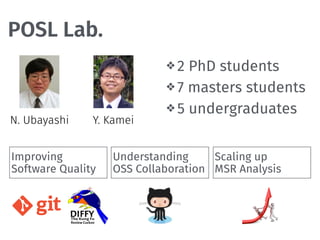
POSL Lab.
❖ 2 PhD students
❖ 7 masters students
❖ 5 undergraduates
N. Ubayashi Y. Kamei
Improving

Software Quality
Scaling up

MSR Analysis
Understanding

OSS Collaboration
Defect Prediction
Fumio Akiyama
An Example of Software
System Debugging
IFIC, 1971
Defect Prediction
Fumio Akiyama
An Example of Software
System Debugging
IFIC, 1971
Background
Accomplishments
Future Challenges
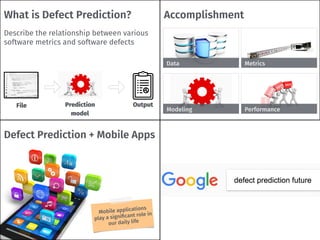
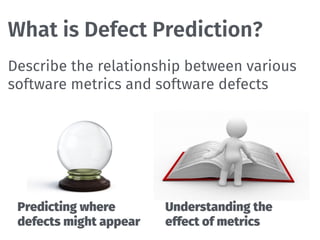
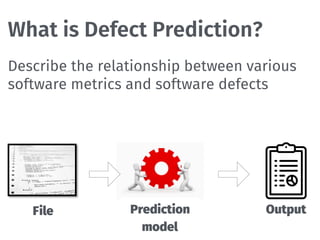
What is Defect Prediction?
Describe the relationship between various
software metrics and software defects
Predicting where
defects might appear
Understanding the
effect of metrics
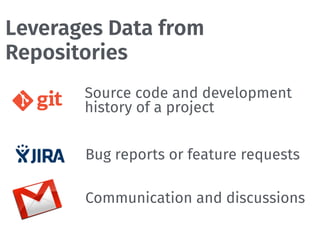
Leverages Data from
Repositories
Communication and discussions
Source code and development
history of a project
Bug reports or feature requests
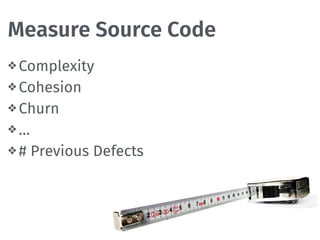
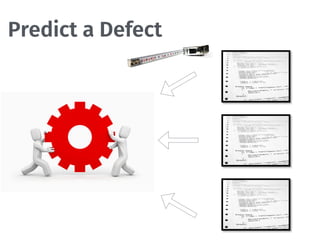
Measure Source Code
❖ Complexity
❖ Cohesion
❖ Churn
❖ …
❖ # Previous Defects
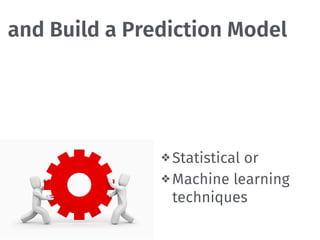
and Build a Prediction Model
❖ Statistical or
❖ Machine learning

techniques
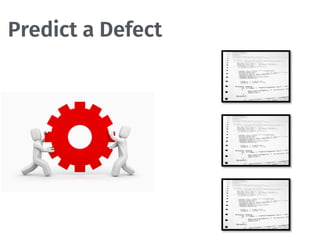
Predict a Defect
Predict a Defect
Predict a Defect
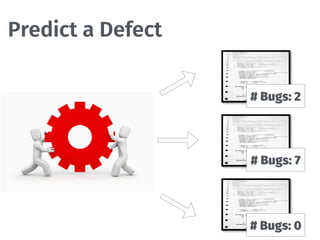
# Bugs: 0
# Bugs: 7
# Bugs: 2
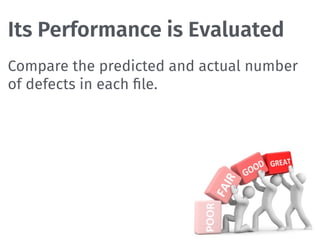
Its Performance is Evaluated
Compare the predicted and actual number
of defects in each file.
Background
Accomplishments
Future Challenges
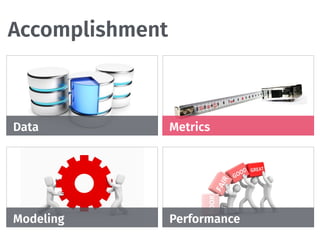
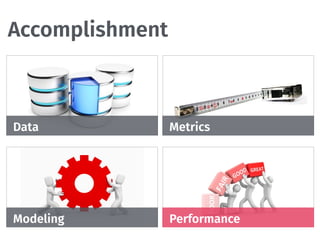
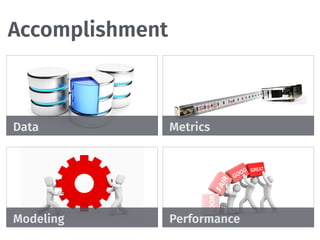
Accomplishment
Data Metrics
Modeling Performance
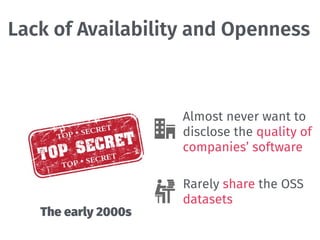
Lack of Availability and Openness
The early 2000s
Almost never want to
disclose the quality of
companies’ software
Rarely share the OSS
datasets
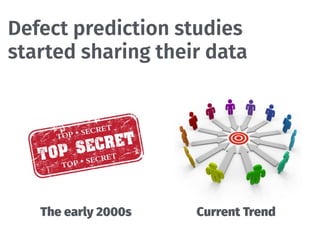
Defect prediction studies
started sharing their data
The early 2000s Current Trend
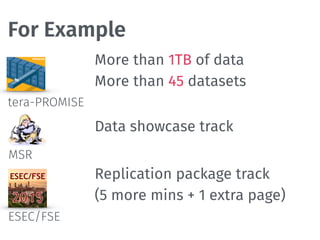
For Example
MSR
Data showcase track
ESEC/FSE
Replication package track
(5 more mins + 1 extra page)
tera-PROMISE
More than 1TB of data
More than 45 datasets
Accomplishment
Data Metrics
Modeling Performance
Most Papers Used Data from
Source Code Repositories
The early 2000s
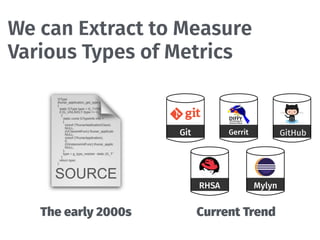
We can Extract to Measure
Various Types of Metrics
The early 2000s Current Trend
GerritGit GitHub
RHSA Mylyn
 え
Accomplishment
Data Metrics
Modeling Performance
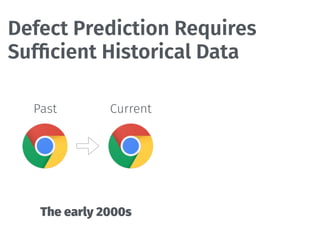
Defect Prediction Requires
Sufficient Historical Data
The early 2000s
Past Current
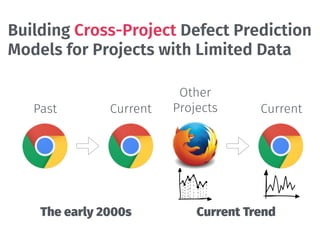
Building Cross-Project Defect Prediction
Models for Projects with Limited Data
The early 2000s
Other
Projects Current
Current Trend
Past Current
Accomplishment
Data Metrics
Modeling Performance
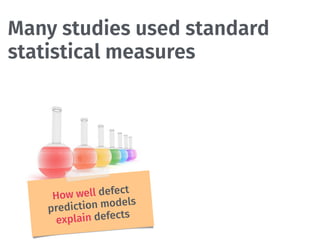
Many studies used standard
statistical measures
The early 2000s
How well defect
prediction models
explain defects
The early 2000s Current Trend
How well defect
prediction models
explain defects
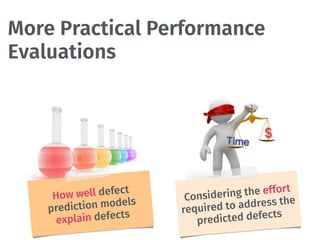
Considering the effort
required to address the
predicted defects
More Practical Performance
Evaluations
Background
Accomplishments
Future Challenges
Consider new markets
Defect Prediction + Mobile Apps
Defect Prediction + Green Mining
We anticipate new markets to be
an area of significant growth in the
future.
Keeping Up with the Fast Pace
of Development
Firefox project
Reducing release cycles
to days or even hours
1,000 improvem-
ents in 3 months
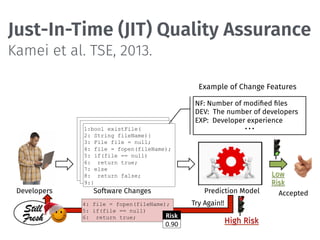
Just-In-Time (JIT) Quality Assurance
Prediction ModelDevelopers
Example of Change Features
Still
Fresh
Low
Risk
High Risk
AcceptedSoftware Changes
4: file = fopen(fileName);
5: if(file == null)
6: return true; Risk
0.90
Try Again!!
NF: Number of modified files
DEV: The number of developers
EXP: Developer experience
1:bool existFile(
2: String fileName){
3: File file = null;
4: file = fopen(fileName);
5: if(file == null)
6: return true;
7: else
8: return false;
9:}
Kamei et al. TSE, 2013.
Just-In-Time (JIT) Quality Assurance
Prediction ModelDevelopers
Example of Change Features
Still
Fresh
Low
Risk
High Risk
AcceptedSoftware Changes
4: file = fopen(fileName);
5: if(file == null)
6: return true; Risk
0.90
Try Again!!
NF: Number of modified files
DEV: The number of developers
EXP: Developer experience
1:bool existFile(
2: String fileName){
3: File file = null;
4: file = fopen(fileName);
5: if(file == null)
6: return true;
7: else
8: return false;
9:}
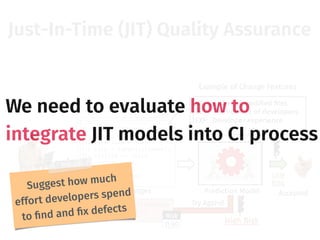
We need to evaluate how to
integrate JIT models into CI process
Suggest how much
effort developers spend
to find and fix defects
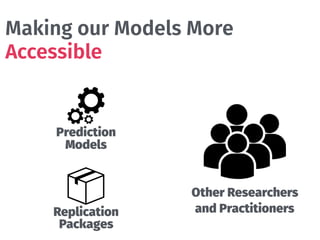
Making our Models More
Accessible
Replication
Packages
Prediction

Models
Other Researchers
and Practitioners
Our Models and Techniques
Simple and Extendable
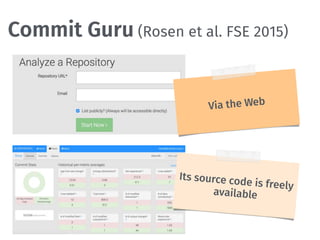
Commit Guru (Rosen et al. FSE 2015)
Via the Web
Its source code is freely
available
Conclusion
What is Defect Prediction?
Describe the relationship between various
software metrics and software defects
File Prediction
model
Output
Accomplishment
Data Metrics
Modeling Performance
Defect Prediction + Mobile Apps
Mobile applications
play a significant role in
our daily life
Defect Prediction:
Accomplishments and Future Challenges
Yasutaka Kamei
Principles of Software Languages Group (POSL)
Kyushu University, Fukuoka, Japan
Email: kamei@ait.kyushu-u.ac.jp
Emad Shihab
Dept. of Computer Science and Software Engineering
Concordia University, Montr´eal, Canada
Email: eshihab@encs.concordia.ca
Abstract—As software systems play an increasingly important
role in our lives, their complexity continues to increase. The
increased complexity of software systems makes the assurance
of their quality very difficult. Therefore, a significant amount of
recent research focuses on the prioritization of software quality
assurance efforts. One line of work that has been receiving an
increasing amount of attention for over 40 years is software
defect prediction, where predictions are made to determine where
future defects might appear. Since then, there have been many
studies and many accomplishments in the area of software defect
prediction. At the same time, there remain many challenges that
face that field of software defect prediction. The paper aims to
accomplish four things. First, we provide a brief overview of
software defect prediction and its various components. Second,
we revisit the challenges of software prediction models as they
were seen in the year 2000, in order to reflect on our accom-
plishments since then. Third, we highlight our accomplishments
and current trends, as well as, discuss the game changers that
had a significant impact on software defect prediction. Fourth,
we highlight some key challenges that lie ahead in the near (and
not so near) future in order for us as a research community to
tackle these future challenges.
I. INTRODUCTION
future and allocate SQA resources to defect-prone artifacts
(e.g., subsystems and files) [58] and (2) to understand the
effect of factors on the likelihood of finding a defect and
derive practical guidelines for future software development
projects [9, 45].
Due to its importance, defect prediction work has been
at the focus of researchers for over 40 years. Akiyama [3]
first attempted to build defect prediction models using size-
based metrics and regression modelling techniques in 1971.
Since then, there have been a plethora of studies and many
accomplishments in the software defect prediction area [23].
At the same time, there remain many challenges that face
software defect prediction. Hence, we believe that it is a
perfect time to write a Future of Software Engineering (FoSE)
paper on the topic of software defect prediction.
The paper is written from a budding university researchers’
point of view and aims to accomplish four things. First, we
provide a brief overview of software defect prediction and
its various components. Second, we revisit the challenges of
Accomplishment
Data Metrics
Modeling Performance
What is Defect Prediction?
Describe the relationship between various
software metrics and software defects
File Prediction
model
Output
Defect Prediction + Mobile Apps
Mobile applications
play a significant role in
our daily life

Defect Prediction: Accomplishments and Future Challenges

  • 1.
    Defect Prediction: Accomplishments andFuture Challenges Yasutaka Kamei POSL Lab, Kyushu University Emad Shihab CSE, Concordia University
  • 2.
    POSL Lab. ❖ 2PhD students ❖ 7 masters students ❖ 5 undergraduates N. Ubayashi Y. Kamei Improving
 Software Quality Scaling up
 MSR Analysis Understanding
 OSS Collaboration
  • 3.
    Defect Prediction Fumio Akiyama AnExample of Software System Debugging IFIC, 1971
  • 4.
    Defect Prediction Fumio Akiyama AnExample of Software System Debugging IFIC, 1971 Background Accomplishments Future Challenges
  • 5.
    What is DefectPrediction? Describe the relationship between various software metrics and software defects Predicting where defects might appear Understanding the effect of metrics
  • 6.
    Leverages Data from Repositories Communicationand discussions Source code and development history of a project Bug reports or feature requests
  • 7.
    Measure Source Code ❖Complexity ❖ Cohesion ❖ Churn ❖ … ❖ # Previous Defects
  • 8.
    and Build aPrediction Model ❖ Statistical or ❖ Machine learning
 techniques
  • 9.
  • 10.
  • 11.
    Predict a Defect #Bugs: 0 # Bugs: 7 # Bugs: 2
  • 12.
    Its Performance isEvaluated Compare the predicted and actual number of defects in each file.
  • 13.
  • 14.
  • 15.
    Lack of Availabilityand Openness The early 2000s Almost never want to disclose the quality of companies’ software Rarely share the OSS datasets
  • 16.
    Defect prediction studies startedsharing their data The early 2000s Current Trend
  • 17.
    For Example MSR Data showcasetrack ESEC/FSE Replication package track (5 more mins + 1 extra page) tera-PROMISE More than 1TB of data More than 45 datasets
  • 18.
  • 19.
    Most Papers UsedData from Source Code Repositories The early 2000s
  • 20.
    We can Extractto Measure Various Types of Metrics The early 2000s Current Trend GerritGit GitHub RHSA Mylyn
  • 21.
  • 22.
  • 23.
    Defect Prediction Requires SufficientHistorical Data The early 2000s Past Current
  • 24.
    Building Cross-Project DefectPrediction Models for Projects with Limited Data The early 2000s Other Projects Current Current Trend Past Current
  • 25.
  • 26.
    Many studies usedstandard statistical measures The early 2000s How well defect prediction models explain defects
  • 27.
    The early 2000sCurrent Trend How well defect prediction models explain defects Considering the effort required to address the predicted defects More Practical Performance Evaluations
  • 28.
  • 29.
  • 30.
  • 31.
    Defect Prediction +Green Mining
  • 32.
    Defect Prediction +Green Mining We anticipate new markets to be an area of significant growth in the future.
  • 33.
    Keeping Up withthe Fast Pace of Development Firefox project Reducing release cycles to days or even hours 1,000 improvem- ents in 3 months
  • 34.
    Just-In-Time (JIT) QualityAssurance Prediction ModelDevelopers Example of Change Features Still Fresh Low Risk High Risk AcceptedSoftware Changes 4: file = fopen(fileName); 5: if(file == null) 6: return true; Risk 0.90 Try Again!! NF: Number of modified files DEV: The number of developers EXP: Developer experience 1:bool existFile( 2: String fileName){ 3: File file = null; 4: file = fopen(fileName); 5: if(file == null) 6: return true; 7: else 8: return false; 9:} Kamei et al. TSE, 2013.
  • 35.
    Just-In-Time (JIT) QualityAssurance Prediction ModelDevelopers Example of Change Features Still Fresh Low Risk High Risk AcceptedSoftware Changes 4: file = fopen(fileName); 5: if(file == null) 6: return true; Risk 0.90 Try Again!! NF: Number of modified files DEV: The number of developers EXP: Developer experience 1:bool existFile( 2: String fileName){ 3: File file = null; 4: file = fopen(fileName); 5: if(file == null) 6: return true; 7: else 8: return false; 9:} We need to evaluate how to integrate JIT models into CI process Suggest how much effort developers spend to find and fix defects
  • 36.
    Making our ModelsMore Accessible Replication Packages Prediction
 Models Other Researchers and Practitioners
  • 37.
    Our Models andTechniques Simple and Extendable
  • 38.
    Commit Guru (Rosenet al. FSE 2015) Via the Web Its source code is freely available
  • 39.
  • 40.
    What is DefectPrediction? Describe the relationship between various software metrics and software defects File Prediction model Output
  • 41.
  • 42.
    Defect Prediction +Mobile Apps Mobile applications play a significant role in our daily life
  • 43.
    Defect Prediction: Accomplishments andFuture Challenges Yasutaka Kamei Principles of Software Languages Group (POSL) Kyushu University, Fukuoka, Japan Email: kamei@ait.kyushu-u.ac.jp Emad Shihab Dept. of Computer Science and Software Engineering Concordia University, Montr´eal, Canada Email: eshihab@encs.concordia.ca Abstract—As software systems play an increasingly important role in our lives, their complexity continues to increase. The increased complexity of software systems makes the assurance of their quality very difficult. Therefore, a significant amount of recent research focuses on the prioritization of software quality assurance efforts. One line of work that has been receiving an increasing amount of attention for over 40 years is software defect prediction, where predictions are made to determine where future defects might appear. Since then, there have been many studies and many accomplishments in the area of software defect prediction. At the same time, there remain many challenges that face that field of software defect prediction. The paper aims to accomplish four things. First, we provide a brief overview of software defect prediction and its various components. Second, we revisit the challenges of software prediction models as they were seen in the year 2000, in order to reflect on our accom- plishments since then. Third, we highlight our accomplishments and current trends, as well as, discuss the game changers that had a significant impact on software defect prediction. Fourth, we highlight some key challenges that lie ahead in the near (and not so near) future in order for us as a research community to tackle these future challenges. I. INTRODUCTION future and allocate SQA resources to defect-prone artifacts (e.g., subsystems and files) [58] and (2) to understand the effect of factors on the likelihood of finding a defect and derive practical guidelines for future software development projects [9, 45]. Due to its importance, defect prediction work has been at the focus of researchers for over 40 years. Akiyama [3] first attempted to build defect prediction models using size- based metrics and regression modelling techniques in 1971. Since then, there have been a plethora of studies and many accomplishments in the software defect prediction area [23]. At the same time, there remain many challenges that face software defect prediction. Hence, we believe that it is a perfect time to write a Future of Software Engineering (FoSE) paper on the topic of software defect prediction. The paper is written from a budding university researchers’ point of view and aims to accomplish four things. First, we provide a brief overview of software defect prediction and its various components. Second, we revisit the challenges of
  • 44.
    Accomplishment Data Metrics Modeling Performance Whatis Defect Prediction? Describe the relationship between various software metrics and software defects File Prediction model Output Defect Prediction + Mobile Apps Mobile applications play a significant role in our daily life