
Quality Factors
Question
   To know that quality has improved, it
    would be helpful to be able to measure
    quality.
   How can we measure quality?
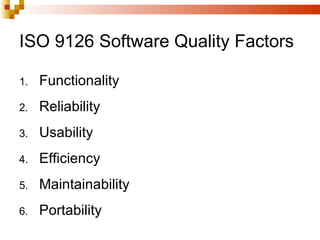
ISO 9126 Software Quality Factors

1.   Functionality
2.   Reliability
3.   Usability
4.   Efficiency
5.   Maintainability
6.   Portability
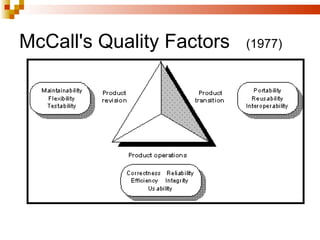
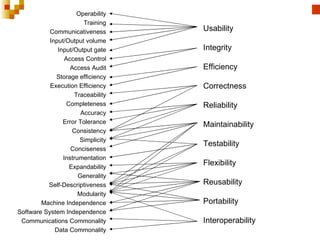
McCall's Quality Factors   (1977)
Define and give example of each
      Usability
      Integrity
      Efficiency
      Correctness
      Reliability
      Maintainability
      Testability
      Flexibility
      Reusability
      Portability
      Interoperability
Operability
                        Training
           Communicativeness       Usability
           Input/Output volume
              Input/Output gate    Integrity
                 Access Control
                   Access Audit    Efficiency
             Storage efficiency
           Execution Efficiency    Correctness
                    Traceability
                  Completeness     Reliability
                       Accuracy
                Error Tolerance    Maintainability
                    Consistency
                      Simplicity
                                   Testability
                   Conciseness
                Instrumentation
                   Expandability
                                   Flexibility
                      Generality
          Self-Descriptiveness     Reusability
                      Modularity
        Machine Independence       Portability
Software System Independence
 Communications Commonality        Interoperability
             Data Commonality
Reality Check…
 Q: So, how does that long list help us
    with SQA?

 A: Most, if not all, of those factors
    should be covered explicitly in the
    software requirements document.

 A: Measuring those factors tell us
    where we need improvement.
IEEE 982
" Reliability is an estimation of system failure-freeness. … A
constructive approach to reliable software seeks to remove the root
causes of this class of system failure through software development and
support processes that promote fault avoidance, early fault detection,
appropriately prompt removal, and system-designed fault tolerance.
   The analysis of the errors, faults, and failures from previous
development and support processes can lead to improved future
processes. While the exact functional relationships are not proven, it is
through experience that the majority of failures are related to their
origins. Examples include the following:
 Incompletely defined user needs and requirements
 Omissions in the design and coding process
 Improper usage of the system
 Excessive change activity
IEEE 982
          Nine Classes of Measures
    Product Measures
    1.   errors, faults, failures
    2.   mean-time-to-failure
    3.   realibility growth and projection
    4.   remaining products faults
    5.   completeness and consistency
    6.   complexity
    Process Measures
    1.   management control
    2.   coverage
    3.   risk, benefit, cost evaluation
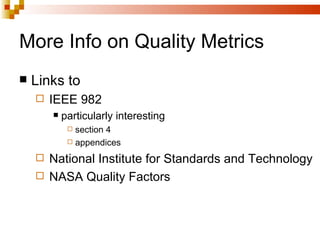
More Info on Quality Metrics
   Links to
       IEEE 982
           particularly interesting
              section 4
              appendices

       National Institute for Standards and Technology
       NASA Quality Factors

factors

  • 1.
  • 2.
    Question  To know that quality has improved, it would be helpful to be able to measure quality.  How can we measure quality?
  • 3.
    ISO 9126 SoftwareQuality Factors 1. Functionality 2. Reliability 3. Usability 4. Efficiency 5. Maintainability 6. Portability
  • 4.
  • 5.
    Define and giveexample of each  Usability  Integrity  Efficiency  Correctness  Reliability  Maintainability  Testability  Flexibility  Reusability  Portability  Interoperability
  • 6.
    Operability Training Communicativeness Usability Input/Output volume Input/Output gate Integrity Access Control Access Audit Efficiency Storage efficiency Execution Efficiency Correctness Traceability Completeness Reliability Accuracy Error Tolerance Maintainability Consistency Simplicity Testability Conciseness Instrumentation Expandability Flexibility Generality Self-Descriptiveness Reusability Modularity Machine Independence Portability Software System Independence Communications Commonality Interoperability Data Commonality
  • 7.
    Reality Check… Q:So, how does that long list help us with SQA? A: Most, if not all, of those factors should be covered explicitly in the software requirements document. A: Measuring those factors tell us where we need improvement.
  • 8.
    IEEE 982 " Reliabilityis an estimation of system failure-freeness. … A constructive approach to reliable software seeks to remove the root causes of this class of system failure through software development and support processes that promote fault avoidance, early fault detection, appropriately prompt removal, and system-designed fault tolerance. The analysis of the errors, faults, and failures from previous development and support processes can lead to improved future processes. While the exact functional relationships are not proven, it is through experience that the majority of failures are related to their origins. Examples include the following:  Incompletely defined user needs and requirements  Omissions in the design and coding process  Improper usage of the system  Excessive change activity
  • 9.
    IEEE 982 Nine Classes of Measures  Product Measures 1. errors, faults, failures 2. mean-time-to-failure 3. realibility growth and projection 4. remaining products faults 5. completeness and consistency 6. complexity  Process Measures 1. management control 2. coverage 3. risk, benefit, cost evaluation
  • 10.
    More Info onQuality Metrics  Links to  IEEE 982  particularly interesting  section 4  appendices  National Institute for Standards and Technology  NASA Quality Factors