Dominica

By Yago López Vázquez
CPI Tino Grandio
3ºESO Bilingual Sections
2013/2014
Dominica
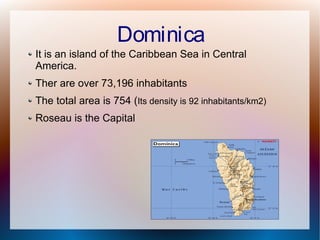
It is an island of the Caribbean Sea in Central
America.
Ther are over 73,196 inhabitants
The total area is 754 (Its density is 92 inhabitants/km2)
Roseau is the Capital
Dominica
●

Population:73.196 inhabitants

●

Land area: 754km2

●

Languages:English the oficial language and French

●

Main cities:Roseau, Canefield and Portsmouth

●

Monetary unit:Caribean dollar

●

Government:Dominica is a parlamentary democracy

●

Head of the state:The President is Nicholas Liverpool
Dominica
The official language is English and theVernacular Languages
Antillean Creole French.
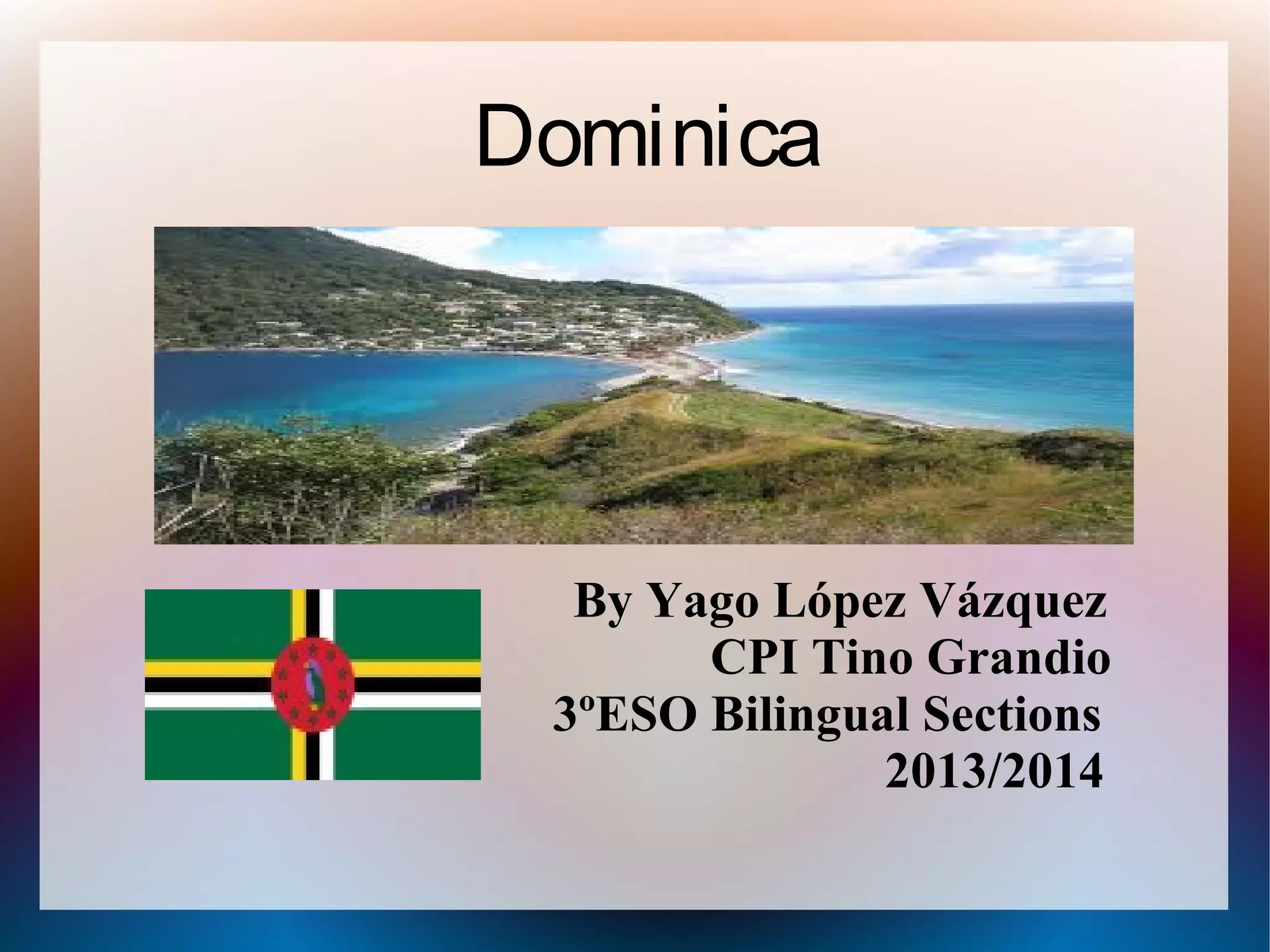
Dominica has been nicknamed the "Nature Isle of the Caribbean"for
its unspoiled natural beauty. It is the youngest island in the Lesser
Antilles, still being formed by geothermal-volcanic activity.
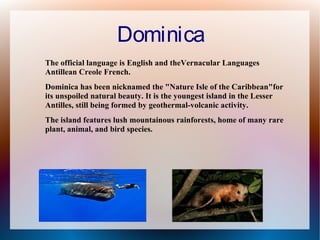
The island features lush mountainous rainforests, home of many rare
plant, animal, and bird species.
Dominica

Origins and History
●

●

●

●

●

●

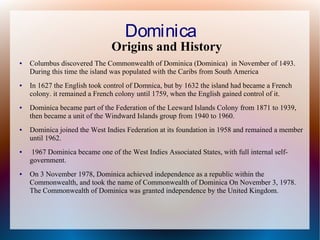
Columbus discovered The Commonwealth of Dominica (Dominica) in November of 1493.
During this time the island was populated with the Caribs from South America
In 1627 the English took control of Domnica, but by 1632 the island had became a French
colony. it remained a French colony until 1759, when the English gained control of it.
Dominica became part of the Federation of the Leeward Islands Colony from 1871 to 1939,
then became a unit of the Windward Islands group from 1940 to 1960.
Dominica joined the West Indies Federation at its foundation in 1958 and remained a member
until 1962.
1967 Dominica became one of the West Indies Associated States, with full internal selfgovernment.
On 3 November 1978, Dominica achieved independence as a republic within the
Commonwealth, and took the name of Commonwealth of Dominica On November 3, 1978.
The Commonwealth of Dominica was granted independence by the United Kingdom.
Dominica

Roseau:

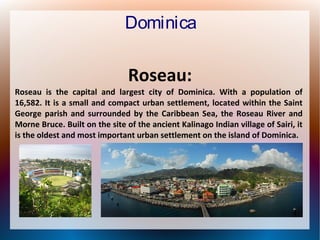
Roseau is the capital and largest city of Dominica. With a population of
16,582. It is a small and compact urban settlement, located within the Saint
George parish and surrounded by the Caribbean Sea, the Roseau River and
Morne Bruce. Built on the site of the ancient Kalinago Indian village of Sairi, it
is the oldest and most important urban settlement on the island of Dominica.
Dominica
Portsmouth:
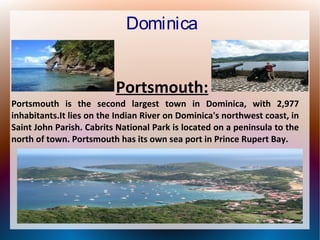
Portsmouth is the second largest town in Dominica, with 2,977
inhabitants.It lies on the Indian River on Dominica's northwest coast, in
Saint John Parish. Cabrits National Park is located on a peninsula to the
north of town. Portsmouth has its own sea port in Prince Rupert Bay.
Dominica
Saint Joseph
Saint Joseph is one of Dominica's 10 administrative parishes. It is bordered by St. Peter
to the north, St. Andrew to the northeast, St. David to the east, and St. Paul to the south.
It has an area of 120.1 km² (46.37 mi²), and a population of 5,765.
Saint Joseph Village is the largest settlement in the parish; it was used as a filming
location for 1988's The Seventh Sign.[2] Most villages are located on the coast (Salisbury
(also called Baroui), Coulibistrie, Mero and Morne Raquette), but another small locale,
Belles, is located in the interior. The parish is also home to the Layou River.
Dominica
Traditions
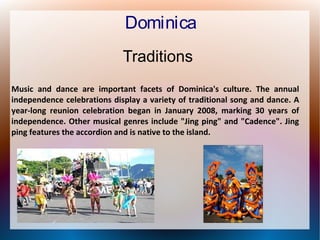
Music and dance are important facets of Dominica's culture. The annual
independence celebrations display a variety of traditional song and dance. A
year-long reunion celebration began in January 2008, marking 30 years of
independence. Other musical genres include "Jing ping" and "Cadence". Jing
ping features the accordion and is native to the island.
Dominica
Traditional food

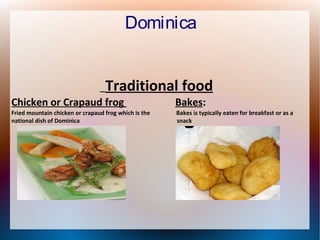
Chicken or Crapaud frog

Bakes:

Fried mountain chicken or crapaud frog which is the
national dish of Dominica

Bakes is typically eaten for breakfast or as a
snack
Dominica
Sports
●

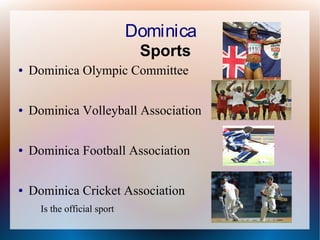
Dominica Olympic Committee

●

Dominica Volleyball Association

●

Dominica Football Association

●

Dominica Cricket Association
Is the official sport
Dominica
Interesting places to visit:
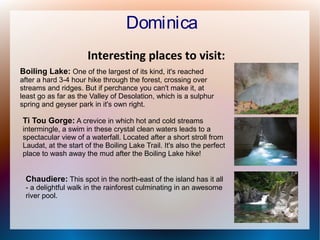
Boiling Lake: One of the largest of its kind, it's reached

after a hard 3-4 hour hike through the forest, crossing over
streams and ridges. But if perchance you can't make it, at
least go as far as the Valley of Desolation, which is a sulphur
spring and geyser park in it's own right.

Ti Tou Gorge: A crevice in which hot and cold streams

intermingle, a swim in these crystal clean waters leads to a
spectacular view of a waterfall. Located after a short stroll from
Laudat, at the start of the Boiling Lake Trail. It's also the perfect
place to wash away the mud after the Boiling Lake hike!

Chaudiere: This spot in the north-east of the island has it all
- a delightful walk in the rainforest culminating in an awesome
river pool.
Dominica

Reference:
●http://www.geonames.org
●www.cia.gov
●www.en.wikipedia.org
●https://www.google.es/searchq=dominica+animals
●http://www.avirtualdominica.com/nature.cfm
Dominica

The End

Dominica work

  • 1.
    Dominica By Yago LópezVázquez CPI Tino Grandio 3ºESO Bilingual Sections 2013/2014
  • 2.
    Dominica It is anisland of the Caribbean Sea in Central America. Ther are over 73,196 inhabitants The total area is 754 (Its density is 92 inhabitants/km2) Roseau is the Capital
  • 3.
    Dominica ● Population:73.196 inhabitants ● Land area:754km2 ● Languages:English the oficial language and French ● Main cities:Roseau, Canefield and Portsmouth ● Monetary unit:Caribean dollar ● Government:Dominica is a parlamentary democracy ● Head of the state:The President is Nicholas Liverpool
  • 4.
    Dominica The official languageis English and theVernacular Languages Antillean Creole French. Dominica has been nicknamed the "Nature Isle of the Caribbean"for its unspoiled natural beauty. It is the youngest island in the Lesser Antilles, still being formed by geothermal-volcanic activity. The island features lush mountainous rainforests, home of many rare plant, animal, and bird species.
  • 5.
    Dominica Origins and History ● ● ● ● ● ● Columbusdiscovered The Commonwealth of Dominica (Dominica) in November of 1493. During this time the island was populated with the Caribs from South America In 1627 the English took control of Domnica, but by 1632 the island had became a French colony. it remained a French colony until 1759, when the English gained control of it. Dominica became part of the Federation of the Leeward Islands Colony from 1871 to 1939, then became a unit of the Windward Islands group from 1940 to 1960. Dominica joined the West Indies Federation at its foundation in 1958 and remained a member until 1962. 1967 Dominica became one of the West Indies Associated States, with full internal selfgovernment. On 3 November 1978, Dominica achieved independence as a republic within the Commonwealth, and took the name of Commonwealth of Dominica On November 3, 1978. The Commonwealth of Dominica was granted independence by the United Kingdom.
  • 6.
    Dominica Roseau: Roseau is thecapital and largest city of Dominica. With a population of 16,582. It is a small and compact urban settlement, located within the Saint George parish and surrounded by the Caribbean Sea, the Roseau River and Morne Bruce. Built on the site of the ancient Kalinago Indian village of Sairi, it is the oldest and most important urban settlement on the island of Dominica.
  • 7.
    Dominica Portsmouth: Portsmouth is thesecond largest town in Dominica, with 2,977 inhabitants.It lies on the Indian River on Dominica's northwest coast, in Saint John Parish. Cabrits National Park is located on a peninsula to the north of town. Portsmouth has its own sea port in Prince Rupert Bay.
  • 8.
    Dominica Saint Joseph Saint Josephis one of Dominica's 10 administrative parishes. It is bordered by St. Peter to the north, St. Andrew to the northeast, St. David to the east, and St. Paul to the south. It has an area of 120.1 km² (46.37 mi²), and a population of 5,765. Saint Joseph Village is the largest settlement in the parish; it was used as a filming location for 1988's The Seventh Sign.[2] Most villages are located on the coast (Salisbury (also called Baroui), Coulibistrie, Mero and Morne Raquette), but another small locale, Belles, is located in the interior. The parish is also home to the Layou River.
  • 9.
    Dominica Traditions Music and danceare important facets of Dominica's culture. The annual independence celebrations display a variety of traditional song and dance. A year-long reunion celebration began in January 2008, marking 30 years of independence. Other musical genres include "Jing ping" and "Cadence". Jing ping features the accordion and is native to the island.
  • 10.
    Dominica Traditional food Chicken orCrapaud frog Bakes: Fried mountain chicken or crapaud frog which is the national dish of Dominica Bakes is typically eaten for breakfast or as a snack
  • 11.
    Dominica Sports ● Dominica Olympic Committee ● DominicaVolleyball Association ● Dominica Football Association ● Dominica Cricket Association Is the official sport
  • 12.
    Dominica Interesting places tovisit: Boiling Lake: One of the largest of its kind, it's reached after a hard 3-4 hour hike through the forest, crossing over streams and ridges. But if perchance you can't make it, at least go as far as the Valley of Desolation, which is a sulphur spring and geyser park in it's own right. Ti Tou Gorge: A crevice in which hot and cold streams intermingle, a swim in these crystal clean waters leads to a spectacular view of a waterfall. Located after a short stroll from Laudat, at the start of the Boiling Lake Trail. It's also the perfect place to wash away the mud after the Boiling Lake hike! Chaudiere: This spot in the north-east of the island has it all - a delightful walk in the rainforest culminating in an awesome river pool.
  • 13.
  • 14.