Download as PDF, PPTX




![References
Brown, V.A. (2010) Collective inquiry and its wicked problems. In: Brown et al. (2010), ch.4, pp.61-83.
Brown, V., Harris, J.A. & Russell, J.Y. (eds.) (2010) Tackling wicked problems through the transdisciplinary imagination. Abingdon:
Earthscan.
Cantor, A., DeLauer, V., Martin, D. & Rogan, J. (2015) Trai i g i terdis ipli ary i ked pro le sol ers: applyi g lesso s fro
HERO in community-based research experiences for undergraduates. Journal of Geography in Higher Education, 39(3), 407-419.
Davidson , J. & Lyth, A. (2012) Edu atio for li ate ha ge adaptatio […] Journal of Education in the Built Environment, 7(2), 63-
83.
Dentoni, D. & Bitzer, V. (2015) The role(s) of universities in dealing with global wicked problems through multi-stakeholder
initiatives. Journal of Cleaner Production, 106, 68-78.
Duckett, D., Feliciano, D., Martin-Ortago, J. & Munoz-Rojas, J. (2016) Tackling wicked environmental problems: the discourse and
its influence on praxis in Scotland. Landscape & Urban Planning, online.
Haigh, M. (2014) Gaia: thi ki g like a pla et as tra sfor ati e lear i g. Journal of Geography in Higher Education, 38(1), 49-68.
Hall, T., Toms, P., McGuinness, M., Parker, C. & Roberts, N. (2015) Where s the Geography Depart e t? The ha gi g
administrative place of Geography in Higher Education. Area, 47(1), 56-64.
Jentoft, S. & Chuenpagdee, R. (2009) Fisheries and coastal governance as a wicked problem. Marine Policy, 33: 553-560.
Jordan, M.E., Kleinsasser, R.C. & Roe, M.F. (2014) Wicked problems: inescapable wickedity. Journal of Education for Teaching,
40(4), 415-430.
Langellier, J.M. (2013) Storytelling, turning points, and wicked problems in Performance Studies. Text and Performance Quarterly,
33, 214-219.
Norris, P.E., O ‘ourke, M., Ma er, A.S. & Halversen, K.E. (2016) Managing the wicked problem of transdisciplinary team formation
in socio-ecological systems. Landscape & Urban Planning, online.
Paynter, S. (2014) Tackling wicked problems through engaged scholarship. Journal of Community Engagement & Scholarship, 7, 48-
59.
Rittel, H. & Webber, M. (1973) Dilemmas in a general theory of planning. Policy Sciences, 4, 155-169.
VanKooten, C. & Berkley, A. (2016) Messy problem-exploring through video in first-year writing: assessing what counts. Computers
& Composition, 40, 151-163.](https://image.slidesharecdn.com/applyingpedagogiestowickedproblemsingeography-230806153142-4d963393/75/Applying-Pedagogies-To-Wicked-Problems-In-Geography-15-2048.jpg)

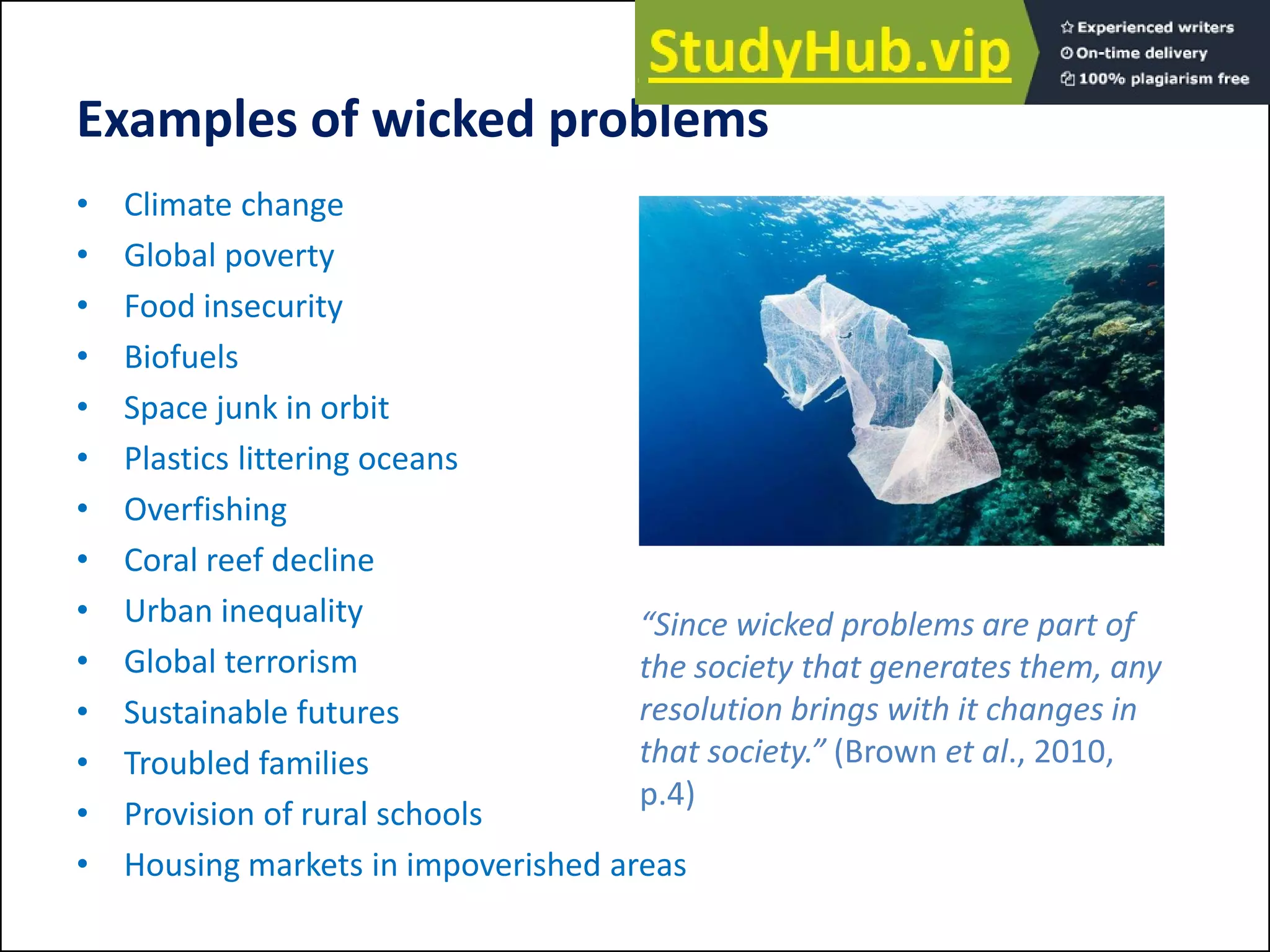
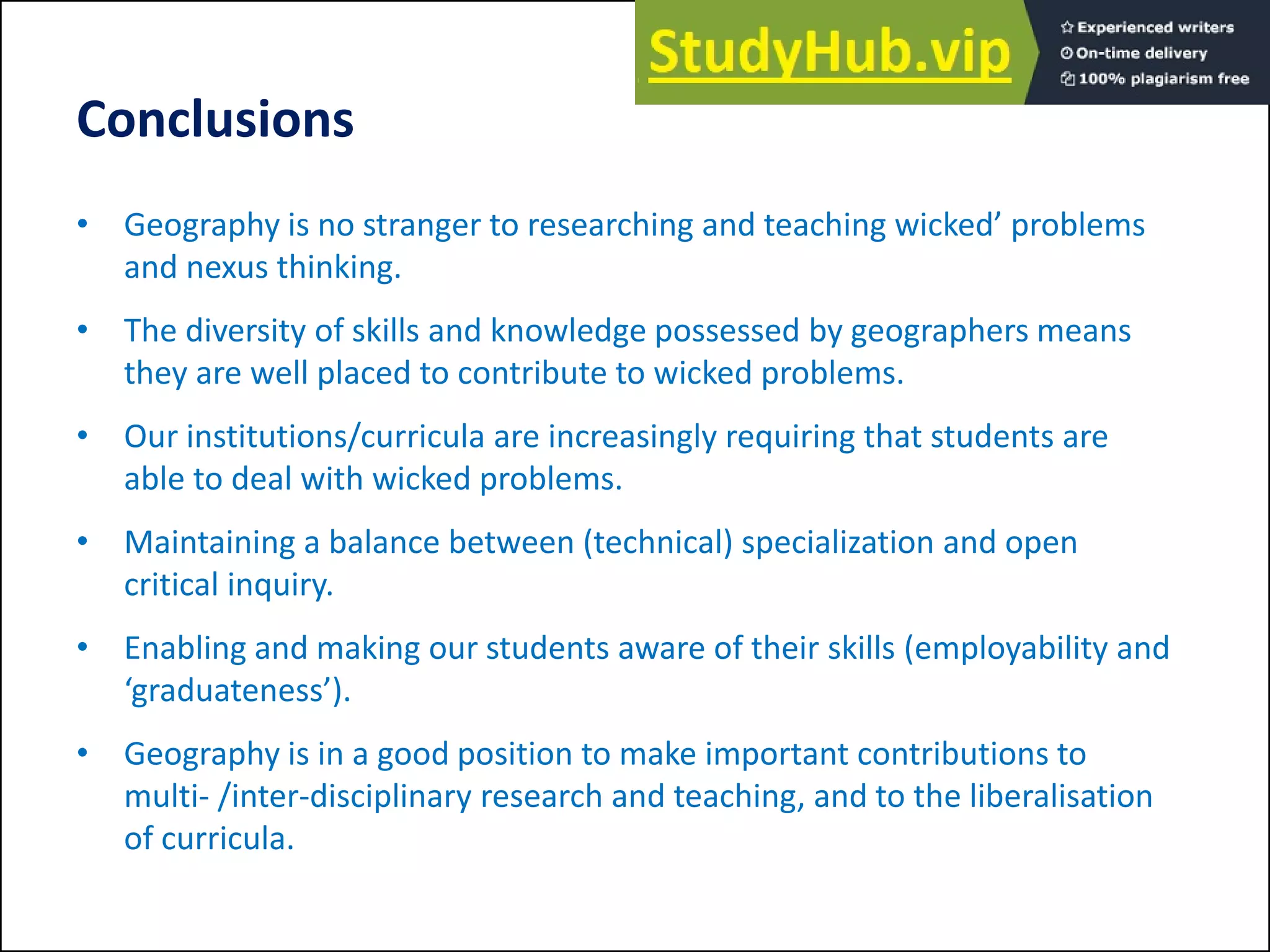
This document discusses applying pedagogies to teach wicked problems in geography. It begins by defining wicked problems as complex problems with no clear solutions that often have moral and political dimensions. Examples of wicked problems discussed include climate change, poverty, and sustainability issues. The document then examines what makes wicked problems difficult to research and teach, and opportunities to address them through interdisciplinary collaboration and more open curricula. It provides an example of a climate change teaching project and concludes by arguing geography is well-positioned to contribute to solving wicked problems through diverse skills and multi-disciplinary approaches.


