WHAT TO EXPECT WHEN SELLING IN
THE
AMAZON APPSTORE
Reach  Engage  Earn
MIKE HINES
DEVELOPER EVANGELIST, AMAZON
@MikeFHines mikehines45
mihines@amazon.com
CREDIBLY INNOVATE PHOTO HERE
Amazon Appstore
TODAY’S AGENDA
What’s the same
What’s different
How to get started
What is the same about the
Amazon Appstore
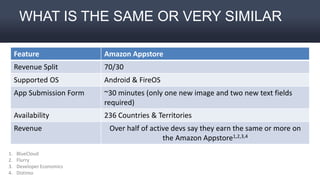
WHAT IS THE SAME OR VERY SIMILAR
Feature Amazon Appstore
Revenue Split 70/30
Supported OS Android & FireOS
App Submission Form ~30 minutes (only one new image and two new text fields
required)
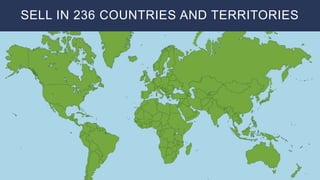
Availability 236 Countries & Territories
Revenue Over half of active devs say they earn the same or more on
the Amazon Appstore1,2,3,4
1. BlueCloud
2. Flurry
3. Developer Economics
4. Distimo
SELL IN 236 COUNTRIES AND TERRITORIES
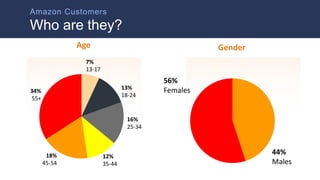
Who are they?
Amazon Customers
56%
Females
44%
Males
Gender
7%
13-17
13%
18-24
16%
25-34
12%
35-44
18%
45-54
34%
55+
Age
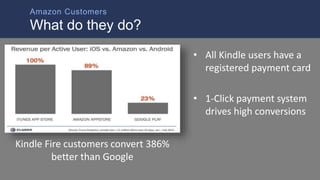
What do they do?
Amazon Customers
• All Kindle users have a
registered payment card
• 1-Click payment system
drives high conversions
Kindle Fire customers convert 386%
better than Google
What do they do?
Amazon Customers
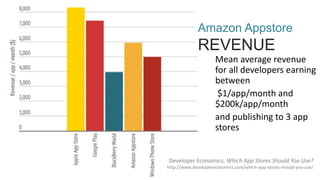
• Mean average revenue
for all developers earning
between
• $1/app/month and
$200k/app/month
• and publishing to 3 app
stores
Amazon Appstore
REVENUE
Developer Economics, Which App Stores Should You Use?
http://www.developereconomics.com/which-app-stores-should-you-use/
What is the different about
the Amazon Appstore
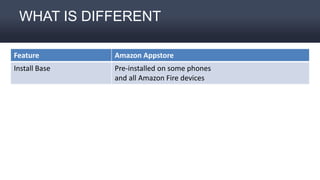
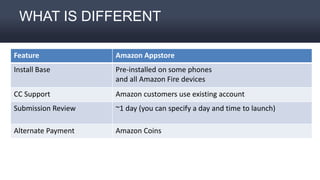
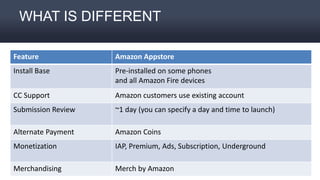
WHAT IS DIFFERENT
Feature Amazon Appstore
Install Base Pre-installed on some phones
and all Amazon Fire devices
CC Support Amazon customers use existing account
Submission Review ~1 day (you can specify a day and time to launch)
Availability 236 Countries & Territories
Alternate Payment Amazon Coins
Monetization IAP, Premium, Ads, Subscription, Underground
Merchandising Merch by Amazon
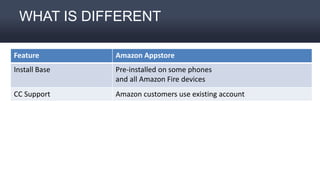
WHAT IS DIFFERENT
Feature Amazon Appstore
Install Base Pre-installed on some phones
and all Amazon Fire devices
CC Support Amazon customers use existing account
Submission Review ~1 day (you can specify a day and time to launch)
Availability 236 Countries & Territories
Alternate Payment Limited CB, Amazon Coins
Monetization IAP, Premium, Ads, Subscription, Underground
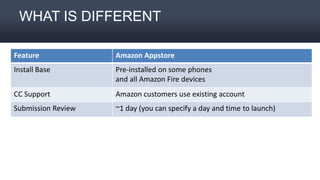
WHAT IS DIFFERENT
Feature Amazon Appstore
Install Base Pre-installed on some phones
and all Amazon Fire devices
CC Support Amazon customers use existing account
Submission Review ~1 day (you can specify a day and time to launch)
Availability 236 Countries & Territories
Alternate Payment Limited CB, Amazon Coins
Monetization IAP, Premium, Ads, Subscription, Underground
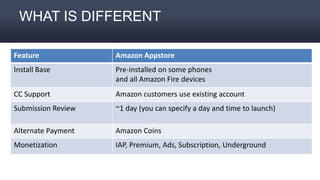
WHAT IS DIFFERENT
Feature Amazon Appstore
Install Base Pre-installed on some phones
and all Amazon Fire devices
CC Support Amazon customers use existing account
Submission Review ~1 day (you can specify a day and time to launch)
Alternate Payment Amazon Coins
Monetization IAP, Premium, Ads, Subscription, Underground
Merchandising Merch by Amazon
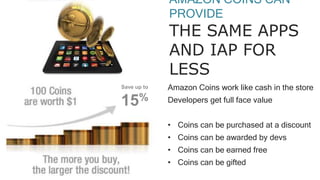
AMAZON COINS CAN
PROVIDE
THE SAME APPS
AND IAP FOR
LESS
Amazon Coins work like cash in the store
Developers get full face value
• Coins can be purchased at a discount
• Coins can be awarded by devs
• Coins can be earned free
• Coins can be gifted
Save up to
15%
WHAT IS DIFFERENT
Feature Amazon Appstore
Install Base Pre-installed on some phones
and all Amazon Fire devices
CC Support Amazon customers use existing account
Submission Review ~1 day (you can specify a day and time to launch)
Alternate Payment Amazon Coins
Monetization IAP, Premium, Ads, Subscription, Underground
Merchandising Merch by Amazon
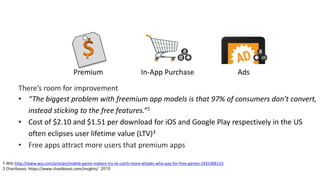
MANY MONETIZATION OPTIONS BUT,
Premium In-App Purchase Ads
There’s room for improvement
• “The biggest problem with freemium app models is that 97% of consumers don’t convert,
instead sticking to the free features.”1
• Cost of $2.10 and $1.51 per download for iOS and Google Play respectively in the US
often eclipses user lifetime value (LTV)3
• Free apps attract more users that premium apps
1 WSJ http://www.wsj.com/articles/mobile-game-makers-try-to-catch-more-whales-who-pay-for-free-games-1431306115
3 Chartboost: https://www.chartboost.com/insights/ 2015
A NEW SHOPPING APP
DISTRIBUTING
#ACTUALLYFREE
APPS
Turn 100% of your Android users into
revenue-generating customers
Developers waive fees on apps
and In App Purchase items.
Customers get #ActuallyFree
apps!
Amazon pays developers for
cumulative minutes customers
spend in an Amazon
Underground app.
AMAZON UNDERGROUND
HOW WILL IT WORK
FOR YOU?
• Back-of-the-napkin
• Back it out of ARPU
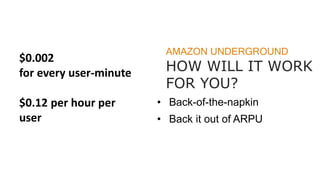
$0.002
for every user-minute
$0.12 per hour per
user
AMAZON UNDERGROUND
HOW WILL IT WORK
FOR YOU?
• Back-of-the-napkin
• Back it out of ARPU
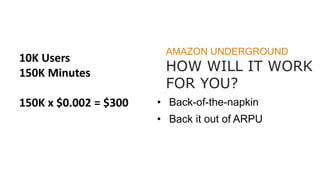
10K Users
150K Minutes
150K x $0.002 = $300
WHAT IS DIFFERENT
Feature Amazon Appstore
Install Base Pre-installed on some phones
and all Amazon Fire devices
CC Support Amazon customers use existing account
Submission Review ~1 day (you can specify a day and time to launch)
Alternate Payment Amazon Coins
Monetization IAP, Premium, Ads, Subscription, Underground
Merchandising Merch by Amazon
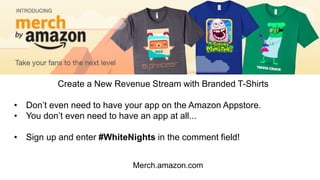
Merch.amazon.com
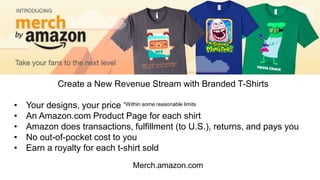
Create a New Revenue Stream with Branded T-Shirts
• Your designs, your price *Within some reasonable limits
• An Amazon.com Product Page for each shirt
• Amazon does transactions, fulfillment (to U.S.), returns, and pays you
• No out-of-pocket cost to you
• Earn a royalty for each t-shirt sold
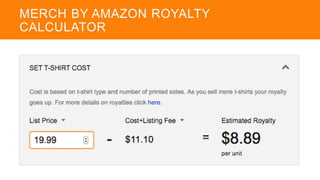
MERCH BY AMAZON ROYALTY
CALCULATOR
merch.amazon.com
Merch.amazon.com
Create a New Revenue Stream with Branded T-Shirts
• Don’t even need to have your app on the Amazon Appstore.
• You don’t even need to have an app at all...
• Sign up and enter #WhiteNights in the comment field!
GETTING STARTED WITH
THE AMAZON APPSTORE
GETTING STARTED
Test your existing APK for compatibility
Over 75% of apps submitted just work with no engineering required
Find out here: http://bit.ly/AppstoreAppTesting
Pick the most profitable monetization model
http://bit.ly/UndergroundCalculator
Sign up for a free Amazon Appstore account
https://developer.amazon.com/login.html
Submit your app!
Learn more:
http://developer.amazon.com/welcome
http://merch.amazon.com
http://developer.amazon.com/underground
How did we do:
http://bit.ly/mikehines
Follow us:
@MikeFHines
developer.amazon.com/blog

Mike Hines, Amazon

  • 1.
    WHAT TO EXPECTWHEN SELLING IN THE AMAZON APPSTORE Reach  Engage  Earn MIKE HINES DEVELOPER EVANGELIST, AMAZON @MikeFHines mikehines45 mihines@amazon.com
  • 2.
    CREDIBLY INNOVATE PHOTOHERE Amazon Appstore TODAY’S AGENDA What’s the same What’s different How to get started
  • 3.
    What is thesame about the Amazon Appstore
  • 4.
    WHAT IS THESAME OR VERY SIMILAR Feature Amazon Appstore Revenue Split 70/30 Supported OS Android & FireOS App Submission Form ~30 minutes (only one new image and two new text fields required) Availability 236 Countries & Territories Revenue Over half of active devs say they earn the same or more on the Amazon Appstore1,2,3,4 1. BlueCloud 2. Flurry 3. Developer Economics 4. Distimo
  • 5.
    SELL IN 236COUNTRIES AND TERRITORIES
  • 6.
    Who are they? AmazonCustomers 56% Females 44% Males Gender 7% 13-17 13% 18-24 16% 25-34 12% 35-44 18% 45-54 34% 55+ Age
  • 7.
    What do theydo? Amazon Customers • All Kindle users have a registered payment card • 1-Click payment system drives high conversions Kindle Fire customers convert 386% better than Google
  • 8.
    What do theydo? Amazon Customers • Mean average revenue for all developers earning between • $1/app/month and $200k/app/month • and publishing to 3 app stores Amazon Appstore REVENUE Developer Economics, Which App Stores Should You Use? http://www.developereconomics.com/which-app-stores-should-you-use/
  • 9.
    What is thedifferent about the Amazon Appstore
  • 10.
    WHAT IS DIFFERENT FeatureAmazon Appstore Install Base Pre-installed on some phones and all Amazon Fire devices CC Support Amazon customers use existing account Submission Review ~1 day (you can specify a day and time to launch) Availability 236 Countries & Territories Alternate Payment Amazon Coins Monetization IAP, Premium, Ads, Subscription, Underground Merchandising Merch by Amazon
  • 11.
    WHAT IS DIFFERENT FeatureAmazon Appstore Install Base Pre-installed on some phones and all Amazon Fire devices CC Support Amazon customers use existing account Submission Review ~1 day (you can specify a day and time to launch) Availability 236 Countries & Territories Alternate Payment Limited CB, Amazon Coins Monetization IAP, Premium, Ads, Subscription, Underground
  • 12.
    WHAT IS DIFFERENT FeatureAmazon Appstore Install Base Pre-installed on some phones and all Amazon Fire devices CC Support Amazon customers use existing account Submission Review ~1 day (you can specify a day and time to launch) Availability 236 Countries & Territories Alternate Payment Limited CB, Amazon Coins Monetization IAP, Premium, Ads, Subscription, Underground
  • 13.
    WHAT IS DIFFERENT FeatureAmazon Appstore Install Base Pre-installed on some phones and all Amazon Fire devices CC Support Amazon customers use existing account Submission Review ~1 day (you can specify a day and time to launch) Alternate Payment Amazon Coins Monetization IAP, Premium, Ads, Subscription, Underground Merchandising Merch by Amazon
  • 14.
    AMAZON COINS CAN PROVIDE THESAME APPS AND IAP FOR LESS Amazon Coins work like cash in the store Developers get full face value • Coins can be purchased at a discount • Coins can be awarded by devs • Coins can be earned free • Coins can be gifted Save up to 15%
  • 15.
    WHAT IS DIFFERENT FeatureAmazon Appstore Install Base Pre-installed on some phones and all Amazon Fire devices CC Support Amazon customers use existing account Submission Review ~1 day (you can specify a day and time to launch) Alternate Payment Amazon Coins Monetization IAP, Premium, Ads, Subscription, Underground Merchandising Merch by Amazon
  • 16.
    MANY MONETIZATION OPTIONSBUT, Premium In-App Purchase Ads There’s room for improvement • “The biggest problem with freemium app models is that 97% of consumers don’t convert, instead sticking to the free features.”1 • Cost of $2.10 and $1.51 per download for iOS and Google Play respectively in the US often eclipses user lifetime value (LTV)3 • Free apps attract more users that premium apps 1 WSJ http://www.wsj.com/articles/mobile-game-makers-try-to-catch-more-whales-who-pay-for-free-games-1431306115 3 Chartboost: https://www.chartboost.com/insights/ 2015
  • 18.
    A NEW SHOPPINGAPP DISTRIBUTING #ACTUALLYFREE APPS Turn 100% of your Android users into revenue-generating customers Developers waive fees on apps and In App Purchase items. Customers get #ActuallyFree apps! Amazon pays developers for cumulative minutes customers spend in an Amazon Underground app.
  • 19.
    AMAZON UNDERGROUND HOW WILLIT WORK FOR YOU? • Back-of-the-napkin • Back it out of ARPU $0.002 for every user-minute $0.12 per hour per user
  • 20.
    AMAZON UNDERGROUND HOW WILLIT WORK FOR YOU? • Back-of-the-napkin • Back it out of ARPU 10K Users 150K Minutes 150K x $0.002 = $300
  • 21.
    WHAT IS DIFFERENT FeatureAmazon Appstore Install Base Pre-installed on some phones and all Amazon Fire devices CC Support Amazon customers use existing account Submission Review ~1 day (you can specify a day and time to launch) Alternate Payment Amazon Coins Monetization IAP, Premium, Ads, Subscription, Underground Merchandising Merch by Amazon
  • 22.
    Merch.amazon.com Create a NewRevenue Stream with Branded T-Shirts • Your designs, your price *Within some reasonable limits • An Amazon.com Product Page for each shirt • Amazon does transactions, fulfillment (to U.S.), returns, and pays you • No out-of-pocket cost to you • Earn a royalty for each t-shirt sold
  • 23.
    MERCH BY AMAZONROYALTY CALCULATOR
  • 24.
  • 25.
    Merch.amazon.com Create a NewRevenue Stream with Branded T-Shirts • Don’t even need to have your app on the Amazon Appstore. • You don’t even need to have an app at all... • Sign up and enter #WhiteNights in the comment field!
  • 26.
    GETTING STARTED WITH THEAMAZON APPSTORE
  • 27.
    GETTING STARTED Test yourexisting APK for compatibility Over 75% of apps submitted just work with no engineering required Find out here: http://bit.ly/AppstoreAppTesting Pick the most profitable monetization model http://bit.ly/UndergroundCalculator Sign up for a free Amazon Appstore account https://developer.amazon.com/login.html Submit your app!
  • 28.
    Learn more: http://developer.amazon.com/welcome http://merch.amazon.com http://developer.amazon.com/underground How didwe do: http://bit.ly/mikehines Follow us: @MikeFHines developer.amazon.com/blog

Editor's Notes

  • #7 Who is the Amazon customer?... …. And what do they do in our Appstore?
  • #8 … Amazon Appstore customers engage more, and convert 386% better than other Android store users. Why? Is it something about the Amazon Appstore?
  • #9 … Amazon Appstore customers engage more, and convert 386% better than other Android store users. Why? Is it something about the Amazon Appstore?
  • #11 http://www.inc.com/christina-desmarais/difference-between-startup-accelerator-and-incubator.html http://www.techrepublic.com/article/accelerators-vs-incubators-what-startups-need-to-know/ http://techcitynews.com/2015/11/02/incubators-vs-accelerators-what-you-need-to-know/ http://yfsmagazine.com/2013/04/01/business-incubators-vs-accelerators-whats-the-real-difference/2/ On Feb 2, 2016, at 7:23 AM, Keith Katz <keith@executionlabs.com> wrote: Ha! Well, will do my best. Was just talking about this at PGC so it's fresh on my mind. Incubators tend to be focused on helping people find a great idea and building a company around them. They’re combining soil and sunlight and water to create an environment in which something promising can sprout. Accelerators are usually about giving fuel to an existing company. Keeping with the original metaphor, the take a little living plant and put fertilizer on it to help it grow successfully and, preferably, quickly. Accelerators are typically cohort (batch) based and fixed term, whereas incubators are much more flexible. The economics are also different. Usually accelerators provide a little bit of capital for a little bit of equity in the your studio or IP. Incubators take a lot of both. These are some of the things an Accelerator should provide: General business coaching (including learning how to pitch effectively) An alumni network that's helpful to you Access to management’s network Relevant mentors Money Access to more money (of the right kind); in games this usually means contacts with indie-friendly publishers and 1st party funds, as early stage VC money is super rare in games I listed "money" because if an accelerator is taking equity in your studio, they better be giving you money. If they're not, I consider them co-working spaces. It's not just a matter of fairness either. If the "accelerator" you're talking to can't convince somebody to fund their program, do you really think they're going to be able to help you convince someone to give *you* money when you're looking for it? When picking an accelerator, I would suggest not just talking to that accelerator's management team: of course they will say good things. Talk to 1) their alumni studios and 2) publishers and investors. If they say good things, you're in the clear. Also, look at who has "graduated" from the accelerator and see if they've received funding and/or publishing deals. This is a big KPI. Hope that helps! -Keith
  • #12 http://www.inc.com/christina-desmarais/difference-between-startup-accelerator-and-incubator.html http://www.techrepublic.com/article/accelerators-vs-incubators-what-startups-need-to-know/ http://techcitynews.com/2015/11/02/incubators-vs-accelerators-what-you-need-to-know/ http://yfsmagazine.com/2013/04/01/business-incubators-vs-accelerators-whats-the-real-difference/2/ On Feb 2, 2016, at 7:23 AM, Keith Katz <keith@executionlabs.com> wrote: Ha! Well, will do my best. Was just talking about this at PGC so it's fresh on my mind. Incubators tend to be focused on helping people find a great idea and building a company around them. They’re combining soil and sunlight and water to create an environment in which something promising can sprout. Accelerators are usually about giving fuel to an existing company. Keeping with the original metaphor, the take a little living plant and put fertilizer on it to help it grow successfully and, preferably, quickly. Accelerators are typically cohort (batch) based and fixed term, whereas incubators are much more flexible. The economics are also different. Usually accelerators provide a little bit of capital for a little bit of equity in the your studio or IP. Incubators take a lot of both. These are some of the things an Accelerator should provide: General business coaching (including learning how to pitch effectively) An alumni network that's helpful to you Access to management’s network Relevant mentors Money Access to more money (of the right kind); in games this usually means contacts with indie-friendly publishers and 1st party funds, as early stage VC money is super rare in games I listed "money" because if an accelerator is taking equity in your studio, they better be giving you money. If they're not, I consider them co-working spaces. It's not just a matter of fairness either. If the "accelerator" you're talking to can't convince somebody to fund their program, do you really think they're going to be able to help you convince someone to give *you* money when you're looking for it? When picking an accelerator, I would suggest not just talking to that accelerator's management team: of course they will say good things. Talk to 1) their alumni studios and 2) publishers and investors. If they say good things, you're in the clear. Also, look at who has "graduated" from the accelerator and see if they've received funding and/or publishing deals. This is a big KPI. Hope that helps! -Keith
  • #13 http://www.inc.com/christina-desmarais/difference-between-startup-accelerator-and-incubator.html http://www.techrepublic.com/article/accelerators-vs-incubators-what-startups-need-to-know/ http://techcitynews.com/2015/11/02/incubators-vs-accelerators-what-you-need-to-know/ http://yfsmagazine.com/2013/04/01/business-incubators-vs-accelerators-whats-the-real-difference/2/ On Feb 2, 2016, at 7:23 AM, Keith Katz <keith@executionlabs.com> wrote: Ha! Well, will do my best. Was just talking about this at PGC so it's fresh on my mind. Incubators tend to be focused on helping people find a great idea and building a company around them. They’re combining soil and sunlight and water to create an environment in which something promising can sprout. Accelerators are usually about giving fuel to an existing company. Keeping with the original metaphor, the take a little living plant and put fertilizer on it to help it grow successfully and, preferably, quickly. Accelerators are typically cohort (batch) based and fixed term, whereas incubators are much more flexible. The economics are also different. Usually accelerators provide a little bit of capital for a little bit of equity in the your studio or IP. Incubators take a lot of both. These are some of the things an Accelerator should provide: General business coaching (including learning how to pitch effectively) An alumni network that's helpful to you Access to management’s network Relevant mentors Money Access to more money (of the right kind); in games this usually means contacts with indie-friendly publishers and 1st party funds, as early stage VC money is super rare in games I listed "money" because if an accelerator is taking equity in your studio, they better be giving you money. If they're not, I consider them co-working spaces. It's not just a matter of fairness either. If the "accelerator" you're talking to can't convince somebody to fund their program, do you really think they're going to be able to help you convince someone to give *you* money when you're looking for it? When picking an accelerator, I would suggest not just talking to that accelerator's management team: of course they will say good things. Talk to 1) their alumni studios and 2) publishers and investors. If they say good things, you're in the clear. Also, look at who has "graduated" from the accelerator and see if they've received funding and/or publishing deals. This is a big KPI. Hope that helps! -Keith
  • #14 http://www.inc.com/christina-desmarais/difference-between-startup-accelerator-and-incubator.html http://www.techrepublic.com/article/accelerators-vs-incubators-what-startups-need-to-know/ http://techcitynews.com/2015/11/02/incubators-vs-accelerators-what-you-need-to-know/ http://yfsmagazine.com/2013/04/01/business-incubators-vs-accelerators-whats-the-real-difference/2/ On Feb 2, 2016, at 7:23 AM, Keith Katz <keith@executionlabs.com> wrote: Ha! Well, will do my best. Was just talking about this at PGC so it's fresh on my mind. Incubators tend to be focused on helping people find a great idea and building a company around them. They’re combining soil and sunlight and water to create an environment in which something promising can sprout. Accelerators are usually about giving fuel to an existing company. Keeping with the original metaphor, the take a little living plant and put fertilizer on it to help it grow successfully and, preferably, quickly. Accelerators are typically cohort (batch) based and fixed term, whereas incubators are much more flexible. The economics are also different. Usually accelerators provide a little bit of capital for a little bit of equity in the your studio or IP. Incubators take a lot of both. These are some of the things an Accelerator should provide: General business coaching (including learning how to pitch effectively) An alumni network that's helpful to you Access to management’s network Relevant mentors Money Access to more money (of the right kind); in games this usually means contacts with indie-friendly publishers and 1st party funds, as early stage VC money is super rare in games I listed "money" because if an accelerator is taking equity in your studio, they better be giving you money. If they're not, I consider them co-working spaces. It's not just a matter of fairness either. If the "accelerator" you're talking to can't convince somebody to fund their program, do you really think they're going to be able to help you convince someone to give *you* money when you're looking for it? When picking an accelerator, I would suggest not just talking to that accelerator's management team: of course they will say good things. Talk to 1) their alumni studios and 2) publishers and investors. If they say good things, you're in the clear. Also, look at who has "graduated" from the accelerator and see if they've received funding and/or publishing deals. This is a big KPI. Hope that helps! -Keith
  • #16 http://www.inc.com/christina-desmarais/difference-between-startup-accelerator-and-incubator.html http://www.techrepublic.com/article/accelerators-vs-incubators-what-startups-need-to-know/ http://techcitynews.com/2015/11/02/incubators-vs-accelerators-what-you-need-to-know/ http://yfsmagazine.com/2013/04/01/business-incubators-vs-accelerators-whats-the-real-difference/2/ On Feb 2, 2016, at 7:23 AM, Keith Katz <keith@executionlabs.com> wrote: Ha! Well, will do my best. Was just talking about this at PGC so it's fresh on my mind. Incubators tend to be focused on helping people find a great idea and building a company around them. They’re combining soil and sunlight and water to create an environment in which something promising can sprout. Accelerators are usually about giving fuel to an existing company. Keeping with the original metaphor, the take a little living plant and put fertilizer on it to help it grow successfully and, preferably, quickly. Accelerators are typically cohort (batch) based and fixed term, whereas incubators are much more flexible. The economics are also different. Usually accelerators provide a little bit of capital for a little bit of equity in the your studio or IP. Incubators take a lot of both. These are some of the things an Accelerator should provide: General business coaching (including learning how to pitch effectively) An alumni network that's helpful to you Access to management’s network Relevant mentors Money Access to more money (of the right kind); in games this usually means contacts with indie-friendly publishers and 1st party funds, as early stage VC money is super rare in games I listed "money" because if an accelerator is taking equity in your studio, they better be giving you money. If they're not, I consider them co-working spaces. It's not just a matter of fairness either. If the "accelerator" you're talking to can't convince somebody to fund their program, do you really think they're going to be able to help you convince someone to give *you* money when you're looking for it? When picking an accelerator, I would suggest not just talking to that accelerator's management team: of course they will say good things. Talk to 1) their alumni studios and 2) publishers and investors. If they say good things, you're in the clear. Also, look at who has "graduated" from the accelerator and see if they've received funding and/or publishing deals. This is a big KPI. Hope that helps! -Keith
  • #17 Inc. top apps, ARPU: $0.0628/month (vision mobile Top Apps) For most of us, ARPU: $0.0442/month (vision mobile All Apps) Cost per install: $1.15 (iOS, Fiksu 6/15 index) $.80 android http://www.adweek.com/socialtimes/dau-up-android-games-nearly-as-profitable-as-ios/613646 http://venturebeat.com/2013/12/05/androids-revenue-per-user-is-higher-on-gingerbread-than-jelly-bean-and-thats-potentially-a-good-thing/ The top 10 apps make 25% of the revenue The top 1000 apps make 80% of the revenue Data: Phone and Tablet games NewZoo 2015 2-10% -Source is GGV Capital, Feb 2013 http://bit.ly/1Ldu5Fu https://medium.com/its-an-app-world/march-2015-iphone-vs-android-monetization-capabilities-you-won-t-believe-who-won-7a02fde2dc2 http://www.developereconomics.com/how-much-is-an-active-user-worth/ https://www.fiksu.com/resources/fiksu-indexes
  • #18 Pay $.002/min. That’s $0.12 per hour or a $0.01 every 5 min/ We care about getting great products to customers. Do it with books, music, movies. Enable it with AWS We also do it with Apps. We’re heavily invested in apps, games and your success. Our customers keep coming back to us if we deliver great content and great value. Our success is directly tied to your success In Amazon Underground you get paid for every min that they use
  • #19 Amazon Underground is pretty revolutionary. The only thing you have to sell is a compelling and engaging experience. As users spend time in your app, you get paid. [mention current rate here] The regular Freemium model is still available on Amazon Appstore (we’ve taken nothing away), so I’ll show you how to evaluate which is better for you at the end of the presentation. Also, you still need to get paid on Google Play and iTunes, so you still need to know how to optimize IAP. Why is amazon doing this:
  • #20 You can do a back of the napkin calculation or back it out from ARPU (or use our online calculator)
  • #21 Amazon Underground is pretty revolutionary. The only thing you have to sell is a compelling and engaging experience. As users spend time in your app, you get paid. [mention current rate here] iStock Image
  • #22 http://www.inc.com/christina-desmarais/difference-between-startup-accelerator-and-incubator.html http://www.techrepublic.com/article/accelerators-vs-incubators-what-startups-need-to-know/ http://techcitynews.com/2015/11/02/incubators-vs-accelerators-what-you-need-to-know/ http://yfsmagazine.com/2013/04/01/business-incubators-vs-accelerators-whats-the-real-difference/2/ On Feb 2, 2016, at 7:23 AM, Keith Katz <keith@executionlabs.com> wrote: Ha! Well, will do my best. Was just talking about this at PGC so it's fresh on my mind. Incubators tend to be focused on helping people find a great idea and building a company around them. They’re combining soil and sunlight and water to create an environment in which something promising can sprout. Accelerators are usually about giving fuel to an existing company. Keeping with the original metaphor, the take a little living plant and put fertilizer on it to help it grow successfully and, preferably, quickly. Accelerators are typically cohort (batch) based and fixed term, whereas incubators are much more flexible. The economics are also different. Usually accelerators provide a little bit of capital for a little bit of equity in the your studio or IP. Incubators take a lot of both. These are some of the things an Accelerator should provide: General business coaching (including learning how to pitch effectively) An alumni network that's helpful to you Access to management’s network Relevant mentors Money Access to more money (of the right kind); in games this usually means contacts with indie-friendly publishers and 1st party funds, as early stage VC money is super rare in games I listed "money" because if an accelerator is taking equity in your studio, they better be giving you money. If they're not, I consider them co-working spaces. It's not just a matter of fairness either. If the "accelerator" you're talking to can't convince somebody to fund their program, do you really think they're going to be able to help you convince someone to give *you* money when you're looking for it? When picking an accelerator, I would suggest not just talking to that accelerator's management team: of course they will say good things. Talk to 1) their alumni studios and 2) publishers and investors. If they say good things, you're in the clear. Also, look at who has "graduated" from the accelerator and see if they've received funding and/or publishing deals. This is a big KPI. Hope that helps! -Keith
  • #23 This is what I did first. Why? Because I’m lazy. No code, no re-submit to appstore. Just submit my artwork (the icon I’ve already made) pick some shirt options, and set my price.
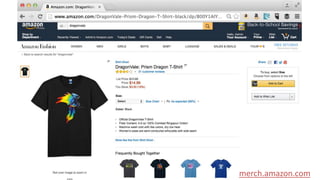
  • #25 Here’s an example of the Prism Dragon. It’s available on Amazon.com. This means that anyone. Even people that don’t play the game can buy this shirt. Grandma now has a gift idea.