Revisit the Strategies to Make Money
with Free Apps
Do you fear that your app cannot generate revenue if it is available for free use?
That’s just an assumption.
Because a report shows that nearly 96.4% of apps on the Google Play Store and 94.5% on the
App Store are free to use.
If free apps are not making enough money, why is the number this huge?
Did you ever think of it?
Don’t be worried!
We will inform you about everything and help you find valuable insights on monetizing your
free apps using this guide. Just ensure to explore throughout and learn how the monetization of
free apps over paid apps can help you skyrocket your business growth.
Let’s begin.
Freemium Apps Vs. Paid Apps Market Analysis
• Almost 50% of mobile phone users do not prefer paying for an app.
• The app store has a 3.73 rating for free apps compared to 3.38 for paid apps.
• Free apps can generate 98% of revenue.
• 94.5% of apps are free in the App Store, and 96.4% are on the Google Play store.
• More than 55% of gaming and education apps are paid apps on Google Play store and App
Store.
Significant ways to make money with free apps?
Not just these strategies below help you earn a great deal of profit but also prove to be the easiest
to perform. These monetization models work best for specific industries and app types. So,
according to your business goals, you can pick any of them and enjoy the revenue generated by
these apps.
• Advertising and Affiliate Marketing
Do you know that seven out of ten entrepreneurs prefer ads to promote their apps and attract new
users?
Here are significant ways through which you can enable free app monetization. Such as:
• Cost-per-click (CPC): With every click on the display ads, you receive payment.
• Cost-per-install (CPI): You will receive compensation when the user installs the app you display.
• Cost-per-mile (CPM): This payment occurs when the ad makes 1000 views.
• Cost-per-view (CPV): The advertiser is liable to pay for the number of interactions on the ad.
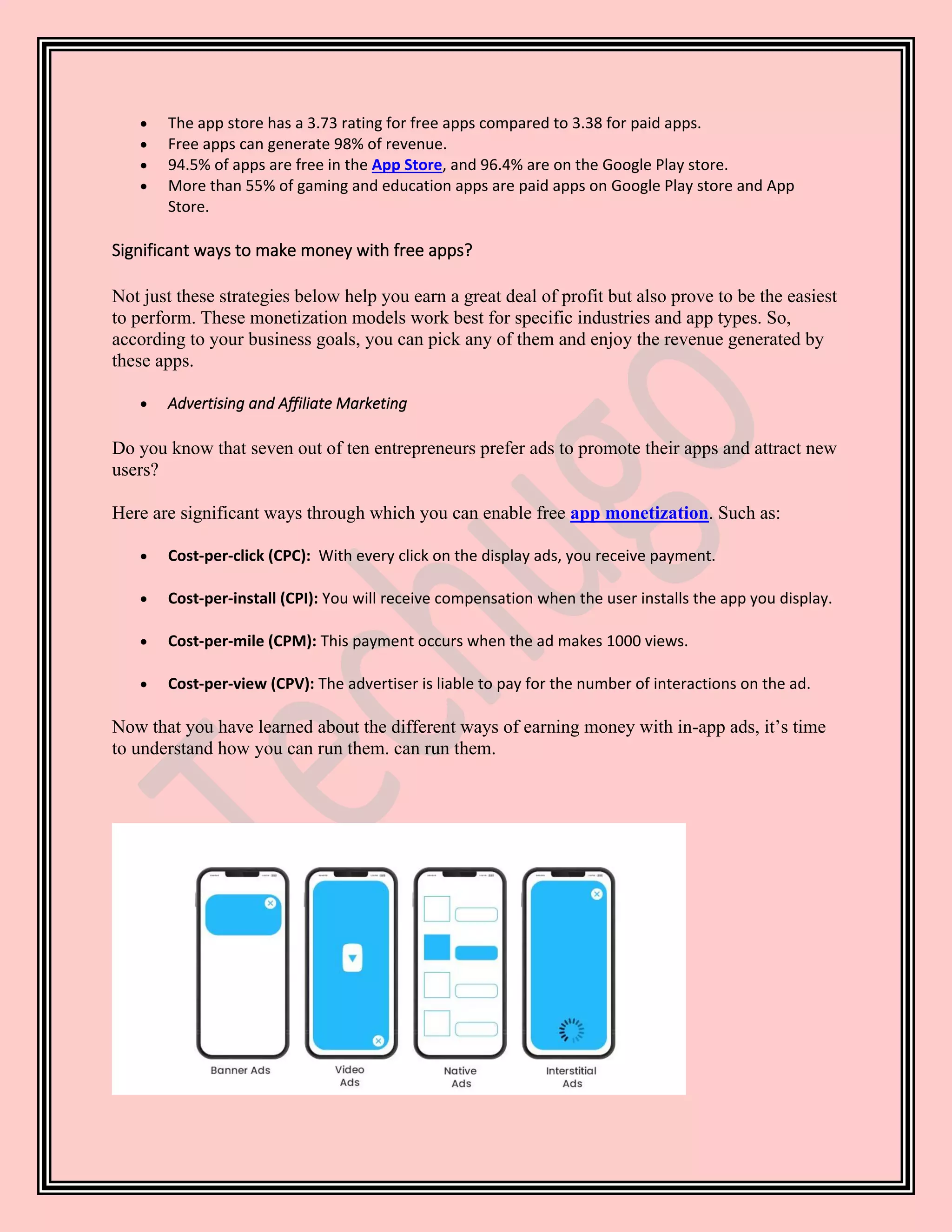
Now that you have learned about the different ways of earning money with in-app ads, it’s time
to understand how you can run them. can run them.
• Video Ads: These ads last for 10-30 seconds and appear during a specific time of app
usage. Instead, many users are rewarded when watching a full ad video.
• Interstitial Ads: You may have seen full-screen pop-ups that generally appear when you
open or close the app; this kind is known as interstitial ads. The user can either resume or
skip them.
• Native Ads: Instead of distracting the users, the motive of these native ads is to include
sponsored videos or content. If we compare the other types, it feels less irritating to
users.
• Banner Ads: We mostly find them either at the top or bottom of the mobile screen
because of their intent to not disturb the users. However, the conversion rate is 0.1%.
Pros Cons
Generates more income through CTR Only relevant with apps having an extensive user
base
Aids in measuring the user interaction App users can easily ignore the ads
More traffic via video ads than with web browsing,
audio ads, or social media networking
Disturb the user interaction with the app
Provide a higher probability of attracting the
targeted audience.
Bring irrelevant ads entirely different from the
context
• In-App Purchases
Another app monetization model that can let you sell items like:
1. Consumable Items like digital currencies and health points that users can only access and use
while running the app.
2. Non-consumable Items like blocking, new games, and maps that can be used permanently.
What’s more?
In-app purchase is mainly found in 39% of gaming and 6% of non-gaming apps that include big
names like Youtube, TikTok, Netflix, Tencent Video, and Tinder.
This monetization strategy integrates payment gateways as the app store charges 3% whenever
any in-app purchase happens. Unlike others, it does not disturb the app usage time and lets users
be glued to their mobile phone screens.
Forbes has mentioned that in-app purchases generate the highest revenue and will dominate the
industry soon.
Pros Cons
Offer more modern services Dynamic features add more to the
development cost
A low monetization strategy that ensures high
profits
Bring bad reviews if implemented wrongly
Ensure the security of credit details In-app purchases increase the user’s
expectations
Suitable for gaming apps as they provide
multiple currencies like coins, gold, and gems.
• Freemium Upsell
Another leading strategy that can help you make money with free apps is Fremium upsell. It is
more like a subscription model. However, what makes it different is the usage of the free app
version without any time restrictions.
Suppose your app has two versions, primary with limited features and premium with more
features. In that case, you can use this monetization model and make users pay for a specific
amount monthly or annually when they want to access the premium version of the app.
According to a report, 0.5-2% of app users unlock and access premium features.
Pros Cons
Excludes intrusive ads Fluctuate the revenue
Affordable app monetization tactic Maintenance costs can burn your pocket
Widely used category as it is free for users Users can abandon the app
Provide compatibility with other approaches
Also Read : Which Platforms Can App Developers Utilize To Make More Money?
• Subscriptions
5% of apps with high user engagement, like video streaming, music, or educational, prefer a
subscription monetization model to make money with free apps. Stripe or Paypal, like third-
party payment gateways, are required because app stores do not charge commissions.
Once download an app, we usually receive a trial period of one month to use it. When the period
ends, the app asks for a subscription, which is of two types:
• Automatically renewing subscriptions
After the trial period, the user must provide the credit card details to renew the subscription
every month or once a year. Only after this, they get access to the app.
• Non-renewing subscriptions
The user requires to pay for the subscription manually for a specific period. To avoid unexpected
bills, this is widely used among app users. Also, this monetization method works best for
seasonal apps like gardening, hunting, or sport.
Do you know which popular apps use subscription tactics to make money with free apps?
Hulu, Evernote, Spotify, and Dropbox are the top among many using this monetization tactic.
Pros Cons
Derive the attention of a serious audience Continuous improvement in the app features
A perfect solution for cloud services offering
audio & video content
You can endure severe fallout of users with a
quick transition from a one-time fee to a monthly
charge
Enjoy rewards from Apple if you have an engaging
audience
Sometimes it does not justify to ask for recurring
monthly payments
Increase more reliable income
• Crowdfunding
Do you know that there are various crowdfunding platforms like AppsFunder, Kickstarter,
CrowdFunder, and Indiegogo that let entrepreneurs raise money for their mobile app projects?
However, you must follow some essential steps to prepare your crowdfunding campaign.
Wondering what they are:
• Ensure a measurable, achievable, appropriate, and time-based goal for your fundraising
campaign.
• Create a story that donors read about your app, like what it’s all about, why you develop it, how
it solves problems and its potential.
• Engaging video content can attract more participants.
• Share a campaign page with a detailed description of what your project is all about.
• Try to drive potential investors with a social media campaign.
Pros Cons
Seamless investor relations Fundraising is a bit expensive
Pre-funding of the upcoming product Enhanced transparency
Access to funds Time-consuming activity that might fail at the end
• Selling Merchandise
Merchandise refers to the sales and marketing of products.
It is very prevalent today with the free versions built by various e-commerce businesses to sell
physical products like shoes, apparel, and toys via apps or email marketing.
Amazon has started Merch to let publishers craft their artwork, upload the same to their
platforms, and enable their promotion.
Pros Cons
Reach more people anytime, anywhere with
online sales.
Inventory visibility becomes poor.
Shoppers never have to leave empty-handed. Issues while integrating the software
Users can browse their inventory & order
accordingly.
A must-have user-friendly experience.
• Sponsorship
The strategy involves finding a sponsor that knows your niche. For instance, if you want to
monetize your fitness app, search for sponsors on websites like healthy diet, fitness centers, and
personal trainers.
Sponsorship lets you make money with free apps in exchange for monetary compensation while
adding a sponsor’s brand, advertising its services and products, or providing a website link that
users can visit.
Pros Cons
Provide advertising space to exclusive brands Wrong sponsors can majorly affect your ROI.
The slightest disturbance to the user
experience
Require some tools to calculate success
Users can access various offers, and brands
can outstand their presence.
The app should be a significant brand in the
industry.
• Collecting and Selling Data
The time we spend using our applications is collected in terms of behavioral data.
So, what’s the point here?
App owners can sell this data that contains social media accounts, personal preferences, and
email addresses to research-based companies, which opens up opportunities to make money with
free apps.
Collected data can be worked for you in two ways. For instance, you can sell this to outside
companies or use the raw data for your motives.
What’s more?
Companies generally pay for the advertisement having the most relevant audience. With the raw
data you have, you can attract a targeted audience toward your ad and, thus, charge other parties.
Pros Cons
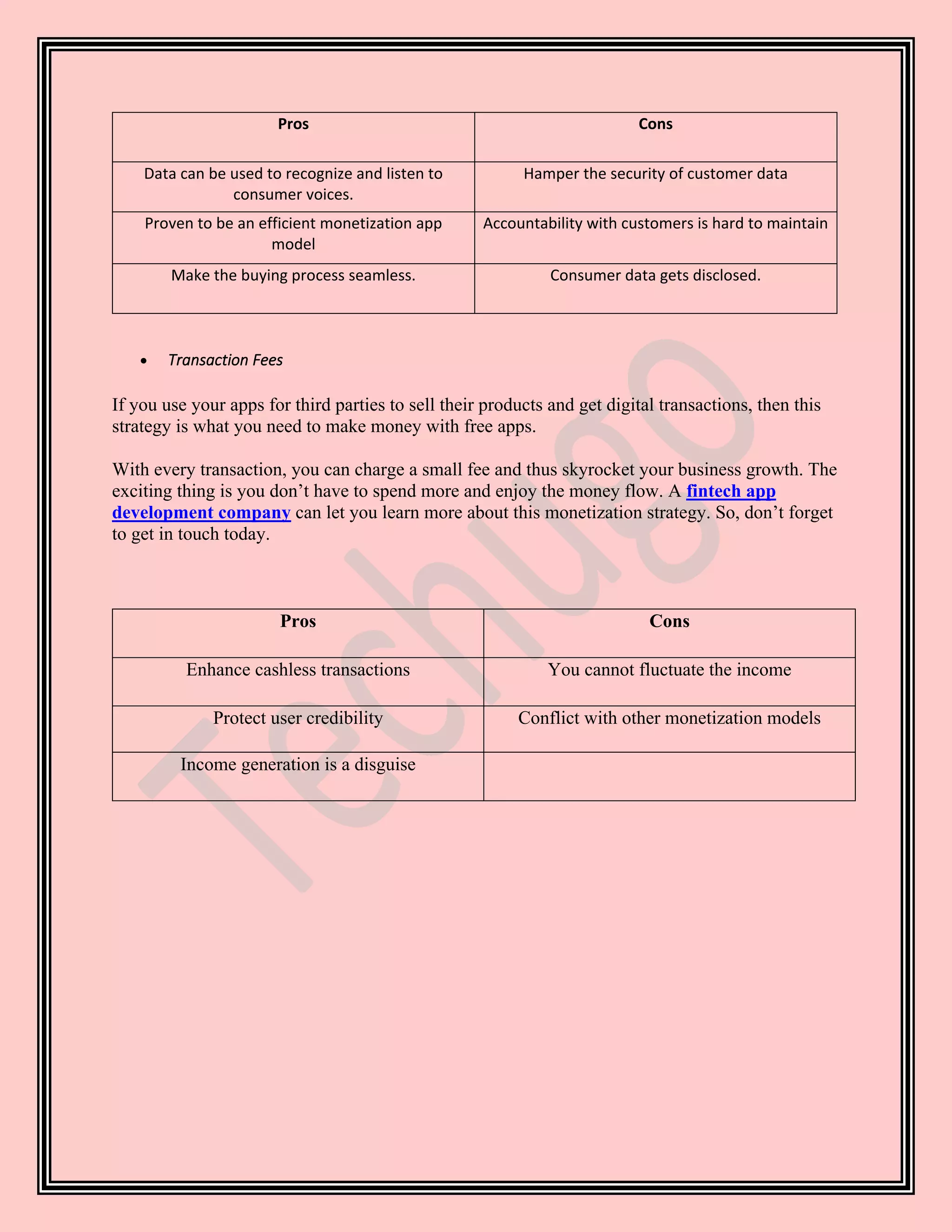
Data can be used to recognize and listen to
consumer voices.
Hamper the security of customer data
Proven to be an efficient monetization app
model
Accountability with customers is hard to maintain
Make the buying process seamless. Consumer data gets disclosed.
• Transaction Fees
If you use your apps for third parties to sell their products and get digital transactions, then this
strategy is what you need to make money with free apps.
With every transaction, you can charge a small fee and thus skyrocket your business growth. The
exciting thing is you don’t have to spend more and enjoy the money flow. A fintech app
development company can let you learn more about this monetization strategy. So, don’t forget
to get in touch today.
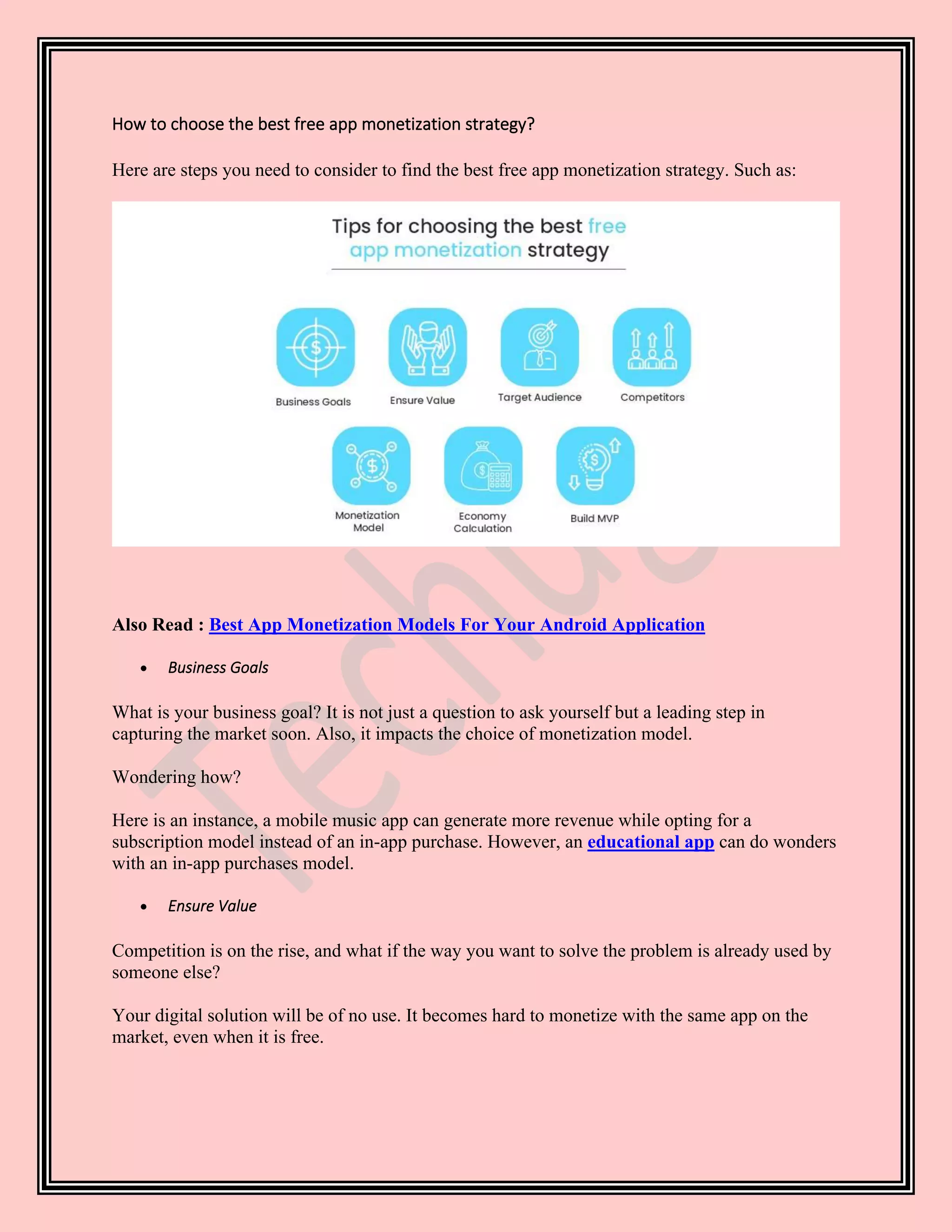
Pros Cons
Enhance cashless transactions You cannot fluctuate the income
Protect user credibility Conflict with other monetization models
Income generation is a disguise
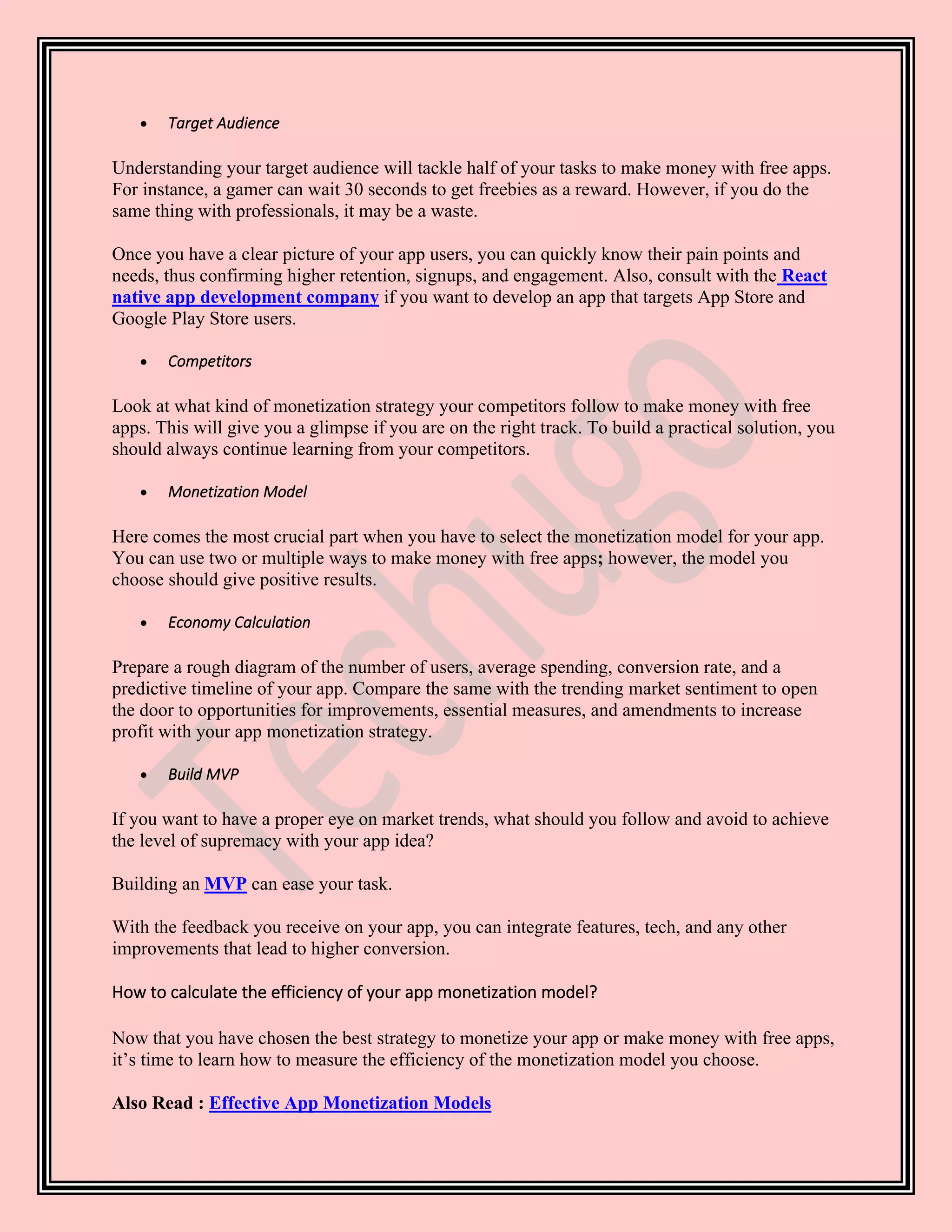
How to choose the best free app monetization strategy?
Here are steps you need to consider to find the best free app monetization strategy. Such as:
Also Read : Best App Monetization Models For Your Android Application
• Business Goals
What is your business goal? It is not just a question to ask yourself but a leading step in
capturing the market soon. Also, it impacts the choice of monetization model.
Wondering how?
Here is an instance, a mobile music app can generate more revenue while opting for a
subscription model instead of an in-app purchase. However, an educational app can do wonders
with an in-app purchases model.
• Ensure Value
Competition is on the rise, and what if the way you want to solve the problem is already used by
someone else?
Your digital solution will be of no use. It becomes hard to monetize with the same app on the
market, even when it is free.
• Target Audience
Understanding your target audience will tackle half of your tasks to make money with free apps.
For instance, a gamer can wait 30 seconds to get freebies as a reward. However, if you do the
same thing with professionals, it may be a waste.
Once you have a clear picture of your app users, you can quickly know their pain points and
needs, thus confirming higher retention, signups, and engagement. Also, consult with the React
native app development company if you want to develop an app that targets App Store and
Google Play Store users.
• Competitors
Look at what kind of monetization strategy your competitors follow to make money with free
apps. This will give you a glimpse if you are on the right track. To build a practical solution, you
should always continue learning from your competitors.
• Monetization Model
Here comes the most crucial part when you have to select the monetization model for your app.
You can use two or multiple ways to make money with free apps; however, the model you
choose should give positive results.
• Economy Calculation
Prepare a rough diagram of the number of users, average spending, conversion rate, and a
predictive timeline of your app. Compare the same with the trending market sentiment to open
the door to opportunities for improvements, essential measures, and amendments to increase
profit with your app monetization strategy.
• Build MVP
If you want to have a proper eye on market trends, what should you follow and avoid to achieve
the level of supremacy with your app idea?
Building an MVP can ease your task.
With the feedback you receive on your app, you can integrate features, tech, and any other
improvements that lead to higher conversion.
How to calculate the efficiency of your app monetization model?
Now that you have chosen the best strategy to monetize your app or make money with free apps,
it’s time to learn how to measure the efficiency of the monetization model you choose.
Also Read : Effective App Monetization Models
So, let’s get started.
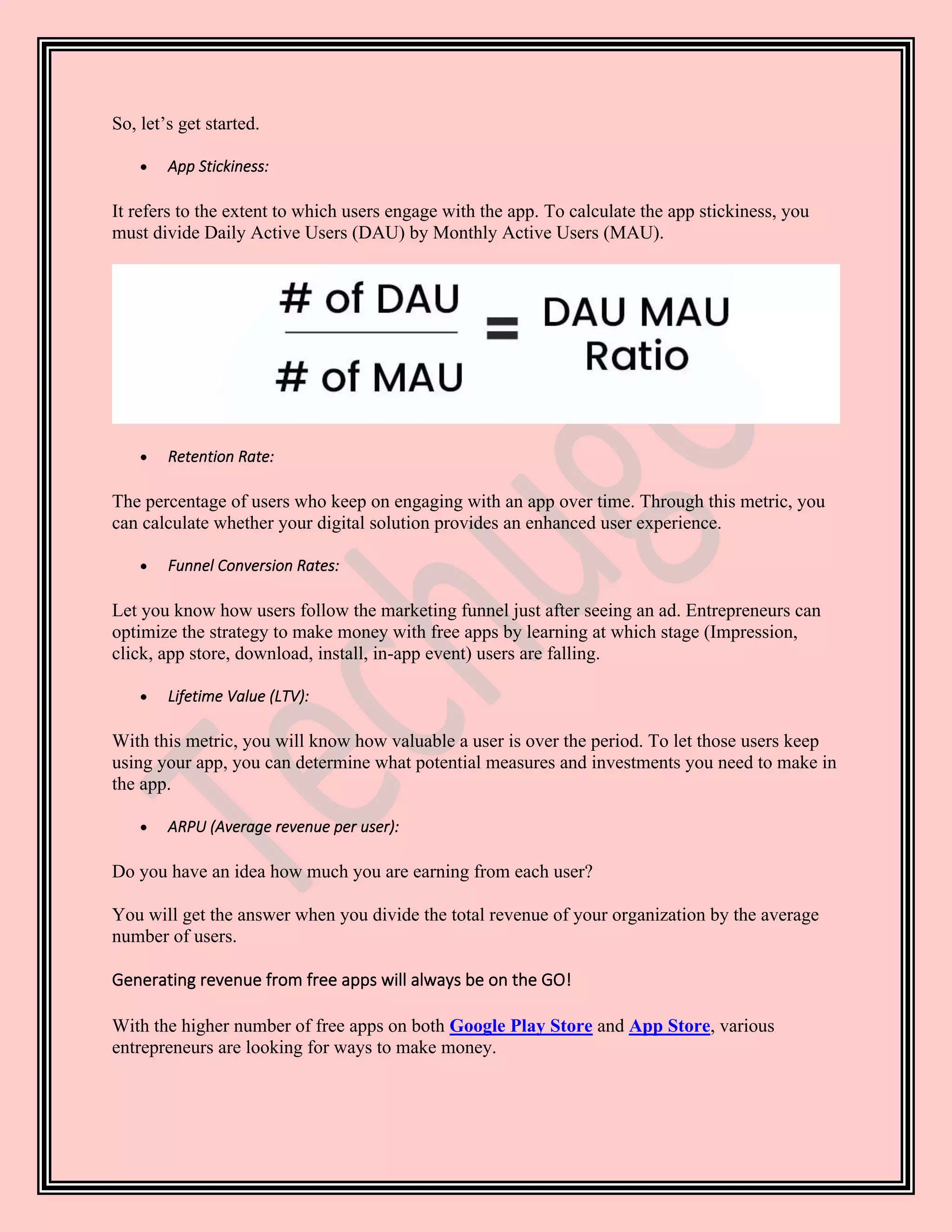
• App Stickiness:
It refers to the extent to which users engage with the app. To calculate the app stickiness, you
must divide Daily Active Users (DAU) by Monthly Active Users (MAU).
• Retention Rate:
The percentage of users who keep on engaging with an app over time. Through this metric, you
can calculate whether your digital solution provides an enhanced user experience.
• Funnel Conversion Rates:
Let you know how users follow the marketing funnel just after seeing an ad. Entrepreneurs can
optimize the strategy to make money with free apps by learning at which stage (Impression,
click, app store, download, install, in-app event) users are falling.
• Lifetime Value (LTV):
With this metric, you will know how valuable a user is over the period. To let those users keep
using your app, you can determine what potential measures and investments you need to make in
the app.
• ARPU (Average revenue per user):
Do you have an idea how much you are earning from each user?
You will get the answer when you divide the total revenue of your organization by the average
number of users.
Generating revenue from free apps will always be on the GO!
With the higher number of free apps on both Google Play Store and App Store, various
entrepreneurs are looking for ways to make money.
The above strategies will help you turn your app into a revenue-generated tool. Just ensure to
pick the one that best suits your business goals, industry, and app type.
However, if you need any further help, consult with experts of Techugo, a leading on demand
app development company today.
FAQs
1. How to make money with free apps in 2023?
Here are various monetization methods that you can try. But choose the one that goes well with
your application, location, target audience, and business goals. For instance:
• You can use the freemium model if your app belongs to the nutrition, wellness, education,
fitness, and photo-editing category.
• The in-app advertising monetization model can let you make money with free apps like hotel
property management, construction, and banking.
• Gaming, messengers, and dating apps must use in-app purchases for revenue generation.
2. What are the possible ways to make money with free apps?
Several monetization models can let you upscale your revenue. Such as:
• Advertising
• In-app purchase
• Subscription
• Freemium upsell
• Transaction fee
• Selling merchandise
• Collecting and selling data
• Sponsorship
• Crowdfunding
3. What is the freemium model?
A freemium model provides users with the basic features of the app, and they can access the
premium features only via in-app purchases or subscriptions.
Contact Us
A-26, Lohia Rd, A Block, Sector 63, Noida, Uttar Pradesh 201301
096671 34400
sales@techugo.com
https://www.techugo.com/
***Thankyou***

Revisit the Strategies to Make Money with Free Apps.pdf

  • 1.
    Revisit the Strategiesto Make Money with Free Apps Do you fear that your app cannot generate revenue if it is available for free use? That’s just an assumption. Because a report shows that nearly 96.4% of apps on the Google Play Store and 94.5% on the App Store are free to use. If free apps are not making enough money, why is the number this huge? Did you ever think of it? Don’t be worried! We will inform you about everything and help you find valuable insights on monetizing your free apps using this guide. Just ensure to explore throughout and learn how the monetization of free apps over paid apps can help you skyrocket your business growth. Let’s begin. Freemium Apps Vs. Paid Apps Market Analysis • Almost 50% of mobile phone users do not prefer paying for an app.
  • 2.
    • The appstore has a 3.73 rating for free apps compared to 3.38 for paid apps. • Free apps can generate 98% of revenue. • 94.5% of apps are free in the App Store, and 96.4% are on the Google Play store. • More than 55% of gaming and education apps are paid apps on Google Play store and App Store. Significant ways to make money with free apps? Not just these strategies below help you earn a great deal of profit but also prove to be the easiest to perform. These monetization models work best for specific industries and app types. So, according to your business goals, you can pick any of them and enjoy the revenue generated by these apps. • Advertising and Affiliate Marketing Do you know that seven out of ten entrepreneurs prefer ads to promote their apps and attract new users? Here are significant ways through which you can enable free app monetization. Such as: • Cost-per-click (CPC): With every click on the display ads, you receive payment. • Cost-per-install (CPI): You will receive compensation when the user installs the app you display. • Cost-per-mile (CPM): This payment occurs when the ad makes 1000 views. • Cost-per-view (CPV): The advertiser is liable to pay for the number of interactions on the ad. Now that you have learned about the different ways of earning money with in-app ads, it’s time to understand how you can run them. can run them.
  • 3.
    • Video Ads:These ads last for 10-30 seconds and appear during a specific time of app usage. Instead, many users are rewarded when watching a full ad video. • Interstitial Ads: You may have seen full-screen pop-ups that generally appear when you open or close the app; this kind is known as interstitial ads. The user can either resume or skip them. • Native Ads: Instead of distracting the users, the motive of these native ads is to include sponsored videos or content. If we compare the other types, it feels less irritating to users. • Banner Ads: We mostly find them either at the top or bottom of the mobile screen because of their intent to not disturb the users. However, the conversion rate is 0.1%. Pros Cons Generates more income through CTR Only relevant with apps having an extensive user base Aids in measuring the user interaction App users can easily ignore the ads More traffic via video ads than with web browsing, audio ads, or social media networking Disturb the user interaction with the app Provide a higher probability of attracting the targeted audience. Bring irrelevant ads entirely different from the context • In-App Purchases Another app monetization model that can let you sell items like: 1. Consumable Items like digital currencies and health points that users can only access and use while running the app. 2. Non-consumable Items like blocking, new games, and maps that can be used permanently. What’s more? In-app purchase is mainly found in 39% of gaming and 6% of non-gaming apps that include big names like Youtube, TikTok, Netflix, Tencent Video, and Tinder.
  • 4.
    This monetization strategyintegrates payment gateways as the app store charges 3% whenever any in-app purchase happens. Unlike others, it does not disturb the app usage time and lets users be glued to their mobile phone screens. Forbes has mentioned that in-app purchases generate the highest revenue and will dominate the industry soon. Pros Cons Offer more modern services Dynamic features add more to the development cost A low monetization strategy that ensures high profits Bring bad reviews if implemented wrongly Ensure the security of credit details In-app purchases increase the user’s expectations Suitable for gaming apps as they provide multiple currencies like coins, gold, and gems. • Freemium Upsell Another leading strategy that can help you make money with free apps is Fremium upsell. It is more like a subscription model. However, what makes it different is the usage of the free app version without any time restrictions. Suppose your app has two versions, primary with limited features and premium with more features. In that case, you can use this monetization model and make users pay for a specific amount monthly or annually when they want to access the premium version of the app. According to a report, 0.5-2% of app users unlock and access premium features.
  • 5.
    Pros Cons Excludes intrusiveads Fluctuate the revenue Affordable app monetization tactic Maintenance costs can burn your pocket Widely used category as it is free for users Users can abandon the app Provide compatibility with other approaches Also Read : Which Platforms Can App Developers Utilize To Make More Money? • Subscriptions 5% of apps with high user engagement, like video streaming, music, or educational, prefer a subscription monetization model to make money with free apps. Stripe or Paypal, like third- party payment gateways, are required because app stores do not charge commissions. Once download an app, we usually receive a trial period of one month to use it. When the period ends, the app asks for a subscription, which is of two types: • Automatically renewing subscriptions After the trial period, the user must provide the credit card details to renew the subscription every month or once a year. Only after this, they get access to the app. • Non-renewing subscriptions The user requires to pay for the subscription manually for a specific period. To avoid unexpected bills, this is widely used among app users. Also, this monetization method works best for seasonal apps like gardening, hunting, or sport. Do you know which popular apps use subscription tactics to make money with free apps? Hulu, Evernote, Spotify, and Dropbox are the top among many using this monetization tactic.
  • 6.
    Pros Cons Derive theattention of a serious audience Continuous improvement in the app features A perfect solution for cloud services offering audio & video content You can endure severe fallout of users with a quick transition from a one-time fee to a monthly charge Enjoy rewards from Apple if you have an engaging audience Sometimes it does not justify to ask for recurring monthly payments Increase more reliable income • Crowdfunding Do you know that there are various crowdfunding platforms like AppsFunder, Kickstarter, CrowdFunder, and Indiegogo that let entrepreneurs raise money for their mobile app projects? However, you must follow some essential steps to prepare your crowdfunding campaign. Wondering what they are: • Ensure a measurable, achievable, appropriate, and time-based goal for your fundraising campaign. • Create a story that donors read about your app, like what it’s all about, why you develop it, how it solves problems and its potential. • Engaging video content can attract more participants. • Share a campaign page with a detailed description of what your project is all about.
  • 7.
    • Try todrive potential investors with a social media campaign. Pros Cons Seamless investor relations Fundraising is a bit expensive Pre-funding of the upcoming product Enhanced transparency Access to funds Time-consuming activity that might fail at the end • Selling Merchandise Merchandise refers to the sales and marketing of products. It is very prevalent today with the free versions built by various e-commerce businesses to sell physical products like shoes, apparel, and toys via apps or email marketing. Amazon has started Merch to let publishers craft their artwork, upload the same to their platforms, and enable their promotion. Pros Cons Reach more people anytime, anywhere with online sales. Inventory visibility becomes poor. Shoppers never have to leave empty-handed. Issues while integrating the software Users can browse their inventory & order accordingly. A must-have user-friendly experience.
  • 8.
    • Sponsorship The strategyinvolves finding a sponsor that knows your niche. For instance, if you want to monetize your fitness app, search for sponsors on websites like healthy diet, fitness centers, and personal trainers. Sponsorship lets you make money with free apps in exchange for monetary compensation while adding a sponsor’s brand, advertising its services and products, or providing a website link that users can visit. Pros Cons Provide advertising space to exclusive brands Wrong sponsors can majorly affect your ROI. The slightest disturbance to the user experience Require some tools to calculate success Users can access various offers, and brands can outstand their presence. The app should be a significant brand in the industry. • Collecting and Selling Data The time we spend using our applications is collected in terms of behavioral data. So, what’s the point here? App owners can sell this data that contains social media accounts, personal preferences, and email addresses to research-based companies, which opens up opportunities to make money with free apps. Collected data can be worked for you in two ways. For instance, you can sell this to outside companies or use the raw data for your motives. What’s more? Companies generally pay for the advertisement having the most relevant audience. With the raw data you have, you can attract a targeted audience toward your ad and, thus, charge other parties.
  • 9.
    Pros Cons Data canbe used to recognize and listen to consumer voices. Hamper the security of customer data Proven to be an efficient monetization app model Accountability with customers is hard to maintain Make the buying process seamless. Consumer data gets disclosed. • Transaction Fees If you use your apps for third parties to sell their products and get digital transactions, then this strategy is what you need to make money with free apps. With every transaction, you can charge a small fee and thus skyrocket your business growth. The exciting thing is you don’t have to spend more and enjoy the money flow. A fintech app development company can let you learn more about this monetization strategy. So, don’t forget to get in touch today. Pros Cons Enhance cashless transactions You cannot fluctuate the income Protect user credibility Conflict with other monetization models Income generation is a disguise
  • 10.
    How to choosethe best free app monetization strategy? Here are steps you need to consider to find the best free app monetization strategy. Such as: Also Read : Best App Monetization Models For Your Android Application • Business Goals What is your business goal? It is not just a question to ask yourself but a leading step in capturing the market soon. Also, it impacts the choice of monetization model. Wondering how? Here is an instance, a mobile music app can generate more revenue while opting for a subscription model instead of an in-app purchase. However, an educational app can do wonders with an in-app purchases model. • Ensure Value Competition is on the rise, and what if the way you want to solve the problem is already used by someone else? Your digital solution will be of no use. It becomes hard to monetize with the same app on the market, even when it is free.
  • 11.
    • Target Audience Understandingyour target audience will tackle half of your tasks to make money with free apps. For instance, a gamer can wait 30 seconds to get freebies as a reward. However, if you do the same thing with professionals, it may be a waste. Once you have a clear picture of your app users, you can quickly know their pain points and needs, thus confirming higher retention, signups, and engagement. Also, consult with the React native app development company if you want to develop an app that targets App Store and Google Play Store users. • Competitors Look at what kind of monetization strategy your competitors follow to make money with free apps. This will give you a glimpse if you are on the right track. To build a practical solution, you should always continue learning from your competitors. • Monetization Model Here comes the most crucial part when you have to select the monetization model for your app. You can use two or multiple ways to make money with free apps; however, the model you choose should give positive results. • Economy Calculation Prepare a rough diagram of the number of users, average spending, conversion rate, and a predictive timeline of your app. Compare the same with the trending market sentiment to open the door to opportunities for improvements, essential measures, and amendments to increase profit with your app monetization strategy. • Build MVP If you want to have a proper eye on market trends, what should you follow and avoid to achieve the level of supremacy with your app idea? Building an MVP can ease your task. With the feedback you receive on your app, you can integrate features, tech, and any other improvements that lead to higher conversion. How to calculate the efficiency of your app monetization model? Now that you have chosen the best strategy to monetize your app or make money with free apps, it’s time to learn how to measure the efficiency of the monetization model you choose. Also Read : Effective App Monetization Models
  • 12.
    So, let’s getstarted. • App Stickiness: It refers to the extent to which users engage with the app. To calculate the app stickiness, you must divide Daily Active Users (DAU) by Monthly Active Users (MAU). • Retention Rate: The percentage of users who keep on engaging with an app over time. Through this metric, you can calculate whether your digital solution provides an enhanced user experience. • Funnel Conversion Rates: Let you know how users follow the marketing funnel just after seeing an ad. Entrepreneurs can optimize the strategy to make money with free apps by learning at which stage (Impression, click, app store, download, install, in-app event) users are falling. • Lifetime Value (LTV): With this metric, you will know how valuable a user is over the period. To let those users keep using your app, you can determine what potential measures and investments you need to make in the app. • ARPU (Average revenue per user): Do you have an idea how much you are earning from each user? You will get the answer when you divide the total revenue of your organization by the average number of users. Generating revenue from free apps will always be on the GO! With the higher number of free apps on both Google Play Store and App Store, various entrepreneurs are looking for ways to make money.
  • 13.
    The above strategieswill help you turn your app into a revenue-generated tool. Just ensure to pick the one that best suits your business goals, industry, and app type. However, if you need any further help, consult with experts of Techugo, a leading on demand app development company today. FAQs 1. How to make money with free apps in 2023? Here are various monetization methods that you can try. But choose the one that goes well with your application, location, target audience, and business goals. For instance: • You can use the freemium model if your app belongs to the nutrition, wellness, education, fitness, and photo-editing category. • The in-app advertising monetization model can let you make money with free apps like hotel property management, construction, and banking. • Gaming, messengers, and dating apps must use in-app purchases for revenue generation. 2. What are the possible ways to make money with free apps? Several monetization models can let you upscale your revenue. Such as: • Advertising • In-app purchase • Subscription • Freemium upsell • Transaction fee • Selling merchandise • Collecting and selling data • Sponsorship • Crowdfunding 3. What is the freemium model? A freemium model provides users with the basic features of the app, and they can access the premium features only via in-app purchases or subscriptions.
  • 14.
    Contact Us A-26, LohiaRd, A Block, Sector 63, Noida, Uttar Pradesh 201301 096671 34400 sales@techugo.com https://www.techugo.com/ ***Thankyou***