Dissolution
Vivek
M.pharm (ceutics)
Ist yr
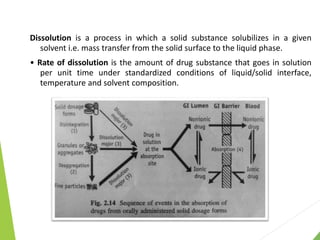
Dissolution is a process in which a solid substance solubilizes in a given
solvent i.e. mass transfer from the solid surface to the liquid phase.
• Rate of dissolution is the amount of drug substance that goes in solution
per unit time under standardized conditions of liquid/solid interface,
temperature and solvent composition.
Factors influencing GI Absorption of a Drug from its Dosage Form
1. PHYSICOCHEMICAL FACTORS-AFFECTING DRUG ABSORPTION
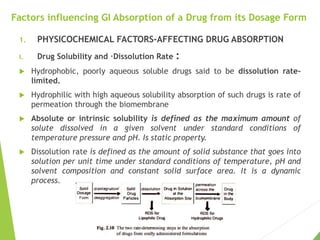
I. Drug Solubility and ·Dissolution Rate :
 Hydrophobic, poorly aqueous soluble drugs said to be dissolution rate-
limited.
 Hydrophilic with high aqueous solubility absorption of such drugs is rate of
permeation through the biomembrane
 Absolute or intrinsic solubility is defined as the maximum amount of
solute dissolved in a given solvent under standard conditions of
temperature pressure and pH. Is static property.
 Dissolution rate is defined as the amount of solid substance that goes into
solution per unit time under standard conditions of temperature, pH and
solvent composition and constant solid surface area. It is a dynamic
process.
Continue…
 Absolute or intrinsic solubility is defined as the maximum amount of solute
dissolved in a given solvent under standard conditions of temperature
pressure and pH. Is static property.
 Dissolution rate is defined as the amount of solid substance that goes into
solution per unit time under standard conditions of temperature, pH and
solvent composition and constant solid surface area. It is a dynamic process.
Theories of Drug Dissolution :
 Dissolution is a process in which a solid substance solubilizes in a given
solvent i.e. mass transfer from the solid surface to the liquid phase.
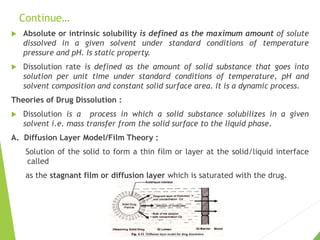
A. Diffusion Layer Model/Film Theory :
Solution of the solid to form a thin film or layer at the solid/liquid interface
called
as the stagnant film or diffusion layer which is saturated with the drug.
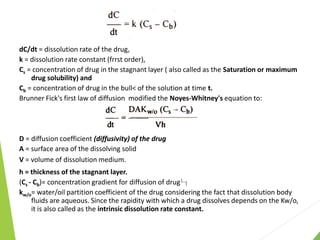
dC/dt = dissolution rate of the drug,
k = dissolution rate constant (frrst order),
Cs = concentration of drug in the stagnant layer ( also called as the Saturation or maximum
drug solubility) and
Cb = concentration of drug in the bull< of the solution at time t.
Brunner Fick's first law of diffusion modified the Noyes-Whitney's equation to:
D = diffusion coefficient (diffusivity) of the drug
A = surface area of the dissolving solid
V = volume of dissolution medium.
h = thickness of the stagnant layer.
(Cs - Cb)= concentration gradient for diffusion of drug𠃑
kw/o= water/oil partition coefficient of the drug considering the fact that dissolution body
fluids are aqueous. Since the rapidity with which a drug dissolves depends on the Kw/o,
it is also called as the intrinsic dissolution rate constant.
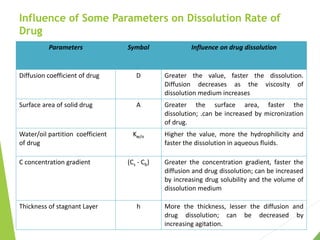
Influence of Some Parameters on Dissolution Rate of
Drug
Parameters Symbol Influence on drug dissolution
Diffusion coefficient of drug D Greater the value, faster the dissolution.
Diffusion decreases as the viscosity of
dissolution medium increases
Surface area of solid drug A Greater the surface area, faster the
dissolution; .can be increased by micronization
of drug.
Water/oil partition coefficient
of drug
Kw/o Higher the value, more the hydrophilicity and
faster the dissolution in aqueous fluids.
C concentration gradient (Cs - Cb) Greater the concentration gradient, faster the
diffusion and drug dissolution; can be increased
by increasing drug solubility and the volume of
dissolution medium
Thickness of stagnant Layer h More the thickness, lesser the diffusion and
drug dissolution; can be decreased by
increasing agitation.
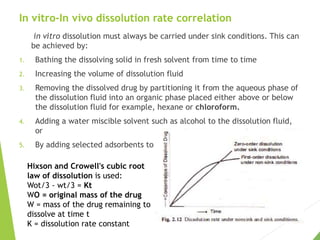
In vitro-In vivo dissolution rate correlation
in vitro dissolution must always be carried under sink conditions. This can
be achieved by:
1. Bathing the dissolving solid in fresh solvent from time to time
2. Increasing the volume of dissolution fluid
3. Removing the dissolved drug by partitioning it from the aqueous phase of
the dissolution fluid into an organic phase placed either above or below
the dissolution fluid for example, hexane or chloroform.
4. Adding a water miscible solvent such as alcohol to the dissolution fluid,
or
5. By adding selected adsorbents to remove the dissolved drug.
Hixson and Crowell's cubic root
law of dissolution is used:
Wot/3 - wt/3 = Kt
WO = original mass of the drug
W = mass of the drug remaining to
dissolve at time t
K = dissolution rate constant
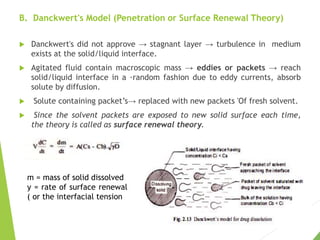
B. Danckwert's Model (Penetration or Surface Renewal Theory)
 Danckwert's did not approve → stagnant layer → turbulence in medium
exists at the solid/liquid interface.
 Agitated fluid contain macroscopic mass → eddies or packets → reach
solid/liquid interface in a ·random fashion due to eddy currents, absorb
solute by diffusion.
 Solute containing packet’s→ replaced with new packets 'Of fresh solvent.
 Since the solvent packets are exposed to new solid surface each time,
the theory is called as surface renewal theory.
m = mass of solid dissolved
y = rate of surface renewal
( or the interfacial tension
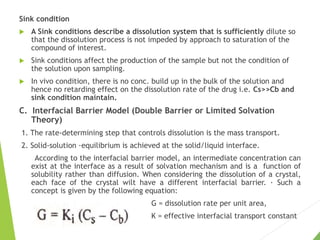
Sink condition
 A Sink conditions describe a dissolution system that is sufficiently dilute so
that the dissolution process is not impeded by approach to saturation of the
compound of interest.
 Sink conditions affect the production of the sample but not the condition of
the solution upon sampling.
 In vivo condition, there is no conc. build up in the bulk of the solution and
hence no retarding effect on the dissolution rate of the drug i.e. Cs>>Cb and
sink condition maintain.
C. Interfacial Barrier Model (Double Barrier or Limited Solvation
Theory)
1. The rate-determining step that controls dissolution is the mass transport.
2. Solid-solution ·equilibrium is achieved at the solid/liquid interface.
According to the interfacial barrier model, an intermediate concentration can
exist at the interface as a result of solvation mechanism and is a function of
solubility rather than diffusion. When considering the dissolution of a crystal,
each face of the crystal wilt have a different interfacial barrier. · Such a
concept is given by the following equation:
G = dissolution rate per unit area,
K = effective interfacial transport constant
 Factors Affecting Drug Dissolution and Dissolution Rate
1. Physicochemical properties of the drug
a. Particle Size and Effective Surface Area of the Drug
 Smaller the drug particle, greater the surface area.
 Since, surface area increases with decrease in particle size, higher dissolution rates
may be achieved through reduction of particle size.
 Micronization of hydrophobic powders can lead to aggregation and floatation.hence
increase in S.A. of drug does not always guarantee dissolution ,it must increase in
the “effective”S.A.,
1. Absolute surface area → total area of solid surface of any particle,
2. Effective surface area → area of solid surface exposed to the dissolution medium .
Hydrates/Solvates (Pseudo polymorphism)
 The stoichiometric type of adducts where the solvent molecules are incorporated in the
crystal lattice of the solid are called the solvates and the trapped solvent as solvent
of crystallization.
 The solvates can exist in different crystalline forms called as pseudo polymorphs.
 This phenomenon is called as pseudo polymorphism. When the solvent in association
with the d0rug is water, the solvate is known as a hydrate.
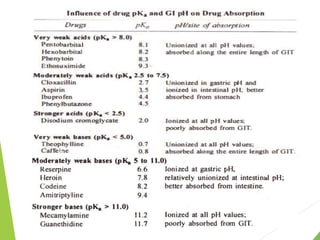
1. Drug pKa and Lipophilicity and GI pH-pH Partition Hypothesis
The theory states that for drug compounds of molecular weight greater than 1OO, which
are primarily transported across the biomembrane by passive diffusion, the process of
absorption is governed by:
1. The dissociation constant (pKa) of the drug.
2. The lipid solubility of the unionized drug (a function of drug Ko/w).
3. The pH at the absorption site.
Most drugs are weak electrolytes (weak acids or weak base)
 Degree of ionization depends upon the pH of the biological fluid.
 If the pH on either side on the membrane is different, then the Compartment
 whose pH favors greater ionization of the drug will contain greater amount of drug, and
only the unionized or undissociated fraction of drug,·· if
 sufficiently lipid soluble, can permeate the membrane passively until the.
 concentration of unionized drug on either side of the membrane becomes
 equal i.e. until equilibrium is attained.
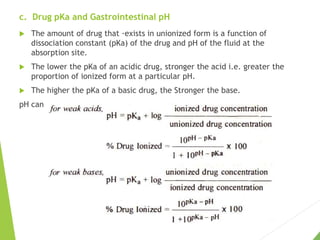
c. Drug pKa and Gastrointestinal pH
 The amount of drug that ·exists in unionized form is a function of
dissociation constant (pKa) of the drug and pH of the fluid at the
absorption site.
 The lower the pKa of an acidic drug, stronger the acid i.e. greater the
proportion of ionized form at a particular pH.
 The higher the pKa of a basic drug, the Stronger the base.
pH can be determined by Henderson-Hasselbach equations:
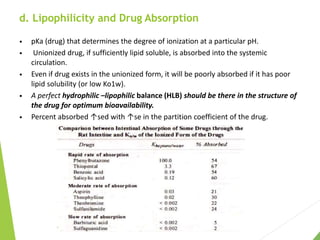
d. Lipophilicity and Drug Absorption
• pKa (drug) that determines the degree of ionization at a particular pH.
• Unionized drug, if sufficiently lipid soluble, is absorbed into the systemic
circulation.
• Even if drug exists in the unionized form, it will be poorly absorbed if it has poor
lipid solubility (or low Ko1w).
• A perfect hydrophilic –lipophilic balance (HLB) should be there in the structure of
the drug for optimum bioavailability.
• Percent absorbed ↑sed with ↑se in the partition coefficient of the drug.
Limitations of pH-Partition Hypothesis
1. Presence of virtual membrane pH: a virtual pH, also called as the
microclimate pH, different from the luminal pH exists at the membrane
surface. This virtual membrane pH actually determines the extent of drug
ionization and thus, drug absorption.
2. Absorption of ionized drug: This is true to a large extent as ionized drugs have
low lipid solubility and relatively poor permeability.
 If such drugs have a large lipophilic group in their structure, despite their
ionization, they will be absorbed passively.
3. Influence of GI surface area and residence time of drug: pH-partition theory,
acidic drugs are best ·absorbed from stomach ( acidic pH) and basic drugs from
intestine ( alkaline pH) in which conditions they are unionized to a large
extent.
 the degree of ionization, both acidic and .basic drugs are more rapidly
absorbed from the intestine, primarily· because of its large surface area and
secondly, because of long residence time of the drug in the intestine.
 4. Presence of aqueous unstirred diffusion layer: drugs having large partition
coefficient can rapidly penetrate the lipid membrane but diffusion through
unstirred water layer is the rate limiting step in their absorption. This applies
in particular to high molecular weight fatty acids and bile acids.
1. Disintegration Time
• if DT not conform solid dosage form → bioavailability problems → dissolution slower →
absorption insufficient.
• Microcrystalline cellulose very good but → high compression force → retard drug
dissolution.
• Starch is superior disintegrant due to → hydrophilicity and swelling property
• Harder tablet with large amount of binder
• Disintegrant added after & before granulation effect.
2. Manufacturing/Processing Variables: Excipients (formulation ,ingredients , API)
and Manufacturing processes.
i. Method of Granulation: Enhances dissolution rate of poorly soluble drug.
• Wet granulation superior
exception eg.Sodium salicylate → wet gran. : slower disso.rate
→ Direct comp. :rapid,faster,complete disso.rate
• Limitations: (i) Formation of crystal bridge → by presence of liquid.
(ii) Liquid in chemical reactions → Hydrolysis.
(iii) Drying → harm → thermolabile drugs.
• APOC “Agglomerative Phase of Comminution”: produce mechanically stronger tablets
higher dissolution rates than those made by wet granulation.
• Mechanism is increased internal surface area of granules.
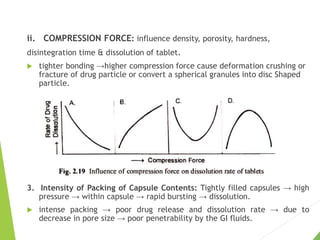
ii. COMPRESSION FORCE: influence density, porosity, hardness,
disintegration time & dissolution of tablet.
 tighter bonding →higher compression force cause deformation crushing or
fracture of drug particle or convert a spherical granules into disc Shaped
particle.
3. Intensity of Packing of Capsule Contents: Tightly filled capsules → high
pressure → within capsule → rapid bursting → dissolution.
 intense packing → poor drug release and dissolution rate → due to
decrease in pore size → poor penetrability by the GI fluids.
4. Pharmaceutical Ingredients/Excipients (Formulation factors) :
 Excipients- Ensure acceptability; physicochemical stability during the
shelf-life; uniformity of composition and dosage; and optimum
bioavailability and function ability of the drug product.
 More excipients → More complex → greater potential for absorption &
→ bioavailability problems
a. Vehicles: Aqueous → water , syrup
Non aq. water miscible → propylene glycol, glycerol,
sorbitol
Non aq. water immiscible → vegetable oil
 Aq. and water miscible are miscible with the body fluids
 Drug more soluble in water miscible vehicles like propylene glycol (co-
solvent) and show better bioavailability.
 Solubilizers (tween 80) → promote solubility → drug in aq. vehicles.
 Rate of drug absorption → depends on → partitioning from the oil/fluids
 Bioavailability α miscibility with biofluids.
 If Viscous → diffusion in GI Slower.
2. DOSAGE FORM FACTORS AFFECTING DRUG ABSORPTION
b. Diluents: Bulking agent
 Inorganic - dicalcium phosphate (DCP)→ drug-Diluent interaction → poor
bioavailability, due to formation of divalent calcium-tetracycline complex.
 organic diluents carbohydrates ; starch, lactose, microcrystalline cellulose
→promoting dissolution of poorly water-soluble
• starch on dissolution rate of salicylic acid tablet dry double compression
process three times increase in dissolution rate when the starch content
increase from the 5 – 20 %.
 Here starch particles form a layer on the outer surface of hydrophobic drug
particles resulting in imparting hydrophilic character to granules & thus
increase in effective surface area & rate of dissolution.
c. Binders and Granulating Agent : Hold powder together → ↑se cohesive impact
 Poly materials (natural , semi synthetic and synthetic) like starch, cellulose
derivatives, acacia, PVP , gelatin and sugar solution.
 Large amounts increase hardness & decrease DT/dissolution rates of tablets.
 PEG 6000 + Phenobarbital → poorly soluble complex drug
 Ethyl cellulose retard drug dissolution.
d. Disintegrant : overcome cohessive strength & break them up on contact with water
• Hydrophilic nature
• As disintegrant ↓se →Bioavailability↓se
• MCC good binder too but at High compression retard dissolution.
• Phenobarbital tablet showed that when copagel (low viscosity grade of Na CMC)
added before granulation decreased dissolution rate but if added after did not had
any effect on dissolution rate.
e. Lubricant : increase flow of granules
 ↓se interparticle friction & Sticking or adhesion to punch and die
 Hydrophobic→Inhibit →wetability, penetration of water, dissolution and DT
 eg →SLS, carbowax
f. Suspending Agent: they increase the viscosity of the medium and decrease
dissolution rate and DT .
 it causes mechanical barrier to diffusion due to formation of viscous layer on GI
 eg. Acacia tragacanth, CMC , MC , etc.
g. Surfactant: used as solublizers , emulsifier & wetting agent
increase absorption
 promote wetting , eg. polysorbate 80
 better membrane contact of drug absorption
 Enhanced membrane permeability
Decrease absorption
 formation of unabsorbable drug micelle complex
 laxative action induced by large surfactant conc.
h. Nature and type of dosage form : bioavailability decrease order
Solution> Emultion> Suspension> capsules> Tablet> Coated Tablets>
Enteric Coated Tablets> Sustained Release products
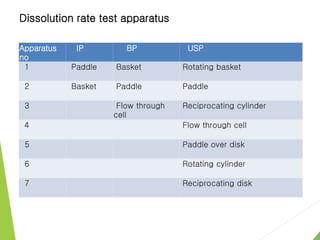
Dissolution rate test apparatus
Apparatus
no
IP BP USP
1 Paddle Basket Rotating basket
2 Basket Paddle Paddle
3 Flow through
cell
Reciprocating cylinder
4 Flow through cell
5 Paddle over disk
6 Rotating cylinder
7 Reciprocating disk
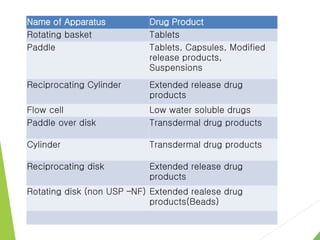
Name of Apparatus Drug Product
Rotating basket Tablets
Paddle Tablets, Capsules, Modified
release products,
Suspensions
Reciprocating Cylinder Extended release drug
products
Flow cell Low water soluble drugs
Paddle over disk Transdermal drug products
Cylinder Transdermal drug products
Reciprocating disk Extended release drug
products
Rotating disk (non USP –NF) Extended realese drug
products(Beads)
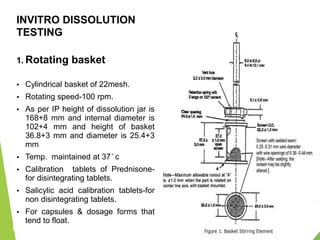
INVITRO DISSOLUTION
TESTING
1. Rotating basket
 Cylindrical basket of 22mesh.
 Rotating speed-100 rpm.
 As per IP height of dissolution jar is
168+8 mm and internal diameter is
102+4 mm and height of basket
36.8+3 mm and diameter is 25.4+3
mm
 Temp. maintained at 37 ̇ c
 Calibration tablets of Prednisone-
for disintegrating tablets.
 Salicylic acid calibration tablets-for
non disintegrating tablets.
 For capsules & dosage forms that
tend to float.
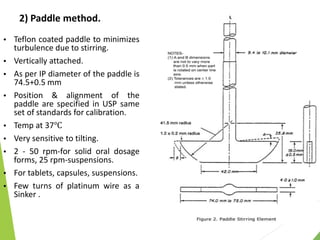
2) Paddle method.
 Teflon coated paddle to minimizes
turbulence due to stirring.
 Vertically attached.
 As per IP diameter of the paddle is
74.5+0.5 mm
 Position & alignment of the
paddle are specified in USP same
set of standards for calibration.
 Temp at 37℃
 Very sensitive to tilting.
 2 - 50 rpm-for solid oral dosage
forms, 25 rpm-suspensions.
 For tablets, capsules, suspensions.
 Few turns of platinum wire as a
Sinker .
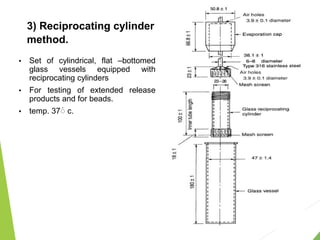
3) Reciprocating cylinder
method.
 Set of cylindrical, flat –bottomed
glass vessels equipped with
reciprocating cylinders
 For testing of extended release
products and for beads.
 temp. 37۠ c.
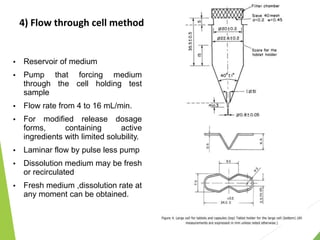
4) Flow through cell method
 Reservoir of medium
 Pump that forcing medium
through the cell holding test
sample
 Flow rate from 4 to 16 mL/min.
 For modified release dosage
forms, containing active
ingredients with limited solubility.
 Laminar flow by pulse less pump
 Dissolution medium may be fresh
or recirculated
 Fresh medium ,dissolution rate at
any moment can be obtained.
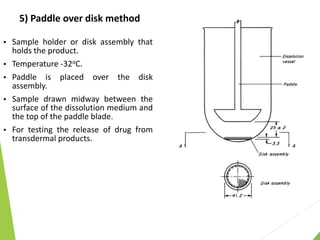
5) Paddle over disk method
 Sample holder or disk assembly that
holds the product.
 Temperature -32oC.
 Paddle is placed over the disk
assembly.
 Sample drawn midway between the
surface of the dissolution medium and
the top of the paddle blade.
 For testing the release of drug from
transdermal products.
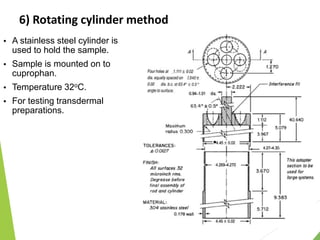
6) Rotating cylinder method
 A stainless steel cylinder is
used to hold the sample.
 Sample is mounted on to
cuprophan.
 Temperature 32oC.
 For testing transdermal
preparations.
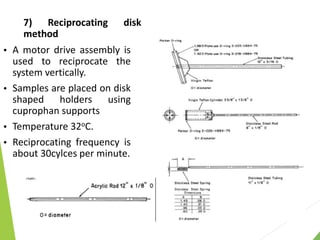
7) Reciprocating disk
method
 A motor drive assembly is
used to reciprocate the
system vertically.
 Samples are placed on disk
shaped holders using
cuprophan supports
 Temperature 32oC.
 Reciprocating frequency is
about 30cylces per minute.
Advantages of official methods
1. Better reproducibility
2. For capsules as they tend to float at surface thus minimizing area exposed
to dissolution fluid.
Disadvantage
1. Clogging of basket screen by gummy particles
2. Tendency of a light particles to float at surface after leaving baskets or in
paddle method
3. Sensitivity of apparatus to variables such as vibrations, eccentricity.
4. Rapid corrosion of SS mesh in presence of HCl
5. Sensitivity of apparatus to any slight changes in paddle orientation
6. Non reproducible position of tablet at bottom of flask
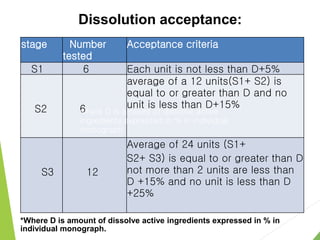
Dissolution acceptance:
*Where D is amount of dissolve active ingredients expressed in % in
individual monograph.
stage Number
tested
Acceptance criteria
S1 6 Each unit is not less than D+5%
S2 6
average of a 12 units(S1+ S2) is
equal to or greater than D and no
unit is less than D+15%
S3 12
Average of 24 units (S1+
S2+ S3) is equal to or greater than D
not more than 2 units are less than
D +15% and no unit is less than D
+25%
where D is amount of dissolve active
ingredients expressed in % in individual
monograph
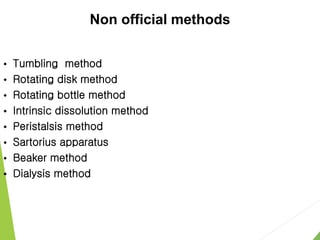
Non official methods
 Tumbling method
 Rotating disk method
 Rotating bottle method
 Intrinsic dissolution method
 Peristalsis method
 Sartorius apparatus
 Beaker method
 Dialysis method
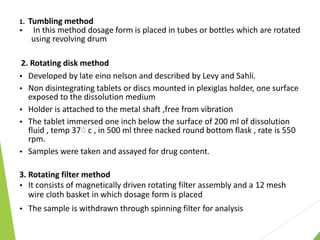
1. Tumbling method
 In this method dosage form is placed in tubes or bottles which are rotated
using revolving drum
2. Rotating disk method
 Developed by late eino nelson and described by Levy and Sahli.
 Non disintegrating tablets or discs mounted in plexiglas holder, one surface
exposed to the dissolution medium
 Holder is attached to the metal shaft ,free from vibration
 The tablet immersed one inch below the surface of 200 ml of dissolution
fluid , temp 37۠ c , in 500 ml three nacked round bottom flask , rate is 550
rpm.
 Samples were taken and assayed for drug content.
3. Rotating filter method
 It consists of magnetically driven rotating filter assembly and a 12 mesh
wire cloth basket in which dosage form is placed
 The sample is withdrawn through spinning filter for analysis
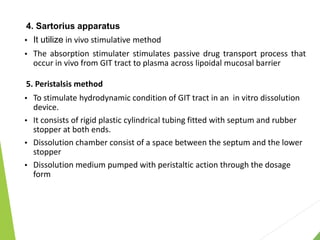
4. Sartorius apparatus
 It utilize in vivo stimulative method
 The absorption stimulater stimulates passive drug transport process that
occur in vivo from GIT tract to plasma across lipoidal mucosal barrier
5. Peristalsis method
 To stimulate hydrodynamic condition of GIT tract in an in vitro dissolution
device.
 It consists of rigid plastic cylindrical tubing fitted with septum and rubber
stopper at both ends.
 Dissolution chamber consist of a space between the septum and the lower
stopper
 Dissolution medium pumped with peristaltic action through the dosage
form
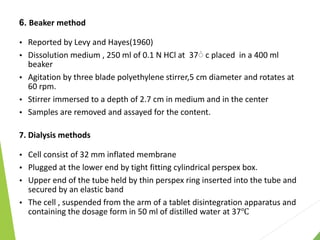
6. Beaker method
 Reported by Levy and Hayes(1960)
 Dissolution medium , 250 ml of 0.1 N HCl at 37۠ c placed in a 400 ml
beaker
 Agitation by three blade polyethylene stirrer,5 cm diameter and rotates at
60 rpm.
 Stirrer immersed to a depth of 2.7 cm in medium and in the center
 Samples are removed and assayed for the content.
7. Dialysis methods
 Cell consist of 32 mm inflated membrane
 Plugged at the lower end by tight fitting cylindrical perspex box.
 Upper end of the tube held by thin perspex ring inserted into the tube and
secured by an elastic band
 The cell , suspended from the arm of a tablet disintegration apparatus and
containing the dosage form in 50 ml of distilled water at 37℃
 The cell was raised and lowered 30 times a min into 150 ml of distilled
water at same temp.
 Agitation by slight flexing and streching of the dialysis membrane as it
enters and leave the bath
 Rotation at 60 rpm
 Samples taken and assayed for content.
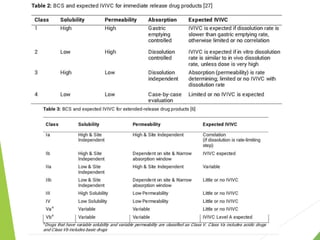
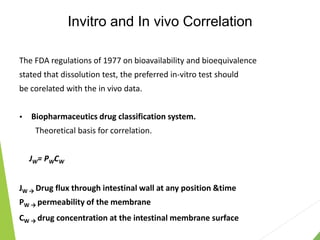
Invitro and In vivo Correlation
The FDA regulations of 1977 on bioavailability and bioequivalence
stated that dissolution test, the preferred in-vitro test should
be corelated with the in vivo data.
 Biopharmaceutics drug classification system.
Theoretical basis for correlation.
JW= PWCW
JW → Drug flux through intestinal wall at any position &time
PW → permeability of the membrane
CW → drug concentration at the intestinal membrane surface
Developing correlation:
The basic requirements for developing IVIVC are:
• Data obtained from human studies are required for
regulatory consideration of the correlation
• Two or more drug product formulations with different
release rates are developed and their in vitro dissolution
profiles generated using dissolution method
• Usage of same dissolution method for all the formulations,
and
• Plasma concentration data from a bioavailability study for
each of the formulations
Reference :
 Dissolution, bioavailability & bioequivalence by,Hameed M. Abdou.
 Biopharmaceutics & clinical pharmacokinetics by,Milo Gibaldi.
 Applied Biopharmaceutics & clinical pharmacokinetics by, Leon Shargel
/Andrew B. C. Yu
 Pharmaceutical dissolution testing by,Banker, Dekker series.
 Biopharmaceutics & pharmacokinetics by, G.R. Chatwal.
 Biopharmaceutics & pharmacokinetics – A treatise, D.M.Brahmankar, Sunil
B. Jaiswal.
 https://www.accessdata.fda.gov>cder
Thank you
all...

Dissolution

  • 1.
  • 2.
    Dissolution is aprocess in which a solid substance solubilizes in a given solvent i.e. mass transfer from the solid surface to the liquid phase. • Rate of dissolution is the amount of drug substance that goes in solution per unit time under standardized conditions of liquid/solid interface, temperature and solvent composition.
  • 3.
    Factors influencing GIAbsorption of a Drug from its Dosage Form 1. PHYSICOCHEMICAL FACTORS-AFFECTING DRUG ABSORPTION I. Drug Solubility and ·Dissolution Rate :  Hydrophobic, poorly aqueous soluble drugs said to be dissolution rate- limited.  Hydrophilic with high aqueous solubility absorption of such drugs is rate of permeation through the biomembrane  Absolute or intrinsic solubility is defined as the maximum amount of solute dissolved in a given solvent under standard conditions of temperature pressure and pH. Is static property.  Dissolution rate is defined as the amount of solid substance that goes into solution per unit time under standard conditions of temperature, pH and solvent composition and constant solid surface area. It is a dynamic process.
  • 4.
    Continue…  Absolute orintrinsic solubility is defined as the maximum amount of solute dissolved in a given solvent under standard conditions of temperature pressure and pH. Is static property.  Dissolution rate is defined as the amount of solid substance that goes into solution per unit time under standard conditions of temperature, pH and solvent composition and constant solid surface area. It is a dynamic process. Theories of Drug Dissolution :  Dissolution is a process in which a solid substance solubilizes in a given solvent i.e. mass transfer from the solid surface to the liquid phase. A. Diffusion Layer Model/Film Theory : Solution of the solid to form a thin film or layer at the solid/liquid interface called as the stagnant film or diffusion layer which is saturated with the drug.
  • 5.
    dC/dt = dissolutionrate of the drug, k = dissolution rate constant (frrst order), Cs = concentration of drug in the stagnant layer ( also called as the Saturation or maximum drug solubility) and Cb = concentration of drug in the bull< of the solution at time t. Brunner Fick's first law of diffusion modified the Noyes-Whitney's equation to: D = diffusion coefficient (diffusivity) of the drug A = surface area of the dissolving solid V = volume of dissolution medium. h = thickness of the stagnant layer. (Cs - Cb)= concentration gradient for diffusion of drug𠃑 kw/o= water/oil partition coefficient of the drug considering the fact that dissolution body fluids are aqueous. Since the rapidity with which a drug dissolves depends on the Kw/o, it is also called as the intrinsic dissolution rate constant.
  • 6.
    Influence of SomeParameters on Dissolution Rate of Drug Parameters Symbol Influence on drug dissolution Diffusion coefficient of drug D Greater the value, faster the dissolution. Diffusion decreases as the viscosity of dissolution medium increases Surface area of solid drug A Greater the surface area, faster the dissolution; .can be increased by micronization of drug. Water/oil partition coefficient of drug Kw/o Higher the value, more the hydrophilicity and faster the dissolution in aqueous fluids. C concentration gradient (Cs - Cb) Greater the concentration gradient, faster the diffusion and drug dissolution; can be increased by increasing drug solubility and the volume of dissolution medium Thickness of stagnant Layer h More the thickness, lesser the diffusion and drug dissolution; can be decreased by increasing agitation.
  • 7.
    In vitro-In vivodissolution rate correlation in vitro dissolution must always be carried under sink conditions. This can be achieved by: 1. Bathing the dissolving solid in fresh solvent from time to time 2. Increasing the volume of dissolution fluid 3. Removing the dissolved drug by partitioning it from the aqueous phase of the dissolution fluid into an organic phase placed either above or below the dissolution fluid for example, hexane or chloroform. 4. Adding a water miscible solvent such as alcohol to the dissolution fluid, or 5. By adding selected adsorbents to remove the dissolved drug. Hixson and Crowell's cubic root law of dissolution is used: Wot/3 - wt/3 = Kt WO = original mass of the drug W = mass of the drug remaining to dissolve at time t K = dissolution rate constant
  • 8.
    B. Danckwert's Model(Penetration or Surface Renewal Theory)  Danckwert's did not approve → stagnant layer → turbulence in medium exists at the solid/liquid interface.  Agitated fluid contain macroscopic mass → eddies or packets → reach solid/liquid interface in a ·random fashion due to eddy currents, absorb solute by diffusion.  Solute containing packet’s→ replaced with new packets 'Of fresh solvent.  Since the solvent packets are exposed to new solid surface each time, the theory is called as surface renewal theory. m = mass of solid dissolved y = rate of surface renewal ( or the interfacial tension
  • 9.
    Sink condition  ASink conditions describe a dissolution system that is sufficiently dilute so that the dissolution process is not impeded by approach to saturation of the compound of interest.  Sink conditions affect the production of the sample but not the condition of the solution upon sampling.  In vivo condition, there is no conc. build up in the bulk of the solution and hence no retarding effect on the dissolution rate of the drug i.e. Cs>>Cb and sink condition maintain. C. Interfacial Barrier Model (Double Barrier or Limited Solvation Theory) 1. The rate-determining step that controls dissolution is the mass transport. 2. Solid-solution ·equilibrium is achieved at the solid/liquid interface. According to the interfacial barrier model, an intermediate concentration can exist at the interface as a result of solvation mechanism and is a function of solubility rather than diffusion. When considering the dissolution of a crystal, each face of the crystal wilt have a different interfacial barrier. · Such a concept is given by the following equation: G = dissolution rate per unit area, K = effective interfacial transport constant
  • 10.
     Factors AffectingDrug Dissolution and Dissolution Rate 1. Physicochemical properties of the drug a. Particle Size and Effective Surface Area of the Drug  Smaller the drug particle, greater the surface area.  Since, surface area increases with decrease in particle size, higher dissolution rates may be achieved through reduction of particle size.  Micronization of hydrophobic powders can lead to aggregation and floatation.hence increase in S.A. of drug does not always guarantee dissolution ,it must increase in the “effective”S.A., 1. Absolute surface area → total area of solid surface of any particle, 2. Effective surface area → area of solid surface exposed to the dissolution medium .
  • 11.
    Hydrates/Solvates (Pseudo polymorphism) The stoichiometric type of adducts where the solvent molecules are incorporated in the crystal lattice of the solid are called the solvates and the trapped solvent as solvent of crystallization.  The solvates can exist in different crystalline forms called as pseudo polymorphs.  This phenomenon is called as pseudo polymorphism. When the solvent in association with the d0rug is water, the solvate is known as a hydrate. 1. Drug pKa and Lipophilicity and GI pH-pH Partition Hypothesis The theory states that for drug compounds of molecular weight greater than 1OO, which are primarily transported across the biomembrane by passive diffusion, the process of absorption is governed by: 1. The dissociation constant (pKa) of the drug. 2. The lipid solubility of the unionized drug (a function of drug Ko/w). 3. The pH at the absorption site. Most drugs are weak electrolytes (weak acids or weak base)  Degree of ionization depends upon the pH of the biological fluid.  If the pH on either side on the membrane is different, then the Compartment  whose pH favors greater ionization of the drug will contain greater amount of drug, and only the unionized or undissociated fraction of drug,·· if  sufficiently lipid soluble, can permeate the membrane passively until the.  concentration of unionized drug on either side of the membrane becomes  equal i.e. until equilibrium is attained.
  • 12.
    c. Drug pKaand Gastrointestinal pH  The amount of drug that ·exists in unionized form is a function of dissociation constant (pKa) of the drug and pH of the fluid at the absorption site.  The lower the pKa of an acidic drug, stronger the acid i.e. greater the proportion of ionized form at a particular pH.  The higher the pKa of a basic drug, the Stronger the base. pH can be determined by Henderson-Hasselbach equations:
  • 14.
    d. Lipophilicity andDrug Absorption • pKa (drug) that determines the degree of ionization at a particular pH. • Unionized drug, if sufficiently lipid soluble, is absorbed into the systemic circulation. • Even if drug exists in the unionized form, it will be poorly absorbed if it has poor lipid solubility (or low Ko1w). • A perfect hydrophilic –lipophilic balance (HLB) should be there in the structure of the drug for optimum bioavailability. • Percent absorbed ↑sed with ↑se in the partition coefficient of the drug.
  • 15.
    Limitations of pH-PartitionHypothesis 1. Presence of virtual membrane pH: a virtual pH, also called as the microclimate pH, different from the luminal pH exists at the membrane surface. This virtual membrane pH actually determines the extent of drug ionization and thus, drug absorption. 2. Absorption of ionized drug: This is true to a large extent as ionized drugs have low lipid solubility and relatively poor permeability.  If such drugs have a large lipophilic group in their structure, despite their ionization, they will be absorbed passively. 3. Influence of GI surface area and residence time of drug: pH-partition theory, acidic drugs are best ·absorbed from stomach ( acidic pH) and basic drugs from intestine ( alkaline pH) in which conditions they are unionized to a large extent.  the degree of ionization, both acidic and .basic drugs are more rapidly absorbed from the intestine, primarily· because of its large surface area and secondly, because of long residence time of the drug in the intestine.  4. Presence of aqueous unstirred diffusion layer: drugs having large partition coefficient can rapidly penetrate the lipid membrane but diffusion through unstirred water layer is the rate limiting step in their absorption. This applies in particular to high molecular weight fatty acids and bile acids.
  • 16.
    1. Disintegration Time •if DT not conform solid dosage form → bioavailability problems → dissolution slower → absorption insufficient. • Microcrystalline cellulose very good but → high compression force → retard drug dissolution. • Starch is superior disintegrant due to → hydrophilicity and swelling property • Harder tablet with large amount of binder • Disintegrant added after & before granulation effect. 2. Manufacturing/Processing Variables: Excipients (formulation ,ingredients , API) and Manufacturing processes. i. Method of Granulation: Enhances dissolution rate of poorly soluble drug. • Wet granulation superior exception eg.Sodium salicylate → wet gran. : slower disso.rate → Direct comp. :rapid,faster,complete disso.rate • Limitations: (i) Formation of crystal bridge → by presence of liquid. (ii) Liquid in chemical reactions → Hydrolysis. (iii) Drying → harm → thermolabile drugs. • APOC “Agglomerative Phase of Comminution”: produce mechanically stronger tablets higher dissolution rates than those made by wet granulation. • Mechanism is increased internal surface area of granules.
  • 17.
    ii. COMPRESSION FORCE:influence density, porosity, hardness, disintegration time & dissolution of tablet.  tighter bonding →higher compression force cause deformation crushing or fracture of drug particle or convert a spherical granules into disc Shaped particle. 3. Intensity of Packing of Capsule Contents: Tightly filled capsules → high pressure → within capsule → rapid bursting → dissolution.  intense packing → poor drug release and dissolution rate → due to decrease in pore size → poor penetrability by the GI fluids.
  • 18.
    4. Pharmaceutical Ingredients/Excipients(Formulation factors) :  Excipients- Ensure acceptability; physicochemical stability during the shelf-life; uniformity of composition and dosage; and optimum bioavailability and function ability of the drug product.  More excipients → More complex → greater potential for absorption & → bioavailability problems a. Vehicles: Aqueous → water , syrup Non aq. water miscible → propylene glycol, glycerol, sorbitol Non aq. water immiscible → vegetable oil  Aq. and water miscible are miscible with the body fluids  Drug more soluble in water miscible vehicles like propylene glycol (co- solvent) and show better bioavailability.  Solubilizers (tween 80) → promote solubility → drug in aq. vehicles.  Rate of drug absorption → depends on → partitioning from the oil/fluids  Bioavailability α miscibility with biofluids.  If Viscous → diffusion in GI Slower.
  • 19.
    2. DOSAGE FORMFACTORS AFFECTING DRUG ABSORPTION b. Diluents: Bulking agent  Inorganic - dicalcium phosphate (DCP)→ drug-Diluent interaction → poor bioavailability, due to formation of divalent calcium-tetracycline complex.  organic diluents carbohydrates ; starch, lactose, microcrystalline cellulose →promoting dissolution of poorly water-soluble • starch on dissolution rate of salicylic acid tablet dry double compression process three times increase in dissolution rate when the starch content increase from the 5 – 20 %.  Here starch particles form a layer on the outer surface of hydrophobic drug particles resulting in imparting hydrophilic character to granules & thus increase in effective surface area & rate of dissolution. c. Binders and Granulating Agent : Hold powder together → ↑se cohesive impact  Poly materials (natural , semi synthetic and synthetic) like starch, cellulose derivatives, acacia, PVP , gelatin and sugar solution.  Large amounts increase hardness & decrease DT/dissolution rates of tablets.  PEG 6000 + Phenobarbital → poorly soluble complex drug  Ethyl cellulose retard drug dissolution.
  • 20.
    d. Disintegrant :overcome cohessive strength & break them up on contact with water • Hydrophilic nature • As disintegrant ↓se →Bioavailability↓se • MCC good binder too but at High compression retard dissolution. • Phenobarbital tablet showed that when copagel (low viscosity grade of Na CMC) added before granulation decreased dissolution rate but if added after did not had any effect on dissolution rate. e. Lubricant : increase flow of granules  ↓se interparticle friction & Sticking or adhesion to punch and die  Hydrophobic→Inhibit →wetability, penetration of water, dissolution and DT  eg →SLS, carbowax f. Suspending Agent: they increase the viscosity of the medium and decrease dissolution rate and DT .  it causes mechanical barrier to diffusion due to formation of viscous layer on GI  eg. Acacia tragacanth, CMC , MC , etc.
  • 21.
    g. Surfactant: usedas solublizers , emulsifier & wetting agent increase absorption  promote wetting , eg. polysorbate 80  better membrane contact of drug absorption  Enhanced membrane permeability Decrease absorption  formation of unabsorbable drug micelle complex  laxative action induced by large surfactant conc. h. Nature and type of dosage form : bioavailability decrease order Solution> Emultion> Suspension> capsules> Tablet> Coated Tablets> Enteric Coated Tablets> Sustained Release products
  • 22.
    Dissolution rate testapparatus Apparatus no IP BP USP 1 Paddle Basket Rotating basket 2 Basket Paddle Paddle 3 Flow through cell Reciprocating cylinder 4 Flow through cell 5 Paddle over disk 6 Rotating cylinder 7 Reciprocating disk
  • 23.
    Name of ApparatusDrug Product Rotating basket Tablets Paddle Tablets, Capsules, Modified release products, Suspensions Reciprocating Cylinder Extended release drug products Flow cell Low water soluble drugs Paddle over disk Transdermal drug products Cylinder Transdermal drug products Reciprocating disk Extended release drug products Rotating disk (non USP –NF) Extended realese drug products(Beads)
  • 24.
    INVITRO DISSOLUTION TESTING 1. Rotatingbasket  Cylindrical basket of 22mesh.  Rotating speed-100 rpm.  As per IP height of dissolution jar is 168+8 mm and internal diameter is 102+4 mm and height of basket 36.8+3 mm and diameter is 25.4+3 mm  Temp. maintained at 37 ̇ c  Calibration tablets of Prednisone- for disintegrating tablets.  Salicylic acid calibration tablets-for non disintegrating tablets.  For capsules & dosage forms that tend to float.
  • 25.
    2) Paddle method. Teflon coated paddle to minimizes turbulence due to stirring.  Vertically attached.  As per IP diameter of the paddle is 74.5+0.5 mm  Position & alignment of the paddle are specified in USP same set of standards for calibration.  Temp at 37℃  Very sensitive to tilting.  2 - 50 rpm-for solid oral dosage forms, 25 rpm-suspensions.  For tablets, capsules, suspensions.  Few turns of platinum wire as a Sinker .
  • 26.
    3) Reciprocating cylinder method. Set of cylindrical, flat –bottomed glass vessels equipped with reciprocating cylinders  For testing of extended release products and for beads.  temp. 37۠ c.
  • 27.
    4) Flow throughcell method  Reservoir of medium  Pump that forcing medium through the cell holding test sample  Flow rate from 4 to 16 mL/min.  For modified release dosage forms, containing active ingredients with limited solubility.  Laminar flow by pulse less pump  Dissolution medium may be fresh or recirculated  Fresh medium ,dissolution rate at any moment can be obtained.
  • 28.
    5) Paddle overdisk method  Sample holder or disk assembly that holds the product.  Temperature -32oC.  Paddle is placed over the disk assembly.  Sample drawn midway between the surface of the dissolution medium and the top of the paddle blade.  For testing the release of drug from transdermal products.
  • 29.
    6) Rotating cylindermethod  A stainless steel cylinder is used to hold the sample.  Sample is mounted on to cuprophan.  Temperature 32oC.  For testing transdermal preparations.
  • 30.
    7) Reciprocating disk method A motor drive assembly is used to reciprocate the system vertically.  Samples are placed on disk shaped holders using cuprophan supports  Temperature 32oC.  Reciprocating frequency is about 30cylces per minute.
  • 31.
    Advantages of officialmethods 1. Better reproducibility 2. For capsules as they tend to float at surface thus minimizing area exposed to dissolution fluid. Disadvantage 1. Clogging of basket screen by gummy particles 2. Tendency of a light particles to float at surface after leaving baskets or in paddle method 3. Sensitivity of apparatus to variables such as vibrations, eccentricity. 4. Rapid corrosion of SS mesh in presence of HCl 5. Sensitivity of apparatus to any slight changes in paddle orientation 6. Non reproducible position of tablet at bottom of flask
  • 32.
    Dissolution acceptance: *Where Dis amount of dissolve active ingredients expressed in % in individual monograph. stage Number tested Acceptance criteria S1 6 Each unit is not less than D+5% S2 6 average of a 12 units(S1+ S2) is equal to or greater than D and no unit is less than D+15% S3 12 Average of 24 units (S1+ S2+ S3) is equal to or greater than D not more than 2 units are less than D +15% and no unit is less than D +25% where D is amount of dissolve active ingredients expressed in % in individual monograph
  • 33.
    Non official methods Tumbling method  Rotating disk method  Rotating bottle method  Intrinsic dissolution method  Peristalsis method  Sartorius apparatus  Beaker method  Dialysis method
  • 34.
    1. Tumbling method In this method dosage form is placed in tubes or bottles which are rotated using revolving drum 2. Rotating disk method  Developed by late eino nelson and described by Levy and Sahli.  Non disintegrating tablets or discs mounted in plexiglas holder, one surface exposed to the dissolution medium  Holder is attached to the metal shaft ,free from vibration  The tablet immersed one inch below the surface of 200 ml of dissolution fluid , temp 37۠ c , in 500 ml three nacked round bottom flask , rate is 550 rpm.  Samples were taken and assayed for drug content. 3. Rotating filter method  It consists of magnetically driven rotating filter assembly and a 12 mesh wire cloth basket in which dosage form is placed  The sample is withdrawn through spinning filter for analysis
  • 35.
    4. Sartorius apparatus It utilize in vivo stimulative method  The absorption stimulater stimulates passive drug transport process that occur in vivo from GIT tract to plasma across lipoidal mucosal barrier 5. Peristalsis method  To stimulate hydrodynamic condition of GIT tract in an in vitro dissolution device.  It consists of rigid plastic cylindrical tubing fitted with septum and rubber stopper at both ends.  Dissolution chamber consist of a space between the septum and the lower stopper  Dissolution medium pumped with peristaltic action through the dosage form
  • 36.
    6. Beaker method Reported by Levy and Hayes(1960)  Dissolution medium , 250 ml of 0.1 N HCl at 37۠ c placed in a 400 ml beaker  Agitation by three blade polyethylene stirrer,5 cm diameter and rotates at 60 rpm.  Stirrer immersed to a depth of 2.7 cm in medium and in the center  Samples are removed and assayed for the content. 7. Dialysis methods  Cell consist of 32 mm inflated membrane  Plugged at the lower end by tight fitting cylindrical perspex box.  Upper end of the tube held by thin perspex ring inserted into the tube and secured by an elastic band  The cell , suspended from the arm of a tablet disintegration apparatus and containing the dosage form in 50 ml of distilled water at 37℃
  • 37.
     The cellwas raised and lowered 30 times a min into 150 ml of distilled water at same temp.  Agitation by slight flexing and streching of the dialysis membrane as it enters and leave the bath  Rotation at 60 rpm  Samples taken and assayed for content.
  • 38.
    Invitro and Invivo Correlation The FDA regulations of 1977 on bioavailability and bioequivalence stated that dissolution test, the preferred in-vitro test should be corelated with the in vivo data.  Biopharmaceutics drug classification system. Theoretical basis for correlation. JW= PWCW JW → Drug flux through intestinal wall at any position &time PW → permeability of the membrane CW → drug concentration at the intestinal membrane surface
  • 39.
    Developing correlation: The basicrequirements for developing IVIVC are: • Data obtained from human studies are required for regulatory consideration of the correlation • Two or more drug product formulations with different release rates are developed and their in vitro dissolution profiles generated using dissolution method • Usage of same dissolution method for all the formulations, and • Plasma concentration data from a bioavailability study for each of the formulations
  • 41.
    Reference :  Dissolution,bioavailability & bioequivalence by,Hameed M. Abdou.  Biopharmaceutics & clinical pharmacokinetics by,Milo Gibaldi.  Applied Biopharmaceutics & clinical pharmacokinetics by, Leon Shargel /Andrew B. C. Yu  Pharmaceutical dissolution testing by,Banker, Dekker series.  Biopharmaceutics & pharmacokinetics by, G.R. Chatwal.  Biopharmaceutics & pharmacokinetics – A treatise, D.M.Brahmankar, Sunil B. Jaiswal.  https://www.accessdata.fda.gov>cder
  • 42.