VMC Seminar
   April 28, 2011
 Renton, Washington


      Fred Huang, MD
    Valley Orthopedic Associates
A Division of Proliance Surgeons, Inc.
 Meniscal  Tears
 ACL Tears

 Multi-ligament Injuries

 Tibial Plateau Fractures
Healthy
 Right
 Knee


Source: Knee Ligament Injuries
The Staywell Company, 2001
Meniscal Tears

    Symptoms – what patients notice
         Swelling
         Catching and locking
         Pain with pivoting and squatting


    Exam Findings – what doctors find
         Swelling (fluid on the knee)
         Tenderness at the site of the tear
         Pain with flexion/twisting
Meniscal Tears

    Arthroscopic surgery to
     remove torn tissue

                               Source: www.stoneclinic.com
    Degenerative tears:
     associated with
     minimal or no trauma

    Degenerative tears
     often associated with
     arthritis & not always
     treated with surgery
                               Source: www.opsmart.com
Types of Ligament Injuries

     ACL very common

     MCL most common with ski injuries
          Usually treated with bracing for 6 weeks


     Combination injuries (ACL w/ MCL most common,
      but any combo possible)

     PCL involved frequently in multi-ligament injuries
ACL Tears


Source: Knee Ligament Injuries
The Staywell Company, 2001
ACL Tears

  Twisting and/or
   cutting – often a
   non-contact injury
  Usually unable to
   continue sporting
   activity
  Swelling within 1-2
   hours                 Source: Knee Ligament Injuries
                         The Staywell Company, 2001
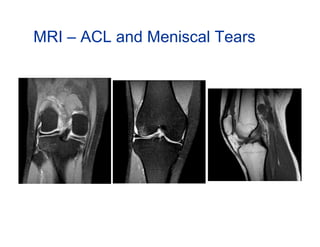
MRI – ACL and Meniscal Tears
ACL Tears - Treatment

  Non-operative     treatment (Brace?)

  Surgical   treatment
     Only after motion returns to normal
     Graft options: hamstrings, patellar tendon,
      quad tendon, or allograft
     Associated procedures: meniscal or
      cartilage procedures
ACL Reconstruction


    Sources:
     Left: www.arthroscopy.com
     Right: www.orthop.washington.edu
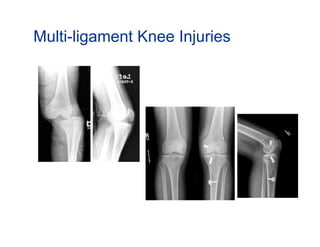
Multi-ligament Knee Injuries

  Higher   energy mechanism than ACL
   tears
  Can be due to a complete knee
   dislocation
  Nerve and/or blood vessel injuries
   possible
Multi-ligament Knee Injuries
Tibial Plateau Fractures


    Wide spectrum of injury
     patterns

    Often treated surgically to
     re-establish normal
     architecture at the joint
     surface
Tibial Plateau Fractures


    CT scans helpful
Tibial Plateau Fixation with
Lateral Ligament Repair (Simple)
Tibial Plateau Fixation - Moderate
Tibial Plateau Fixation - Complex
Patello-femoral Pain

  Frequent cause for ANTERIOR knee pain
  Pain worsened by running, squatting,

   stair-climbing, and lunges
  Often associated with grinding/popping at the
   kneecap
  MRI’s often “normal”

  Treatment consists of formal P.T., NSAID’s,
   weight loss, and occasional steroid injections
Knee Arthritis


    Pain worse with standing
     and better with rest

    Physical Exam:
         Stiffness & swelling
         Deformity (bow-legged
           versus knock-kneed)
Knee Arthritis – Treatment Options


Standard treatments:
    1. Medicines

    2. Injections

    3. Surgery

        (replacement usually)
Knee Arthritis Treatment – Tibial Osteotomy


    Intermediate solution that
     improves pain and function
     usually for < 10 years

    Allows for continued impact
     activities

    Associated with a longer
     recovery time (to allow for
     healing of the osteotomy)
Total Knee Replacement

    Reliable solution that improves pain
     and function usually for >15 years

    Physical therapy and home exercises
     important after surgery

    New interest in better pain
     management, smaller incisions, and
     accelerated rehab

    Not designed for impact activities
Thank You

    Fred Huang, MD
    www.valleyorthopedicassociates.com

Common Knee Conditions by: Fred Huang

  • 1.
    VMC Seminar April 28, 2011 Renton, Washington Fred Huang, MD Valley Orthopedic Associates A Division of Proliance Surgeons, Inc.
  • 2.
     Meniscal Tears  ACLTears  Multi-ligament Injuries  Tibial Plateau Fractures
  • 3.
    Healthy Right Knee Source:Knee Ligament Injuries The Staywell Company, 2001
  • 4.
    Meniscal Tears   Symptoms – what patients notice   Swelling   Catching and locking   Pain with pivoting and squatting   Exam Findings – what doctors find   Swelling (fluid on the knee)   Tenderness at the site of the tear   Pain with flexion/twisting
  • 5.
    Meniscal Tears   Arthroscopic surgery to remove torn tissue Source: www.stoneclinic.com   Degenerative tears: associated with minimal or no trauma   Degenerative tears often associated with arthritis & not always treated with surgery Source: www.opsmart.com
  • 6.
    Types of LigamentInjuries   ACL very common   MCL most common with ski injuries   Usually treated with bracing for 6 weeks   Combination injuries (ACL w/ MCL most common, but any combo possible)   PCL involved frequently in multi-ligament injuries
  • 7.
    ACL Tears Source: KneeLigament Injuries The Staywell Company, 2001
  • 8.
    ACL Tears   Twistingand/or cutting – often a non-contact injury   Usually unable to continue sporting activity   Swelling within 1-2 hours Source: Knee Ligament Injuries The Staywell Company, 2001
  • 9.
    MRI – ACLand Meniscal Tears
  • 10.
    ACL Tears -Treatment   Non-operative treatment (Brace?)   Surgical treatment   Only after motion returns to normal   Graft options: hamstrings, patellar tendon, quad tendon, or allograft   Associated procedures: meniscal or cartilage procedures
  • 11.
    ACL Reconstruction   Sources: Left: www.arthroscopy.com Right: www.orthop.washington.edu
  • 12.
    Multi-ligament Knee Injuries  Higher energy mechanism than ACL tears   Can be due to a complete knee dislocation   Nerve and/or blood vessel injuries possible
  • 13.
  • 14.
    Tibial Plateau Fractures   Wide spectrum of injury patterns   Often treated surgically to re-establish normal architecture at the joint surface
  • 15.
  • 16.
    Tibial Plateau Fixationwith Lateral Ligament Repair (Simple)
  • 17.
  • 18.
  • 19.
    Patello-femoral Pain   Frequentcause for ANTERIOR knee pain   Pain worsened by running, squatting, stair-climbing, and lunges   Often associated with grinding/popping at the kneecap   MRI’s often “normal”   Treatment consists of formal P.T., NSAID’s, weight loss, and occasional steroid injections
  • 20.
    Knee Arthritis   Pain worse with standing and better with rest   Physical Exam:   Stiffness & swelling   Deformity (bow-legged versus knock-kneed)
  • 21.
    Knee Arthritis –Treatment Options Standard treatments:   1. Medicines   2. Injections   3. Surgery (replacement usually)
  • 22.
    Knee Arthritis Treatment– Tibial Osteotomy   Intermediate solution that improves pain and function usually for < 10 years   Allows for continued impact activities   Associated with a longer recovery time (to allow for healing of the osteotomy)
  • 23.
    Total Knee Replacement   Reliable solution that improves pain and function usually for >15 years   Physical therapy and home exercises important after surgery   New interest in better pain management, smaller incisions, and accelerated rehab   Not designed for impact activities
  • 24.
    Thank You   Fred Huang, MD   www.valleyorthopedicassociates.com