Convergence to mHealth

              Pankaj Vaish                          Convergence

           President, HealthFore
                                                    Why mHealth?


(Healthcare IT Division of Religare Technologies)   Use Cases
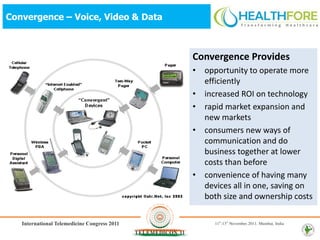
Convergence – Voice, Video & Data


                                    Convergence Provides
                                    • opportunity to operate more
                                      efficiently
                                    • increased ROI on technology
                                    • rapid market expansion and
                                      new markets
                                    • consumers new ways of
                                      communication and do
                                      business together at lower
                                      costs than before
                                    • convenience of having many
                                      devices all in one, saving on
                                      both size and ownership costs
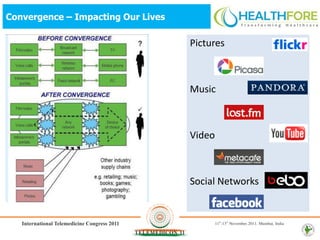
Convergence – Impacting Our Lives

                                    Pictures


                                    Music


                                    Video


                                    Social Networks
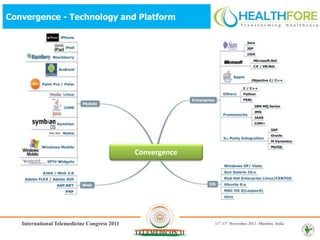
Convergence - Technology and Platform


                            Convergence
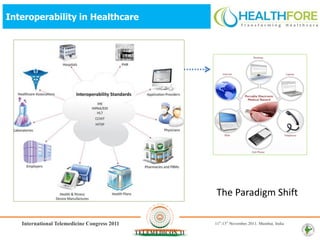
Interoperability in Healthcare


                                 The Paradigm Shift

                                                      5
Convergence


Why mHealth?


Use Cases
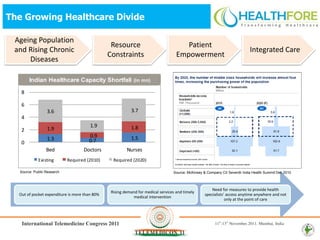
The Growing Healthcare Divide

 Ageing Population
                                                Resource                              Patient
 and Rising Chronic                                                                                                         Integrated Care
                                               Constraints                         Empowerment
     Diseases

       Indian Healthcare Capacity Shortfall (in mn)

   8

   6
                 3.6                                      3.7
   4
                                       1.9                1.8
   2             1.9
                                      0.9                 1.5
                 1.3                  0.7
   0
                 Bed               Doctors              Nurses
            Existing        Required (2010)      Required (2020)

  Source: Public Research                                                        Source: McKinsey & Company CII Seventh India Health Summit Dec 2010


                                                                                                      Need for measures to provide health
                                                Rising demand for medical services and timely
  Out of pocket expenditure is more than 80%                                                      specialists’ access anytime anywhere and not
                                                            medical intervention
                                                                                                              only at the point of care


                                                                                                                                                       7
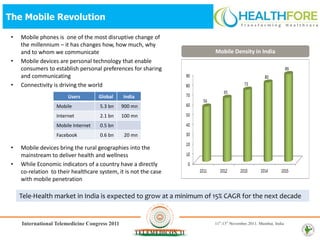
The Mobile Revolution

 •   Mobile phones is one of the most disruptive change of
     the millennium – it has changes how, how much, why
     and to whom we communicate                                      Mobile Density in India
 •   Mobile devices are personal technology that enable
     consumers to establish personal preferences for sharing
     and communicating
 •   Connectivity is driving the world
                        Users        Global    India
                   Mobile            5.3 bn   900 mn
                   Internet          2.1 bn   100 mn
                   Mobile Internet   0.5 bn
                   Facebook          0.6 bn    20 mn

 •   Mobile devices bring the rural geographies into the
     mainstream to deliver health and wellness
 •   While Economic indicators of a country have a directly
     co-relation to their healthcare system, it is not the case
     with mobile penetration

     Tele-Health market in India is expected to grow at a minimum of 15% CAGR for the next decade
Convergence


Why mHealth?


Use Cases
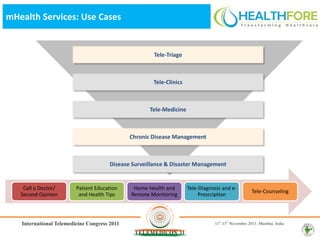
mHealth Services: Use Cases


                                                 Tele-Triage


                                                 Tele-Clinics


                                                Tele-Medicine


                                         Chronic Disease Management


                                  Disease Surveillance & Disaster Management


    Call a Doctor/   Patient Education    Home Health and       Tele-Diagnosis and e-
                                                                                        Tele-Counseling
   Second Opinion     and Health Tips    Remote Monitoring           Prescription


                                                                                                          10
Tele-Triage
  (Typical OP consultation services to subscribers)

                Service Highlights                                         Benefits

  Scope of Services:                                •     Improved quality of care, access, reimbursement,
 • Emergency referrals for critical, life                 and cost reduction.
   threatening illnesses or non-life                •     Tele-triage is an access tool for patients that can
                                                          increase patient satisfaction, as well as their
   threatening cases that require urgent
                                                          compliance with telephone advice.
   medical care
                                                    •     Vital tool for Health Authorities to control demand
    • Ambulance services                                  in view of the limited healthcare resources and
    • Consultation services with physician                manage costs as well as care
    • Referral services to nearest hospital
 • Regular/ routine cases
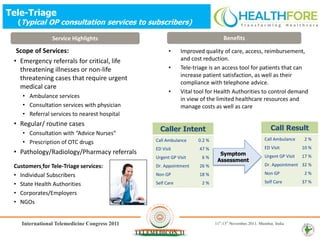
                                                Caller Intent                                 Call Result
    • Consultation with “Advice Nurses”
                                              Call Ambulance     0.2 %                     Call Ambulance     2%
    • Prescription of OTC drugs
                                              ED Visit           47 %                      ED Visit          10 %
 • Pathology/Radiology/Pharmacy referrals                                 Symptom
                                              Urgent GP Visit     6%                       Urgent GP Visit   17 %
                                                                         Assessment
 Customers for Tele-Triage services:          Dr. Appointment    26 %                      Dr. Appointment 32 %

 • Individual Subscribers                     Non GP             18 %                      Non GP             2%
                                                                                           Self Care         37 %
 • State Health Authorities                   Self Care           2%

 • Corporates/Employers
 • NGOs


                                                                                                             11
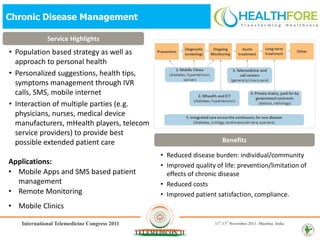
Chronic Disease Management

           Service Highlights
• Population based strategy as well as
  approach to personal health
• Personalized suggestions, health tips,
  symptoms management through IVR
  calls, SMS, mobile internet
• Interaction of multiple parties (e.g.
  physicians, nurses, medical device
  manufacturers, mHealth players, telecom
  service providers) to provide best
  possible extended patient care                                  Benefits

                                            • Reduced disease burden: individual/community
Applications:                               • Improved quality of life: prevention/limitation of
• Mobile Apps and SMS based patient           effects of chronic disease
  management                                • Reduced costs
• Remote Monitoring                         • Improved patient satisfaction, compliance.
• Mobile Clinics
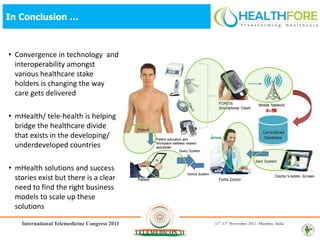
In Conclusion …


• Convergence in technology and
  interoperability amongst
  various healthcare stake
  holders is changing the way
  care gets delivered

• mHealth/ tele-health is helping
  bridge the healthcare divide
  that exists in the developing/
  underdeveloped countries

• mHealth solutions and success
  stories exist but there is a clear
  need to find the right business
  models to scale up these
  solutions
Thank You
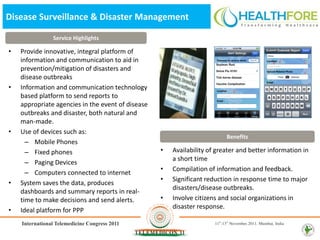
Disease Surveillance & Disaster Management

               Service Highlights

•   Provide innovative, integral platform of
    information and communication to aid in
    prevention/mitigation of disasters and
    disease outbreaks
•   Information and communication technology
    based platform to send reports to
    appropriate agencies in the event of disease
    outbreaks and disaster, both natural and
    man-made.
•   Use of devices such as:
                                                                          Benefits
      – Mobile Phones
      – Fixed phones                               •   Availability of greater and better information in
                                                       a short time
      – Paging Devices
                                                   •   Compilation of information and feedback.
      – Computers connected to internet
                                                   •   Significant reduction in response time to major
•   System saves the data, produces
                                                       disasters/disease outbreaks.
    dashboards and summary reports in real-
    time to make decisions and send alerts.        •   Involve citizens and social organizations in
                                                       disaster response.
•   Ideal platform for PPP
Tele-Clinics
(Clinical care at a distance through e-clinics or centers)

                 Service Highlights
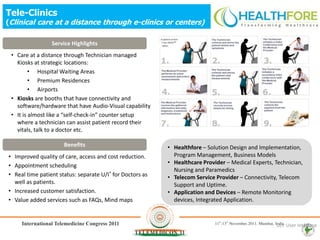
 • Care at a distance through Technician managed
   Kiosks at strategic locations:
         • Hospital Waiting Areas
         • Premium Residences
         • Airports
 • Kiosks are booths that have connectivity and
   software/hardware that have Audio-Visual capability
 • It is almost like a “self-check-in” counter setup
   where a technician can assist patient record their
   vitals, talk to a doctor etc.

                      Benefits                             • Healthfore – Solution Design and Implementation,
• Improved quality of care, access and cost reduction.       Program Management, Business Models
                                                           • Healthcare Provider – Medical Experts, Technician,
• Appointment scheduling
                                                             Nursing and Paramedics
• Real time patient status: separate U/I* for Doctors as   • Telecom Service Provider – Connectivity, Telecom
  well as patients.                                          Support and Uptime.
• Increased customer satisfaction.                         • Application and Devices – Remote Monitoring
• Value added services such as FAQs, Mind maps               devices, Integrated Application.


                                                                                                    U/I: User Interface
                                                                                                                 16
Tele-Medicine
(Tele-Radiology, Tele-Pathology, Tele-dermatology, etc.)

                      Service Highlights
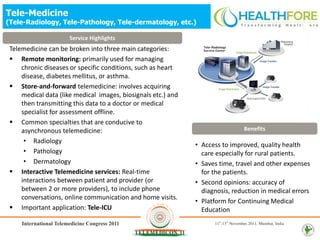
 Telemedicine can be broken into three main categories:
  Remote monitoring: primarily used for managing
     chronic diseases or specific conditions, such as heart
     disease, diabetes mellitus, or asthma.
  Store-and-forward telemedicine: involves acquiring
     medical data (like medical images, biosignals etc.) and
     then transmitting this data to a doctor or medical
     specialist for assessment offline.
  Common specialties that are conducive to
     asynchronous telemedicine:                                                Benefits
      • Radiology
                                                               • Access to improved, quality health
      • Pathology                                                care especially for rural patients.
      • Dermatology                                            • Saves time, travel and other expenses
  Interactive Telemedicine services: Real-time                  for the patients.
     interactions between patient and provider (or             • Second opinions: accuracy of
     between 2 or more providers), to include phone              diagnosis, reduction in medical errors
     conversations, online communication and home visits.
                                                               • Platform for Continuing Medical
  Important application: Tele-ICU                               Education

Convergence to mHealth

  • 1.
    Convergence to mHealth Pankaj Vaish Convergence President, HealthFore Why mHealth? (Healthcare IT Division of Religare Technologies) Use Cases
  • 2.
    Convergence – Voice,Video & Data Convergence Provides • opportunity to operate more efficiently • increased ROI on technology • rapid market expansion and new markets • consumers new ways of communication and do business together at lower costs than before • convenience of having many devices all in one, saving on both size and ownership costs
  • 3.
    Convergence – ImpactingOur Lives Pictures Music Video Social Networks
  • 4.
    Convergence - Technologyand Platform Convergence
  • 5.
    Interoperability in Healthcare The Paradigm Shift 5
  • 6.
  • 7.
    The Growing HealthcareDivide Ageing Population Resource Patient and Rising Chronic Integrated Care Constraints Empowerment Diseases Indian Healthcare Capacity Shortfall (in mn) 8 6 3.6 3.7 4 1.9 1.8 2 1.9 0.9 1.5 1.3 0.7 0 Bed Doctors Nurses Existing Required (2010) Required (2020) Source: Public Research Source: McKinsey & Company CII Seventh India Health Summit Dec 2010 Need for measures to provide health Rising demand for medical services and timely Out of pocket expenditure is more than 80% specialists’ access anytime anywhere and not medical intervention only at the point of care 7
  • 8.
    The Mobile Revolution • Mobile phones is one of the most disruptive change of the millennium – it has changes how, how much, why and to whom we communicate Mobile Density in India • Mobile devices are personal technology that enable consumers to establish personal preferences for sharing and communicating • Connectivity is driving the world Users Global India Mobile 5.3 bn 900 mn Internet 2.1 bn 100 mn Mobile Internet 0.5 bn Facebook 0.6 bn 20 mn • Mobile devices bring the rural geographies into the mainstream to deliver health and wellness • While Economic indicators of a country have a directly co-relation to their healthcare system, it is not the case with mobile penetration Tele-Health market in India is expected to grow at a minimum of 15% CAGR for the next decade
  • 9.
  • 10.
    mHealth Services: UseCases Tele-Triage Tele-Clinics Tele-Medicine Chronic Disease Management Disease Surveillance & Disaster Management Call a Doctor/ Patient Education Home Health and Tele-Diagnosis and e- Tele-Counseling Second Opinion and Health Tips Remote Monitoring Prescription 10
  • 11.
    Tele-Triage (TypicalOP consultation services to subscribers) Service Highlights Benefits Scope of Services: • Improved quality of care, access, reimbursement, • Emergency referrals for critical, life and cost reduction. threatening illnesses or non-life • Tele-triage is an access tool for patients that can increase patient satisfaction, as well as their threatening cases that require urgent compliance with telephone advice. medical care • Vital tool for Health Authorities to control demand • Ambulance services in view of the limited healthcare resources and • Consultation services with physician manage costs as well as care • Referral services to nearest hospital • Regular/ routine cases Caller Intent Call Result • Consultation with “Advice Nurses” Call Ambulance 0.2 % Call Ambulance 2% • Prescription of OTC drugs ED Visit 47 % ED Visit 10 % • Pathology/Radiology/Pharmacy referrals Symptom Urgent GP Visit 6% Urgent GP Visit 17 % Assessment Customers for Tele-Triage services: Dr. Appointment 26 % Dr. Appointment 32 % • Individual Subscribers Non GP 18 % Non GP 2% Self Care 37 % • State Health Authorities Self Care 2% • Corporates/Employers • NGOs 11
  • 12.
    Chronic Disease Management Service Highlights • Population based strategy as well as approach to personal health • Personalized suggestions, health tips, symptoms management through IVR calls, SMS, mobile internet • Interaction of multiple parties (e.g. physicians, nurses, medical device manufacturers, mHealth players, telecom service providers) to provide best possible extended patient care Benefits • Reduced disease burden: individual/community Applications: • Improved quality of life: prevention/limitation of • Mobile Apps and SMS based patient effects of chronic disease management • Reduced costs • Remote Monitoring • Improved patient satisfaction, compliance. • Mobile Clinics
  • 13.
    In Conclusion … •Convergence in technology and interoperability amongst various healthcare stake holders is changing the way care gets delivered • mHealth/ tele-health is helping bridge the healthcare divide that exists in the developing/ underdeveloped countries • mHealth solutions and success stories exist but there is a clear need to find the right business models to scale up these solutions
  • 14.
  • 15.
    Disease Surveillance &Disaster Management Service Highlights • Provide innovative, integral platform of information and communication to aid in prevention/mitigation of disasters and disease outbreaks • Information and communication technology based platform to send reports to appropriate agencies in the event of disease outbreaks and disaster, both natural and man-made. • Use of devices such as: Benefits – Mobile Phones – Fixed phones • Availability of greater and better information in a short time – Paging Devices • Compilation of information and feedback. – Computers connected to internet • Significant reduction in response time to major • System saves the data, produces disasters/disease outbreaks. dashboards and summary reports in real- time to make decisions and send alerts. • Involve citizens and social organizations in disaster response. • Ideal platform for PPP
  • 16.
    Tele-Clinics (Clinical care ata distance through e-clinics or centers) Service Highlights • Care at a distance through Technician managed Kiosks at strategic locations: • Hospital Waiting Areas • Premium Residences • Airports • Kiosks are booths that have connectivity and software/hardware that have Audio-Visual capability • It is almost like a “self-check-in” counter setup where a technician can assist patient record their vitals, talk to a doctor etc. Benefits • Healthfore – Solution Design and Implementation, • Improved quality of care, access and cost reduction. Program Management, Business Models • Healthcare Provider – Medical Experts, Technician, • Appointment scheduling Nursing and Paramedics • Real time patient status: separate U/I* for Doctors as • Telecom Service Provider – Connectivity, Telecom well as patients. Support and Uptime. • Increased customer satisfaction. • Application and Devices – Remote Monitoring • Value added services such as FAQs, Mind maps devices, Integrated Application. U/I: User Interface 16
  • 17.
    Tele-Medicine (Tele-Radiology, Tele-Pathology, Tele-dermatology,etc.) Service Highlights Telemedicine can be broken into three main categories:  Remote monitoring: primarily used for managing chronic diseases or specific conditions, such as heart disease, diabetes mellitus, or asthma.  Store-and-forward telemedicine: involves acquiring medical data (like medical images, biosignals etc.) and then transmitting this data to a doctor or medical specialist for assessment offline.  Common specialties that are conducive to asynchronous telemedicine: Benefits • Radiology • Access to improved, quality health • Pathology care especially for rural patients. • Dermatology • Saves time, travel and other expenses  Interactive Telemedicine services: Real-time for the patients. interactions between patient and provider (or • Second opinions: accuracy of between 2 or more providers), to include phone diagnosis, reduction in medical errors conversations, online communication and home visits. • Platform for Continuing Medical  Important application: Tele-ICU Education