Telehealth Use in
The Los Angeles County
Department of Mental Health
Marc Heiser MD, PhD
Racheal Burgess
Los Angeles County Department of Mental Health
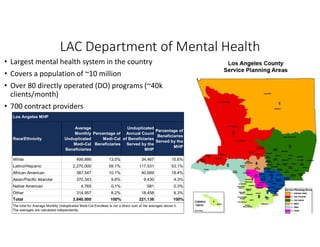
LAC Department of Mental Health
Race/Ethnicity
Average
Monthly
Unduplicated
Medi-Cal
Beneficiaries
Percentage of
Medi-Cal
Beneficiaries
Unduplicated
Annual Count
of Beneficiaries
Served by the
MHP
Percentage of
Beneficiaries
Served by the
MHP
White 499,886 13.0% 34,467 15.6%
Latino/Hispanic 2,270,000 59.1% 117,531 53.1%
African-American 387,547 10.1% 40,669 18.4%
Asian/Pacific Islander 370,343 9.6% 9,430 4.3%
Native American 4,765 0.1% 581 0.3%
Other 314,957 8.2% 18,458 8.3%
Total 3,840,000 100% 221,136 100%
The total for Average Monthly Unduplicated Medi-Cal Enrollees is not a direct sum of the averages above it.
The averages are calculated independently.
Los Angeles MHP
• Largest mental health system in the country
• Covers a population of ~10 million
• Over 80 directly operated (DO) programs (~40k
clients/month)
• 700 contract providers
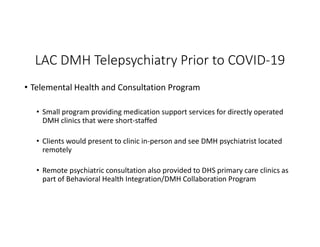
LAC DMH Telepsychiatry Prior to COVID-19
• Telemental Health and Consultation Program
• Small program providing medication support services for directly operated
DMH clinics that were short-staffed
• Clients would present to clinic in-person and see DMH psychiatrist located
remotely
• Remote psychiatric consultation also provided to DHS primary care clinics as
part of Behavioral Health Integration/DMH Collaboration Program
Telepsychiatry Now: Rapid Pivot To Remote
Care
• Priority: Maintain client services, check in on health, ensure housing
and food security
• All disciplines have shifted to remote service delivery
• Case management
• Peer support and community health workers: Outreach and engagement,
support groups
• Therapy: Individual and groups
• Nursing: Education, symptom screening, client management
• Medication support: New evaluations and ongoing care
Opportunity and Innovation
• Expand support for people residing in shelters
• Deployed field-based teams with remote psychiatric support for people
residing in emergency shelters and isolation and quarantine shelters
• Improve access to care: Redistribution of psychiatric resources
• Traditionally, psychiatrists are clustered in certain geographic areas of LA
County, leaving other areas underserved
• Using telehealth, we have been able to redeploy psychiatrists more equitably
across the county
• These psychiatrists no longer see clients in one clinic, but rather see clients
throughout the system
LAC DMH Outpatient Services (DO Only): Jul 2019- Sept 2021
Telehealth
Telephone
Other
COVID-19 Safer at Home
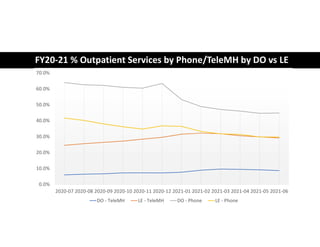
• Client services increased
during COVID-19
• Phone predominates
FY20-21 % Outpatient Services by Phone/TeleMH by DO vs LE
0.0%
10.0%
20.0%
30.0%
40.0%
50.0%
60.0%
70.0%
2020-07 2020-08 2020-09 2020-10 2020-11 2020-12 2021-01 2021-02 2021-03 2021-04 2021-05 2021-06
DO - TeleMH LE - TeleMH DO - Phone LE - Phone
0
1000
2000
3000
4000
5000
6000
7000
8000
9000
10000
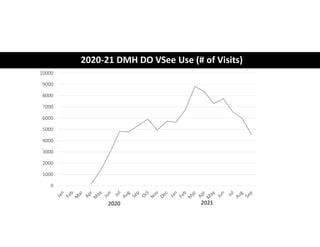
2020-21 DMH DO VSee Use (# of Visits)
2020 2021
Challenges with Telehealth
• Access to technology: Individuals may not have smart phones and/or
data capable of supporting audiovisual conferencing. They may not
have enough minutes to use for telephone services
• Comfort with technology: Varying levels of comfort with telehealth
technology
• Privacy: Individuals may be unhoused or they may not have private
space where they reside
DO Clinic Efforts To Increase Video Visits
• Quality Goal: Increase use of videoconferencing for mental health care
• Video conferencing is equivalent to in-person care (Hilty et al. 2013)
• Superior to telephone visits
• To increase videoconferencing we have implemented the following:
• Increased training sessions to twice a week
• Trained “VSee Champions” to assist staff and clients
• Implemented a clinic workflow to get clients online
• Reviewing clinic VSee use at APEX meetings
• Applied for federal funding for telehealth equipment
• 6 month QI review of data
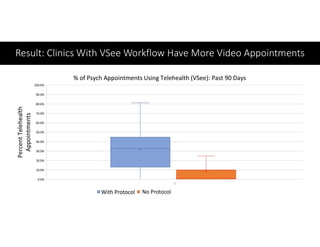
Result: Clinics With VSee Workflow Have More Video Appointments
No Protocol
Future Directions: Expand Access And
Improve Quality
• Integration of telehealth software with DMH electronic medical
record system
• Leverage cultural capacity: Clients may be matched with providers in
part based upon language and, if desired, cultural knowledge rather
than geography
• Use customer satisfaction survey and telehealth usage data to guide
further expansion, understand unmet needs and barriers
• Explore sources of funding for smart phones and data including
government and public-private partnerships

Deploying Telehealth to 1.2 M Users - LA County Case Study

  • 1.
    Telehealth Use in TheLos Angeles County Department of Mental Health Marc Heiser MD, PhD Racheal Burgess Los Angeles County Department of Mental Health
  • 2.
    LAC Department ofMental Health Race/Ethnicity Average Monthly Unduplicated Medi-Cal Beneficiaries Percentage of Medi-Cal Beneficiaries Unduplicated Annual Count of Beneficiaries Served by the MHP Percentage of Beneficiaries Served by the MHP White 499,886 13.0% 34,467 15.6% Latino/Hispanic 2,270,000 59.1% 117,531 53.1% African-American 387,547 10.1% 40,669 18.4% Asian/Pacific Islander 370,343 9.6% 9,430 4.3% Native American 4,765 0.1% 581 0.3% Other 314,957 8.2% 18,458 8.3% Total 3,840,000 100% 221,136 100% The total for Average Monthly Unduplicated Medi-Cal Enrollees is not a direct sum of the averages above it. The averages are calculated independently. Los Angeles MHP • Largest mental health system in the country • Covers a population of ~10 million • Over 80 directly operated (DO) programs (~40k clients/month) • 700 contract providers
  • 3.
    LAC DMH TelepsychiatryPrior to COVID-19 • Telemental Health and Consultation Program • Small program providing medication support services for directly operated DMH clinics that were short-staffed • Clients would present to clinic in-person and see DMH psychiatrist located remotely • Remote psychiatric consultation also provided to DHS primary care clinics as part of Behavioral Health Integration/DMH Collaboration Program
  • 4.
    Telepsychiatry Now: RapidPivot To Remote Care • Priority: Maintain client services, check in on health, ensure housing and food security • All disciplines have shifted to remote service delivery • Case management • Peer support and community health workers: Outreach and engagement, support groups • Therapy: Individual and groups • Nursing: Education, symptom screening, client management • Medication support: New evaluations and ongoing care
  • 5.
    Opportunity and Innovation •Expand support for people residing in shelters • Deployed field-based teams with remote psychiatric support for people residing in emergency shelters and isolation and quarantine shelters • Improve access to care: Redistribution of psychiatric resources • Traditionally, psychiatrists are clustered in certain geographic areas of LA County, leaving other areas underserved • Using telehealth, we have been able to redeploy psychiatrists more equitably across the county • These psychiatrists no longer see clients in one clinic, but rather see clients throughout the system
  • 6.
    LAC DMH OutpatientServices (DO Only): Jul 2019- Sept 2021 Telehealth Telephone Other COVID-19 Safer at Home • Client services increased during COVID-19 • Phone predominates
  • 7.
    FY20-21 % OutpatientServices by Phone/TeleMH by DO vs LE 0.0% 10.0% 20.0% 30.0% 40.0% 50.0% 60.0% 70.0% 2020-07 2020-08 2020-09 2020-10 2020-11 2020-12 2021-01 2021-02 2021-03 2021-04 2021-05 2021-06 DO - TeleMH LE - TeleMH DO - Phone LE - Phone
  • 8.
  • 9.
    Challenges with Telehealth •Access to technology: Individuals may not have smart phones and/or data capable of supporting audiovisual conferencing. They may not have enough minutes to use for telephone services • Comfort with technology: Varying levels of comfort with telehealth technology • Privacy: Individuals may be unhoused or they may not have private space where they reside
  • 10.
    DO Clinic EffortsTo Increase Video Visits • Quality Goal: Increase use of videoconferencing for mental health care • Video conferencing is equivalent to in-person care (Hilty et al. 2013) • Superior to telephone visits • To increase videoconferencing we have implemented the following: • Increased training sessions to twice a week • Trained “VSee Champions” to assist staff and clients • Implemented a clinic workflow to get clients online • Reviewing clinic VSee use at APEX meetings • Applied for federal funding for telehealth equipment • 6 month QI review of data
  • 11.
    Result: Clinics WithVSee Workflow Have More Video Appointments No Protocol
  • 12.
    Future Directions: ExpandAccess And Improve Quality • Integration of telehealth software with DMH electronic medical record system • Leverage cultural capacity: Clients may be matched with providers in part based upon language and, if desired, cultural knowledge rather than geography • Use customer satisfaction survey and telehealth usage data to guide further expansion, understand unmet needs and barriers • Explore sources of funding for smart phones and data including government and public-private partnerships