Bioleaching: technique and
application
By:
Utkarsh Ravindra Moon
Indian Institute of Technology Kharagpur
Bioleaching is the simple and effective technology for
metal extraction from low grade ores and mineral
concentrate by the use of micro organisms.
Commonly used microorganisms are:
 Mesophiles
 Moderately thermophilic bacteria
 extremophiles
Microorganisms used in
bioleaching
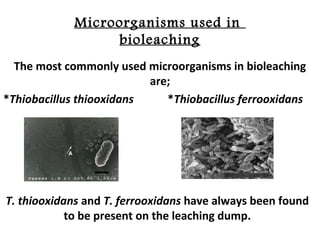
The most commonly used microorganisms in bioleaching
are;
*Thiobacillus thiooxidans *Thiobacillus ferrooxidans
T. thiooxidans and T. ferrooxidans have always been found
to be present on the leaching dump.
 Copper recovery from mine waters in the Mediterranean area
3000 years ago.
 The role of bacteria in bioleaching was shown in 1947.
 In 1950´s copper dump leaching.
 In 1960´s the first industrial copper heap leaching operation.
 First industrial gold bioleaching plant in 1980´s
 Nowadays about 40 plants in industrial use for copper, gold,
zinc, cobalt, uranium.
History
Features of organisms involved
Single celled organisms
Chemosynthetic metabolism
Derive carbon dioxide, oxygen from
atmosphere
Requires acidic PH
Procedure
Bacteria helps in regenerating major ore oxidizer, mostly ferric
ion. This reaction takes place in the cell membrane of
bacteria.
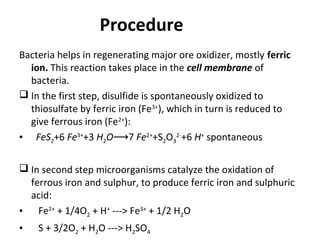
 In the first step, disulfide is spontaneously oxidized to
thiosulfate by ferric iron (Fe3+
), which in turn is reduced to
give ferrous iron (Fe2+
):
• FeS2+6 Fe3+
+3 H2O 7⟶ Fe2+
+S2O3
2-
+6 H+
spontaneous
 In second step microorganisms catalyze the oxidation of
ferrous iron and sulphur, to produce ferric iron and sulphuric
acid:
• Fe2+
+ 1/4O2 + H+
---> Fe3+
+ 1/2 H2O
• S + 3/2O2 + H2O ---> H2SO4
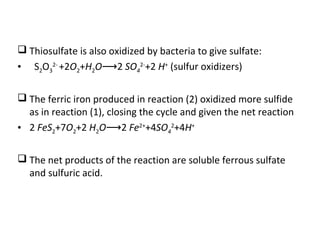
 Thiosulfate is also oxidized by bacteria to give sulfate:
• S2O3
2-
+2O2+H2O 2⟶ SO4
2-
+2 H+
(sulfur oxidizers)
 The ferric iron produced in reaction (2) oxidized more sulfide
as in reaction (1), closing the cycle and given the net reaction
• 2 FeS2+7O2+2 H2O 2⟶ Fe2+
+4SO4
2
+4H+
 The net products of the reaction are soluble ferrous sulfate
and sulfuric acid.
Mechanism involved in bioleaching
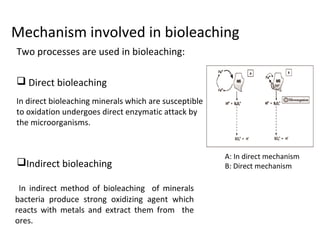
Two processes are used in bioleaching:
 Direct bioleaching
In direct bioleaching minerals which are susceptible
to oxidation undergoes direct enzymatic attack by
the microorganisms.
In indirect method of bioleaching of minerals
bacteria produce strong oxidizing agent which
reacts with metals and extract them from the
ores.
Indirect bioleaching
A: In direct mechanism
B: Direct mechanism
Commercial process of bioleaching
 Naturally occurring bioleaching process is very slow. For
commercial extraction of metal by bioleaching the process is
optimized by controlling the pH, temperature, humidity, O2
and CO2 concentrations.
 These processes are:
 Heap leaching
 In-situ leaching
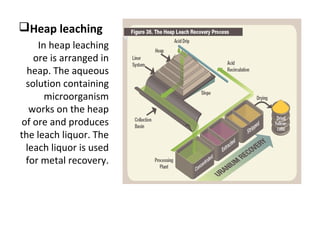
Heap leaching
In heap leaching
ore is arranged in
heap. The aqueous
solution containing
microorganism
works on the heap
of ore and produces
the leach liquor. The
leach liquor is used
for metal recovery.
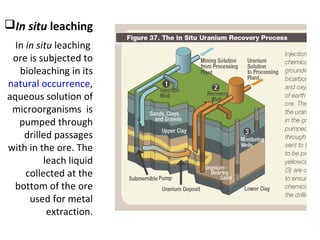
In situ leaching
In in situ leaching
ore is subjected to
bioleaching in its
natural occurrence,
aqueous solution of
microorganisms is
pumped through
drilled passages
with in the ore. The
leach liquid
collected at the
bottom of the ore
used for metal
extraction.
Ores of copper from which copper is
recovered are,
• Chalcocite(Cu2S)
• Chalcopyrite(CuFeS2)
• Covellite(CuS)
Examples
Copper leaching
• Copper leaching is operated as simple heap
leaching and in situ leaching process
• Dilute sulphuric acid is percolated down
through the pile
• Liquid coming out of bottom of pile rich in
mineral
• Liquid is collected and transported to
precipitation plant
• Metal is precipitated and purified
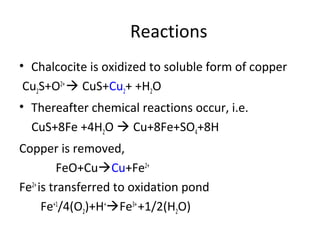
• Chalcocite is oxidized to soluble form of copper
Cu2S+O2+
 CuS+Cu2+ +H2O
• Thereafter chemical reactions occur, i.e.
CuS+8Fe +4H2O  Cu+8Fe+SO4+8H
Copper is removed,
FeO+CuCu+Fe2+
Fe2+
is transferred to oxidation pond
Fe+1
/4(O2)+H+
Fe3+
+1/2(H2O)
Reactions
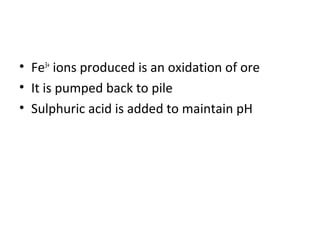
• Fe3+
ions produced is an oxidation of ore
• It is pumped back to pile
• Sulphuric acid is added to maintain pH
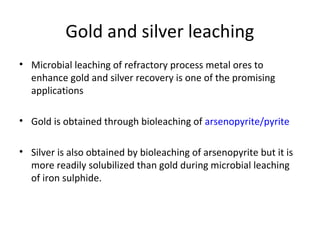
• Microbial leaching of refractory process metal ores to
enhance gold and silver recovery is one of the promising
applications
• Gold is obtained through bioleaching of arsenopyrite/pyrite
• Silver is also obtained by bioleaching of arsenopyrite but it is
more readily solubilized than gold during microbial leaching
of iron sulphide.
Gold and silver leaching
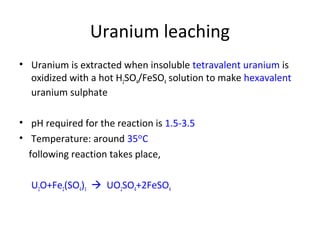
• Uranium is extracted when insoluble tetravalent uranium is
oxidized with a hot H2SO4/FeSO4 solution to make hexavalent
uranium sulphate
• pH required for the reaction is 1.5-3.5
• Temperature: around 35 Cᵒ
following reaction takes place,
U2O+Fe2(SO4)3  UO2SO4+2FeSO4
Uranium leaching
• Uranium leaching is an indirect process
• When T. ferrooxidans are involved in uranium extraction, they
do not directly attack on ore but on the iron oxidants.
• The pyrite reaction is used for the initial production of Fe
Reaction;
2FeS+H2O+7 ½[O2]  Fe2[SO4]3+ H2SO4
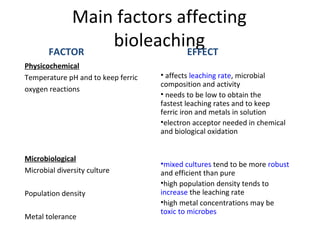
Main factors affecting
bioleachingFACTOR
Physicochemical
Temperature pH and to keep ferric
oxygen reactions
Microbiological
Microbial diversity culture
Population density
Metal tolerance
EFFECT
• affects leaching rate, microbial
composition and activity
• needs to be low to obtain the
fastest leaching rates and to keep
ferric iron and metals in solution
•electron acceptor needed in chemical
and biological oxidation
•mixed cultures tend to be more robust
and efficient than pure
•high population density tends to
increase the leaching rate
•high metal concentrations may be
toxic to microbes
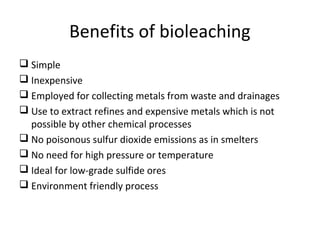
Benefits of bioleaching
 Simple
 Inexpensive
 Employed for collecting metals from waste and drainages
 Use to extract refines and expensive metals which is not
possible by other chemical processes
 No poisonous sulfur dioxide emissions as in smelters
 No need for high pressure or temperature
 Ideal for low-grade sulfide ores
 Environment friendly process
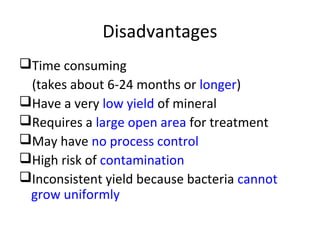
Disadvantages
Time consuming
(takes about 6-24 months or longer)
Have a very low yield of mineral
Requires a large open area for treatment
May have no process control
High risk of contamination
Inconsistent yield because bacteria cannot
grow uniformly
Thank you

Bioleaching its technique and applications

  • 1.
    Bioleaching: technique and application By: UtkarshRavindra Moon Indian Institute of Technology Kharagpur
  • 2.
    Bioleaching is thesimple and effective technology for metal extraction from low grade ores and mineral concentrate by the use of micro organisms. Commonly used microorganisms are:  Mesophiles  Moderately thermophilic bacteria  extremophiles
  • 3.
    Microorganisms used in bioleaching Themost commonly used microorganisms in bioleaching are; *Thiobacillus thiooxidans *Thiobacillus ferrooxidans T. thiooxidans and T. ferrooxidans have always been found to be present on the leaching dump.
  • 4.
     Copper recoveryfrom mine waters in the Mediterranean area 3000 years ago.  The role of bacteria in bioleaching was shown in 1947.  In 1950´s copper dump leaching.  In 1960´s the first industrial copper heap leaching operation.  First industrial gold bioleaching plant in 1980´s  Nowadays about 40 plants in industrial use for copper, gold, zinc, cobalt, uranium. History
  • 5.
    Features of organismsinvolved Single celled organisms Chemosynthetic metabolism Derive carbon dioxide, oxygen from atmosphere Requires acidic PH
  • 6.
    Procedure Bacteria helps inregenerating major ore oxidizer, mostly ferric ion. This reaction takes place in the cell membrane of bacteria.  In the first step, disulfide is spontaneously oxidized to thiosulfate by ferric iron (Fe3+ ), which in turn is reduced to give ferrous iron (Fe2+ ): • FeS2+6 Fe3+ +3 H2O 7⟶ Fe2+ +S2O3 2- +6 H+ spontaneous  In second step microorganisms catalyze the oxidation of ferrous iron and sulphur, to produce ferric iron and sulphuric acid: • Fe2+ + 1/4O2 + H+ ---> Fe3+ + 1/2 H2O • S + 3/2O2 + H2O ---> H2SO4
  • 7.
     Thiosulfate isalso oxidized by bacteria to give sulfate: • S2O3 2- +2O2+H2O 2⟶ SO4 2- +2 H+ (sulfur oxidizers)  The ferric iron produced in reaction (2) oxidized more sulfide as in reaction (1), closing the cycle and given the net reaction • 2 FeS2+7O2+2 H2O 2⟶ Fe2+ +4SO4 2 +4H+  The net products of the reaction are soluble ferrous sulfate and sulfuric acid.
  • 8.
    Mechanism involved inbioleaching Two processes are used in bioleaching:  Direct bioleaching In direct bioleaching minerals which are susceptible to oxidation undergoes direct enzymatic attack by the microorganisms. In indirect method of bioleaching of minerals bacteria produce strong oxidizing agent which reacts with metals and extract them from the ores. Indirect bioleaching A: In direct mechanism B: Direct mechanism
  • 9.
    Commercial process ofbioleaching  Naturally occurring bioleaching process is very slow. For commercial extraction of metal by bioleaching the process is optimized by controlling the pH, temperature, humidity, O2 and CO2 concentrations.  These processes are:  Heap leaching  In-situ leaching
  • 10.
    Heap leaching In heapleaching ore is arranged in heap. The aqueous solution containing microorganism works on the heap of ore and produces the leach liquor. The leach liquor is used for metal recovery.
  • 11.
    In situ leaching Inin situ leaching ore is subjected to bioleaching in its natural occurrence, aqueous solution of microorganisms is pumped through drilled passages with in the ore. The leach liquid collected at the bottom of the ore used for metal extraction.
  • 12.
    Ores of copperfrom which copper is recovered are, • Chalcocite(Cu2S) • Chalcopyrite(CuFeS2) • Covellite(CuS) Examples Copper leaching
  • 13.
    • Copper leachingis operated as simple heap leaching and in situ leaching process • Dilute sulphuric acid is percolated down through the pile • Liquid coming out of bottom of pile rich in mineral • Liquid is collected and transported to precipitation plant • Metal is precipitated and purified
  • 14.
    • Chalcocite isoxidized to soluble form of copper Cu2S+O2+  CuS+Cu2+ +H2O • Thereafter chemical reactions occur, i.e. CuS+8Fe +4H2O  Cu+8Fe+SO4+8H Copper is removed, FeO+CuCu+Fe2+ Fe2+ is transferred to oxidation pond Fe+1 /4(O2)+H+ Fe3+ +1/2(H2O) Reactions
  • 15.
    • Fe3+ ions producedis an oxidation of ore • It is pumped back to pile • Sulphuric acid is added to maintain pH
  • 16.
    • Microbial leachingof refractory process metal ores to enhance gold and silver recovery is one of the promising applications • Gold is obtained through bioleaching of arsenopyrite/pyrite • Silver is also obtained by bioleaching of arsenopyrite but it is more readily solubilized than gold during microbial leaching of iron sulphide. Gold and silver leaching
  • 17.
    • Uranium isextracted when insoluble tetravalent uranium is oxidized with a hot H2SO4/FeSO4 solution to make hexavalent uranium sulphate • pH required for the reaction is 1.5-3.5 • Temperature: around 35 Cᵒ following reaction takes place, U2O+Fe2(SO4)3  UO2SO4+2FeSO4 Uranium leaching
  • 18.
    • Uranium leachingis an indirect process • When T. ferrooxidans are involved in uranium extraction, they do not directly attack on ore but on the iron oxidants. • The pyrite reaction is used for the initial production of Fe Reaction; 2FeS+H2O+7 ½[O2]  Fe2[SO4]3+ H2SO4
  • 19.
    Main factors affecting bioleachingFACTOR Physicochemical TemperaturepH and to keep ferric oxygen reactions Microbiological Microbial diversity culture Population density Metal tolerance EFFECT • affects leaching rate, microbial composition and activity • needs to be low to obtain the fastest leaching rates and to keep ferric iron and metals in solution •electron acceptor needed in chemical and biological oxidation •mixed cultures tend to be more robust and efficient than pure •high population density tends to increase the leaching rate •high metal concentrations may be toxic to microbes
  • 20.
    Benefits of bioleaching Simple  Inexpensive  Employed for collecting metals from waste and drainages  Use to extract refines and expensive metals which is not possible by other chemical processes  No poisonous sulfur dioxide emissions as in smelters  No need for high pressure or temperature  Ideal for low-grade sulfide ores  Environment friendly process
  • 21.
    Disadvantages Time consuming (takes about6-24 months or longer) Have a very low yield of mineral Requires a large open area for treatment May have no process control High risk of contamination Inconsistent yield because bacteria cannot grow uniformly
  • 22.