Transportation Network
Design
Name:M.sneha
Latha Latha
Roll no: 98
Introduction to Transportation Network
Design
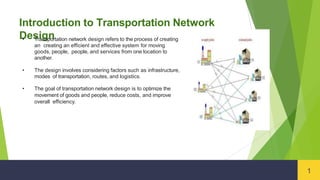
• Transportation network design refers to the process of creating
an creating an efficient and effective system for moving
goods, people, people, and services from one location to
another.
• The design involves considering factors such as infrastructure,
modes of transportation, routes, and logistics.
• The goal of transportation network design is to optimize the
movement of goods and people, reduce costs, and improve
overall efficiency.
1
Key Components of Transportation Network
Design
2
• Infrastructure: The physical facilities, such as roads, railways,
airports, and airports, and ports, that are essential for
transportation.
• Modes of Transportation: The different methods used for moving
goods
and people, including road, rail, air, and water.
• Routes: The paths or corridors chosen for transportation,
considering
factors like distance, accessibility, and cost.
Factors Influencing Transportation Network
Design
3
• Demand: The volume and nature of goods and people that
need to be transported, including time sensitivity and frequency.
• Geography: The physical layout and features of an area,
such as mountains, rivers, and coastlines, that impact
transportation infrastructure and route planning.
• Economic Considerations: The costs associated with
transportation, including fuel, labor, maintenance, and
infrastructure development.
Benefits of Effective Transportation Network
Design
4
• Improved Efficiency: A well-designed transportation network
reduces travel time, congestion, and delays, resulting in faster
delivery and reduced costs.
• Enhanced Sustainability: Optimal transportation network
design can minimize environmental impacts by promoting the
use of cleanerand more efficient transportation modes.
• Economic Growth: An efficient transportation network facilitates
trade, commerce, and economic development by connecting
businesses, industries, and markets.
Challenges in Transportation Network
Design
5
• Changing Demands: Transportation needs evolve over time,
requiring ongoing monitoring and adaptation of the network
design to meet new requirements.
• Limited Resources: Designing and implementing
transportation infrastructure can be costly, and limited funding
and resources may constrain network development.
• Stakeholder Coordination: Transportation network design
involves collaboration and coordination among multiple
stakeholders, including government agencies, private entities,
and community representatives.
Conclusio
n
6
• Transportation network design is crucial for optimizing the
movement of goods and people, reducing costs, and improving
overall efficiency.
• It involves considering factors such as infrastructure, modes of
transportation, routes, and logistics.
• Effective transportation network design can bring numerous
benefits, including improved efficiency, enhanced sustainability,
and economic growth, while also addressing challenges such
as changing demands, limited resources, and stakeholder
coordination.

TRANSPORTATION NETWORK DESIGN

TRANSPORTATION NETWORK DESIGN

  • 1.
  • 2.
    Introduction to TransportationNetwork Design • Transportation network design refers to the process of creating an creating an efficient and effective system for moving goods, people, people, and services from one location to another. • The design involves considering factors such as infrastructure, modes of transportation, routes, and logistics. • The goal of transportation network design is to optimize the movement of goods and people, reduce costs, and improve overall efficiency. 1
  • 3.
    Key Components ofTransportation Network Design 2 • Infrastructure: The physical facilities, such as roads, railways, airports, and airports, and ports, that are essential for transportation. • Modes of Transportation: The different methods used for moving goods and people, including road, rail, air, and water. • Routes: The paths or corridors chosen for transportation, considering factors like distance, accessibility, and cost.
  • 4.
    Factors Influencing TransportationNetwork Design 3 • Demand: The volume and nature of goods and people that need to be transported, including time sensitivity and frequency. • Geography: The physical layout and features of an area, such as mountains, rivers, and coastlines, that impact transportation infrastructure and route planning. • Economic Considerations: The costs associated with transportation, including fuel, labor, maintenance, and infrastructure development.
  • 5.
    Benefits of EffectiveTransportation Network Design 4 • Improved Efficiency: A well-designed transportation network reduces travel time, congestion, and delays, resulting in faster delivery and reduced costs. • Enhanced Sustainability: Optimal transportation network design can minimize environmental impacts by promoting the use of cleanerand more efficient transportation modes. • Economic Growth: An efficient transportation network facilitates trade, commerce, and economic development by connecting businesses, industries, and markets.
  • 6.
    Challenges in TransportationNetwork Design 5 • Changing Demands: Transportation needs evolve over time, requiring ongoing monitoring and adaptation of the network design to meet new requirements. • Limited Resources: Designing and implementing transportation infrastructure can be costly, and limited funding and resources may constrain network development. • Stakeholder Coordination: Transportation network design involves collaboration and coordination among multiple stakeholders, including government agencies, private entities, and community representatives.
  • 7.
    Conclusio n 6 • Transportation networkdesign is crucial for optimizing the movement of goods and people, reducing costs, and improving overall efficiency. • It involves considering factors such as infrastructure, modes of transportation, routes, and logistics. • Effective transportation network design can bring numerous benefits, including improved efficiency, enhanced sustainability, and economic growth, while also addressing challenges such as changing demands, limited resources, and stakeholder coordination.