PRINCIPLE OF
TRANSPORTATION
ENGINEERING
CE 412
TRANSPORTATION
AND
SOCIETY
Chapter 1
Transportation is an essential part of
today's life. It has been an essential
part of most societies of the past. One
can hardly conceive of a future society
in which it would not continue to be
essential. The adequacy of its
transportation system is a fair index of
a country's economic development.
INTRODUCTION
TABLE OF
CONTENTS
FUNCTION
01 SIGNIFICANCE
02
TRANSPORTATION
ENGINEERING
03 ROLE OF
TRANSPORTATION
ENGINEER
04
TABLE OF
CONTENTS
MAJOR
DISCIPLINES OF
TRANSPORTATION
05 ROLE OF CIVIL
ENGINEER IN
HIGHWAY AND
TRANSPORTATION
06
FUNCTION
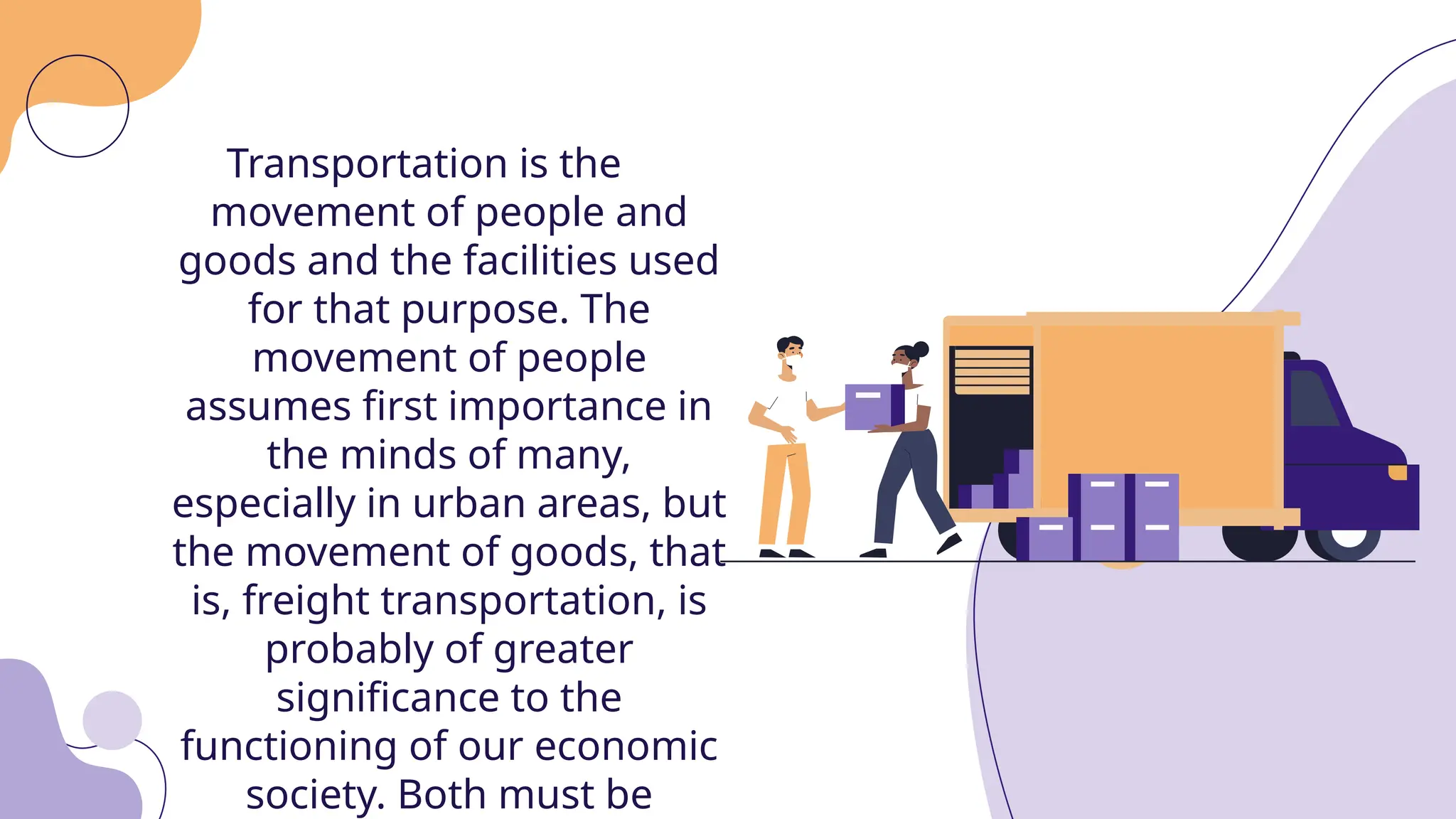
Transportation is the
movement of people and
goods and the facilities used
for that purpose. The
movement of people
assumes first importance in
the minds of many,
especially in urban areas, but
the movement of goods, that
is, freight transportation, is
probably of greater
significance to the
functioning of our economic
society. Both must be
SIGNIFICANCE
of transportation in the society
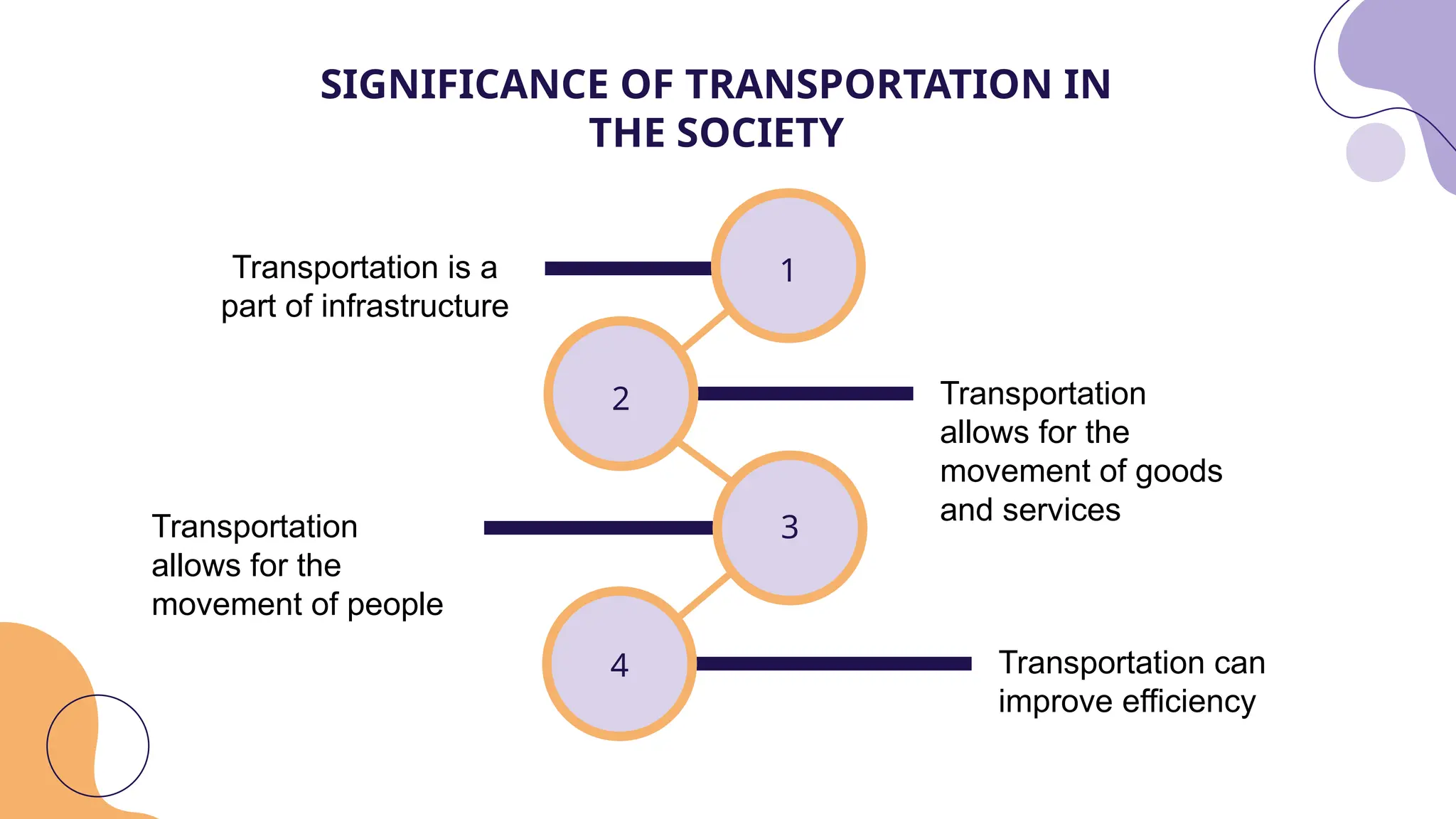
SIGNIFICANCE OF TRANSPORTATION IN
THE SOCIETY
Transportation is a
part of infrastructure
Transportation
allows for the
movement of people
Transportation
allows for the
movement of goods
and services
Transportation can
improve efficiency
1
2
4
3
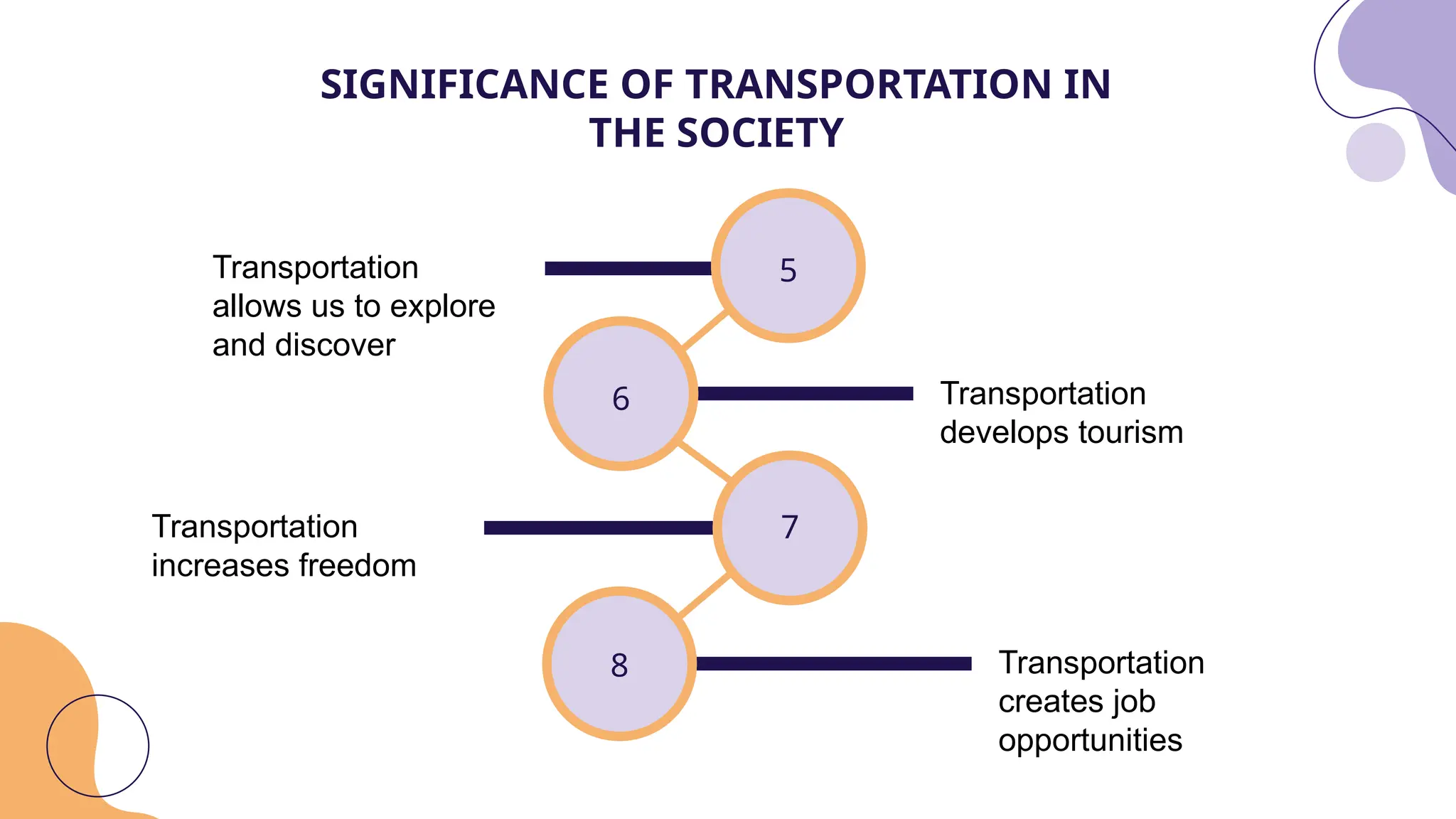
SIGNIFICANCE OF TRANSPORTATION IN
THE SOCIETY
Transportation
allows us to explore
and discover
Transportation
increases freedom
Transportation
develops tourism
Transportation
creates job
opportunities
5
6
8
7
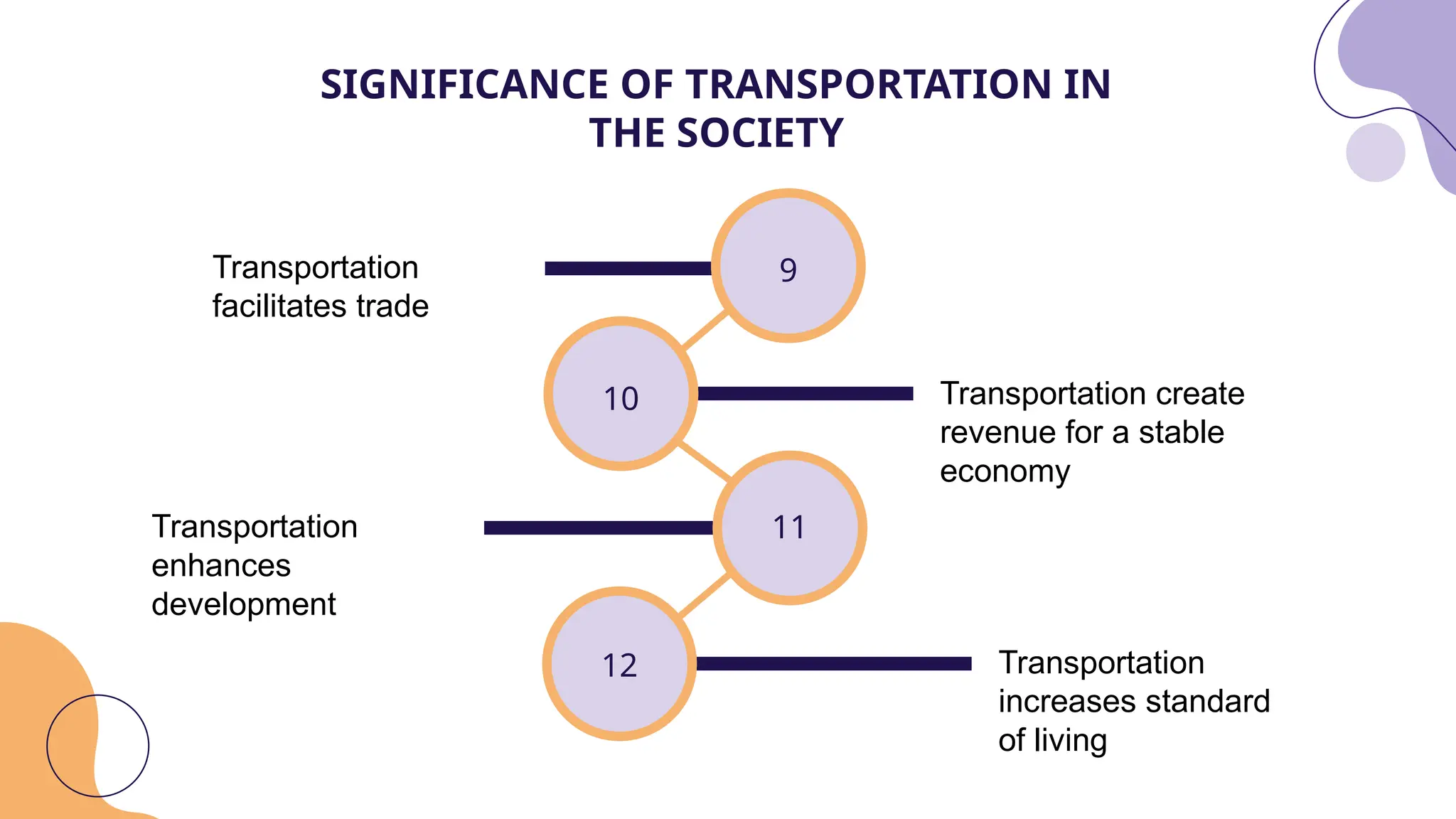
SIGNIFICANCE OF TRANSPORTATION IN
THE SOCIETY
Transportation
facilitates trade
Transportation
enhances
development
Transportation create
revenue for a stable
economy
Transportation
increases standard
of living
9
10
12
11
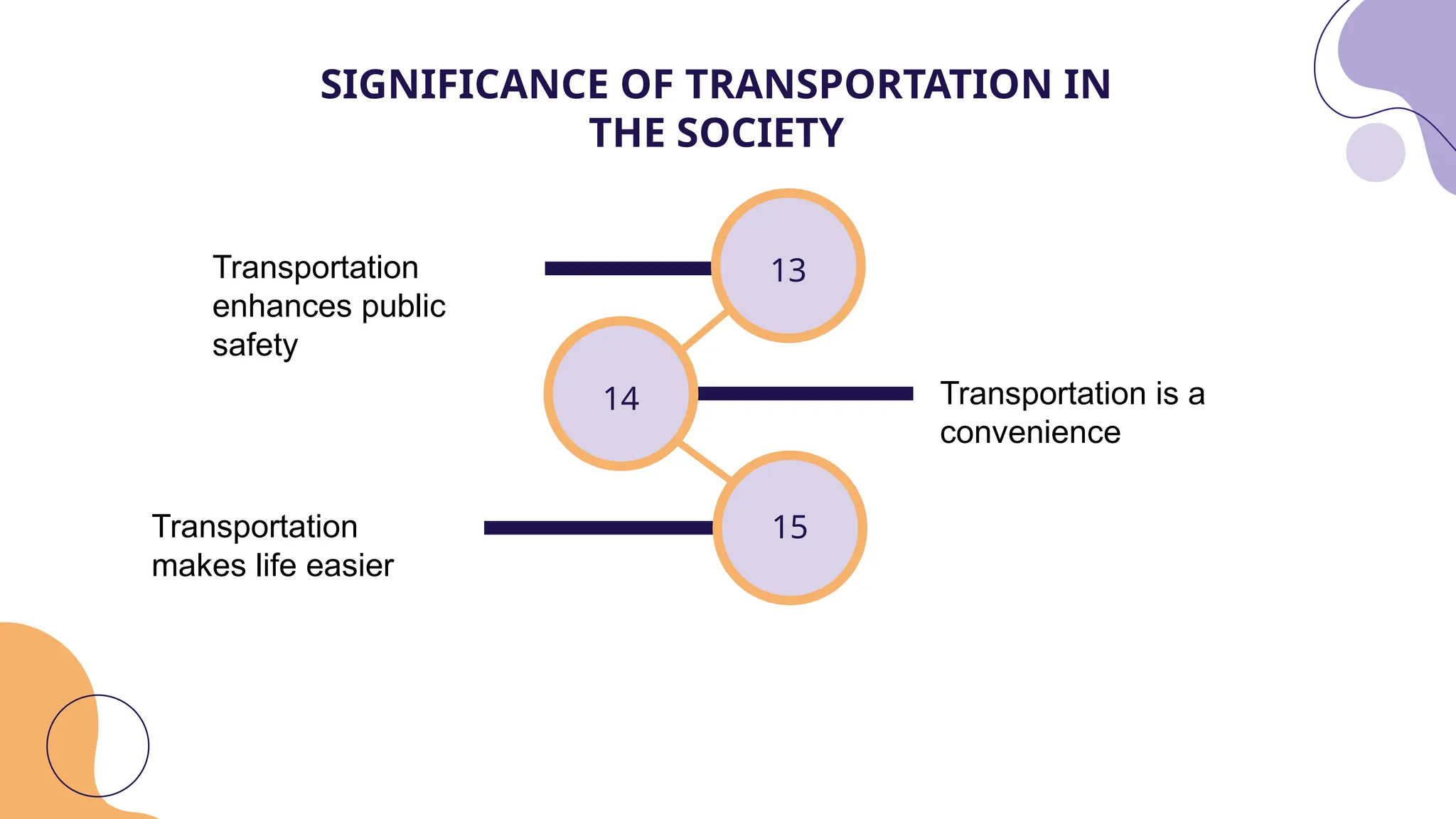
SIGNIFICANCE OF TRANSPORTATION IN
THE SOCIETY
Transportation
enhances public
safety
Transportation
makes life easier
Transportation is a
convenience
13
14
15
TRANSPORTATION
ENGINEERING
Transportation Engineering
Transportation engineering is a branch of
civil engineering that involves the
planning, design, operation, and
maintenance of transportation systems to
help build smart, safe, and livable
communities.
Any system that moves people and goods
from one place to another falls under the
scope of transportation engineering,
which includes:
• Highway and roadways
• Railway
• Oil pipelines
• Public transport systems
• Traffic control
systems
• Automated transport
systems
• Space transport systems
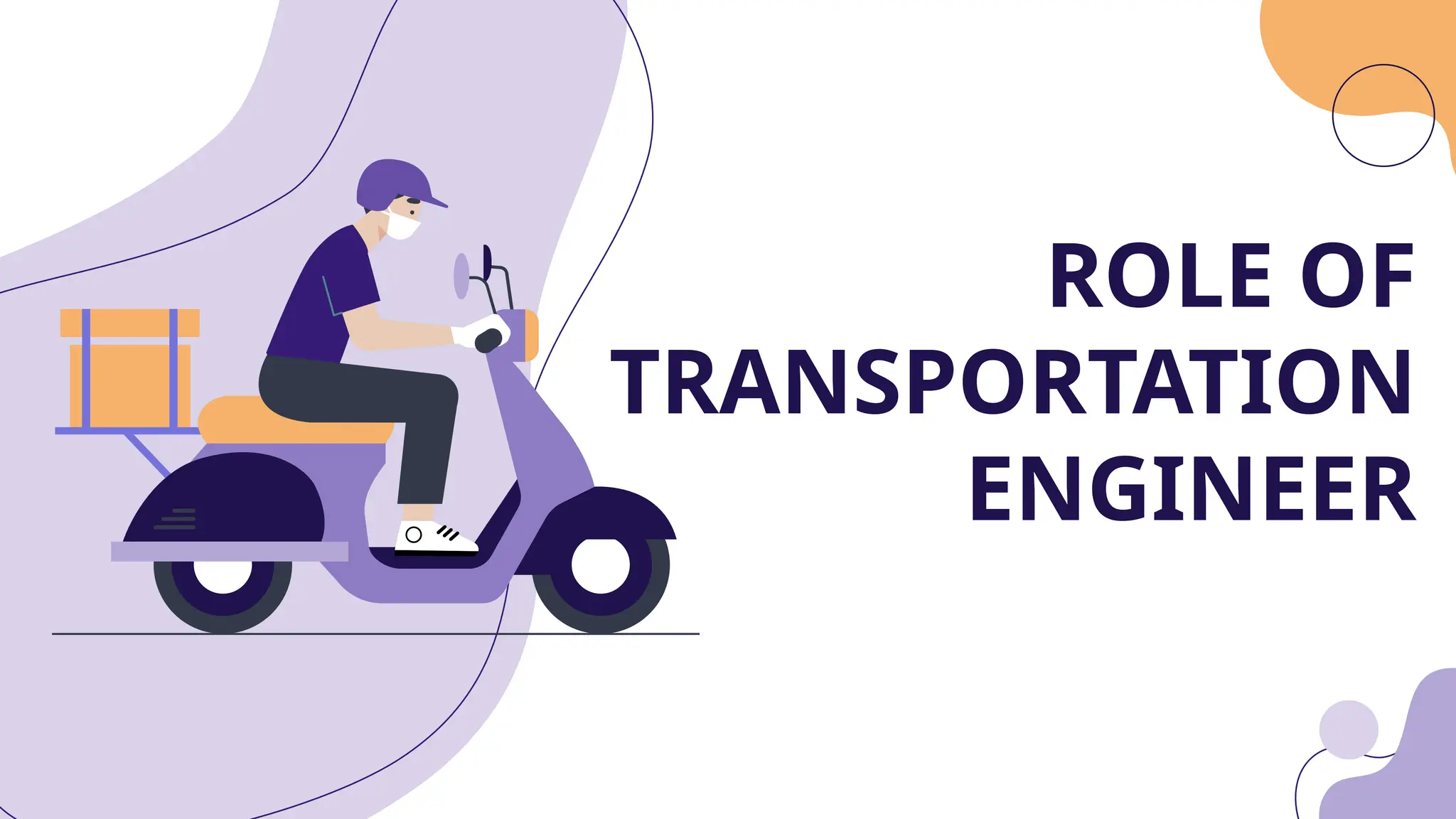
ROLE OF
TRANSPORTATION
ENGINEER
In spite of the diversity of problem types, institutional contexts and
technical perspectives there is an underlying unity: a body of theory
and set of basic principles to be utilized in every analysis of
transportation systems. The core of this is the transportation system
analysis approach. The focus of this is the interaction between the
transportation and activity systems of region. This approach is to
intervene, delicately and deliberately in the complex fabric of society to
use transport effectively in coordination with other public and private
actions to achieve the goals of that society. For this the analyst must
have substantial understanding of the transportation systems and
their interaction with activity systems; which requires understanding of
the basic theoretical concepts and available empirical knowledge.
MAJOR DISCIPLINES
OF
TRANSPORTATION
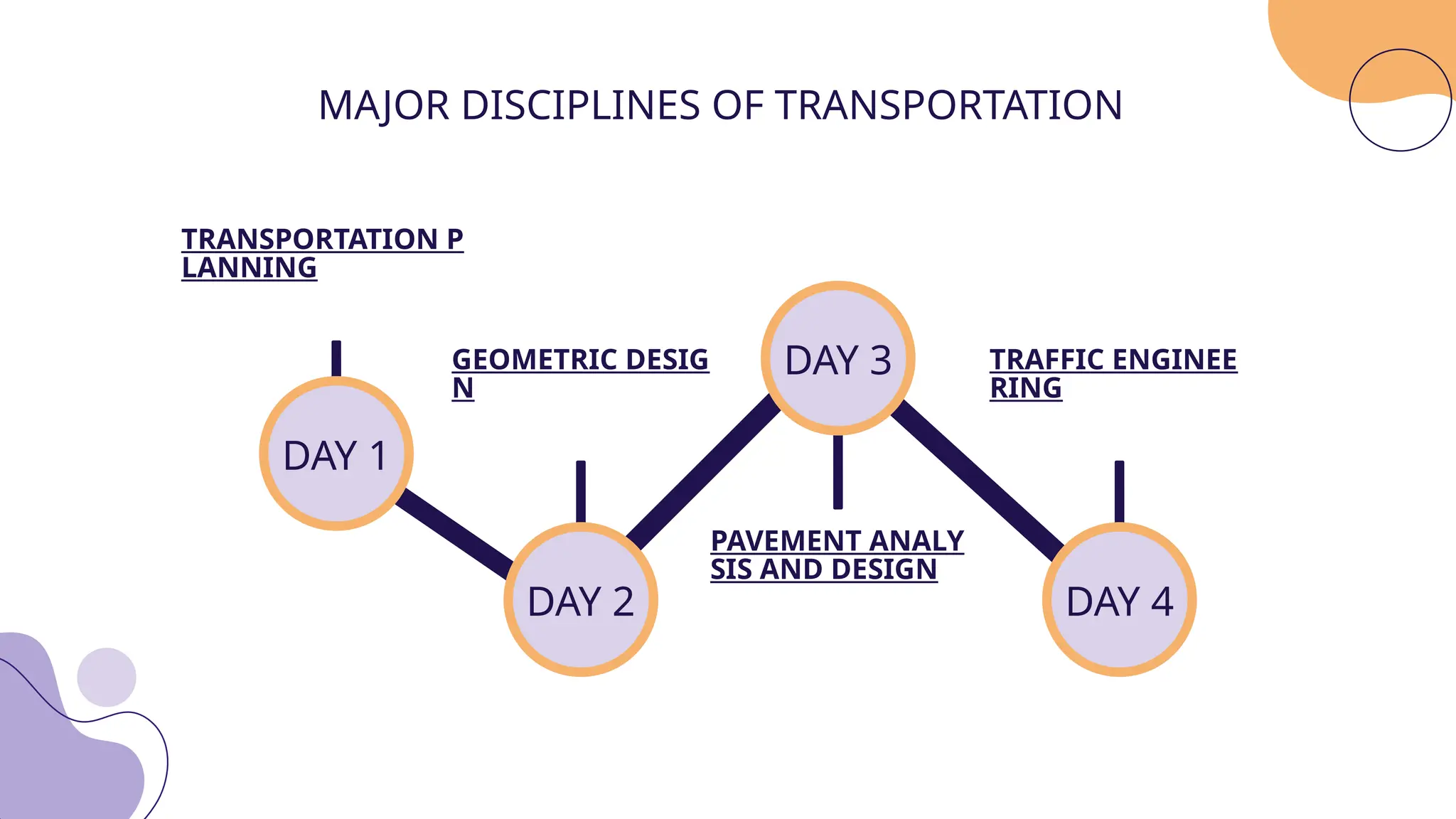
MAJOR DISCIPLINES OF TRANSPORTATION
DAY 1
DAY 2
DAY 3
DAY 4
TRANSPORTATION P
LANNING
GEOMETRIC DESIG
N
PAVEMENT ANALY
SIS AND DESIGN
TRAFFIC ENGINEE
RING
Transportation planning essentially
involves the development of a
transport model which will
accurately represent both the
current as well as future
transportation system.
TRANSPORTATION PLANNING
GEOMETRIC DESIGN
Geometric design deals with physical
proportioning of other transportation facilities, in
contrast with the structural design of the facilities.
The topics include the cross-sectional features,
horizontal alignment, vertical alignment and
intersections. Although there are several modes
of travel like road, rail, air, etc.. the underlying
principles are common to a great extent.
Therefore emphasis will be normally given for the
geometric design of roads.
PAVEMENT ANALYSIS AND DESIGN
Pavement design deals with the structural design of roads,
both (bituminous and concrete), commonly known as
(flexible pavements and rigid pavements) respectively. It
deals with the design of paving materials, determination of
the layer thickness, and construction and maintenance
procedures. The design mainly covers structural aspects,
functional aspects, drainage. Structural design ensures the
pavement has enough strength to withstand the impact of
loads, functional design emphasizes on the riding quality,
and the drainage design protects the pavement from
TRAFFIC ENGINEERING
Traffic engineering covers a broad range of engineering applications with
a focus on the safety of the public, the efficient use of transportation
resources, and the mobility of people and goods. Traffic engineering
involves a variety of engineering and management skills, including design,
operation, and system optimization. In order to address the above
requirement, the traffic engineer must first understand the traffic flow
behaviour and characteristics by extensive collection of traffic flow data
and analysis. Based on this analysis, traffic flow is controlled so that the
transport infrastructure is used optimally as well as with good service
quality. In short, the role of traffic engineer is to protect the environment
while providing mobility , to preserve scarce resources while assuring
economic activity, and to assure safety and security to people and vehicles,
through both acceptable practices and high-tech communications.
ROLE OF CIVIL
ENGINEER IN
HIGHWAY AND
TRANSPORTATION
PLANNING AND DESIGN: route selection, geometric
design, and structural design
CONSTRUCTION MANAGEMENT: project
management, material selection, and quality
control
TRANSPORTATION SYSTEM: traffic engineering,
public transit integration, and safety analysis
ROLE OF CIVIL ENGINNER IN HIGHWAY AND
TRANSPORTATION FACILITIES AND SERVICES
ENVIRONMENTAL AND SOCIAL CONSIDERATION:
environmental impact assessment, sustainability,
and community engagement
MAINTENANCE AND REHABILITATIONS: routine
maintenance and rehabilitation and upgrading
ROLE OF CIVIL ENGINNER IN HIGHWAY AND
TRANSPORTATION FACILITIES AND SERVICES
References:
1. Transportation Engineering I by Tom V. Mathew
2. An Introduction to Transportation Engineering by William
W. Hay second edition
3. https://
curiousdesire.com/reasons-why-transportation-is-importa
nt/
4. https
://online.egr.msu.edu/articles/what-is-transportation-engi
neering/
THANK YOU!

GROUP-1-CHAPTER-PRESENTATION-TRANSPORTATION

  • 1.
  • 2.
  • 3.
    Transportation is anessential part of today's life. It has been an essential part of most societies of the past. One can hardly conceive of a future society in which it would not continue to be essential. The adequacy of its transportation system is a fair index of a country's economic development. INTRODUCTION
  • 4.
  • 5.
    TABLE OF CONTENTS MAJOR DISCIPLINES OF TRANSPORTATION 05ROLE OF CIVIL ENGINEER IN HIGHWAY AND TRANSPORTATION 06
  • 6.
  • 7.
    Transportation is the movementof people and goods and the facilities used for that purpose. The movement of people assumes first importance in the minds of many, especially in urban areas, but the movement of goods, that is, freight transportation, is probably of greater significance to the functioning of our economic society. Both must be
  • 8.
  • 9.
    SIGNIFICANCE OF TRANSPORTATIONIN THE SOCIETY Transportation is a part of infrastructure Transportation allows for the movement of people Transportation allows for the movement of goods and services Transportation can improve efficiency 1 2 4 3
  • 10.
    SIGNIFICANCE OF TRANSPORTATIONIN THE SOCIETY Transportation allows us to explore and discover Transportation increases freedom Transportation develops tourism Transportation creates job opportunities 5 6 8 7
  • 11.
    SIGNIFICANCE OF TRANSPORTATIONIN THE SOCIETY Transportation facilitates trade Transportation enhances development Transportation create revenue for a stable economy Transportation increases standard of living 9 10 12 11
  • 12.
    SIGNIFICANCE OF TRANSPORTATIONIN THE SOCIETY Transportation enhances public safety Transportation makes life easier Transportation is a convenience 13 14 15
  • 13.
  • 14.
    Transportation Engineering Transportation engineeringis a branch of civil engineering that involves the planning, design, operation, and maintenance of transportation systems to help build smart, safe, and livable communities. Any system that moves people and goods from one place to another falls under the scope of transportation engineering, which includes:
  • 15.
    • Highway androadways • Railway • Oil pipelines • Public transport systems • Traffic control systems • Automated transport systems • Space transport systems
  • 16.
  • 17.
    In spite ofthe diversity of problem types, institutional contexts and technical perspectives there is an underlying unity: a body of theory and set of basic principles to be utilized in every analysis of transportation systems. The core of this is the transportation system analysis approach. The focus of this is the interaction between the transportation and activity systems of region. This approach is to intervene, delicately and deliberately in the complex fabric of society to use transport effectively in coordination with other public and private actions to achieve the goals of that society. For this the analyst must have substantial understanding of the transportation systems and their interaction with activity systems; which requires understanding of the basic theoretical concepts and available empirical knowledge.
  • 18.
  • 19.
    MAJOR DISCIPLINES OFTRANSPORTATION DAY 1 DAY 2 DAY 3 DAY 4 TRANSPORTATION P LANNING GEOMETRIC DESIG N PAVEMENT ANALY SIS AND DESIGN TRAFFIC ENGINEE RING
  • 20.
    Transportation planning essentially involvesthe development of a transport model which will accurately represent both the current as well as future transportation system. TRANSPORTATION PLANNING
  • 21.
    GEOMETRIC DESIGN Geometric designdeals with physical proportioning of other transportation facilities, in contrast with the structural design of the facilities. The topics include the cross-sectional features, horizontal alignment, vertical alignment and intersections. Although there are several modes of travel like road, rail, air, etc.. the underlying principles are common to a great extent. Therefore emphasis will be normally given for the geometric design of roads.
  • 22.
    PAVEMENT ANALYSIS ANDDESIGN Pavement design deals with the structural design of roads, both (bituminous and concrete), commonly known as (flexible pavements and rigid pavements) respectively. It deals with the design of paving materials, determination of the layer thickness, and construction and maintenance procedures. The design mainly covers structural aspects, functional aspects, drainage. Structural design ensures the pavement has enough strength to withstand the impact of loads, functional design emphasizes on the riding quality, and the drainage design protects the pavement from
  • 23.
    TRAFFIC ENGINEERING Traffic engineeringcovers a broad range of engineering applications with a focus on the safety of the public, the efficient use of transportation resources, and the mobility of people and goods. Traffic engineering involves a variety of engineering and management skills, including design, operation, and system optimization. In order to address the above requirement, the traffic engineer must first understand the traffic flow behaviour and characteristics by extensive collection of traffic flow data and analysis. Based on this analysis, traffic flow is controlled so that the transport infrastructure is used optimally as well as with good service quality. In short, the role of traffic engineer is to protect the environment while providing mobility , to preserve scarce resources while assuring economic activity, and to assure safety and security to people and vehicles, through both acceptable practices and high-tech communications.
  • 24.
    ROLE OF CIVIL ENGINEERIN HIGHWAY AND TRANSPORTATION
  • 25.
    PLANNING AND DESIGN:route selection, geometric design, and structural design CONSTRUCTION MANAGEMENT: project management, material selection, and quality control TRANSPORTATION SYSTEM: traffic engineering, public transit integration, and safety analysis ROLE OF CIVIL ENGINNER IN HIGHWAY AND TRANSPORTATION FACILITIES AND SERVICES
  • 26.
    ENVIRONMENTAL AND SOCIALCONSIDERATION: environmental impact assessment, sustainability, and community engagement MAINTENANCE AND REHABILITATIONS: routine maintenance and rehabilitation and upgrading ROLE OF CIVIL ENGINNER IN HIGHWAY AND TRANSPORTATION FACILITIES AND SERVICES
  • 27.
    References: 1. Transportation EngineeringI by Tom V. Mathew 2. An Introduction to Transportation Engineering by William W. Hay second edition 3. https:// curiousdesire.com/reasons-why-transportation-is-importa nt/ 4. https ://online.egr.msu.edu/articles/what-is-transportation-engi neering/
  • 28.