Tobby Gondwe
ZACODE
Calculating Frequency Densities
Introduction
 Frequency density is a way of presenting the
frequency in a compacted way.
 To calculate frequency density, we use the
formula:
 Frequency Density =
𝐹𝑟𝑒𝑞𝑢𝑒𝑛𝑐𝑦
𝐶𝑙𝑎𝑠𝑠 𝑤𝑖𝑑𝑡ℎ
Example
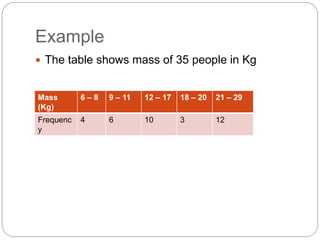
 The table shows mass of 35 people in Kg
Mass
(Kg)
6 – 8 9 – 11 12 – 17 18 – 20 21 – 29
Frequenc
y
4 6 10 3 12
Frequency Densities
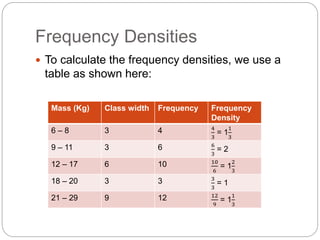
 To calculate the frequency densities, we use a
table as shown here:
Mass (Kg) Class width Frequency Frequency
Density
6 – 8 3 4 4
3
= 1
1
3
9 – 11 3 6 6
3
= 2
12 – 17 6 10 10
6
= 1
2
3
18 – 20 3 3 3
3
= 1
21 – 29 9 12 12
9
= 1
1
3
Frequency Densities
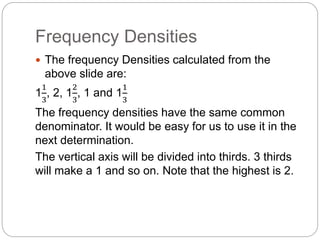
 The frequency Densities calculated from the
above slide are:
1
1
3
, 2, 1
2
3
, 1 and 1
1
3
The frequency densities have the same common
denominator. It would be easy for us to use it in the
next determination.
The vertical axis will be divided into thirds. 3 thirds
will make a 1 and so on. Note that the highest is 2.
Class boundaries
 Using the lowest class width, we determine the
class boundaries.
 Since our lowest mass is 6, our first class
boundary is 5.5.
 To find the second, we add 3(lowest class width)
to 5.5 and get 8.5.
 We continue adding 3 and get the following class
boundary values:
 5.5, 8.5, 11.5, 14.5, 17.5, 20.5, 23.5, 26.5 and
29.5.
Drawing the Histogram
On the Horizontal axis:
As seen from the class boundary values,
 the one with class width 6, takes up two classes
from 11.5 to 17.5 and
 the one with class width 9 takes up three classes
from 20.5 to 29.5.
 The rest of the classes take up one class each
Histogram
 In the end the histogram appears as shown here:
Area Under the Histogram
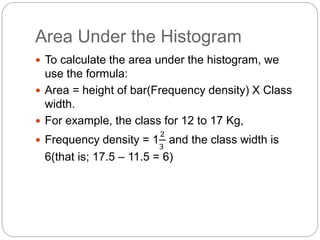
 To calculate the area under the histogram, we
use the formula:
 Area = height of bar(Frequency density) X Class
width.
 For example, the class for 12 to 17 Kg,
 Frequency density = 1
2
3
and the class width is
6(that is; 17.5 – 11.5 = 6)
Area under the Histogram
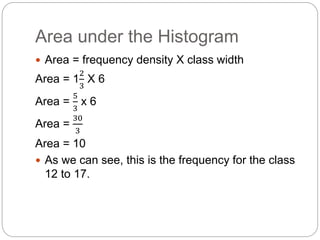
 Area = frequency density X class width
Area = 1
2
3
X 6
Area =
5
3
x 6
Area =
30
3
Area = 10
 As we can see, this is the frequency for the class
12 to 17.
Remember!
Area ∝ Frequency!
 Thank you!

Calculating frequency densities

  • 1.
  • 2.
    Introduction  Frequency densityis a way of presenting the frequency in a compacted way.  To calculate frequency density, we use the formula:  Frequency Density = 𝐹𝑟𝑒𝑞𝑢𝑒𝑛𝑐𝑦 𝐶𝑙𝑎𝑠𝑠 𝑤𝑖𝑑𝑡ℎ
  • 3.
    Example  The tableshows mass of 35 people in Kg Mass (Kg) 6 – 8 9 – 11 12 – 17 18 – 20 21 – 29 Frequenc y 4 6 10 3 12
  • 4.
    Frequency Densities  Tocalculate the frequency densities, we use a table as shown here: Mass (Kg) Class width Frequency Frequency Density 6 – 8 3 4 4 3 = 1 1 3 9 – 11 3 6 6 3 = 2 12 – 17 6 10 10 6 = 1 2 3 18 – 20 3 3 3 3 = 1 21 – 29 9 12 12 9 = 1 1 3
  • 5.
    Frequency Densities  Thefrequency Densities calculated from the above slide are: 1 1 3 , 2, 1 2 3 , 1 and 1 1 3 The frequency densities have the same common denominator. It would be easy for us to use it in the next determination. The vertical axis will be divided into thirds. 3 thirds will make a 1 and so on. Note that the highest is 2.
  • 6.
    Class boundaries  Usingthe lowest class width, we determine the class boundaries.  Since our lowest mass is 6, our first class boundary is 5.5.  To find the second, we add 3(lowest class width) to 5.5 and get 8.5.  We continue adding 3 and get the following class boundary values:  5.5, 8.5, 11.5, 14.5, 17.5, 20.5, 23.5, 26.5 and 29.5.
  • 7.
    Drawing the Histogram Onthe Horizontal axis: As seen from the class boundary values,  the one with class width 6, takes up two classes from 11.5 to 17.5 and  the one with class width 9 takes up three classes from 20.5 to 29.5.  The rest of the classes take up one class each
  • 8.
    Histogram  In theend the histogram appears as shown here:
  • 9.
    Area Under theHistogram  To calculate the area under the histogram, we use the formula:  Area = height of bar(Frequency density) X Class width.  For example, the class for 12 to 17 Kg,  Frequency density = 1 2 3 and the class width is 6(that is; 17.5 – 11.5 = 6)
  • 10.
    Area under theHistogram  Area = frequency density X class width Area = 1 2 3 X 6 Area = 5 3 x 6 Area = 30 3 Area = 10  As we can see, this is the frequency for the class 12 to 17.
  • 11.