INTRODUCTION TO SYSTEMS 
THINKING 
Professor Ockie Bosch 
Dr Nam Nguyen
Introduction to the systems concept 
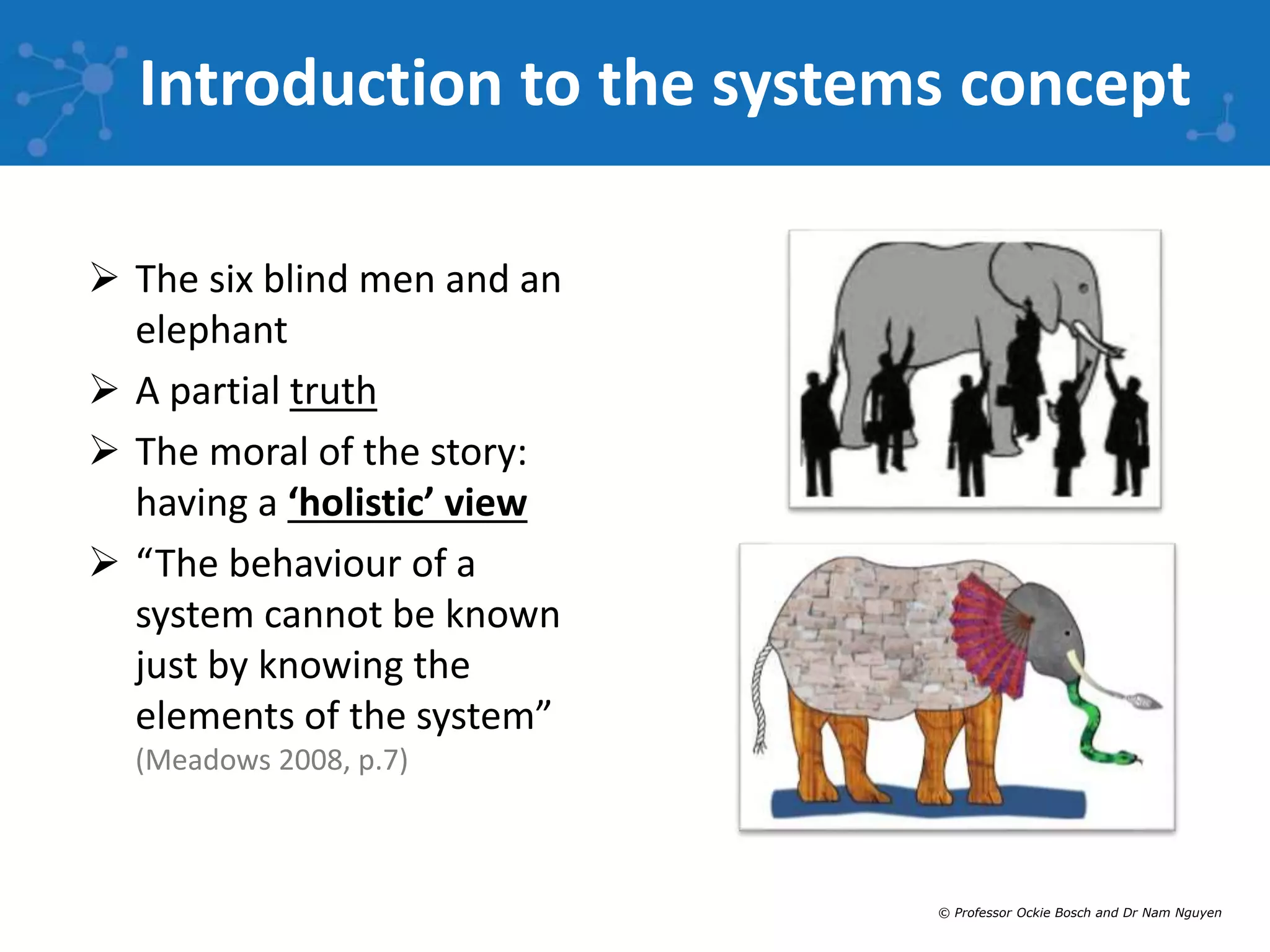
 The six blind men and an 
elephant 
 A partial truth 
 The moral of the story: 
having a ‘holistic’ view 
 “The behaviour of a 
system cannot be known 
just by knowing the 
elements of the system” 
(Meadows 2008, p.7) 
© Professor Ockie Bosch and Dr Nam Nguyen
Definitions of Systems 
 “A system is a set of elements or parts that is 
coherently organised and interconnected in a pattern 
or structure that produces a characteristic set of a 
behaviours, often classified as its ‘function’ or 
‘purpose’” (Meadows 2008, p.188) 
 “Simply defined, a system is a complex whole the 
functioning of which depends on its parts and the 
interactions between those parts” (Jackson 2003, p.3) 
 “A system is more than the sum of its parts – it is the 
product of their interactions” (Ackoff 1999) 
© Professor Ockie Bosch and Dr Nam Nguyen
A System versus a Collection 
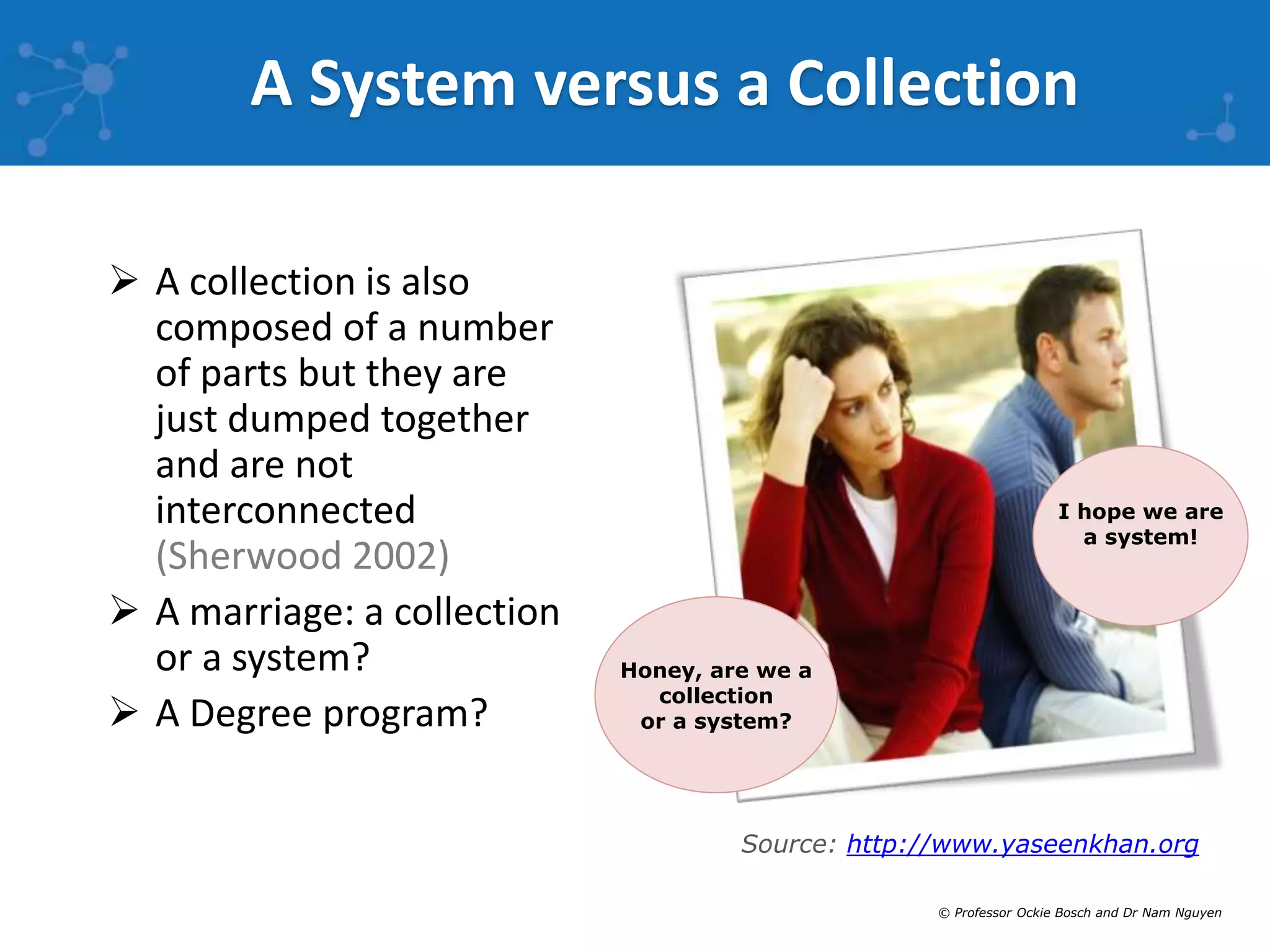
 A collection is also 
composed of a number 
of parts but they are 
just dumped together 
and are not 
interconnected 
(Sherwood 2002) 
 A marriage: a collection 
or a system? 
 A Degree program? 
Honey, are we a 
collection 
or a system? 
I hope we are 
a system! 
Source: http://www.yaseenkhan.org 
© Professor Ockie Bosch and Dr Nam Nguyen
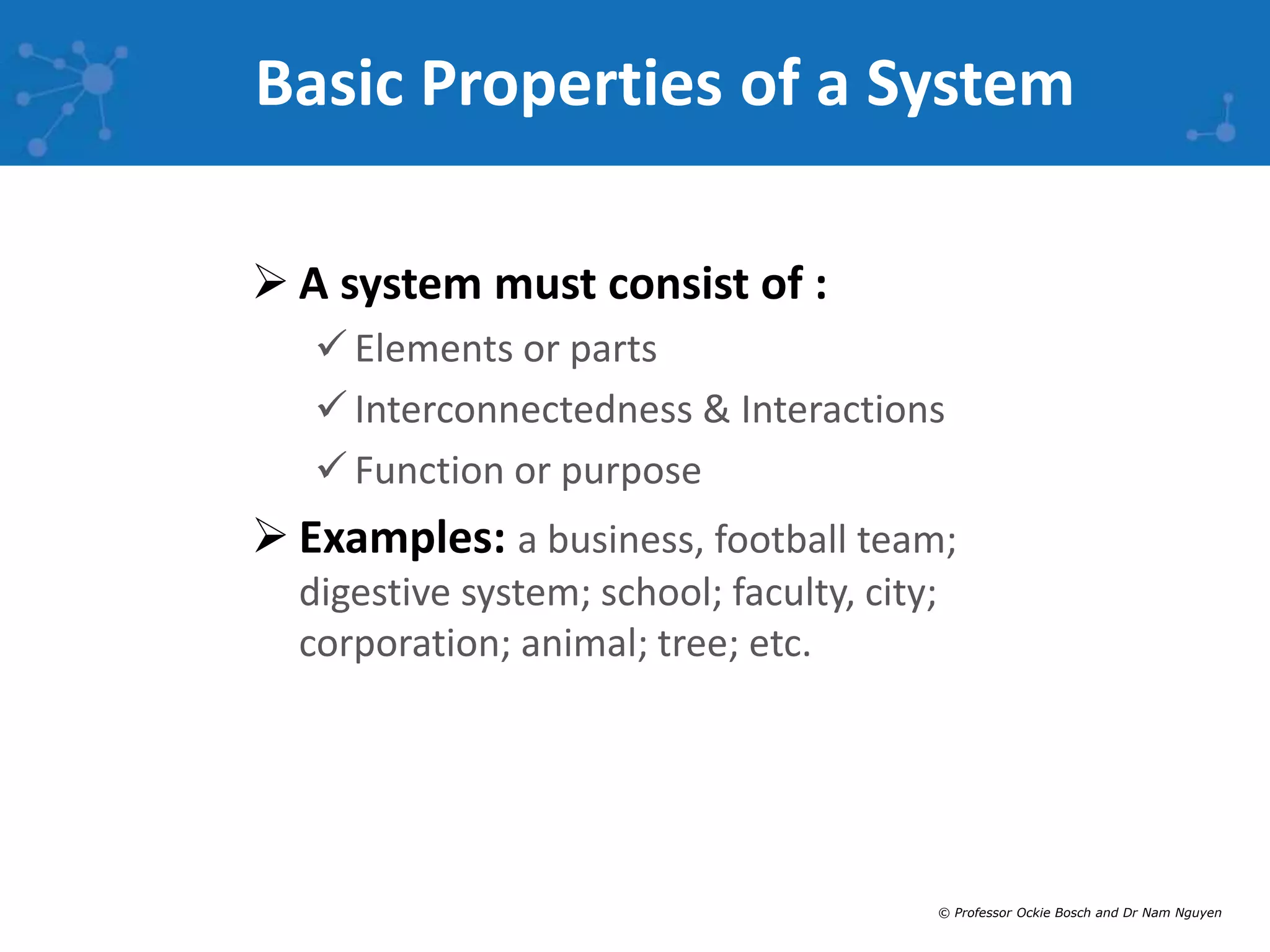
Basic Properties of a System 
 A system must consist of : 
 Elements or parts 
 Interconnectedness & Interactions 
 Function or purpose 
 Examples: a business, football team; 
digestive system; school; faculty, city; 
corporation; animal; tree; etc. 
© Professor Ockie Bosch and Dr Nam Nguyen
Definitions of Systems Thinking 
 “Systems thinking is a way of looking at, learning 
about, and understanding complex situations” 
(Wilson 2004, p.7) 
 “Systems thinking is a way of seeing and talking 
about reality that helps us better understand and 
work with systems to influence the quality of our 
lives” (Kim 1999, p.2) 
 Systems thinking is a ‘new way of thinking’ to 
understand and manage complex problems (Bosch 
et al. 2007; Cabrera et al. 2008) 
© Professor Ockie Bosch and Dr Nam Nguyen
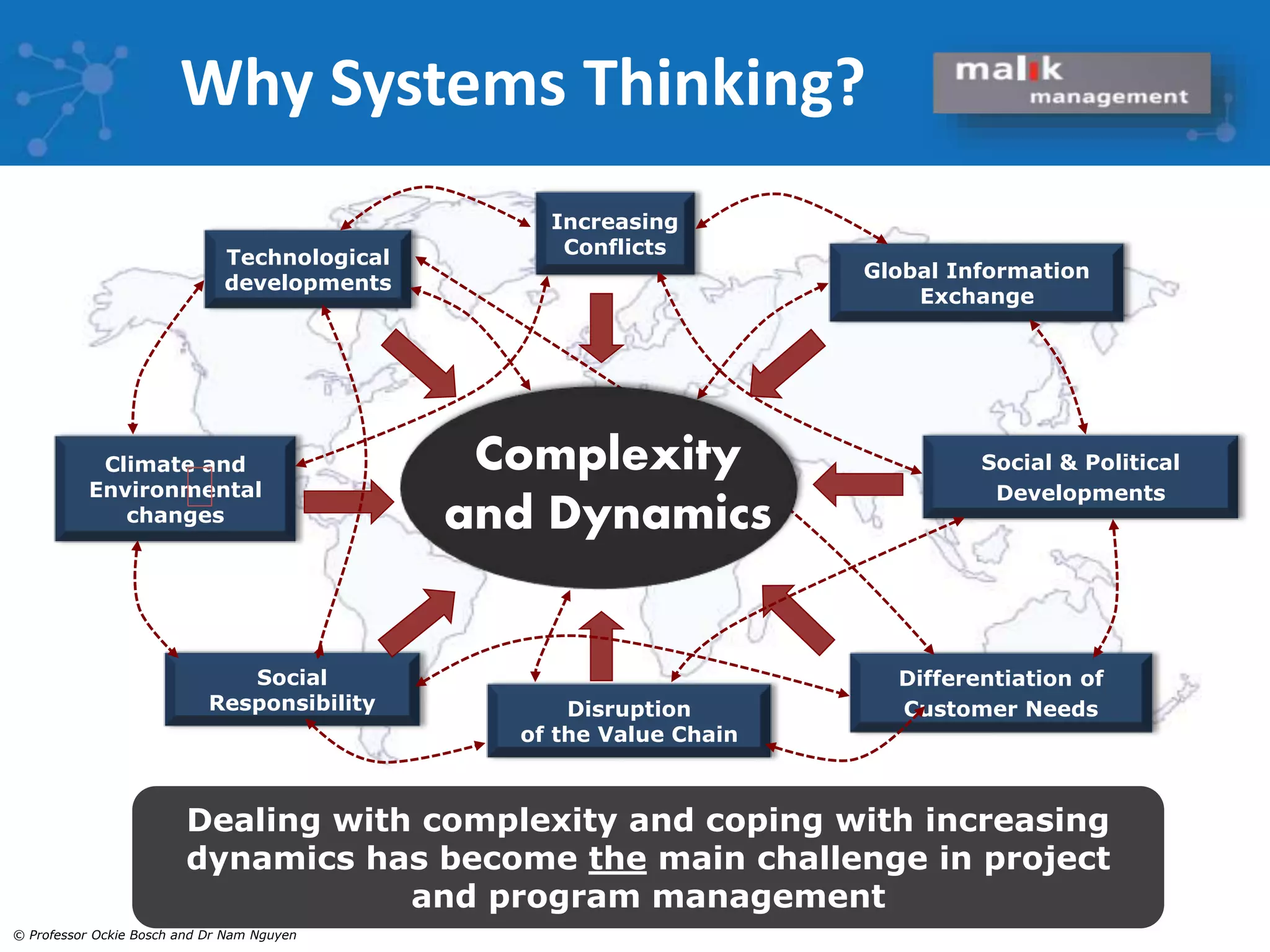
Why Systems Thinking? 
Climate and 
Environmental 
changes 
Technological 
developments 
Global Information 
Exchange 
Increasing 
Conflicts 
Complexity 
and Dynamics 
Disruption 
of the Value Chain 
Social & Political 
Developments 
Differentiation of 
Customer Needs 
Social 
Responsibility 
Dealing with complexity and coping with increasing 
dynamics has become the main challenge in project 
and program management 
© Professor Ockie Bosch and Dr Nam Nguyen
Making Decisions in such a 
Complex Web of Interactions 
Politicians, business managers and all members of society have to make 
important decisions on a daily basis in the complex web in which 
business, social issues, finance and economics, environment, politics and 
culture are all highly interconnected 
Do we get it right? 
• Do we make good policy and investment decisions? 
• Are we aware of the unintended consequences of our decisions? 
• Are we effective in our cross-sectoral communication and 
collaboration to deal with the multi-dimensional nature of complex 
problems? 
• Do we go for quick fixes because it is easier to treat the 
symptoms? 
OR 
Do we urgently need new and innovative ways of thinking and a fresh 
approach and tools to deal with the problems facing our society? 
© Professor Ockie Bosch and Dr Nam Nguyen
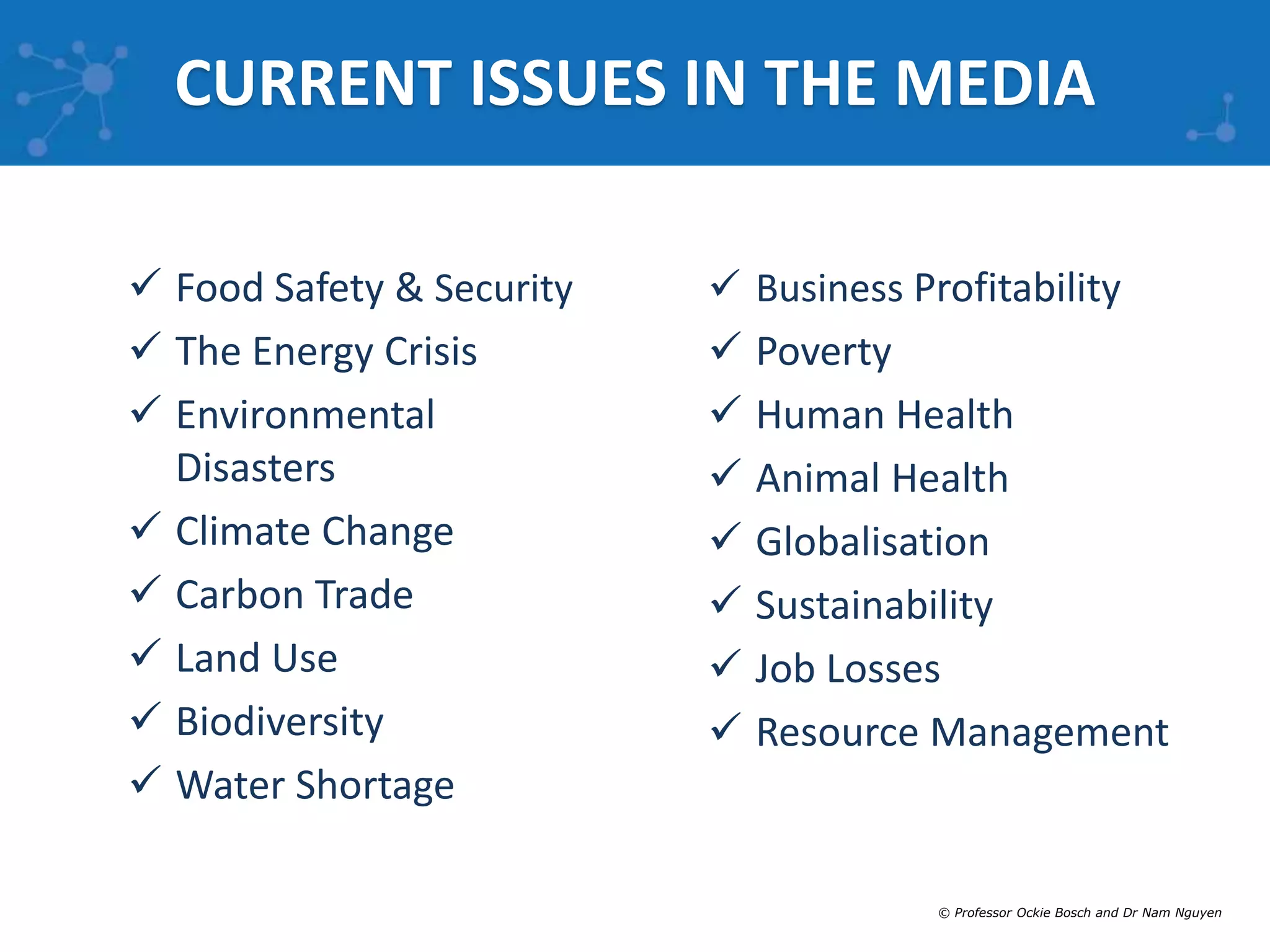
CURRENT ISSUES IN THE MEDIA 
 Food Safety & Security 
 The Energy Crisis 
 Environmental 
Disasters 
 Climate Change 
 Carbon Trade 
 Land Use 
 Biodiversity 
 Water Shortage 
 Business Profitability 
 Poverty 
 Human Health 
 Animal Health 
 Globalisation 
 Sustainability 
 Job Losses 
 Resource Management 
© Professor Ockie Bosch and Dr Nam Nguyen
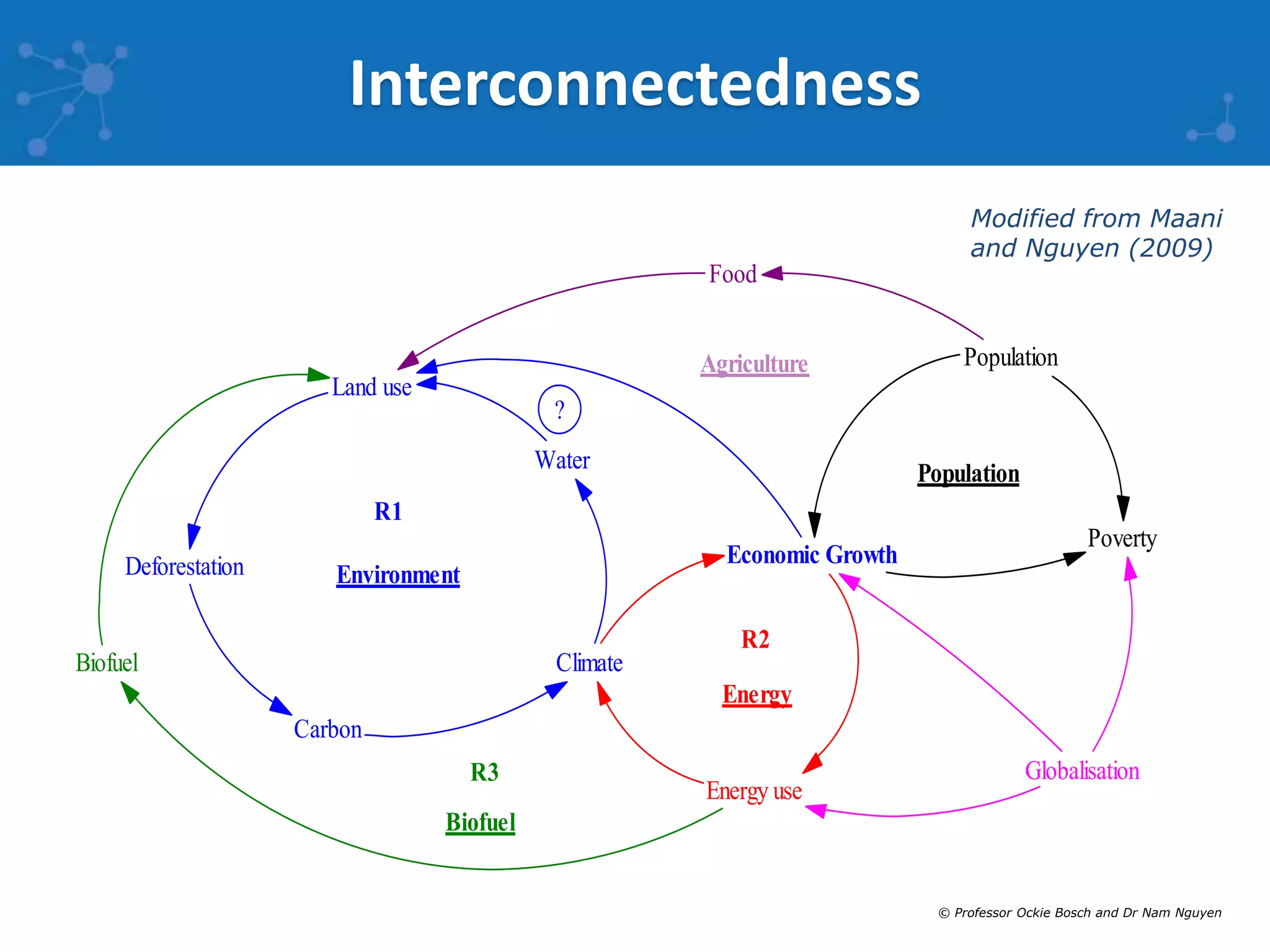
Modified from Maani 
and Nguyen (2009) 
Interconnectedness 
© Professor Ockie Bosch and Dr Nam Nguyen 
Water 
Carbon 
Deforestation 
Land use 
Climate 
R1 
Environment 
? 
Economic Growth 
R2 
Energy 
Energy use 
Population 
Poverty 
Population 
Food 
Agriculture 
Biofuel 
R3 
Biofuel 
Globalisation
The Torn Net 
© Professor Ockie Bosch and Dr Nam Nguyen
Agric. & Rural 
Development 
Operating in “Silos” 
Natural Res & 
Environment 
Culture, Sport 
& Tourism 
Planning & 
Investment 
Training & 
Education 
Departments of Hai Phong City 
Plans 
Collaboration 
Sharing 
Integrated Systemic Master Plan for Governance 
© Professor Ockie Bosch and Dr Nam Nguyen
OOPS 
? 
Taking stock of a failed project 
Andrew Stellman on July 24, 2009 
© Professor Ockie Bosch and Dr Nam Nguyen
Sanitation 
Clean water 
Living conditions 
© Professor Ockie Bosch and Dr Nam Nguyen
 Family 
Planning 
 Need for 
Education 
 Health issues 
© Professor Ockie Bosch and Dr Nam Nguyen
By concentrating on the 
particular……… © Professor Ockie Bosch and Dr Nam Nguyen
….bourgeois 
thought fails to see 
the totality 
© Professor Ockie Bosch and Dr Nam Nguyen
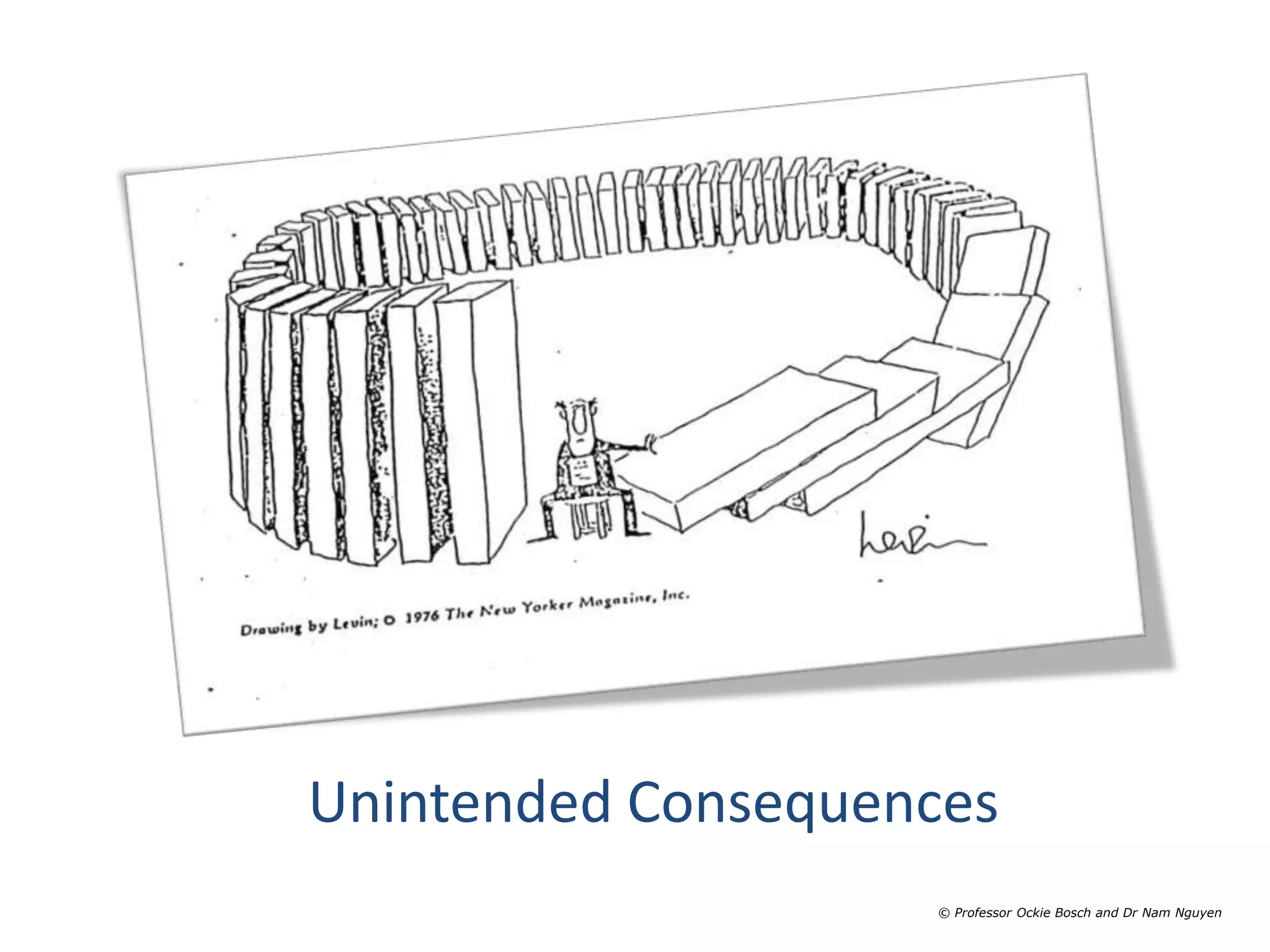
Unintended Consequences 
© Professor Ockie Bosch and Dr Nam Nguyen
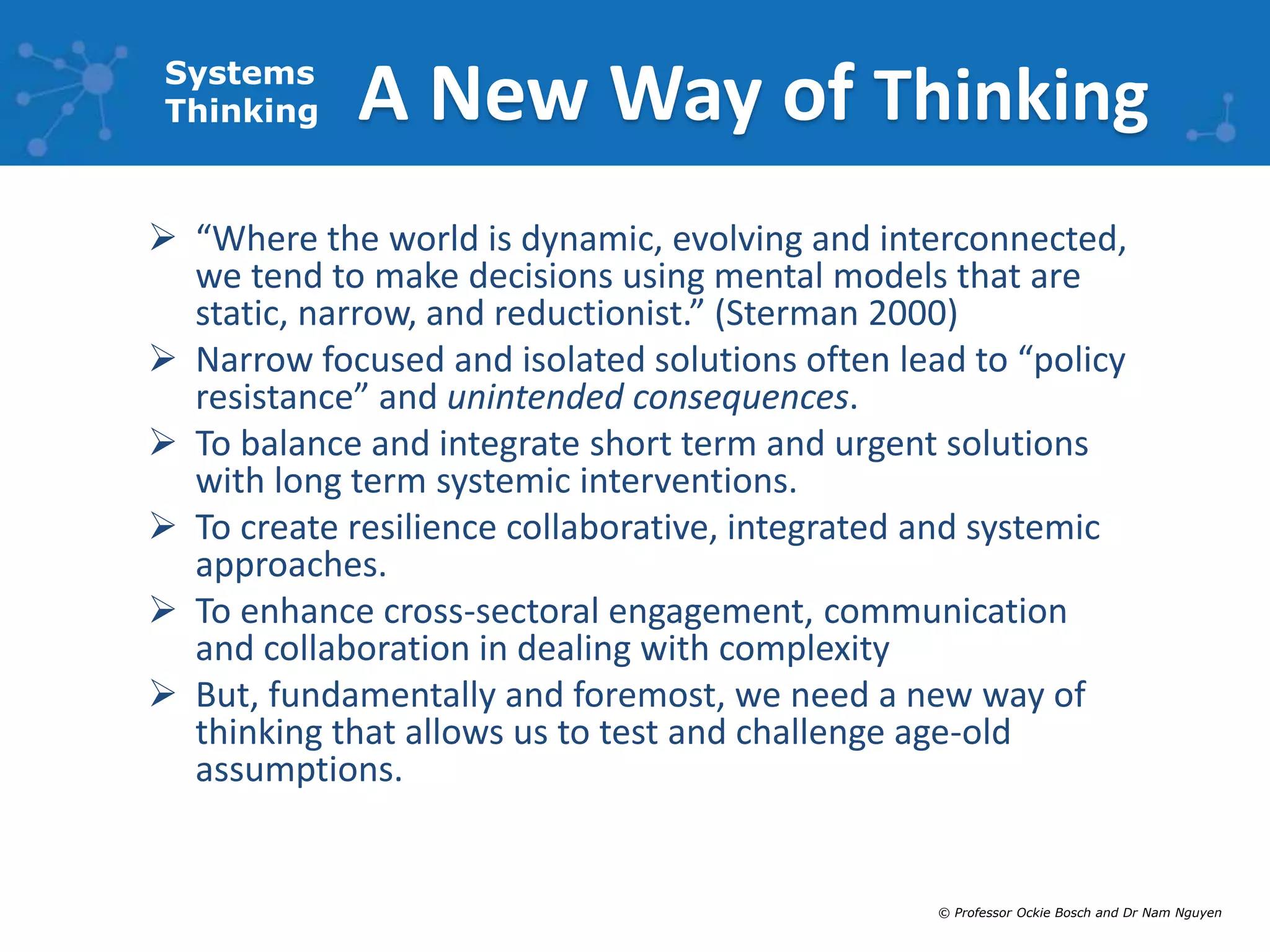
Systems 
Thinking 
A New Way of Thinking  “Where the world is dynamic, evolving and interconnected, 
we tend to make decisions using mental models that are 
static, narrow, and reductionist.” (Sterman 2000) 
 Narrow focused and isolated solutions often lead to “policy 
resistance” and unintended consequences. 
 To balance and integrate short term and urgent solutions 
with long term systemic interventions. 
 To create resilience collaborative, integrated and systemic 
approaches. 
 To enhance cross-sectoral engagement, communication 
and collaboration in dealing with complexity 
 But, fundamentally and foremost, we need a new way of 
thinking that allows us to test and challenge age-old 
assumptions. 
© Professor Ockie Bosch and Dr Nam Nguyen
Application of Systems Thinking 
 Business (Sterman 2000; Walker et al. 2009) 
 Health (Cavana et al. 1999; Lee 2009) 
 Commodity systems (Sawin et al. 2003) 
 Agricultural production systems (Wilson 2004) 
 Natural resource management (Allison and Hobbs 2006) 
 Education (Galbraith 1999; Hung 2008) 
 Decision making (Maani 2002) 
 Human resource management (Quatro et al. 2007) 
 Organisational learning and change (Galanakis 2006) 
 Philosophy, biology, social theory and management 
(Mingers 2006) 
 Sustainability and evolutionary learning laboratories for 
addressing complex issues (Nguyen, Bosch et al. 2011; Nguyen, Bosch 
et al. 2013a; Bosch, Nguyen et al.2013b) 
© Professor Ockie Bosch and Dr Nam Nguyen
The capacity to redesign in systems and 
sustainability terms, will increasingly be 
what society and employers will require 
from new people entering the workforce 
 A “requirement” that has become one of the biggest challenges 
for education in this century 
 Only a deep understanding of the disciplines insufficient - need to 
fully understand how disciplines fit into societal and global systems 
 Living in a Century when humanity will meet ever more limits 
 Didactic autonomous discipline based courses fail to foster a social 
networking culture (interactions between students in different 
disciplines) 
 Need innovative curriculum designs and learning environments that 
address academic paradigms as well as industry requirements 
© Professor Ockie Bosch and Dr Nam Nguyen
$$$ for 
mitigating 
unintended 
consequences 
24 
STyHEstIeCEmBEsR AG ApPpPrRoOaACcHh 
Symptoms 
Events 
PATTERNS 
interactions between 
components 
$$$ for root 
causes of 
poverty 
SYSTEMIC STRUCTURES 
What does system look like 
MENTAL MODELS/MIND MAPS 
People’s understanding 
$$$ for alleviating 
poverty 
Addressing fundamental 
problems to achieve 
sustainable systems 
Adapted from Maani and Cavana, 2007
LINEAR THINKING 
Improved 
Quality of 
Life 
Enhance 
Tourism 
More Tourists 
More Jobs 
More $$$ 
© Professor Ockie Bosch and Dr Nam Nguyen
Pollution 
+ 
Temporary 
immigration 
SYSTEMS THINKING 
Empoloyment 
opportunity 
Land required 
for tourism 
Natural 
beauty 
- 
Availability of 
underground water 
+ 
Fresh water 
consumption 
Employment 
opportunity for local 
people 
+ 
+ 
Social 
issues 
Infrastruture 
& facility 
+ 
+ 
Number of 
tourists 
Attractiveness 
of Cat Ba Island 
- 
+ 
- 
Wealth of 
local people 
+ 
+ Waste 
+ 
+ 
+ 
Illegal forest 
- exploitaion 
- 
Total 
population 
Agricultural 
Production 
Living 
cost 
- 
+ 
+ 
- 
+ 
- 
+ 
+ 
- 
Conservation and 
agricultural land 
+ 
- 
B2 
R1 B1 
R3 
R2 
B3 
B4 
B5 
B6 
Student 
population 
Assess to 
education 
+ 
- 
- 
- 
R5 
R4 
Investment 
+ 
+ 
+ 
Resident 
population 
+ 
+ 
Wealth of 
Local 
People 
Number 
of 
Tourists 
Increasing 
n Jobs 
© Professor Ockie Bosch and Dr Nam Nguyen

Module 1 Introduction to systems thinking

  • 1.
    INTRODUCTION TO SYSTEMS THINKING Professor Ockie Bosch Dr Nam Nguyen
  • 2.
    Introduction to thesystems concept  The six blind men and an elephant  A partial truth  The moral of the story: having a ‘holistic’ view  “The behaviour of a system cannot be known just by knowing the elements of the system” (Meadows 2008, p.7) © Professor Ockie Bosch and Dr Nam Nguyen
  • 3.
    Definitions of Systems  “A system is a set of elements or parts that is coherently organised and interconnected in a pattern or structure that produces a characteristic set of a behaviours, often classified as its ‘function’ or ‘purpose’” (Meadows 2008, p.188)  “Simply defined, a system is a complex whole the functioning of which depends on its parts and the interactions between those parts” (Jackson 2003, p.3)  “A system is more than the sum of its parts – it is the product of their interactions” (Ackoff 1999) © Professor Ockie Bosch and Dr Nam Nguyen
  • 4.
    A System versusa Collection  A collection is also composed of a number of parts but they are just dumped together and are not interconnected (Sherwood 2002)  A marriage: a collection or a system?  A Degree program? Honey, are we a collection or a system? I hope we are a system! Source: http://www.yaseenkhan.org © Professor Ockie Bosch and Dr Nam Nguyen
  • 5.
    Basic Properties ofa System  A system must consist of :  Elements or parts  Interconnectedness & Interactions  Function or purpose  Examples: a business, football team; digestive system; school; faculty, city; corporation; animal; tree; etc. © Professor Ockie Bosch and Dr Nam Nguyen
  • 6.
    Definitions of SystemsThinking  “Systems thinking is a way of looking at, learning about, and understanding complex situations” (Wilson 2004, p.7)  “Systems thinking is a way of seeing and talking about reality that helps us better understand and work with systems to influence the quality of our lives” (Kim 1999, p.2)  Systems thinking is a ‘new way of thinking’ to understand and manage complex problems (Bosch et al. 2007; Cabrera et al. 2008) © Professor Ockie Bosch and Dr Nam Nguyen
  • 7.
    Why Systems Thinking? Climate and Environmental changes Technological developments Global Information Exchange Increasing Conflicts Complexity and Dynamics Disruption of the Value Chain Social & Political Developments Differentiation of Customer Needs Social Responsibility Dealing with complexity and coping with increasing dynamics has become the main challenge in project and program management © Professor Ockie Bosch and Dr Nam Nguyen
  • 8.
    Making Decisions insuch a Complex Web of Interactions Politicians, business managers and all members of society have to make important decisions on a daily basis in the complex web in which business, social issues, finance and economics, environment, politics and culture are all highly interconnected Do we get it right? • Do we make good policy and investment decisions? • Are we aware of the unintended consequences of our decisions? • Are we effective in our cross-sectoral communication and collaboration to deal with the multi-dimensional nature of complex problems? • Do we go for quick fixes because it is easier to treat the symptoms? OR Do we urgently need new and innovative ways of thinking and a fresh approach and tools to deal with the problems facing our society? © Professor Ockie Bosch and Dr Nam Nguyen
  • 9.
    CURRENT ISSUES INTHE MEDIA  Food Safety & Security  The Energy Crisis  Environmental Disasters  Climate Change  Carbon Trade  Land Use  Biodiversity  Water Shortage  Business Profitability  Poverty  Human Health  Animal Health  Globalisation  Sustainability  Job Losses  Resource Management © Professor Ockie Bosch and Dr Nam Nguyen
  • 10.
    Modified from Maani and Nguyen (2009) Interconnectedness © Professor Ockie Bosch and Dr Nam Nguyen Water Carbon Deforestation Land use Climate R1 Environment ? Economic Growth R2 Energy Energy use Population Poverty Population Food Agriculture Biofuel R3 Biofuel Globalisation
  • 11.
    The Torn Net © Professor Ockie Bosch and Dr Nam Nguyen
  • 12.
    Agric. & Rural Development Operating in “Silos” Natural Res & Environment Culture, Sport & Tourism Planning & Investment Training & Education Departments of Hai Phong City Plans Collaboration Sharing Integrated Systemic Master Plan for Governance © Professor Ockie Bosch and Dr Nam Nguyen
  • 13.
    © Professor OckieBosch and Dr Nam Nguyen
  • 14.
    OOPS ? Takingstock of a failed project Andrew Stellman on July 24, 2009 © Professor Ockie Bosch and Dr Nam Nguyen
  • 15.
    Sanitation Clean water Living conditions © Professor Ockie Bosch and Dr Nam Nguyen
  • 16.
     Family Planning  Need for Education  Health issues © Professor Ockie Bosch and Dr Nam Nguyen
  • 17.
    By concentrating onthe particular……… © Professor Ockie Bosch and Dr Nam Nguyen
  • 18.
    ….bourgeois thought failsto see the totality © Professor Ockie Bosch and Dr Nam Nguyen
  • 19.
    Unintended Consequences ©Professor Ockie Bosch and Dr Nam Nguyen
  • 20.
    Systems Thinking ANew Way of Thinking  “Where the world is dynamic, evolving and interconnected, we tend to make decisions using mental models that are static, narrow, and reductionist.” (Sterman 2000)  Narrow focused and isolated solutions often lead to “policy resistance” and unintended consequences.  To balance and integrate short term and urgent solutions with long term systemic interventions.  To create resilience collaborative, integrated and systemic approaches.  To enhance cross-sectoral engagement, communication and collaboration in dealing with complexity  But, fundamentally and foremost, we need a new way of thinking that allows us to test and challenge age-old assumptions. © Professor Ockie Bosch and Dr Nam Nguyen
  • 21.
    Application of SystemsThinking  Business (Sterman 2000; Walker et al. 2009)  Health (Cavana et al. 1999; Lee 2009)  Commodity systems (Sawin et al. 2003)  Agricultural production systems (Wilson 2004)  Natural resource management (Allison and Hobbs 2006)  Education (Galbraith 1999; Hung 2008)  Decision making (Maani 2002)  Human resource management (Quatro et al. 2007)  Organisational learning and change (Galanakis 2006)  Philosophy, biology, social theory and management (Mingers 2006)  Sustainability and evolutionary learning laboratories for addressing complex issues (Nguyen, Bosch et al. 2011; Nguyen, Bosch et al. 2013a; Bosch, Nguyen et al.2013b) © Professor Ockie Bosch and Dr Nam Nguyen
  • 22.
    The capacity toredesign in systems and sustainability terms, will increasingly be what society and employers will require from new people entering the workforce  A “requirement” that has become one of the biggest challenges for education in this century  Only a deep understanding of the disciplines insufficient - need to fully understand how disciplines fit into societal and global systems  Living in a Century when humanity will meet ever more limits  Didactic autonomous discipline based courses fail to foster a social networking culture (interactions between students in different disciplines)  Need innovative curriculum designs and learning environments that address academic paradigms as well as industry requirements © Professor Ockie Bosch and Dr Nam Nguyen
  • 23.
    © Professor OckieBosch and Dr Nam Nguyen
  • 24.
    $$$ for mitigating unintended consequences 24 STyHEstIeCEmBEsR AG ApPpPrRoOaACcHh Symptoms Events PATTERNS interactions between components $$$ for root causes of poverty SYSTEMIC STRUCTURES What does system look like MENTAL MODELS/MIND MAPS People’s understanding $$$ for alleviating poverty Addressing fundamental problems to achieve sustainable systems Adapted from Maani and Cavana, 2007
  • 25.
    LINEAR THINKING Improved Quality of Life Enhance Tourism More Tourists More Jobs More $$$ © Professor Ockie Bosch and Dr Nam Nguyen
  • 26.
    Pollution + Temporary immigration SYSTEMS THINKING Empoloyment opportunity Land required for tourism Natural beauty - Availability of underground water + Fresh water consumption Employment opportunity for local people + + Social issues Infrastruture & facility + + Number of tourists Attractiveness of Cat Ba Island - + - Wealth of local people + + Waste + + + Illegal forest - exploitaion - Total population Agricultural Production Living cost - + + - + - + + - Conservation and agricultural land + - B2 R1 B1 R3 R2 B3 B4 B5 B6 Student population Assess to education + - - - R5 R4 Investment + + + Resident population + + Wealth of Local People Number of Tourists Increasing n Jobs © Professor Ockie Bosch and Dr Nam Nguyen