Systems
Thinking for
Changing
Agriculture 4
Systems Thinking
for Changing
Agriculture
CHAPTER ONE
Introduction
• The world has become more complex in recent years due to many factors,
including our growing population and its demands for more food, water,
and energy, the limited arable land for expanding food production, and
increasing pressures on natural resources
• An agricultural system is an assemblage of components which are united
by some form of interaction and interdependence and which operate
within a prescribed boundary to achieve a specified agricultural objective
on behalf of the beneficiaries of the system
• System theory provides concepts and tools to better understand complex
developments in agriculture and society, because farming systems are just
one type of system in general
Introduction
• The terms „system theory‟ and
„system thinking‟ both refer to an
activity that is as old as mankind and
that knows many traditions
Concept, characteristics
and properties of a system
• An understanding of the concepts of
systems and systems thinking can
therefore help Agricultural Research for
Development partners better understand
and visualize their partnership, its aims
and activities, as well as their own roles
within the system
What is system?
• An arrangement of components or processes
that interact in such a way that they act as a
whole
• Where the properties of the whole arise from
the relationships between the component
parts; and
• Something that has a purpose or is of interest
to someone
What is system?
• A system is a group of interacting/interrelated/interconnected/interdependent elements that constitute a complex and
integrated whole
• A system is an "interconnected" group of elements "coherently organized" for a goal
• A system is a group of essential parts or subsystems, that can "affect the behavior and properties of the whole system and
none of which has an independent effect on it"
• Solar system
• School system
• Computer system
• Educational system
• Political system
• Accounting system etc
What is system?
• System Science: is usually associated with observations, identification,
description, experimental investigation, and theoretical modeling and
explanations that are associated with natural phenomena in fields, such as
biology, chemistry and physics
• System analysis: includes ongoing analytical processes of evaluating
various alternatives in design and model construction by employing
mathematical methods
• For scientists and engineers, the definition of a system can be stated as “a
regularly interacting or interdependent group of items forming a unified
whole that has some attributes of interest.”
Characteristics of system
• Orientation towards the objective: A system is an assembled set of elements, acting
together to accomplish a common goal, purpose or objective
• Structure of the system: The component parts of a system are arranged in a
systematic manner, according to a specific design, and each of them has definite
function to perform in the system
• Inputs: Inputs for a system involve elements that enter the system to be processed
• Processing of inputs: It is the process of transformation through which inputs are
converted into outputs, for instance, manufacturing process, data calculation etc
• Outputs: They are the result of the transformation process, like human services,
finished products, etc
• Interdependence: The components of a system are interdependent
Characteristics
of system
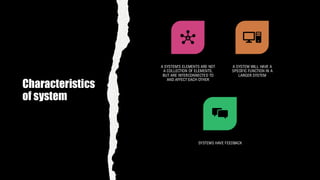
A SYSTEM'S ELEMENTS ARE NOT
A COLLECTION OF ELEMENTS,
BUT ARE INTERCONNECTED TO
AND AFFECT EACH OTHER
A SYSTEM WILL HAVE A
SPECIFIC FUNCTION IN A
LARGER SYSTEM
SYSTEMS HAVE FEEDBACK
Characteristics of system
• Properties of systems
• Components and sub-systems
System basic
components
Purpose/Goal
• Central objective
Purpose/Goal
• Integration
• Synergistic effect
Purpose/Goal
• I. Central Objective: Central objective means the
common goal, because without common goal system
will not start moving in all directions
• II. Integration: It is combined work of all the
components in order to achieve the goal of the system
• III. Synergistic effect: From the integration concept it is
clear that the system has to be viewed as ‘whole’ rather
than just as sum of its parts
Interaction and feedback
• An important feature of the system is the basic
components must interact among themselves
• If we consider, computer as a system then if some
information is keyed it gets processed by arithmetic or
logic unit or both and the final result is displayed on the
screen
• Such a relationship among the components which
define the boundary between the system and
environment is called as the structure of the system
Boundaries/environment
• In ARD partnerships, the boundaries of what partners consider to be “the
system of interest” is drawn around the factors they can change
• ARD partnerships need to consider which factors are likely to be critical to
the success of their partnership, which partners are needed to achieve
this, and hence where they draw the boundaries of their system
• Typically, ARD partnerships increase the boundaries of their “system of
interest” as they grow and evolve – progressively adding marketing or
policy issues, to an initial focus on production
Behavior
• Behavior is the way the system reacts to its
surrounding environment
• Behavior is determined by the procedures
designed to make sure that components
behave in ways that will allow system to
achieve common goal
• Procedure describes what ought to be done
and behavior describes what is actually done
Hierarchies and
scale
• Many ARD issues require linked actions at local level, national or even
international level
• Examples within PAEPARD partnerships include aflatoxin contamination in the
groundnut and livestock value chains, the use of mango fruit by-products, and
the development of Trichoderma soil amendments
• In other words, the areas of action can be considered to cover a “hierarchy” of
systems, consisting of interlinked “sub-systems” at these different levels
Inputs and outputs
• Systems are regarded as a means of
transforming inputs into outputs
• Actors typically start with a focus on physical
inputs or technical information
• Actions to build the functional capacity of
actors in the system to trust and relate to each
other, are therefore also critical inputs to the
system
Emergent
properties
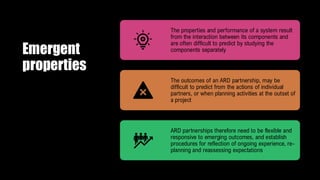
The properties and performance of a system result
from the interaction between its components and
are often difficult to predict by studying the
components separately
The outcomes of an ARD partnership, may be
difficult to predict from the actions of individual
partners, or when planning activities at the outset of
a project
ARD partnerships therefore need to be flexible and
responsive to emerging outcomes, and establish
procedures for reflection of ongoing experience, re-
planning and reassessing expectations
Life cycle
• System is integrated collection of the components which satisfy functions necessary
to achieve the system goals and which have relationship to one another that defines
structure of the system
• A system is a set of elements forming an activity or scheme seeking a common goal
• Types of Systems
• Conceptual Systems: Conceptual systems deal with theoretical structures which may
or may not have any counterpart in the world
• Empirical systems are concrete operational systems made up of people, machines,
materials, energy, and other physical things
• Permanent and temporary systems: Systems enduring for a long-time span, in
relation to the operations of humans in the systems, are called permanent systems
Life cycle
• Natural systems: Natural systems are found abundantly in nature, like solar system,
water system etc
• Manufactured systems or artificial systems are formed by human efforts
• Deterministic systems: In deterministic systems, the interaction among the parts is
known with certainty
• The probabilistic system: is described in terms of probable behavior
• Subsystems and super system: smaller systems within the system or the
components of a system are called subsystems
• Stationary and non-stationary systems: A stationary system is one whose properties
and operations either do not vary significantly or vary in a repetitive manner
• Open and Closed system: Open systems interact with their environment exchange
information, and material energy with it
Life cycle
• Adaptive and non-adaptive systems: A system,
which reaches out to its environment in such a
way as to improve its functioning,
achievement or probability of survival, is
called an adaptive system
• Social, people-machine, and machine systems:
A social system is a system purely made up of
people
Chapter Two
Systems thinking:
definition, nature
and scope
Systems thinking —
What is it?
• Systems thinking, or “systemic” thinking, is thinking about the
whole, and the relationship between the parts of the system
instead of focusing on the parts themselves in isolation
• Hard systems thinkers assume systems exist objectively, have
a clear purpose and well-defined boundaries
• Soft systems thinkers, on the other hand, assume that
systems are fuzzy: difficult to define, dynamic, chaotic,
changing and unpredictable
Systems thinking —
What is it?
• Consider the big picture
• Balance short-term and long-term perspectives
• Recognize the dynamic, complex, and interdependent nature
of systems
• Consider both measurable and non-measurable nature of
systems, and
• Keep in mind we are all part of the systems in which we
function, and that we each influence those systems even as
we are being influenced by them
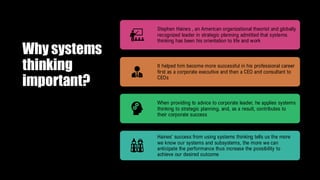
Why systems
thinking
important?
Stephen Haines , an American organizational theorist and globally
recognized leader in strategic planning admitted that systems
thinking has been his orientation to life and work
It helped him become more successful in his professional career
first as a corporate executive and then a CEO and consultant to
CEOs
When providing to advice to corporate leader, he applies systems
thinking to strategic planning, and, as a result, contributes to
their corporate success
Haines' success from using systems thinking tells us the more
we know our systems and subsystems, the more we can
anticipate the performance thus increase the possibility to
achieve our desired outcome
Why systems thinking
important?
• The design process discussed in Lesson 1 is not only
systematic and iterative, the design process is also systemic
• In the end, a holistic approach provides a better
understanding of the system where our output will be used
and ensures that our final output will be closer to meeting the
needs of the users and achieving the final goal
• Systems thinking sees dynamic relationships among the parts
Systems thinking? Vs
Conventional thinking
• With systems thinking, you solve problems by investigating factors and
outcomes of those factors on your operation or educational work
• Systems thinking is an approach to integration that is based on the belief
that the component parts of a system will act differently when isolated
from the system’s environment or other parts of the system
• Consistent with systems philosophy, systems thinking concerns an
understanding of a system by examining the linkages and interactions
between the elements that comprise the whole of the system
Systems thinking? Vs
Conventional thinking
• Systems thinking in practice
encourages us to explore inter-
relationships , perspectives
and boundaries
• Systems thinking is particularly useful
in addressing complex or wicked
problem situations
Systems Thinking in
Agriculture
• Holistic Perspective: It takes a holistic view, considering all elements of the
agricultural ecosystem and their interdependencies
• Long-Term Sustainability: It prioritizes long-term sustainability by
considering the impact of current practices on future generations and the
environment
• Feedback and Adaptation: It values feedback loops and the ability to adapt
to changing agricultural conditions, making adjustments based on real-
time feedback
• Root Cause Analysis: It seeks to address challenges by understanding the
root causes and systemic issues within the agricultural system
Logical Thinking in
Agriculture
• Reductionist Perspective: It breaks down complex agricultural
challenges into simpler, more isolated parts
• Cause-and-Effect Analysis: It often deals with cause-and-
effect relationships in a linear and sequential manner
• Short-Term Goals: It may have a shorter-term perspective,
prioritizing immediate or short-term outcomes and gains
• Predefined Solutions: It tends to rely on predefined, well-
established agricultural practices and solutions
Concepts and attitudes
associated with systems
thinking/Approaches
• Systems thinking, when applied to agricultural
and rural development, entails a set of
concepts and attitudes that help address
complex issues in a holistic and sustainable
manner
• In this context, the following paragraphs
elaborate on key concepts and attitudes
associated with systems thinking
2.5. When should I use systems
thinking? in agricultural and
Rural Development
• Systems thinking can be a valuable approach in agricultural and rural development,
particularly when dealing with complex and interconnected challenges
• Systems thinking helps to understand how these components interact and impact
each other
• Systems thinking allows you to consider the long-term consequences of farming
methods on soil quality, water resources, and biodiversity
• Systems thinking is essential for understanding the ecological relationships and
ensuring the sustainable use of resources
• Systems thinking can help develop adaptive strategies that consider the dynamic and
uncertain nature of climate-related challenges
• Systems thinking can help policymakers consider the full range of impacts and
unintended consequences of their decisions
CHAPTER 3
Developing and fostering
systems thinking
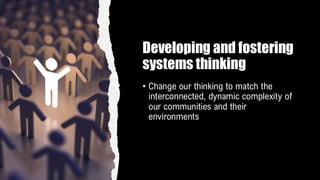
• Change our thinking to match the
interconnected, dynamic complexity of
our communities and their
environments
Developing and fostering
systems thinking
• Become more aware of the potential for
unintended consequences of our
actions
Introductions
• In agricultural and rural development, the adoption of systems thinking is
a pivotal shift in perspective that can significantly enhance the
effectiveness of development initiatives
• This chapter is dedicated to unraveling the strategies and approaches
necessary for cultivating and fostering systems thinking within this
specific context
• At its core, systems thinking recognizes the inherent complexity of rural
and agricultural systems, which often involve multifaceted
interdependencies
• The chapter opens by elucidating the intrinsic value of systems thinking,
presenting a compelling argument for its adoption by highlighting the
limitations of reductionist thinking
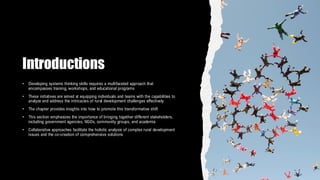
Introductions
• Developing systems thinking skills requires a multifaceted approach that
encompasses training, workshops, and educational programs
• These initiatives are aimed at equipping individuals and teams with the capabilities to
analyze and address the intricacies of rural development challenges effectively
• The chapter provides insights into how to promote this transformative shift
• This section emphasizes the importance of bringing together different stakeholders,
including government agencies, NGOs, community groups, and academia
• Collaborative approaches facilitate the holistic analysis of complex rural development
issues and the co-creation of comprehensive solutions
Introductions
• Promoting and fostering systems thinking in agricultural and
rural development is essential for several compelling reasons:
Complexity of Rural Systems: Rural and agricultural systems
are inherently complex, with numerous interrelated
components, including natural resources, socio-economic
factors, and ecological processes
• Interconnected Challenges: Rural development often involves
a multitude of interconnected challenges, such as food
security, poverty alleviation, natural resource management,
and infrastructure development
3.2. How do we promote or foster
system thinking in agricultural
and rural development
• Promoting and fostering systems thinking in agricultural and rural
development involves a combination of strategies and approaches aimed
at changing mindsets, building capacity, and integrating systems-oriented
practices into the development process
• Here are some key ways to promote and foster systems thinking in this
context: Education and Training: Incorporate systems thinking into formal
education and training programs
• Develop curricula, courses, and workshops that focus on systems-
oriented problem-solving
• Encourage students and practitioners to explore complex rural
development challenges from a systems perspective
3.2. How do we
promote or
foster system
thinking in
agricultural
and rural
development
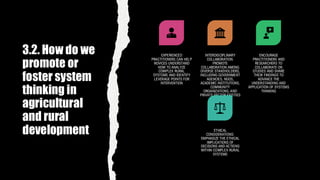
EXPERIENCED
PRACTITIONERS CAN HELP
NOVICES UNDERSTAND
HOW TO ANALYZE
COMPLEX RURAL
SYSTEMS AND IDENTIFY
LEVERAGE POINTS FOR
INTERVENTION
INTERDISCIPLINARY
COLLABORATION:
PROMOTE
COLLABORATION AMONG
DIVERSE STAKEHOLDERS,
INCLUDING GOVERNMENT
AGENCIES, NGOS,
ACADEMIC INSTITUTIONS,
COMMUNITY
ORGANIZATIONS, AND
PRIVATE SECTOR ENTITIES
ENCOURAGE
PRACTITIONERS AND
RESEARCHERS TO
COLLABORATE ON
STUDIES AND SHARE
THEIR FINDINGS TO
ADVANCE THE
UNDERSTANDING AND
APPLICATION OF SYSTEMS
THINKING
ETHICAL
CONSIDERATIONS:
EMPHASIZE THE ETHICAL
IMPLICATIONS OF
DECISIONS AND ACTIONS
WITHIN COMPLEX RURAL
SYSTEMS
3.3. Developmental stages
in systems thinking
• Systems thinking is a dynamic and evolving approach to
problem-solving and decision-making
• Here are the key developmental stages in systems
thinking: In this initial stage, individuals or organizations
become aware of the concept of systems thinking
• This phase is characterized by the recognition that
reductionist thinking, which breaks problems down into
isolated components, has limitations, and there may be
a need for a more holistic approach
Stage 2;
Exploration and
Learning
After gaining awareness, individuals or
groups typically embark on a learning
journey
They study the fundamental concepts and
principles of systems thinking, such as
feedback loops, interconnections, and
system boundaries
They engage in reading, training, and
education to build a foundational
understanding of the approach
Stage 4; Practical
Application
• With a basic understanding of systems thinking,
practitioners move on to practical application
• They start using systems thinking tools and
techniques to address real-world problems
• This often involves creating causal loop diagrams,
conducting system mapping, and analyzing
feedback loops within specific contexts
Stage 5;
Mistakes and
Challenges
As individuals or organizations apply
systems thinking in practical situations, they
may encounter challenges and make
mistakes
This stage is a crucial part of the learning
process, as it highlights the complexities
and uncertainties of systems
Practitioners may need to reevaluate their
models and strategies when facing
unexpected outcomes
Stage 6; Deeper
Understanding
• Over time, individuals and organizations gain a
deeper understanding of systems thinking
• They develop the ability to see patterns,
identify hidden feedback loops, and recognize
the emergence of system behaviors
• This stage involves greater proficiency in
using advanced systems thinking tools and
concepts
Stage 7;
Integration into
Decision-
Making
At this stage, systems thinking
becomes integrated into decision-
making processes
Practitioners routinely apply systems
thinking to analyze and address
complex issues
Leadership in systems thinking may
involve advocating for its use in
broader contexts
Stage 9; Continuous
Learning and Adaptation
• Systems thinking is a field where learning is
ongoing
• Even experienced practitioners continue to
adapt and refine their skills
• They remain open to new insights, evolving
methodologies, and emerging tools, always
seeking to improve their understanding and
application of systems thinking
Stage 10;
Cultural Shift
In some cases, organizations or communities
may undergo a cultural shift where systems
thinking becomes ingrained in their values and
practices
It influences decision-making at all levels, and the
entire organization or community embraces a
systems-oriented perspective
The developmental process of systems thinking
is iterative, and each experience and challenge
contributes to a deeper understanding and more
effective application of the approach
3.4. Steps in systems
thinking
• Systems thinking involves a holistic approach to
understanding complex systems and their
interdependencies
• While it doesn't follow a rigid set of steps like some
linear problem-solving processes, there is a general
sequence of activities that can guide the application of
systems thinking
• Here are the key steps often associated with systems
thinking
Define the Problem or
System
• Begin by defining the problem or
system of interest
• Clearly articulate the boundaries and
scope of the system
• Identify the goals and objectives of your
analysis or intervention
Gather Information
• This includes quantitative data, qualitative insights,
historical trends, and any available documentation
• Engage with stakeholders and experts to gain a
comprehensive understanding of the system
• These could be physical entities, such as people,
resources, and infrastructure, as well as non-
physical elements like policies, rules, and feedback
mechanisms
Establish Relationships
and Interconnections
• Identify the relationships and
interconnections between the variables
and components
• Determine how changes in one variable
can impact others
• This includes understanding cause-and-
effect relationships and feedback loops
Create Visual Models
• Develop visual models to represent the
system
• Common tools in systems thinking include
causal loop diagrams, stock-and-flow
diagrams, and system dynamics models
• These models help in visualizing the
structure and behavior of the system
Feedback and Feedback
Loops
• Analyze feedback loops within the
system
• Identify reinforcing and balancing
feedback loops
• Understand how feedback mechanisms
can lead to system behaviors and
patterns
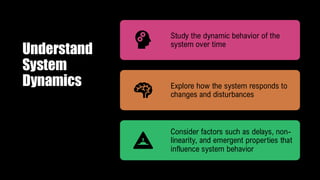
Understand
System
Dynamics
Study the dynamic behavior of the
system over time
Explore how the system responds to
changes and disturbances
Consider factors such as delays, non-
linearity, and emergent properties that
influence system behavior
Identify Leverage Points
• Determine potential leverage points
within the system where interventions
can have a significant impact
• Leverage points are areas where
changes can lead to desired outcomes
Scenario Analysis
• Conduct scenario analysis to explore
different possible future states of the
system
• Consider how the system might respond to
various changes or interventions
• Scenario analysis helps in understanding
the implications of different decisions
Testing and Simulation
• Use computer modeling and simulation
tools to test the impact of different
interventions on the system
• Simulation allows for experimenting
with various strategies and
understanding their consequences
Identify Solutions and
Interventions
• Based on your analysis and simulations,
identify potential solutions and
interventions
• These should be designed to address
the root causes of the problems or
improve the desired outcomes within
the system
Implement and Monitor
• Implement the selected interventions
and monitor their effects on the system
• Continuously collect data, assess the
system's response, and make
adjustments as needed
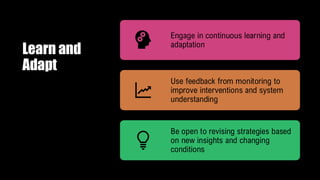
Learn and
Adapt
Engage in continuous learning and
adaptation
Use feedback from monitoring to
improve interventions and system
understanding
Be open to revising strategies based
on new insights and changing
conditions
Collaborate and
Communicate
• Throughout the process, collaborate
with stakeholders and communicate
findings and solutions effectively
• Systems thinking often involves
multiple parties working together to
address complex issues
Evaluate
and
Reflect
What are the challenges
and opportunities of
system thinking in
agriculture?
Challenges of Systems
Thinking in Agriculture
• Complexity: Agricultural systems are inherently complex, with numerous
interrelated components
• Understanding and modeling this complexity can be challenging,
especially when dealing with diverse factors like soil, climate, crops, and
human behavior
• Interdisciplinary Collaboration: Systems thinking often requires
collaboration between experts from various fields, such as agronomy,
economics, ecology, and social sciences
• Uncertainty: Agricultural systems are subject to a range of uncertainties,
including weather variability, pest outbreaks, and market fluctuations
Opportunities of Systems
Thinking in Agriculture
• Sustainable Practices: Systems thinking allows for the development of sustainable
agricultural practices by considering ecological, social, and economic factors
• Resilience: Understanding the dynamics of agricultural systems helps build resilience
to external shocks like climate change, droughts, or pests
• Systems thinking enables farmers to adapt and bounce back from disturbances
• Optimized Resource Use: Systems thinking aids in optimizing resource use by
identifying the most efficient and effective practices
• Innovation: Systems thinking encourages innovative solutions to agricultural
challenges
• Community Empowerment: Systems thinking often involves engaging local
communities in decision-making and problem-solving
3.6. Applications of system
thinking in rural
Development
• Systems thinking offers valuable applications in the field of rural
development, enabling a more comprehensive and effective approach to
addressing complex challenges in rural areas
• Here are some key applications of systems thinking in rural development:
Agricultural Sustainability: Systems thinking helps analyze the complex
interactions within rural agricultural systems, including factors like crop
choices, land use, water management, and ecological balance
• Systems thinking aids in understanding the intricate relationships between
ecosystems, human activities, and resource sustainability
3.6. Applications of system
thinking in rural
Development
• Poverty Alleviation: Rural poverty is a complex challenge, influenced by
various factors like education, healthcare, employment opportunities, and
access to markets
• Systems thinking encourages participatory approaches, where community
members actively engage in decision-making and problem-solving,
fostering a sense of ownership and empowerment
• Systems thinking helps communities prepare for and respond to disasters
by analyzing the various factors that influence vulnerability, such as
infrastructure, social cohesion, and early warning systems
• Healthcare Systems: Rural healthcare involves complex interactions
between healthcare facilities, healthcare providers, community practices,
and public health
3.6. Applications of system
thinking in rural
Development
• Systems thinking considers the diverse
factors influencing livelihoods, such as
access to markets, skills development,
and social networks, to create
comprehensive strategies for rural
economic empowerment
CHAPTER
Basic approaches
to systems
thinking
4.1. Reductionist Scientific
Approach in agricultural
and rural Development
• The reductionist scientific approach in agricultural and rural development
involves the application of reductionism, a methodology that seeks to
understand complex agricultural and rural systems by breaking them
down into their fundamental or simpler components
• This approach is used to gain a deeper understanding of various
agricultural and rural development aspects and to uncover underlying
principles and mechanisms
• Here's how it applies to agricultural and rural development: Components
of Reductionist Scientific Approach in Agricultural and Rural Development:
Complex Agricultural Systems: Agricultural and rural development often
involve complex systems with numerous interrelated components
Application in Agricultural
and Rural Development
• Crop Yield Improvement: In the context of agricultural development, the
reductionist approach can be applied to study individual factors affecting
crop yield, such as soil nutrients, water availability, and pest management
• Researchers can apply the reductionist approach to study aspects of
livestock management, such as animal nutrition, disease control, or
breeding practices, to enhance livestock productivity
• A reductionist technological approach refers to a method of understanding
and solving complex problems by breaking them down into simpler, more
manageable components
• This approach assumes that complex systems can be comprehended by
studying their individual parts and their interactions
Application in Agricultural
and Rural Development
• Key characteristics of a reductionist
technological approach include:
Analytical Focus: It emphasizes detailed
analysis of individual components to
gain a deep understanding of their
behavior, function, and
interrelationships
Advantages of a
reductionist technological
approach include
• Precision: It allows for precise understanding and
manipulation of individual components, leading to
controlled and predictable outcomes
• Problem Isolation: It helps in isolating specific issues or
challenges within a system, making it easier to identify
and address them
• Interdisciplinary Application: Reductionism is a
fundamental approach in many scientific disciplines,
including physics, biology, and engineering
However, reductionism
also has its limitations
• Ethical Considerations: In fields like biology and medicine, a
reductionist approach may oversimplify complex biological or
social phenomena, potentially leading to ethical dilemmas
• In practice, a balanced approach that combines reductionism
with a holistic understanding of systems is often beneficial,
particularly for addressing highly complex and interconnected
technological challenges
• The reductionist technological approach can be applied in
rural development to address specific challenges and improve
the quality of life in rural areas
Application of Reductionist
Technological Approach in
rural development
• While the reductionist approach can be effective in addressing specific
challenges, it should be complemented with a holistic perspective that
considers the interconnections between various components
• Additionally, community participation and local knowledge are essential for
successful rural development, so engaging with the local population and
understanding their needs and priorities is crucial
• Balancing reductionism with a broader understanding of the social,
cultural, and environmental context is important for achieving sustainable
and inclusive rural development
Reductionist Scientific Vs
Technological Approach in
Rural Development
• Reductionist scientific and technological approaches play distinct but
interconnected roles in rural development
• Here's a comparison of the two approaches: In summary, the reductionist
scientific approach in rural development focuses on understanding the
fundamental principles and processes, while the reductionist technological
approach emphasizes the practical application of technology to solve
specific issues
• Both approaches are valuable and often work together to create effective
solutions for rural development, but they should be integrated with a
broader understanding of the local context and community engagement
for sustainable and holistic development
Reference Materials
• Systems Thinking for the 21st Century by Daniel H. Kim
• Systemic Innovation for a Sustainable Future: A Theoretical and Practical
Framework by Mark A. Cusumano
• The Systems Thinking Approach to Sustainability by Jerry Molesworth
• The Systems Thinking Playbook: How to Apply Systems Thinking to Solve
Your Toughest Problems by Derek Cabrera and David Cabrera
• Systems Thinking for Sustainability: A Practical Guide for Researchers by
Peter M. Senge, Adam Roberts, Bryan J. Smith, George T. Roth, Richard L.
Meadows

Systems Thinking for Changing Agriculture 4.pdf

  • 1.
  • 2.
  • 3.
  • 4.
    Introduction • The worldhas become more complex in recent years due to many factors, including our growing population and its demands for more food, water, and energy, the limited arable land for expanding food production, and increasing pressures on natural resources • An agricultural system is an assemblage of components which are united by some form of interaction and interdependence and which operate within a prescribed boundary to achieve a specified agricultural objective on behalf of the beneficiaries of the system • System theory provides concepts and tools to better understand complex developments in agriculture and society, because farming systems are just one type of system in general
  • 5.
    Introduction • The terms„system theory‟ and „system thinking‟ both refer to an activity that is as old as mankind and that knows many traditions
  • 6.
    Concept, characteristics and propertiesof a system • An understanding of the concepts of systems and systems thinking can therefore help Agricultural Research for Development partners better understand and visualize their partnership, its aims and activities, as well as their own roles within the system
  • 7.
    What is system? •An arrangement of components or processes that interact in such a way that they act as a whole • Where the properties of the whole arise from the relationships between the component parts; and • Something that has a purpose or is of interest to someone
  • 8.
    What is system? •A system is a group of interacting/interrelated/interconnected/interdependent elements that constitute a complex and integrated whole • A system is an "interconnected" group of elements "coherently organized" for a goal • A system is a group of essential parts or subsystems, that can "affect the behavior and properties of the whole system and none of which has an independent effect on it" • Solar system • School system • Computer system • Educational system • Political system • Accounting system etc
  • 9.
    What is system? •System Science: is usually associated with observations, identification, description, experimental investigation, and theoretical modeling and explanations that are associated with natural phenomena in fields, such as biology, chemistry and physics • System analysis: includes ongoing analytical processes of evaluating various alternatives in design and model construction by employing mathematical methods • For scientists and engineers, the definition of a system can be stated as “a regularly interacting or interdependent group of items forming a unified whole that has some attributes of interest.”
  • 10.
    Characteristics of system •Orientation towards the objective: A system is an assembled set of elements, acting together to accomplish a common goal, purpose or objective • Structure of the system: The component parts of a system are arranged in a systematic manner, according to a specific design, and each of them has definite function to perform in the system • Inputs: Inputs for a system involve elements that enter the system to be processed • Processing of inputs: It is the process of transformation through which inputs are converted into outputs, for instance, manufacturing process, data calculation etc • Outputs: They are the result of the transformation process, like human services, finished products, etc • Interdependence: The components of a system are interdependent
  • 11.
    Characteristics of system A SYSTEM'SELEMENTS ARE NOT A COLLECTION OF ELEMENTS, BUT ARE INTERCONNECTED TO AND AFFECT EACH OTHER A SYSTEM WILL HAVE A SPECIFIC FUNCTION IN A LARGER SYSTEM SYSTEMS HAVE FEEDBACK
  • 12.
    Characteristics of system •Properties of systems • Components and sub-systems
  • 13.
  • 14.
  • 15.
  • 16.
    Purpose/Goal • I. CentralObjective: Central objective means the common goal, because without common goal system will not start moving in all directions • II. Integration: It is combined work of all the components in order to achieve the goal of the system • III. Synergistic effect: From the integration concept it is clear that the system has to be viewed as ‘whole’ rather than just as sum of its parts
  • 17.
    Interaction and feedback •An important feature of the system is the basic components must interact among themselves • If we consider, computer as a system then if some information is keyed it gets processed by arithmetic or logic unit or both and the final result is displayed on the screen • Such a relationship among the components which define the boundary between the system and environment is called as the structure of the system
  • 18.
    Boundaries/environment • In ARDpartnerships, the boundaries of what partners consider to be “the system of interest” is drawn around the factors they can change • ARD partnerships need to consider which factors are likely to be critical to the success of their partnership, which partners are needed to achieve this, and hence where they draw the boundaries of their system • Typically, ARD partnerships increase the boundaries of their “system of interest” as they grow and evolve – progressively adding marketing or policy issues, to an initial focus on production
  • 19.
    Behavior • Behavior isthe way the system reacts to its surrounding environment • Behavior is determined by the procedures designed to make sure that components behave in ways that will allow system to achieve common goal • Procedure describes what ought to be done and behavior describes what is actually done
  • 20.
    Hierarchies and scale • ManyARD issues require linked actions at local level, national or even international level • Examples within PAEPARD partnerships include aflatoxin contamination in the groundnut and livestock value chains, the use of mango fruit by-products, and the development of Trichoderma soil amendments • In other words, the areas of action can be considered to cover a “hierarchy” of systems, consisting of interlinked “sub-systems” at these different levels
  • 21.
    Inputs and outputs •Systems are regarded as a means of transforming inputs into outputs • Actors typically start with a focus on physical inputs or technical information • Actions to build the functional capacity of actors in the system to trust and relate to each other, are therefore also critical inputs to the system
  • 22.
    Emergent properties The properties andperformance of a system result from the interaction between its components and are often difficult to predict by studying the components separately The outcomes of an ARD partnership, may be difficult to predict from the actions of individual partners, or when planning activities at the outset of a project ARD partnerships therefore need to be flexible and responsive to emerging outcomes, and establish procedures for reflection of ongoing experience, re- planning and reassessing expectations
  • 23.
    Life cycle • Systemis integrated collection of the components which satisfy functions necessary to achieve the system goals and which have relationship to one another that defines structure of the system • A system is a set of elements forming an activity or scheme seeking a common goal • Types of Systems • Conceptual Systems: Conceptual systems deal with theoretical structures which may or may not have any counterpart in the world • Empirical systems are concrete operational systems made up of people, machines, materials, energy, and other physical things • Permanent and temporary systems: Systems enduring for a long-time span, in relation to the operations of humans in the systems, are called permanent systems
  • 24.
    Life cycle • Naturalsystems: Natural systems are found abundantly in nature, like solar system, water system etc • Manufactured systems or artificial systems are formed by human efforts • Deterministic systems: In deterministic systems, the interaction among the parts is known with certainty • The probabilistic system: is described in terms of probable behavior • Subsystems and super system: smaller systems within the system or the components of a system are called subsystems • Stationary and non-stationary systems: A stationary system is one whose properties and operations either do not vary significantly or vary in a repetitive manner • Open and Closed system: Open systems interact with their environment exchange information, and material energy with it
  • 25.
    Life cycle • Adaptiveand non-adaptive systems: A system, which reaches out to its environment in such a way as to improve its functioning, achievement or probability of survival, is called an adaptive system • Social, people-machine, and machine systems: A social system is a system purely made up of people
  • 26.
  • 27.
  • 28.
    Systems thinking — Whatis it? • Systems thinking, or “systemic” thinking, is thinking about the whole, and the relationship between the parts of the system instead of focusing on the parts themselves in isolation • Hard systems thinkers assume systems exist objectively, have a clear purpose and well-defined boundaries • Soft systems thinkers, on the other hand, assume that systems are fuzzy: difficult to define, dynamic, chaotic, changing and unpredictable
  • 29.
    Systems thinking — Whatis it? • Consider the big picture • Balance short-term and long-term perspectives • Recognize the dynamic, complex, and interdependent nature of systems • Consider both measurable and non-measurable nature of systems, and • Keep in mind we are all part of the systems in which we function, and that we each influence those systems even as we are being influenced by them
  • 30.
    Why systems thinking important? Stephen Haines, an American organizational theorist and globally recognized leader in strategic planning admitted that systems thinking has been his orientation to life and work It helped him become more successful in his professional career first as a corporate executive and then a CEO and consultant to CEOs When providing to advice to corporate leader, he applies systems thinking to strategic planning, and, as a result, contributes to their corporate success Haines' success from using systems thinking tells us the more we know our systems and subsystems, the more we can anticipate the performance thus increase the possibility to achieve our desired outcome
  • 31.
    Why systems thinking important? •The design process discussed in Lesson 1 is not only systematic and iterative, the design process is also systemic • In the end, a holistic approach provides a better understanding of the system where our output will be used and ensures that our final output will be closer to meeting the needs of the users and achieving the final goal • Systems thinking sees dynamic relationships among the parts
  • 32.
    Systems thinking? Vs Conventionalthinking • With systems thinking, you solve problems by investigating factors and outcomes of those factors on your operation or educational work • Systems thinking is an approach to integration that is based on the belief that the component parts of a system will act differently when isolated from the system’s environment or other parts of the system • Consistent with systems philosophy, systems thinking concerns an understanding of a system by examining the linkages and interactions between the elements that comprise the whole of the system
  • 33.
    Systems thinking? Vs Conventionalthinking • Systems thinking in practice encourages us to explore inter- relationships , perspectives and boundaries • Systems thinking is particularly useful in addressing complex or wicked problem situations
  • 34.
    Systems Thinking in Agriculture •Holistic Perspective: It takes a holistic view, considering all elements of the agricultural ecosystem and their interdependencies • Long-Term Sustainability: It prioritizes long-term sustainability by considering the impact of current practices on future generations and the environment • Feedback and Adaptation: It values feedback loops and the ability to adapt to changing agricultural conditions, making adjustments based on real- time feedback • Root Cause Analysis: It seeks to address challenges by understanding the root causes and systemic issues within the agricultural system
  • 35.
    Logical Thinking in Agriculture •Reductionist Perspective: It breaks down complex agricultural challenges into simpler, more isolated parts • Cause-and-Effect Analysis: It often deals with cause-and- effect relationships in a linear and sequential manner • Short-Term Goals: It may have a shorter-term perspective, prioritizing immediate or short-term outcomes and gains • Predefined Solutions: It tends to rely on predefined, well- established agricultural practices and solutions
  • 36.
    Concepts and attitudes associatedwith systems thinking/Approaches • Systems thinking, when applied to agricultural and rural development, entails a set of concepts and attitudes that help address complex issues in a holistic and sustainable manner • In this context, the following paragraphs elaborate on key concepts and attitudes associated with systems thinking
  • 37.
    2.5. When shouldI use systems thinking? in agricultural and Rural Development • Systems thinking can be a valuable approach in agricultural and rural development, particularly when dealing with complex and interconnected challenges • Systems thinking helps to understand how these components interact and impact each other • Systems thinking allows you to consider the long-term consequences of farming methods on soil quality, water resources, and biodiversity • Systems thinking is essential for understanding the ecological relationships and ensuring the sustainable use of resources • Systems thinking can help develop adaptive strategies that consider the dynamic and uncertain nature of climate-related challenges • Systems thinking can help policymakers consider the full range of impacts and unintended consequences of their decisions
  • 38.
  • 39.
    Developing and fostering systemsthinking • Change our thinking to match the interconnected, dynamic complexity of our communities and their environments
  • 40.
    Developing and fostering systemsthinking • Become more aware of the potential for unintended consequences of our actions
  • 41.
    Introductions • In agriculturaland rural development, the adoption of systems thinking is a pivotal shift in perspective that can significantly enhance the effectiveness of development initiatives • This chapter is dedicated to unraveling the strategies and approaches necessary for cultivating and fostering systems thinking within this specific context • At its core, systems thinking recognizes the inherent complexity of rural and agricultural systems, which often involve multifaceted interdependencies • The chapter opens by elucidating the intrinsic value of systems thinking, presenting a compelling argument for its adoption by highlighting the limitations of reductionist thinking
  • 42.
    Introductions • Developing systemsthinking skills requires a multifaceted approach that encompasses training, workshops, and educational programs • These initiatives are aimed at equipping individuals and teams with the capabilities to analyze and address the intricacies of rural development challenges effectively • The chapter provides insights into how to promote this transformative shift • This section emphasizes the importance of bringing together different stakeholders, including government agencies, NGOs, community groups, and academia • Collaborative approaches facilitate the holistic analysis of complex rural development issues and the co-creation of comprehensive solutions
  • 43.
    Introductions • Promoting andfostering systems thinking in agricultural and rural development is essential for several compelling reasons: Complexity of Rural Systems: Rural and agricultural systems are inherently complex, with numerous interrelated components, including natural resources, socio-economic factors, and ecological processes • Interconnected Challenges: Rural development often involves a multitude of interconnected challenges, such as food security, poverty alleviation, natural resource management, and infrastructure development
  • 44.
    3.2. How dowe promote or foster system thinking in agricultural and rural development • Promoting and fostering systems thinking in agricultural and rural development involves a combination of strategies and approaches aimed at changing mindsets, building capacity, and integrating systems-oriented practices into the development process • Here are some key ways to promote and foster systems thinking in this context: Education and Training: Incorporate systems thinking into formal education and training programs • Develop curricula, courses, and workshops that focus on systems- oriented problem-solving • Encourage students and practitioners to explore complex rural development challenges from a systems perspective
  • 45.
    3.2. How dowe promote or foster system thinking in agricultural and rural development EXPERIENCED PRACTITIONERS CAN HELP NOVICES UNDERSTAND HOW TO ANALYZE COMPLEX RURAL SYSTEMS AND IDENTIFY LEVERAGE POINTS FOR INTERVENTION INTERDISCIPLINARY COLLABORATION: PROMOTE COLLABORATION AMONG DIVERSE STAKEHOLDERS, INCLUDING GOVERNMENT AGENCIES, NGOS, ACADEMIC INSTITUTIONS, COMMUNITY ORGANIZATIONS, AND PRIVATE SECTOR ENTITIES ENCOURAGE PRACTITIONERS AND RESEARCHERS TO COLLABORATE ON STUDIES AND SHARE THEIR FINDINGS TO ADVANCE THE UNDERSTANDING AND APPLICATION OF SYSTEMS THINKING ETHICAL CONSIDERATIONS: EMPHASIZE THE ETHICAL IMPLICATIONS OF DECISIONS AND ACTIONS WITHIN COMPLEX RURAL SYSTEMS
  • 46.
    3.3. Developmental stages insystems thinking • Systems thinking is a dynamic and evolving approach to problem-solving and decision-making • Here are the key developmental stages in systems thinking: In this initial stage, individuals or organizations become aware of the concept of systems thinking • This phase is characterized by the recognition that reductionist thinking, which breaks problems down into isolated components, has limitations, and there may be a need for a more holistic approach
  • 47.
    Stage 2; Exploration and Learning Aftergaining awareness, individuals or groups typically embark on a learning journey They study the fundamental concepts and principles of systems thinking, such as feedback loops, interconnections, and system boundaries They engage in reading, training, and education to build a foundational understanding of the approach
  • 48.
    Stage 4; Practical Application •With a basic understanding of systems thinking, practitioners move on to practical application • They start using systems thinking tools and techniques to address real-world problems • This often involves creating causal loop diagrams, conducting system mapping, and analyzing feedback loops within specific contexts
  • 49.
    Stage 5; Mistakes and Challenges Asindividuals or organizations apply systems thinking in practical situations, they may encounter challenges and make mistakes This stage is a crucial part of the learning process, as it highlights the complexities and uncertainties of systems Practitioners may need to reevaluate their models and strategies when facing unexpected outcomes
  • 50.
    Stage 6; Deeper Understanding •Over time, individuals and organizations gain a deeper understanding of systems thinking • They develop the ability to see patterns, identify hidden feedback loops, and recognize the emergence of system behaviors • This stage involves greater proficiency in using advanced systems thinking tools and concepts
  • 51.
    Stage 7; Integration into Decision- Making Atthis stage, systems thinking becomes integrated into decision- making processes Practitioners routinely apply systems thinking to analyze and address complex issues Leadership in systems thinking may involve advocating for its use in broader contexts
  • 52.
    Stage 9; Continuous Learningand Adaptation • Systems thinking is a field where learning is ongoing • Even experienced practitioners continue to adapt and refine their skills • They remain open to new insights, evolving methodologies, and emerging tools, always seeking to improve their understanding and application of systems thinking
  • 53.
    Stage 10; Cultural Shift Insome cases, organizations or communities may undergo a cultural shift where systems thinking becomes ingrained in their values and practices It influences decision-making at all levels, and the entire organization or community embraces a systems-oriented perspective The developmental process of systems thinking is iterative, and each experience and challenge contributes to a deeper understanding and more effective application of the approach
  • 54.
    3.4. Steps insystems thinking • Systems thinking involves a holistic approach to understanding complex systems and their interdependencies • While it doesn't follow a rigid set of steps like some linear problem-solving processes, there is a general sequence of activities that can guide the application of systems thinking • Here are the key steps often associated with systems thinking
  • 55.
    Define the Problemor System • Begin by defining the problem or system of interest • Clearly articulate the boundaries and scope of the system • Identify the goals and objectives of your analysis or intervention
  • 56.
    Gather Information • Thisincludes quantitative data, qualitative insights, historical trends, and any available documentation • Engage with stakeholders and experts to gain a comprehensive understanding of the system • These could be physical entities, such as people, resources, and infrastructure, as well as non- physical elements like policies, rules, and feedback mechanisms
  • 57.
    Establish Relationships and Interconnections •Identify the relationships and interconnections between the variables and components • Determine how changes in one variable can impact others • This includes understanding cause-and- effect relationships and feedback loops
  • 58.
    Create Visual Models •Develop visual models to represent the system • Common tools in systems thinking include causal loop diagrams, stock-and-flow diagrams, and system dynamics models • These models help in visualizing the structure and behavior of the system
  • 59.
    Feedback and Feedback Loops •Analyze feedback loops within the system • Identify reinforcing and balancing feedback loops • Understand how feedback mechanisms can lead to system behaviors and patterns
  • 60.
    Understand System Dynamics Study the dynamicbehavior of the system over time Explore how the system responds to changes and disturbances Consider factors such as delays, non- linearity, and emergent properties that influence system behavior
  • 61.
    Identify Leverage Points •Determine potential leverage points within the system where interventions can have a significant impact • Leverage points are areas where changes can lead to desired outcomes
  • 62.
    Scenario Analysis • Conductscenario analysis to explore different possible future states of the system • Consider how the system might respond to various changes or interventions • Scenario analysis helps in understanding the implications of different decisions
  • 63.
    Testing and Simulation •Use computer modeling and simulation tools to test the impact of different interventions on the system • Simulation allows for experimenting with various strategies and understanding their consequences
  • 64.
    Identify Solutions and Interventions •Based on your analysis and simulations, identify potential solutions and interventions • These should be designed to address the root causes of the problems or improve the desired outcomes within the system
  • 65.
    Implement and Monitor •Implement the selected interventions and monitor their effects on the system • Continuously collect data, assess the system's response, and make adjustments as needed
  • 66.
    Learn and Adapt Engage incontinuous learning and adaptation Use feedback from monitoring to improve interventions and system understanding Be open to revising strategies based on new insights and changing conditions
  • 67.
    Collaborate and Communicate • Throughoutthe process, collaborate with stakeholders and communicate findings and solutions effectively • Systems thinking often involves multiple parties working together to address complex issues
  • 68.
    Evaluate and Reflect What are thechallenges and opportunities of system thinking in agriculture?
  • 69.
    Challenges of Systems Thinkingin Agriculture • Complexity: Agricultural systems are inherently complex, with numerous interrelated components • Understanding and modeling this complexity can be challenging, especially when dealing with diverse factors like soil, climate, crops, and human behavior • Interdisciplinary Collaboration: Systems thinking often requires collaboration between experts from various fields, such as agronomy, economics, ecology, and social sciences • Uncertainty: Agricultural systems are subject to a range of uncertainties, including weather variability, pest outbreaks, and market fluctuations
  • 70.
    Opportunities of Systems Thinkingin Agriculture • Sustainable Practices: Systems thinking allows for the development of sustainable agricultural practices by considering ecological, social, and economic factors • Resilience: Understanding the dynamics of agricultural systems helps build resilience to external shocks like climate change, droughts, or pests • Systems thinking enables farmers to adapt and bounce back from disturbances • Optimized Resource Use: Systems thinking aids in optimizing resource use by identifying the most efficient and effective practices • Innovation: Systems thinking encourages innovative solutions to agricultural challenges • Community Empowerment: Systems thinking often involves engaging local communities in decision-making and problem-solving
  • 71.
    3.6. Applications ofsystem thinking in rural Development • Systems thinking offers valuable applications in the field of rural development, enabling a more comprehensive and effective approach to addressing complex challenges in rural areas • Here are some key applications of systems thinking in rural development: Agricultural Sustainability: Systems thinking helps analyze the complex interactions within rural agricultural systems, including factors like crop choices, land use, water management, and ecological balance • Systems thinking aids in understanding the intricate relationships between ecosystems, human activities, and resource sustainability
  • 72.
    3.6. Applications ofsystem thinking in rural Development • Poverty Alleviation: Rural poverty is a complex challenge, influenced by various factors like education, healthcare, employment opportunities, and access to markets • Systems thinking encourages participatory approaches, where community members actively engage in decision-making and problem-solving, fostering a sense of ownership and empowerment • Systems thinking helps communities prepare for and respond to disasters by analyzing the various factors that influence vulnerability, such as infrastructure, social cohesion, and early warning systems • Healthcare Systems: Rural healthcare involves complex interactions between healthcare facilities, healthcare providers, community practices, and public health
  • 73.
    3.6. Applications ofsystem thinking in rural Development • Systems thinking considers the diverse factors influencing livelihoods, such as access to markets, skills development, and social networks, to create comprehensive strategies for rural economic empowerment
  • 74.
  • 75.
  • 76.
    4.1. Reductionist Scientific Approachin agricultural and rural Development • The reductionist scientific approach in agricultural and rural development involves the application of reductionism, a methodology that seeks to understand complex agricultural and rural systems by breaking them down into their fundamental or simpler components • This approach is used to gain a deeper understanding of various agricultural and rural development aspects and to uncover underlying principles and mechanisms • Here's how it applies to agricultural and rural development: Components of Reductionist Scientific Approach in Agricultural and Rural Development: Complex Agricultural Systems: Agricultural and rural development often involve complex systems with numerous interrelated components
  • 77.
    Application in Agricultural andRural Development • Crop Yield Improvement: In the context of agricultural development, the reductionist approach can be applied to study individual factors affecting crop yield, such as soil nutrients, water availability, and pest management • Researchers can apply the reductionist approach to study aspects of livestock management, such as animal nutrition, disease control, or breeding practices, to enhance livestock productivity • A reductionist technological approach refers to a method of understanding and solving complex problems by breaking them down into simpler, more manageable components • This approach assumes that complex systems can be comprehended by studying their individual parts and their interactions
  • 78.
    Application in Agricultural andRural Development • Key characteristics of a reductionist technological approach include: Analytical Focus: It emphasizes detailed analysis of individual components to gain a deep understanding of their behavior, function, and interrelationships
  • 79.
    Advantages of a reductionisttechnological approach include • Precision: It allows for precise understanding and manipulation of individual components, leading to controlled and predictable outcomes • Problem Isolation: It helps in isolating specific issues or challenges within a system, making it easier to identify and address them • Interdisciplinary Application: Reductionism is a fundamental approach in many scientific disciplines, including physics, biology, and engineering
  • 80.
    However, reductionism also hasits limitations • Ethical Considerations: In fields like biology and medicine, a reductionist approach may oversimplify complex biological or social phenomena, potentially leading to ethical dilemmas • In practice, a balanced approach that combines reductionism with a holistic understanding of systems is often beneficial, particularly for addressing highly complex and interconnected technological challenges • The reductionist technological approach can be applied in rural development to address specific challenges and improve the quality of life in rural areas
  • 81.
    Application of Reductionist TechnologicalApproach in rural development • While the reductionist approach can be effective in addressing specific challenges, it should be complemented with a holistic perspective that considers the interconnections between various components • Additionally, community participation and local knowledge are essential for successful rural development, so engaging with the local population and understanding their needs and priorities is crucial • Balancing reductionism with a broader understanding of the social, cultural, and environmental context is important for achieving sustainable and inclusive rural development
  • 82.
    Reductionist Scientific Vs TechnologicalApproach in Rural Development • Reductionist scientific and technological approaches play distinct but interconnected roles in rural development • Here's a comparison of the two approaches: In summary, the reductionist scientific approach in rural development focuses on understanding the fundamental principles and processes, while the reductionist technological approach emphasizes the practical application of technology to solve specific issues • Both approaches are valuable and often work together to create effective solutions for rural development, but they should be integrated with a broader understanding of the local context and community engagement for sustainable and holistic development
  • 83.
    Reference Materials • SystemsThinking for the 21st Century by Daniel H. Kim • Systemic Innovation for a Sustainable Future: A Theoretical and Practical Framework by Mark A. Cusumano • The Systems Thinking Approach to Sustainability by Jerry Molesworth • The Systems Thinking Playbook: How to Apply Systems Thinking to Solve Your Toughest Problems by Derek Cabrera and David Cabrera • Systems Thinking for Sustainability: A Practical Guide for Researchers by Peter M. Senge, Adam Roberts, Bryan J. Smith, George T. Roth, Richard L. Meadows