unite for
children
Child work in the Karamoja
Early Childhood Development
cash or food transfer program
Luisa Natali
UNICEF Office of Research—Innocenti
Transfer Project workshop
Arusha, 3rd of April 2019
2
Karamoja WFP food or cash transfers
• Objectives: Food security & early
childhood development
• Targeting: households with young
children (3-5) enrolled in ECD centres
• Transfers: Unconditional, every 6
weeks:
• Food or Cash
• ~10% of pre-program average
consumption per month
• Recipient: woman in the household
Districts: Kaabong, Kotido, Napak
3
Evaluation design
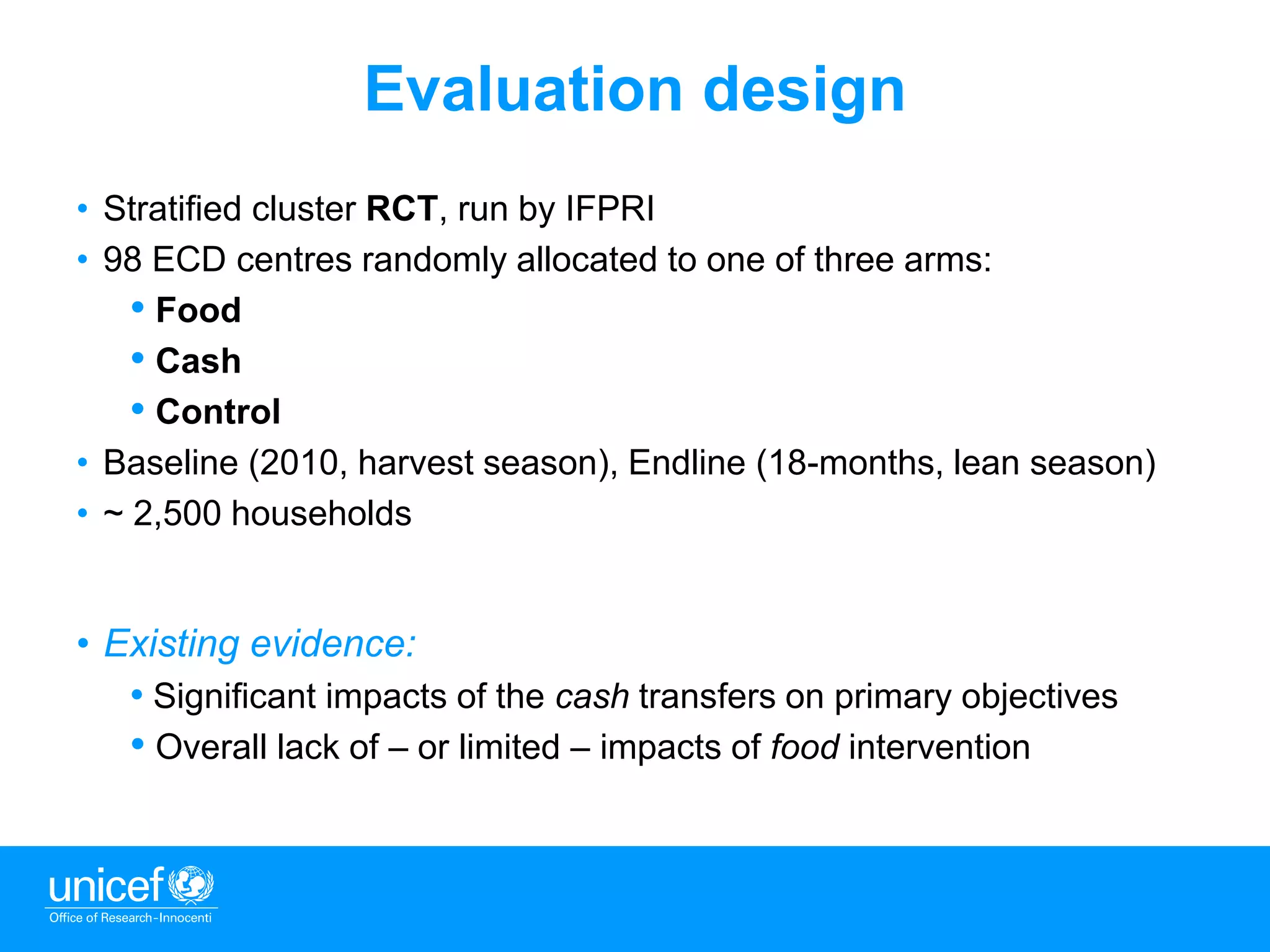
• Stratified cluster RCT, run by IFPRI
• 98 ECD centres randomly allocated to one of three arms:
• Food
• Cash
• Control
• Baseline (2010, harvest season), Endline (18-months, lean season)
• ~ 2,500 households
• Existing evidence:
• Significant impacts of the cash transfers on primary objectives
• Overall lack of – or limited – impacts of food intervention
4
Results
Photo credit: Amber Peterman
5
Positive impact of cash (not food) on adults’
engagement in agricultural work
93% 93%
79%
89%
Control Cash
Baseline Endline
+ 9 pp** impact
…accompanied by 25%
positive impact on time
spent on income-earning
activities
6
Cash (not food) relaxes liquidity constraints
related to agricultural activity
Cash beneficiaries
invest significantly
more in land
+ 12 pp** impact
7
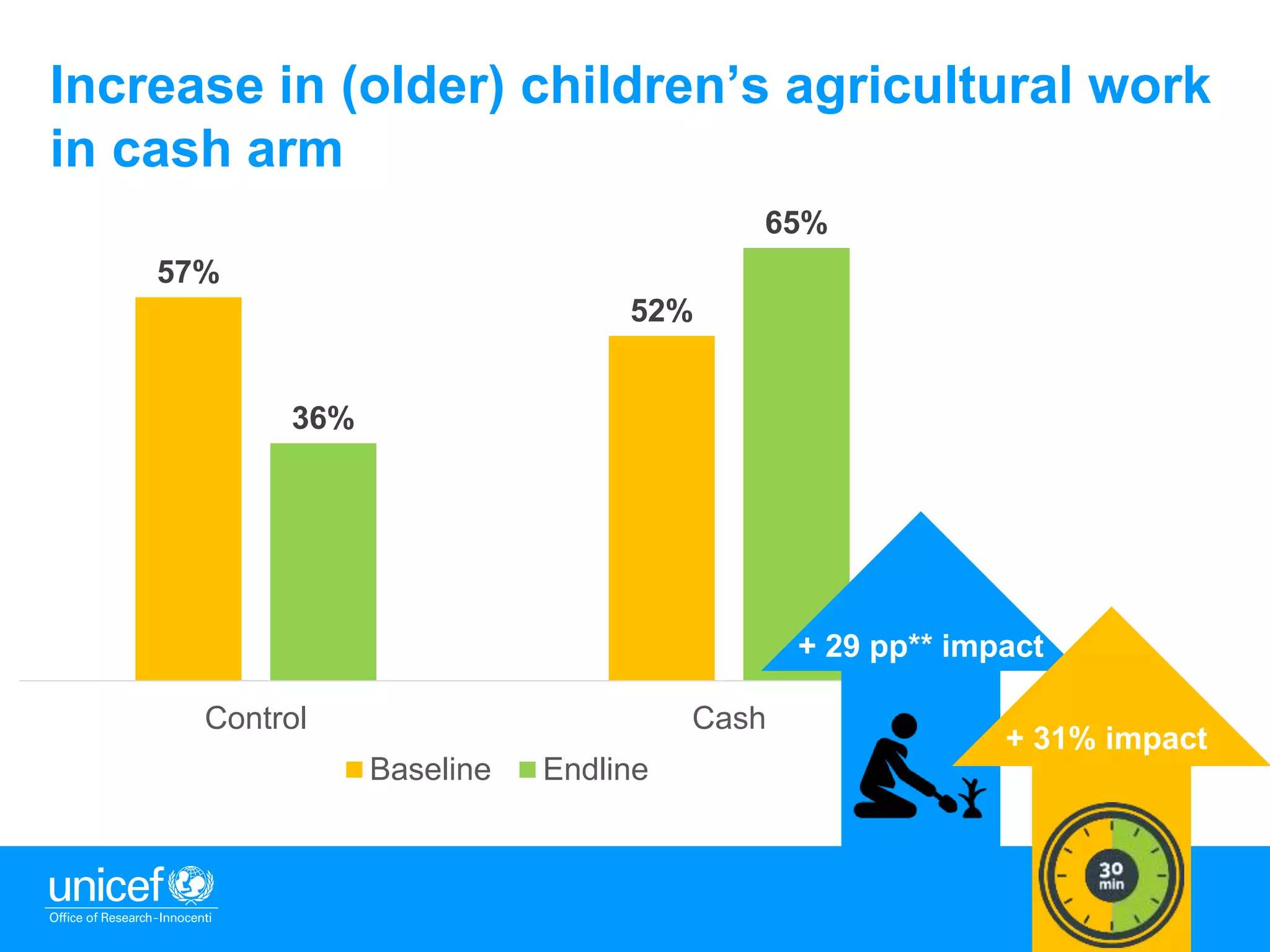
Increase in (older) children’s agricultural work
in cash arm
57%
52%
36%
65%
Control Cash
Baseline Endline
+ 29 pp** impact
+ 31% impact
8
No impact on schooling (neither cash nor food)
61% 59% 59%
Control Cash Food
Currently enrolled at endline
• Neither positive nor detrimental
effect (school enrollment, attendance,
education expenditures)
• Findings suggest decrease in
children’s leisure time
Are there impacts on child labour?
• No significant impact on long
working hours
• Lack of data on engagement
in hazardous activities
@ILO
9
Q1: Is the overall impact
of cash transfers for older
children welfare improving
or not?
Cash Food
ECD outcomes
 ̶
HH food security
 ̶
HH agricultural work &
time on income-earning
activities
 ̶
HH investment in land
 ̶
Child (agricultural) work
 ̶
Schooling
̶ ̶
Long working hours
̶ ̶
Hazardous activities
? ?
Broader indicators of
child wellbeing
? ?
Long-term implications
? ?
Q2: How to better design
programmes – apart from
conditionalities or larger
transfers – to encourage
human capital investment
overall for the household,
without children engaging
in hazardous labour?
(Cash plus?)
10
• Transfer Project website: www.cpc.unc.edu/projects/transfer
• Briefs: http://www.cpc.unc.edu/projects/transfer/publications/briefs
• Facebook: https://www.facebook.com/TransferProject
• Twitter: @TransferProjct email: lnatali@unicef.org
For more information
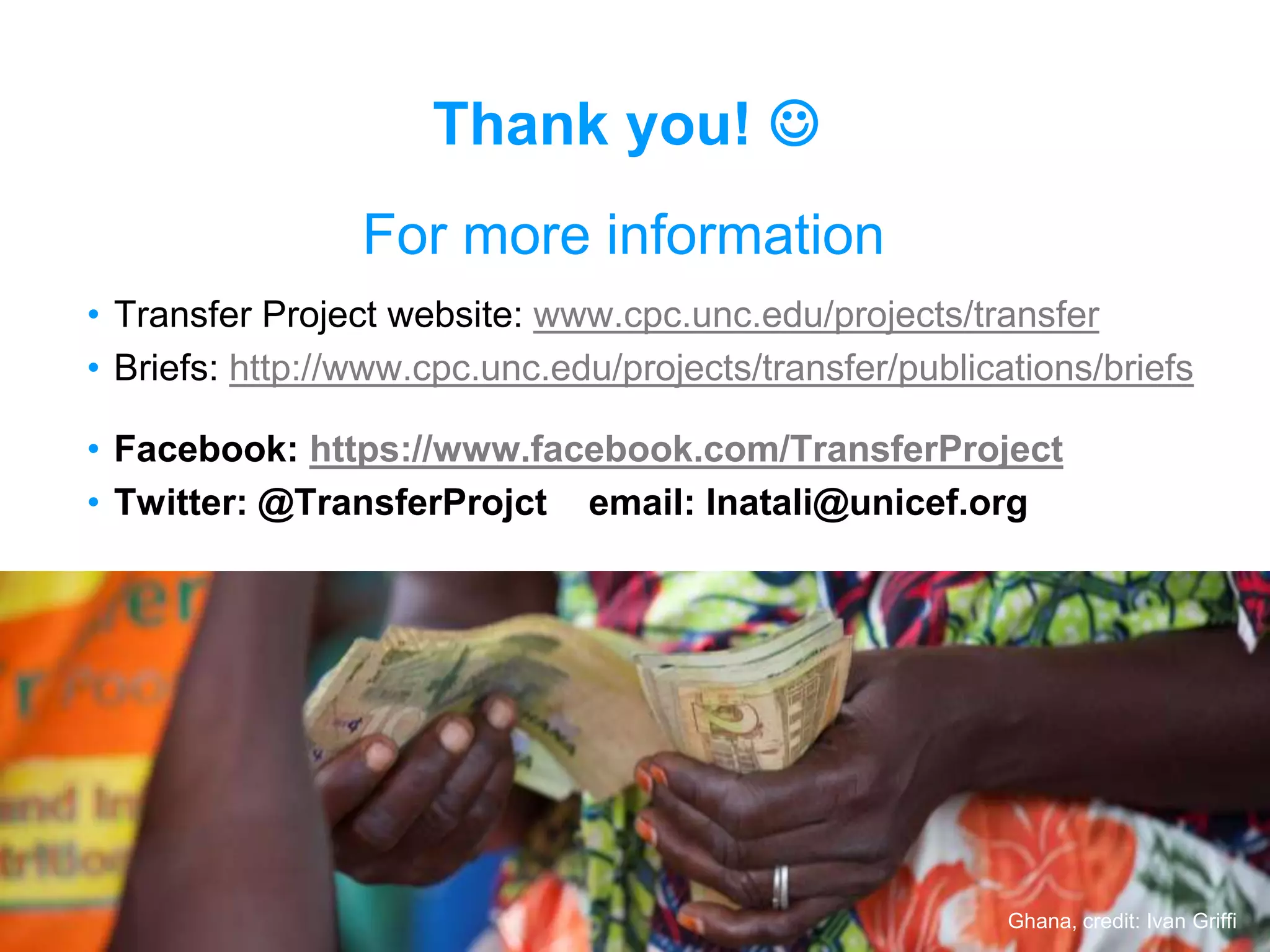
Ghana, credit: Ivan Griffi
Thank you! 
11
References
• Dammert, A.C., J. de Hoop, E. Mvukiyehe, and F.C. Rosati (2018). Effects of Public Policy
on Child Labor: Current Knowledge, Gaps, and Implications for Program Design. World
Development, 110: 104-123.
• Gilligan, D., A. Margolies, E. Quiñones, and S. Roy (2013). WFP/UNICEF/IFPRI Impact
Evaluation of Cash and Food Transfers at Early Childhood Development Centers in
Karamoja, Uganda: Final Impact Report. Submitted to: World Food Programme, Rome;
World Food Programme, Kampala; and UNICEF, Kampala, May 2013.
• Gilligan, D.O., M. Hidrobo, J. Hoddinott, S. Roy, and B. Schwab (2014). Much Ado about
Modalities: Multicountry Experiments on the Effects of Cash and Food Transfers on
Consumption Patterns. IFPRI Conference Paper, International Food Policy Research
Institute.
• Gilligan, D. O. and S. Roy (2015). Resources, Stimulation, and Cognition: How Transfer
Programs and Preschool Shape Cognitive Development in Uganda, IFPRI Conference
Paper, International Food Policy Research Institute.
• De Hoop, J., Groppo, V., and S. Handa on behalf of the Malawi SCTP and Zambia MCTG
study teams (2017) Household Micro-entrepreneurial Activity and Child Work: Evidence
from Two African Unconditional Cash Transfer Programs, Presented at NEUDC 2017.
• De Hoop, J., and F.C. Rosati (2014). Cash Transfers and Child Labor. The World Bank
Research Observer, 29: 202–34.
12
Food for thought
• Importance of:
• Local context / initial conditions
• Level of transfer / regularity
• Targeting / (Primary) objectives
• Program duration
• Lack of data on broader child wellbeing indicators
• Need for long-term impact evaluations

Child Work in the Karamoja ECD Cash or Food Transfer Programme

  • 1.
    unite for children Child workin the Karamoja Early Childhood Development cash or food transfer program Luisa Natali UNICEF Office of Research—Innocenti Transfer Project workshop Arusha, 3rd of April 2019
  • 2.
    2 Karamoja WFP foodor cash transfers • Objectives: Food security & early childhood development • Targeting: households with young children (3-5) enrolled in ECD centres • Transfers: Unconditional, every 6 weeks: • Food or Cash • ~10% of pre-program average consumption per month • Recipient: woman in the household Districts: Kaabong, Kotido, Napak
  • 3.
    3 Evaluation design • Stratifiedcluster RCT, run by IFPRI • 98 ECD centres randomly allocated to one of three arms: • Food • Cash • Control • Baseline (2010, harvest season), Endline (18-months, lean season) • ~ 2,500 households • Existing evidence: • Significant impacts of the cash transfers on primary objectives • Overall lack of – or limited – impacts of food intervention
  • 4.
  • 5.
    5 Positive impact ofcash (not food) on adults’ engagement in agricultural work 93% 93% 79% 89% Control Cash Baseline Endline + 9 pp** impact …accompanied by 25% positive impact on time spent on income-earning activities
  • 6.
    6 Cash (not food)relaxes liquidity constraints related to agricultural activity Cash beneficiaries invest significantly more in land + 12 pp** impact
  • 7.
    7 Increase in (older)children’s agricultural work in cash arm 57% 52% 36% 65% Control Cash Baseline Endline + 29 pp** impact + 31% impact
  • 8.
    8 No impact onschooling (neither cash nor food) 61% 59% 59% Control Cash Food Currently enrolled at endline • Neither positive nor detrimental effect (school enrollment, attendance, education expenditures) • Findings suggest decrease in children’s leisure time Are there impacts on child labour? • No significant impact on long working hours • Lack of data on engagement in hazardous activities @ILO
  • 9.
    9 Q1: Is theoverall impact of cash transfers for older children welfare improving or not? Cash Food ECD outcomes  ̶ HH food security  ̶ HH agricultural work & time on income-earning activities  ̶ HH investment in land  ̶ Child (agricultural) work  ̶ Schooling ̶ ̶ Long working hours ̶ ̶ Hazardous activities ? ? Broader indicators of child wellbeing ? ? Long-term implications ? ? Q2: How to better design programmes – apart from conditionalities or larger transfers – to encourage human capital investment overall for the household, without children engaging in hazardous labour? (Cash plus?)
  • 10.
    10 • Transfer Projectwebsite: www.cpc.unc.edu/projects/transfer • Briefs: http://www.cpc.unc.edu/projects/transfer/publications/briefs • Facebook: https://www.facebook.com/TransferProject • Twitter: @TransferProjct email: lnatali@unicef.org For more information Ghana, credit: Ivan Griffi Thank you! 
  • 11.
    11 References • Dammert, A.C.,J. de Hoop, E. Mvukiyehe, and F.C. Rosati (2018). Effects of Public Policy on Child Labor: Current Knowledge, Gaps, and Implications for Program Design. World Development, 110: 104-123. • Gilligan, D., A. Margolies, E. Quiñones, and S. Roy (2013). WFP/UNICEF/IFPRI Impact Evaluation of Cash and Food Transfers at Early Childhood Development Centers in Karamoja, Uganda: Final Impact Report. Submitted to: World Food Programme, Rome; World Food Programme, Kampala; and UNICEF, Kampala, May 2013. • Gilligan, D.O., M. Hidrobo, J. Hoddinott, S. Roy, and B. Schwab (2014). Much Ado about Modalities: Multicountry Experiments on the Effects of Cash and Food Transfers on Consumption Patterns. IFPRI Conference Paper, International Food Policy Research Institute. • Gilligan, D. O. and S. Roy (2015). Resources, Stimulation, and Cognition: How Transfer Programs and Preschool Shape Cognitive Development in Uganda, IFPRI Conference Paper, International Food Policy Research Institute. • De Hoop, J., Groppo, V., and S. Handa on behalf of the Malawi SCTP and Zambia MCTG study teams (2017) Household Micro-entrepreneurial Activity and Child Work: Evidence from Two African Unconditional Cash Transfer Programs, Presented at NEUDC 2017. • De Hoop, J., and F.C. Rosati (2014). Cash Transfers and Child Labor. The World Bank Research Observer, 29: 202–34.
  • 12.
    12 Food for thought •Importance of: • Local context / initial conditions • Level of transfer / regularity • Targeting / (Primary) objectives • Program duration • Lack of data on broader child wellbeing indicators • Need for long-term impact evaluations