
Child Protection Decision-Making:
The Safeguarding Children
Assessment and Analysis Framework (SAAF)
Stephen Pizzey, Phil Heasman and Carla Thomas
Arnon Bentovim, Antony Cox, Liza Bingley Miller
and Simon Tapp
www.childandfamilytraining.org.uk
Child and Family Training (C&FT)
Started in 2000 as a result of a government-funded
collaboration between senior professionals to develop:
 A range of evidence-based assessment approaches
 Training packages
 Team of accredited trainers and consultants
Contributes to agencies’ training programmes around the UK
and abroad for social work and other professionals
Commitment to continuous development
Child and Family Training
2© Child and Family Training 2015
Please discuss with the person next to you;
What makes a safeguarding case complex?
Complex child protection cases
3© Child and Family Training 2015
Definition of child protection is where the concerns about
the safety of the child are such that there is serious
consideration of:
the child having to be moved away from their current care
setting (or not to be returned to their previous care setting)
in order to
prevent further or likely future major impairment of the
child’s development
Definition of Child Protection
4© Child and Family Training 2015
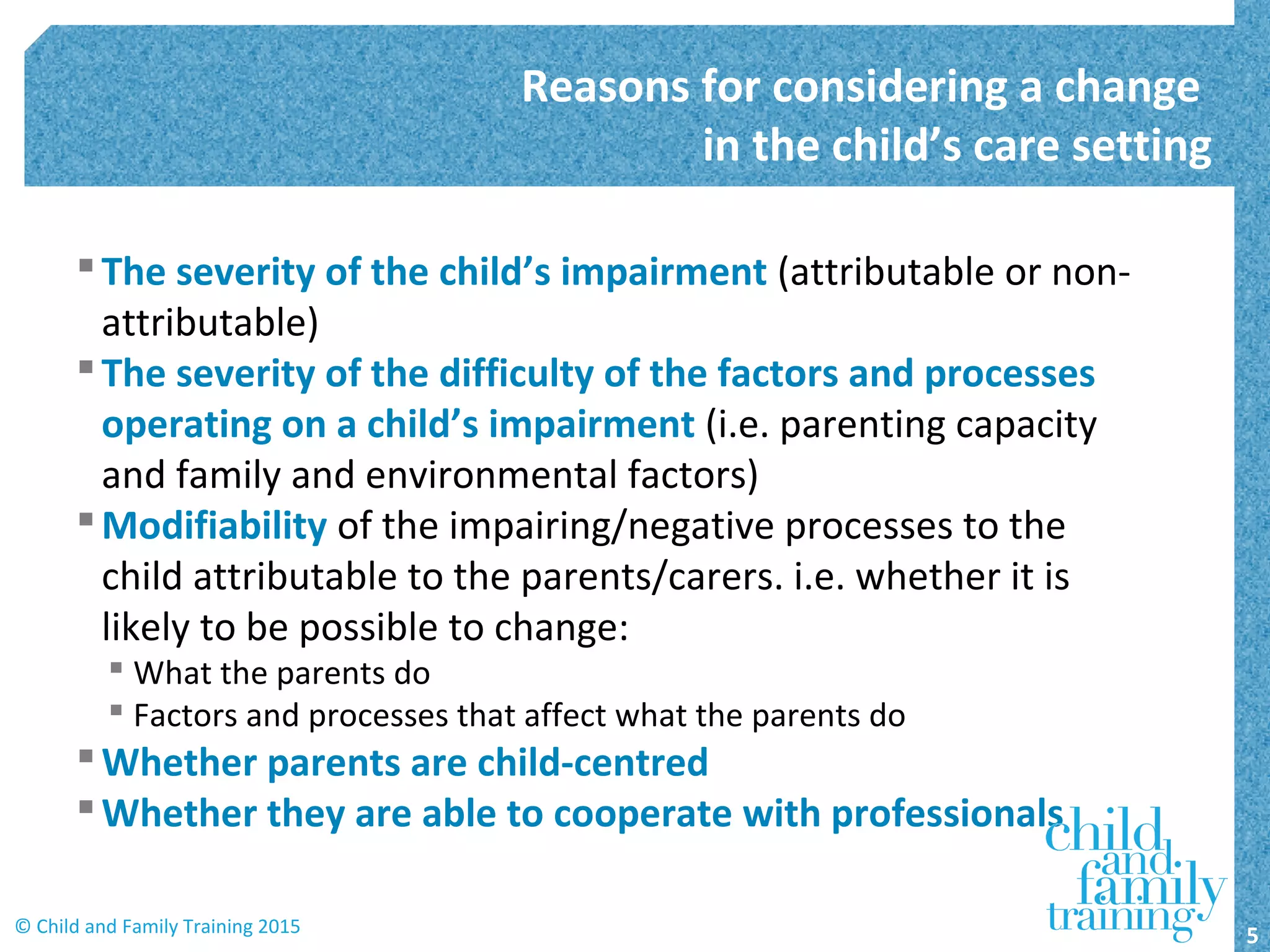
The severity of the child’s impairment (attributable or non-
attributable)
The severity of the difficulty of the factors and processes
operating on a child’s impairment (i.e. parenting capacity
and family and environmental factors)
Modifiability of the impairing/negative processes to the
child attributable to the parents/carers. i.e. whether it is
likely to be possible to change:
 What the parents do
 Factors and processes that affect what the parents do
Whether parents are child-centred
Whether they are able to cooperate with professionals
Reasons for considering a change
in the child’s care setting
5© Child and Family Training 2015
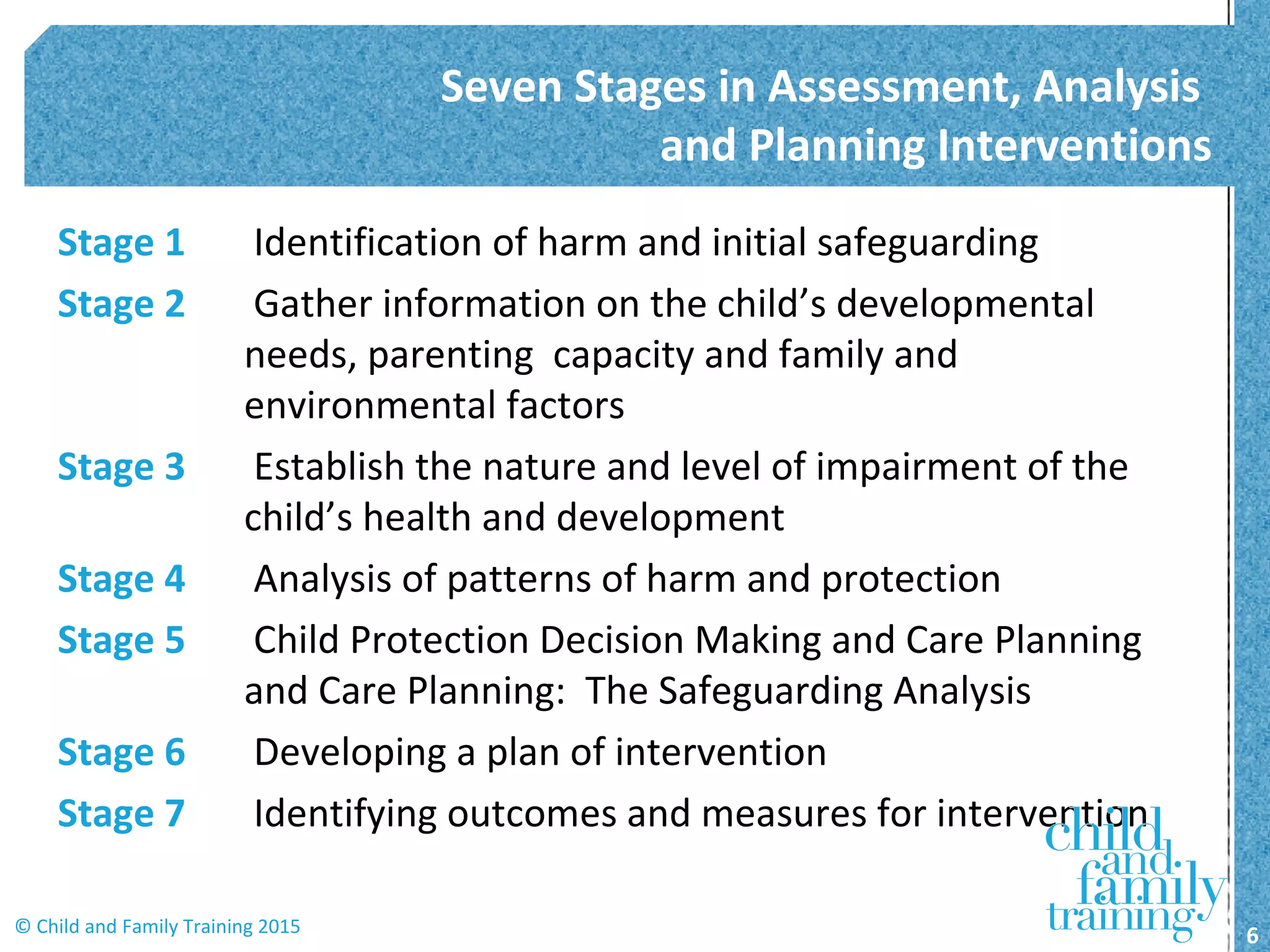
Stage 1 Identification of harm and initial safeguarding
Stage 2 Gather information on the child’s developmental
needs, parenting capacity and family and
environmental factors
Stage 3 Establish the nature and level of impairment of the
child’s health and development
Stage 4 Analysis of patterns of harm and protection
Stage 5 Child Protection Decision Making and Care Planning
and Care Planning: The Safeguarding Analysis
Stage 6 Developing a plan of intervention
Stage 7 Identifying outcomes and measures for intervention
Seven Stages in Assessment, Analysis
and Planning Interventions
6© Child and Family Training 2015
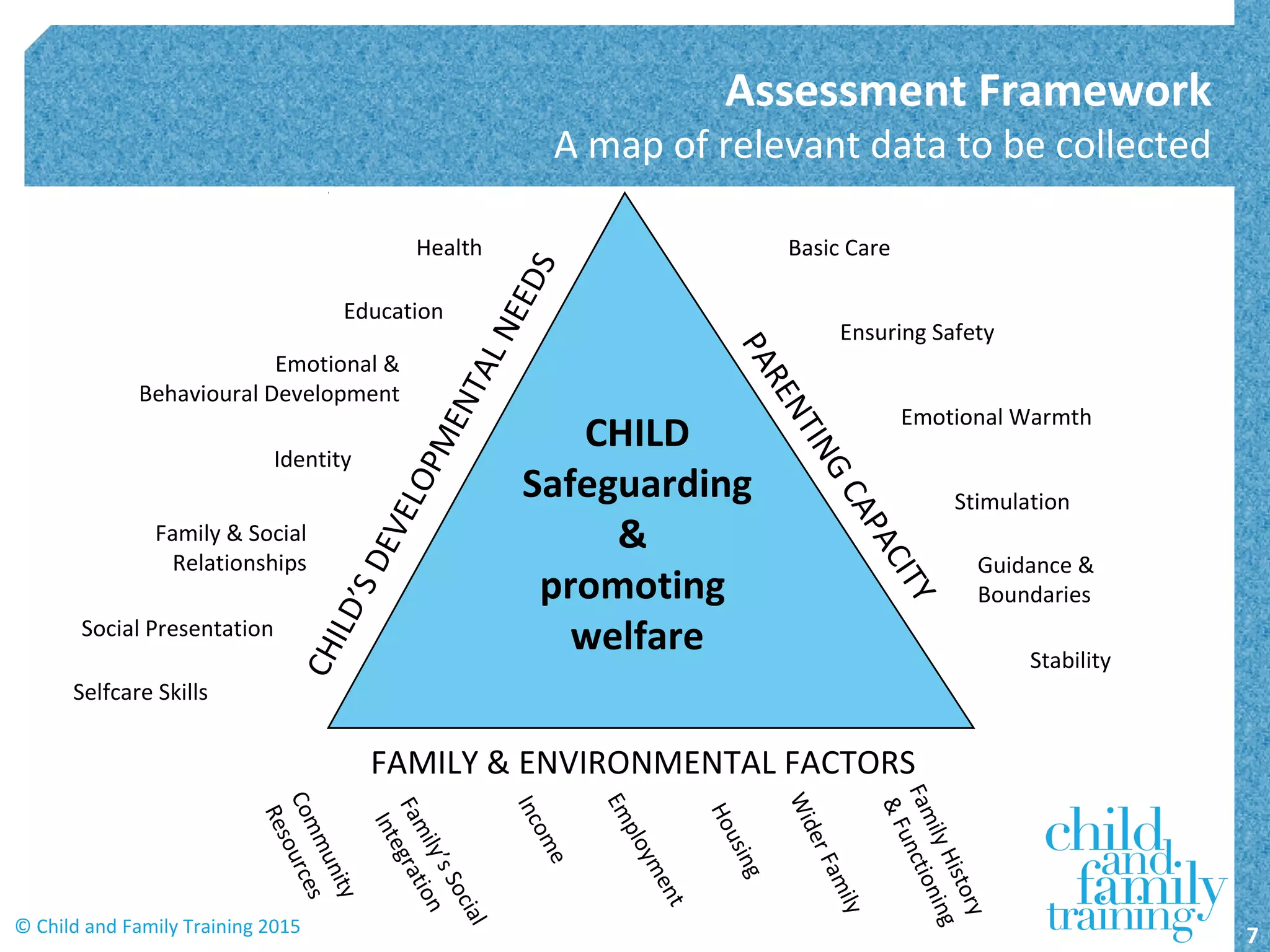
Assessment Framework
A map of relevant data to be collected
7
Health
Education
Identity
Family & Social
Relationships
Social Presentation
Emotional &
Behavioural Development
Selfcare Skills
CHILD’SDEVELOPMENTALNEEDS
PARENTINGCAPACITY
FAMILY & ENVIRONMENTAL FACTORS
Basic Care
Emotional Warmth
Stimulation
Guidance &
Boundaries
Ensuring Safety
Stability
WiderFamily
Housing
Employment
Income
Family’sSocial
Integration
FamilyHistory
&Functioning
Community
Resources
CHILD
Safeguarding
&
promoting
welfare
© Child and Family Training 2015
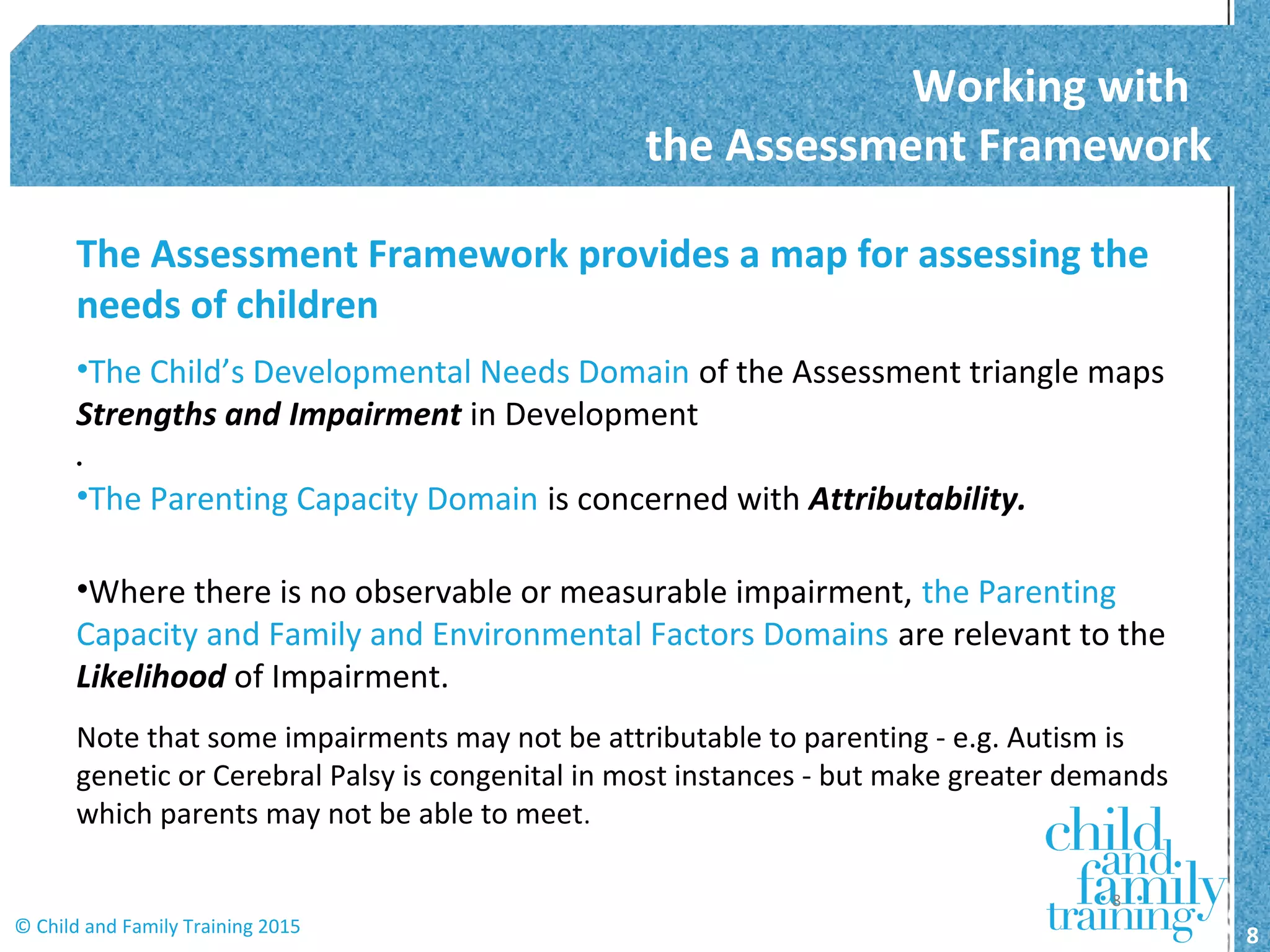
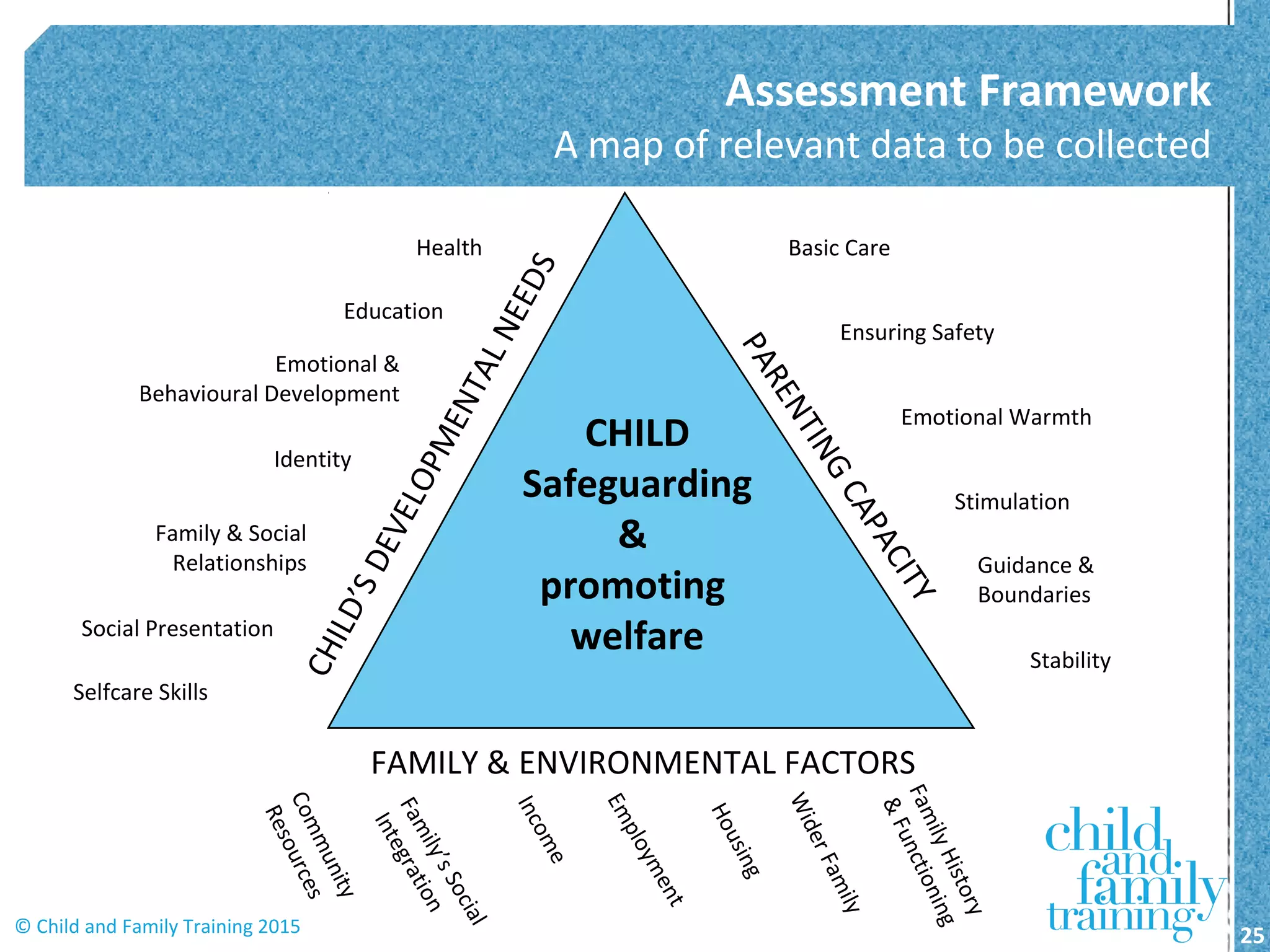
The Assessment Framework provides a map for assessing the
needs of children
•The Child’s Developmental Needs Domain of the Assessment triangle maps
Strengths and Impairment in Development
•
•The Parenting Capacity Domain is concerned with Attributability.
•Where there is no observable or measurable impairment, the Parenting
Capacity and Family and Environmental Factors Domains are relevant to the
Likelihood of Impairment.
Note that some impairments may not be attributable to parenting - e.g. Autism is
genetic or Cerebral Palsy is congenital in most instances - but make greater demands
which parents may not be able to meet.
Working with
the Assessment Framework
8© Child and Family Training 2015
8
Consider the referral and the aims of the
assessment
The awareness of harm arises in many contexts
Multi-agency child protection conferences - have to judge
current risk and future harm
Extent of harm to the child and nature of parenting capacity
and family and environmental factors often unknown
Stage 1: Identification of Harm and Initial Safeguarding
9© Child and Family Training 2015
In order to make a full assessment of the child’s
needs, parenting capacity and family and
environmental factors the assessor needs to:
Gather information from available sources including
using assessment tools
Create comprehensive chronology of salient
information
Good assessments use multiple sources of information.
An assessment should not rely on one source of
information.
Stage 2: Making a full assessment and create
comprehensive chronology
10© Child and Family Training 2015
Stage 2: Making a full assessment
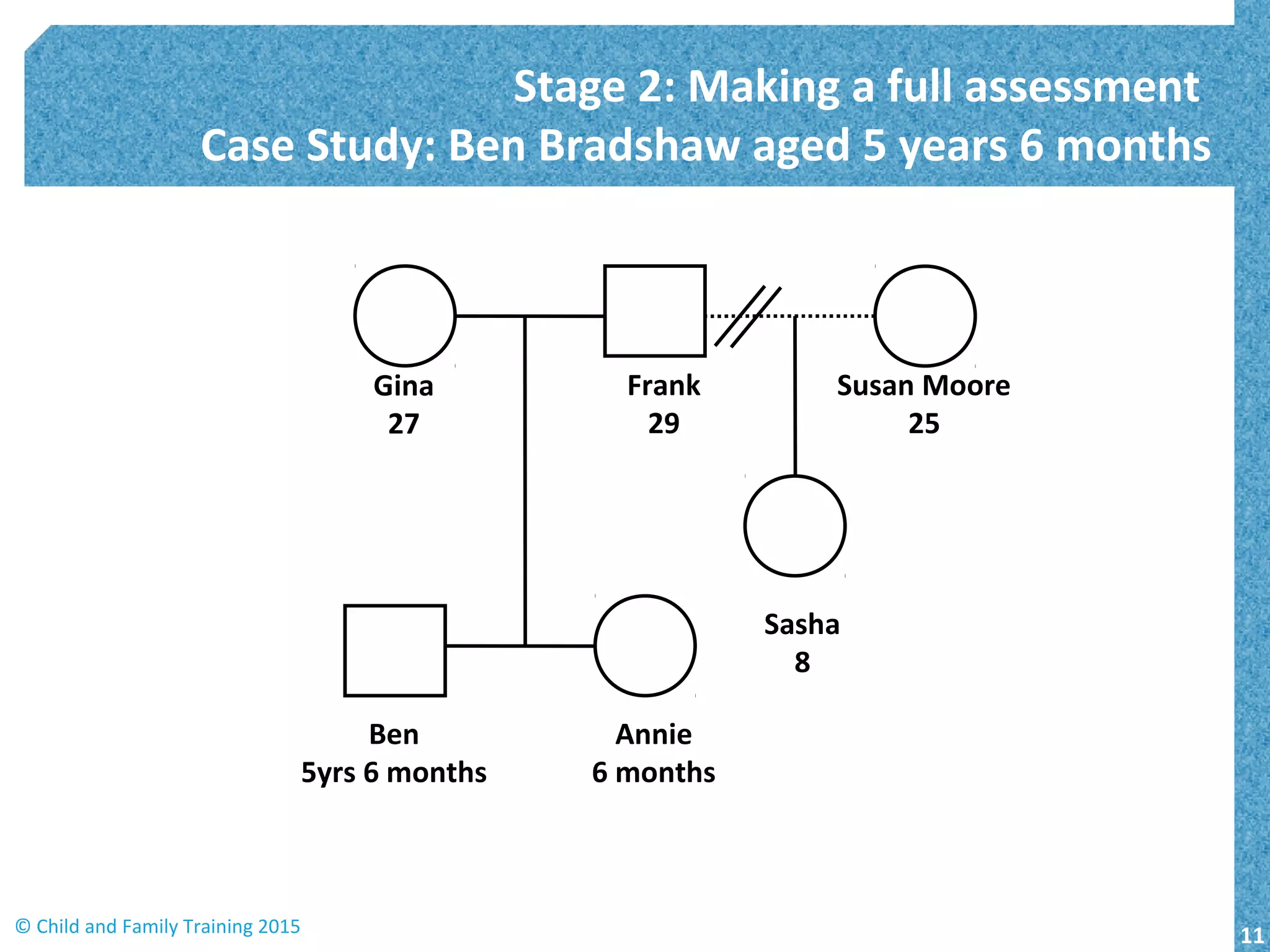
Case Study: Ben Bradshaw aged 5 years 6 months
11© Child and Family Training 2015
Gina
27
Susan Moore
25
Ben
5yrs 6 months
Frank
29
Annie
6 months
Sasha
8
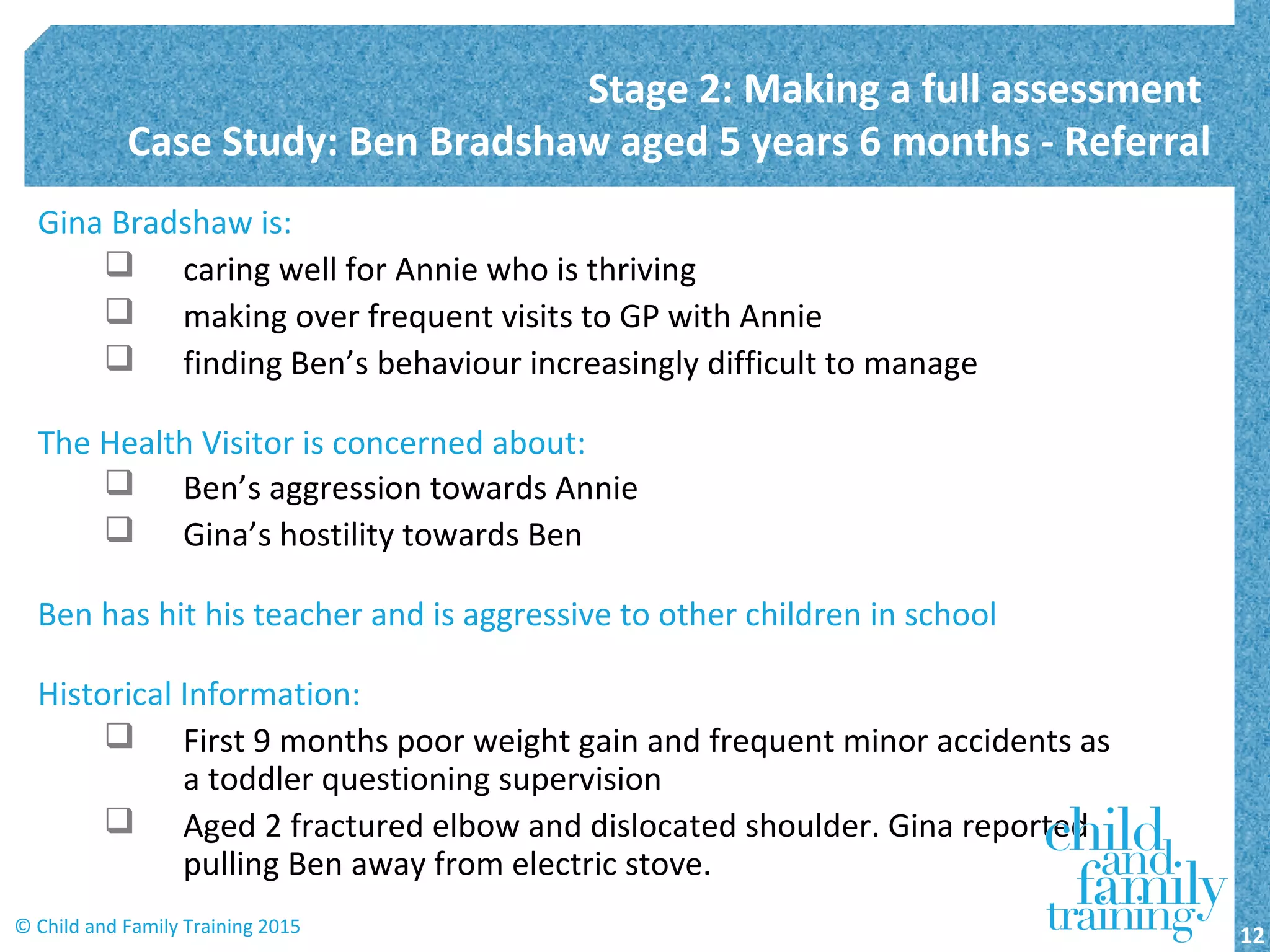
Gina Bradshaw is:
 caring well for Annie who is thriving
 making over frequent visits to GP with Annie
 finding Ben’s behaviour increasingly difficult to manage
The Health Visitor is concerned about:
 Ben’s aggression towards Annie
 Gina’s hostility towards Ben
Ben has hit his teacher and is aggressive to other children in school
Historical Information:
 First 9 months poor weight gain and frequent minor accidents as
a toddler questioning supervision
 Aged 2 fractured elbow and dislocated shoulder. Gina reported
pulling Ben away from electric stove.
Stage 2: Making a full assessment
Case Study: Ben Bradshaw aged 5 years 6 months - Referral
12© Child and Family Training 2015
Gina was sexually abused as a child for a number of years by an uncle.
Gina had a troubled adolescence and early adulthood:
• truanting, aggression to staff and exclusion from school;
• running away from home and accommodated by local authority;
• extensive drug use
• termination aged 15
• series of violent relationships
• overdosed twice
• convictions for shoplifting to fund drug habit
Gina found it difficult to bond with Ben because he was a boy and felt protective
towards Annie because she was a girl.
Stage 2: Making a full assessment
Case Study: Gina Bradshaw Background
13© Child and Family Training 2015
Frank Bradshaw’s early experiences included:
• disruption in early childhood – older brother aged 8 sent to
grandparents;
• regular school attendance;
• occasional drug use;
• a series of brief relationships;
• unhappy relationship with Susan mother of his daughter, Sasha
• private law proceedings regarding Sasha – monthly contact
which petered out
• clinical depression
Stage 2: Making a full assessment
Case Study: Frank Bradshaw Background
14© Child and Family Training 2015
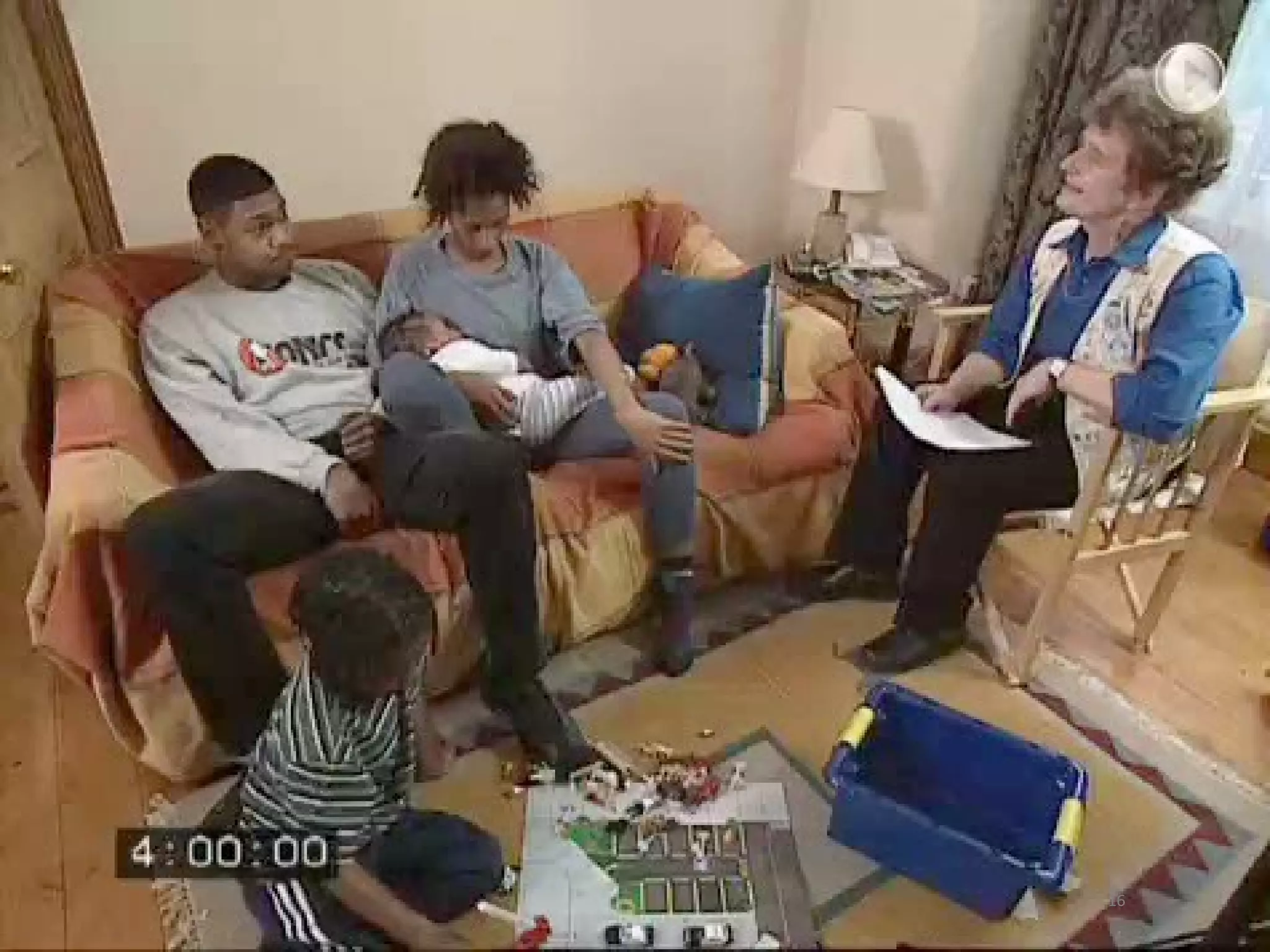
Watch short extracts from:
• a Family Assessment interview with the whole family;
• an Early Childhood (3-6) HOME Inventory Assessment of
Ben’s experience of care in the family with Ben and Gina.
Take detailed notes of what observed and what reported
Stage 2: Making a full assessment
Case Study: Ben Bradshaw
15© Child and Family Training 2015
Stage 2: Making a full assessment
Ben Bradshaw – Family Assessment Interview
16© Child and Family Training 2011
16
Stage 2: Making a full assessment
Ben Bradshaw – HOME Inventory Interview (1)
17© Child and Family Training 2011
17
Organise information using the Assessment Framework
•Record information on the Assessment Framework handout
in the following dimensions:
• Emotional & Behavioural Development
• Family & Social Relationships
• Emotional Warmth
• Guidance and Boundaries
• Family Functioning
•Identify strengths and difficulties
Stage 3: Establish the nature and level of harm
and harmful effects on the child
18© Child and Family Training 2015
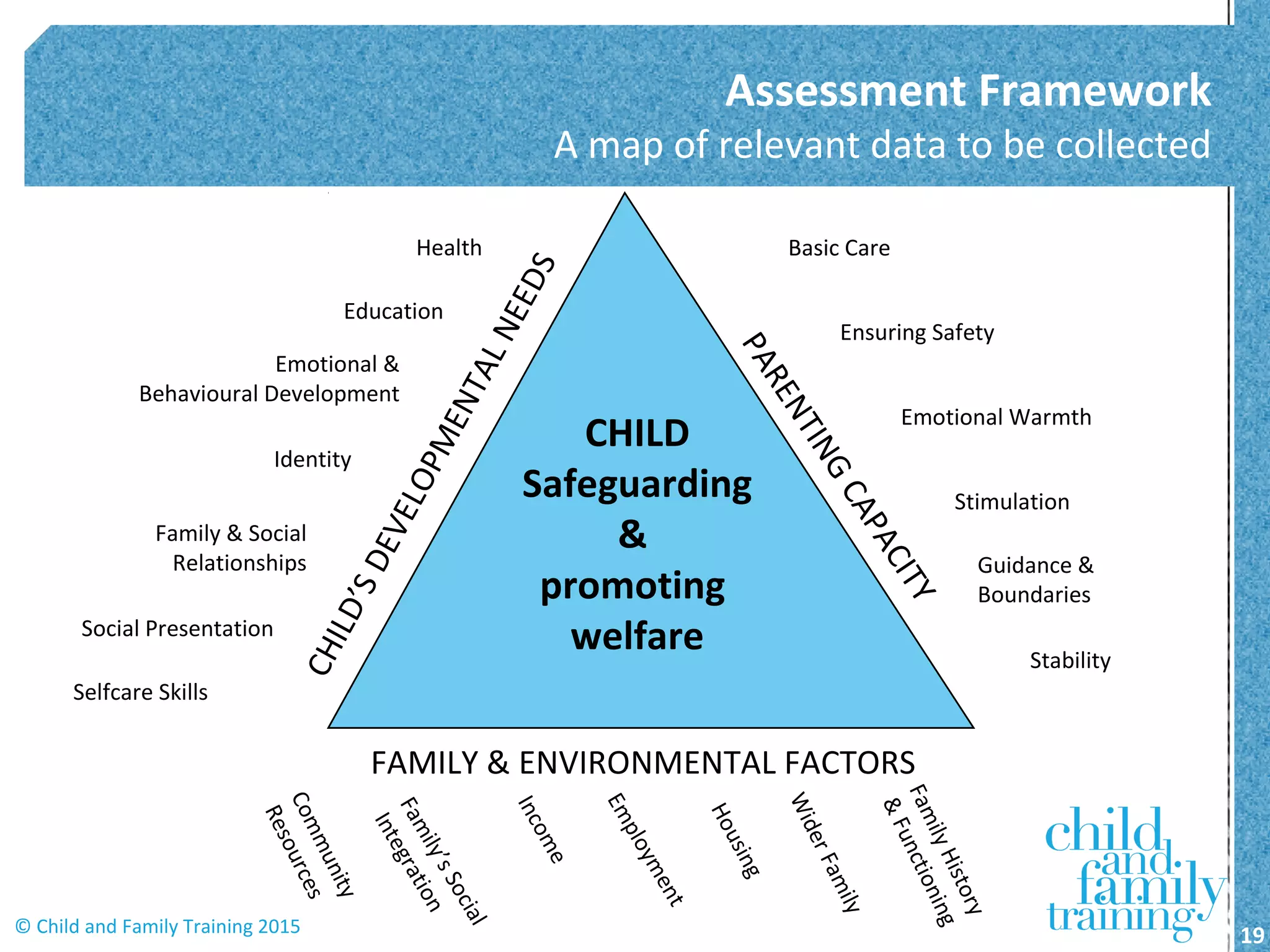
Assessment Framework
A map of relevant data to be collected
19
Health
Education
Identity
Family & Social
Relationships
Social Presentation
Emotional &
Behavioural Development
Selfcare Skills
CHILD’SDEVELOPMENTALNEEDS
PARENTINGCAPACITY
FAMILY & ENVIRONMENTAL FACTORS
Basic Care
Emotional Warmth
Stimulation
Guidance &
Boundaries
Ensuring Safety
Stability
WiderFamily
Housing
Employment
Income
Family’sSocial
Integration
FamilyHistory
&Functioning
Community
Resources
CHILD
Safeguarding
&
promoting
welfare
© Child and Family Training 2015
In analysing the categorised information consideration
should be given to:
 Processes – the pattern of influences
&
 Impact – the weight/effect of factors/processes
Note
 What is central is whether there is impairment or likelihood of
impairment of the CHILD’S DEVELOPMENT.
 Difficulties/impairments in Parenting or broader Family and
Environment may or may not be producing impairments in the child’s
development.
Stage 4: Analysis of patterns of ham and protection
Angold et al 1995 Bentovim et al 2009
20© Child and Family Training 2015
20
Distinguish:
 What has brought things about from the past
 What keeps things going in the present
both of which
 Can help to predict what’s likely to happen in
the future if things carry on as they are
Stage 4: Analysis of patterns of harm and protection
21© Child and Family Training 2015
When examining processes consider:
 the time relationships between impairments in
the child’s development and life events and
stressors
which
 can raise hypotheses about processes
influencing the child’s health and development
Stage 4: Analysis of patterns of harm and protection
Develop a chronology of salient information
22© Child and Family Training 2015
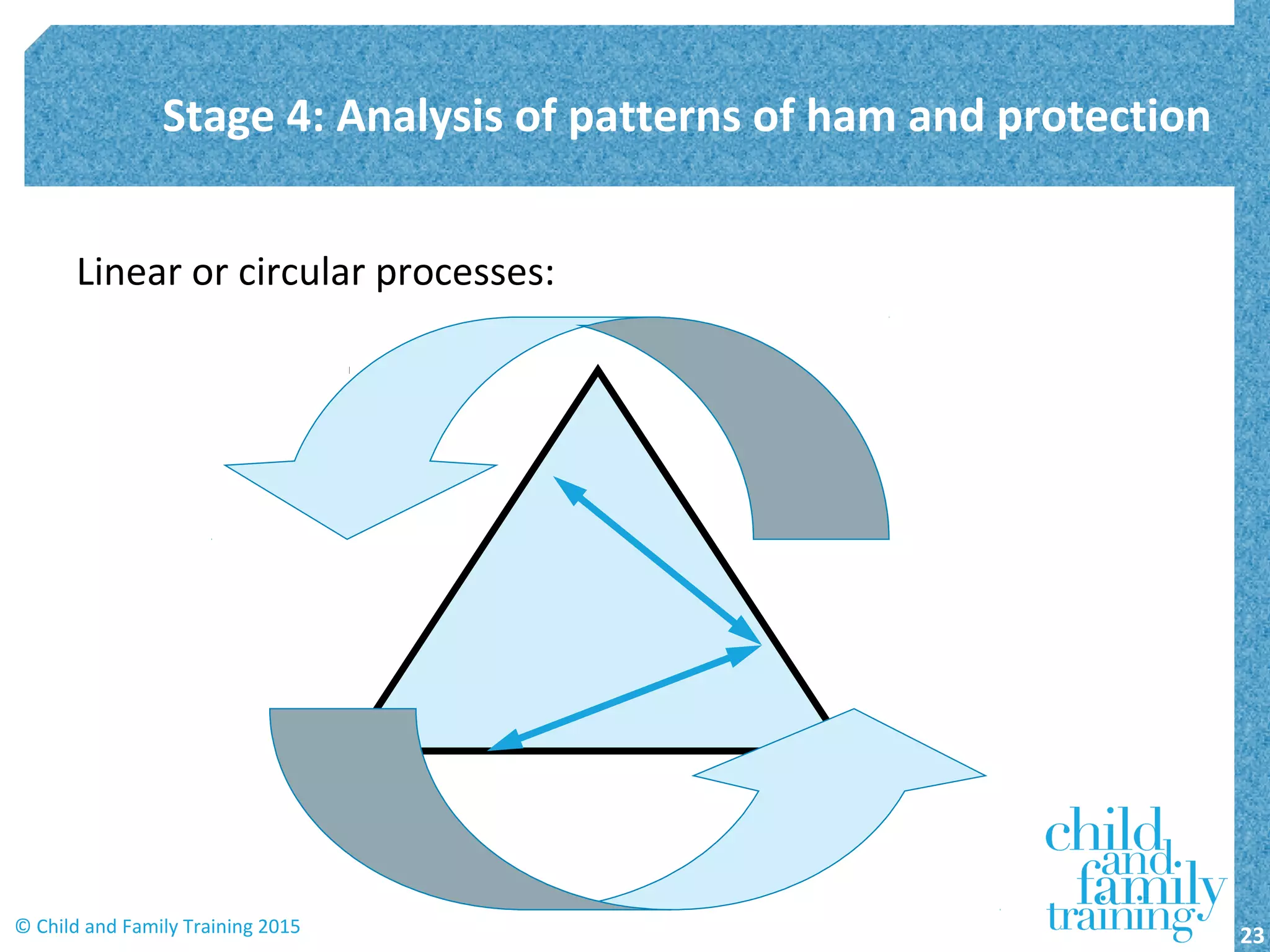
Linear or circular processes:
Stage 4: Analysis of patterns of ham and protection
23© Child and Family Training 2015
Identify Strengths and impairments in the child’s
development
• What are Ben’s strengths in health and development and
how have they been brought about?
• What are Ben’s impairments in health and development
and why have they occurred?
Stage 4: Analysis of patterns of ham and protection
24© Child and Family Training 2015
Assessment Framework
A map of relevant data to be collected
25
Health
Education
Identity
Family & Social
Relationships
Social Presentation
Emotional &
Behavioural Development
Selfcare Skills
CHILD’SDEVELOPMENTALNEEDS
PARENTINGCAPACITY
FAMILY & ENVIRONMENTAL FACTORS
Basic Care
Emotional Warmth
Stimulation
Guidance &
Boundaries
Ensuring Safety
Stability
WiderFamily
Housing
Employment
Income
Family’sSocial
Integration
FamilyHistory
&Functioning
Community
Resources
CHILD
Safeguarding
&
promoting
welfare
© Child and Family Training 2015
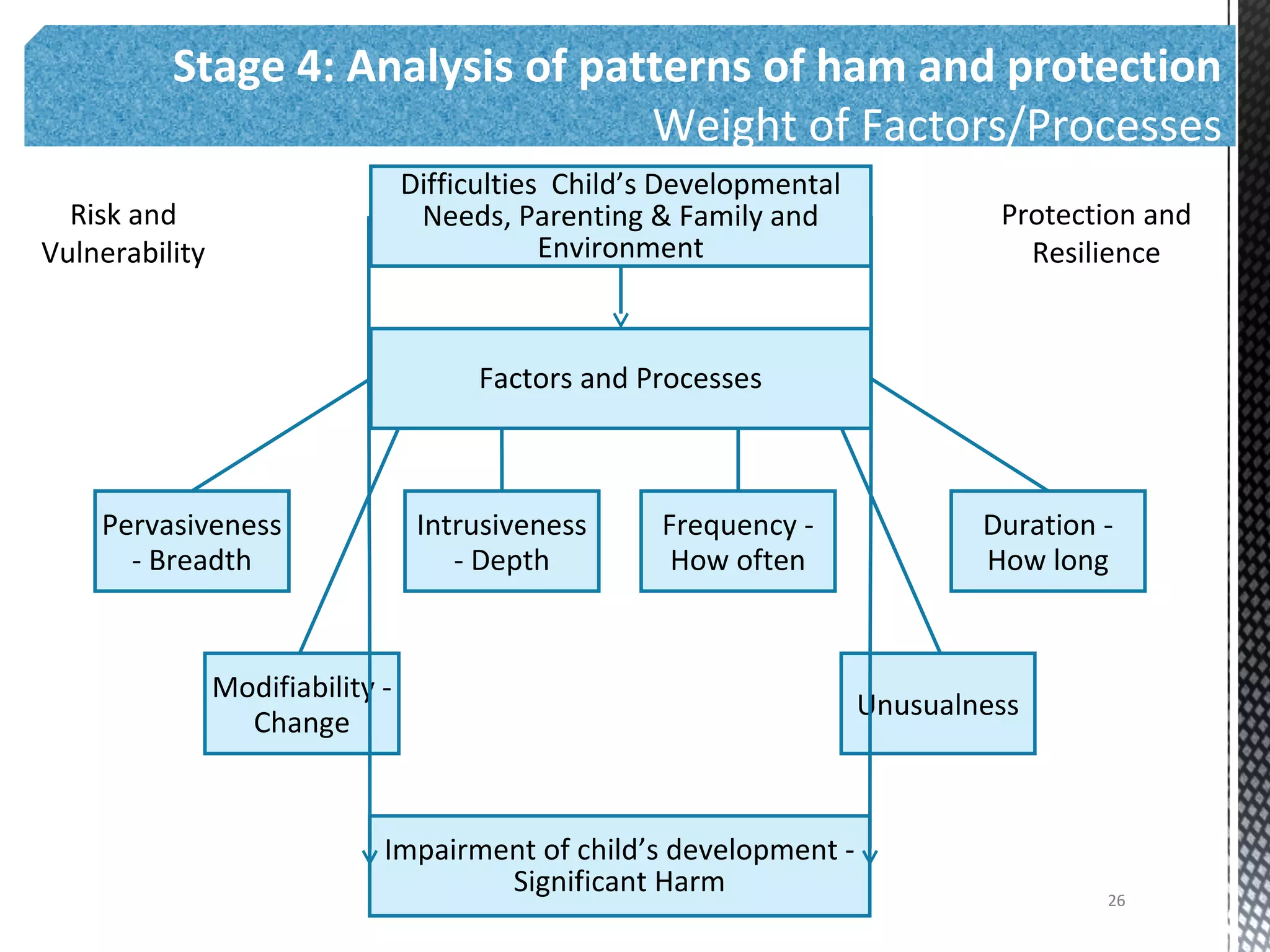
Stage 4: Analysis of patterns of ham and protection
Weight of Factors/Processes
Difficulties Child’s Developmental
Needs, Parenting & Family and
Environment
Factors and Processes
Impairment of child’s development -
Significant Harm
Protection and
Resilience
Risk and
Vulnerability
Modifiability -
Change
Intrusiveness
- Depth
Pervasiveness
- Breadth
Unusualness
Frequency -
How often
Duration -
How long
26
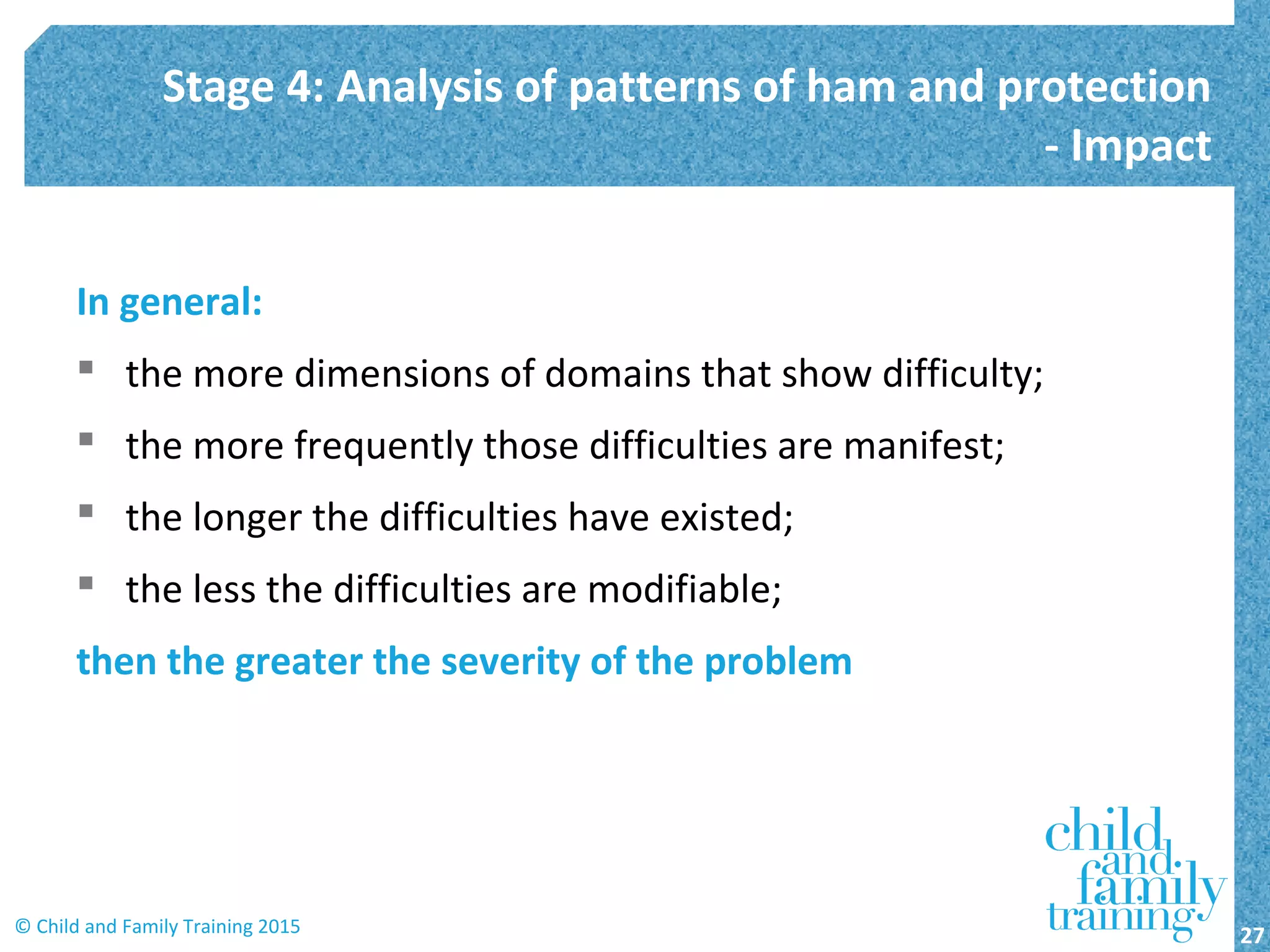
In general:
 the more dimensions of domains that show difficulty;
 the more frequently those difficulties are manifest;
 the longer the difficulties have existed;
 the less the difficulties are modifiable;
then the greater the severity of the problem
Stage 4: Analysis of patterns of ham and protection
- Impact
27© Child and Family Training 2015
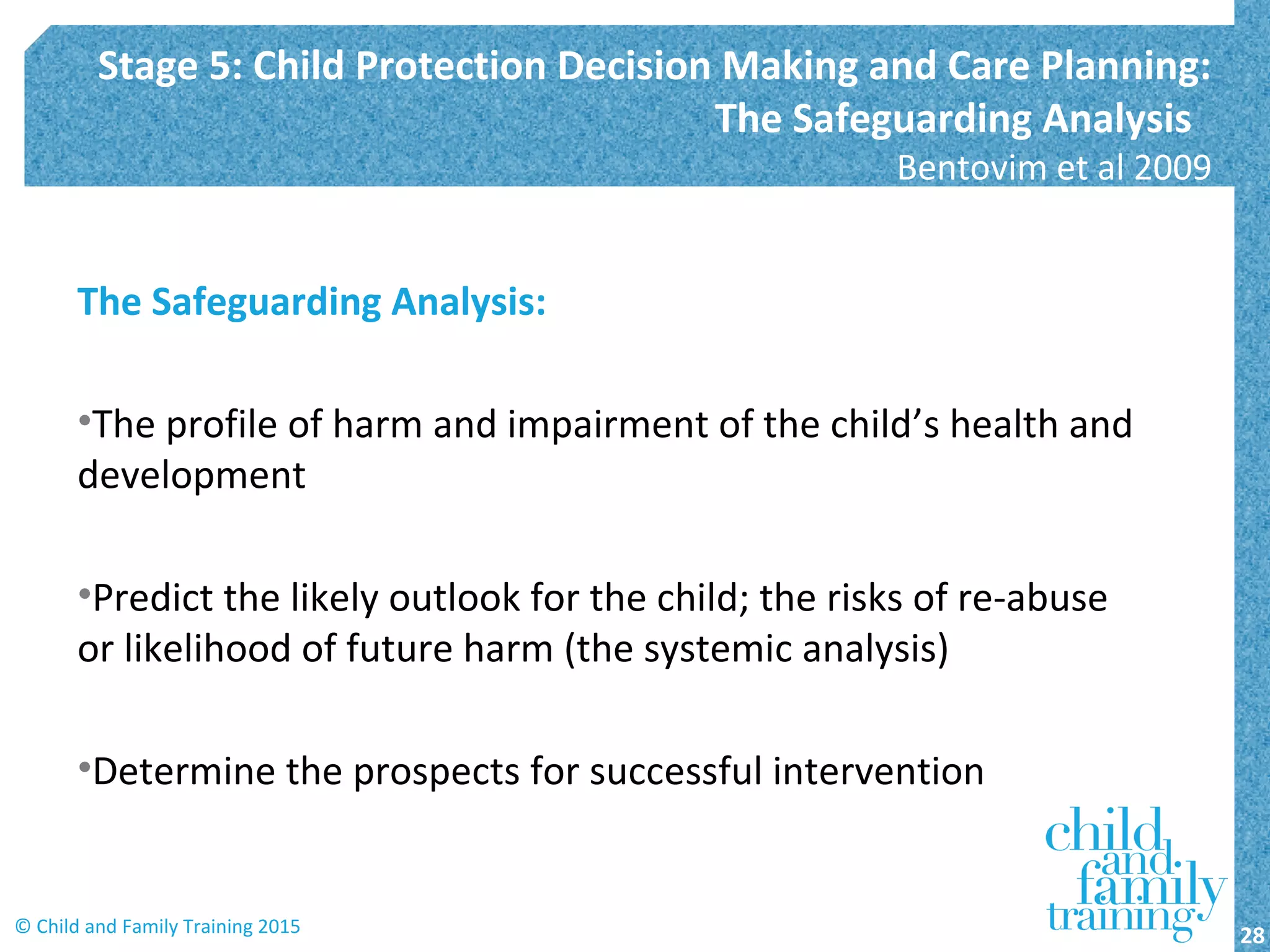
The Safeguarding Analysis:
•The profile of harm and impairment of the child’s health and
development
•Predict the likely outlook for the child; the risks of re-abuse
or likelihood of future harm (the systemic analysis)
•Determine the prospects for successful intervention
Stage 5: Child Protection Decision Making and Care Planning:
The Safeguarding Analysis
Bentovim et al 2009
28© Child and Family Training 2015
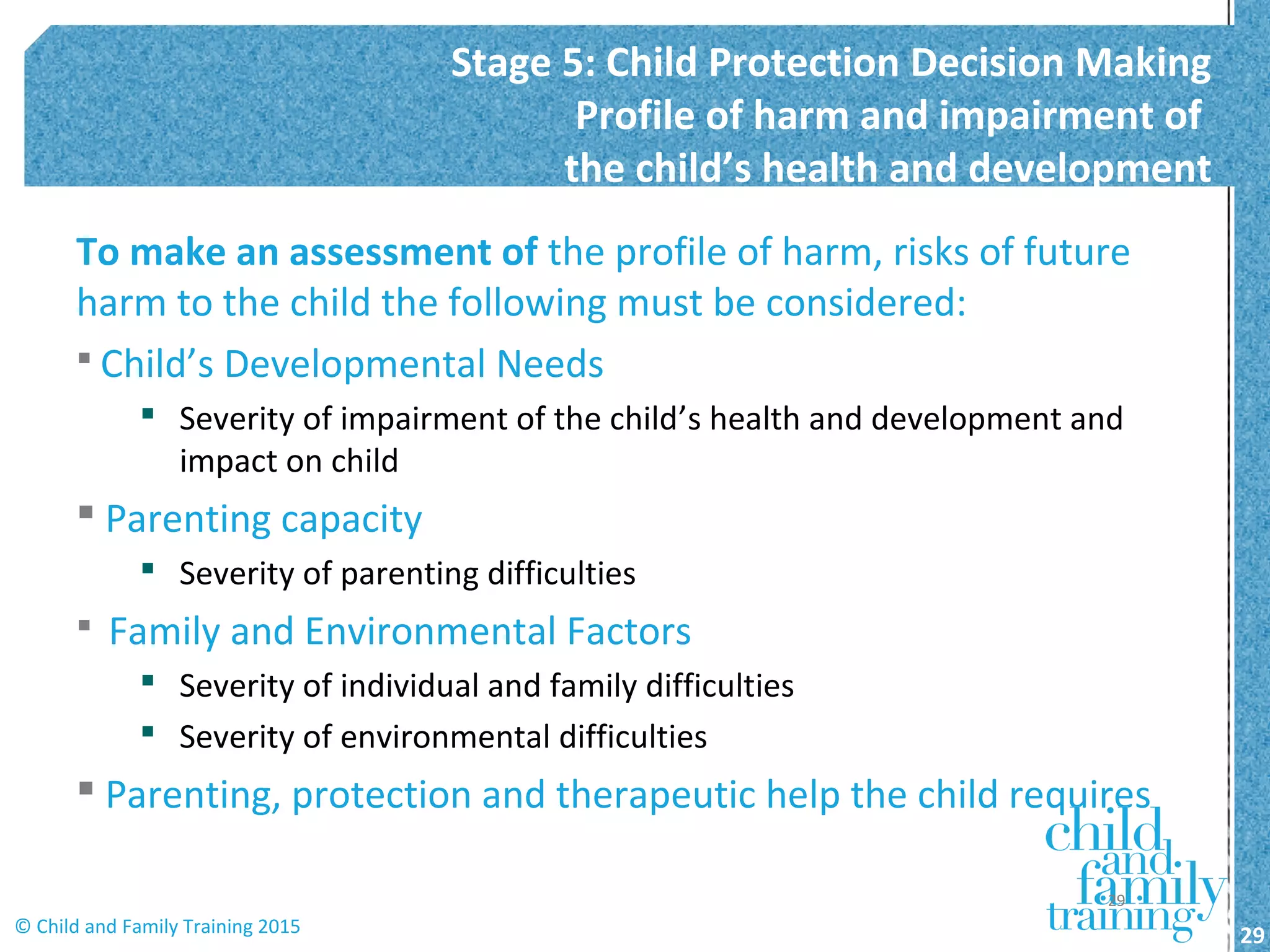
To make an assessment of the profile of harm, risks of future
harm to the child the following must be considered:
 Child’s Developmental Needs
 Severity of impairment of the child’s health and development and
impact on child
 Parenting capacity
 Severity of parenting difficulties
 Family and Environmental Factors
 Severity of individual and family difficulties
 Severity of environmental difficulties
 Parenting, protection and therapeutic help the child requires
Stage 5: Child Protection Decision Making
Profile of harm and impairment of
the child’s health and development
29© Child and Family Training 2015
29
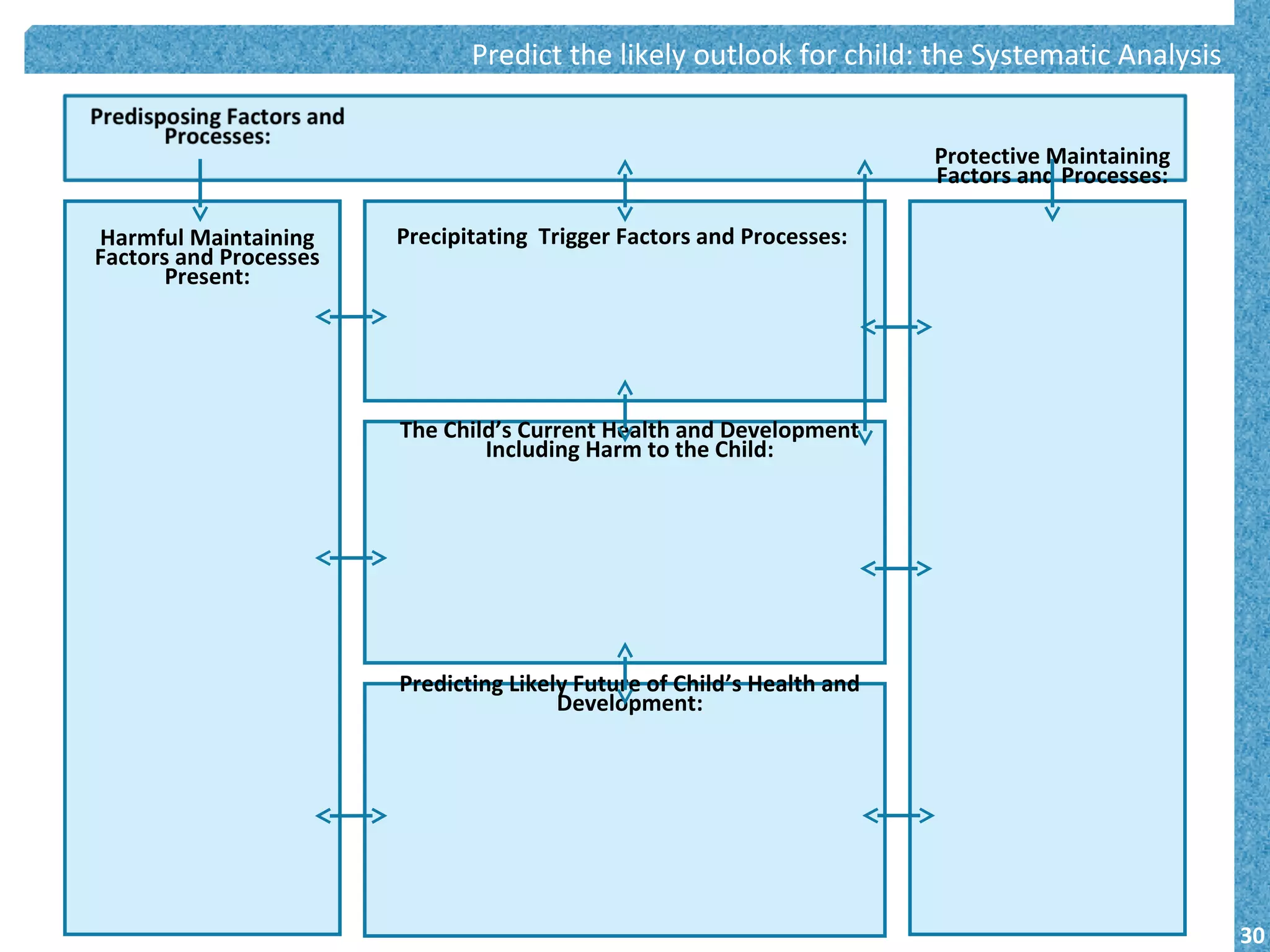
30
Harmful Maintaining
Factors and Processes
Present:
Precipitating Trigger Factors and Processes:
Protective Maintaining
Factors and Processes:
The Child’s Current Health and Development
Including Harm to the Child:
Predicting Likely Future of Child’s Health and
Development:
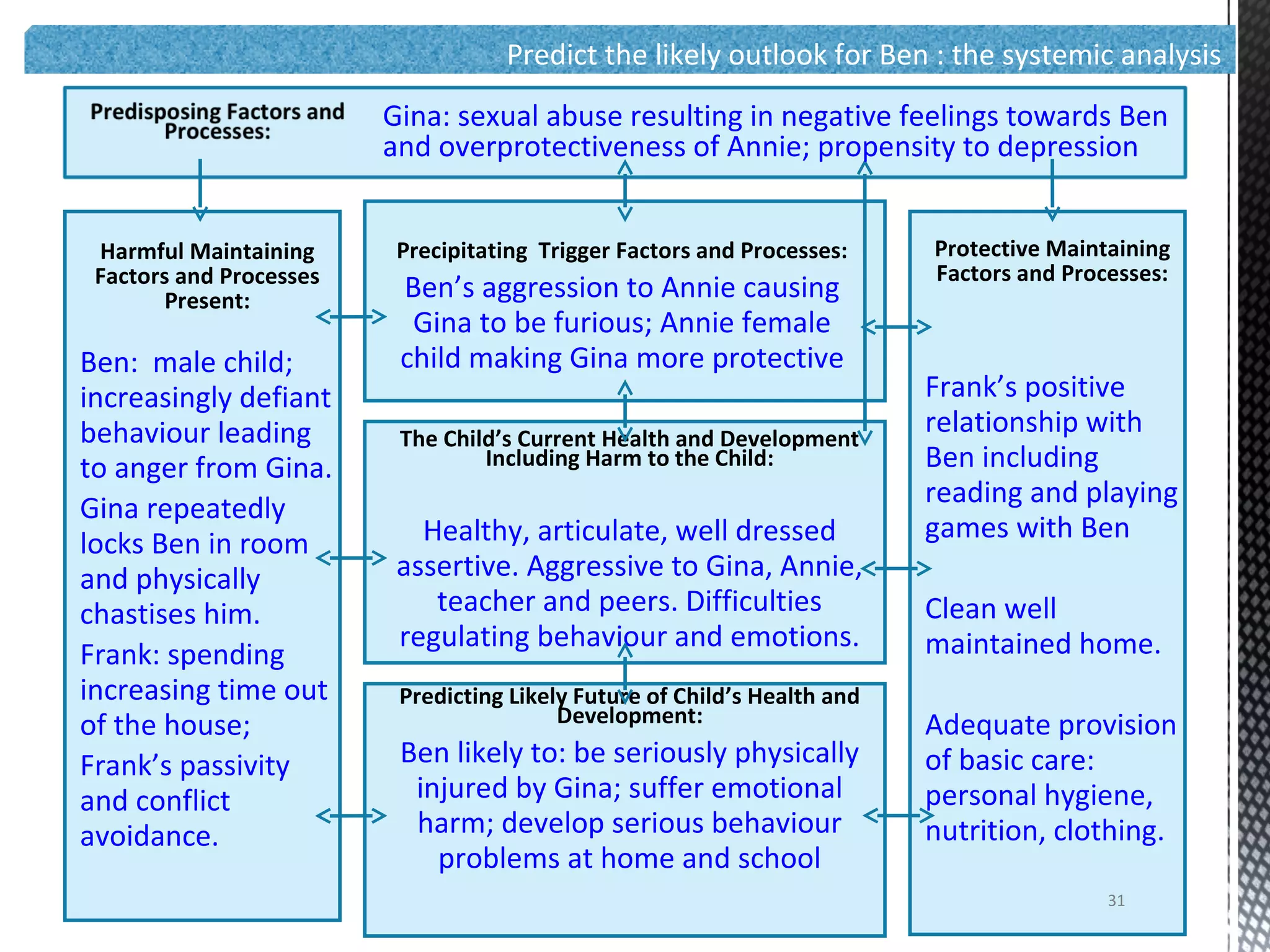
Predict the likely outlook for child: the Systematic Analysis
Harmful Maintaining
Factors and Processes
Present:
Ben: male child;
increasingly defiant
behaviour leading
to anger from Gina.
Gina repeatedly
locks Ben in room
and physically
chastises him.
Frank: spending
increasing time out
of the house;
Frank’s passivity
and conflict
avoidance.
Precipitating Trigger Factors and Processes:
Ben’s aggression to Annie causing
Gina to be furious; Annie female
child making Gina more protective
Protective Maintaining
Factors and Processes:
Frank’s positive
relationship with
Ben including
reading and playing
games with Ben
Clean well
maintained home.
Adequate provision
of basic care:
personal hygiene,
nutrition, clothing.
The Child’s Current Health and Development
Including Harm to the Child:
Healthy, articulate, well dressed
assertive. Aggressive to Gina, Annie,
teacher and peers. Difficulties
regulating behaviour and emotions.
Predicting Likely Future of Child’s Health and
Development:
Ben likely to: be seriously physically
injured by Gina; suffer emotional
harm; develop serious behaviour
problems at home and school
Predict the likely outlook for Ben : the systemic analysis
Gina: sexual abuse resulting in negative feelings towards Ben
and overprotectiveness of Annie; propensity to depression
31
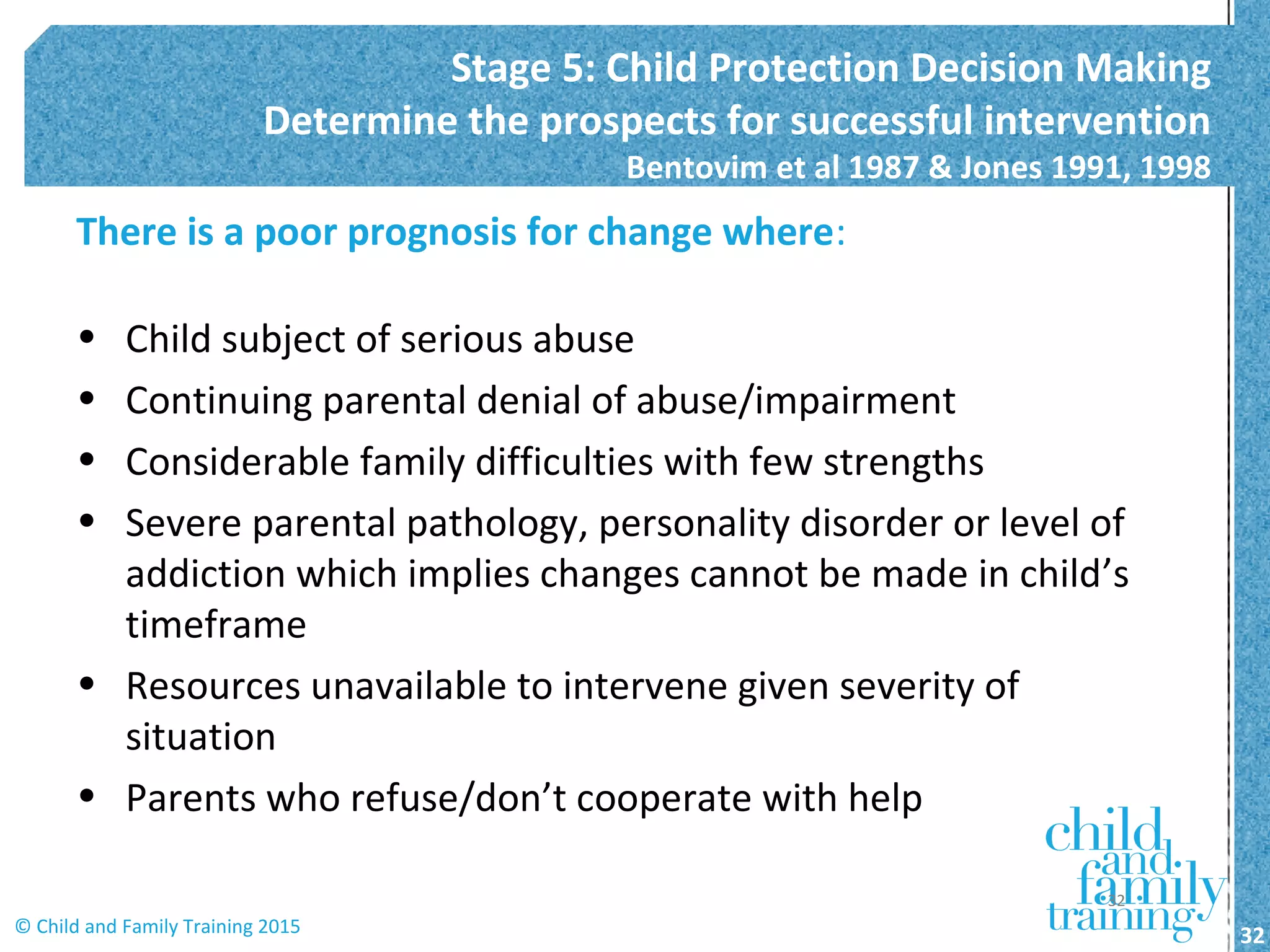
There is a poor prognosis for change where:
• Child subject of serious abuse
• Continuing parental denial of abuse/impairment
• Considerable family difficulties with few strengths
• Severe parental pathology, personality disorder or level of
addiction which implies changes cannot be made in child’s
timeframe
• Resources unavailable to intervene given severity of
situation
• Parents who refuse/don’t cooperate with help
Stage 5: Child Protection Decision Making
Determine the prospects for successful intervention
Bentovim et al 1987 & Jones 1991, 1998
32© Child and Family Training 2015
32
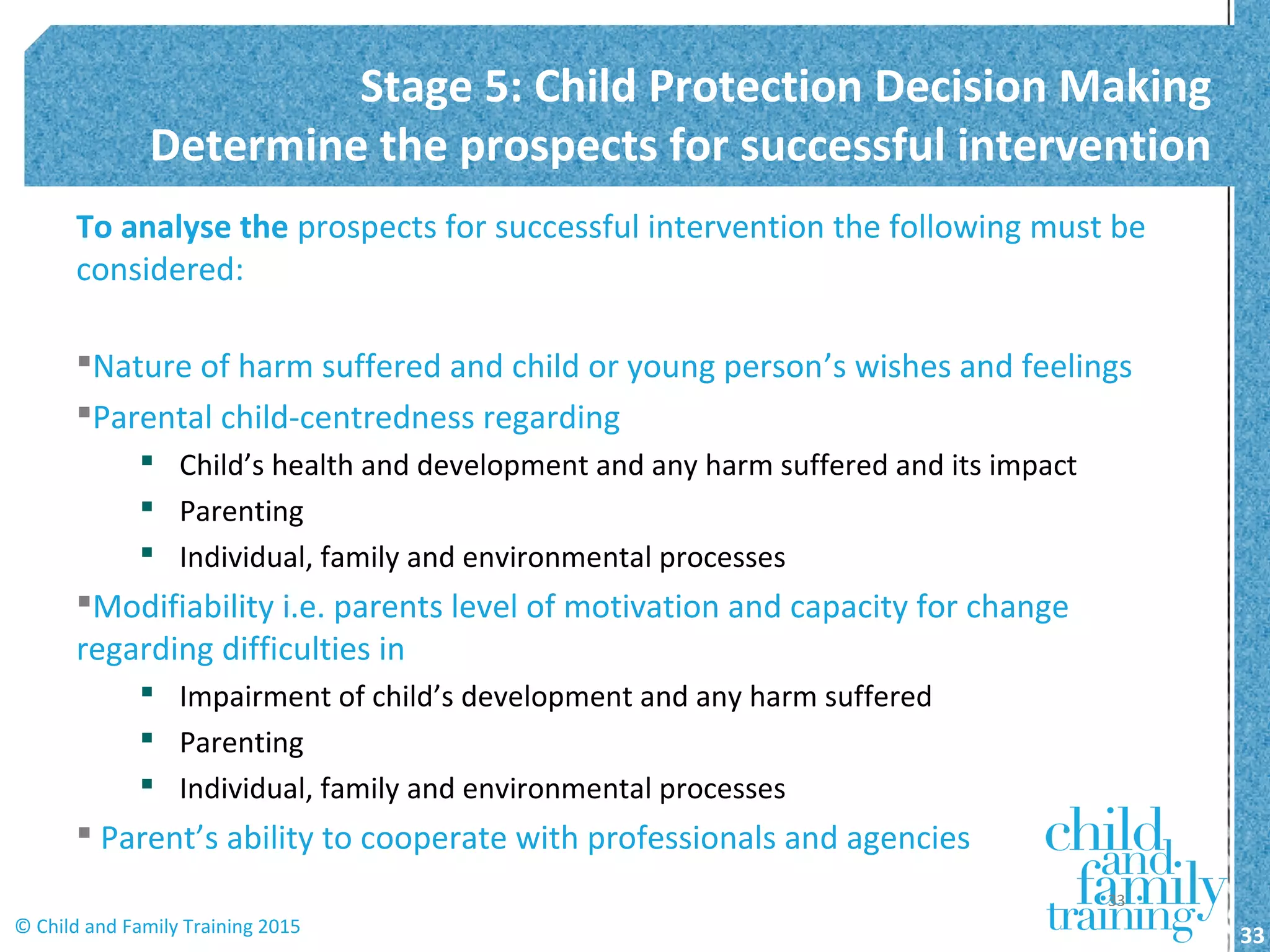
To analyse the prospects for successful intervention the following must be
considered:
Nature of harm suffered and child or young person’s wishes and feelings
Parental child-centredness regarding
 Child’s health and development and any harm suffered and its impact
 Parenting
 Individual, family and environmental processes
Modifiability i.e. parents level of motivation and capacity for change
regarding difficulties in
 Impairment of child’s development and any harm suffered
 Parenting
 Individual, family and environmental processes
 Parent’s ability to cooperate with professionals and agencies
Stage 5: Child Protection Decision Making
Determine the prospects for successful intervention
33© Child and Family Training 2015
33
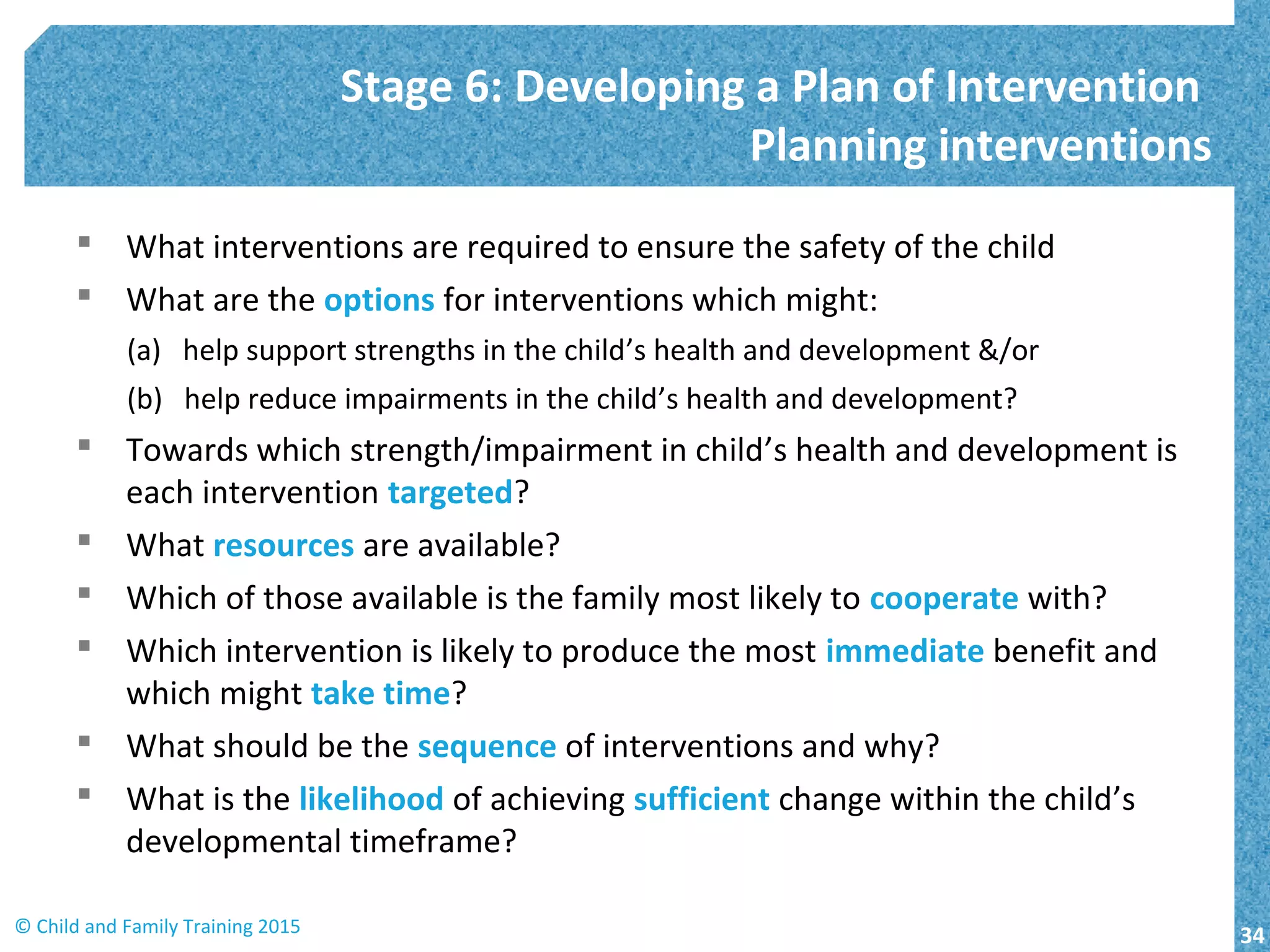
 What interventions are required to ensure the safety of the child
 What are the options for interventions which might:
(a) help support strengths in the child’s health and development &/or
(b) help reduce impairments in the child’s health and development?
 Towards which strength/impairment in child’s health and development is
each intervention targeted?
 What resources are available?
 Which of those available is the family most likely to cooperate with?
 Which intervention is likely to produce the most immediate benefit and
which might take time?
 What should be the sequence of interventions and why?
 What is the likelihood of achieving sufficient change within the child’s
developmental timeframe?
Stage 6: Developing a Plan of Intervention
Planning interventions
34© Child and Family Training 2015
The key outcome is the child’s developmental
progress
The aims are to assess :
• Whether the child has progressed and in which dimensions (child’s
development);
• How improvements or deteriorations have come about (factors and
processes thought to influence the child's development)
Need baseline and follow-up measures to assess change over
time
Stage 7: Identifying and Measuring Outcomes
Assessing outcomes of intervention
35© Child and Family Training 2015
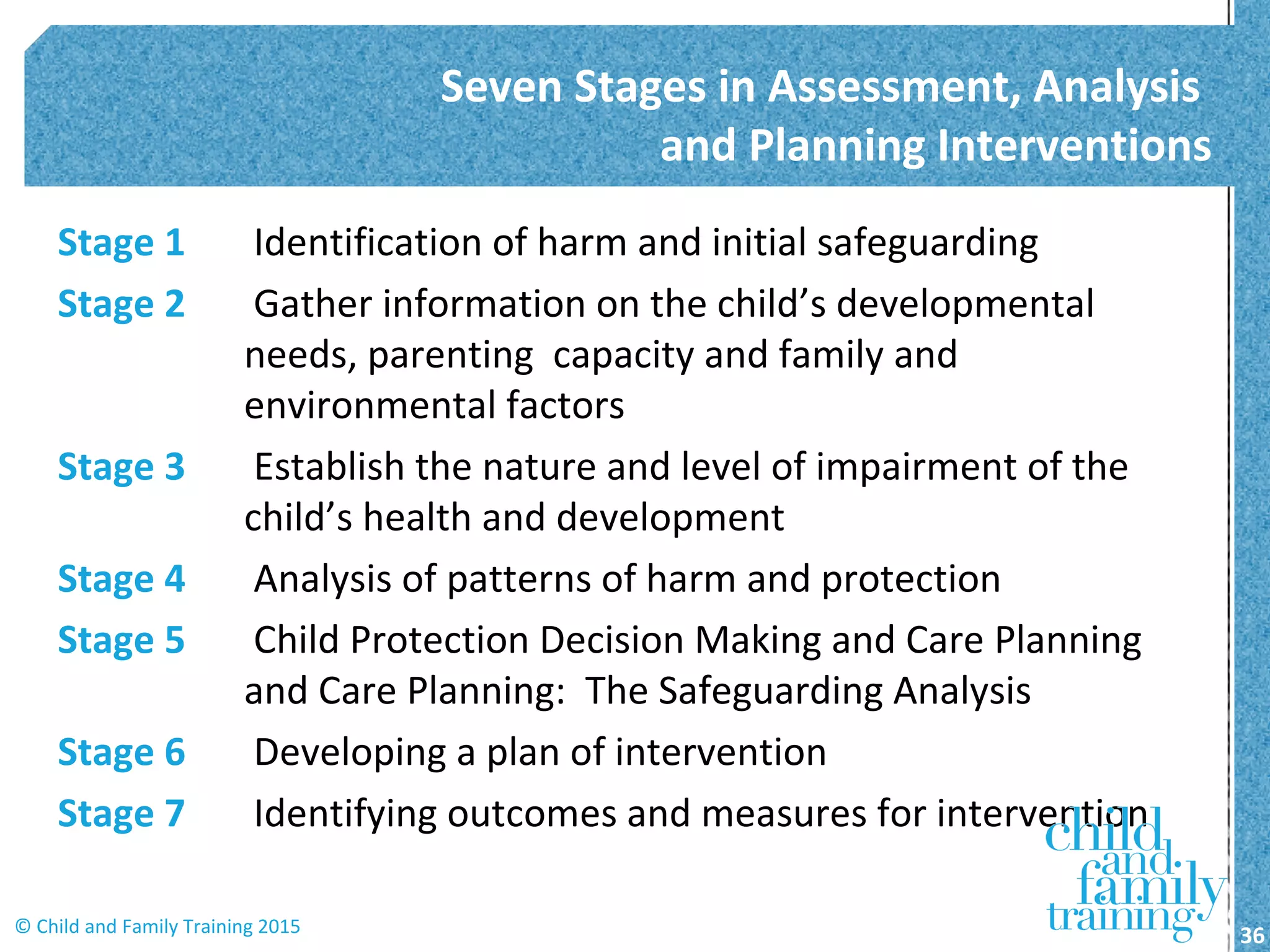
Stage 1 Identification of harm and initial safeguarding
Stage 2 Gather information on the child’s developmental
needs, parenting capacity and family and
environmental factors
Stage 3 Establish the nature and level of impairment of the
child’s health and development
Stage 4 Analysis of patterns of harm and protection
Stage 5 Child Protection Decision Making and Care Planning
and Care Planning: The Safeguarding Analysis
Stage 6 Developing a plan of intervention
Stage 7 Identifying outcomes and measures for intervention
Seven Stages in Assessment, Analysis
and Planning Interventions
36© Child and Family Training 2015
Angold, A., Predergast, M., Cox, A., Harrington, R., Simonoff, I. and Rutter, M. (1995) ‘The Child and
Adolescent Psychiatric Assessment (CAPA).’ Psychological Medicine 25, 739–753.
Bentovim, A., Elton, A. and Tranter, M. (1987) ‘Prognosis for rehabilitation after abuse.’ Adoption and
Fostering 11, 26–31.
Bentovim, A. and Bingley Miller, L. (2001) The Family Assessment: Assessment of Family Competence,
Strengths and Difficulties. York: Child and Family Training.
Bentovim, A., Cox, A, Bingley Miller, L. and Pizzey, S. (2009) Safeguarding Children Living with Trauma and
Family Violence: A Guide to Evidence-Based Assessment, Analysis and Planning
Interventions. London: Jessica Kingsley.
Bentovim, A., Bingley Miller, L., Pizzey, S. and Tapp, S. (2013) The Safeguarding Children Assessment and
Analysis Framework. York: Child and Family Training.
Caldwell, B.M. and Bradley, R.H. (2003) HOME Inventory: Administration Manual Comprehensive Edition.
Little Rock, AR: University of Arkansas for Medical Sciences.
Cox, A., Pizzey, S. and Walker, S. (2009) The HOME Inventory: A Guide for Practitioners – The UK Approach.
York: Child and Family Training.
Department of Health, Department for Education and Employment, and Home Office (2000b) Framework
for the Assessment of Children in Need and their Families. London. The Stationery
Office.
Jones, D.P.H. (1998) ‘The Effectiveness of Intervention.’ In M. Adcock and R. White (eds) Significant Harm: Its
Management and Outcome. Croydon: Significant Publications.
The Safeguarding Assessment and Analysis Framework
Contact: Stephen.Pizzey@ntlworld.com
37© Child and Family Training 2015

Child Protection Decision-Making: The Safeguarding Children Assessment and Analysis Framework (SAAF)

  • 1.
    Child Protection Decision-Making: TheSafeguarding Children Assessment and Analysis Framework (SAAF) Stephen Pizzey, Phil Heasman and Carla Thomas Arnon Bentovim, Antony Cox, Liza Bingley Miller and Simon Tapp www.childandfamilytraining.org.uk
  • 2.
    Child and FamilyTraining (C&FT) Started in 2000 as a result of a government-funded collaboration between senior professionals to develop:  A range of evidence-based assessment approaches  Training packages  Team of accredited trainers and consultants Contributes to agencies’ training programmes around the UK and abroad for social work and other professionals Commitment to continuous development Child and Family Training 2© Child and Family Training 2015
  • 3.
    Please discuss withthe person next to you; What makes a safeguarding case complex? Complex child protection cases 3© Child and Family Training 2015
  • 4.
    Definition of childprotection is where the concerns about the safety of the child are such that there is serious consideration of: the child having to be moved away from their current care setting (or not to be returned to their previous care setting) in order to prevent further or likely future major impairment of the child’s development Definition of Child Protection 4© Child and Family Training 2015
  • 5.
    The severity ofthe child’s impairment (attributable or non- attributable) The severity of the difficulty of the factors and processes operating on a child’s impairment (i.e. parenting capacity and family and environmental factors) Modifiability of the impairing/negative processes to the child attributable to the parents/carers. i.e. whether it is likely to be possible to change:  What the parents do  Factors and processes that affect what the parents do Whether parents are child-centred Whether they are able to cooperate with professionals Reasons for considering a change in the child’s care setting 5© Child and Family Training 2015
  • 6.
    Stage 1 Identificationof harm and initial safeguarding Stage 2 Gather information on the child’s developmental needs, parenting capacity and family and environmental factors Stage 3 Establish the nature and level of impairment of the child’s health and development Stage 4 Analysis of patterns of harm and protection Stage 5 Child Protection Decision Making and Care Planning and Care Planning: The Safeguarding Analysis Stage 6 Developing a plan of intervention Stage 7 Identifying outcomes and measures for intervention Seven Stages in Assessment, Analysis and Planning Interventions 6© Child and Family Training 2015
  • 7.
    Assessment Framework A mapof relevant data to be collected 7 Health Education Identity Family & Social Relationships Social Presentation Emotional & Behavioural Development Selfcare Skills CHILD’SDEVELOPMENTALNEEDS PARENTINGCAPACITY FAMILY & ENVIRONMENTAL FACTORS Basic Care Emotional Warmth Stimulation Guidance & Boundaries Ensuring Safety Stability WiderFamily Housing Employment Income Family’sSocial Integration FamilyHistory &Functioning Community Resources CHILD Safeguarding & promoting welfare © Child and Family Training 2015
  • 8.
    The Assessment Frameworkprovides a map for assessing the needs of children •The Child’s Developmental Needs Domain of the Assessment triangle maps Strengths and Impairment in Development • •The Parenting Capacity Domain is concerned with Attributability. •Where there is no observable or measurable impairment, the Parenting Capacity and Family and Environmental Factors Domains are relevant to the Likelihood of Impairment. Note that some impairments may not be attributable to parenting - e.g. Autism is genetic or Cerebral Palsy is congenital in most instances - but make greater demands which parents may not be able to meet. Working with the Assessment Framework 8© Child and Family Training 2015 8
  • 9.
    Consider the referraland the aims of the assessment The awareness of harm arises in many contexts Multi-agency child protection conferences - have to judge current risk and future harm Extent of harm to the child and nature of parenting capacity and family and environmental factors often unknown Stage 1: Identification of Harm and Initial Safeguarding 9© Child and Family Training 2015
  • 10.
    In order tomake a full assessment of the child’s needs, parenting capacity and family and environmental factors the assessor needs to: Gather information from available sources including using assessment tools Create comprehensive chronology of salient information Good assessments use multiple sources of information. An assessment should not rely on one source of information. Stage 2: Making a full assessment and create comprehensive chronology 10© Child and Family Training 2015
  • 11.
    Stage 2: Makinga full assessment Case Study: Ben Bradshaw aged 5 years 6 months 11© Child and Family Training 2015 Gina 27 Susan Moore 25 Ben 5yrs 6 months Frank 29 Annie 6 months Sasha 8
  • 12.
    Gina Bradshaw is: caring well for Annie who is thriving  making over frequent visits to GP with Annie  finding Ben’s behaviour increasingly difficult to manage The Health Visitor is concerned about:  Ben’s aggression towards Annie  Gina’s hostility towards Ben Ben has hit his teacher and is aggressive to other children in school Historical Information:  First 9 months poor weight gain and frequent minor accidents as a toddler questioning supervision  Aged 2 fractured elbow and dislocated shoulder. Gina reported pulling Ben away from electric stove. Stage 2: Making a full assessment Case Study: Ben Bradshaw aged 5 years 6 months - Referral 12© Child and Family Training 2015
  • 13.
    Gina was sexuallyabused as a child for a number of years by an uncle. Gina had a troubled adolescence and early adulthood: • truanting, aggression to staff and exclusion from school; • running away from home and accommodated by local authority; • extensive drug use • termination aged 15 • series of violent relationships • overdosed twice • convictions for shoplifting to fund drug habit Gina found it difficult to bond with Ben because he was a boy and felt protective towards Annie because she was a girl. Stage 2: Making a full assessment Case Study: Gina Bradshaw Background 13© Child and Family Training 2015
  • 14.
    Frank Bradshaw’s earlyexperiences included: • disruption in early childhood – older brother aged 8 sent to grandparents; • regular school attendance; • occasional drug use; • a series of brief relationships; • unhappy relationship with Susan mother of his daughter, Sasha • private law proceedings regarding Sasha – monthly contact which petered out • clinical depression Stage 2: Making a full assessment Case Study: Frank Bradshaw Background 14© Child and Family Training 2015
  • 15.
    Watch short extractsfrom: • a Family Assessment interview with the whole family; • an Early Childhood (3-6) HOME Inventory Assessment of Ben’s experience of care in the family with Ben and Gina. Take detailed notes of what observed and what reported Stage 2: Making a full assessment Case Study: Ben Bradshaw 15© Child and Family Training 2015
  • 16.
    Stage 2: Makinga full assessment Ben Bradshaw – Family Assessment Interview 16© Child and Family Training 2011 16
  • 17.
    Stage 2: Makinga full assessment Ben Bradshaw – HOME Inventory Interview (1) 17© Child and Family Training 2011 17
  • 18.
    Organise information usingthe Assessment Framework •Record information on the Assessment Framework handout in the following dimensions: • Emotional & Behavioural Development • Family & Social Relationships • Emotional Warmth • Guidance and Boundaries • Family Functioning •Identify strengths and difficulties Stage 3: Establish the nature and level of harm and harmful effects on the child 18© Child and Family Training 2015
  • 19.
    Assessment Framework A mapof relevant data to be collected 19 Health Education Identity Family & Social Relationships Social Presentation Emotional & Behavioural Development Selfcare Skills CHILD’SDEVELOPMENTALNEEDS PARENTINGCAPACITY FAMILY & ENVIRONMENTAL FACTORS Basic Care Emotional Warmth Stimulation Guidance & Boundaries Ensuring Safety Stability WiderFamily Housing Employment Income Family’sSocial Integration FamilyHistory &Functioning Community Resources CHILD Safeguarding & promoting welfare © Child and Family Training 2015
  • 20.
    In analysing thecategorised information consideration should be given to:  Processes – the pattern of influences &  Impact – the weight/effect of factors/processes Note  What is central is whether there is impairment or likelihood of impairment of the CHILD’S DEVELOPMENT.  Difficulties/impairments in Parenting or broader Family and Environment may or may not be producing impairments in the child’s development. Stage 4: Analysis of patterns of ham and protection Angold et al 1995 Bentovim et al 2009 20© Child and Family Training 2015 20
  • 21.
    Distinguish:  What hasbrought things about from the past  What keeps things going in the present both of which  Can help to predict what’s likely to happen in the future if things carry on as they are Stage 4: Analysis of patterns of harm and protection 21© Child and Family Training 2015
  • 22.
    When examining processesconsider:  the time relationships between impairments in the child’s development and life events and stressors which  can raise hypotheses about processes influencing the child’s health and development Stage 4: Analysis of patterns of harm and protection Develop a chronology of salient information 22© Child and Family Training 2015
  • 23.
    Linear or circularprocesses: Stage 4: Analysis of patterns of ham and protection 23© Child and Family Training 2015
  • 24.
    Identify Strengths andimpairments in the child’s development • What are Ben’s strengths in health and development and how have they been brought about? • What are Ben’s impairments in health and development and why have they occurred? Stage 4: Analysis of patterns of ham and protection 24© Child and Family Training 2015
  • 25.
    Assessment Framework A mapof relevant data to be collected 25 Health Education Identity Family & Social Relationships Social Presentation Emotional & Behavioural Development Selfcare Skills CHILD’SDEVELOPMENTALNEEDS PARENTINGCAPACITY FAMILY & ENVIRONMENTAL FACTORS Basic Care Emotional Warmth Stimulation Guidance & Boundaries Ensuring Safety Stability WiderFamily Housing Employment Income Family’sSocial Integration FamilyHistory &Functioning Community Resources CHILD Safeguarding & promoting welfare © Child and Family Training 2015
  • 26.
    Stage 4: Analysisof patterns of ham and protection Weight of Factors/Processes Difficulties Child’s Developmental Needs, Parenting & Family and Environment Factors and Processes Impairment of child’s development - Significant Harm Protection and Resilience Risk and Vulnerability Modifiability - Change Intrusiveness - Depth Pervasiveness - Breadth Unusualness Frequency - How often Duration - How long 26
  • 27.
    In general:  themore dimensions of domains that show difficulty;  the more frequently those difficulties are manifest;  the longer the difficulties have existed;  the less the difficulties are modifiable; then the greater the severity of the problem Stage 4: Analysis of patterns of ham and protection - Impact 27© Child and Family Training 2015
  • 28.
    The Safeguarding Analysis: •Theprofile of harm and impairment of the child’s health and development •Predict the likely outlook for the child; the risks of re-abuse or likelihood of future harm (the systemic analysis) •Determine the prospects for successful intervention Stage 5: Child Protection Decision Making and Care Planning: The Safeguarding Analysis Bentovim et al 2009 28© Child and Family Training 2015
  • 29.
    To make anassessment of the profile of harm, risks of future harm to the child the following must be considered:  Child’s Developmental Needs  Severity of impairment of the child’s health and development and impact on child  Parenting capacity  Severity of parenting difficulties  Family and Environmental Factors  Severity of individual and family difficulties  Severity of environmental difficulties  Parenting, protection and therapeutic help the child requires Stage 5: Child Protection Decision Making Profile of harm and impairment of the child’s health and development 29© Child and Family Training 2015 29
  • 30.
    30 Harmful Maintaining Factors andProcesses Present: Precipitating Trigger Factors and Processes: Protective Maintaining Factors and Processes: The Child’s Current Health and Development Including Harm to the Child: Predicting Likely Future of Child’s Health and Development: Predict the likely outlook for child: the Systematic Analysis
  • 31.
    Harmful Maintaining Factors andProcesses Present: Ben: male child; increasingly defiant behaviour leading to anger from Gina. Gina repeatedly locks Ben in room and physically chastises him. Frank: spending increasing time out of the house; Frank’s passivity and conflict avoidance. Precipitating Trigger Factors and Processes: Ben’s aggression to Annie causing Gina to be furious; Annie female child making Gina more protective Protective Maintaining Factors and Processes: Frank’s positive relationship with Ben including reading and playing games with Ben Clean well maintained home. Adequate provision of basic care: personal hygiene, nutrition, clothing. The Child’s Current Health and Development Including Harm to the Child: Healthy, articulate, well dressed assertive. Aggressive to Gina, Annie, teacher and peers. Difficulties regulating behaviour and emotions. Predicting Likely Future of Child’s Health and Development: Ben likely to: be seriously physically injured by Gina; suffer emotional harm; develop serious behaviour problems at home and school Predict the likely outlook for Ben : the systemic analysis Gina: sexual abuse resulting in negative feelings towards Ben and overprotectiveness of Annie; propensity to depression 31
  • 32.
    There is apoor prognosis for change where: • Child subject of serious abuse • Continuing parental denial of abuse/impairment • Considerable family difficulties with few strengths • Severe parental pathology, personality disorder or level of addiction which implies changes cannot be made in child’s timeframe • Resources unavailable to intervene given severity of situation • Parents who refuse/don’t cooperate with help Stage 5: Child Protection Decision Making Determine the prospects for successful intervention Bentovim et al 1987 & Jones 1991, 1998 32© Child and Family Training 2015 32
  • 33.
    To analyse theprospects for successful intervention the following must be considered: Nature of harm suffered and child or young person’s wishes and feelings Parental child-centredness regarding  Child’s health and development and any harm suffered and its impact  Parenting  Individual, family and environmental processes Modifiability i.e. parents level of motivation and capacity for change regarding difficulties in  Impairment of child’s development and any harm suffered  Parenting  Individual, family and environmental processes  Parent’s ability to cooperate with professionals and agencies Stage 5: Child Protection Decision Making Determine the prospects for successful intervention 33© Child and Family Training 2015 33
  • 34.
     What interventionsare required to ensure the safety of the child  What are the options for interventions which might: (a) help support strengths in the child’s health and development &/or (b) help reduce impairments in the child’s health and development?  Towards which strength/impairment in child’s health and development is each intervention targeted?  What resources are available?  Which of those available is the family most likely to cooperate with?  Which intervention is likely to produce the most immediate benefit and which might take time?  What should be the sequence of interventions and why?  What is the likelihood of achieving sufficient change within the child’s developmental timeframe? Stage 6: Developing a Plan of Intervention Planning interventions 34© Child and Family Training 2015
  • 35.
    The key outcomeis the child’s developmental progress The aims are to assess : • Whether the child has progressed and in which dimensions (child’s development); • How improvements or deteriorations have come about (factors and processes thought to influence the child's development) Need baseline and follow-up measures to assess change over time Stage 7: Identifying and Measuring Outcomes Assessing outcomes of intervention 35© Child and Family Training 2015
  • 36.
    Stage 1 Identificationof harm and initial safeguarding Stage 2 Gather information on the child’s developmental needs, parenting capacity and family and environmental factors Stage 3 Establish the nature and level of impairment of the child’s health and development Stage 4 Analysis of patterns of harm and protection Stage 5 Child Protection Decision Making and Care Planning and Care Planning: The Safeguarding Analysis Stage 6 Developing a plan of intervention Stage 7 Identifying outcomes and measures for intervention Seven Stages in Assessment, Analysis and Planning Interventions 36© Child and Family Training 2015
  • 37.
    Angold, A., Predergast,M., Cox, A., Harrington, R., Simonoff, I. and Rutter, M. (1995) ‘The Child and Adolescent Psychiatric Assessment (CAPA).’ Psychological Medicine 25, 739–753. Bentovim, A., Elton, A. and Tranter, M. (1987) ‘Prognosis for rehabilitation after abuse.’ Adoption and Fostering 11, 26–31. Bentovim, A. and Bingley Miller, L. (2001) The Family Assessment: Assessment of Family Competence, Strengths and Difficulties. York: Child and Family Training. Bentovim, A., Cox, A, Bingley Miller, L. and Pizzey, S. (2009) Safeguarding Children Living with Trauma and Family Violence: A Guide to Evidence-Based Assessment, Analysis and Planning Interventions. London: Jessica Kingsley. Bentovim, A., Bingley Miller, L., Pizzey, S. and Tapp, S. (2013) The Safeguarding Children Assessment and Analysis Framework. York: Child and Family Training. Caldwell, B.M. and Bradley, R.H. (2003) HOME Inventory: Administration Manual Comprehensive Edition. Little Rock, AR: University of Arkansas for Medical Sciences. Cox, A., Pizzey, S. and Walker, S. (2009) The HOME Inventory: A Guide for Practitioners – The UK Approach. York: Child and Family Training. Department of Health, Department for Education and Employment, and Home Office (2000b) Framework for the Assessment of Children in Need and their Families. London. The Stationery Office. Jones, D.P.H. (1998) ‘The Effectiveness of Intervention.’ In M. Adcock and R. White (eds) Significant Harm: Its Management and Outcome. Croydon: Significant Publications. The Safeguarding Assessment and Analysis Framework Contact: Stephen.Pizzey@ntlworld.com 37© Child and Family Training 2015

Editor's Notes

  • #2 Introduce
  • #3 C&FT developed as a result of a collaboration between senior professionals from Great Ormond Street Children's Hospital and Guys Hospital and others in 2000 funded by the government to develop a range of evidence-based assessment tools for use with children and families, training and trainers linked to the Assessment Framework Run by Dr Arnon Bentovim and Liza Bingley Miller with a team of colleagues including Professor Antony Cox, and team of trainers who have run high-quality training around the UK Commitment to continuous development incorporating new tools and approaches from research and good practice – such as: a model of analysis and planning intervention a new training on Child Protection Decision Making In My Shoes – a laptop interview for communicating with children and young people a process for training and licensing Agency-Based Trainers
  • #4 C&FT developed as a result of a collaboration between senior professionals from Great Ormond Street Children's Hospital and Guys Hospital and others in 2000 funded by the government to develop a range of evidence-based assessment tools for use with children and families, training and trainers linked to the Assessment Framework Run by Dr Arnon Bentovim and Liza Bingley Miller with a team of colleagues including Professor Antony Cox, and team of trainers who have run high-quality training around the UK Commitment to continuous development incorporating new tools and approaches from research and good practice – such as: a model of analysis and planning intervention a new training on Child Protection Decision Making In My Shoes – a laptop interview for communicating with children and young people a process for training and licensing Agency-Based Trainers
  • #6 In making a safeguarding assessment there are a number of key considerations the seven stage model seeks systematically to address. We know these are central to the risk of future harm and prospects for successful intervention : The severity of the child's impairment (attributable or non-attributable) The severity of the factors and processes operating on a child’s impairment (i.e. parenting capacity and family and environmental factors) Modifiability of the impairing/negative processes to the child attributable to the parents/carers. i.e. whether it is likely to be possible to change: What the parents do (Parenting) Factors and processes that affect what the parents do (Individual, Family & Environmental Factors) 4. Whether parents are child-centred i.e. able to recognise, acknowledge and take responsibility 5. Whether they are able to cooperate with professionals
  • #7 Stage 1 Identification of harm and initial safeguarding Consider the referral and aims of the assessment or re-assessment Stage 2 Making a full assessment of the child’s needs, parenting capacity, family and environmental factors and creating comprehensive chronology Gather information from available sources including assessment tools Create a comprehensive chronology Stage 3 Establishing the nature and level of harm and harmful effects on the child Categorise information and organise information/data using the Assessment Framework Assessment of degree of strengths and difficulties in domains and dimensions Stage 4 Safeguarding Analysis Systemic analysis of patterns of harm and protection - Factors and processes influencing the child’s health and development Stage 5 Child Protection Decision Making and Care Planning: Predicting the Likely Outlook for the Child in the light of an analysis of: the profile of harm and risks of re-abuse or likelihood of future harm the prospects for successful intervention within the child’s timeframe Stage 6 Developing a plan of intervention to include therapeutic work in a context of safety and protection from harm Stage 7 Identifying Outcomes and Measures that would indicate whether interventions have been successful In the light of the outcomes of the intervention(s) return to Stage 5 and review
  • #8 Assessment Framework triangle is a map for gathering and ordering data/info How you gather information is not prescribed by the Assessment Framework We (C&FT) offer tools that help the gathering and assessment process Also offer model for analysis and planning – will discuss later The triangle: The Child’s Developmental Needs Domain of the Assessment Framework triangle maps Strengths and Impairment or Harm to child’s health and development The Parenting Capacity Domain is concerned with Attributability of harmful actions Where there is no observable or measurable impairment, the Parenting Capacity and Family and Environmental Factors Domains are relevant to the Likelihood of Impairment or Future Harm .  Note that the nature of any impairments is also relevant to attributability e.g. Autism is genetic, Cerebral Palsy is congenital in most instances. 6. The work of Bentovim at al (2009) was geared to extension of the Assessment Framework triangle into the child protection context What you will find in your Seminar Booklet on page XXXX are some of the ways of doing that – which we will look at in more detail later
  • #9 Munro Report is part of an ongoing process of reviews of child protection practice including Laming and the Victoria Climbie Report which emphasise the importance of analysis and planning
  • #10 Stage 1 of the 7 stages in Assessment, Analysis and Planning Interventions is Identification of Harm and Initial Safeguarding A field in its’ own right. Just to remind ourselves – when considering and initial referral staff need to take into account: The awareness of harm arises in many contexts – family, community and professionals requires a variety of routes and established ways of communicating this awareness Social work, Health, Police and Education Professionals involved in Child Protection Conferences, judge of current risk and future harm Extent of harm, extent of trauma, extent of Children's needs, Parenting capacities and Family and Environment factors unknown
  • #11 May be a need to make a full assessment or to make a re-assessment based on new information on a known case where safeguarding concerns have been raised The assessment tools can include those C&FT were commissioned by the government to develop including the HOME Inventory, Family Pack of Questionnaires and Scales and Family Assessment Later tools include: In My Shoes for communicating with children The Attachment Style Interview for assessing the capacity of adults to make and maintain relationships, their attitudes towards and use of support and their attachment styles
  • #12 Explain that we are going to use a case study to illustrate the use of the tools and the assessment information they can provide. This is a case used in training hich was based on a serious child protection case but taken at a relatively early stage of the case. Michael and Laura are the children of Moira’s marriage to Bill Ward. The marriage broke up shortly after Michael’s birth. Bill has moved out of the area and has not had contact with Michael and Laura for several years. Four years ago Moira met Gary Wills and shortly afterwards he moved into the family home. Gary got on well with Michael and Laura and the break-up of the relationship between Moira and Gary a year ago has had a significant impact on both children. About a year ago Moira met Ian Ross and he soon moved into the family home. Ian has a son, Alan, from a previous relationship. Alan lives with his mother and currently has no contact with his father.
  • #13 Michael was referred to social services because of concerns about a recent, marked change in his appearance and behaviour. The school reported that Michael has become anxious, distracted and has difficulty in concentrating. He is persistently late and has a very neglected appearance. Last term he was bright, cheerful and smartly turned out. Laura has been truanting and reported to be out late at night
  • #14 Michael was referred to social services because of concerns about a recent, marked change in his appearance and behaviour. The school reported that Michael has become anxious, distracted and has difficulty in concentrating. He is persistently late and has a very neglected appearance. Last term he was bright, cheerful and smartly turned out. Laura has been truanting and reported to be out late at night
  • #15 Michael was referred to social services because of concerns about a recent, marked change in his appearance and behaviour. The school reported that Michael has become anxious, distracted and has difficulty in concentrating. He is persistently late and has a very neglected appearance. Last term he was bright, cheerful and smartly turned out. Laura has been truanting and reported to be out late at night
  • #16 The HOME provides both a quantitative (i.e. ratings) and a qualitative assessment The interviewer is using the semi-structured interview specially written for the UK practitioner version of the HOME – designed to be user friendly and to make sense to families and structured to gather evidence and examples on which to base an assessment In watching this DVD clip - focus on the qualitative information – and the evidence for any assessments made Set task– watching DVD &taking notes etc Talk in pairs Feedback Not using the HOME assessment tool today – we will use an element of the Child Protection Decision Making Tool to gather the information – the Proforma for Operationalising the Assessment Framework in Safeguarding
  • #17 The HOME provides both a quantitative (i.e. ratings) and a qualitative assessment The interviewer is using the semi-structured interview specially written for the UK practitioner version of the HOME – designed to be user friendly and to make sense to families and structured to gather evidence and examples on which to base an assessment In watching this DVD clip - focus on the qualitative information – and the evidence for any assessments made Set task– watching DVD &taking notes etc Talk in pairs Feedback Not using the HOME assessment tool today – we will use an element of the Child Protection Decision Making Tool to gather the information – the Proforma for Operationalising the Assessment Framework in Safeguarding
  • #18 The HOME provides both a quantitative (i.e. ratings) and a qualitative assessment The interviewer is using the semi-structured interview specially written for the UK practitioner version of the HOME – designed to be user friendly and to make sense to families and structured to gather evidence and examples on which to base an assessment In watching this DVD clip - focus on the qualitative information – and the evidence for any assessments made Set task– watching DVD &taking notes etc Talk in pairs Feedback Not using the HOME assessment tool today – we will use an element of the Child Protection Decision Making Tool to gather the information – the Proforma for Operationalising the Assessment Framework in Safeguarding
  • #20 Assessment Framework triangle is a map for gathering and ordering data/info How you gather information is not prescribed by the Assessment Framework We (C&FT) offer tools that help the gathering and assessment process Also offer model for analysis and planning – will discuss later The triangle: The Child’s Developmental Needs Domain of the Assessment Framework triangle maps Strengths and Impairment or Harm to child’s health and development The Parenting Capacity Domain is concerned with Attributability of harmful actions Where there is no observable or measurable impairment, the Parenting Capacity and Family and Environmental Factors Domains are relevant to the Likelihood of Impairment or Future Harm .  Note that the nature of any impairments is also relevant to attributability e.g. Autism is genetic, Cerebral Palsy is congenital in most instances. 6. The work of Bentovim at al (2009) was geared to extension of the Assessment Framework triangle into the child protection context What you will find in your Seminar Booklet on page XXXX are some of the ways of doing that – which we will look at in more detail later
  • #21 Analysis in the safeguarding context uses all these principles but a more sophisticated analysis is required to understand the impact of the processes of harm and projection on the child and the likely outlook for the child in the future – in order to make decisions and plan effectively So we have developed two tools for analysis and planning in child prtoetcion The first is the systemic analysis was developed as a tool for understanding the patterns of harm and protection related to a child The systemic analysis is specific to the Child Protection Decision Making Training we run LOOK AT PAGE XXXX in Seminar Booklet 4. TALK THROUGH THE SYSTEMIC ANLAYSIS PROFORMA: BRIEFLY Predisposing factors and processes Past factors or processes which may influencing likelihood of harm and protection? Precipitating trigger factors or processes Past: what brought things about? The child’s health and development including harm to the child Present: current impact on the child? Harmful maintaining factors and processes Present: what keeps things going? Protective maintaining factors and processes Present: what keeps things going? Predicting the child’s likely future health and development Future: likely outlook for the child if things remain the same 5. TURN OVER PAGEAND TALK THROUGH WARD SYSTEMIC ANALYSIS BRIEFLY
  • #24 We train staff to distinguish between linear and circular causation as this affects how patterns of harm and protection are understood and plans for intervention. Linear causation involves a direct linear relationship between one factor which affects or causes another. A + B leads to C When Ian gets angry and hits Michael Ward, Michael is (a) injured and (b) frightened. 3. Circular causation involves a sequence of factors influencing each other which result in a circular processes which are self-maintaining. A leads to B which leads to C which results in A would be a simple circular process Ian moves into the house Ian puts pressure on Michael to grow up Moira finds this stressful and drinks more heavily Her basic care of Michael deteriorates and her emotional warmth is reduced He arrives late, scruffy, tired, hungry and anxious to school Michael can’t concentrate at school and his schoolwork and peer relationships are affected School writes home Ian gets angry and hits Michael Ian and Moira argue but Moira cannot assert her parenting approach Moira drinks more Moira's basic care deteriorates further and she is unable to protect Michael (ensure safety) Etc etc This is an example of circular causation – with an escalating pattern of processes which is self-maintaining The pattern of processes also provides indications of where intervention may need to be considered in order to address the risk of future harm and the impact of the harmful actions on Michael
  • #25 The identification of linear and circular process allows us to answer the two key questions in analysis using the Assessment Framework triangle as a map: Met child’s developmental needs: What needs of the child are being met - and how? Unmet child’s developmental needs: What needs of the child are not being met - and why? These questions apply just as much in the safeguarding context in relation to harm. We know which needs of Michael are not being met – including the significant harm he has now suffered – and we know something about ‘why’ that is occurring.
  • #26 Assessment Framework triangle is a map for gathering and ordering data/info How you gather information is not prescribed by the Assessment Framework We (C&FT) offer tools that help the gathering and assessment process Also offer model for analysis and planning – will discuss later The triangle: The Child’s Developmental Needs Domain of the Assessment Framework triangle maps Strengths and Impairment or Harm to child’s health and development The Parenting Capacity Domain is concerned with Attributability of harmful actions Where there is no observable or measurable impairment, the Parenting Capacity and Family and Environmental Factors Domains are relevant to the Likelihood of Impairment or Future Harm .  Note that the nature of any impairments is also relevant to attributability e.g. Autism is genetic, Cerebral Palsy is congenital in most instances. 6. The work of Bentovim at al (2009) was geared to extension of the Assessment Framework triangle into the child protection context What you will find in your Seminar Booklet on page XXXX are some of the ways of doing that – which we will look at in more detail later
  • #28 In general: the more dimensions of domains that show difficulty; the more frequently those difficulties are manifest; the longer the difficulties have existed; the less the difficulties are modifiable; then the greater the severity of the problem In the safeguarding context: This often means the greater the severity and significance of the harm to the child
  • #29 The model we have developed for addressing these two key questions in the SAAF is based on research, the literature and clinical experience. The research on predicting the outlook for children in child protection cases highlighted the need for the development of tools for analysis and child protection decision making in safeguarding and child protection
  • #30 Analysing the profile of harm and the risks of future harm and determining the prospects of successful intervention are central to predicting the future outlook for the child. How do we operationalise the Assessment Framework in the safeguarding context to address these questions? We use a set of 12 steps to make a systematic analysis This involves considering each domain in turn asking certain key questions - using a proforma to guide professionals TURN TO PAGE XXX of Seminar Booklet TALK THEM THROUGH THE 12 STEPS Draw out key themes of: Severity of the child's impairment - including harm to child’s health and development Severity of factors and processes operating on a child’s impairment - including harmful actions Modifiability – capacity for change Whether parents are child-centred Whether they are able to cooperate with professionals 8. SHOW THEM WARD EG ON NEXT PAGE
  • #33 Analysing the profile of harm and the risks of future harm and determining the prospects of successful intervention are central to predicting the future outlook for the child. How do we operationalise the Assessment Framework in the safeguarding context to address these questions? We use a set of 12 steps to make a systematic analysis This involves considering each domain in turn asking certain key questions - using a proforma to guide professionals TURN TO PAGE XXX of Seminar Booklet TALK THEM THROUGH THE 12 STEPS Draw out key themes of: Severity of the child's impairment - including harm to child’s health and development Severity of factors and processes operating on a child’s impairment - including harmful actions Modifiability – capacity for change Whether parents are child-centred Whether they are able to cooperate with professionals 8. SHOW THEM WARD EG ON NEXT PAGE
  • #34 Analysing the profile of harm and the risks of future harm and determining the prospects of successful intervention are central to predicting the future outlook for the child. How do we operationalise the Assessment Framework in the safeguarding context to address these questions? We use a set of 12 steps to make a systematic analysis This involves considering each domain in turn asking certain key questions - using a proforma to guide professionals TURN TO PAGE XXX of Seminar Booklet TALK THEM THROUGH THE 12 STEPS Draw out key themes of: Severity of the child's impairment - including harm to child’s health and development Severity of factors and processes operating on a child’s impairment - including harmful actions Modifiability – capacity for change Whether parents are child-centred Whether they are able to cooperate with professionals 8. SHOW THEM WARD EG ON NEXT PAGE
  • #35 Once the analysis of risk of future harm and prospects of successful intervention have been determined and a decision made about whether the child can stay with their family or not – the next step is to plan interventions 2. Common to all our courses involves analysis and planning is this structure for planning interventions which we train people to use 3. READ TRHOUGH BRIEFLY 4. In the safeguarding context we pay special attention of course to any impairments the child may have and the need to target the harmful actions (i.e. parenting capacity) and the individual, family and environmental factors and processes associated with the harmful actions and/or affecting the child directly
  • #36 The Munro Review and many other previous reports on child protection and Serious Case Reviews emphasise not only the need for evidence-based assessment and careful child-centred analysis but also the need to identify outcomes which will indicate whether or not change has been achieved. The training take staff through a series of steps in identifying measurable outcomes
  • #37 Stage 1 Identification of harm and initial safeguarding Consider the referral and aims of the assessment or re-assessment Stage 2 Making a full assessment of the child’s needs, parenting capacity, family and environmental factors and creating comprehensive chronology Gather information from available sources including assessment tools Create a comprehensive chronology Stage 3 Establishing the nature and level of harm and harmful effects on the child Categorise information and organise information/data using the Assessment Framework Assessment of degree of strengths and difficulties in domains and dimensions Stage 4 Safeguarding Analysis Systemic analysis of patterns of harm and protection - Factors and processes influencing the child’s health and development Stage 5 Child Protection Decision Making and Care Planning: Predicting the Likely Outlook for the Child in the light of an analysis of: the profile of harm and risks of re-abuse or likelihood of future harm the prospects for successful intervention within the child’s timeframe Stage 6 Developing a plan of intervention to include therapeutic work in a context of safety and protection from harm Stage 7 Identifying Outcomes and Measures that would indicate whether interventions have been successful In the light of the outcomes of the intervention(s) return to Stage 5 and review
  • #38 Stage 1 Identification of harm and initial safeguarding Consider the referral and aims of the assessment or re-assessment Stage 2 Making a full assessment of the child’s needs, parenting capacity, family and environmental factors and creating comprehensive chronology Gather information from available sources including assessment tools Create a comprehensive chronology Stage 3 Establishing the nature and level of harm and harmful effects on the child Categorise information and organise information/data using the Assessment Framework Assessment of degree of strengths and difficulties in domains and dimensions Stage 4 Safeguarding Analysis Systemic analysis of patterns of harm and protection - Factors and processes influencing the child’s health and development Stage 5 Child Protection Decision Making and Care Planning: Predicting the Likely Outlook for the Child in the light of an analysis of: the profile of harm and risks of re-abuse or likelihood of future harm the prospects for successful intervention within the child’s timeframe Stage 6 Developing a plan of intervention to include therapeutic work in a context of safety and protection from harm Stage 7 Identifying Outcomes and Measures that would indicate whether interventions have been successful In the light of the outcomes of the intervention(s) return to Stage 5 and review