Concierge MVPLearning from early adopters at Food on the TableManuel Rosso
Food on the Table helps families eat better and save money at the grocery store.
We combine your family’s food preferences with sales at your local grocery store to create a meal plan and organized grocery listHow it WorksSelect your favorite grocery storeSelect what your family enjoys eatingBuild a meal plan based on your preferred ingredients that are on sale at your favorite storeGo shopping with a super organized grocery listPrepare our chef curated recipes in no more than 45 minutes
Why Concierge MVP?If you can't get them to adopt your idea with high-touch, face-to-face service, they sure as hell are not going to buy into your cold web page.At the SLLC I told the story of user #1 This is the story of users #2 to #20.
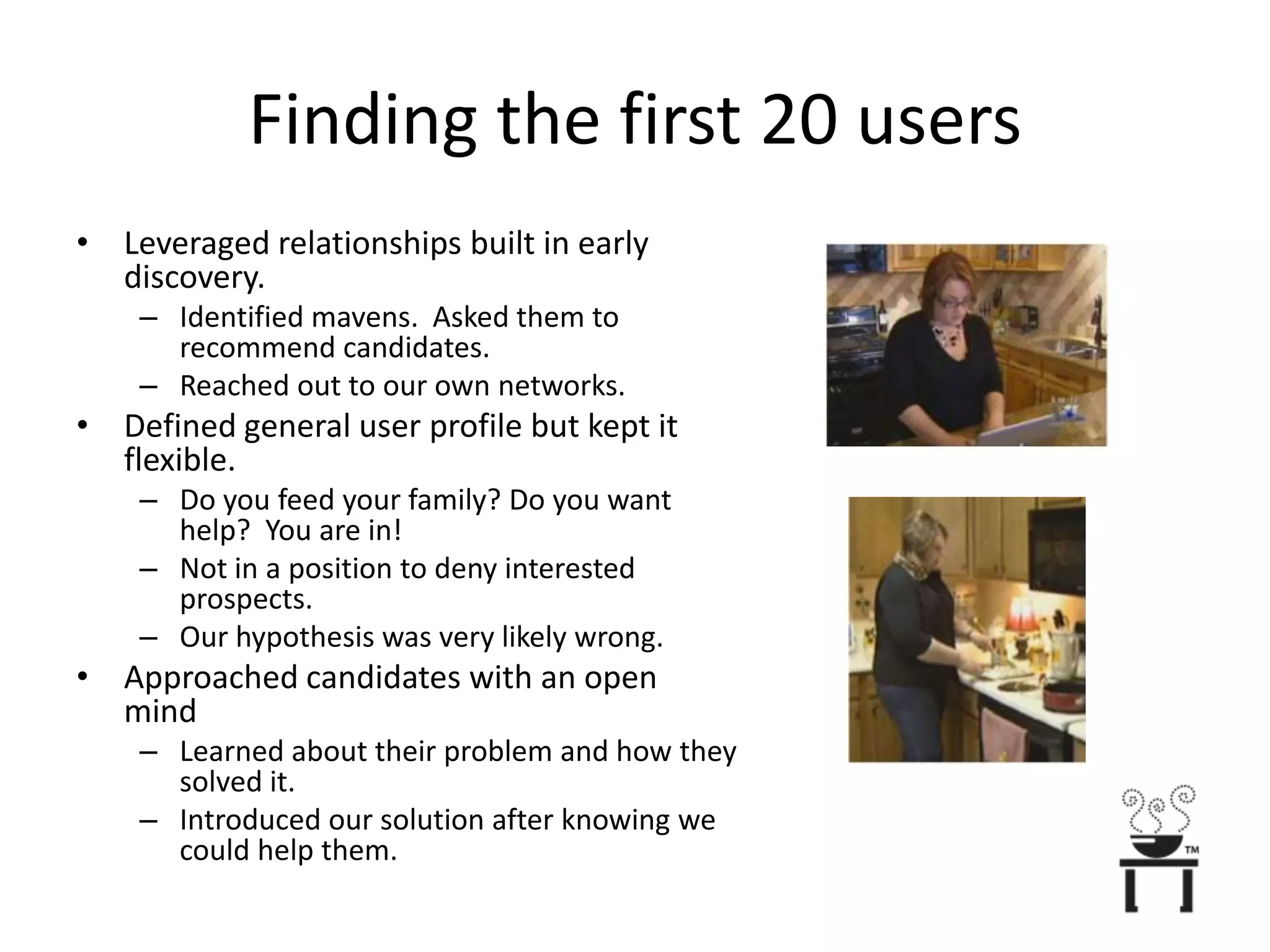
Finding the first 20 usersLeveraged relationships built in early discovery.Identified mavens.  Asked them to recommend candidates.Reached out to our own networks.Defined general user profile but kept it flexible.Do you feed your family? Do you want help?  You are in!Not in a position to deny interested prospects.Our hypothesis was very likely wrong.Approached candidates with an open mindLearned about their problem and how they solved it.Introduced our solution after knowing we could help them.
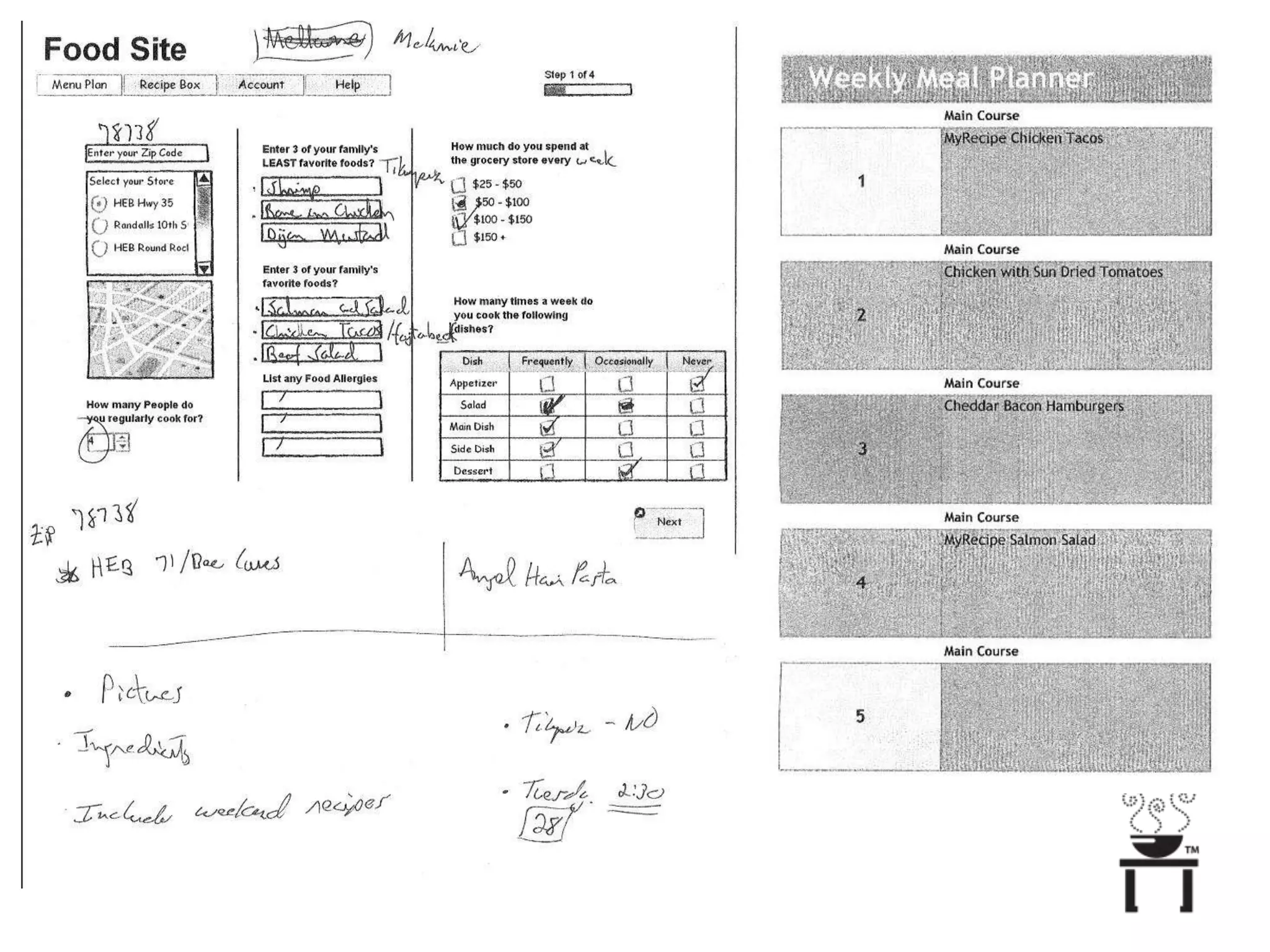
Learn First, Code Last1st InteractionFace to face, Out of the office.Learned how they solved the problem on their own.Verbally positioned our solution as it would look like on the web but rapidly iterated based on reaction.2nd InteractionPhone conversation.Emulated the web experience through questions but clarified when necessary.Delivered recipes and grocery list through email.Further InteractionsAttempted to make it as autonomous as possible.Focused on the experience, not code.Used Google Apps as proxy for “dynamic” web pages.
Get over your vision and think simpleAbandoning the complexity of the large vision allowed us to focus on what really mattered… …How are we going to solve their problem!
What we learnedDon’t try to learn it all at once, break it into small steps.  (store selection, recipe selection, etc…)Move on to the next step when you can anticipate what your early adopters are going to say before they say it.Automate when you are spending most of your time doing repetitive tasks that slow down your learning.If your currency is learning, only code when it will make learning cheaper.

Manuel Rosso, Food on the Table

  • 1.
    Concierge MVPLearning fromearly adopters at Food on the TableManuel Rosso
  • 2.
    Food on theTable helps families eat better and save money at the grocery store.
  • 3.
    We combine yourfamily’s food preferences with sales at your local grocery store to create a meal plan and organized grocery listHow it WorksSelect your favorite grocery storeSelect what your family enjoys eatingBuild a meal plan based on your preferred ingredients that are on sale at your favorite storeGo shopping with a super organized grocery listPrepare our chef curated recipes in no more than 45 minutes
  • 4.
    Why Concierge MVP?Ifyou can't get them to adopt your idea with high-touch, face-to-face service, they sure as hell are not going to buy into your cold web page.At the SLLC I told the story of user #1 This is the story of users #2 to #20.
  • 5.
    Finding the first20 usersLeveraged relationships built in early discovery.Identified mavens. Asked them to recommend candidates.Reached out to our own networks.Defined general user profile but kept it flexible.Do you feed your family? Do you want help? You are in!Not in a position to deny interested prospects.Our hypothesis was very likely wrong.Approached candidates with an open mindLearned about their problem and how they solved it.Introduced our solution after knowing we could help them.
  • 6.
    Learn First, CodeLast1st InteractionFace to face, Out of the office.Learned how they solved the problem on their own.Verbally positioned our solution as it would look like on the web but rapidly iterated based on reaction.2nd InteractionPhone conversation.Emulated the web experience through questions but clarified when necessary.Delivered recipes and grocery list through email.Further InteractionsAttempted to make it as autonomous as possible.Focused on the experience, not code.Used Google Apps as proxy for “dynamic” web pages.
  • 8.
    Get over yourvision and think simpleAbandoning the complexity of the large vision allowed us to focus on what really mattered… …How are we going to solve their problem!
  • 9.
    What we learnedDon’ttry to learn it all at once, break it into small steps. (store selection, recipe selection, etc…)Move on to the next step when you can anticipate what your early adopters are going to say before they say it.Automate when you are spending most of your time doing repetitive tasks that slow down your learning.If your currency is learning, only code when it will make learning cheaper.

Editor's Notes

  • #7 Re: coding last, we kept google apps (actually spreadsheets) as proxy for both our front-end and for our database; initially we copy & pasted from our “database spreadsheet” of recipes, onto specific user meal plan spreadsheets; later we used simple (ruby) scripts to automate this
  • #9 Re: stores: initially we adopted users who used the same store, which simplified our work & let us focus on the hypothesis around meal planning; later we added new storesRe: recipes: not only 3 recipes per sale item, we initially assumed a unique plan for each user; instead, we simplified to use the same plan for each sale item, e.g. everyone (regardless of store) who wanted to cook “chicken breast” this week received the same initial recipe + backup recipes; we introduced customer specific variety later