*
Charter College T.Miller – 7/2017
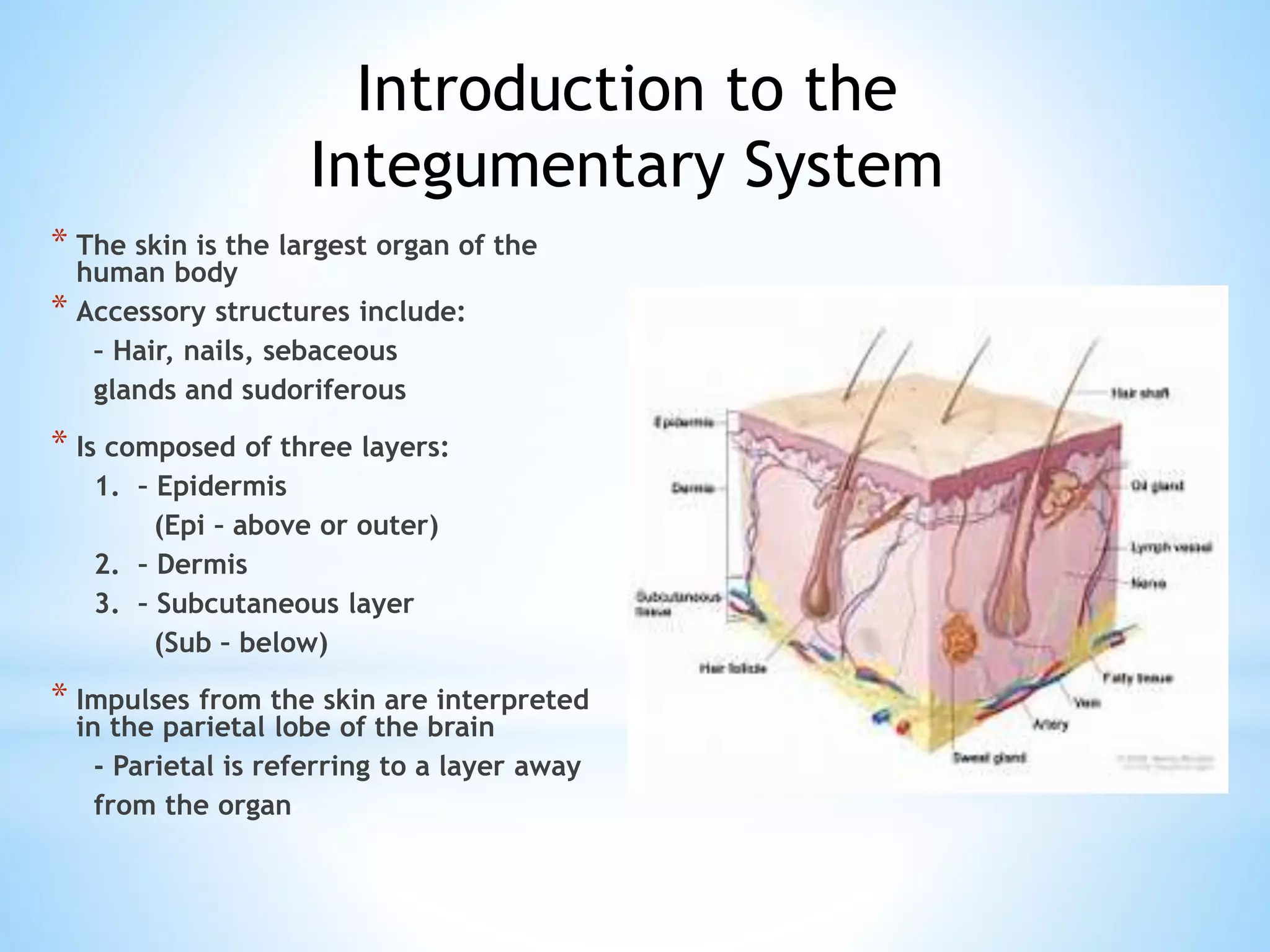
* The skin is the largest organ of the
human body
* Accessory structures include:
– Hair, nails, sebaceous
glands and sudoriferous
* Is composed of three layers:
1. – Epidermis
(Epi – above or outer)
2. – Dermis
3. – Subcutaneous layer
(Sub – below)
* Impulses from the skin are interpreted
in the parietal lobe of the brain
- Parietal is referring to a layer away
from the organ
Introduction to the
Integumentary System
*
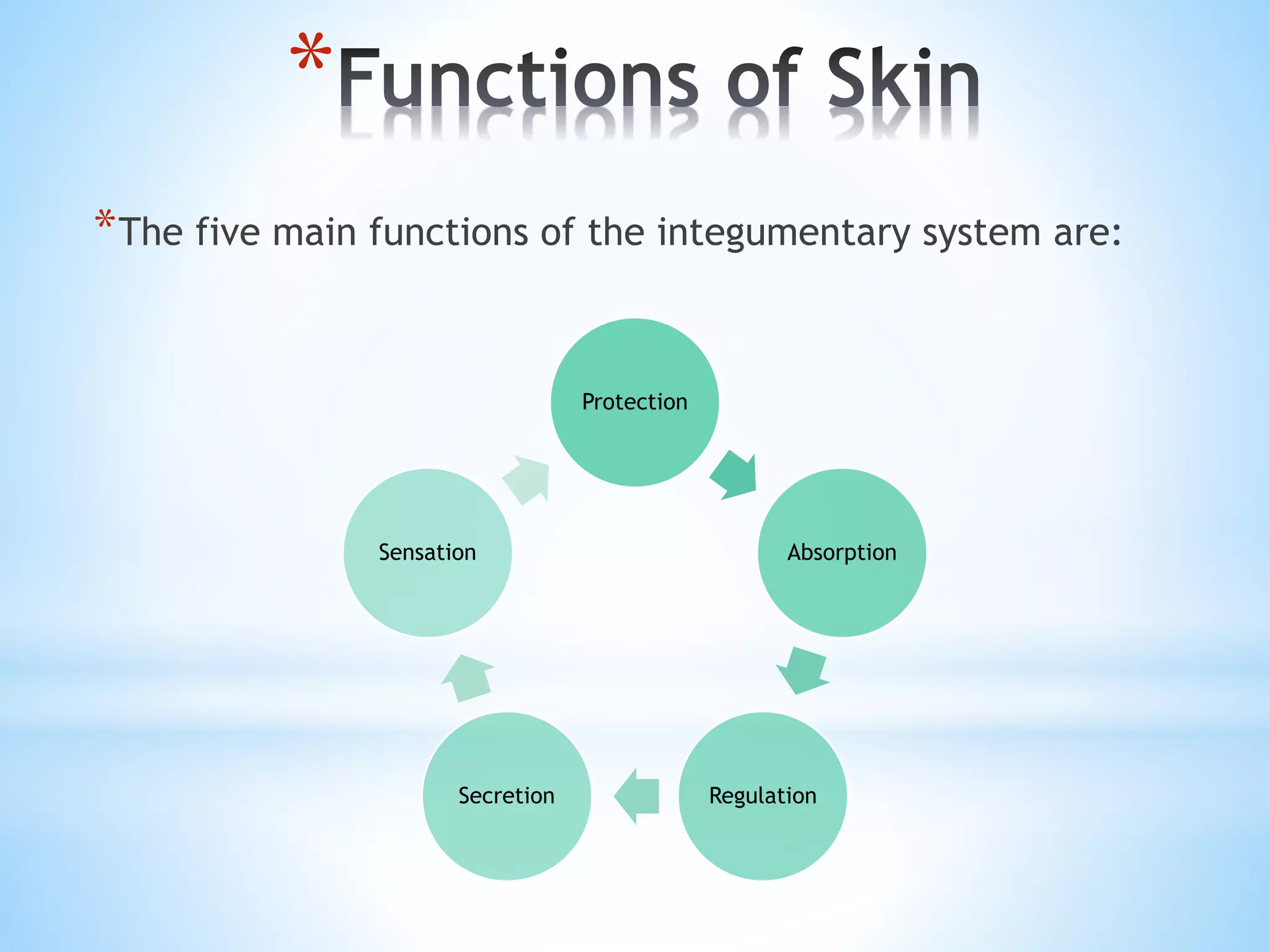
*The five main functions of the integumentary system are:
Protection
Absorption
RegulationSecretion
Sensation
*Intact skin serves as a protective barrier to our
internal structures.
*Prevents harmful agents like bacteria, viruses
and pollution from entering the body and blood
stream.
*Guards against the sun’s UV rays by producing a
protective pigmentation called melanin.
*Vitamin D is produced by the skin.
Protection
*The skin is a route by which substances can
enter the body.
*Medications can be administered by transdermal
absorption such as motion sickness medications
and hormonal therapies.
*Medication lotions are applied to the skin for
quick absorption and surface treatment.
*Transdermal patches and medication pastes
have time-release properties that allow
medications to be absorbed through the skin at
a slower rate of process.
Absorption
*Body temperature is regulated with assistance
by the skin.
*Blood vessels dilate when body temperature
rises and requires cooling.
*Sweat glands release sweat to cool the body
and are most numerous in the palms of our
hands and soles of our feet.
*When cold, blood vessels will constrict to keep
muscles warm.
*Integumentary and Nervous system work
together to maintain homeostasis.
Regulation
Regulation
*The skin contains millions of sudoriferous glands
that produce sweat and sebaceous glands that
produce oil for skin lubrication.
*Perspiration is a mixture of salt and water with
other chemical compounds.
*Accumulated sweat produces body odor and
bacteria.
*Sebaceous glands produce sebum, which
protects the body from dehydration.
Secretion
*The skin has millions of microscopic nerve
endings that act as sensory receptors.
*Sensory reactions include responses to pressure,
traction, heat, cold, pain and other sensations.
*Nerve endings send information to the brain for
the appropriate response to sensations.
*The integumentary and nervous systems work
together for the function of sensation.
Sensation
*A membrane is a thin layer of tissue surrounding cells and
organs and provides a lining around body cavities.
*Mucous membranes provide a lining in our body cavities
that are open to the external environment (nose, eyes).
*A serous membrane provides a double lining to cavities
that are closed to the external environment.
*Our cutaneous membrane is hard and dry skin covering
our body and offers protection.
*The visceral layer is the layer of the membrane closest to
the organ.
*The outermost layer of skin.
*The epidermis is divided into four layers of strata:
StratumCorneum
• The outermost
layer of skin,
consists of dead
cells filled with
keratin.
Thickness varies.
• Keratinization is
the formation of
keratin in cells
as they move up
towards the
surface of the
skin or nails.
StratumLucidum
• A translucent
layer directly
below the
stratum
corneum. It is
absent in thinner
skin as the cells
are either dying
or dead.
StratumGranulosum
• Several layers of
living cells that
are in the
process of
becoming
Stratum Lucidum
and Stratum
Corneum.
• They actively
become
keratinized after
losing their
nuclei.
StratumGerminativum
• Contains several
layers of living
cells that are
still capable of
cell division.
• This layer is most
responsible for
cell
regeneration.
• This layer
contains
melanocytes,
pigment that
gives skin it’s
color.
*The middle layer of skin. Often referred to as “true skin”.
*Composed of connective tissue containing nerves and
nerve endings.
*Contains blood vessels, sebaceous and sweat glands, hair
follicles and lymph vessels.
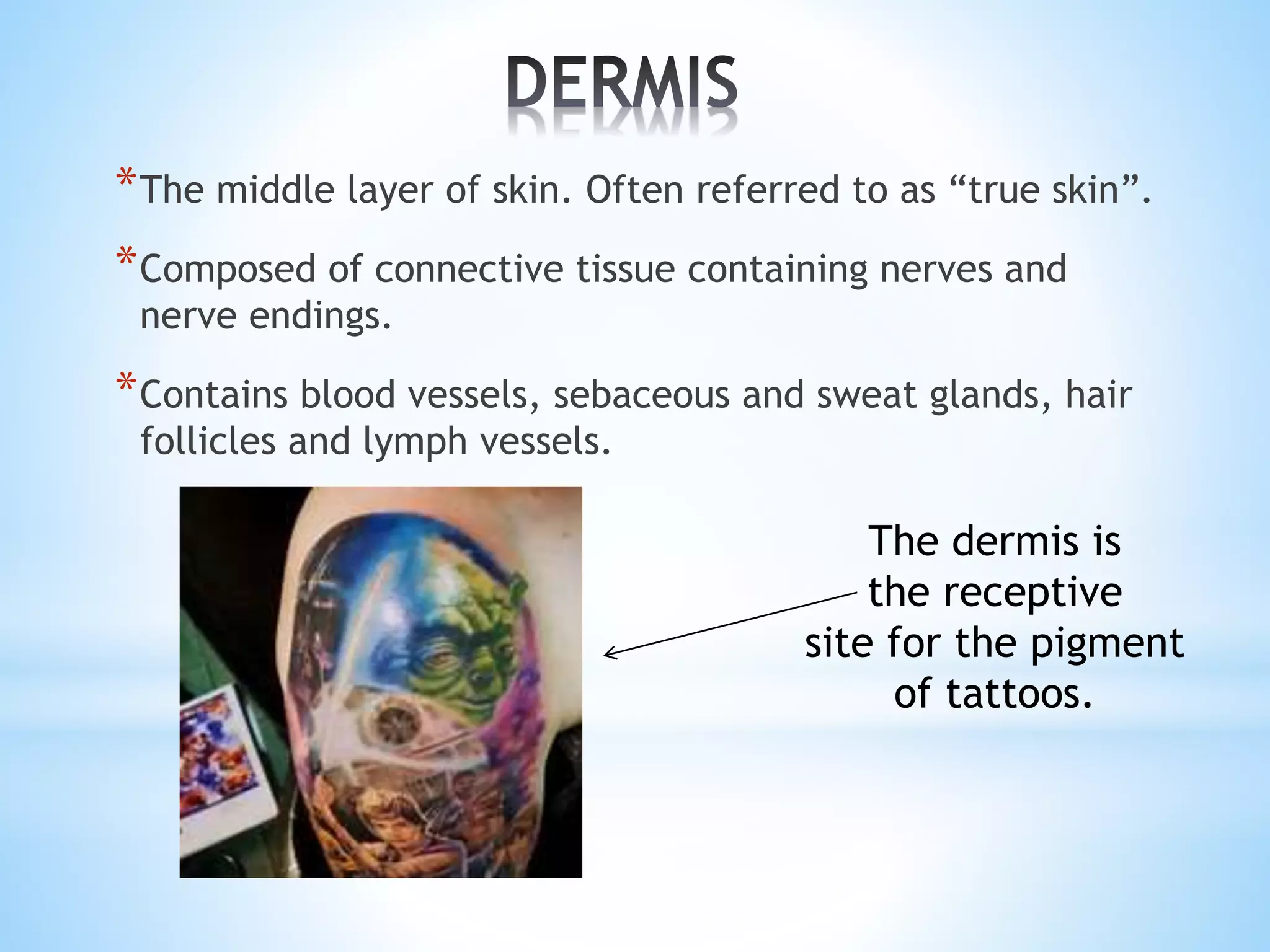
The dermis is
the receptive
site for the pigment
of tattoos.
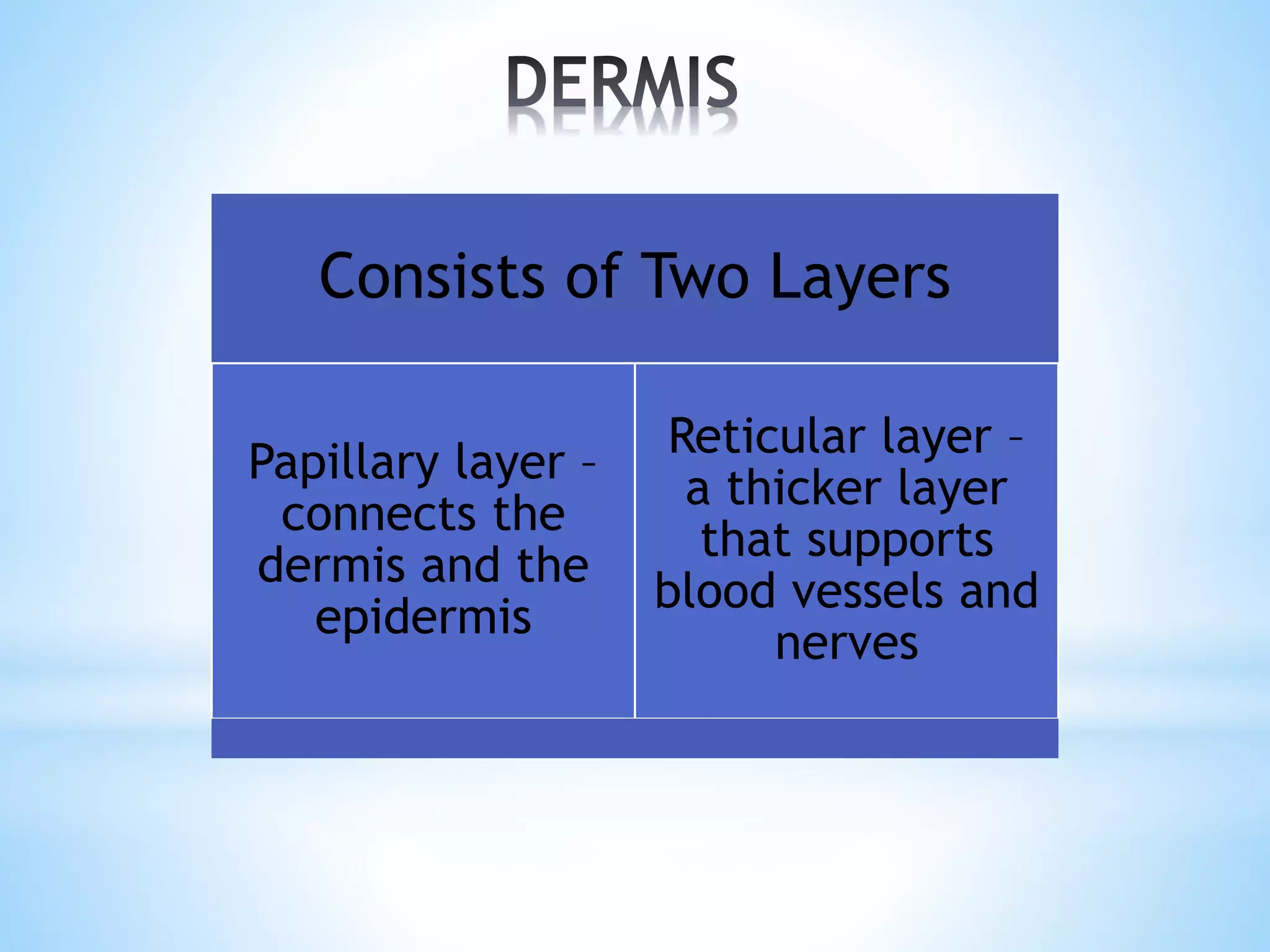
Consists of Two Layers
Papillary layer –
connects the
dermis and the
epidermis
Reticular layer –
a thicker layer
that supports
blood vessels and
nerves
*The innermost layer of skin.
*Composed of loose connective tissue with small lobes
of fat.
*Helps support, nourish, insulate and cushion skin.
*Contains larger blood vessels and nerves than those
found in the dermis.
*MA’s often inject medications into the subcutaneous
layer.
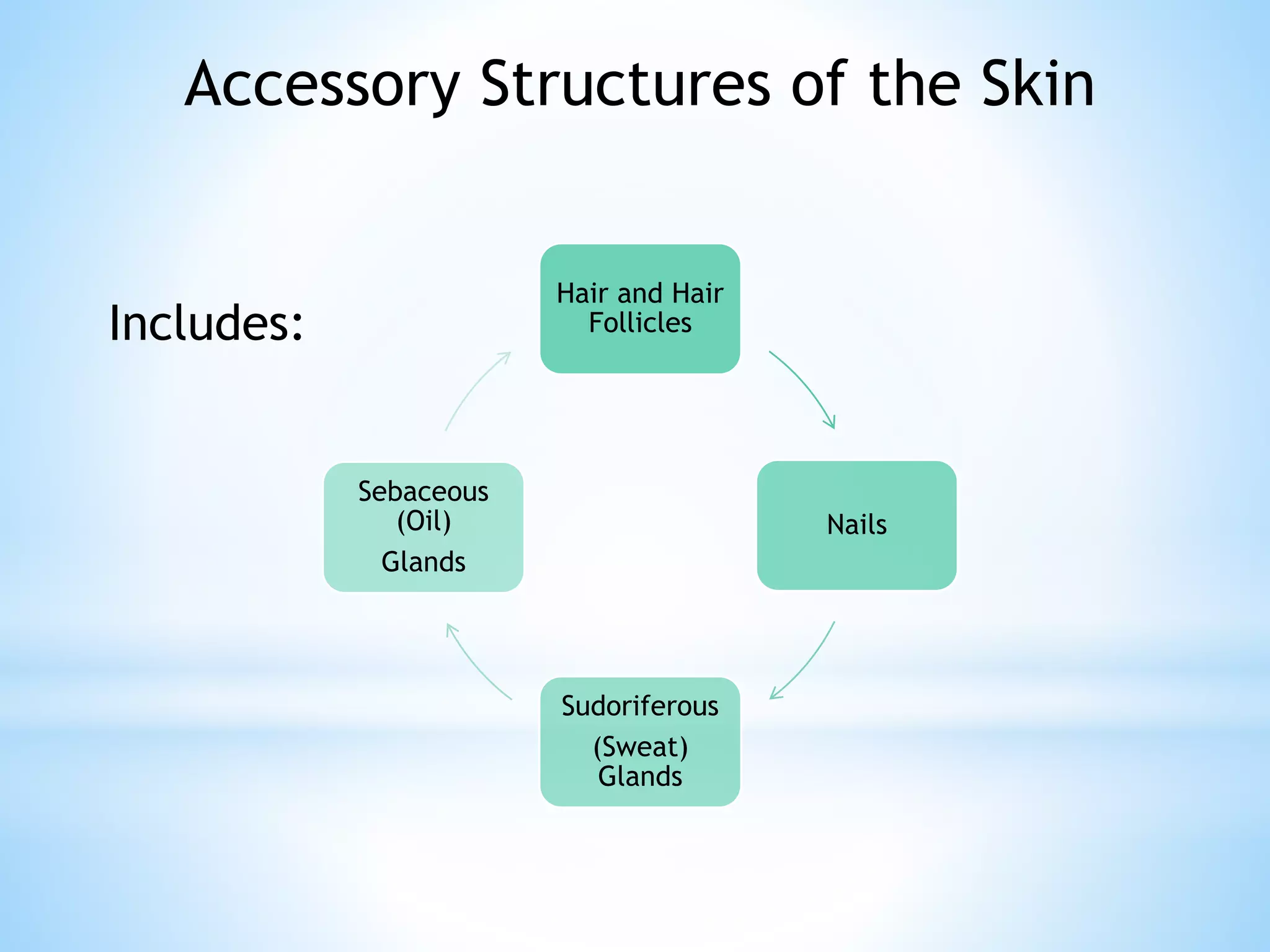
Accessory Structures of the Skin
Includes:
Hair and Hair
Follicles
Nails
Sudoriferous
(Sweat)
Glands
Sebaceous
(Oil)
Glands
*
*Functions of hair:
• Warmth – less on humans than other mammals
• Sense light touch of the skin (Goosebumps)
• Protective barrier around eyes, ears and nose keeps
particles out
*Loop of capillaries enclosed in connective tissue is the
hair papilla
*The papilla is found at the base of each hair follicle
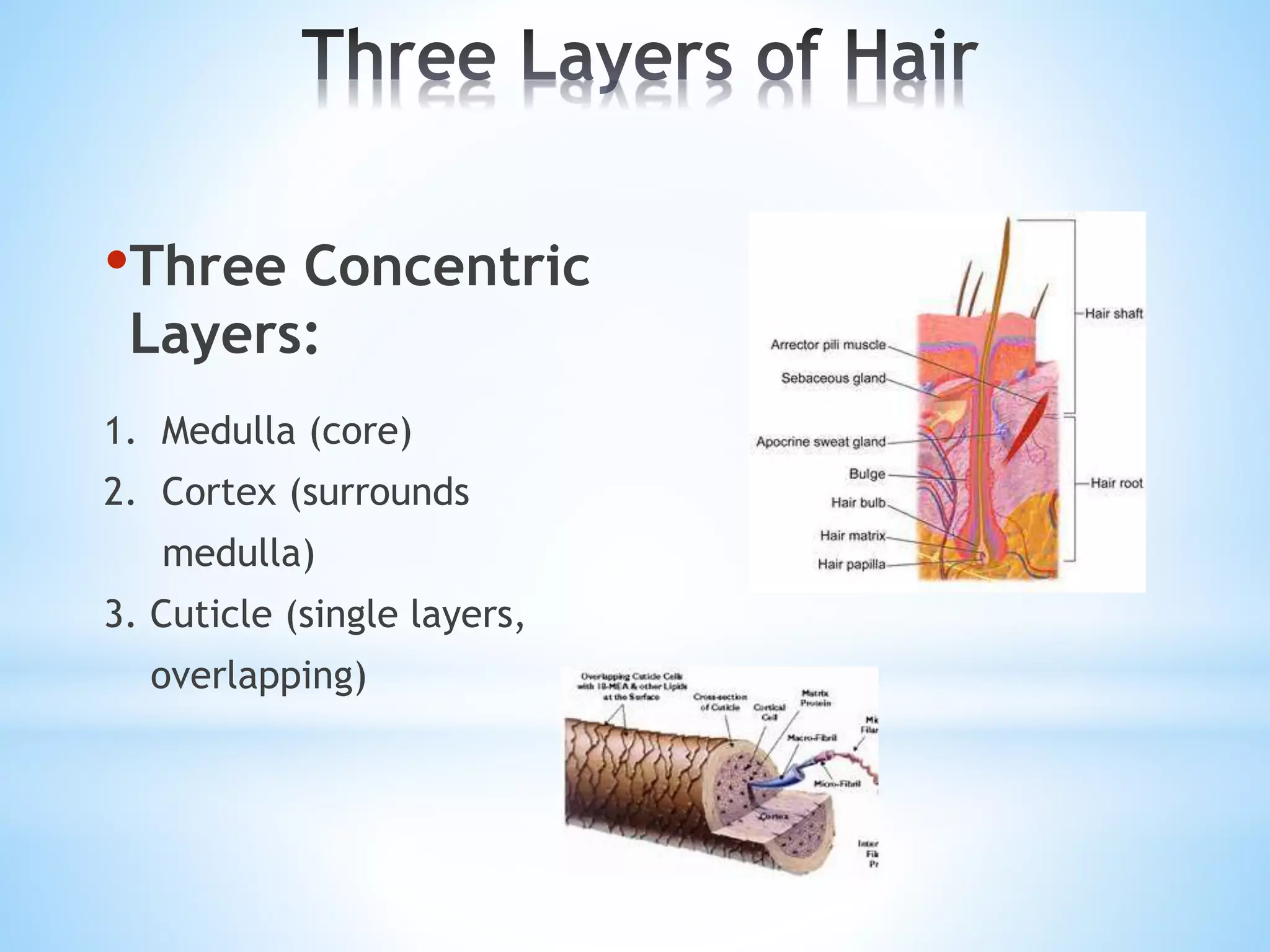
•Three Concentric
Layers:
1. Medulla (core)
2. Cortex (surrounds
medulla)
3. Cuticle (single layers,
overlapping)
Nails
 Composed of hard keratin, nails are horny cell structures of the epidermis
 Consists of the body, the root and the matrix (nail bed)
 The lunula is the crescent -shaped white area at the base
 Average nail growth is about 1mm per week
 Nail growth can be affected by disease and hormonal deficiencies
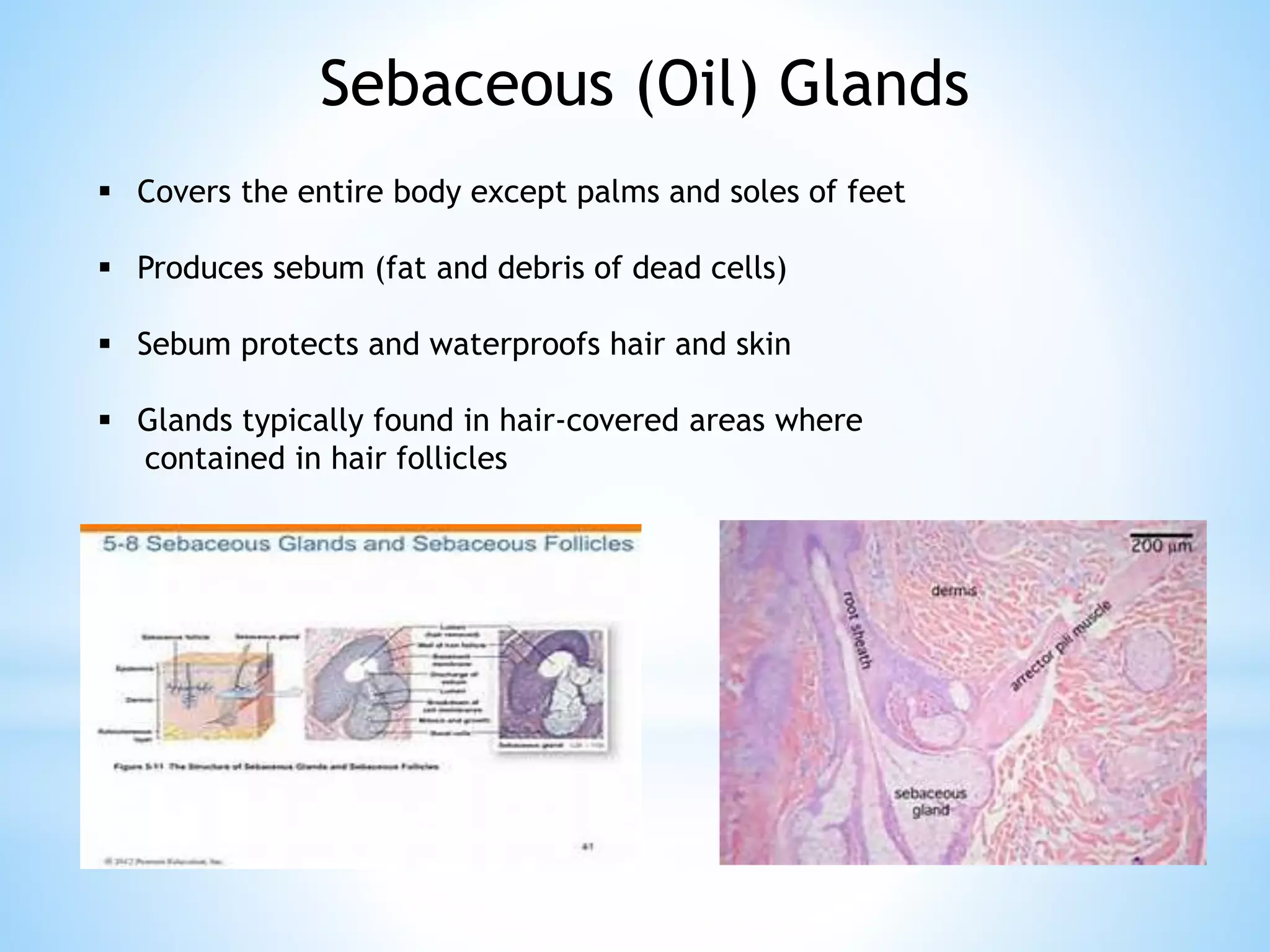
Sebaceous (Oil) Glands
 Covers the entire body except palms and soles of feet
 Produces sebum (fat and debris of dead cells)
 Sebum protects and waterproofs hair and skin
 Glands typically found in hair-covered areas where
contained in hair follicles
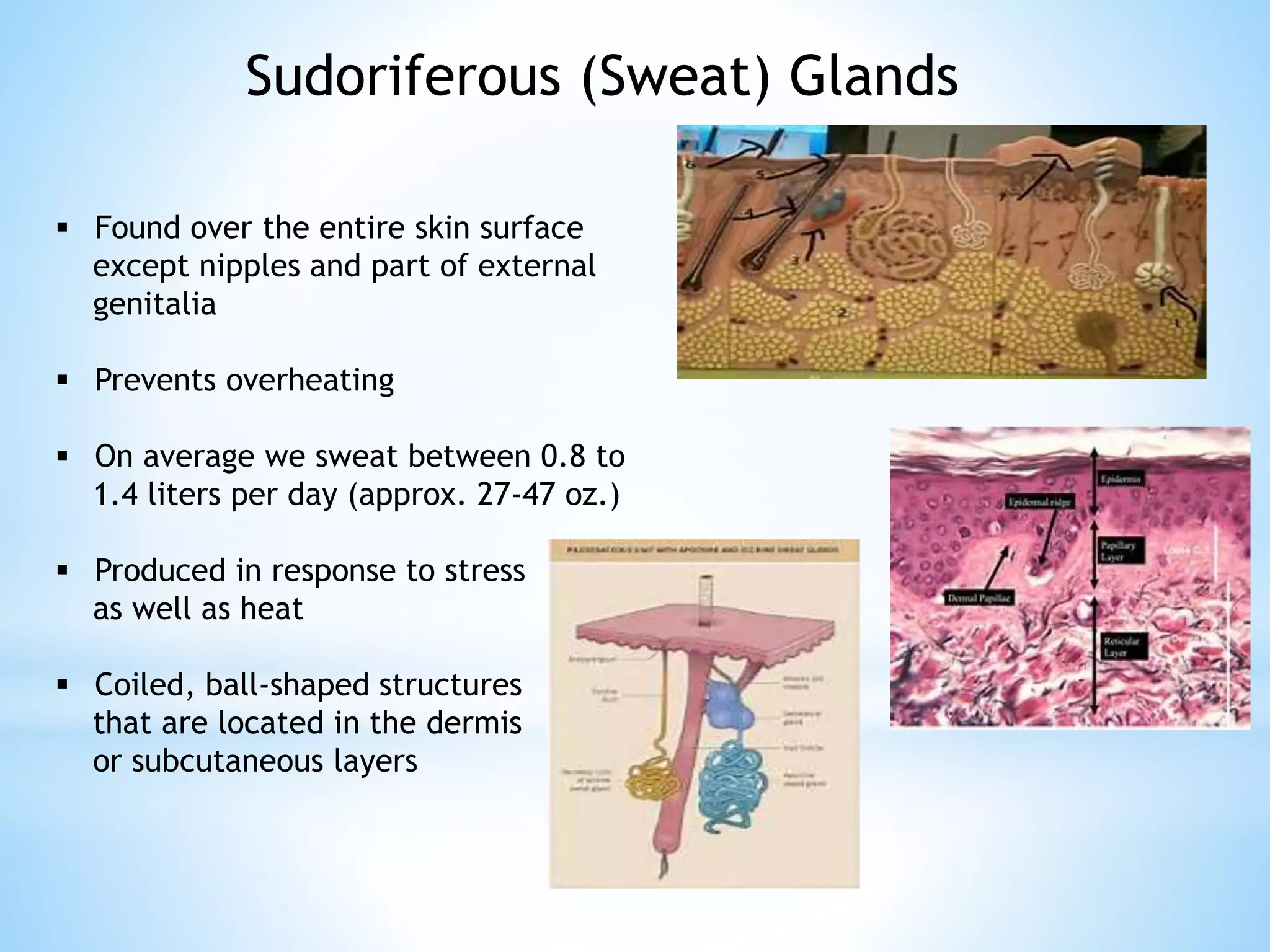
Sudoriferous (Sweat) Glands
 Found over the entire skin surface
except nipples and part of external
genitalia
 Prevents overheating
 On average we sweat between 0.8 to
1.4 liters per day (approx. 27-47 oz.)
 Produced in response to stress
as well as heat
 Coiled, ball-shaped structures
that are located in the dermis
or subcutaneous layers
Can be life threatening
• Catastrophic loss of body
fluids
• Dehydration and fatal
circulatory shock
• Infection
Classes:
• First degree – epidermis:
redness (sunburn)
• Second degree – epidermis
and upper dermis: blister
• Third degree - full
thickness
Treatment:
• Cool water for small
surface areas
• Skin graphs on large
surface areas
depending on the
degree
• Analgesic creams and
lotions to relieve pain
• Sterile dressings or
sheets
Disorders of the Integumentary System
BURNS:
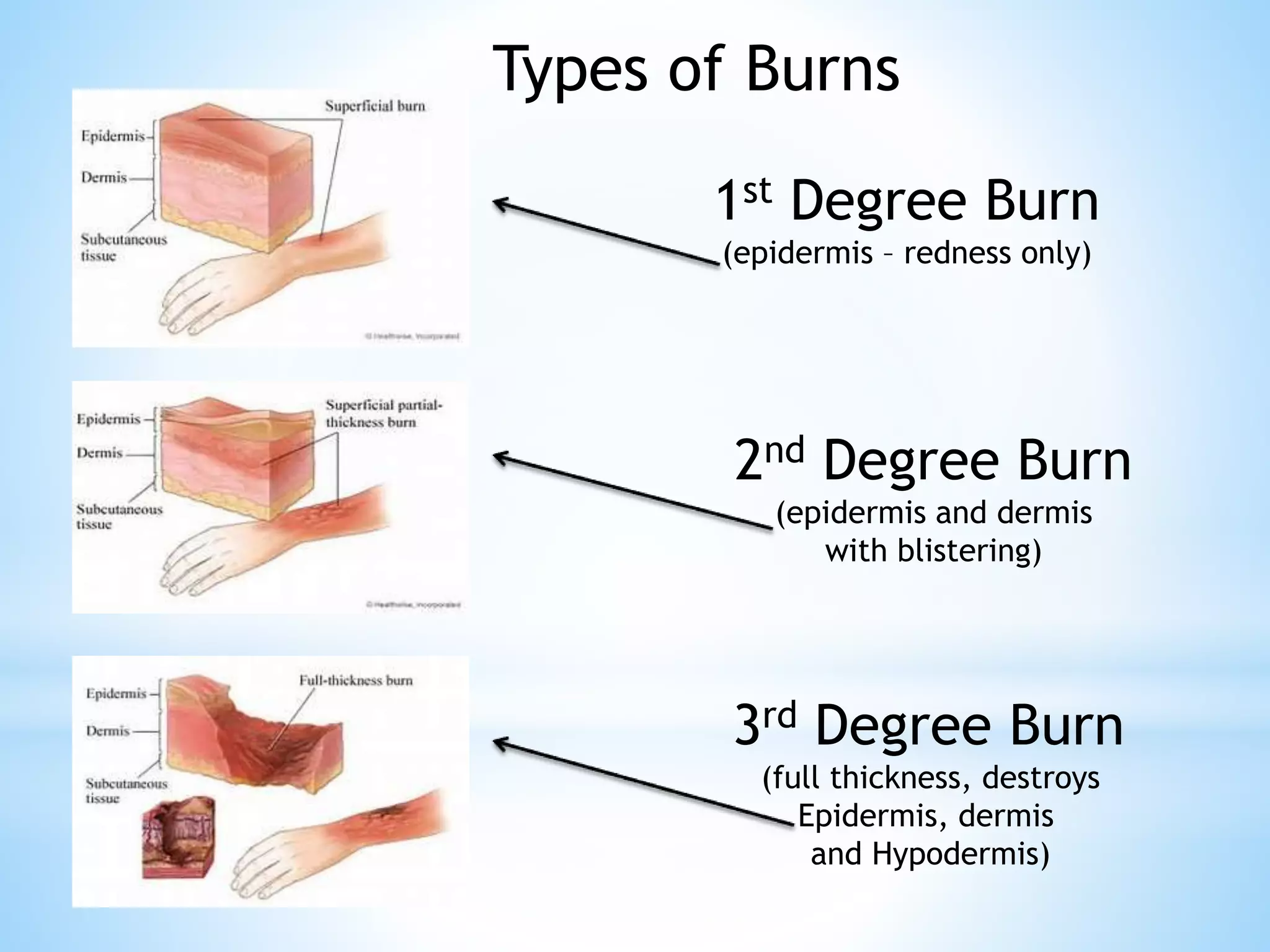
1st Degree Burn
(epidermis – redness only)
2nd Degree Burn
(epidermis and dermis
with blistering)
3rd Degree Burn
(full thickness, destroys
Epidermis, dermis
and Hypodermis)
Types of Burns
 Most common of all cancers – affecting
more than one million people each year
 Three major types of skin cancer:
• Basal cell carcinoma
• Squamous cell carcinoma
• Malignant melanoma
 Abnormal cells multiply and form
masses
called tumors
 Malignant (cancerous) tumors
encroach on
neighboring tissues like lymph and
cancer begins
 Most common change is a dysplastic
nevus, or an
abnormal mole.
Skin Cancer:
Basal Cell
Carcinoma
Squamous Cell
Carcinoma
Malignant
Melanoma
 Common skin condition
occurs when oil and dead
cells clog pores
 Most commonly affects teens
 Caused by hormonal changes
 Skin becomes oilier during
teen years
Acne Vulgaris: Alopecia:
 Baldness or hair loss
 Affects 1 in 100 people
 Can be an inherited disorder or
side effect of chemotherapy
 An acute, spreading bacterial
infection below the surface of the
skin
 Common in diabetic patients
 Is not contagious
Cellulitis:
 Allergic reaction caused by
irritating substances
 Poison ivy, poison oak,
allergies to metals lotions or
detergents
Contact Dermatitis
A disease that causes thickened rigid skin
Treatment can help, but there isn’t a cure
Scleroderma:
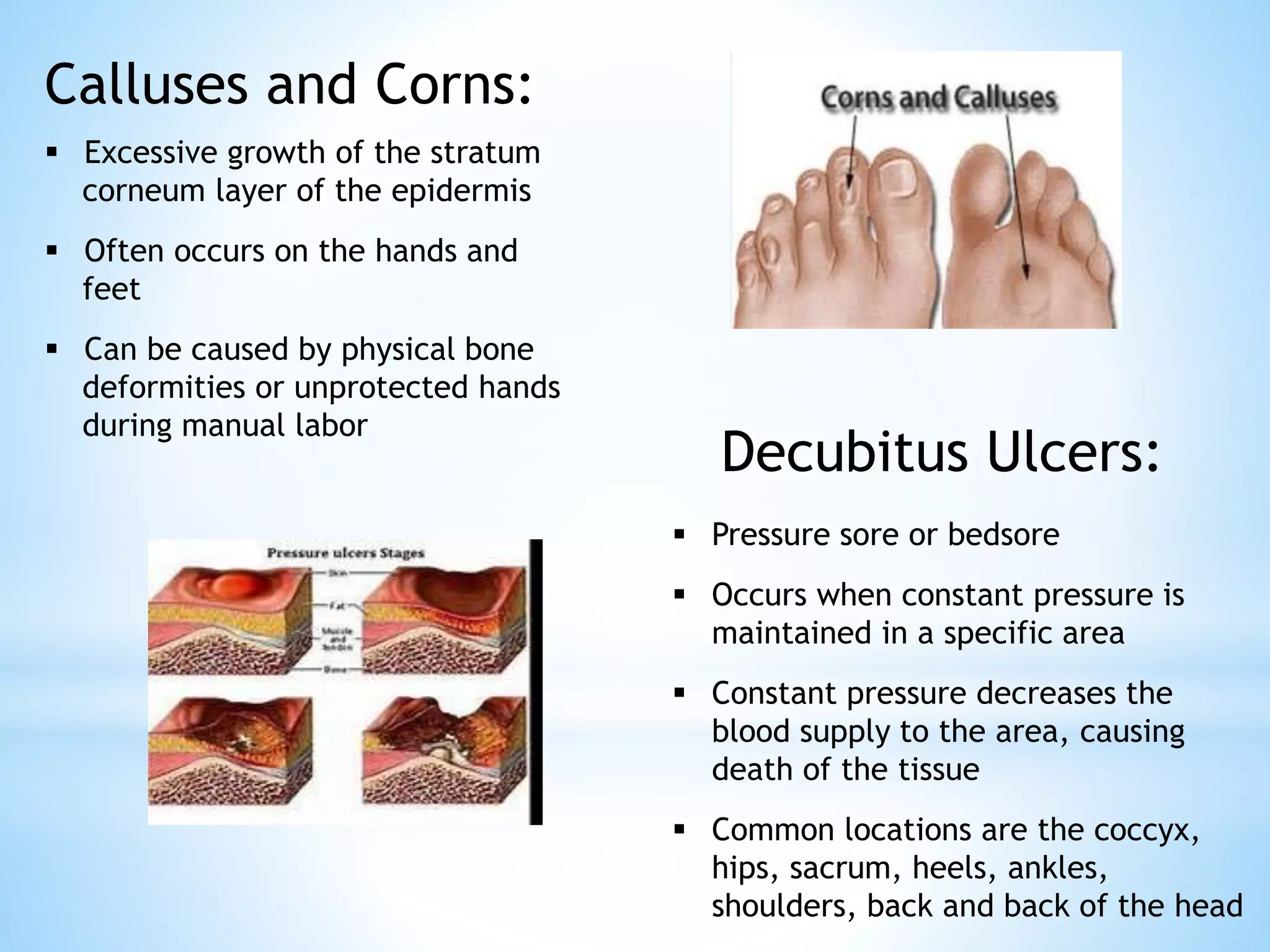
Calluses and Corns:
 Excessive growth of the stratum
corneum layer of the epidermis
 Often occurs on the hands and
feet
 Can be caused by physical bone
deformities or unprotected hands
during manual labor
Decubitus Ulcers:
 Pressure sore or bedsore
 Occurs when constant pressure is
maintained in a specific area
 Constant pressure decreases the
blood supply to the area, causing
death of the tissue
 Common locations are the coccyx,
hips, sacrum, heels, ankles,
shoulders, back and back of the head
Atopic dermatitis is a
chronic skin condition
caused by an allergic-
type reaction on the
skin
Typically hereditary
The most common
foods causing eczema
include:
eggs
Milk
peanuts
seafood
wheat
Eczema:
*
* Primarily affects the mouth or genital area.
* Two strains:
1. Herpes Simplex Virus Type I
– affects the face, including lips and mouth
and is the most common type of herpes
2. Herpes Simplex Virus Type II
- sexually transmitted
- some have no symptoms
Herpes Simplex Type I Herpes Simplex Type II
*Commonly known as
shingles
*Caused by the varicella
zoster virus (chickenpox)
*If you have not had
chickenpox, and you are
exposed to the sores from
shingles, you could get
chicken pox
*Virus lays dormant for
many years and can
reappear as blisters
Herpes Zoster
HHV1: Also known as Herpes Simplex Virus 1 (HSV -1) and it causes oral herpes
also known as cold sores.
HHV2: Also known as Herpes Simplex Virus 2 (HSV – 2) and it causes genital
herpes.
HHV3: Also known as Varicella Zoster Virus (VZV) and it causes chickenpox when
people are infected with it for the first time. The symptoms can recur as shingles
later on in life.
HHV4: Also known as Epstein Barr Virus (EBV) and it causes mononucleosis in
humans. In popular jargon this disease is also known as mono.
HHV5: Also known as Cytomegolo Virus (CMV) and it effect 5 out of every 1000
live births. Children infected with this virus initially show symptoms that are very
similar to rubella.
HHV6: Also known as Roseola virus because it causes Roseola Infantum, which is
essentially a high fever accompanied by a rash.
HHV7: This is very similar to HHV6, however the infections caused by this virus is
usually not as severe as that caused by HHV6.
HHV8: Also known as Kaposi’s sarcoma-associated herpes virus (KSHV), which is a
form of cancer that people suffering from HIV/AIDS are especially susceptible to.
The Truth About Herpes – Did you Know
There are 8 Different Types?
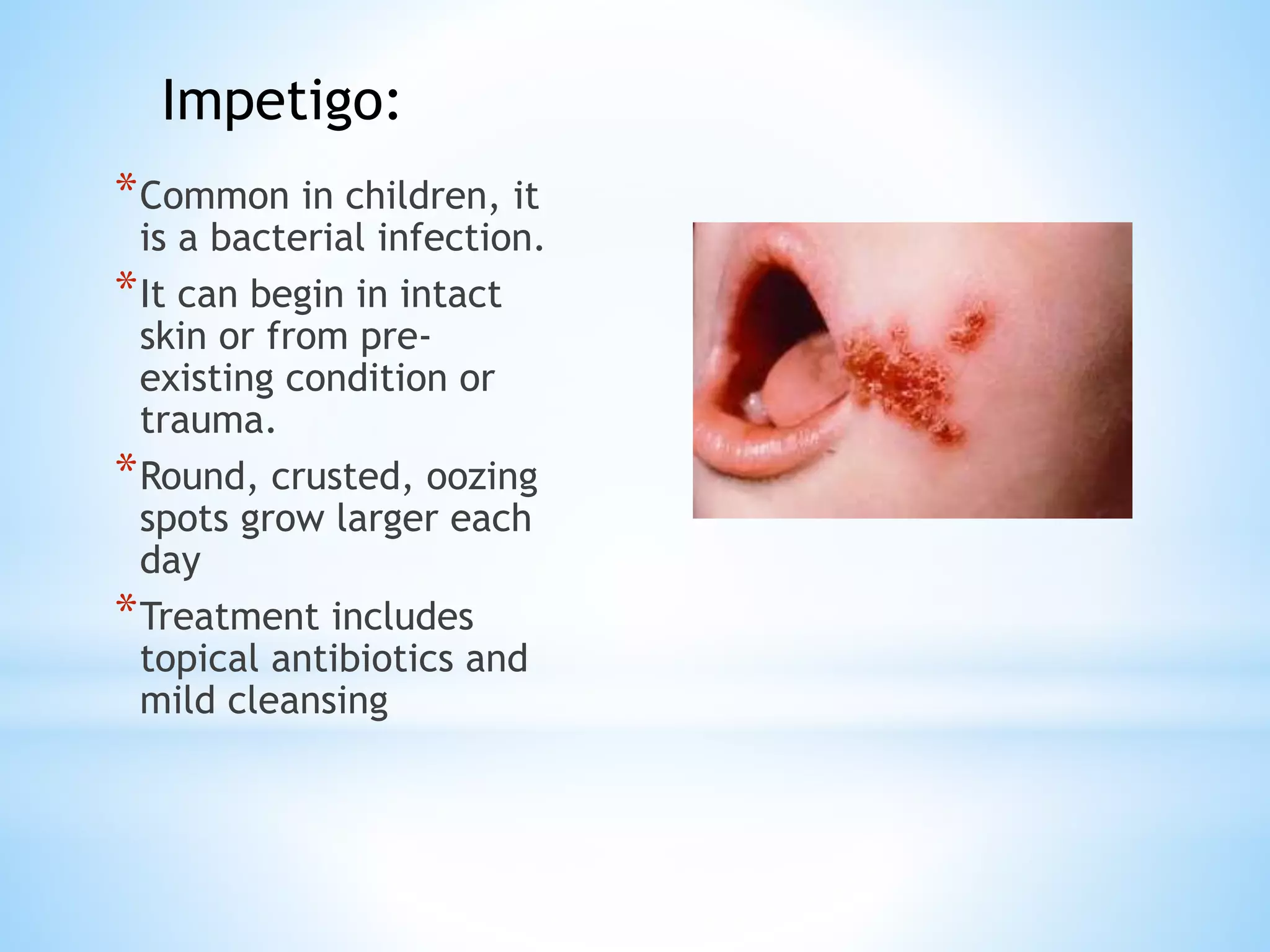
*Common in children, it
is a bacterial infection.
*It can begin in intact
skin or from pre-
existing condition or
trauma.
*Round, crusted, oozing
spots grow larger each
day
*Treatment includes
topical antibiotics and
mild cleansing
Impetigo:
*Can develop at any age, most
commonly between 30 and 50
years old. Not contagious.
*Scaly, red patches on the skin
are indicators
*Joint pain can accompany the
dry skin as well
*Extreme cases can lead to
severe dehydration
*Treatment can be as easy as
topical medications or as
severe as intravenous fluids.
Psoriasis:
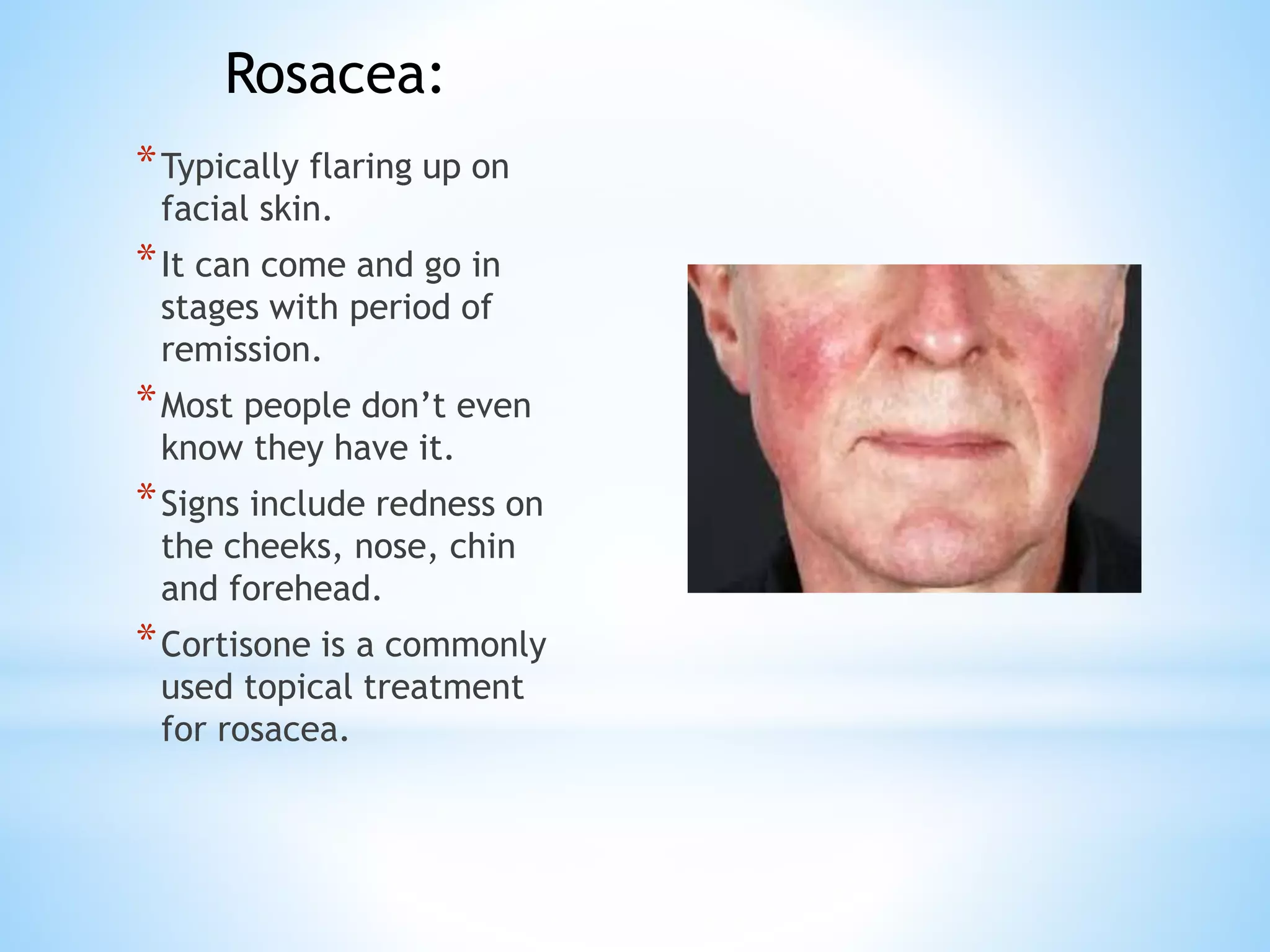
*Typically flaring up on
facial skin.
*It can come and go in
stages with period of
remission.
*Most people don’t even
know they have it.
*Signs include redness on
the cheeks, nose, chin
and forehead.
*Cortisone is a commonly
used topical treatment
for rosacea.
Rosacea:
*Caused by viruses in the HPV
family (human papillomavirus).
*Can grow anywhere on the
body, even inside body
cavities.
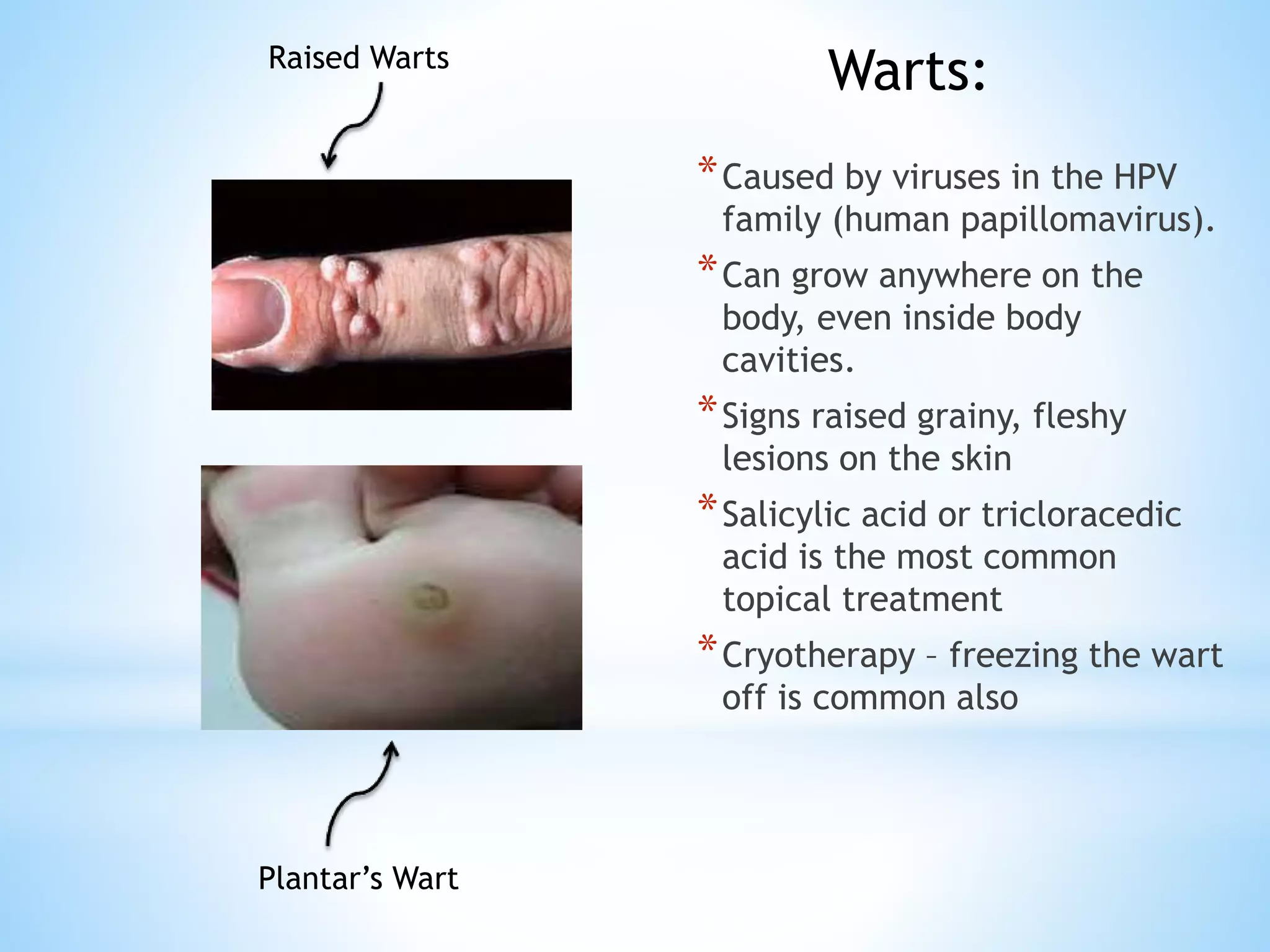
*Signs raised grainy, fleshy
lesions on the skin
*Salicylic acid or tricloracedic
acid is the most common
topical treatment
*Cryotherapy – freezing the wart
off is common also
Warts:
Plantar’s Wart
Raised Warts
*
*The top layer of dead skin
cells is removed to provide
skin with a rejuvenated look
*Tiny crystals and suctions
devices work together to
produce healthier looking
skin
*Non-invasive and non-
chemical treatment is
appealing to many who do
not wish more aggressive
treatments.
*Acid concentrations used to
remove old damaged layers
of skin
*Light – Reduces size of
pores, making skin appear
softer and more colorful
*Medium – To reduce
wrinkles. Top layer and some
underlying cells will be
stripped.
*Deep – More aggressive.
Aimed at reducing all signs
aging. Pre-cancerous lesions
can be removed by this level
of peel
Microdermabrasion: Chemical Peel:
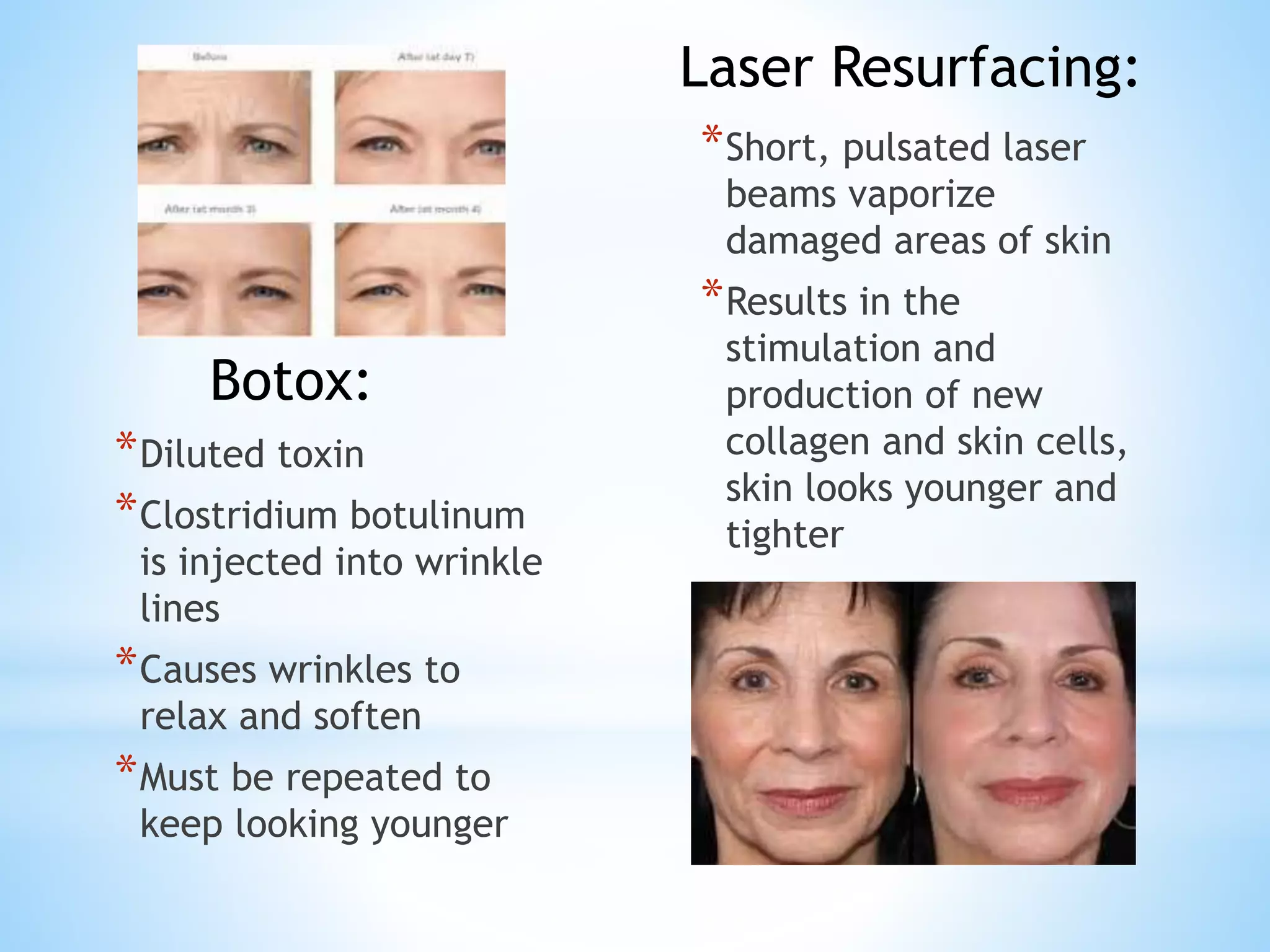
*Diluted toxin
*Clostridium botulinum
is injected into wrinkle
lines
*Causes wrinkles to
relax and soften
*Must be repeated to
keep looking younger
*Short, pulsated laser
beams vaporize
damaged areas of skin
*Results in the
stimulation and
production of new
collagen and skin cells,
skin looks younger and
tighter
Botox:
Laser Resurfacing:

The Integumentary System

  • 1.
  • 2.
    * The skinis the largest organ of the human body * Accessory structures include: – Hair, nails, sebaceous glands and sudoriferous * Is composed of three layers: 1. – Epidermis (Epi – above or outer) 2. – Dermis 3. – Subcutaneous layer (Sub – below) * Impulses from the skin are interpreted in the parietal lobe of the brain - Parietal is referring to a layer away from the organ Introduction to the Integumentary System
  • 3.
    * *The five mainfunctions of the integumentary system are: Protection Absorption RegulationSecretion Sensation
  • 4.
    *Intact skin servesas a protective barrier to our internal structures. *Prevents harmful agents like bacteria, viruses and pollution from entering the body and blood stream. *Guards against the sun’s UV rays by producing a protective pigmentation called melanin. *Vitamin D is produced by the skin. Protection
  • 5.
    *The skin isa route by which substances can enter the body. *Medications can be administered by transdermal absorption such as motion sickness medications and hormonal therapies. *Medication lotions are applied to the skin for quick absorption and surface treatment. *Transdermal patches and medication pastes have time-release properties that allow medications to be absorbed through the skin at a slower rate of process. Absorption
  • 6.
    *Body temperature isregulated with assistance by the skin. *Blood vessels dilate when body temperature rises and requires cooling. *Sweat glands release sweat to cool the body and are most numerous in the palms of our hands and soles of our feet. *When cold, blood vessels will constrict to keep muscles warm. *Integumentary and Nervous system work together to maintain homeostasis. Regulation Regulation
  • 7.
    *The skin containsmillions of sudoriferous glands that produce sweat and sebaceous glands that produce oil for skin lubrication. *Perspiration is a mixture of salt and water with other chemical compounds. *Accumulated sweat produces body odor and bacteria. *Sebaceous glands produce sebum, which protects the body from dehydration. Secretion
  • 8.
    *The skin hasmillions of microscopic nerve endings that act as sensory receptors. *Sensory reactions include responses to pressure, traction, heat, cold, pain and other sensations. *Nerve endings send information to the brain for the appropriate response to sensations. *The integumentary and nervous systems work together for the function of sensation. Sensation
  • 9.
    *A membrane isa thin layer of tissue surrounding cells and organs and provides a lining around body cavities. *Mucous membranes provide a lining in our body cavities that are open to the external environment (nose, eyes). *A serous membrane provides a double lining to cavities that are closed to the external environment. *Our cutaneous membrane is hard and dry skin covering our body and offers protection. *The visceral layer is the layer of the membrane closest to the organ.
  • 10.
    *The outermost layerof skin. *The epidermis is divided into four layers of strata: StratumCorneum • The outermost layer of skin, consists of dead cells filled with keratin. Thickness varies. • Keratinization is the formation of keratin in cells as they move up towards the surface of the skin or nails. StratumLucidum • A translucent layer directly below the stratum corneum. It is absent in thinner skin as the cells are either dying or dead. StratumGranulosum • Several layers of living cells that are in the process of becoming Stratum Lucidum and Stratum Corneum. • They actively become keratinized after losing their nuclei. StratumGerminativum • Contains several layers of living cells that are still capable of cell division. • This layer is most responsible for cell regeneration. • This layer contains melanocytes, pigment that gives skin it’s color.
  • 11.
    *The middle layerof skin. Often referred to as “true skin”. *Composed of connective tissue containing nerves and nerve endings. *Contains blood vessels, sebaceous and sweat glands, hair follicles and lymph vessels. The dermis is the receptive site for the pigment of tattoos.
  • 12.
    Consists of TwoLayers Papillary layer – connects the dermis and the epidermis Reticular layer – a thicker layer that supports blood vessels and nerves
  • 13.
    *The innermost layerof skin. *Composed of loose connective tissue with small lobes of fat. *Helps support, nourish, insulate and cushion skin. *Contains larger blood vessels and nerves than those found in the dermis. *MA’s often inject medications into the subcutaneous layer.
  • 14.
    Accessory Structures ofthe Skin Includes: Hair and Hair Follicles Nails Sudoriferous (Sweat) Glands Sebaceous (Oil) Glands
  • 15.
    * *Functions of hair: •Warmth – less on humans than other mammals • Sense light touch of the skin (Goosebumps) • Protective barrier around eyes, ears and nose keeps particles out *Loop of capillaries enclosed in connective tissue is the hair papilla *The papilla is found at the base of each hair follicle
  • 16.
    •Three Concentric Layers: 1. Medulla(core) 2. Cortex (surrounds medulla) 3. Cuticle (single layers, overlapping)
  • 17.
    Nails  Composed ofhard keratin, nails are horny cell structures of the epidermis  Consists of the body, the root and the matrix (nail bed)  The lunula is the crescent -shaped white area at the base  Average nail growth is about 1mm per week  Nail growth can be affected by disease and hormonal deficiencies
  • 18.
    Sebaceous (Oil) Glands Covers the entire body except palms and soles of feet  Produces sebum (fat and debris of dead cells)  Sebum protects and waterproofs hair and skin  Glands typically found in hair-covered areas where contained in hair follicles
  • 19.
    Sudoriferous (Sweat) Glands Found over the entire skin surface except nipples and part of external genitalia  Prevents overheating  On average we sweat between 0.8 to 1.4 liters per day (approx. 27-47 oz.)  Produced in response to stress as well as heat  Coiled, ball-shaped structures that are located in the dermis or subcutaneous layers
  • 20.
    Can be lifethreatening • Catastrophic loss of body fluids • Dehydration and fatal circulatory shock • Infection Classes: • First degree – epidermis: redness (sunburn) • Second degree – epidermis and upper dermis: blister • Third degree - full thickness Treatment: • Cool water for small surface areas • Skin graphs on large surface areas depending on the degree • Analgesic creams and lotions to relieve pain • Sterile dressings or sheets Disorders of the Integumentary System BURNS:
  • 21.
    1st Degree Burn (epidermis– redness only) 2nd Degree Burn (epidermis and dermis with blistering) 3rd Degree Burn (full thickness, destroys Epidermis, dermis and Hypodermis) Types of Burns
  • 22.
     Most commonof all cancers – affecting more than one million people each year  Three major types of skin cancer: • Basal cell carcinoma • Squamous cell carcinoma • Malignant melanoma  Abnormal cells multiply and form masses called tumors  Malignant (cancerous) tumors encroach on neighboring tissues like lymph and cancer begins  Most common change is a dysplastic nevus, or an abnormal mole. Skin Cancer: Basal Cell Carcinoma Squamous Cell Carcinoma Malignant Melanoma
  • 23.
     Common skincondition occurs when oil and dead cells clog pores  Most commonly affects teens  Caused by hormonal changes  Skin becomes oilier during teen years Acne Vulgaris: Alopecia:  Baldness or hair loss  Affects 1 in 100 people  Can be an inherited disorder or side effect of chemotherapy  An acute, spreading bacterial infection below the surface of the skin  Common in diabetic patients  Is not contagious Cellulitis:  Allergic reaction caused by irritating substances  Poison ivy, poison oak, allergies to metals lotions or detergents Contact Dermatitis A disease that causes thickened rigid skin Treatment can help, but there isn’t a cure Scleroderma:
  • 24.
    Calluses and Corns: Excessive growth of the stratum corneum layer of the epidermis  Often occurs on the hands and feet  Can be caused by physical bone deformities or unprotected hands during manual labor Decubitus Ulcers:  Pressure sore or bedsore  Occurs when constant pressure is maintained in a specific area  Constant pressure decreases the blood supply to the area, causing death of the tissue  Common locations are the coccyx, hips, sacrum, heels, ankles, shoulders, back and back of the head
  • 25.
    Atopic dermatitis isa chronic skin condition caused by an allergic- type reaction on the skin Typically hereditary The most common foods causing eczema include: eggs Milk peanuts seafood wheat Eczema:
  • 26.
    * * Primarily affectsthe mouth or genital area. * Two strains: 1. Herpes Simplex Virus Type I – affects the face, including lips and mouth and is the most common type of herpes 2. Herpes Simplex Virus Type II - sexually transmitted - some have no symptoms Herpes Simplex Type I Herpes Simplex Type II
  • 27.
    *Commonly known as shingles *Causedby the varicella zoster virus (chickenpox) *If you have not had chickenpox, and you are exposed to the sores from shingles, you could get chicken pox *Virus lays dormant for many years and can reappear as blisters Herpes Zoster
  • 28.
    HHV1: Also knownas Herpes Simplex Virus 1 (HSV -1) and it causes oral herpes also known as cold sores. HHV2: Also known as Herpes Simplex Virus 2 (HSV – 2) and it causes genital herpes. HHV3: Also known as Varicella Zoster Virus (VZV) and it causes chickenpox when people are infected with it for the first time. The symptoms can recur as shingles later on in life. HHV4: Also known as Epstein Barr Virus (EBV) and it causes mononucleosis in humans. In popular jargon this disease is also known as mono. HHV5: Also known as Cytomegolo Virus (CMV) and it effect 5 out of every 1000 live births. Children infected with this virus initially show symptoms that are very similar to rubella. HHV6: Also known as Roseola virus because it causes Roseola Infantum, which is essentially a high fever accompanied by a rash. HHV7: This is very similar to HHV6, however the infections caused by this virus is usually not as severe as that caused by HHV6. HHV8: Also known as Kaposi’s sarcoma-associated herpes virus (KSHV), which is a form of cancer that people suffering from HIV/AIDS are especially susceptible to. The Truth About Herpes – Did you Know There are 8 Different Types?
  • 29.
    *Common in children,it is a bacterial infection. *It can begin in intact skin or from pre- existing condition or trauma. *Round, crusted, oozing spots grow larger each day *Treatment includes topical antibiotics and mild cleansing Impetigo:
  • 30.
    *Can develop atany age, most commonly between 30 and 50 years old. Not contagious. *Scaly, red patches on the skin are indicators *Joint pain can accompany the dry skin as well *Extreme cases can lead to severe dehydration *Treatment can be as easy as topical medications or as severe as intravenous fluids. Psoriasis:
  • 31.
    *Typically flaring upon facial skin. *It can come and go in stages with period of remission. *Most people don’t even know they have it. *Signs include redness on the cheeks, nose, chin and forehead. *Cortisone is a commonly used topical treatment for rosacea. Rosacea:
  • 32.
    *Caused by virusesin the HPV family (human papillomavirus). *Can grow anywhere on the body, even inside body cavities. *Signs raised grainy, fleshy lesions on the skin *Salicylic acid or tricloracedic acid is the most common topical treatment *Cryotherapy – freezing the wart off is common also Warts: Plantar’s Wart Raised Warts
  • 33.
    * *The top layerof dead skin cells is removed to provide skin with a rejuvenated look *Tiny crystals and suctions devices work together to produce healthier looking skin *Non-invasive and non- chemical treatment is appealing to many who do not wish more aggressive treatments. *Acid concentrations used to remove old damaged layers of skin *Light – Reduces size of pores, making skin appear softer and more colorful *Medium – To reduce wrinkles. Top layer and some underlying cells will be stripped. *Deep – More aggressive. Aimed at reducing all signs aging. Pre-cancerous lesions can be removed by this level of peel Microdermabrasion: Chemical Peel:
  • 34.
    *Diluted toxin *Clostridium botulinum isinjected into wrinkle lines *Causes wrinkles to relax and soften *Must be repeated to keep looking younger *Short, pulsated laser beams vaporize damaged areas of skin *Results in the stimulation and production of new collagen and skin cells, skin looks younger and tighter Botox: Laser Resurfacing: