DARK ROOM & PITFALLS OF IMAGING
Dr.Tarique Ajij
Junior Resident,
Department of Radio-
Diagnosis,
Medical College,
Kolkata
DARK ROOM CONSTRUCTION
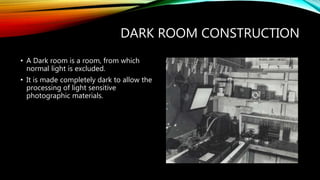
• A Dark room is a room, from which
normal light is excluded.
• It is made completely dark to allow the
processing of light sensitive
photographic materials.
LOCATION
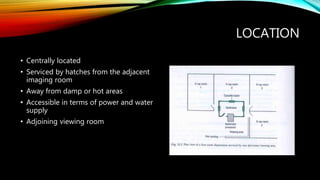
• Centrally located
• Serviced by hatches from the adjacent
imaging room
• Away from damp or hot areas
• Accessible in terms of power and water
supply
• Adjoining viewing room
HATCHES
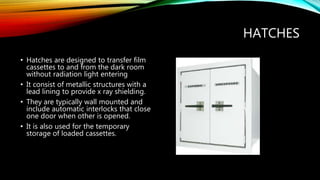
• Hatches are designed to transfer film
cassettes to and from the dark room
without radiation light entering
• It consist of metallic structures with a
lead lining to provide x ray shielding.
• They are typically wall mounted and
include automatic interlocks that close
one door when other is opened.
• It is also used for the temporary
storage of loaded cassettes.
SIZE
• Minimum floor area of 10 sq meter
• Ceiling height of 2.5 - 3 meter
• Size may be reduced depending upon
the department needs
RADIATION PROTECTION
• Walls adjacent to the radiographic
room should be shielded with correct
thickness of the lead all the way to the
ceiling
• In the interests of both darkroom staff
and film material alike
• 1.6 mm lead is mostly used
FLOORS
• Non-porous flooring
• Non-slip flooring
• Chemical resistant
• Stain proof
• Durable & easy to maintain
• Light coloured (low-light working
conditions)
• Asphalt tiles
• Porcelain tiles
• Clay tiles
• Plastic tiles may be used in the dry
dark-rooms
WALLS/CEILING
• Light in colour to reflect as much light
as possible onto the working surface
• Easy to wipe or clean
• Covered with chemical resistant
materials
• Special paints, varnish, ceramic or
plastic wall
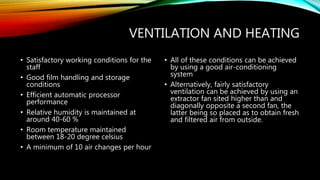
VENTILATION AND HEATING
• Satisfactory working conditions for the
staff
• Good film handling and storage
conditions
• Efficient automatic processor
performance
• Relative humidity is maintained at
around 40-60 %
• Room temperature maintained
between 18-20 degree celsius
• A minimum of 10 air changes per hour
• All of these conditions can be achieved
by using a good air-conditioning
system
• Alternatively, fairly satisfactory
ventilation can be achieved by using an
extractor fan sited higher than and
diagonally opposite a second fan, the
latter being so placed as to obtain fresh
and filtered air from outside.
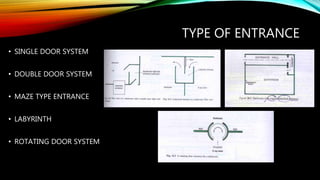
TYPE OF ENTRANCE
• SINGLE DOOR SYSTEM
• DOUBLE DOOR SYSTEM
• MAZE TYPE ENTRANCE
• LABYRINTH
• ROTATING DOOR SYSTEM
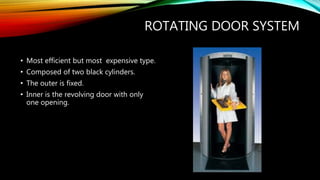
ROTATING DOOR SYSTEM
• Most efficient but most expensive type.
• Composed of two black cylinders.
• The outer is fixed.
• Inner is the revolving door with only
one opening.
FIRE SAFETY
• Ideally, all darkrooms should be
provided with an alternative exit, which
should be indicated clearly and left
unobstructed at all times
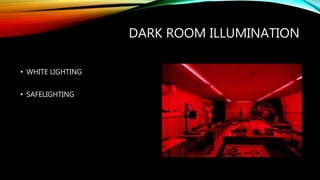
DARK ROOM ILLUMINATION
• WHITE LIGHTING
• SAFELIGHTING
WHITE LIGHTING
• For inspection & maintenance of
cassettes & screens
• Cleaning of work surfaces
• Servicing of equipment
• Sited close to the ceiling
• Moderate in intensity
• (60w tungsten, 30w fluorescent )
• Preferably centrally placed
• More than one switch preferable
• Identification of respective switches is
important
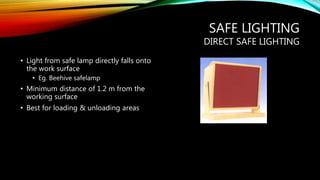
SAFE LIGHTING
DIRECT SAFE LIGHTING
• Light from safe lamp directly falls onto
the work surface
• Eg. Beehive safelamp
• Minimum distance of 1.2 m from the
working surface
• Best for loading & unloading areas
SAFE LIGHTING
INDIRECT SAFE LIGHTING
• Directs the light towards the ceiling
which reflects light back into the room
• Is intended to provide general
illumination of the dark room
• Suspended atleast 2.1 m above floor
level
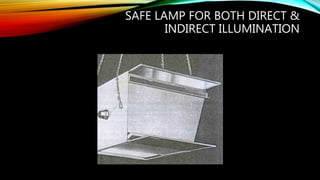
SAFE LAMP FOR BOTH DIRECT &
INDIRECT ILLUMINATION
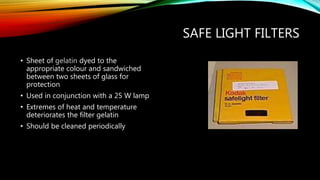
SAFE LIGHT FILTERS
• Sheet of gelatin dyed to the
appropriate colour and sandwiched
between two sheets of glass for
protection
• Used in conjunction with a 25 W lamp
• Extremes of heat and temperature
deteriorates the filter gelatin
• Should be cleaned periodically
HOW DOES A SAFELIGHT WORK?
• When white light is passed through
coloured filters, certain wavelengths (or
colours) are absorbed by the filters,
whilst those wavelengths, which
correspond to the colour of the filters
will be transmitted.
• Making the correct selection of
safelight filter (matching the filter to
the film), means choosing a filter, which
will transmit a colour to which the film
is relatively unresponsive, whilst
stopping all light to which the film is
most sensitive.
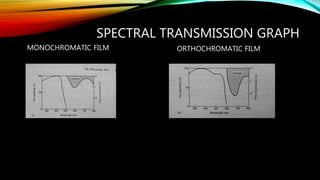
SPECTRUM TRANSMISSION
GRAPH:
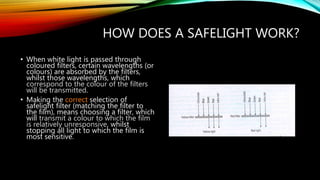
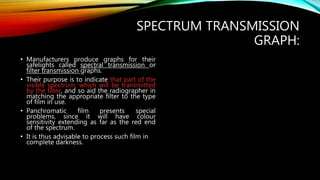
• Manufacturers produce graphs for their
safelights called spectral transmission or
filter transmission graphs.
• Their purpose is to indicate that part of the
visible spectrum, which will be transmitted
by the filter, and so aid the radiographer in
matching the appropriate filter to the type
of film in use.
• Panchromatic film presents special
problems, since it will have colour
sensitivity extending as far as the red end
of the spectrum.
• It is thus advisable to process such film in
complete darkness.
SPECTRAL TRANSMISSION GRAPH
MONOCHROMATIC FILM ORTHOCHROMATIC FILM
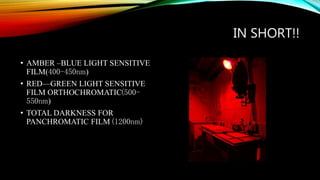
IN SHORT!!
• AMBER –BLUE LIGHT SENSITIVE
FILM(400-450nm)
• RED—GREEN LIGHT SENSITIVE
FILM ORTHOCHROMATIC(500-
550nm)
• TOTAL DARKNESS FOR
PANCHROMATIC FILM (1200nm)
HOW SAFE IS SAFE LIGHTING?
• No safe lighting is completely safe; all
films will become significantly fogged if
exposed to safelights for long enough.
• This is because safelight filters are not
perfect absorbers of the undesirable
wavelengths and, in truth, all films have
some sensitivity to all wavelengths.
• Thus, the intensity of illumination and
the film-handling time must be kept to
a minimum if significant fogging is not
to occur.
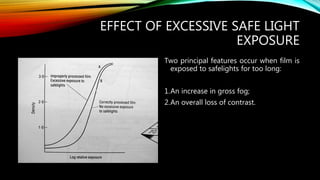
EFFECT OF EXCESSIVE SAFE LIGHT
EXPOSURE
Two principal features occur when film is
exposed to safelights for too long:
1.An increase in gross fog;
2.An overall loss of contrast.
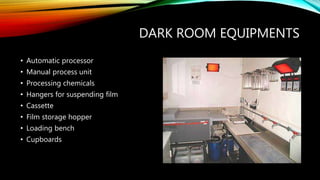
DARK ROOM EQUIPMENTS
• Automatic processor
• Manual process unit
• Processing chemicals
• Hangers for suspending film
• Cassette
• Film storage hopper
• Loading bench
• Cupboards
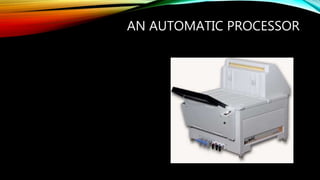
AN AUTOMATIC PROCESSOR
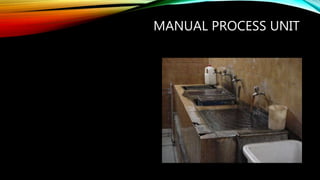
MANUAL PROCESS UNIT
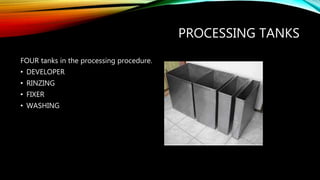
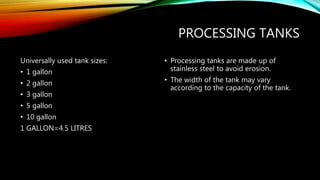
PROCESSING TANKS
FOUR tanks in the processing procedure.
• DEVELOPER
• RINZING
• FIXER
• WASHING
PROCESSING TANKS
Universally used tank sizes:
• 1 gallon
• 2 gallon
• 3 gallon
• 5 gallon
• 10 gallon
1 GALLON=4.5 LITRES
• Processing tanks are made up of
stainless steel to avoid erosion.
• The width of the tank may vary
according to the capacity of the tank.
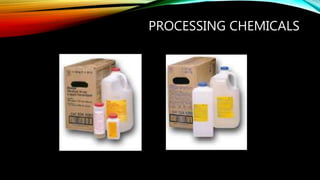
PROCESSING CHEMICALS
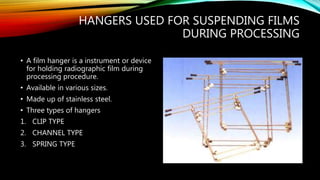
HANGERS USED FOR SUSPENDING FILMS
DURING PROCESSING
• A film hanger is a instrument or device
for holding radiographic film during
processing procedure.
• Available in various sizes.
• Made up of stainless steel.
• Three types of hangers
1. CLIP TYPE
2. CHANNEL TYPE
3. SPRING TYPE
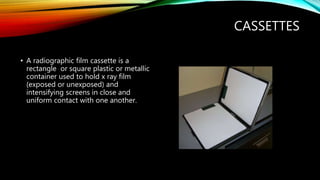
CASSETTES
• A radiographic film cassette is a
rectangle or square plastic or metallic
container used to hold x ray film
(exposed or unexposed) and
intensifying screens in close and
uniform contact with one another.
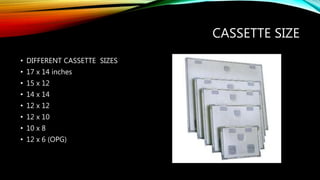
CASSETTE SIZE
• DIFFERENT CASSETTE SIZES
• 17 x 14 inches
• 15 x 12
• 14 x 14
• 12 x 12
• 12 x 10
• 10 x 8
• 12 x 6 (OPG)
USES OF CASSETTES
1. Hold intensifying screen and protect
them from damage.
2. Exclude all light from entering the
cassette and fogging the film.
3. Maintain a close and uniform
contact between the screen and
film.
4. Exclude dust and dirt from the
sensitive films.
5. Act as a medium from exposure up
to further processing of film.
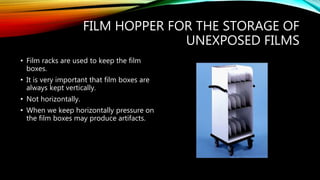
FILM HOPPER FOR THE STORAGE OF
UNEXPOSED FILMS
• Film racks are used to keep the film
boxes.
• It is very important that film boxes are
always kept vertically.
• Not horizontally.
• When we keep horizontally pressure on
the film boxes may produce artifacts.
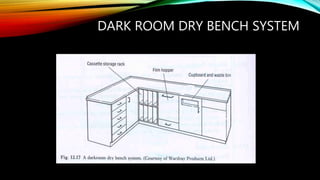
DARK ROOM DRY BENCH SYSTEM
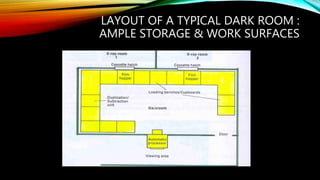
LAYOUT OF A TYPICAL DARK ROOM :
AMPLE STORAGE & WORK SURFACES
HEALTH AND SAFETY IN THE
PROCESSING AREA
• ELECTRICAL SAFETY
• GENERAL SAFETY
• CHEMICAL SAFETY
ELECTRICAL SAFETTY
• All electrical equipments to be sited
well away from sinks & manual
processing units
• Adequate earthing of all electrical
appliances
• No trailing cables from appliances
• Pull-cord switching for lights
GENERAL SAFETY MEASURES
• The maximum level of safe lighting
consistent with film sensitivity
• Adequate ventilation
• Second exits for fire safety
CHEMICAL HAZARDS
• Processing chemicals contain many
toxic substances and must always be
handled with care.
• Staff should always be aware of the
harmful effects of exposure to the
chemistry its fumes through inhalation,
ingestion or skin contact.
• All staff involved with the handling of
film chemistry should be regularly
advised to read product labels and
mixing instructions before handling
solutions.
• Safety glasses, facemask, rubber gloves
and plastic apron should be available
within the processing area for each
procedure.
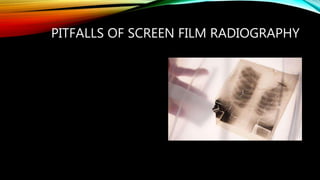
PITFALLS OF SCREEN FILM RADIOGRAPHY
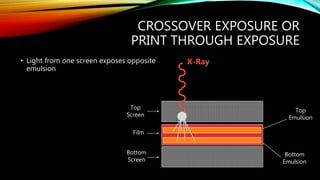
CROSSOVER EXPOSURE OR
PRINT THROUGH EXPOSURE
• Light from one screen exposes opposite
emulsion
Top
Screen
Bottom
Screen
Bottom
Emulsion
Top
Emulsion
Film
X-Ray
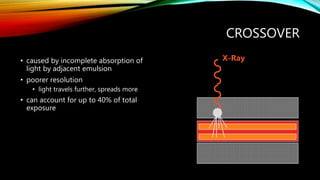
CROSSOVER
• caused by incomplete absorption of
light by adjacent emulsion
• poorer resolution
• light travels further, spreads more
• can account for up to 40% of total
exposure
X-Ray
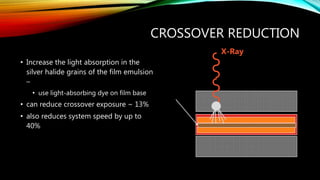
CROSSOVER REDUCTION
• Increase the light absorption in the
silver halide grains of the film emulsion
–
• use light-absorbing dye on film base
• can reduce crossover exposure ~ 13%
• also reduces system speed by up to
40%
X-Ray
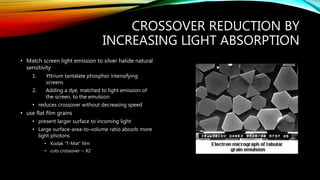
CROSSOVER REDUCTION BY
INCREASING LIGHT ABSORPTION
• Match screen light emission to silver halide natural
sensitivity
1. Yttrium tantalate phosphor intensifying
screens
2. Adding a dye, matched to light emission of
the screen, to the emulsion
• reduces crossover without decreasing speed
• use flat film grains
• present larger surface to incoming light
• Large surface-area-to-volume ratio absorb more
light photons
• Kodak “T-Mat” film
• cuts crossover ~ X2
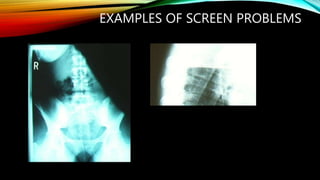
EXAMPLES OF SCREEN PROBLEMS
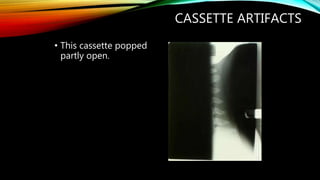
CASSETTE ARTIFACTS
• This cassette popped
partly open.
CASSETTE ARTIFACTS
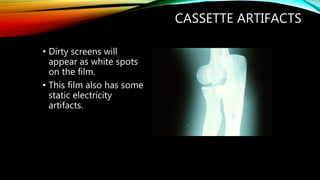
• Dirty screens will
appear as white spots
on the film.
• This film also has some
static electricity
artifacts.
CASSETTE ARTIFACT DIRTY SCREENS
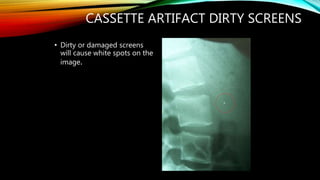
• Dirty or damaged screens
will cause white spots on the
image.
DIRTY OR DAMAGED SCREENS
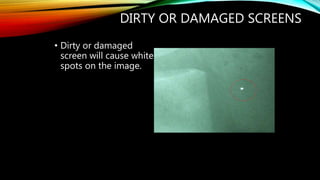
• Dirty or damaged
screen will cause white
spots on the image.
DIRTY & DAMAGED SCREENS
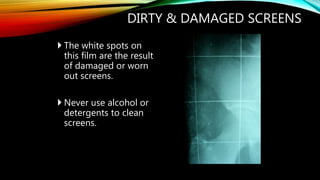
 The white spots on
this film are the result
of damaged or worn
out screens.
 Never use alcohol or
detergents to clean
screens.
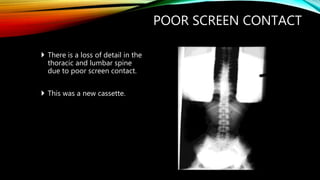
POOR SCREEN CONTACT
 There is a loss of detail in the
thoracic and lumbar spine
due to poor screen contact.
 This was a new cassette.
Dark Room Construction

Dark Room Construction

  • 1.
    DARK ROOM &PITFALLS OF IMAGING Dr.Tarique Ajij Junior Resident, Department of Radio- Diagnosis, Medical College, Kolkata
  • 2.
    DARK ROOM CONSTRUCTION •A Dark room is a room, from which normal light is excluded. • It is made completely dark to allow the processing of light sensitive photographic materials.
  • 3.
    LOCATION • Centrally located •Serviced by hatches from the adjacent imaging room • Away from damp or hot areas • Accessible in terms of power and water supply • Adjoining viewing room
  • 4.
    HATCHES • Hatches aredesigned to transfer film cassettes to and from the dark room without radiation light entering • It consist of metallic structures with a lead lining to provide x ray shielding. • They are typically wall mounted and include automatic interlocks that close one door when other is opened. • It is also used for the temporary storage of loaded cassettes.
  • 5.
    SIZE • Minimum floorarea of 10 sq meter • Ceiling height of 2.5 - 3 meter • Size may be reduced depending upon the department needs
  • 6.
    RADIATION PROTECTION • Wallsadjacent to the radiographic room should be shielded with correct thickness of the lead all the way to the ceiling • In the interests of both darkroom staff and film material alike • 1.6 mm lead is mostly used
  • 7.
    FLOORS • Non-porous flooring •Non-slip flooring • Chemical resistant • Stain proof • Durable & easy to maintain • Light coloured (low-light working conditions) • Asphalt tiles • Porcelain tiles • Clay tiles • Plastic tiles may be used in the dry dark-rooms
  • 8.
    WALLS/CEILING • Light incolour to reflect as much light as possible onto the working surface • Easy to wipe or clean • Covered with chemical resistant materials • Special paints, varnish, ceramic or plastic wall
  • 9.
    VENTILATION AND HEATING •Satisfactory working conditions for the staff • Good film handling and storage conditions • Efficient automatic processor performance • Relative humidity is maintained at around 40-60 % • Room temperature maintained between 18-20 degree celsius • A minimum of 10 air changes per hour • All of these conditions can be achieved by using a good air-conditioning system • Alternatively, fairly satisfactory ventilation can be achieved by using an extractor fan sited higher than and diagonally opposite a second fan, the latter being so placed as to obtain fresh and filtered air from outside.
  • 10.
    TYPE OF ENTRANCE •SINGLE DOOR SYSTEM • DOUBLE DOOR SYSTEM • MAZE TYPE ENTRANCE • LABYRINTH • ROTATING DOOR SYSTEM
  • 11.
    ROTATING DOOR SYSTEM •Most efficient but most expensive type. • Composed of two black cylinders. • The outer is fixed. • Inner is the revolving door with only one opening.
  • 12.
    FIRE SAFETY • Ideally,all darkrooms should be provided with an alternative exit, which should be indicated clearly and left unobstructed at all times
  • 13.
    DARK ROOM ILLUMINATION •WHITE LIGHTING • SAFELIGHTING
  • 14.
    WHITE LIGHTING • Forinspection & maintenance of cassettes & screens • Cleaning of work surfaces • Servicing of equipment • Sited close to the ceiling • Moderate in intensity • (60w tungsten, 30w fluorescent ) • Preferably centrally placed • More than one switch preferable • Identification of respective switches is important
  • 15.
    SAFE LIGHTING DIRECT SAFELIGHTING • Light from safe lamp directly falls onto the work surface • Eg. Beehive safelamp • Minimum distance of 1.2 m from the working surface • Best for loading & unloading areas
  • 16.
    SAFE LIGHTING INDIRECT SAFELIGHTING • Directs the light towards the ceiling which reflects light back into the room • Is intended to provide general illumination of the dark room • Suspended atleast 2.1 m above floor level
  • 17.
    SAFE LAMP FORBOTH DIRECT & INDIRECT ILLUMINATION
  • 18.
    SAFE LIGHT FILTERS •Sheet of gelatin dyed to the appropriate colour and sandwiched between two sheets of glass for protection • Used in conjunction with a 25 W lamp • Extremes of heat and temperature deteriorates the filter gelatin • Should be cleaned periodically
  • 19.
    HOW DOES ASAFELIGHT WORK? • When white light is passed through coloured filters, certain wavelengths (or colours) are absorbed by the filters, whilst those wavelengths, which correspond to the colour of the filters will be transmitted. • Making the correct selection of safelight filter (matching the filter to the film), means choosing a filter, which will transmit a colour to which the film is relatively unresponsive, whilst stopping all light to which the film is most sensitive.
  • 20.
    SPECTRUM TRANSMISSION GRAPH: • Manufacturersproduce graphs for their safelights called spectral transmission or filter transmission graphs. • Their purpose is to indicate that part of the visible spectrum, which will be transmitted by the filter, and so aid the radiographer in matching the appropriate filter to the type of film in use. • Panchromatic film presents special problems, since it will have colour sensitivity extending as far as the red end of the spectrum. • It is thus advisable to process such film in complete darkness.
  • 21.
  • 22.
    IN SHORT!! • AMBER–BLUE LIGHT SENSITIVE FILM(400-450nm) • RED—GREEN LIGHT SENSITIVE FILM ORTHOCHROMATIC(500- 550nm) • TOTAL DARKNESS FOR PANCHROMATIC FILM (1200nm)
  • 23.
    HOW SAFE ISSAFE LIGHTING? • No safe lighting is completely safe; all films will become significantly fogged if exposed to safelights for long enough. • This is because safelight filters are not perfect absorbers of the undesirable wavelengths and, in truth, all films have some sensitivity to all wavelengths. • Thus, the intensity of illumination and the film-handling time must be kept to a minimum if significant fogging is not to occur.
  • 24.
    EFFECT OF EXCESSIVESAFE LIGHT EXPOSURE Two principal features occur when film is exposed to safelights for too long: 1.An increase in gross fog; 2.An overall loss of contrast.
  • 25.
    DARK ROOM EQUIPMENTS •Automatic processor • Manual process unit • Processing chemicals • Hangers for suspending film • Cassette • Film storage hopper • Loading bench • Cupboards
  • 26.
  • 27.
  • 28.
    PROCESSING TANKS FOUR tanksin the processing procedure. • DEVELOPER • RINZING • FIXER • WASHING
  • 29.
    PROCESSING TANKS Universally usedtank sizes: • 1 gallon • 2 gallon • 3 gallon • 5 gallon • 10 gallon 1 GALLON=4.5 LITRES • Processing tanks are made up of stainless steel to avoid erosion. • The width of the tank may vary according to the capacity of the tank.
  • 30.
  • 31.
    HANGERS USED FORSUSPENDING FILMS DURING PROCESSING • A film hanger is a instrument or device for holding radiographic film during processing procedure. • Available in various sizes. • Made up of stainless steel. • Three types of hangers 1. CLIP TYPE 2. CHANNEL TYPE 3. SPRING TYPE
  • 32.
    CASSETTES • A radiographicfilm cassette is a rectangle or square plastic or metallic container used to hold x ray film (exposed or unexposed) and intensifying screens in close and uniform contact with one another.
  • 33.
    CASSETTE SIZE • DIFFERENTCASSETTE SIZES • 17 x 14 inches • 15 x 12 • 14 x 14 • 12 x 12 • 12 x 10 • 10 x 8 • 12 x 6 (OPG)
  • 34.
    USES OF CASSETTES 1.Hold intensifying screen and protect them from damage. 2. Exclude all light from entering the cassette and fogging the film. 3. Maintain a close and uniform contact between the screen and film. 4. Exclude dust and dirt from the sensitive films. 5. Act as a medium from exposure up to further processing of film.
  • 35.
    FILM HOPPER FORTHE STORAGE OF UNEXPOSED FILMS • Film racks are used to keep the film boxes. • It is very important that film boxes are always kept vertically. • Not horizontally. • When we keep horizontally pressure on the film boxes may produce artifacts.
  • 36.
    DARK ROOM DRYBENCH SYSTEM
  • 37.
    LAYOUT OF ATYPICAL DARK ROOM : AMPLE STORAGE & WORK SURFACES
  • 38.
    HEALTH AND SAFETYIN THE PROCESSING AREA • ELECTRICAL SAFETY • GENERAL SAFETY • CHEMICAL SAFETY
  • 39.
    ELECTRICAL SAFETTY • Allelectrical equipments to be sited well away from sinks & manual processing units • Adequate earthing of all electrical appliances • No trailing cables from appliances • Pull-cord switching for lights
  • 40.
    GENERAL SAFETY MEASURES •The maximum level of safe lighting consistent with film sensitivity • Adequate ventilation • Second exits for fire safety
  • 41.
    CHEMICAL HAZARDS • Processingchemicals contain many toxic substances and must always be handled with care. • Staff should always be aware of the harmful effects of exposure to the chemistry its fumes through inhalation, ingestion or skin contact. • All staff involved with the handling of film chemistry should be regularly advised to read product labels and mixing instructions before handling solutions. • Safety glasses, facemask, rubber gloves and plastic apron should be available within the processing area for each procedure.
  • 42.
    PITFALLS OF SCREENFILM RADIOGRAPHY
  • 43.
    CROSSOVER EXPOSURE OR PRINTTHROUGH EXPOSURE • Light from one screen exposes opposite emulsion Top Screen Bottom Screen Bottom Emulsion Top Emulsion Film X-Ray
  • 44.
    CROSSOVER • caused byincomplete absorption of light by adjacent emulsion • poorer resolution • light travels further, spreads more • can account for up to 40% of total exposure X-Ray
  • 45.
    CROSSOVER REDUCTION • Increasethe light absorption in the silver halide grains of the film emulsion – • use light-absorbing dye on film base • can reduce crossover exposure ~ 13% • also reduces system speed by up to 40% X-Ray
  • 46.
    CROSSOVER REDUCTION BY INCREASINGLIGHT ABSORPTION • Match screen light emission to silver halide natural sensitivity 1. Yttrium tantalate phosphor intensifying screens 2. Adding a dye, matched to light emission of the screen, to the emulsion • reduces crossover without decreasing speed • use flat film grains • present larger surface to incoming light • Large surface-area-to-volume ratio absorb more light photons • Kodak “T-Mat” film • cuts crossover ~ X2
  • 47.
  • 48.
    CASSETTE ARTIFACTS • Thiscassette popped partly open.
  • 49.
    CASSETTE ARTIFACTS • Dirtyscreens will appear as white spots on the film. • This film also has some static electricity artifacts.
  • 50.
    CASSETTE ARTIFACT DIRTYSCREENS • Dirty or damaged screens will cause white spots on the image.
  • 51.
    DIRTY OR DAMAGEDSCREENS • Dirty or damaged screen will cause white spots on the image.
  • 52.
    DIRTY & DAMAGEDSCREENS  The white spots on this film are the result of damaged or worn out screens.  Never use alcohol or detergents to clean screens.
  • 53.
    POOR SCREEN CONTACT There is a loss of detail in the thoracic and lumbar spine due to poor screen contact.  This was a new cassette.