TOO4TO MODULE
Climate Change and Sustainability
Part 2: Present approaches to climatic change mitigation and adaptation
2
PART 2 LEARNING OBJECTIVES
• To understand two approaches to dealing with climate change: adaptation and
mitigation.
• To explore how the climate change may influence businesses.
• To familiarize with the financial and policy instruments that set the course of
actions and provide necessary support.
3
TABLE OF CONTENTS
ADAPTATION & MITIGATION
• Definitions
• Strategies
• Measures
IMPACT OF CLIMATE CHANGE
ON BUSINESSES
• Risk
• Opportunities
4
FINANCIAL & POLICY INSTRUMENTS
• Paris Agreement
• European Green Deal
• EU Taxonomy
• EU Strategy on Adaptation to Climate
Change
• EU ETS
• COP27
CAN WE SUPPORT NATURE
TO HELP EVERYONE?
Let’s check
5
ADAPTATION & MITIGATION
Definitions; Strategies and Measures
6
ADAPTATION VS MITIGATION
Definitions
Adaptation - adjustment
to the current or anticipated
future environment. It
examines how to lessen
negative impacts of climate
change and seize any
possibilities that may come.
Mitigation - actions taken
to slow down the climate
change by reducing the
amount of heat trapping
greenhouse gases entering
the atmosphere.
7
8
ADAPTATION STRATEGIES
Communities' ability to adapt to climate change will rely on the extent to
which it affects the area in which it is located, as well as on its access to
resources both financial and technological.
Reduction of risks of:
• sea-level rise;
• more intense extreme
weather conditions;
• food scarcity.
Taking advantage of:
• longer growing seasons;
• increased yields in some
regions.
Source
ADAPTATION STRATEGIES – E.G. PREVENTING
FLOOD DAMAGE
• levees and seawalls can reduce flooding in coastal regions;
• wetlands can be constructed to protect coast;
• improved stormwater drainage can help to drain excess
precipitation during storms and prevent cities from flooding;
• changing the construction of houses by raising them on stilts
or floating houses may help protecting against flooding.
9
ADAPTATION STRATEGIES – E.G. ADAPTING TO
HEAT
• changing the construction of building with:
• more insulation;
• efficient cooling technologies;
• green roofs;
• planting more trees to get more shade.
10
11
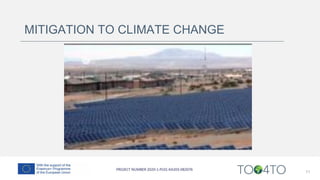
MITIGATION TO CLIMATE CHANGE
12
MITIGATION STRATEGIES (1/2)
Reduction of energy
consumption
• carbon taxes;
• increasing awareness of the concept of
community energy;
• changing lifestyle – reducing the impact on
climate change by daily choices of
transport, consumers goods and services;
• efficiency standards for household
appliances;
• fuel efficiency standards for cars and trucks.
Reduction of emission of NOx
and CH4 from agriculture
• limit the use of chemical fertilizer;
• limit the intensive livestock farming.
Mitigation aims to cut down the green house gases emission
(GHGs).
13
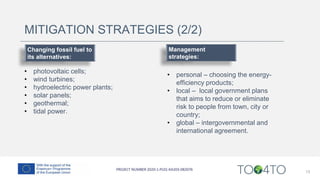
MITIGATION STRATEGIES (2/2)
Changing fossil fuel to
its alternatives:
• photovoltaic cells;
• wind turbines;
• hydroelectric power plants;
• solar panels;
• geothermal;
• tidal power.
Management
strategies:
• personal – choosing the energy-
efficiency products;
• local – local government plans
that aims to reduce or eliminate
risk to people from town, city or
country;
• global – intergovernmental and
international agreement.
14
MITIGATION STRATEGIES FOR CO2 REMOVAL (1/2)
• Strengthen the natural reservoir that collect and hold CO2 such
as: oceans, forests and soil;
• Remove CO2 from the atmosphere by the carbon capture
storage (CCS);
• Use biomass as a fuel;
• Enhance mineralization of oceans to increase CO2 absorption.
Source
15
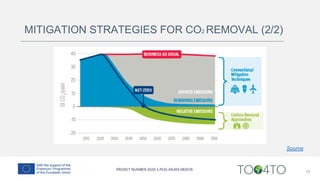
MITIGATION STRATEGIES FOR CO2 REMOVAL (2/2)
Source
MITIGATION MEASURES
„Mitigation measures provide for a system to reduce, avoid or offset the potential
adverse environmental consequences of development activities. Their objective is to
maximise project benefits and minimise undesirable impacts. Such mitigation
measures can be in the form of preventative, corrective or compensatory measures.
Prevention means that the potential impact is prevented or reduced before it occurs.
Corrective measures reduce the impact to a level which is acceptable. If preventative or
corrective measures fail, then compensatory measures are applied. They will compensate
for the unavoidable impact.”
Definition presented by European Commission
Source
16
17
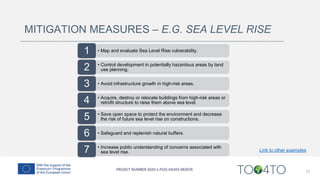
MITIGATION MEASURES – E.G. SEA LEVEL RISE
• Map and evaluate Sea Level Rise vulnerability.
1
• Control development in potentially hazardous areas by land
use planning.
2
• Avoid infrastructure growth in high-risk areas.
3
• Acquire, destroy or relocate buildings from high-risk areas or
retrofit structure to raise them above sea level.
4
• Save open space to protect the environment and decrease
the risk of future sea level rise on constructions.
5
• Safeguard and replenish natural buffers.
6
• Increase public understanding of concerns associated with
sea level rise.
7 Link to other examples
IMPACT OF CLIMATE CHANGE ON
BUSINESSES
Risks & Opportunities
18
19
RISKS RELATED WITH CLIMATE CHANGE ON
BUSINESS
• Physical: operational effects of harsh weather conditions;
supply problems brought by water scarcity;
• Transition: changes in markets, technologies, and
regulations can raise operating costs and threaten the
profitability of already available goods and services;
• GHGs emission reduction targets: in recent years, an
increasing number of legal actions have been taken directly
against fossil fuel businesses and utilities.
20
OPPORTUNITIES RELATED WITH CLIMATE CHANGE
ON BUSINESS
• Increasing energy efficiency: reduce the cost and improve
the resource productivity;
• Driving force for innovation: it forces a need for less
carbon intensive products and services;
• More resilient supply chain: lowering reliance on fossil
fuels and switching to renewable energy sources, which are
more stable in terms of price.
All of them increase competitiveness and help to explore new
market opportunities.
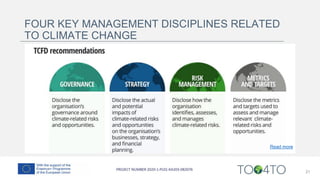
FOUR KEY MANAGEMENT DISCIPLINES RELATED
TO CLIMATE CHANGE
21
Read more
FINANCIAL & POLICY INSTRUMENTS
Paris Agreement; European Green Deal; EU Taxonomy; EU Strategy on
Adaptation to Climate Change; EU ETS; COP27
22
23
PARIS AGREEMENT
While for the first time encouraging voluntary contributions from other
Parties, the Paris Agreement emphasizes developed countries' duties
to assist developing country Parties in constructing clean, climate-
resilient futures. Developed country Parties agree to report on financing
already provided and to provide indicative information on future support,
including estimated amounts of public financing, every two years.
The Green Climate Fund is a fund established under the UNFCCC as an
operating unit of the Financial Mechanism.
Read more
24
PARIS AGREEMENT – GREEN CLIMATE FUND (GFC)
GCF is required to provide 50% of its resources in
grant equivalents to adaptation and 50%
to mitigation. The most climate-vulnerable nations
must get at least half of the money allocated for
adaptation (Least Developed Countries (LDCs),
Small Island Developing States (SIDS), and African
States). In order to reduce potential trade-offs
between adaptation and mitigation, GCF tries to
maximize synergies.
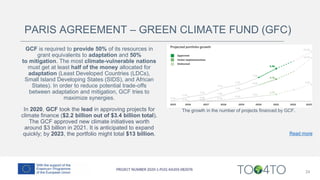
In 2020, GCF took the lead in approving projects for
climate finance ($2.2 billion out of $3.4 billion total).
The GCF approved new climate initiatives worth
around $3 billion in 2021. It is anticipated to expand
quickly; by 2023, the portfolio might total $13 billion.
The growth in the number of projects financed by GCF.
Read more
25
EUROPEAN GREEN DEAL
• The European Green Deal is a package of legislative proposals put out by the
European Commission with the main goal of achieving climate neutrality in Europe
by the year 2050.
• In addition to strengthening adaptation efforts, establishing a process to lay out and
review a trajectory until 2050, regular assessment, and a process in case of
insufficient progress or inconsistencies, the proposal seeks to complement the current
policy framework by establishing the long-term direction of travel and ensuring the
2050 climate-neutrality objective in EU law.
• Consequential adjustments to Regulation (EU) 2018/1999 on the Governance of the
Energy Union and Climate Action have been added to ensure compliance.
Read more
26
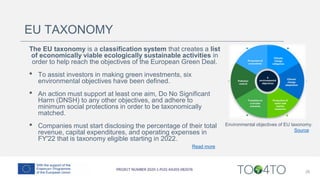
EU TAXONOMY
The EU taxonomy is a classification system that creates a list
of economically viable ecologically sustainable activities in
order to help reach the objectives of the European Green Deal.
• To assist investors in making green investments, six
environmental objectives have been defined.
• An action must support at least one aim, Do No Significant
Harm (DNSH) to any other objectives, and adhere to
minimum social protections in order to be taxonomically
matched.
• Companies must start disclosing the percentage of their total
revenue, capital expenditures, and operating expenses in
FY'22 that is taxonomy eligible starting in 2022.
Read more
Environmental objectives of EU taxonomy.
Source
27
EU STRATEGY ON ADAPTATION TO CLIMATE
CHANGE
The new policy outlines how the European Union can adjust to the
inevitable effects of climate change and become climate resilient by
2050.
The main goals of the Strategy are:
• to increase worldwide action on climate change adaptation;
• to make adaptation more:
o intelligent;
o quick;
o systemic.
Read more
28
EU EMMISSION TRADING SYSTEM (EU ETS) (1/2)
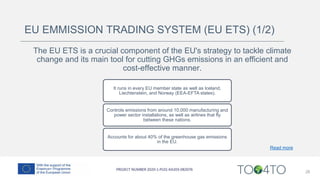
The EU ETS is a crucial component of the EU's strategy to tackle climate
change and its main tool for cutting GHGs emissions in an efficient and
cost-effective manner.
Accounts for about 40% of the greenhouse gas emissions
in the EU.
Controls emissions from around 10,000 manufacturing and
power sector installations, as well as airlines that fly
between these nations.
It runs in every EU member state as well as Iceland,
Liechtenstein, and Norway (EEA-EFTA states).
Read more
29
EU EMMISSION TRADING SYSTEM (EU ETS)(2/2)
The EU ETS include the following industries and gases, concentrating on
emissions that can be accurately measured, reported, and confirmed:
▪ CO2 from:
▪ electricity and heat generation;
▪ energy-intensive industry sectors;
▪ commercial flight in the European economic area;
▪ nitrous oxide (N2O) from production of nitric, adipic and glyoxylic acids
and glyoxal;
▪ perfluorocarbons (PFCs) from production of aluminum.
Companies operating in these areas are required to participate in the
EU ETS.
Read more
30
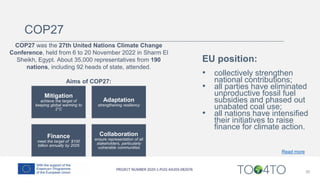
COP27
COP27 was the 27th United Nations Climate Change
Conference, held from 6 to 20 November 2022 in Sharm El
Sheikh, Egypt. About 35,000 representatives from 190
nations, including 92 heads of state, attended.
Aims of COP27:
Mitigation
achieve the target of
keeping global warming to
2°C
Adaptation
strengthening resiliency
Finance
meet the target of $100
billion annually by 2025
Collaboration
ensure representation of all
stakeholders, particularly
vulnerable communities
EU position:
• collectively strengthen
national contributions;
• all parties have eliminated
unproductive fossil fuel
subsidies and phased out
unabated coal use;
• all nations have intensified
their initiatives to raise
finance for climate action.
Read more
31
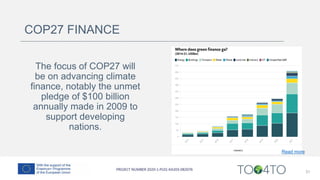
COP27 FINANCE
The focus of COP27 will
be on advancing climate
finance, notably the unmet
pledge of $100 billion
annually made in 2009 to
support developing
nations.
Read more
THUS, CAN WE SUPPORT
NATURE TO HELP
EVERYONE?
YES! ☺
32
Additional reading
Short video - climate change mitigation vs adaptation
https://www.youtube.com/watch?v=g5_upZdHGFQ (3:35 min)
Inter-relationships between adaptation and mitigation
https://www.ipcc.ch/site/assets/uploads/2018/02/ar4-wg2-chapter18-1.pdf
The European Green Deal Investment Plan and Just Transition Mechanism
explained, https://ec.europa.eu/commission/presscorner/detail/en/qanda_20_24
How climate change will impact business everywhere
https://www.zurich.com/en/knowledge/topics/climate-change/how-climate-change-
will-impact-business-everywhere
33
Self-study question
• Which mitigation or adaptation fits better to the concept of
sustainable development? Justify your answer.
34

TOO4TO Module 3 / Climate Change and Sustainability: Part 2

  • 2.
    TOO4TO MODULE Climate Changeand Sustainability Part 2: Present approaches to climatic change mitigation and adaptation 2
  • 3.
    PART 2 LEARNINGOBJECTIVES • To understand two approaches to dealing with climate change: adaptation and mitigation. • To explore how the climate change may influence businesses. • To familiarize with the financial and policy instruments that set the course of actions and provide necessary support. 3
  • 4.
    TABLE OF CONTENTS ADAPTATION& MITIGATION • Definitions • Strategies • Measures IMPACT OF CLIMATE CHANGE ON BUSINESSES • Risk • Opportunities 4 FINANCIAL & POLICY INSTRUMENTS • Paris Agreement • European Green Deal • EU Taxonomy • EU Strategy on Adaptation to Climate Change • EU ETS • COP27
  • 5.
    CAN WE SUPPORTNATURE TO HELP EVERYONE? Let’s check 5
  • 6.
    ADAPTATION & MITIGATION Definitions;Strategies and Measures 6
  • 7.
    ADAPTATION VS MITIGATION Definitions Adaptation- adjustment to the current or anticipated future environment. It examines how to lessen negative impacts of climate change and seize any possibilities that may come. Mitigation - actions taken to slow down the climate change by reducing the amount of heat trapping greenhouse gases entering the atmosphere. 7
  • 8.
    8 ADAPTATION STRATEGIES Communities' abilityto adapt to climate change will rely on the extent to which it affects the area in which it is located, as well as on its access to resources both financial and technological. Reduction of risks of: • sea-level rise; • more intense extreme weather conditions; • food scarcity. Taking advantage of: • longer growing seasons; • increased yields in some regions. Source
  • 9.
    ADAPTATION STRATEGIES –E.G. PREVENTING FLOOD DAMAGE • levees and seawalls can reduce flooding in coastal regions; • wetlands can be constructed to protect coast; • improved stormwater drainage can help to drain excess precipitation during storms and prevent cities from flooding; • changing the construction of houses by raising them on stilts or floating houses may help protecting against flooding. 9
  • 10.
    ADAPTATION STRATEGIES –E.G. ADAPTING TO HEAT • changing the construction of building with: • more insulation; • efficient cooling technologies; • green roofs; • planting more trees to get more shade. 10
  • 11.
  • 12.
    12 MITIGATION STRATEGIES (1/2) Reductionof energy consumption • carbon taxes; • increasing awareness of the concept of community energy; • changing lifestyle – reducing the impact on climate change by daily choices of transport, consumers goods and services; • efficiency standards for household appliances; • fuel efficiency standards for cars and trucks. Reduction of emission of NOx and CH4 from agriculture • limit the use of chemical fertilizer; • limit the intensive livestock farming. Mitigation aims to cut down the green house gases emission (GHGs).
  • 13.
    13 MITIGATION STRATEGIES (2/2) Changingfossil fuel to its alternatives: • photovoltaic cells; • wind turbines; • hydroelectric power plants; • solar panels; • geothermal; • tidal power. Management strategies: • personal – choosing the energy- efficiency products; • local – local government plans that aims to reduce or eliminate risk to people from town, city or country; • global – intergovernmental and international agreement.
  • 14.
    14 MITIGATION STRATEGIES FORCO2 REMOVAL (1/2) • Strengthen the natural reservoir that collect and hold CO2 such as: oceans, forests and soil; • Remove CO2 from the atmosphere by the carbon capture storage (CCS); • Use biomass as a fuel; • Enhance mineralization of oceans to increase CO2 absorption. Source
  • 15.
    15 MITIGATION STRATEGIES FORCO2 REMOVAL (2/2) Source
  • 16.
    MITIGATION MEASURES „Mitigation measuresprovide for a system to reduce, avoid or offset the potential adverse environmental consequences of development activities. Their objective is to maximise project benefits and minimise undesirable impacts. Such mitigation measures can be in the form of preventative, corrective or compensatory measures. Prevention means that the potential impact is prevented or reduced before it occurs. Corrective measures reduce the impact to a level which is acceptable. If preventative or corrective measures fail, then compensatory measures are applied. They will compensate for the unavoidable impact.” Definition presented by European Commission Source 16
  • 17.
    17 MITIGATION MEASURES –E.G. SEA LEVEL RISE • Map and evaluate Sea Level Rise vulnerability. 1 • Control development in potentially hazardous areas by land use planning. 2 • Avoid infrastructure growth in high-risk areas. 3 • Acquire, destroy or relocate buildings from high-risk areas or retrofit structure to raise them above sea level. 4 • Save open space to protect the environment and decrease the risk of future sea level rise on constructions. 5 • Safeguard and replenish natural buffers. 6 • Increase public understanding of concerns associated with sea level rise. 7 Link to other examples
  • 18.
    IMPACT OF CLIMATECHANGE ON BUSINESSES Risks & Opportunities 18
  • 19.
    19 RISKS RELATED WITHCLIMATE CHANGE ON BUSINESS • Physical: operational effects of harsh weather conditions; supply problems brought by water scarcity; • Transition: changes in markets, technologies, and regulations can raise operating costs and threaten the profitability of already available goods and services; • GHGs emission reduction targets: in recent years, an increasing number of legal actions have been taken directly against fossil fuel businesses and utilities.
  • 20.
    20 OPPORTUNITIES RELATED WITHCLIMATE CHANGE ON BUSINESS • Increasing energy efficiency: reduce the cost and improve the resource productivity; • Driving force for innovation: it forces a need for less carbon intensive products and services; • More resilient supply chain: lowering reliance on fossil fuels and switching to renewable energy sources, which are more stable in terms of price. All of them increase competitiveness and help to explore new market opportunities.
  • 21.
    FOUR KEY MANAGEMENTDISCIPLINES RELATED TO CLIMATE CHANGE 21 Read more
  • 22.
    FINANCIAL & POLICYINSTRUMENTS Paris Agreement; European Green Deal; EU Taxonomy; EU Strategy on Adaptation to Climate Change; EU ETS; COP27 22
  • 23.
    23 PARIS AGREEMENT While forthe first time encouraging voluntary contributions from other Parties, the Paris Agreement emphasizes developed countries' duties to assist developing country Parties in constructing clean, climate- resilient futures. Developed country Parties agree to report on financing already provided and to provide indicative information on future support, including estimated amounts of public financing, every two years. The Green Climate Fund is a fund established under the UNFCCC as an operating unit of the Financial Mechanism. Read more
  • 24.
    24 PARIS AGREEMENT –GREEN CLIMATE FUND (GFC) GCF is required to provide 50% of its resources in grant equivalents to adaptation and 50% to mitigation. The most climate-vulnerable nations must get at least half of the money allocated for adaptation (Least Developed Countries (LDCs), Small Island Developing States (SIDS), and African States). In order to reduce potential trade-offs between adaptation and mitigation, GCF tries to maximize synergies. In 2020, GCF took the lead in approving projects for climate finance ($2.2 billion out of $3.4 billion total). The GCF approved new climate initiatives worth around $3 billion in 2021. It is anticipated to expand quickly; by 2023, the portfolio might total $13 billion. The growth in the number of projects financed by GCF. Read more
  • 25.
    25 EUROPEAN GREEN DEAL •The European Green Deal is a package of legislative proposals put out by the European Commission with the main goal of achieving climate neutrality in Europe by the year 2050. • In addition to strengthening adaptation efforts, establishing a process to lay out and review a trajectory until 2050, regular assessment, and a process in case of insufficient progress or inconsistencies, the proposal seeks to complement the current policy framework by establishing the long-term direction of travel and ensuring the 2050 climate-neutrality objective in EU law. • Consequential adjustments to Regulation (EU) 2018/1999 on the Governance of the Energy Union and Climate Action have been added to ensure compliance. Read more
  • 26.
    26 EU TAXONOMY The EUtaxonomy is a classification system that creates a list of economically viable ecologically sustainable activities in order to help reach the objectives of the European Green Deal. • To assist investors in making green investments, six environmental objectives have been defined. • An action must support at least one aim, Do No Significant Harm (DNSH) to any other objectives, and adhere to minimum social protections in order to be taxonomically matched. • Companies must start disclosing the percentage of their total revenue, capital expenditures, and operating expenses in FY'22 that is taxonomy eligible starting in 2022. Read more Environmental objectives of EU taxonomy. Source
  • 27.
    27 EU STRATEGY ONADAPTATION TO CLIMATE CHANGE The new policy outlines how the European Union can adjust to the inevitable effects of climate change and become climate resilient by 2050. The main goals of the Strategy are: • to increase worldwide action on climate change adaptation; • to make adaptation more: o intelligent; o quick; o systemic. Read more
  • 28.
    28 EU EMMISSION TRADINGSYSTEM (EU ETS) (1/2) The EU ETS is a crucial component of the EU's strategy to tackle climate change and its main tool for cutting GHGs emissions in an efficient and cost-effective manner. Accounts for about 40% of the greenhouse gas emissions in the EU. Controls emissions from around 10,000 manufacturing and power sector installations, as well as airlines that fly between these nations. It runs in every EU member state as well as Iceland, Liechtenstein, and Norway (EEA-EFTA states). Read more
  • 29.
    29 EU EMMISSION TRADINGSYSTEM (EU ETS)(2/2) The EU ETS include the following industries and gases, concentrating on emissions that can be accurately measured, reported, and confirmed: ▪ CO2 from: ▪ electricity and heat generation; ▪ energy-intensive industry sectors; ▪ commercial flight in the European economic area; ▪ nitrous oxide (N2O) from production of nitric, adipic and glyoxylic acids and glyoxal; ▪ perfluorocarbons (PFCs) from production of aluminum. Companies operating in these areas are required to participate in the EU ETS. Read more
  • 30.
    30 COP27 COP27 was the27th United Nations Climate Change Conference, held from 6 to 20 November 2022 in Sharm El Sheikh, Egypt. About 35,000 representatives from 190 nations, including 92 heads of state, attended. Aims of COP27: Mitigation achieve the target of keeping global warming to 2°C Adaptation strengthening resiliency Finance meet the target of $100 billion annually by 2025 Collaboration ensure representation of all stakeholders, particularly vulnerable communities EU position: • collectively strengthen national contributions; • all parties have eliminated unproductive fossil fuel subsidies and phased out unabated coal use; • all nations have intensified their initiatives to raise finance for climate action. Read more
  • 31.
    31 COP27 FINANCE The focusof COP27 will be on advancing climate finance, notably the unmet pledge of $100 billion annually made in 2009 to support developing nations. Read more
  • 32.
    THUS, CAN WESUPPORT NATURE TO HELP EVERYONE? YES! ☺ 32
  • 33.
    Additional reading Short video- climate change mitigation vs adaptation https://www.youtube.com/watch?v=g5_upZdHGFQ (3:35 min) Inter-relationships between adaptation and mitigation https://www.ipcc.ch/site/assets/uploads/2018/02/ar4-wg2-chapter18-1.pdf The European Green Deal Investment Plan and Just Transition Mechanism explained, https://ec.europa.eu/commission/presscorner/detail/en/qanda_20_24 How climate change will impact business everywhere https://www.zurich.com/en/knowledge/topics/climate-change/how-climate-change- will-impact-business-everywhere 33
  • 34.
    Self-study question • Whichmitigation or adaptation fits better to the concept of sustainable development? Justify your answer. 34