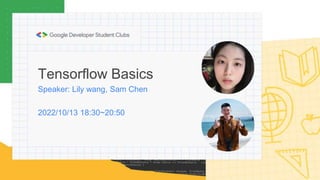
Tensorflow Basics
Speaker: Lily wang, Sam Chen
2022/10/13 18:30~20:50
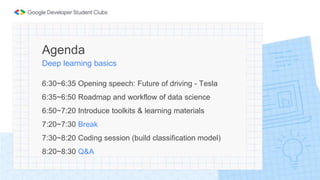
6:30~6:35 Opening speech: Future of driving - Tesla
6:35~6:50 Roadmap and workflow of data science
6:50~7:20 Introduce toolkits & learning materials
7:20~7:30 Break
7:30~8:20 Coding session (build classification model)
8:20~8:30 Q&A
Agenda
Deep learning basics
Opening Speech:
Tesla AI Day
2022
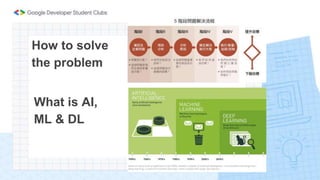
How to solve
the problem
What is AI,
ML & DL
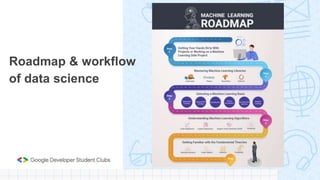
Roadmap & workflow
of data science
Introduce
toolkits & learning materials
Tensorflow: the
best tools to
learn DL
Machine learning education | TensorFlow
Tutorials | TensorFlow Core
How can I self-directed learning
coding?
How can I self-directed learning
coding?
TensorFlow 2.0 Complete
Course - Python Neural
Networks for Beginners
Tutorial
TensorFlow 2.9
documentation — DevDocs
GitHub - tensorflow/docs:
TensorFlow documentation
Coding session
(build classification model)
Now it’s time to start this adventure.
Have you ever code?
If so, what’s project are you working on
If not, what kind of topic you are interested?
Algorithm: Problem-solving
Problem: Find team members for Google solution challenge
Inputs: Previous programing experiences, skills, interests
Outputs: Choice for different roles
Input Algorithm Output
Machine learning
Recommended workflow
● Data acquisition, annotation(supervised learning)
● Problem cases: regression(output:1), classification(output:>1)
● Data preprocessing (augmentation, adjustment)
● Feature extraction (find possible key component behind)
● Build model (parameters, train-test split)
● Result evaluation (confusion matrix, accuracy)
● Make prediction (compare with ground truth)
Neurons vs Neural network(NN)
Input
output
Problem cases
Regression: weather forecast,
probability of precipitation (%)
Classification: decisions (yes
or no), species (cat, dog, cow)
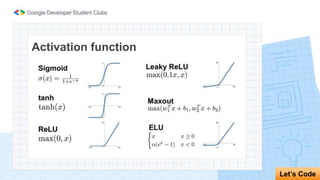
Activation function
Let’s Code
Epochs vs batch size
Issue: Memory cannot afford large input data
Iterations = (Data size/ batch size) * Epochs
● Iterations: Loop number implemented by programers
● Batch size: Divide data into several sections
● Epochs: How many times do the algorithm read through the
whole dataset
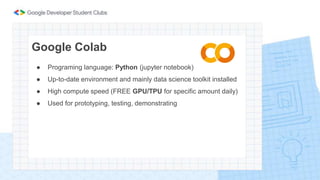
Google Colab
● Programing language: Python (jupyter notebook)
● Up-to-date environment and mainly data science toolkit installed
● High compute speed (FREE GPU/TPU for specific amount daily)
● Used for prototyping, testing, demonstrating
Confusion matrix
Data analysis
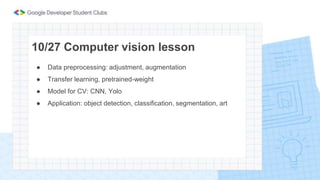
10/27 Computer vision lesson
● Data preprocessing: adjustment, augmentation
● Transfer learning, pretrained-weight
● Model for CV: CNN, Yolo
● Application: object detection, classification, segmentation, art
If you have any further questions please contact
your regional point of contact.
Thanks for listening
Now it’s time to start this adventure.

TensorfLow_Basic.pptx

  • 1.
    Tensorflow Basics Speaker: Lilywang, Sam Chen 2022/10/13 18:30~20:50
  • 2.
    6:30~6:35 Opening speech:Future of driving - Tesla 6:35~6:50 Roadmap and workflow of data science 6:50~7:20 Introduce toolkits & learning materials 7:20~7:30 Break 7:30~8:20 Coding session (build classification model) 8:20~8:30 Q&A Agenda Deep learning basics
  • 3.
  • 4.
    How to solve theproblem What is AI, ML & DL
  • 5.
  • 6.
  • 7.
    Tensorflow: the best toolsto learn DL Machine learning education | TensorFlow Tutorials | TensorFlow Core
  • 8.
    How can Iself-directed learning coding?
  • 9.
    How can Iself-directed learning coding? TensorFlow 2.0 Complete Course - Python Neural Networks for Beginners Tutorial TensorFlow 2.9 documentation — DevDocs GitHub - tensorflow/docs: TensorFlow documentation
  • 10.
    Coding session (build classificationmodel) Now it’s time to start this adventure. Have you ever code? If so, what’s project are you working on If not, what kind of topic you are interested?
  • 11.
    Algorithm: Problem-solving Problem: Findteam members for Google solution challenge Inputs: Previous programing experiences, skills, interests Outputs: Choice for different roles Input Algorithm Output
  • 12.
  • 13.
    Recommended workflow ● Dataacquisition, annotation(supervised learning) ● Problem cases: regression(output:1), classification(output:>1) ● Data preprocessing (augmentation, adjustment) ● Feature extraction (find possible key component behind) ● Build model (parameters, train-test split) ● Result evaluation (confusion matrix, accuracy) ● Make prediction (compare with ground truth)
  • 14.
    Neurons vs Neuralnetwork(NN) Input output
  • 15.
    Problem cases Regression: weatherforecast, probability of precipitation (%) Classification: decisions (yes or no), species (cat, dog, cow)
  • 16.
  • 17.
    Epochs vs batchsize Issue: Memory cannot afford large input data Iterations = (Data size/ batch size) * Epochs ● Iterations: Loop number implemented by programers ● Batch size: Divide data into several sections ● Epochs: How many times do the algorithm read through the whole dataset
  • 18.
    Google Colab ● Programinglanguage: Python (jupyter notebook) ● Up-to-date environment and mainly data science toolkit installed ● High compute speed (FREE GPU/TPU for specific amount daily) ● Used for prototyping, testing, demonstrating
  • 19.
  • 20.
  • 21.
    10/27 Computer visionlesson ● Data preprocessing: adjustment, augmentation ● Transfer learning, pretrained-weight ● Model for CV: CNN, Yolo ● Application: object detection, classification, segmentation, art
  • 22.
    If you haveany further questions please contact your regional point of contact. Thanks for listening Now it’s time to start this adventure.

Editor's Notes

  • #4 Tesla AI Day 2022 Main features: Tesla bot, FSD(Full Self-driving) https://www.youtube.com/watch?v=ODSJsviD_SU&t=6307s
  • #6 Tesla AI Day 2022 Main features: Tesla bot, FSD(Full Self-driving) https://www.youtube.com/watch?v=ODSJsviD_SU&t=6307s
  • #7 Tesla AI Day 2022 Main features: Tesla bot, FSD(Full Self-driving) https://www.youtube.com/watch?v=ODSJsviD_SU&t=6307s
  • #11 Tesla AI Day 2022 Main features: Tesla bot, FSD(Full Self-driving) https://www.youtube.com/watch?v=ODSJsviD_SU&t=6307s