COUPLING REACTIONS
SHAFNA JOSE
ASSISTANT PROFESSOR
DEPARTMENT OF CHEMISTRY
ST. MARY’S COLLEGE
THRISSUR – 680020
KERALA
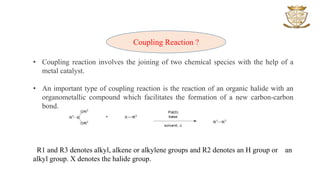
• Coupling reaction involves the joining of two chemical species with the help of a
metal catalyst.
• An important type of coupling reaction is the reaction of an organic halide with an
organometallic compound which facilitates the formation of a new carbon-carbon
bond.
R1 and R3 denotes alkyl, alkene or alkylene groups and R2 denotes an H group or an
alkyl group. X denotes the halide group.
Coupling Reaction ?
hgajkgjghghghafgfahghghghagkhjg
yt65
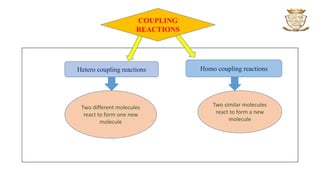
Hetero coupling reactions Homo coupling reactions
Two different molecules
react to form one new
molecule
Two similar molecules
react to form a new
molecule
COUPLING
REACTIONS
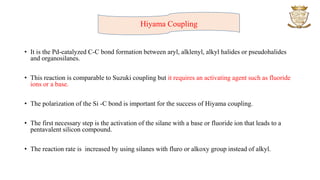
• It is the Pd-catalyzed C-C bond formation between aryl, alklenyl, alkyl halides or pseudohalides
and organosilanes.
• This reaction is comparable to Suzuki coupling but it requires an activating agent such as fluoride
ions or a base.
• The polarization of the Si -C bond is important for the success of Hiyama coupling.
• The first necessary step is the activation of the silane with a base or fluoride ion that leads to a
pentavalent silicon compound.
• The reaction rate is increased by using silanes with fluro or alkoxy group instead of alkyl.
Hiyama Coupling
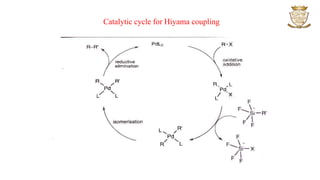
Catalytic cycle for Hiyama coupling
• The reaction proceeds through
oxidative addition,
transmetallation,
cis-trans isomerization and
reductive elimination.
• The purpose of the fluoride ion is to activate the conversion of silicon compound RSiR3 to
a pentacoordinate [RSiR3F]- intermediate which is more amiable to transmetallation.
• Reactions in which the fluoride ion is replaced by a strong base have also been reported.
Advantages
Hiyama coupling possesses advantages such as
• low environmental impact,
• high atom efficiency,
• safe handling compared with the coupling reactions of organoboron, organozinc or
organotin compounds.
Disadvantages
• Use of highly nucleophilic fluoride or hydroxide as an activator makes the transformation
less chemoselective, especially for substrates with a base sensitive functionality.
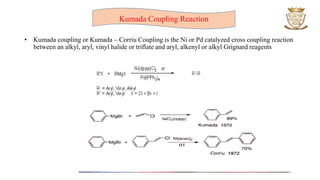
• Kumada coupling or Kumada – Corriu Coupling is the Ni or Pd catalyzed cross coupling reaction
between an alkyl, aryl, vinyl halide or triflate and aryl, alkenyl or alkyl Grignard reagents
Kumada Coupling Reaction
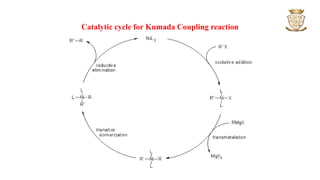
Catalytic cycle for Kumada Coupling reaction
• The reactivity of the halides follows the order I> Br> Cl when Pd is used as the catalyst,
whereas with certain Ni catalysts, the order is Cl> I> Br.
• The reaction is important since it gives access to styrene compounds.
• (Z) –Alkenyl – Grignard reagents couple non- stereospecifically with Ni catalysts, but the
reaction is stereospecific with Pd catalysts.
• Ni is also used to catalyse the reaction of alkyl and aryl Grignard reagents with an aryl
and alkenyl halides
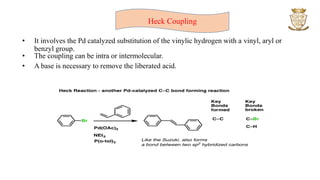
• It involves the Pd catalyzed substitution of the vinylic hydrogen with a vinyl, aryl or
benzyl group.
Heck Coupling
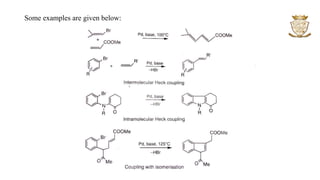
• The coupling can be intra or intermolecular.
• A base is necessary to remove the liberated acid.
Some examples are given below:
• The reaction time and temperature depend on the nature of the organic halide to be activated.
• Heck reactions are useful on the inter and intra molecular level, although intermolecular
reactions are more common.
• Organic halides containing beta hydrogens cannot be used as they tend to form olefins at the
Pd centre.
• Electron rich, disubstituted or cyclic olefins are less reactive than electron deficient,
monosubstituted olefins.
• Many functional groups are compatible with Heck conditions which enables the
synthesis of carbo- and heterocyclic compounds and c-c bonded isomerized products
including natural products.
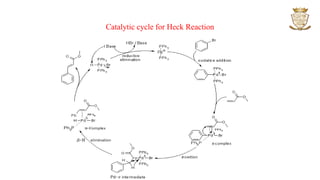
• The active form of the catalyst is a 14e Pd(0) complex with two PPh3 ligands.
• 1,2 migratory insertion step is known as carbometallation in palladium based catalytic
cycles.
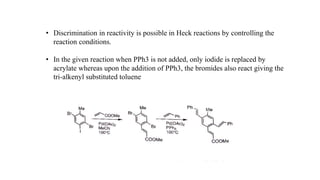
• Discrimination in reactivity is possible in Heck reactions by controlling the
reaction conditions.
• In the given reaction when PPh3 is not added, only iodide is replaced by
acrylate whereas upon the addition of PPh3, the bromides also react giving the
tri-alkenyl substituted toluene
Catalytic cycle for Heck Reaction
Coupling Reactions

Coupling Reactions

  • 1.
    COUPLING REACTIONS SHAFNA JOSE ASSISTANTPROFESSOR DEPARTMENT OF CHEMISTRY ST. MARY’S COLLEGE THRISSUR – 680020 KERALA
  • 2.
    • Coupling reactioninvolves the joining of two chemical species with the help of a metal catalyst. • An important type of coupling reaction is the reaction of an organic halide with an organometallic compound which facilitates the formation of a new carbon-carbon bond. R1 and R3 denotes alkyl, alkene or alkylene groups and R2 denotes an H group or an alkyl group. X denotes the halide group. Coupling Reaction ?
  • 3.
    hgajkgjghghghafgfahghghghagkhjg yt65 Hetero coupling reactionsHomo coupling reactions Two different molecules react to form one new molecule Two similar molecules react to form a new molecule COUPLING REACTIONS
  • 4.
    • It isthe Pd-catalyzed C-C bond formation between aryl, alklenyl, alkyl halides or pseudohalides and organosilanes. • This reaction is comparable to Suzuki coupling but it requires an activating agent such as fluoride ions or a base. • The polarization of the Si -C bond is important for the success of Hiyama coupling. • The first necessary step is the activation of the silane with a base or fluoride ion that leads to a pentavalent silicon compound. • The reaction rate is increased by using silanes with fluro or alkoxy group instead of alkyl. Hiyama Coupling
  • 5.
    Catalytic cycle forHiyama coupling
  • 6.
    • The reactionproceeds through oxidative addition, transmetallation, cis-trans isomerization and reductive elimination. • The purpose of the fluoride ion is to activate the conversion of silicon compound RSiR3 to a pentacoordinate [RSiR3F]- intermediate which is more amiable to transmetallation. • Reactions in which the fluoride ion is replaced by a strong base have also been reported.
  • 7.
    Advantages Hiyama coupling possessesadvantages such as • low environmental impact, • high atom efficiency, • safe handling compared with the coupling reactions of organoboron, organozinc or organotin compounds. Disadvantages • Use of highly nucleophilic fluoride or hydroxide as an activator makes the transformation less chemoselective, especially for substrates with a base sensitive functionality.
  • 8.
    • Kumada couplingor Kumada – Corriu Coupling is the Ni or Pd catalyzed cross coupling reaction between an alkyl, aryl, vinyl halide or triflate and aryl, alkenyl or alkyl Grignard reagents Kumada Coupling Reaction
  • 9.
    Catalytic cycle forKumada Coupling reaction
  • 10.
    • The reactivityof the halides follows the order I> Br> Cl when Pd is used as the catalyst, whereas with certain Ni catalysts, the order is Cl> I> Br. • The reaction is important since it gives access to styrene compounds. • (Z) –Alkenyl – Grignard reagents couple non- stereospecifically with Ni catalysts, but the reaction is stereospecific with Pd catalysts. • Ni is also used to catalyse the reaction of alkyl and aryl Grignard reagents with an aryl and alkenyl halides
  • 11.
    • It involvesthe Pd catalyzed substitution of the vinylic hydrogen with a vinyl, aryl or benzyl group. Heck Coupling • The coupling can be intra or intermolecular. • A base is necessary to remove the liberated acid.
  • 12.
    Some examples aregiven below:
  • 13.
    • The reactiontime and temperature depend on the nature of the organic halide to be activated. • Heck reactions are useful on the inter and intra molecular level, although intermolecular reactions are more common. • Organic halides containing beta hydrogens cannot be used as they tend to form olefins at the Pd centre. • Electron rich, disubstituted or cyclic olefins are less reactive than electron deficient, monosubstituted olefins.
  • 14.
    • Many functionalgroups are compatible with Heck conditions which enables the synthesis of carbo- and heterocyclic compounds and c-c bonded isomerized products including natural products. • The active form of the catalyst is a 14e Pd(0) complex with two PPh3 ligands. • 1,2 migratory insertion step is known as carbometallation in palladium based catalytic cycles.
  • 15.
    • Discrimination inreactivity is possible in Heck reactions by controlling the reaction conditions. • In the given reaction when PPh3 is not added, only iodide is replaced by acrylate whereas upon the addition of PPh3, the bromides also react giving the tri-alkenyl substituted toluene
  • 16.
    Catalytic cycle forHeck Reaction