Department of Computer Science
WiFi-Based	IMSI	Catcher
Piers	O’Hanlon
Ravishankar Borgaonkar
Shakacon,	Honolulu,	12-13th July	2017
Overview
• What	is	an	IMSI?
• Conventional	IMSI	Catchers
• WiFi-based	IMSI	Catcher
• WiFi Network	Authentication	💣
• WiFi Calling	Authentication	💣
• Operator/Vendor/OS	Mitigations
• User	Mitigations
• Demo
What	is	an	IMSI?
• International	Mobile	Subscriber	Identity
• Globally	unique	identifier
• 15	digit	number	(MCountryCode+MNetCode+MSIdNum)
• e.g.	234123456789012
• Allows	for	[mutual]	authentication	of	a	device	to	the	network
• GSM/2G:	Only	using	SIM’s	secret	authentication	Key	(Ki)	
• 3/4G:	Using	Ki and	a	shared	Sequence	Number	(SQN)	
• Stored	in	two	places:
• In	the	‘SIM	Card’	(UICC/USIM)
• IMSI	is	accessible	in	a	read	only	section	of	the	U/SIM
• Secret	key	(Ki)	and	SQN	are	not	directly	readable
• At	the	Operator
• IMSI	indexes	Ki and	SQN	in	Operator’s	Database	(HSS/AuC)
• An	identifier	that	provides	for	tracking	of	devices
• There	are	others	like	WiFi/Bluetooth/NFC	Hardware	address	(e.g.	
MAC),	IMEI,	MSISDN	(Phone	number),	etc.
Conventional	IMSI	Catchers
• Typical	features
• Tracking:	IMSI/IMEI,	Location
• Interception:	Call/SMS/Data
• Operates	on	licensed	Mobile	Bands:	GSM/3G/4G
• Acts	as	a	fake	base	station	to	lure	nearby	mobile	devices
• Passive	- mainly	for	tracking	 (interception	when	no/weak	
ciphering)
• Active	– interception	and	tracking	
• Cost
• Commercial	solutions	expensive	(some	available	on	AliBaba..)
• But	now	possible	with	Laptop+SDR board
• Been	around	since	the	early	1990s
• Patented	in	Europe	in	1993
Techniques	in	Conventional	IMSI	
Catchers	
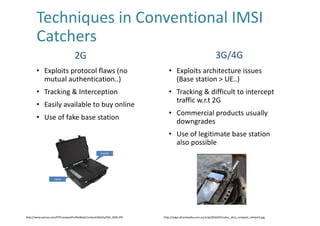
• Exploits	protocol	flaws	(no	
mutual	authentication..)
• Tracking	&	Interception
• Easily	available	to	buy	online
• Use	of	fake	base	station
• Exploits	architecture	issues	
(Base	station	>	UE..)
• Tracking	&	difficult	to	intercept	
traffic	w.r.t 2G	
• Commercial	products	usually	
downgrades
• Use	of	legitimate	base	station	
also	possible	
2G 3G/4G
http://www.epicos.com/EPCompanyProfileWeb/Content/Ability/EM_GSM.JPG http://edge.alluremedia.com.au/m/g/2016/05/nokia_ultra_compact_network.jpg
Protection	against	IMSI	Catchers
• IMSI-Catcher	detection
• App	based	(on	rooted	Android	devices)
• E.g.	Snoopsnitch,	Darshak
• Survey	based
• E.g.	SeaGlass Project	(U	Washington)
• No	protection	for	commercial	non-rooted	mobile	
devices
• Special	phones
• e.g.	Blackphone	
• Turn	off	cellular	connection	or	use	WiFi platform	for	
secure	calls/data??
WiFi-Based	IMSI	Catcher
• Features
• Tracking:	IMSI,	Location
• No	interception	(yet)
• Operates	in	unlicensed	(ISM)	Bands:	WiFi
• Range	- few	hundred	meters	– can	be	extended…
• Fake	Access	Points
• Redirect/Spoofs	mobile	packet	data	gateway
• Exploits	protocol	&	configuration	weaknesses
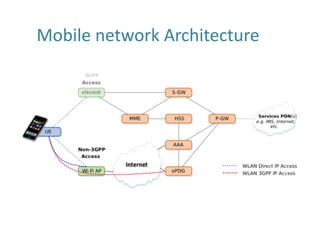
• Based	on	two	separate	techniques	[3GPP	TS33.234]
• WiFi Network	Authentication	(‘WLAN	direct	IP	access’)	
• WiFi-Calling	Authentication	(‘WLAN	3GPP	IP	access’)
• Cost
• Low:	Virtually	any	WiFi capable	computer
Mobile	network	Architecture
WiFi Network	attachment
• Unencrypted	WiFi access	points
• Captive	Portal	approaches
• Wireless	Internet	Service	Provider	roaming(WiSPr)	etc
• Normal	Encrypted	WiFi access	points
• Pre-shared	password/credentials
• ‘Auto	Connect’	Encrypted	WiFi APs	(802.1X)
• WiFi key	is	negotiated	without	user	intervention
• Based	on	credentials	in	the	USIM/UICC	(‘SIM	Card’)
• Controlled	by	operator	provided	configuration
• Automatic/pre-installed
• Manual	options
Automatic	configuration
• Some	Android	and	Windows	phones	automatically	
connect	based	on	SIM
• iOS	configures	phone	based	on	inserted	SIM
• Activates	an	operator	specific	.mobileconfig file
• Configures	a	range	of	operator	specific	options
• Including	a	list	of	802.1X	supported	WiFi SSIDs
• Our	analysis	of	iOS9	profiles	showed
• More	than	60	profiles	(44	countries)	for	802.1X	WiFi
• Containing	66	unique	SSIDS	plus	other	config
• =>	Phones	continuously	trying	to	silently	
automatically	authenticate
Manual	Configuration
• Some	Android	devices	require	initial	manual	
config
• After	which	it	automatically	connects
• Instructions	on	operator	websites
• Follow	simple	steps	to	set	up
• Android	provides	various	Carrier	controlled	
mechanisms
• Lollipop	(v5.1	MR1):	UICC	Carrier	Privileges
• Marshmallow	(v6.0):	Carrier	Configuration
• “Privileged	applications	to	provide	carrier-specific	
configuration	to	the	platform”
Automatic	WiFi Authentication
• Port	Based	Network	Access	Control	[IEEE	802.1X]
• Uses	Extensible	Authentication	Protocol	(EAP)	[RFC3748]	
over	LAN	(EAPOL)	over	WiFi
• Based	upon	two	EAP	Methods
• EAP-SIM	[RFC	4186]
• GSM	based	security	- Currently	most	widely	used
• EAP-AKA	[RFC	4187]
• 3G	based	security	- Being	deployed
• Support	in	Android,	iOS,	Windows	Mobile,	and	
Blackberry	devices
• We’ve	reported	the	issue	to	them	all	and	to	operators	&	
GSMA
• No	privacy	bounties	 😕
• Deployed	in	many	countries	– adoption	growing
EAP-SIM/AKA	Identities
• Three	basic	identity	types	for	authentication	
• Permanent-identity	(IMSI)
• Typically	used	initially	after	which	temporary	ids	are	used
• Pseudonym	identity
• A	pseudonym	for	the	IMSI	has	limited	lifetime
• Fast	reauthentication-identity
• Lower	overhead	re-attachment	after	initial	exchange
• Behaviour	affected	by	peer	policy
• “Liberal”	peer	- Current	default
• Responds	to	any	requests	for	permanent	identity
• “Conservative”	peer	– Future	deployment	option
• Only	respond	to	requests	for	permanent	identity	when	no	
Pseudonym	identity	available
EAP-SIM/AKA	transport	
• Basic	EAP	protocol	is	not	encrypted
• Currently	EAP-SIM/AKA	in	EAPOL	is	unencrypted
• Thus	IMSI	is	visible	(to	a	passive	attacker)	when	
permanent	identity	used	for	full	authentication	 😱
• Also	open	to	active	attacks	by	requesting	full	auth 😱
• WiFi Access	keys	not	compromised
• All	content	still	protected
• There	are	encrypted	tunnel	EAP	methods
• EAP-TTLSv0,	EAP-TLS…
• But	support	required	in	both	mobile	OS	and	operator
EAP-SIM/AKA	transport	
• Basic	EAP	protocol	is	not	encrypted
• Currently	EAP-SIM/AKA	in	EAPOL	is	unencrypted
• Thus	IMSI	is	visible	(to	a	passive	attacker)	when	
permanent	identity	used	for	full	authentication	 😱
• Also	open	to	active	attacks	by	requesting	full	auth 😱
• Problem	amplified	due	to	pre-configured	profiles	
• Mobile	devices	are	constantly	checking	for	pre-
configured	SSIDs	and	attempting	authentication
• WiFi Access	keys	not	compromised
• All	content	still	protected
WiFi-Calling	Connection
• Phone	connects	to	Edge	Packet	Data	Gateway	(EPDG)	
over	WiFi
• Voice	calls	over	WiFi
• Phone	connects	on	low/no	signal
• Also	connects	in	Airplane	mode	+	WiFi …
• Connection	to	EPDG	uses	IPsec
• Authenticates	using	Internet	Key	Exchange	Protocol	(IKEv2)
• Supported	on	iOS,	Android,	and	Windows	devices
• WiFi-Calling	available	in	a	number	of	countries
• The	issue	also	been	reported	to	OS	makers	and	Operators
IPsec	brief	overview
• Internet	Protocol	Security
• Confidentiality,	data	integrity,	access	control,	and	data	source	
authentication
• Recovery	from	transmission	errors:	packet	loss,	packet	replay,	and	
packet	forgery
• Authentication
• Authentication	Header	(AH)	- RFC	4302
• Confidentiality
• Encapsulating	Security	Payload	(ESP)	- RFC	4303
• Key	management
• Internet	Key	Exchange	v2	(IKEv2)	- RFC7296
• Two	modes
• Tunnel	- used	for	connection	to	Gateway	(EPDG)
• Transport
Internet	Key	Exchange	(IKEv2)
• Initiates	connection	in	two	phases
• IKE_SA_INIT
• Negotiate	cryptographic	algorithms,	exchange	nonces,	and	do	
a	Diffie-Hellman	exchange	
• IKE_AUTH
• Authenticate	the	previous	messages,	exchange	identities	(e.g.	
IMSI),	and	certificates,	and	establish	the	child	Security	
Association(s)	(SA)
• IKE_AUTH	uses	EAP-AKA
• IMSI	exchange	not	protected	by	a	certificate
• Open	to	Man-In-the-Middle	attacks	on	identity	(IMSI)	 😱
• IPsec	ESP	keys	are	not	compromised
• Call	content	still	safe
Operator/Vendor	Mitigations
• Deprecate	EAP-SIM	in	favour	of	EAP-AKA
• EAP-SIM	is	weaker	as	it	only	uses	GSM	triplets
• Deploy	EAP-AKA/SIM	with	conservative	peer	pseudonym
• Deploy	Certificate	based	approach
• Deploy	certificates	on	suitable	AAA	infrastructure
• Deploy	certificate	protected	tunnelled	EAP-AKA	for	WLAN	access
• E.g.	EAP-TTLS+EAP-AKA	on	802.1X
• Deploy	certificate	protected	IPsec/IKEv2	to	EPDG
• E.g.	EAP-TTLS+EAP-AKA	for	IKE_AUTH,	or	multiple	IKEv2	auth exchange
• (Re)investigate	other	potential	solutions
• IMSI	encryption	– 5G-ENSURE	project	has	proposed	an	‘enabler’
• E.g.	3GPPP	TD	S3-030081	– ‘Certificate-Based	Protection	of	IMSI	
for	EAP-SIM/AKA’
• Standards	bodies	should	re-evaluate	approaches
Mobile	OS	Mitigations
• Support	conservative	peer	for	EAP-AKA/SIM	
with	pseudonym	support
• Emerging	in	some	Oses (e.g.	iOS10)
• iOS10	has	conservative	peer	pseudonym	support	–
due	to	us	 😉
• Certificate	based	approach
• Support	for	EAP-TTLv0	+	EAP-AKA	in	IKEv2	&	EAPOL
• Other	approaches?
• Allow	for	more	user	choice	with	automatic	WiFi
network	access
• Preferably	allow	for	editing	of	all	stored	associations
User	Mitigation
• WiFi Network	Access	Control
• iOS
• Turn	off	‘Auto-Join’	toggle	for	Auto-WiFi networks
• Only	possible	when	network	in	range
• iOS10	may	provide	better	protection	(once	operators	deploy	
support)
• It	has	conservative	peer	pseudonym	support	
• Android
• ‘Forget’	Auto-WiFi profiles
• Depending	on	version	only	possible	when	network	in	range
• WiFi-Calling
• Android/iOS:	Selectively	disable	WiFi-Calling
• Switch	off	WiFi in	untrusted	environments
Summary
• Large	scale	IMSI	exposure	issues
• Poor	privacy	mandates	in	standards
• Widespread	device	pre-configuration	with	no	opt	out
• Need	better	privacy	testing	procedures
• Most	of	the	world’s	smartphones	affected
• Two	techniques	rely	upon	installed	operator	
automatic	configuration	for	these	popular	services
• We’ve	been	working	with	Operators/Vendors/	
OS	companies	to	fix	the	issue
• But	it’s	a	complex	issue
• EAP-AKA	is	now	starting	to	replace	EAP-SIM
Conclusions	&	Future	Work
• Investigating	other	uses	of	EAP-SIM/AKA
• Exploring	use	of	USIM	credentials	in	other	
WiFi based	protocols
• Continuing	work	in	5GENSURE.EU Project
Department of Computer Science
24
5G	ENSURE	receives	funding	from	the	EU	Framework	Programme for	
Research	and	Innovation	H2020	under	grant	agreement	No	671562	|	
Duration	November	2015	– October	2017
The	5G	Infrastructure	Public	Private	
Partnership	(SG	PPP)
5G	Enablers	for	network	and	system	security	and	resilience	
@5GEnsure
5G-ENSURE:	http://www.5gensure.eu
contact@5gensure.eu
Questions…

WiFi-Based IMSI Catcher