


w w w . e m b e d d e d o n l i n e c o n f e r e n c e . c o m
Firmware Co-Design &
Development for IP Cores
Dr Seyed Amir Alavi
in C++/SystemC using Verilator
© E m b e d d e d O n l i n e C o n f e r e n c e . c o m A l l r i g h t s r e s e r v e d EmbeddedOnlineConference.com
AGENDA
1 Co-design of firmware and
FPGA IP cores
2 Introduction to SystemC
and simulation of logic
blocks in C++
3 How to use Verilator for
simulation of IP cores
written in Verilog HDL
4 Advanced use- cases: Protecting
verilated models and real-time
simulation
5 Tutorial: Showcasing usage of
Verilator, SystemC, CMake build
system, and GTKWave
© E m b e d d e d O n l i n e C o n f e r e n c e . c o m A l l r i g h t s r e s e r v e d EmbeddedOnlineConference.com
THE SPEAKER
Embedded Software Engineer
Focus: Design of embedded software for
control systems of quantum computers
As an embedded systems engineer, I have designed
different types of products in several areas such as the
Internet of Things (IoT), industrial control systems, and
communication networks. I try to employ the latest
technologies for software and hardware development,
from embedded Linux to different real-time operating
systems, and agile software development processes.
Model-based embedded system design and
implementation is my main expertise, which I have done
during the last several years. I have published several
papers in high impact engineering journals and presented
my research in top rank conferences around the world.
Currently, I am working at Riverlane on the design
of control systems for quantum computers.
Dr Seyed Amir Alavi
https://samiralavi.github.io
© E m b e d d e d O n l i n e C o n f e r e n c e . c o m A l l r i g h t s r e s e r v e d EmbeddedOnlineConference.com
The Operating
System for Error
Corrected
Quantum
Computers
https://www.riverlane.com/vacancies/
Co-design & development of
firmware and FPGA IP cores
What is co-design? Co-designBest Practices.
1
© E m b e d d e d O n l i n e C o n f e r e n c e . c o m A l l r i g h t s r e s e r v e d EmbeddedOnlineConference.com
Co-Design Process
A common approach for building the prototype (with SW & HW)
Requirements
Analysis
Product
Definition
HW/SW
Functional
Decomposition
HW
Design
SW
Design
Development
Fabrication
Integration
and Testing
© E m b e d d e d O n l i n e C o n f e r e n c e . c o m A l l r i g h t s r e s e r v e d EmbeddedOnlineConference.com
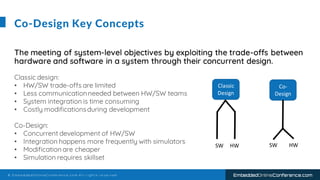
Co-Design Key Concepts
Classic design:
• HW/SW trade-offs are limited
• Less communicationneeded between HW/SW teams
• System integration is time consuming
• Costly modificationsduring development
Co-Design:
• Concurrent development of HW/SW
• Integration happens more frequently with simulators
• Modification are cheaper
• Simulation requires skillset
The meeting of system-level objectives by exploiting the trade-offs between
hardware and software in a system through their concurrent design.
Classic
Design
Co-
Design
SW HW SW HW
© E m b e d d e d O n l i n e C o n f e r e n c e . c o m A l l r i g h t s r e s e r v e d EmbeddedOnlineConference.com
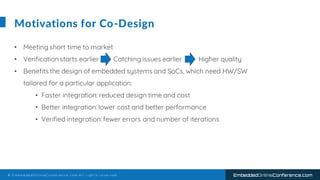
Motivations for Co-Design
• Meeting short time to market
• Verification starts earlier Catching issues earlier Higher quality
• Benefits the design of embedded systems and SoCs, which need HW/SW
tailored for a particular application:
• Faster integration: reduced design time and cost
• Better integration:lower cost and better performance
• Verified integration:fewer errors and number of iterations
© E m b e d d e d O n l i n e C o n f e r e n c e . c o m A l l r i g h t s r e s e r v e d EmbeddedOnlineConference.com
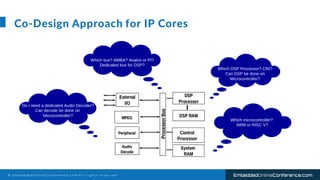
Co-Design Approach for IP Cores
© E m b e d d e d O n l i n e C o n f e r e n c e . c o m A l l r i g h t s r e s e r v e d EmbeddedOnlineConference.com
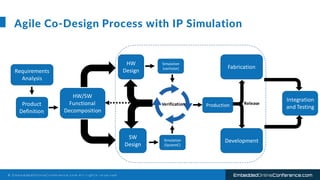
Agile Co-Design Process with IP Simulation
Requirements
Analysis
Product
Definition
HW/SW
Functional
Decomposition
HW
Design
SW
Design
Development
Fabrication
Integration
and Testing
Simulation
(verilator)
Simulation
(SystemC)
Verification Production Release
Introduction to SystemC and
simulation of logic blocks in C++
2
© E m b e d d e d O n l i n e C o n f e r e n c e . c o m A l l r i g h t s r e s e r v e d EmbeddedOnlineConference.com
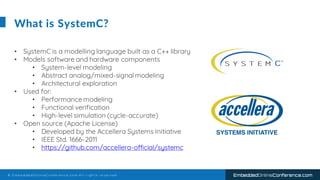
What is SystemC?
• SystemC is a modelling language built as a C++ library
• Models software and hardware components
• System-level modeling
• Abstract analog/mixed-signalmodeling
• Architectural exploration
• Used for:
• Performance modeling
• Functional verification
• High-level simulation (cycle-accurate)
• Open source (Apache License)
• Developed by the Accellera Systems Initiative
• IEEE Std. 1666-2011
• https://github.com/accellera-official/systemc
© E m b e d d e d O n l i n e C o n f e r e n c e . c o m A l l r i g h t s r e s e r v e d EmbeddedOnlineConference.com
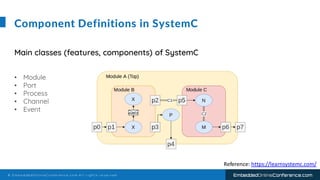
Component Definitions in SystemC
Main classes (features, components) of SystemC
• Module
• Port
• Process
• Channel
• Event
Reference: https://learnsystemc.com/
© E m b e d d e d O n l i n e C o n f e r e n c e . c o m A l l r i g h t s r e s e r v e d EmbeddedOnlineConference.com
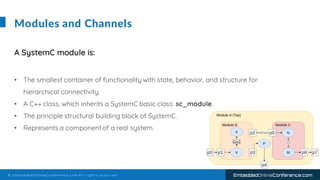
Modules and Channels
A SystemC module is:
• The smallest container of functionality with state, behavior, and structure for
hierarchical connectivity.
• A C++ class, which inherits a SystemC basic class: sc_module.
• The principle structural building block of SystemC.
• Represents a componentof a real system.
© E m b e d d e d O n l i n e C o n f e r e n c e . c o m A l l r i g h t s r e s e r v e d EmbeddedOnlineConference.com
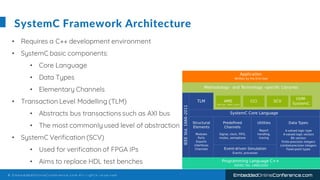
SystemC Framework Architecture
• Requires a C++ development environment
• SystemC basic components:
• Core Language
• Data Types
• Elementary Channels
• Transaction Level Modelling (TLM)
• Abstracts bus transactions such as AXI bus
• The most commonly used level of abstraction
• SystemC Verification (SCV)
• Used for verification of FPGA IPs
• Aims to replace HDL test benches
© E m b e d d e d O n l i n e C o n f e r e n c e . c o m A l l r i g h t s r e s e r v e d EmbeddedOnlineConference.com
Virtual Platform Modelling (cont.)
How to use Verilator for simulation
of IP cores written in Verilog HDL
3
© E m b e d d e d O n l i n e C o n f e r e n c e . c o m A l l r i g h t s r e s e r v e d EmbeddedOnlineConference.com
Verilator
Verilator is a tool that compiles Verilog and SystemVerilog sources to
highly optimized cycle-accurate C++ or SystemC code.
• Time evolution is cycle-based
• No circuit timing (analog propagation time is 0)
• Extremely fast simulation
• Simulates what SW expects from the HW
• Only synthesizable Verilog/SystemVerilog code (few exceptions)
• Verilator is open-source and free both as in free beer and free speech
https://verilator.org/
© E m b e d d e d O n l i n e C o n f e r e n c e . c o m A l l r i g h t s r e s e r v e d EmbeddedOnlineConference.com
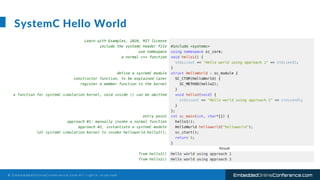
SystemC Hello World
© E m b e d d e d O n l i n e C o n f e r e n c e . c o m A l l r i g h t s r e s e r v e d EmbeddedOnlineConference.com
SystemC Module
© E m b e d d e d O n l i n e C o n f e r e n c e . c o m A l l r i g h t s r e s e r v e d EmbeddedOnlineConference.com
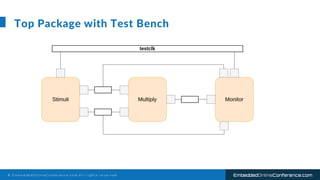
Top Package with Test Bench
© E m b e d d e d O n l i n e C o n f e r e n c e . c o m A l l r i g h t s r e s e r v e d EmbeddedOnlineConference.com
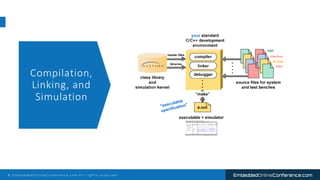
Compilation,
Linking, and
Simulation
Advanced use cases
• Sharing Protected IPs with Verilator
• Co-Simulation of System with QEMU
4
© E m b e d d e d O n l i n e C o n f e r e n c e . c o m A l l r i g h t s r e s e r v e d EmbeddedOnlineConference.com
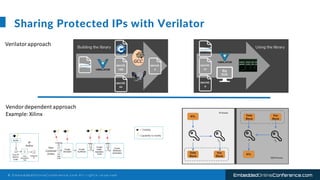
Sharing Protected IPs with Verilator
Vendordependent approach
Example:Xilinx
Verilatorapproach
© E m b e d d e d O n l i n e C o n f e r e n c e . c o m A l l r i g h t s r e s e r v e d EmbeddedOnlineConference.com
Co-Simulation of System with QEMU
Example reference with Xilinx tools
Source: Xilinx Quick
Emulator:User Guide
(UG1169)
Tutorial
Showcasing usage of Verilator, SystemC, CMake build
system, and GTKWave
Source code available here:
https://github.com/samiralavi/fw-codesign-eoc-2022
5
© E m b e d d e d O n l i n e C o n f e r e n c e . c o m A l l r i g h t s r e s e r v e d EmbeddedOnlineConference.com
References
I have used the following references in making the slides:
• System On Chip Design Introduction, Hao Zheng, 2010
• Hardware-Software Codesign,Pao-Ann Hsiung, 2005
• DPI Protected Verilog Instead of Encryption, Todd Strader, ORConf 2019
• https://veripool.org/verilator/documentation/
• https://www.xilinx.com/
• https://accellera.org/
• https://learnsystemc.com/
• https://www.itsembedded.com/dhd/
w w w . e m b e d d e d o n l i n e c o n f e r e n c e . c o m
THANK YOU

Firmware Co-Design & Development for IP Cores in C++/SystemC using Verilator

  • 1.
    w w w. e m b e d d e d o n l i n e c o n f e r e n c e . c o m Firmware Co-Design & Development for IP Cores Dr Seyed Amir Alavi in C++/SystemC using Verilator
  • 2.
    © E mb e d d e d O n l i n e C o n f e r e n c e . c o m A l l r i g h t s r e s e r v e d EmbeddedOnlineConference.com AGENDA 1 Co-design of firmware and FPGA IP cores 2 Introduction to SystemC and simulation of logic blocks in C++ 3 How to use Verilator for simulation of IP cores written in Verilog HDL 4 Advanced use- cases: Protecting verilated models and real-time simulation 5 Tutorial: Showcasing usage of Verilator, SystemC, CMake build system, and GTKWave
  • 3.
    © E mb e d d e d O n l i n e C o n f e r e n c e . c o m A l l r i g h t s r e s e r v e d EmbeddedOnlineConference.com THE SPEAKER Embedded Software Engineer Focus: Design of embedded software for control systems of quantum computers As an embedded systems engineer, I have designed different types of products in several areas such as the Internet of Things (IoT), industrial control systems, and communication networks. I try to employ the latest technologies for software and hardware development, from embedded Linux to different real-time operating systems, and agile software development processes. Model-based embedded system design and implementation is my main expertise, which I have done during the last several years. I have published several papers in high impact engineering journals and presented my research in top rank conferences around the world. Currently, I am working at Riverlane on the design of control systems for quantum computers. Dr Seyed Amir Alavi https://samiralavi.github.io
  • 4.
    © E mb e d d e d O n l i n e C o n f e r e n c e . c o m A l l r i g h t s r e s e r v e d EmbeddedOnlineConference.com The Operating System for Error Corrected Quantum Computers https://www.riverlane.com/vacancies/
  • 5.
    Co-design & developmentof firmware and FPGA IP cores What is co-design? Co-designBest Practices. 1
  • 6.
    © E mb e d d e d O n l i n e C o n f e r e n c e . c o m A l l r i g h t s r e s e r v e d EmbeddedOnlineConference.com Co-Design Process A common approach for building the prototype (with SW & HW) Requirements Analysis Product Definition HW/SW Functional Decomposition HW Design SW Design Development Fabrication Integration and Testing
  • 7.
    © E mb e d d e d O n l i n e C o n f e r e n c e . c o m A l l r i g h t s r e s e r v e d EmbeddedOnlineConference.com Co-Design Key Concepts Classic design: • HW/SW trade-offs are limited • Less communicationneeded between HW/SW teams • System integration is time consuming • Costly modificationsduring development Co-Design: • Concurrent development of HW/SW • Integration happens more frequently with simulators • Modification are cheaper • Simulation requires skillset The meeting of system-level objectives by exploiting the trade-offs between hardware and software in a system through their concurrent design. Classic Design Co- Design SW HW SW HW
  • 8.
    © E mb e d d e d O n l i n e C o n f e r e n c e . c o m A l l r i g h t s r e s e r v e d EmbeddedOnlineConference.com Motivations for Co-Design • Meeting short time to market • Verification starts earlier Catching issues earlier Higher quality • Benefits the design of embedded systems and SoCs, which need HW/SW tailored for a particular application: • Faster integration: reduced design time and cost • Better integration:lower cost and better performance • Verified integration:fewer errors and number of iterations
  • 9.
    © E mb e d d e d O n l i n e C o n f e r e n c e . c o m A l l r i g h t s r e s e r v e d EmbeddedOnlineConference.com Co-Design Approach for IP Cores
  • 10.
    © E mb e d d e d O n l i n e C o n f e r e n c e . c o m A l l r i g h t s r e s e r v e d EmbeddedOnlineConference.com Agile Co-Design Process with IP Simulation Requirements Analysis Product Definition HW/SW Functional Decomposition HW Design SW Design Development Fabrication Integration and Testing Simulation (verilator) Simulation (SystemC) Verification Production Release
  • 11.
    Introduction to SystemCand simulation of logic blocks in C++ 2
  • 12.
    © E mb e d d e d O n l i n e C o n f e r e n c e . c o m A l l r i g h t s r e s e r v e d EmbeddedOnlineConference.com What is SystemC? • SystemC is a modelling language built as a C++ library • Models software and hardware components • System-level modeling • Abstract analog/mixed-signalmodeling • Architectural exploration • Used for: • Performance modeling • Functional verification • High-level simulation (cycle-accurate) • Open source (Apache License) • Developed by the Accellera Systems Initiative • IEEE Std. 1666-2011 • https://github.com/accellera-official/systemc
  • 13.
    © E mb e d d e d O n l i n e C o n f e r e n c e . c o m A l l r i g h t s r e s e r v e d EmbeddedOnlineConference.com Component Definitions in SystemC Main classes (features, components) of SystemC • Module • Port • Process • Channel • Event Reference: https://learnsystemc.com/
  • 14.
    © E mb e d d e d O n l i n e C o n f e r e n c e . c o m A l l r i g h t s r e s e r v e d EmbeddedOnlineConference.com Modules and Channels A SystemC module is: • The smallest container of functionality with state, behavior, and structure for hierarchical connectivity. • A C++ class, which inherits a SystemC basic class: sc_module. • The principle structural building block of SystemC. • Represents a componentof a real system.
  • 15.
    © E mb e d d e d O n l i n e C o n f e r e n c e . c o m A l l r i g h t s r e s e r v e d EmbeddedOnlineConference.com SystemC Framework Architecture • Requires a C++ development environment • SystemC basic components: • Core Language • Data Types • Elementary Channels • Transaction Level Modelling (TLM) • Abstracts bus transactions such as AXI bus • The most commonly used level of abstraction • SystemC Verification (SCV) • Used for verification of FPGA IPs • Aims to replace HDL test benches
  • 16.
    © E mb e d d e d O n l i n e C o n f e r e n c e . c o m A l l r i g h t s r e s e r v e d EmbeddedOnlineConference.com Virtual Platform Modelling (cont.)
  • 17.
    How to useVerilator for simulation of IP cores written in Verilog HDL 3
  • 18.
    © E mb e d d e d O n l i n e C o n f e r e n c e . c o m A l l r i g h t s r e s e r v e d EmbeddedOnlineConference.com Verilator Verilator is a tool that compiles Verilog and SystemVerilog sources to highly optimized cycle-accurate C++ or SystemC code. • Time evolution is cycle-based • No circuit timing (analog propagation time is 0) • Extremely fast simulation • Simulates what SW expects from the HW • Only synthesizable Verilog/SystemVerilog code (few exceptions) • Verilator is open-source and free both as in free beer and free speech https://verilator.org/
  • 19.
    © E mb e d d e d O n l i n e C o n f e r e n c e . c o m A l l r i g h t s r e s e r v e d EmbeddedOnlineConference.com SystemC Hello World
  • 20.
    © E mb e d d e d O n l i n e C o n f e r e n c e . c o m A l l r i g h t s r e s e r v e d EmbeddedOnlineConference.com SystemC Module
  • 21.
    © E mb e d d e d O n l i n e C o n f e r e n c e . c o m A l l r i g h t s r e s e r v e d EmbeddedOnlineConference.com Top Package with Test Bench
  • 22.
    © E mb e d d e d O n l i n e C o n f e r e n c e . c o m A l l r i g h t s r e s e r v e d EmbeddedOnlineConference.com Compilation, Linking, and Simulation
  • 23.
    Advanced use cases •Sharing Protected IPs with Verilator • Co-Simulation of System with QEMU 4
  • 24.
    © E mb e d d e d O n l i n e C o n f e r e n c e . c o m A l l r i g h t s r e s e r v e d EmbeddedOnlineConference.com Sharing Protected IPs with Verilator Vendordependent approach Example:Xilinx Verilatorapproach
  • 25.
    © E mb e d d e d O n l i n e C o n f e r e n c e . c o m A l l r i g h t s r e s e r v e d EmbeddedOnlineConference.com Co-Simulation of System with QEMU Example reference with Xilinx tools Source: Xilinx Quick Emulator:User Guide (UG1169)
  • 26.
    Tutorial Showcasing usage ofVerilator, SystemC, CMake build system, and GTKWave Source code available here: https://github.com/samiralavi/fw-codesign-eoc-2022 5
  • 27.
    © E mb e d d e d O n l i n e C o n f e r e n c e . c o m A l l r i g h t s r e s e r v e d EmbeddedOnlineConference.com References I have used the following references in making the slides: • System On Chip Design Introduction, Hao Zheng, 2010 • Hardware-Software Codesign,Pao-Ann Hsiung, 2005 • DPI Protected Verilog Instead of Encryption, Todd Strader, ORConf 2019 • https://veripool.org/verilator/documentation/ • https://www.xilinx.com/ • https://accellera.org/ • https://learnsystemc.com/ • https://www.itsembedded.com/dhd/
  • 28.
    w w w. e m b e d d e d o n l i n e c o n f e r e n c e . c o m
  • 29.
    w w w. e m b e d d e d o n l i n e c o n f e r e n c e . c o m THANK YOU