1
WCDMA+ Makes
Voice More Efficient
to Support More Data
May 2013
Enhancing proven WCDMA
2
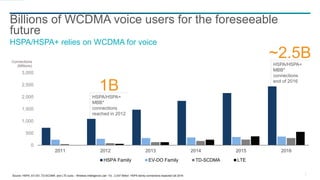
Billions of WCDMA voice users for the foreseeable
future
HSPA/HSPA+ relies on WCDMA for voice
0
500
1,000
1,500
2,000
2,500
3,000
2011 2012 2013 2014 2015 2016
HSPA Family EV-DO Family TD-SCDMA LTE
Source: HSPA, EV-DO ,TD-SCDMA and LTE subs – Wireless Intelligence (Jan ‘13) . 2,437 Billion HSPA family connections expected Q4 2016
Connections
(Millions)
1BHSPA/HSPA+
MBB*
connections
reached in 2012
~2.5BHSPA/HSPA+
MBB*
connections
end of 2016
3
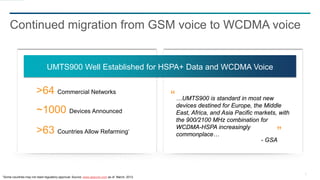
Continued migration from GSM voice to WCDMA voice
>64 Commercial Networks
~1000 Devices Announced
>63 Countries Allow Refarming1
1Some countries may not need regulatory approval; Source: www.gsacom.com as of March, 2013.
UMTS900 Well Established for HSPA+ Data and WCDMA Voice
…UMTS900 is standard in most new
devices destined for Europe, the Middle
East, Africa, and Asia Pacific markets, with
the 900/2100 MHz combination for
WCDMA-HSPA increasingly
commonplace…
“
”- GSA
4
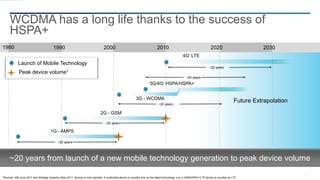
WCDMA has a long life thanks to the success of
HSPA+
1Sources: ABI June 2011 and Strategy Analytics Sept 2011, devices is only handset. A multimode device is counted only as the latest technology, e.g. a GSM/HSPA+/LTE device is counted as LTE.
1990 20001980 2020 20302010
Launch of Mobile Technology
Peak device volume1
1G - AMPS
2G - GSM
3G - WCDMA
‘3G/4G’ HSPA/HSPA+
~20 years
~20 years
~20 years
~20 years
~20 years
Future Extrapolation
~20 years from launch of a new mobile technology generation to peak device volume
‘4G’ LTE
5
2013 2014 2015 2016+2013 2014 2015 2016+
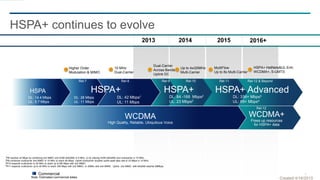
HSPA+ continues to evolve
Note: Estimated commercial dates.
Rel-11Rel-10Rel-9Rel-8Rel-7
DL: 84 -168 Mbps2
UL: 23 Mbps2
DL: 28 Mbps
UL: 11 Mbps
DL: 42 Mbps1
UL: 11 Mbps
DL: 14.4 Mbps
UL: 5.7 Mbps
DL: 336+ Mbps4
UL: 69+ Mbps4
1R8 reaches 42 Mbps by combining 2x2 MIMO and HOM (64QAM) in 5 MHz, or by utilizing HOM (64QAM) and multicarrier in 10 MHz.
2R9 combines multicarrier and MIMO in 10 MHz to reach 84 Mbps. Uplink multicarrier doubles uplink peak data rate to 23 Mbps in 10 MHz.
3R10 expands multicarrier to 20 MHz to reach up to168 Mbps with 2x2 MIMO.
4R11 expands multicarrier up to 40 MHz to reach 336 Mbps with 2x2 MIMO, or 20Mhz with 4x4 MIMO. Uplink 2x2 MIMO with 64QAM reaches 69Mbps.
Rel-12 & Beyond
Rel-12
Created 4/16/2013
10 MHz
Dual-Carrier
Up to 4x/20MHz
Multi-Carrier
Dual-Carrier
Across Bands
Uplink DC
MultiFlow
Up to 8x Multi-Carrier
Higher Order
Modulation & MIMO
HSPA+ HetNets&UL Enh.
WCDMA+, S-UMTS
HSPA+ AdvancedHSPA+HSPA
WCDMA
High Quality, Reliable, Ubiquitous Voice
HSPA+
WCDMA+
Frees up resources
for HSPA+ data
Commercial
6
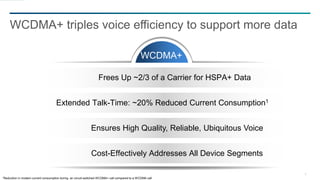
WCDMA+ triples voice efficiency to support more data
1Reduction in modem current consumption during an circuit switched WCDMA+ call compared to a WCDMA call
WCDMA+
Frees Up ~2/3 of a Carrier for HSPA+ Data
Extended Talk-Time: ~20% Reduced Current Consumption1
Ensures High Quality, Reliable, Ubiquitous Voice
Cost-Effectively Addresses All Device Segments
7
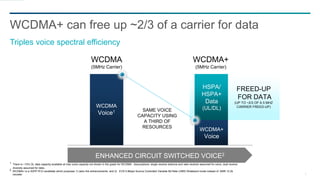
WCDMA+ can free up ~2/3 of a carrier for data
Triples voice spectral efficiency
WCDMA
(5MHz Carrier)
WCDMA+
(5MHz Carrier)
ENHANCED CIRCUIT SWITCHED VOICE2
WCDMA+
Voice
FREED-UP
FOR DATA
(UP TO ~2/3 OF A 5 MHZ
CARRIER FREED-UP)
SAME VOICE
CAPACITY USING
A THIRD OF
RESOURCES
WCDMA
Voice1
HSPA/
HSPA+
Data
(UL/DL)
1 There is ~10% DL data capacity available at max voice capacity not shown in the graph for WCDMA .Assumptions: single receive antenna and rake receiver assumed for voice, dual receive
diversity assumed for data. .
2 WCDMA+ is a 3GPP R12 candidate which proposes 1) radio link enhancements and 2) EVS 5.9kbps Source Controlled Variable Bit Rate (VBR) Wideband mode instead of AMR 12.2k
vocoder
8
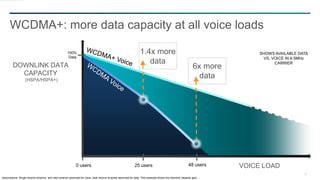
WCDMA+: more data capacity at all voice loads
VOICE LOAD
DOWNLINK DATA
CAPACITY
(HSPA/HSPA+)
SHOWS AVAILABLE DATA
VS. VOICE IN A 5MHz
CARRIER
100%
Data
48 users
Assumptions: Single receive antenna and rake receiver assumed for voice, dual receive diversity assumed for data. This example shows the downlink capacity gain,
25 users0 users
6x more
data
1.4x more
data
9
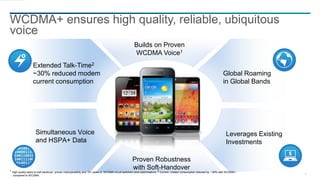
WCDMA+ ensures high quality, reliable, ubiquitous
voice
Extended Talk-Time2
~30% reduced modem
current consumption
Simultaneous Voice
and HSPA+ Data
Global Roaming
in Global Bands
Leverages Existing
Investments
Builds on Proven
WCDMA Voice1
Proven Robustness
with Soft-Handover1 High quality tanks to soft handover, proven interoperability and 10+ years of WCDMA circuit switched voice optimizations. 2 Current modem consumption reduced by ~30% with WCDMA+
compared to WCDMA.
10
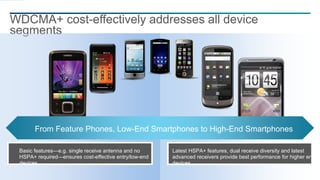
WDCMA+ cost-effectively addresses all device
segments
Basic features—e.g. single receive antenna and no
HSPA+ required—ensures cost-effective entry/low-end
devices
Latest HSPA+ features, dual receive diversity and latest
advanced receivers provide best performance for higher end
devices
From Feature Phones, Low-End Smartphones to High-End Smartphones
11
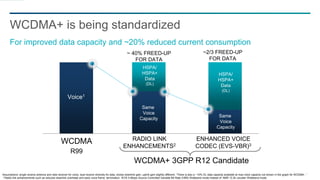
WCDMA+ is being standardized
For improved data capacity and ~20% reduced current consumption
Voice1
WCDMA+ 3GPP R12 Candidate
Same
Voice
Capacity
RADIO LINK
ENHANCEMENTS2
ENHANCED VOICE
CODEC (EVS-VBR)3
HSPA/
HSPA+
Data
(DL)
HSPA/
HSPA+
Data
(DL)
~ 40% FREED-UP
FOR DATA
~2/3 FREED-UP
FOR DATA
WCDMA
R99
Same
Voice
Capacity
Assumptions: single receive antenna and rake receiver for voice, dual receive diversity for data, shows downlink gain, uplink gain slightly different. 1There is also a ~10% DL data capacity available at max voice capacity not shown in the graph for WCDMA.
2 Radio link enhancements such as reduced downlink overhead and early voice frame termination. 3EVS 5.9kbps Source Controlled Variable Bit Rate (VBR) Wideband mode instead of AMR 12.2k vocoder Wideband mode.
12
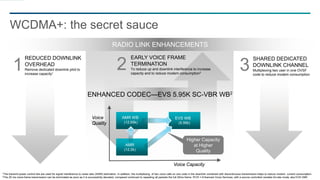
WCDMA+: the secret sauce
1The transmit power control bits are used for signal Interference to noise ratio (SINR) estimation. In addition, the multiplexing of two voice calls on one code in the downlink combined with discontinuous transmission helps to reduce modem current consumption.
2The 20 ms voice-frame transmission can be terminated as soon as it is successfully decoded, compared continued to repeating all packets the full 20ms frame. 2EVS = Enhanced Voice Services, with a source controlled variable bit-rate mode, aka EVS-VBR.
REDUCED DOWNLINK
OVERHEAD
Remove dedicated downlink pilot to
increase capacity1
EARLY VOICE FRAME
TERMINATION
To reduce up and downlink interference to increase
capacity and to reduce modem consumption2
SHARED DEDICATED
DOWNLINK CHANNEL
Multiplexing two user in one OVSF
code to reduce modem consumption
RADIO LINK ENHANCEMENTS
ENHANCED CODEC—EVS 5.95K SC-VBR WB2
1 2 3
AMR WB
(12.65k)
EVS WB
(5.95k)
AMR
(12.2k)
Higher Capacity
at Higher
Quality
Voice
Quality
Voice Capacity
13
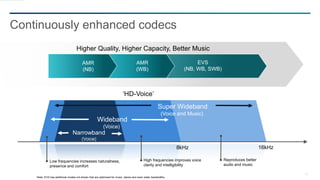
Continuously enhanced codecs
Note: EVS has additional modes not shown that are optimized for music, stereo and even wider bandwidths.
Wideband
(Voice)
Narrowband
(Voice)
Super Wideband
(Voice and Music)
Low frequencies increases naturalness,
presence and comfort
High frequencies improves voice
clarity and intelligibility
16kHz8kHz
Reproduces better
audio and music
‘HD-Voice’
EVS
(NB, WB, SWB)
Higher Quality, Higher Capacity, Better Music
AMR
(WB)
AMR
(NB)
14
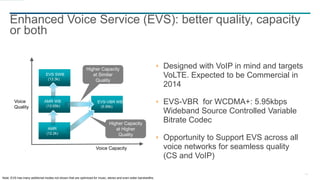
Enhanced Voice Service (EVS): better quality, capacity
or both
AMR WB
(12.65k)
EVS-VBR WB
(5.95k)
AMR
(12.2k)
Higher Capacity
at Higher
Quality
Voice
Quality
Voice Capacity
EVS SWB
(13.3k)
Higher Capacity
at Similar
Quality
Note: EVS has many additional modes not shown that are optimized for music, stereo and even wider bandwidths.
Designed with VoIP in mind and targets
VoLTE. Expected to be Commercial in
2014
EVS-VBR for WCDMA+: 5.95kbps
Wideband Source Controlled Variable
Bitrate Codec
Opportunity to Support EVS across all
voice networks for seamless quality
(CS and VoIP)
15
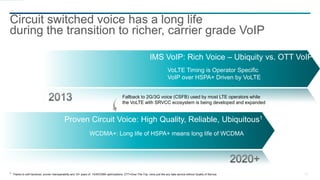
Circuit switched voice has a long life
during the transition to richer, carrier grade VoIP
WCDMA+: Long life of HSPA+ means long life of WCDMA
VoLTE Timing is Operator Specific
VoIP over HSPA+ Driven by VoLTE
Proven Circuit Voice: High Quality, Reliable, Ubiquitous1
IMS VoIP: Rich Voice – Ubiquity vs. OTT VoIP
Fallback to 2G/3G voice (CSFB) used by most LTE operators while
the VoLTE with SRVCC ecosystem is being developed and expanded
1 Thanks to soft handover, proven interoperability and 10+ years of 1X/WCDMA optimizations. OTT=Over-The-Top, voice just like any data service without Quality of Service
16
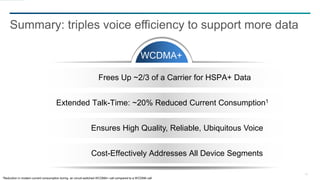
Summary: triples voice efficiency to support more data
1Reduction in modem current consumption during an circuit switched WCDMA+ call compared to a WCDMA call
WCDMA+
Frees Up ~2/3 of a Carrier for HSPA+ Data
Extended Talk-Time: ~20% Reduced Current Consumption1
Ensures High Quality, Reliable, Ubiquitous Voice
Cost-Effectively Addresses All Device Segments
17
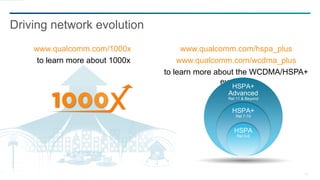
Driving network evolution
www.qualcomm.com/1000x
to learn more about 1000x
www.qualcomm.com/hspa_plus
www.qualcomm.com/wcdma_plus
to learn more about the WCDMA/HSPA+
evolution
HSPA+
Rel 7-10
HSPA+
Advanced
Rel 11 & Beyond
HSPA
Rel 5-6
18
@Qualcomm_tech
http://www.qualcomm.com/blog/contributors/prakash-sangam
http://www.slideshare.net/qualcommwirelessevolution
http://storify.com/qualcomm_tech
http://www.youtube.com/playlist?list=PL8AD95E4F585237C1&feature=plcp
www.qualcomm.com/technology
Questions? - Connect with Us
BLOG
19
For more information on Qualcomm, visit us at:
www.qualcomm.com & www.qualcomm.com/blog
Qualcomm is a trademark of Qualcomm Incorporated, registered in the United States and other
countries.
Other products and brand names may be trademarks or registered trademarks of their respective
owners
Thank you
Follow us on:

HH QUALCOMM - hspa+wcdma - more efficient voice for more data services

  • 1.
    1 WCDMA+ Makes Voice MoreEfficient to Support More Data May 2013 Enhancing proven WCDMA
  • 2.
    2 Billions of WCDMAvoice users for the foreseeable future HSPA/HSPA+ relies on WCDMA for voice 0 500 1,000 1,500 2,000 2,500 3,000 2011 2012 2013 2014 2015 2016 HSPA Family EV-DO Family TD-SCDMA LTE Source: HSPA, EV-DO ,TD-SCDMA and LTE subs – Wireless Intelligence (Jan ‘13) . 2,437 Billion HSPA family connections expected Q4 2016 Connections (Millions) 1BHSPA/HSPA+ MBB* connections reached in 2012 ~2.5BHSPA/HSPA+ MBB* connections end of 2016
  • 3.
    3 Continued migration fromGSM voice to WCDMA voice >64 Commercial Networks ~1000 Devices Announced >63 Countries Allow Refarming1 1Some countries may not need regulatory approval; Source: www.gsacom.com as of March, 2013. UMTS900 Well Established for HSPA+ Data and WCDMA Voice …UMTS900 is standard in most new devices destined for Europe, the Middle East, Africa, and Asia Pacific markets, with the 900/2100 MHz combination for WCDMA-HSPA increasingly commonplace… “ ”- GSA
  • 4.
    4 WCDMA has along life thanks to the success of HSPA+ 1Sources: ABI June 2011 and Strategy Analytics Sept 2011, devices is only handset. A multimode device is counted only as the latest technology, e.g. a GSM/HSPA+/LTE device is counted as LTE. 1990 20001980 2020 20302010 Launch of Mobile Technology Peak device volume1 1G - AMPS 2G - GSM 3G - WCDMA ‘3G/4G’ HSPA/HSPA+ ~20 years ~20 years ~20 years ~20 years ~20 years Future Extrapolation ~20 years from launch of a new mobile technology generation to peak device volume ‘4G’ LTE
  • 5.
    5 2013 2014 20152016+2013 2014 2015 2016+ HSPA+ continues to evolve Note: Estimated commercial dates. Rel-11Rel-10Rel-9Rel-8Rel-7 DL: 84 -168 Mbps2 UL: 23 Mbps2 DL: 28 Mbps UL: 11 Mbps DL: 42 Mbps1 UL: 11 Mbps DL: 14.4 Mbps UL: 5.7 Mbps DL: 336+ Mbps4 UL: 69+ Mbps4 1R8 reaches 42 Mbps by combining 2x2 MIMO and HOM (64QAM) in 5 MHz, or by utilizing HOM (64QAM) and multicarrier in 10 MHz. 2R9 combines multicarrier and MIMO in 10 MHz to reach 84 Mbps. Uplink multicarrier doubles uplink peak data rate to 23 Mbps in 10 MHz. 3R10 expands multicarrier to 20 MHz to reach up to168 Mbps with 2x2 MIMO. 4R11 expands multicarrier up to 40 MHz to reach 336 Mbps with 2x2 MIMO, or 20Mhz with 4x4 MIMO. Uplink 2x2 MIMO with 64QAM reaches 69Mbps. Rel-12 & Beyond Rel-12 Created 4/16/2013 10 MHz Dual-Carrier Up to 4x/20MHz Multi-Carrier Dual-Carrier Across Bands Uplink DC MultiFlow Up to 8x Multi-Carrier Higher Order Modulation & MIMO HSPA+ HetNets&UL Enh. WCDMA+, S-UMTS HSPA+ AdvancedHSPA+HSPA WCDMA High Quality, Reliable, Ubiquitous Voice HSPA+ WCDMA+ Frees up resources for HSPA+ data Commercial
  • 6.
    6 WCDMA+ triples voiceefficiency to support more data 1Reduction in modem current consumption during an circuit switched WCDMA+ call compared to a WCDMA call WCDMA+ Frees Up ~2/3 of a Carrier for HSPA+ Data Extended Talk-Time: ~20% Reduced Current Consumption1 Ensures High Quality, Reliable, Ubiquitous Voice Cost-Effectively Addresses All Device Segments
  • 7.
    7 WCDMA+ can freeup ~2/3 of a carrier for data Triples voice spectral efficiency WCDMA (5MHz Carrier) WCDMA+ (5MHz Carrier) ENHANCED CIRCUIT SWITCHED VOICE2 WCDMA+ Voice FREED-UP FOR DATA (UP TO ~2/3 OF A 5 MHZ CARRIER FREED-UP) SAME VOICE CAPACITY USING A THIRD OF RESOURCES WCDMA Voice1 HSPA/ HSPA+ Data (UL/DL) 1 There is ~10% DL data capacity available at max voice capacity not shown in the graph for WCDMA .Assumptions: single receive antenna and rake receiver assumed for voice, dual receive diversity assumed for data. . 2 WCDMA+ is a 3GPP R12 candidate which proposes 1) radio link enhancements and 2) EVS 5.9kbps Source Controlled Variable Bit Rate (VBR) Wideband mode instead of AMR 12.2k vocoder
  • 8.
    8 WCDMA+: more datacapacity at all voice loads VOICE LOAD DOWNLINK DATA CAPACITY (HSPA/HSPA+) SHOWS AVAILABLE DATA VS. VOICE IN A 5MHz CARRIER 100% Data 48 users Assumptions: Single receive antenna and rake receiver assumed for voice, dual receive diversity assumed for data. This example shows the downlink capacity gain, 25 users0 users 6x more data 1.4x more data
  • 9.
    9 WCDMA+ ensures highquality, reliable, ubiquitous voice Extended Talk-Time2 ~30% reduced modem current consumption Simultaneous Voice and HSPA+ Data Global Roaming in Global Bands Leverages Existing Investments Builds on Proven WCDMA Voice1 Proven Robustness with Soft-Handover1 High quality tanks to soft handover, proven interoperability and 10+ years of WCDMA circuit switched voice optimizations. 2 Current modem consumption reduced by ~30% with WCDMA+ compared to WCDMA.
  • 10.
    10 WDCMA+ cost-effectively addressesall device segments Basic features—e.g. single receive antenna and no HSPA+ required—ensures cost-effective entry/low-end devices Latest HSPA+ features, dual receive diversity and latest advanced receivers provide best performance for higher end devices From Feature Phones, Low-End Smartphones to High-End Smartphones
  • 11.
    11 WCDMA+ is beingstandardized For improved data capacity and ~20% reduced current consumption Voice1 WCDMA+ 3GPP R12 Candidate Same Voice Capacity RADIO LINK ENHANCEMENTS2 ENHANCED VOICE CODEC (EVS-VBR)3 HSPA/ HSPA+ Data (DL) HSPA/ HSPA+ Data (DL) ~ 40% FREED-UP FOR DATA ~2/3 FREED-UP FOR DATA WCDMA R99 Same Voice Capacity Assumptions: single receive antenna and rake receiver for voice, dual receive diversity for data, shows downlink gain, uplink gain slightly different. 1There is also a ~10% DL data capacity available at max voice capacity not shown in the graph for WCDMA. 2 Radio link enhancements such as reduced downlink overhead and early voice frame termination. 3EVS 5.9kbps Source Controlled Variable Bit Rate (VBR) Wideband mode instead of AMR 12.2k vocoder Wideband mode.
  • 12.
    12 WCDMA+: the secretsauce 1The transmit power control bits are used for signal Interference to noise ratio (SINR) estimation. In addition, the multiplexing of two voice calls on one code in the downlink combined with discontinuous transmission helps to reduce modem current consumption. 2The 20 ms voice-frame transmission can be terminated as soon as it is successfully decoded, compared continued to repeating all packets the full 20ms frame. 2EVS = Enhanced Voice Services, with a source controlled variable bit-rate mode, aka EVS-VBR. REDUCED DOWNLINK OVERHEAD Remove dedicated downlink pilot to increase capacity1 EARLY VOICE FRAME TERMINATION To reduce up and downlink interference to increase capacity and to reduce modem consumption2 SHARED DEDICATED DOWNLINK CHANNEL Multiplexing two user in one OVSF code to reduce modem consumption RADIO LINK ENHANCEMENTS ENHANCED CODEC—EVS 5.95K SC-VBR WB2 1 2 3 AMR WB (12.65k) EVS WB (5.95k) AMR (12.2k) Higher Capacity at Higher Quality Voice Quality Voice Capacity
  • 13.
    13 Continuously enhanced codecs Note:EVS has additional modes not shown that are optimized for music, stereo and even wider bandwidths. Wideband (Voice) Narrowband (Voice) Super Wideband (Voice and Music) Low frequencies increases naturalness, presence and comfort High frequencies improves voice clarity and intelligibility 16kHz8kHz Reproduces better audio and music ‘HD-Voice’ EVS (NB, WB, SWB) Higher Quality, Higher Capacity, Better Music AMR (WB) AMR (NB)
  • 14.
    14 Enhanced Voice Service(EVS): better quality, capacity or both AMR WB (12.65k) EVS-VBR WB (5.95k) AMR (12.2k) Higher Capacity at Higher Quality Voice Quality Voice Capacity EVS SWB (13.3k) Higher Capacity at Similar Quality Note: EVS has many additional modes not shown that are optimized for music, stereo and even wider bandwidths. Designed with VoIP in mind and targets VoLTE. Expected to be Commercial in 2014 EVS-VBR for WCDMA+: 5.95kbps Wideband Source Controlled Variable Bitrate Codec Opportunity to Support EVS across all voice networks for seamless quality (CS and VoIP)
  • 15.
    15 Circuit switched voicehas a long life during the transition to richer, carrier grade VoIP WCDMA+: Long life of HSPA+ means long life of WCDMA VoLTE Timing is Operator Specific VoIP over HSPA+ Driven by VoLTE Proven Circuit Voice: High Quality, Reliable, Ubiquitous1 IMS VoIP: Rich Voice – Ubiquity vs. OTT VoIP Fallback to 2G/3G voice (CSFB) used by most LTE operators while the VoLTE with SRVCC ecosystem is being developed and expanded 1 Thanks to soft handover, proven interoperability and 10+ years of 1X/WCDMA optimizations. OTT=Over-The-Top, voice just like any data service without Quality of Service
  • 16.
    16 Summary: triples voiceefficiency to support more data 1Reduction in modem current consumption during an circuit switched WCDMA+ call compared to a WCDMA call WCDMA+ Frees Up ~2/3 of a Carrier for HSPA+ Data Extended Talk-Time: ~20% Reduced Current Consumption1 Ensures High Quality, Reliable, Ubiquitous Voice Cost-Effectively Addresses All Device Segments
  • 17.
    17 Driving network evolution www.qualcomm.com/1000x tolearn more about 1000x www.qualcomm.com/hspa_plus www.qualcomm.com/wcdma_plus to learn more about the WCDMA/HSPA+ evolution HSPA+ Rel 7-10 HSPA+ Advanced Rel 11 & Beyond HSPA Rel 5-6
  • 18.
  • 19.
    19 For more informationon Qualcomm, visit us at: www.qualcomm.com & www.qualcomm.com/blog Qualcomm is a trademark of Qualcomm Incorporated, registered in the United States and other countries. Other products and brand names may be trademarks or registered trademarks of their respective owners Thank you Follow us on: