Liquid chromatography nuclear magnetic resonance spectroscopy
LC-NMR is a hyphenated technique that combines liquid chromatography with nuclear magnetic resonance spectroscopy. It allows for the separation of a complex mixture using LC and then identification of individual components using NMR. There are different modes of LC-NMR including continuous flow, stopped flow, time slices, peak parking, and peak trapping. LC-NMR has applications in areas like natural product analysis, drug discovery, metabolite identification, and polymer analysis by providing separation and structural information without reference compounds.
Liquid chromatography nuclear magnetic resonance spectroscopy
1.
Liquid Chromatography- Nuclear
MagneticResonance Spectroscopy
Prepared By :
Mr. Sanket B. Bhatshankar
M. Pharm (Sem ІІ )
Deparment Of Pharmaceutical Chemistry
Roll No: CH- 203
P.E.S. Modern College Of Pharmacy, Nigdi
INTRODUCTION
A hyphenatedtechnique is combination of two different analytical techniques with the help
of proper interface. Mainly chromatographic techniques are combined with spectroscopic
techniques.
In the chromatographic technique, the pure or nearly pure fractions of chemical components
in a mixture was separated and spectroscopy produces selective information for
identification using standards or library spectra.
The use of HPLC – NMR or LC – NMR hyphenated technique in the analytical laboratories
started in the later part of the 1990s only.
LC- NMR promises to be great value in the analysis of complex mixtures of all types,
particularly the analysis of natural products and drug- related metabolites in biofluids.
4.
PRINCIPLE
For LC (HPLC):
High performance liquid chromatography is basically highly improved form of column
liquid chromatography.
In these instead of solvent being allowed drip through a column under gravity, it is forced
through under high pressure of upto 400 atmosphere, that make it much faster.
All chromatographic separation, including HPLC operate under the same basic principle;
separation of sample into its constituent parts because of the difference in the relative
affinities of different molecules for the mobile phase and the stationary phase used in the
separation.
5.
FOR NMR:
Theprinciple behind NMR is that many nuclei have spin and all nuclei are electrically
charged.
If an external magnetic field is applied, an energy transfer is possible between the base
energy to a higher energy level.
The energy transfer takes place at a wavelength that correspond to radio frequency and
when the spin returns to its base level, energy is emitted at the same frequency.
The signal that matches this transfer is measured in many ways and processed in order to
yield an NMR spectrum for the nucleus concerned.
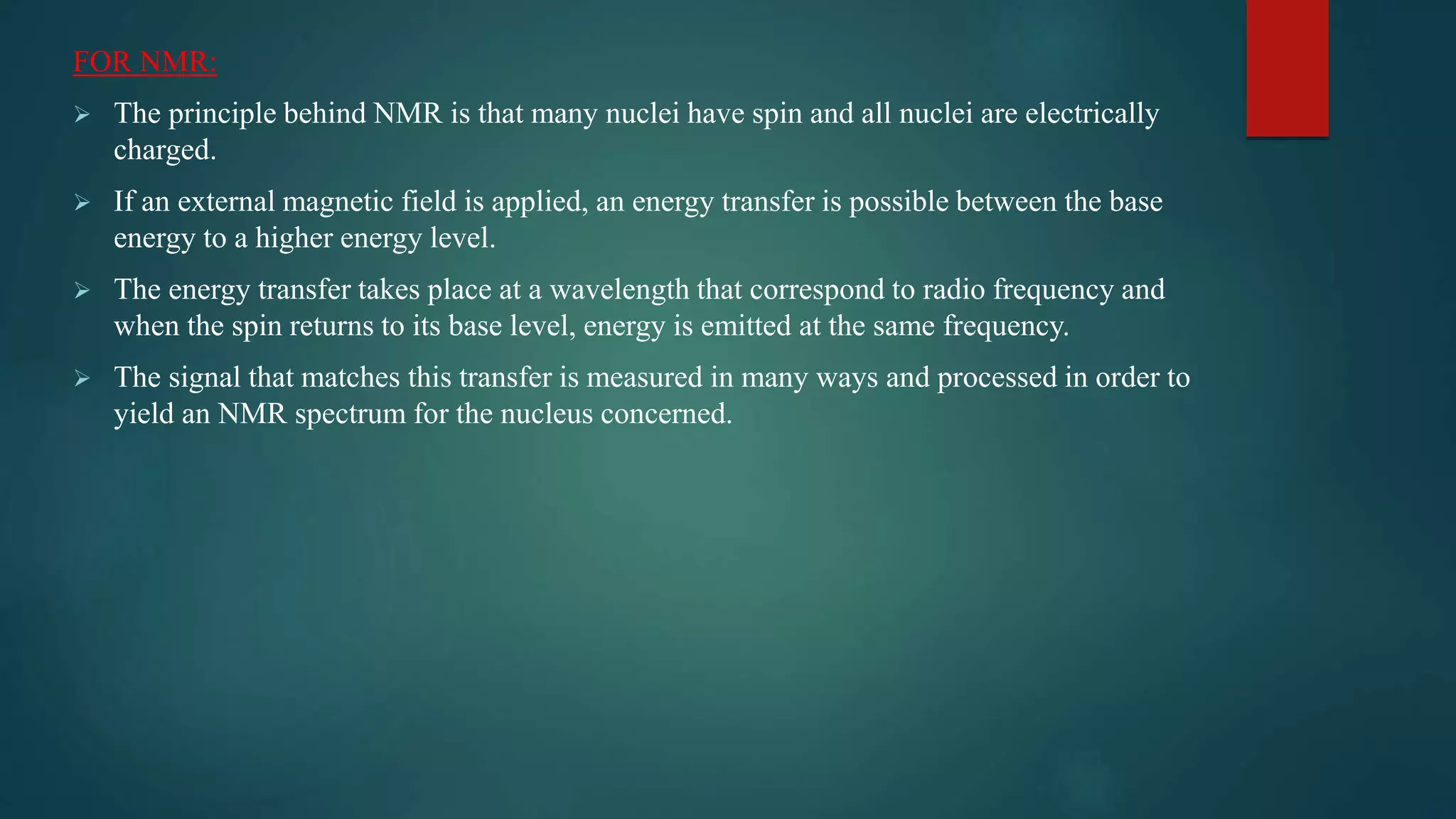
LC Unit
Asshown in the instrumentation diagram , HPLC instrumentation include solvent , Pump,
injector, column, detector and out put mean work station
1) Solvent Reservoir : Mobile phase contained in a glass reservoir. It is a mixture of polar
and non- polar liquid whose concentration varied depend on composition of sample.
2) Pump : A pump aspirate the mobile phase from solvent reservoir and force it through
system column and detector. Operating pressure for pump is 45000 kPa.
3) Sample Injector : The injector used is single injection or automated injection system.
The injector for HPLC should be provide injection of liquid sample in range of 0.1-
100 ml of volume.
4) Columns : It is made up of stainless steel between 50 and 300 mm long. They are filled
with stationary phase with particle size 3 – 10 um. Column internal diameter less than
2 mm
5) Detector : The detector used are UV spectroscopy, fluorescence, mass- spectrometric
and electrochemical detectors and it detect the analyte elute from the chromatographic
column.
6) Output ( Data collection device) : signal from detector collect on recorder as computer
device.
8.
LC- NMRinterface
1) Direct Coupling: It include direct flow of LC effluent in to NMR flow cell and
continuous recording of spectra
Post-column splitter
Valve-switching interface i.e BNMI (Bruker NMR-mass spectrometry interface)
2) Indirect Coupling:
Intermediate storage loop which transfer outlet of LC to NMR flow cell at specified
time interval
SPE unit
9.
NMR Unit
BasicallyNMR instrumentation involve following unit:
1) Magnet : It separate nuclear spin energy state.
2) Two RF channel : one for field / frequency stabilization. And other for supply RF
irradiating energy.
3) Sample probe : It contain coil that coupling the sample with RF field. It consist of
sample holder, RF oscillator, and RF receiver.
4) Detector : It proceed the NMR signals.
5) Recorder : It display the spectrum
10.
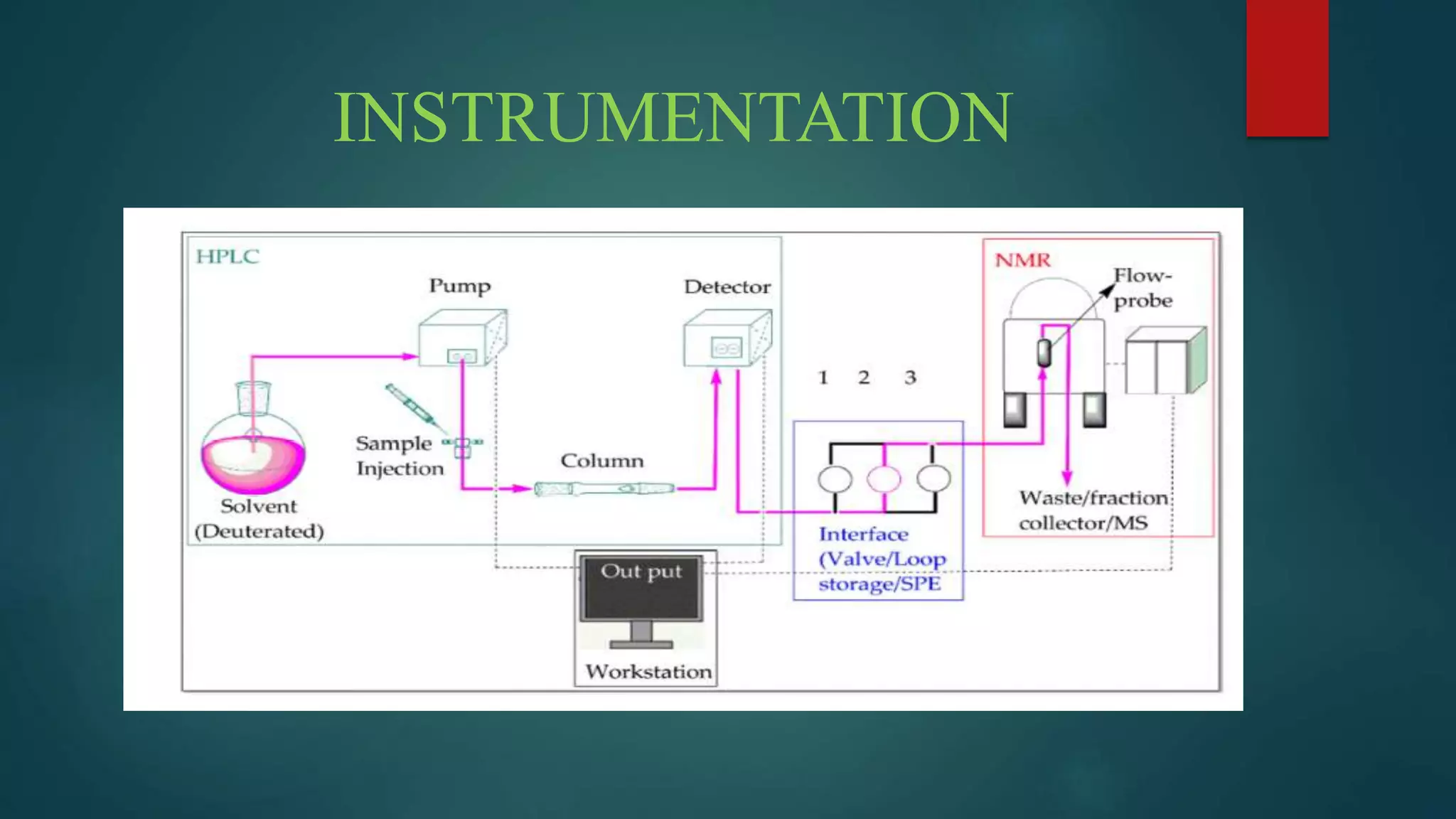
Modes OfLC-NMR
1. Continuous flow(on flow):- Eluent sampled in “real-time” as flowing through NMR detection coil
2. Stopped flow:- Pump is stopped at desired location and data acquired
3. Time slices:- Regions, or “time-slices” of interest are analyzed
4. Peak parking:- Peaks of interest are “parked” in off-line sample loops
5. Peak trapping:- Solid phase extraction cartridges are used to “re-concentrate” samples
1) ON FLOW MODE:
The outlet of the LC-detector is connected directly to the NMR probe. While the peaks are
eluting, NMR spectra are continuously acquired
The chromatographic system is used to move the samples/peaks through the NMR cell
Equipment: - any HPLC system, which delivers a stable pulse free flow.
- Lc-NMR probe
- Lc -NMR interface not required
- With any of the LC-NMR interface, this working mode is also possible, however they are
not required
11.
2) STOPPED FLOWMETHOD
The outlet of the lc-detector is connected directly to the NMR probe. A lc-detector (
normally UV ) is used to detect peaks eluting from the colum
When a peak is detected, the flow continues until the peak arrives in the NMR cell.
At this time, the chromatography ( pump, data acquisition, gradient ) stops and the NMR
experiments are performed
Once the NMR experiments are completed, the chromatography resumes until the next peak
is found.
This process can be repeated several times within one chromatogram
Equipment :- HPLC system
- LC-NMR Probe
- - Controlling station
12.
3) TIME SLICEMETHOD
It include to stop the flow at short interval over the chromatography peak to time slice
different part of chromatography run
It is useful if there is poor chromatography separation or if compound under study have poor
or no UV chromophore or if the exact chromatography retention time is unknown
The data from such a time slice experiment referred as a total NMR chromatogram.
4) PEAK PARKING METHOD
The outlet of the LC-detector is connected to the sample loops of the BPSU-36 or BPSU-12.
A LC-detector ( normally UV ) is used to detect peaks eluting from the column
A detected peak is moved into one of the sample loops without interrupting the
chromatography. When the chromatography is completed, the HPLC pump is used to
transfer the peaks from the loops into the NMR probe
Equipment :- Any HPLC system
- Pump under control for transfer
- LC-NMR Probe
- BPSU-12
- Controlling station
13.
5) PEAK TRAPPINGMETHOD
The outlet of the LC-detector is connected to the SPE unit. A LC-detector ( normally
UV ) is used to detect peaks eluting from the column.
A detected peak is moved trapped on a SPE cartridge without interrupting the
chromatography
When the chromatography is completed, the chromatography solvents are removed and
the peak is transfer with fully deuterated solvents into the NMR probe
Equipment :- Any HPLC system
- pump under control for transfer
- LC-NMR Probe
- SPE system
- Controlling station
14.
ADVANTAGES OF LC-NMR
1.The information between the two (three) techniques is so orthogonal; HPLC methods
resolve “complexity of a mixture” by separation, whereas NMR resolves virtually any
structure question (especially with different experiments)
2. The NMR can determine if the LC peak impure
3. LC-NMR/MS is “THE” ultimate instrument
4. NMR data can be taken without complete separation of mixture
5. It is nondestructive technique
6. Sample can be stored for analysis by another method
15.
DISADVANTAGES OF LC-NMR
1.High costs
2. Capital equipment costs; long experiment times; partial use of 2H solvents
3. Operator training requirements
4. Doing LC-NMR/MS requires a unique set of skills.
5. Difficulty in solvent selection
6. Eg: TFA, phosphate buffers (great for NMR, but not MS)
Triethylamine (great for MS, but not NMR)
7. Stopping the pump (for NMR signal averaging) frequently may affect resolution of
method
8. Flow systems can clog up, and get dirty, and be hard to clean
16.
APPLICATION
1. Separation andcharacterization of peptide libraries
2. Combinatorial chemistry, phytochemical analysis, drug discovery
3. Identification of drug impurities
4. Characterization of isomers of acid glucoronides and vitamin A derivatives
5. Characterization of endogeneous and xenobiotics metabolites directly from biological
fluid
6. Combination of LC-NMR and LC-MS
7. Polymer analysis
8. LC-NMR allowed the differentiation of isomers and identification without reference
compounds
9. Drug metabolism (to analyze biofluids [i.e., Urine or plasma]








![APPLICATION
1. Separation and characterization of peptide libraries
2. Combinatorial chemistry, phytochemical analysis, drug discovery
3. Identification of drug impurities
4. Characterization of isomers of acid glucoronides and vitamin A derivatives
5. Characterization of endogeneous and xenobiotics metabolites directly from biological
fluid
6. Combination of LC-NMR and LC-MS
7. Polymer analysis
8. LC-NMR allowed the differentiation of isomers and identification without reference
compounds
9. Drug metabolism (to analyze biofluids [i.e., Urine or plasma]](https://image.slidesharecdn.com/liquidchromatography-nuclearmagneticresonancespectroscopy-210725153300/75/Liquid-chromatography-nuclear-magnetic-resonance-spectroscopy-16-2048.jpg)


![Noesy [autosaved]](https://cdn.slidesharecdn.com/ss_thumbnails/noesyautosaved-200728183752-thumbnail.jpg?width=640&height=640&fit=bounds)


![LC-NMR_spectroscopy[1].pptx](https://cdn.slidesharecdn.com/ss_thumbnails/lc-nmrspectroscopy1-230716191644-350e0242-thumbnail.jpg?width=640&height=640&fit=bounds)


![Gagandutt sharma(HPLC) [Pharmaceutics].pdf](https://cdn.slidesharecdn.com/ss_thumbnails/gaganduttsharmahplcpharmaceutics-231228113552-2e6d34b5-thumbnail.jpg?width=640&height=640&fit=bounds)


