ENTREPRENEURSHIP
COMPETENCY
Presented By:
Ankita Pal
Sanjana Saini
WHAT
IS
ENTREPRENEURSHIP
COMPETENCY?
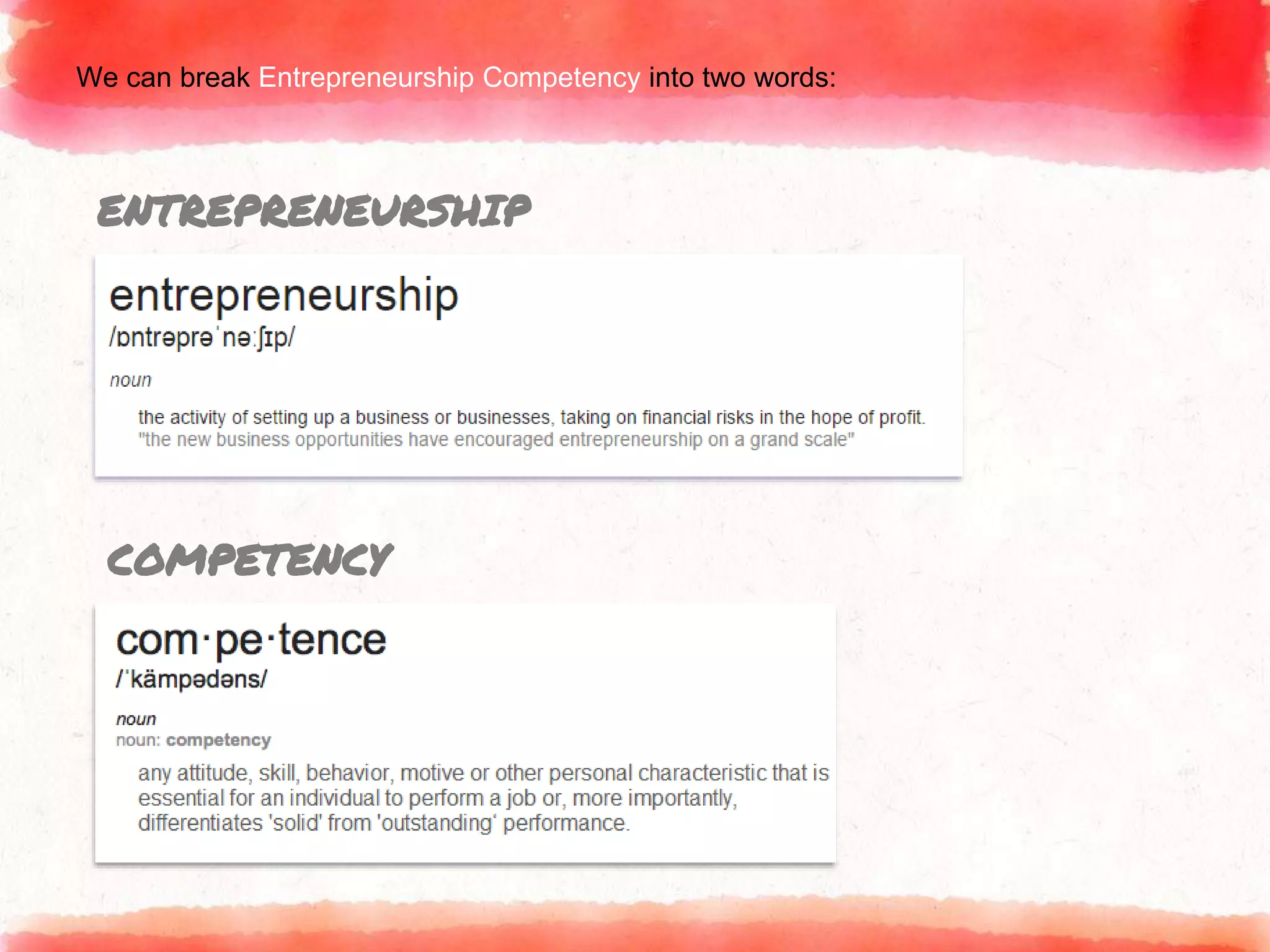
We can break Entrepreneurship Competency into two words:
ENTREPRENEURSHIP
COMPETENCY
“▸Thus, the term "Entrepreneurship Competency" refers to the key
characteristics that should be possessed by successful or budding
entrepreneurs in order to perform entrepreneurial functions effectively.
▸It can be defined as characteristics such as generic and specific
knowledge, motives, traits, self-images, social roles, and skills that result in
venture birth, survival, and/or growth.
TYPES OF COMPETENCIES
Competencies consist of a group of attributes, some of which are applicable to
all entrepreneurs, while others are occupation/industry specific.
Thus, many researchers depict competency as layers that are beneficial for
entrepreneurs in different industries and occupations.
Thus, the competencies can be divided into following categories:
1.Personal Entrepreneurial Competencies
2.Venture Initiation and Success Competencies
1.
Personal
Entrepreneurial
competencies
Personal Competency is often defined
as the extent to which an individual
has satisfactorily met the task
requirements for their job.
For example, an effective person
often has a high level of personal
productivity, stemming from a variety
of personal factors.
Personal effectiveness competencies
are particular important for
entrepreneurial success, as
entrepreneurs do not have a manager
or supervisor to assist with the
development of these abilities.
Personal Entrepreneurship Competency includes following factors that should be taken in
consideration to become a successful Entrepreneur:
LEADERSHIP
DECISION MAKING
MOTIVATION
RISK TAKING
LEADERSHIP
Leadership acts as a distinct area for both Research an Practice. It raises
many questions about the personal competencies of Entrepreneurial leaders
that enable them to successfully lead entrepreneurial endeavors.
Although identifying entrepreneur specific capabilities has been one of the
main focuses of entrepreneurship researches, our knowledge is limited about
the personal leadership competencies required in entrepreneurial context.
MOTIVATION
Motivation is regarded as
the inner state that
energizes activities and
directs or channels behavior
towards the goal.
It can also be seen as a
process that arouses action,
sustains the activity in
progress and that regulates
the pattern of activity.
Motivation is not a gift of
heredity but are the
outcome of the individual's
interaction with others or
the society.
RISK TAKING
Entrepreneurship means risk. Risk can be defined as possibility of failure or loss or other
adverse consequences in pursuing some activity or venture. Risk bearing and entrepreneurship
are inseparable from each other.
Risk-taking behavior is not inborn. We all have an inevitable but different risk-bearing orientation
based on our background, education, value-system, personality, experience, etc. Some of us
have high risk-taking orientation, some others have moderate risk-taking, and yet some
others have low risk- taking orientation.
Risk, as an attribute, affects entrepreneurial
behavior. The risk of walking away from security
and career path to create something new. The risk
of taking yourself and your family into an
unfamiliar storm of stress and uncertainty. The
risk that you've miscalculated an opportunity, or
your own internal resources as you plunge into a
new venture.
DECISION MAKING
Decision Making is all about employing one’s mental processes to
come up with a final choice after careful consideration of several
options or alternatives. The outcome of your decision could
significantly affect your work, your business, and even your life.
Effective and successful decisions make profit to the company and
unsuccessful ones make losses.
This is why in entrepreneurship, making intelligent decisions is
regarded as very important because it could mean the difference
between success and failure of your endeavor.
Usually, decision making is hard. Majority of corporate decisions
involve some level of dissatisfaction or conflict with another party.
WORKPLACE
COMPETENCIES
2 .
Workplace competency is defined as “the application of knowledge, skills, attitudes,
values, and behaviors” in the workplace. Workplace competencies develop from the
synthesis of an individual’s skills, knowledge, and abilities with on the job tasks and work
related experiences.
Workplace competencies give employees a clear guide for what is expected of them in
terms of their performance. They indicate which behaviors are valued, recognized and
rewarded.
Workplace Entrepreneurship Competency includes following factors that should be taken in
consideration to become a successful Entrepreneur:
NETWORKING
PLANNING &
ORGANISING
PROBLEM SOLVING
&
DECISION MAKING
TEAM WORK
CONCLUSION
In recent years, the competency approach has become an increasingly popular
means of studying entrepreneurship. Entrepreneurial Competencies can be
defined as underlying characteristics such as generic and specific
knowledge, motives, traits, self-images, social roles, and skills which result
in venture birth, survival, and/or growth.
All current research that involves entrepreneurial competencies implicitly
presumes that entrepreneurs are different from non-entrepreneurs in terms of
the competencies they possess.
THANK YOU.

Entrepreneurial Competency

  • 1.
  • 2.
  • 3.
    We can breakEntrepreneurship Competency into two words: ENTREPRENEURSHIP COMPETENCY
  • 4.
    “▸Thus, the term"Entrepreneurship Competency" refers to the key characteristics that should be possessed by successful or budding entrepreneurs in order to perform entrepreneurial functions effectively. ▸It can be defined as characteristics such as generic and specific knowledge, motives, traits, self-images, social roles, and skills that result in venture birth, survival, and/or growth.
  • 5.
    TYPES OF COMPETENCIES Competenciesconsist of a group of attributes, some of which are applicable to all entrepreneurs, while others are occupation/industry specific. Thus, many researchers depict competency as layers that are beneficial for entrepreneurs in different industries and occupations. Thus, the competencies can be divided into following categories: 1.Personal Entrepreneurial Competencies 2.Venture Initiation and Success Competencies
  • 6.
  • 7.
    Personal Competency isoften defined as the extent to which an individual has satisfactorily met the task requirements for their job. For example, an effective person often has a high level of personal productivity, stemming from a variety of personal factors. Personal effectiveness competencies are particular important for entrepreneurial success, as entrepreneurs do not have a manager or supervisor to assist with the development of these abilities.
  • 8.
    Personal Entrepreneurship Competencyincludes following factors that should be taken in consideration to become a successful Entrepreneur: LEADERSHIP DECISION MAKING MOTIVATION RISK TAKING
  • 9.
  • 10.
    Leadership acts asa distinct area for both Research an Practice. It raises many questions about the personal competencies of Entrepreneurial leaders that enable them to successfully lead entrepreneurial endeavors. Although identifying entrepreneur specific capabilities has been one of the main focuses of entrepreneurship researches, our knowledge is limited about the personal leadership competencies required in entrepreneurial context.
  • 11.
  • 12.
    Motivation is regardedas the inner state that energizes activities and directs or channels behavior towards the goal. It can also be seen as a process that arouses action, sustains the activity in progress and that regulates the pattern of activity. Motivation is not a gift of heredity but are the outcome of the individual's interaction with others or the society.
  • 13.
  • 14.
    Entrepreneurship means risk.Risk can be defined as possibility of failure or loss or other adverse consequences in pursuing some activity or venture. Risk bearing and entrepreneurship are inseparable from each other. Risk-taking behavior is not inborn. We all have an inevitable but different risk-bearing orientation based on our background, education, value-system, personality, experience, etc. Some of us have high risk-taking orientation, some others have moderate risk-taking, and yet some others have low risk- taking orientation. Risk, as an attribute, affects entrepreneurial behavior. The risk of walking away from security and career path to create something new. The risk of taking yourself and your family into an unfamiliar storm of stress and uncertainty. The risk that you've miscalculated an opportunity, or your own internal resources as you plunge into a new venture.
  • 15.
  • 16.
    Decision Making isall about employing one’s mental processes to come up with a final choice after careful consideration of several options or alternatives. The outcome of your decision could significantly affect your work, your business, and even your life. Effective and successful decisions make profit to the company and unsuccessful ones make losses. This is why in entrepreneurship, making intelligent decisions is regarded as very important because it could mean the difference between success and failure of your endeavor. Usually, decision making is hard. Majority of corporate decisions involve some level of dissatisfaction or conflict with another party.
  • 17.
  • 18.
    Workplace competency isdefined as “the application of knowledge, skills, attitudes, values, and behaviors” in the workplace. Workplace competencies develop from the synthesis of an individual’s skills, knowledge, and abilities with on the job tasks and work related experiences. Workplace competencies give employees a clear guide for what is expected of them in terms of their performance. They indicate which behaviors are valued, recognized and rewarded.
  • 19.
    Workplace Entrepreneurship Competencyincludes following factors that should be taken in consideration to become a successful Entrepreneur: NETWORKING PLANNING & ORGANISING PROBLEM SOLVING & DECISION MAKING TEAM WORK
  • 20.
    CONCLUSION In recent years,the competency approach has become an increasingly popular means of studying entrepreneurship. Entrepreneurial Competencies can be defined as underlying characteristics such as generic and specific knowledge, motives, traits, self-images, social roles, and skills which result in venture birth, survival, and/or growth. All current research that involves entrepreneurial competencies implicitly presumes that entrepreneurs are different from non-entrepreneurs in terms of the competencies they possess.
  • 21.