TERPENOIDS :
CUCURBITACIN
A Seminar on
SUBMITTED TO :
Miss B. R. Gupta
Dept. of Pharmacognosy
PRESENTED BY :
Miss S. A. Salve
1st Year M.Pharmacy
Dept of Pharmacognosy
Department of Pharmacognosy
MGV’s Pharmacy College, Panchavati, Nashik
CONTENTS
• Introduction
• Characterization
• Biosynthesis
• Isolation
• Purification
• Medicinal Uses
• References
INTRODUCTION
What is TERPENOIDS?
• The terpenoids sometimes called isoprenoids, are a large and
diverse class of naturally occurring organic chemicals derived
from terpenoids.
• Terpenoids are hydrocarbons of plant origin of the general
formula (C5H8)n as well as their originated, hydrogen and
dehydrogenated derivatives.
• Plant terpenoids are used for their aromatic qualities and play
a role in traditional herbals remedies.
CHARACTERIZATION
• Terpenoids are colourless liquids.
• Soluble in organic solvent and insoluble in water.
• Volatile in nature
• Boiling Point is around 150-180°C
• They are unsaturated compound.
• Basically it contain isoprene unit in chemical structure.
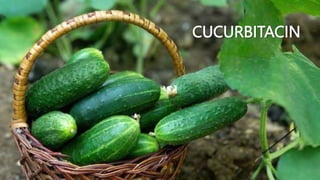
CUCURBITACIN
INTRODUCTION
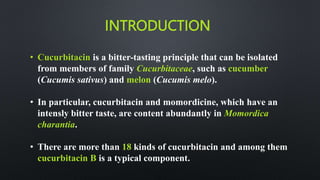
• Cucurbitacin is a bitter-tasting principle that can be isolated
from members of family Cucurbitaceae, such as cucumber
(Cucumis sativus) and melon (Cucumis melo).
• In particular, cucurbitacin and momordicine, which have an
intensly bitter taste, are content abundantly in Momordica
charantia.
• There are more than 18 kinds of cucurbitacin and among them
cucurbitacin B is a typical component.
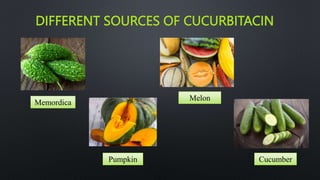
DIFFERENT SOURCES OF CUCURBITACIN
Memordica
Melon
Pumpkin Cucumber
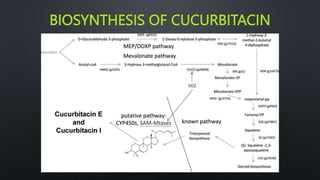
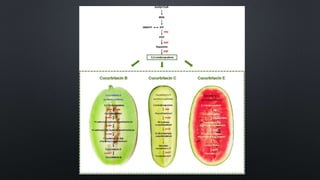
BIOSYNTHESIS OF CUCURBITACIN
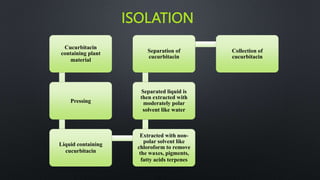
ISOLATION
Cucurbitacin
containing plant
material
Pressing
Liquid containing
cucurbitacin
Extracted with non-
polar solvent like
chloroform to remove
the waxes, pigments,
fatty acids terpenes
Separated liquid is
then extracted with
moderately polar
solvent like water
Separation of
cucurbitacin
Collection of
cucurbitacin
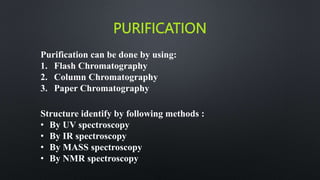
PURIFICATION
Purification can be done by using:
1. Flash Chromatography
2. Column Chromatography
3. Paper Chromatography
Structure identify by following methods :
• By UV spectroscopy
• By IR spectroscopy
• By MASS spectroscopy
• By NMR spectroscopy
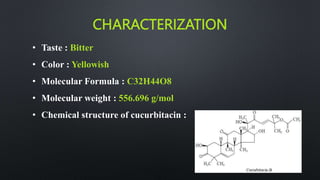
CHARACTERIZATION
• Taste : Bitter
• Color : Yellowish
• Molecular Formula : C32H44O8
• Molecular weight : 556.696 g/mol
• Chemical structure of cucurbitacin :
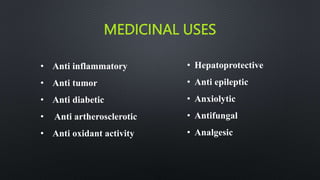
MEDICINAL USES
• Anti inflammatory
• Anti tumor
• Anti diabetic
• Anti artherosclerotic
• Anti oxidant activity
• Hepatoprotective
• Anti epileptic
• Anxiolytic
• Antifungal
• Analgesic
REFERENCES
1. Ujjwal Kaushik, Vidhu Aeri, Showkat R. Mir, Cucurbitacin – An
insight into medical leads from nature, January-June 2015,
Volume 9, Issue 17, Page no. 12-18
2. Dr. Abdullah A. Alghasham, Cucurbitacin – A Promising Target
for Cancer Therapy, International Journal of Health Sciences
(Qassim University) 2013 Jan; Volume 7(1), Page no. 77-89
3. Ashmi Samual, Cucurbitacins and its Anticancer property: A
Review, Himalayan Journal of Health Sciences, Volume 4, Issue 4;
Oct – Dec 2019

Terpenoids Cucurbitacin.pptx

  • 1.
    TERPENOIDS : CUCURBITACIN A Seminaron SUBMITTED TO : Miss B. R. Gupta Dept. of Pharmacognosy PRESENTED BY : Miss S. A. Salve 1st Year M.Pharmacy Dept of Pharmacognosy Department of Pharmacognosy MGV’s Pharmacy College, Panchavati, Nashik
  • 2.
    CONTENTS • Introduction • Characterization •Biosynthesis • Isolation • Purification • Medicinal Uses • References
  • 3.
    INTRODUCTION What is TERPENOIDS? •The terpenoids sometimes called isoprenoids, are a large and diverse class of naturally occurring organic chemicals derived from terpenoids. • Terpenoids are hydrocarbons of plant origin of the general formula (C5H8)n as well as their originated, hydrogen and dehydrogenated derivatives. • Plant terpenoids are used for their aromatic qualities and play a role in traditional herbals remedies.
  • 4.
    CHARACTERIZATION • Terpenoids arecolourless liquids. • Soluble in organic solvent and insoluble in water. • Volatile in nature • Boiling Point is around 150-180°C • They are unsaturated compound. • Basically it contain isoprene unit in chemical structure.
  • 5.
  • 6.
    INTRODUCTION • Cucurbitacin isa bitter-tasting principle that can be isolated from members of family Cucurbitaceae, such as cucumber (Cucumis sativus) and melon (Cucumis melo). • In particular, cucurbitacin and momordicine, which have an intensly bitter taste, are content abundantly in Momordica charantia. • There are more than 18 kinds of cucurbitacin and among them cucurbitacin B is a typical component.
  • 7.
    DIFFERENT SOURCES OFCUCURBITACIN Memordica Melon Pumpkin Cucumber
  • 8.
  • 10.
    ISOLATION Cucurbitacin containing plant material Pressing Liquid containing cucurbitacin Extractedwith non- polar solvent like chloroform to remove the waxes, pigments, fatty acids terpenes Separated liquid is then extracted with moderately polar solvent like water Separation of cucurbitacin Collection of cucurbitacin
  • 11.
    PURIFICATION Purification can bedone by using: 1. Flash Chromatography 2. Column Chromatography 3. Paper Chromatography Structure identify by following methods : • By UV spectroscopy • By IR spectroscopy • By MASS spectroscopy • By NMR spectroscopy
  • 12.
    CHARACTERIZATION • Taste :Bitter • Color : Yellowish • Molecular Formula : C32H44O8 • Molecular weight : 556.696 g/mol • Chemical structure of cucurbitacin :
  • 13.
    MEDICINAL USES • Antiinflammatory • Anti tumor • Anti diabetic • Anti artherosclerotic • Anti oxidant activity • Hepatoprotective • Anti epileptic • Anxiolytic • Antifungal • Analgesic
  • 14.
    REFERENCES 1. Ujjwal Kaushik,Vidhu Aeri, Showkat R. Mir, Cucurbitacin – An insight into medical leads from nature, January-June 2015, Volume 9, Issue 17, Page no. 12-18 2. Dr. Abdullah A. Alghasham, Cucurbitacin – A Promising Target for Cancer Therapy, International Journal of Health Sciences (Qassim University) 2013 Jan; Volume 7(1), Page no. 77-89 3. Ashmi Samual, Cucurbitacins and its Anticancer property: A Review, Himalayan Journal of Health Sciences, Volume 4, Issue 4; Oct – Dec 2019