Advanced Pharmacognosy-II
Adulteration & Deterioration
Topic: Introduction, Type of Adulteration,
Causes & Measures of Adulteration
Presented by :
Miss Shruti Ashok Salve
F. Y. M. Pharmacy
Dept. of Pharmacognosy
M.G.V’s Pharmacy College
Panchavati, Nashik.
Literature Review
Yadav NP, Dixit VK. Recent approaches in herbal drug standardization,
Int J Integr Biol. 2008;2(3)
The quality control standards of various medicinal plants used in indigenous
system of medicine are becoming more relevant today in view of commercialization of
formulations based on medicinal plants. For standardization and quality assurance
purposes, following 3 attributes are desirable i) Authenticity, ii) Purity and iii) Assay.
Authenticity relates to proving that the material is true. Authentication in itself
involves many parameters including gross morphology, microscopy, chemical
analysis and DNA fingerprinting. Purity pertains to evaluating that there are no
adulterants present in the plant material. Assay part of standardization is chemical
and biological profiling which could assess the chemical effects.
Literature Review
Calahan J, Howard D, Almalki AJ, Gupta MP, Chemical Adulterants in
Herbal Medicinal Products: A Review: Planta Medica, 2016
Many herbal medicinal products have been found to contain synthetic
prescription drugs as chemical adulterants. This is become evident by the number of
toxicity cases and adverse reactions reported in which casualties were reported via
analytical techniques that detected the presence of chemical adulterants in them,
which could be responsible for their toxicity. The adulteration of herbal medicinal
products with synthetic drugs continues to be a serious problem for regulatory
agencies. This review provides up to date information on cases of toxicity, major
chemical adulterants in herbal medicinal products, and current analytical techniques
used for their detection.
List of content
1. Literature Review
2. Introduction
3. Types of adulteration
a) Intentional Adulteration
b) Un-intentional Adulteration
4. Causes & measures of adulteration
5. Disadvantages of adulteration
6. References
Introduction
• What is Adulteration?
• Adulteration is a process/practice of substituting the original
drug/herb with completely or partially similar looking substance.
• The substance may be inferior in quality or may be therapeutically
inactive.
• What is Deterioration?
• It is the process of degradation or destruction of herbs which leads to
loss of therapeutic activity of the drug/herb.
• Deterioration & Adulteration are inter-related and deterioration is the
main effect of adulteration.
Types of Adulteration.
Adulteration is classified into 2 types:
1. Intentional Adulteration:
• As the name itself indicates the intentional adulteration is the process where
the substitution of drug/herb is done in full awareness this type of
adulteration is commonly done by suppliers/manufacturers.
2. Un-intentional Adulteration:
• This is the second type of adulteration where the substitution of drug/ herbs
happens without the knowledge of manufacturer/supplier.
• Reasons for Intentional adulteration:
1. Due to high prices of original herb/ drugs.
2. Due to lack of availability of the drug/herbs.
3. To earn more profits by substituting the herbs by the herb of lesser price.
• Types of Intentional adulteration:
1. Substitution with inferior varieties.
2. Adulteration by artificially manufactured substance.
3. Usage of vegetative part of same plant.
4. Substitution with superficially similar but cheaper natural drug substance.
5. Addition of synthetic principles/ exhausted drug.
Methods Used For Types Of Intentional Adulteration
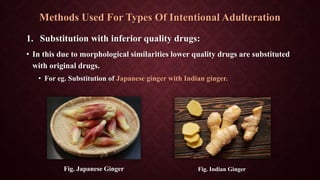
1. Substitution with inferior quality drugs:
• In this due to morphological similarities lower quality drugs are substituted
with original drugs.
• For eg. Substitution of Japanese ginger with Indian ginger.
Fig. Japanese Ginger Fig. Indian Ginger
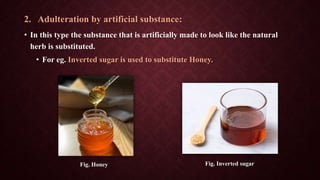
2. Adulteration by artificial substance:
• In this type the substance that is artificially made to look like the natural
herb is substituted.
• For eg. Inverted sugar is used to substitute Honey.
Fig. Honey Fig. Inverted sugar
3. Substitution by exhausted drugs:
• In this type of adulteration the therapeutically inactive substance is substituted
with original drugs.
• For eg. Clove & Fennel are substituted with the original drugs after volatile
oils are extracted from them.
Fig. Clove & Exhausted Clove Fig. Fennel & Exhausted Fennel
Un-intentional Adulteration
• Reasons of Un-intentional adulteration:
1. Confusion in the name of herbs
2. Lack of knowledge of authentic source
3. Due to similarity in Morphology & Aroma
4. Lack of availability
5. Careless collection/ improper collection
6. Improper storage
Reasons of un-intentional Adulteration
1. Confusion in names:
• In India different languages are spoken in different areas thus in such cases
unintentional adulteration occurs due to local/ vernacular names.
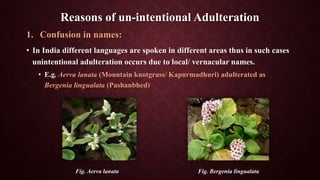
• E.g. Aerva lanata (Mountain knotgrass/ Kapurmadhuri) adulterated as
Bergenia lingualata (Pashanbhed)
Fig. Aerva lanata Fig. Bergenia lingualata
2. Lack of knowledge about authentic source
• The suppliers/ manufacturers are often unaware about the authentic source
of the plants this may lead to the unintentional adulterations.
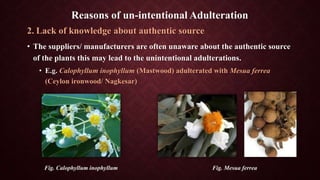
• E.g. Calophyllum inophyllum (Mastwood) adulterated with Mesua ferrea
(Ceylon ironwood/ Nagkesar)
Fig. Calophyllum inophyllum Fig. Mesua ferrea
Reasons of un-intentional Adulteration
3. Similarity in morphology of plants
• This type of adulteration lies under intentional and unintentional
adulteration in this class as the morphology of the herb is same adulteration
occurs without the knowledge of manufacturers.
• E.g. Mucuna deeringiana are used for Mucuna pruriens
4. Lack of availability
• Due to scarcity of the authentic or original drugs of some species
adulteration occurs unintentionally.
Reasons of un-intentional Adulteration
5. Careless collection/ improper collection:
• Definite part of herb should be collected in particular season, place and
part of plant should be collected but ignorance of these things during
collection and drugs collected carelessly may cause adulteration.
6. Improper storage
• Due to improper storage physical factors such as air, humidity, light and
temperature can bring about deterioration directly or indirectly and use
of such type of drug acts as adulteration.
Reasons of un-intentional Adulteration
Causes & Measures of Adulteration.
1. Inferiority
2. Spoilage
3. Deterioration
4. Admixture
5. Substitution
Causes & Measures of Adulteration
1. Inferiority
• It is the lack of quality of the drug/herbs.
• For eg. Indian Senna adulterated with Arabian senna
 Measure: This can be avoided by proper / careful selection of the plants.
2. Spoilage
• A condition of the herb where it is improper for administration due to attack of micro
organisms over the herb.
 Measure: This can be avoided by proper drying of the herb and preserving it at proper
storage conditions.
3. Deterioration
• It is an impairment of the quality or value of the herb due to destruction of valuable
constituents of the drug.
 Measure: The only way to avoid this is to make herbs available from the authentic sources
& to carry out evaluation of the herb samples.
• For eg. Ash Value testing, Heavy metal testing
4. Admixture
• It is the process of addition of worthless material to the herb due to an accident,
ignorance, or carelessness.
 Measure: It can be avoided by careful evaluation of foreign matter as per monograph and
skilled personnel handling of the herbs.
Causes & Measures of Adulteration
5. Substitution
• This cause of adulteration deals with complete replacement of original drug with
duplicate drug.
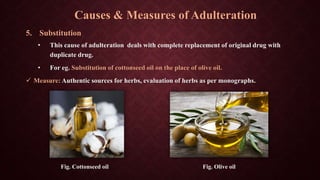
• For eg. Substitution of cottonseed oil on the place of olive oil.
 Measure: Authentic sources for herbs, evaluation of herbs as per monographs.
Fig. Cottonseed oil Fig. Olive oil
Causes & Measures of Adulteration
Disadvantages of adulteration
1. Denaturation and degradation of herbs
2. Leads to deterioration of product.
3. Complete destruction of active principles of herb may occur.
4. Damage to the dosage forms.
5. Alteration in nature of drugs.
6. May cause damage to the patient.
7. May cause unwanted side effects.
8. Causes increase in the price of the product.
References
1. Srirama R, Santhosh Kumar JU, Seethapathy GS, Newmaster SG,
Ragupathy S, Ganeshaiah KN, Uma Shaanker R, Ravikanth G. Species
adulteration in the herbal trade: causes, consequences and mitigation.
Drug safety, 2017 Aug
2. Posadzki P, Watson L, Ernst E. Contamination and adulteration of herbal
medicinal products (HMPs): an overview of systematic reviews, European
journal of clinical pharmacology, 2013
3. Snyman T, Stewart MJ, Grove A, Steenkamp V. Adulteration of South
African traditional herbal remedies, Therapeutic Drug Monitoring, Feb
2005
References
4. Osman AG, Raman V, Haider S, Ali Z, Chittiboyina AG, Khan IA. Overview
of analytical tools for the identification of adulterants in commonly traded
herbs and spices, Journal of AOAC International 2019
5. Santhosh Kumar JU, Krishna V, Seethapathy GS, Ganesan R, Ravikanth G,
Shaanker RU. Assessment of adulteration in raw herbal trade of important
medicinal plants of India using DNA barcoding, 3 Biotech Mar 2018
6. Yadav NP, Dixit VK. Recent approaches in herbal drug standardization. Int J
Integr Biol. 2008; 2(3).
THANK YOU

Adulteration

  • 1.
    Advanced Pharmacognosy-II Adulteration &Deterioration Topic: Introduction, Type of Adulteration, Causes & Measures of Adulteration Presented by : Miss Shruti Ashok Salve F. Y. M. Pharmacy Dept. of Pharmacognosy M.G.V’s Pharmacy College Panchavati, Nashik.
  • 2.
    Literature Review Yadav NP,Dixit VK. Recent approaches in herbal drug standardization, Int J Integr Biol. 2008;2(3) The quality control standards of various medicinal plants used in indigenous system of medicine are becoming more relevant today in view of commercialization of formulations based on medicinal plants. For standardization and quality assurance purposes, following 3 attributes are desirable i) Authenticity, ii) Purity and iii) Assay. Authenticity relates to proving that the material is true. Authentication in itself involves many parameters including gross morphology, microscopy, chemical analysis and DNA fingerprinting. Purity pertains to evaluating that there are no adulterants present in the plant material. Assay part of standardization is chemical and biological profiling which could assess the chemical effects.
  • 3.
    Literature Review Calahan J,Howard D, Almalki AJ, Gupta MP, Chemical Adulterants in Herbal Medicinal Products: A Review: Planta Medica, 2016 Many herbal medicinal products have been found to contain synthetic prescription drugs as chemical adulterants. This is become evident by the number of toxicity cases and adverse reactions reported in which casualties were reported via analytical techniques that detected the presence of chemical adulterants in them, which could be responsible for their toxicity. The adulteration of herbal medicinal products with synthetic drugs continues to be a serious problem for regulatory agencies. This review provides up to date information on cases of toxicity, major chemical adulterants in herbal medicinal products, and current analytical techniques used for their detection.
  • 4.
    List of content 1.Literature Review 2. Introduction 3. Types of adulteration a) Intentional Adulteration b) Un-intentional Adulteration 4. Causes & measures of adulteration 5. Disadvantages of adulteration 6. References
  • 5.
    Introduction • What isAdulteration? • Adulteration is a process/practice of substituting the original drug/herb with completely or partially similar looking substance. • The substance may be inferior in quality or may be therapeutically inactive. • What is Deterioration? • It is the process of degradation or destruction of herbs which leads to loss of therapeutic activity of the drug/herb. • Deterioration & Adulteration are inter-related and deterioration is the main effect of adulteration.
  • 6.
    Types of Adulteration. Adulterationis classified into 2 types: 1. Intentional Adulteration: • As the name itself indicates the intentional adulteration is the process where the substitution of drug/herb is done in full awareness this type of adulteration is commonly done by suppliers/manufacturers. 2. Un-intentional Adulteration: • This is the second type of adulteration where the substitution of drug/ herbs happens without the knowledge of manufacturer/supplier.
  • 7.
    • Reasons forIntentional adulteration: 1. Due to high prices of original herb/ drugs. 2. Due to lack of availability of the drug/herbs. 3. To earn more profits by substituting the herbs by the herb of lesser price. • Types of Intentional adulteration: 1. Substitution with inferior varieties. 2. Adulteration by artificially manufactured substance. 3. Usage of vegetative part of same plant. 4. Substitution with superficially similar but cheaper natural drug substance. 5. Addition of synthetic principles/ exhausted drug.
  • 8.
    Methods Used ForTypes Of Intentional Adulteration 1. Substitution with inferior quality drugs: • In this due to morphological similarities lower quality drugs are substituted with original drugs. • For eg. Substitution of Japanese ginger with Indian ginger. Fig. Japanese Ginger Fig. Indian Ginger
  • 9.
    2. Adulteration byartificial substance: • In this type the substance that is artificially made to look like the natural herb is substituted. • For eg. Inverted sugar is used to substitute Honey. Fig. Honey Fig. Inverted sugar
  • 10.
    3. Substitution byexhausted drugs: • In this type of adulteration the therapeutically inactive substance is substituted with original drugs. • For eg. Clove & Fennel are substituted with the original drugs after volatile oils are extracted from them. Fig. Clove & Exhausted Clove Fig. Fennel & Exhausted Fennel
  • 11.
    Un-intentional Adulteration • Reasonsof Un-intentional adulteration: 1. Confusion in the name of herbs 2. Lack of knowledge of authentic source 3. Due to similarity in Morphology & Aroma 4. Lack of availability 5. Careless collection/ improper collection 6. Improper storage
  • 12.
    Reasons of un-intentionalAdulteration 1. Confusion in names: • In India different languages are spoken in different areas thus in such cases unintentional adulteration occurs due to local/ vernacular names. • E.g. Aerva lanata (Mountain knotgrass/ Kapurmadhuri) adulterated as Bergenia lingualata (Pashanbhed) Fig. Aerva lanata Fig. Bergenia lingualata
  • 13.
    2. Lack ofknowledge about authentic source • The suppliers/ manufacturers are often unaware about the authentic source of the plants this may lead to the unintentional adulterations. • E.g. Calophyllum inophyllum (Mastwood) adulterated with Mesua ferrea (Ceylon ironwood/ Nagkesar) Fig. Calophyllum inophyllum Fig. Mesua ferrea Reasons of un-intentional Adulteration
  • 14.
    3. Similarity inmorphology of plants • This type of adulteration lies under intentional and unintentional adulteration in this class as the morphology of the herb is same adulteration occurs without the knowledge of manufacturers. • E.g. Mucuna deeringiana are used for Mucuna pruriens 4. Lack of availability • Due to scarcity of the authentic or original drugs of some species adulteration occurs unintentionally. Reasons of un-intentional Adulteration
  • 15.
    5. Careless collection/improper collection: • Definite part of herb should be collected in particular season, place and part of plant should be collected but ignorance of these things during collection and drugs collected carelessly may cause adulteration. 6. Improper storage • Due to improper storage physical factors such as air, humidity, light and temperature can bring about deterioration directly or indirectly and use of such type of drug acts as adulteration. Reasons of un-intentional Adulteration
  • 16.
    Causes & Measuresof Adulteration. 1. Inferiority 2. Spoilage 3. Deterioration 4. Admixture 5. Substitution
  • 17.
    Causes & Measuresof Adulteration 1. Inferiority • It is the lack of quality of the drug/herbs. • For eg. Indian Senna adulterated with Arabian senna  Measure: This can be avoided by proper / careful selection of the plants. 2. Spoilage • A condition of the herb where it is improper for administration due to attack of micro organisms over the herb.  Measure: This can be avoided by proper drying of the herb and preserving it at proper storage conditions.
  • 18.
    3. Deterioration • Itis an impairment of the quality or value of the herb due to destruction of valuable constituents of the drug.  Measure: The only way to avoid this is to make herbs available from the authentic sources & to carry out evaluation of the herb samples. • For eg. Ash Value testing, Heavy metal testing 4. Admixture • It is the process of addition of worthless material to the herb due to an accident, ignorance, or carelessness.  Measure: It can be avoided by careful evaluation of foreign matter as per monograph and skilled personnel handling of the herbs. Causes & Measures of Adulteration
  • 19.
    5. Substitution • Thiscause of adulteration deals with complete replacement of original drug with duplicate drug. • For eg. Substitution of cottonseed oil on the place of olive oil.  Measure: Authentic sources for herbs, evaluation of herbs as per monographs. Fig. Cottonseed oil Fig. Olive oil Causes & Measures of Adulteration
  • 20.
    Disadvantages of adulteration 1.Denaturation and degradation of herbs 2. Leads to deterioration of product. 3. Complete destruction of active principles of herb may occur. 4. Damage to the dosage forms. 5. Alteration in nature of drugs. 6. May cause damage to the patient. 7. May cause unwanted side effects. 8. Causes increase in the price of the product.
  • 21.
    References 1. Srirama R,Santhosh Kumar JU, Seethapathy GS, Newmaster SG, Ragupathy S, Ganeshaiah KN, Uma Shaanker R, Ravikanth G. Species adulteration in the herbal trade: causes, consequences and mitigation. Drug safety, 2017 Aug 2. Posadzki P, Watson L, Ernst E. Contamination and adulteration of herbal medicinal products (HMPs): an overview of systematic reviews, European journal of clinical pharmacology, 2013 3. Snyman T, Stewart MJ, Grove A, Steenkamp V. Adulteration of South African traditional herbal remedies, Therapeutic Drug Monitoring, Feb 2005
  • 22.
    References 4. Osman AG,Raman V, Haider S, Ali Z, Chittiboyina AG, Khan IA. Overview of analytical tools for the identification of adulterants in commonly traded herbs and spices, Journal of AOAC International 2019 5. Santhosh Kumar JU, Krishna V, Seethapathy GS, Ganesan R, Ravikanth G, Shaanker RU. Assessment of adulteration in raw herbal trade of important medicinal plants of India using DNA barcoding, 3 Biotech Mar 2018 6. Yadav NP, Dixit VK. Recent approaches in herbal drug standardization. Int J Integr Biol. 2008; 2(3).
  • 23.