Introduction to DID Auth
Markus Sabadello
Danube Tech, Decentralized Identity Foundation,
Sovrin Foundation, W3C VCWG, W3C CCG, OASIS
XDI TC
In a self-sovereign world, how can I prove that “I am me” ?
11th
July 2018, markus@danubetech.com
https://creativecommons.org/licenses/by-sa/4.0/
1. Empower global SSI communities
2. Open to everyone interested in SSI
3. All content is shared with CC BY SA
SSIMeetup.org
Alex Preukschat @SSIMeetup @AlexPreukschat
Coordinating Node SSIMeetup.org
https://creativecommons.org/licenses/by-sa/4.0/
SSIMeetup objectives
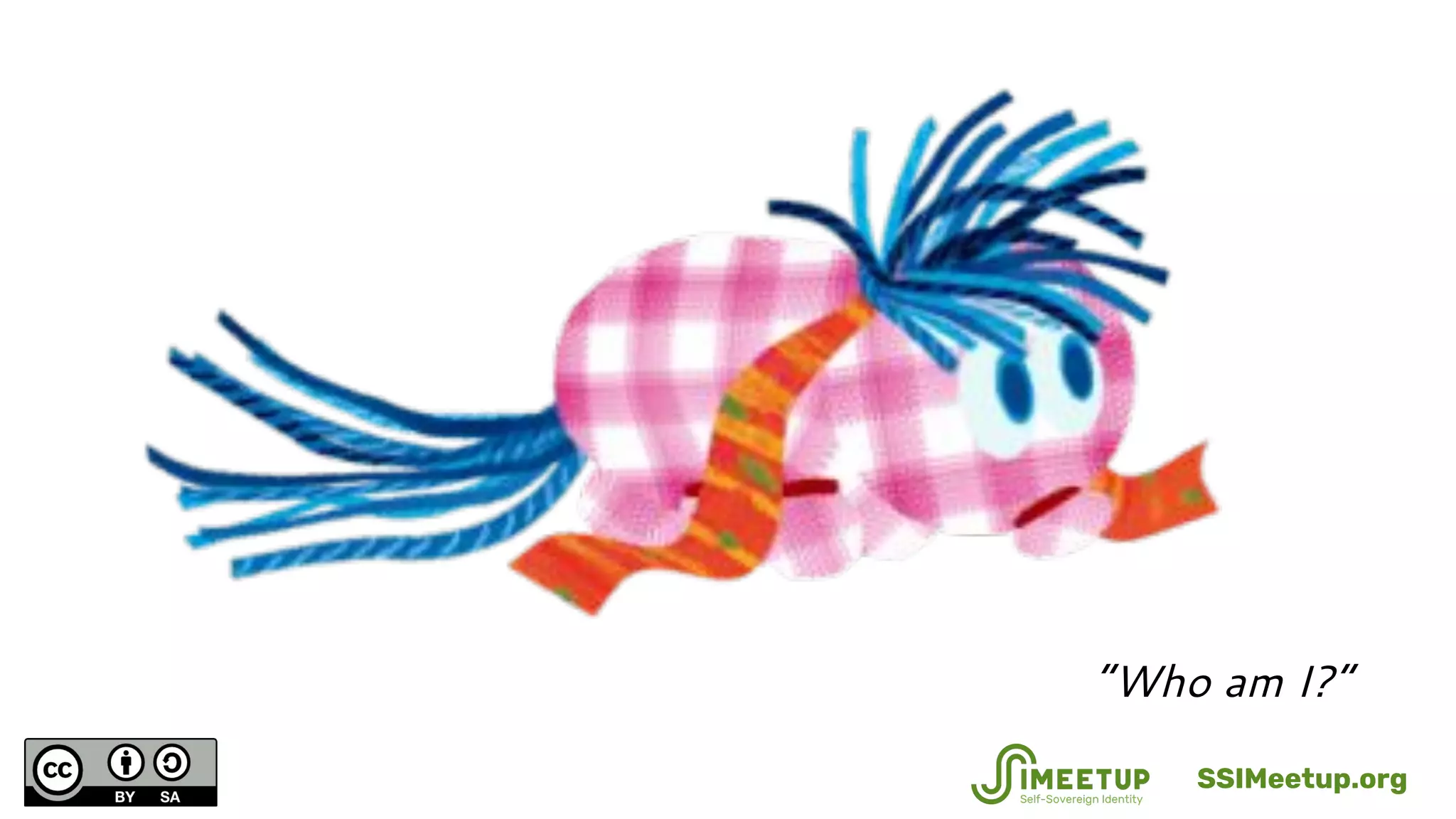
“Who am I?”
SSIMeetup.org
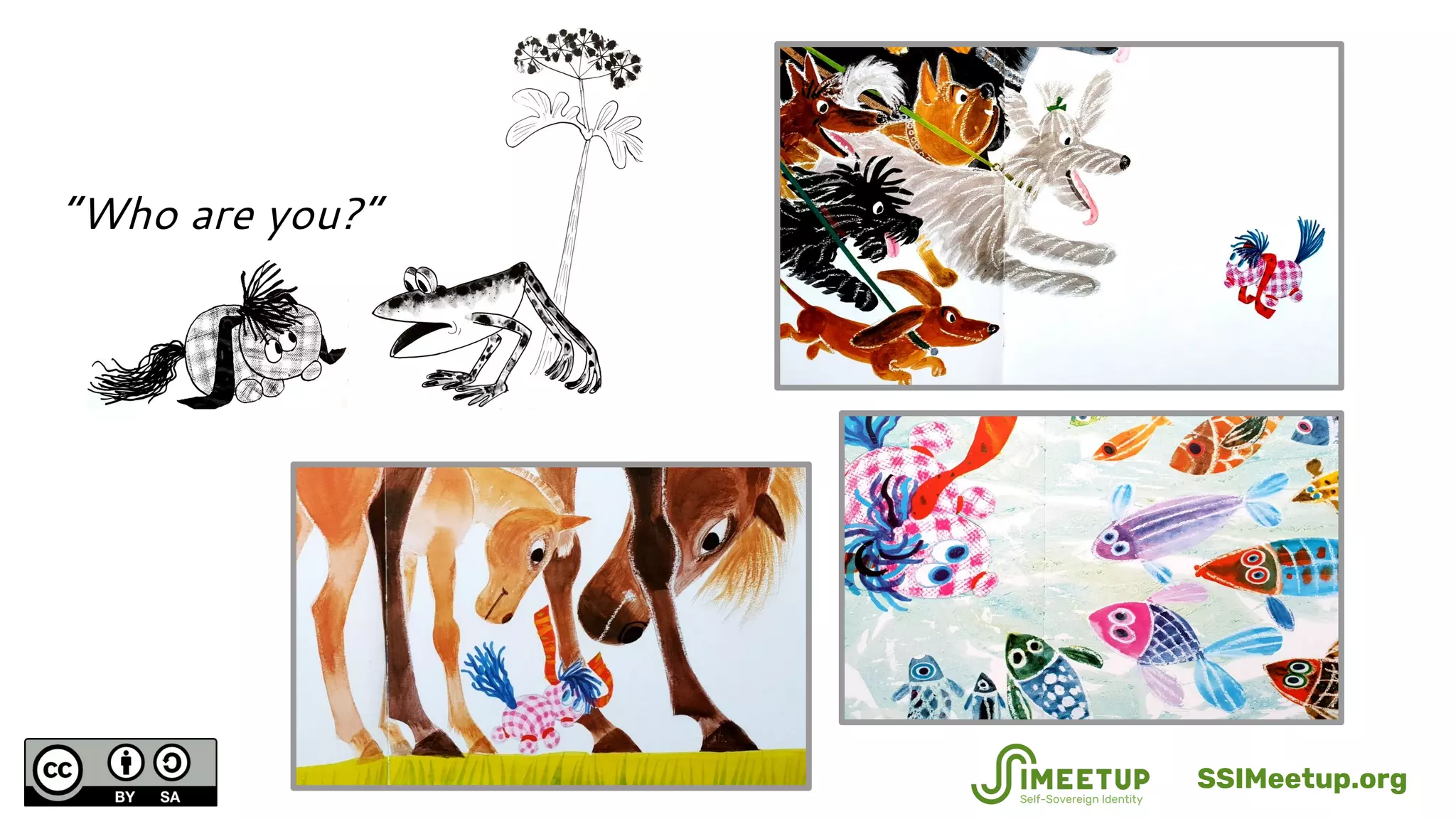
“Who are you?”
SSIMeetup.org
“I am me!”
SSIMeetup.org
Introduction to DID Auth
■ DIDs = Decentralized Identifiers
■ DID Auth = A concept, with different implementation ideas
■ 2018 RWoT paper: “Introduction to DID Auth”
(Markus Sabadello, Kyle Den Hartog, Christian Lundkvist, Cedric Franz,
Alberto Elias, Andrew Hughes, John Jordan, Dmitri Zagidulin)
■
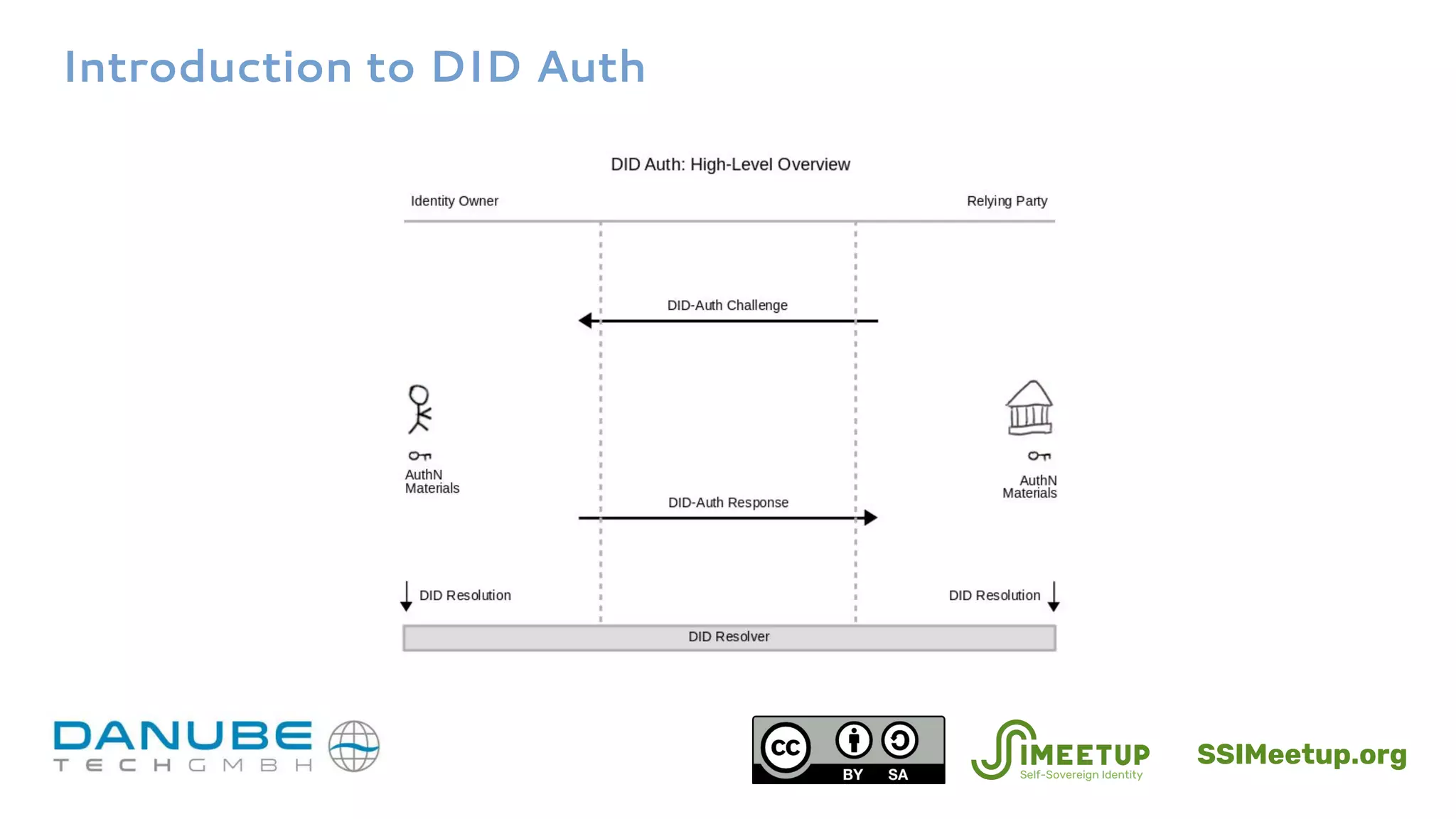
■ Core idea: Proving control of a DID
SSIMeetup.org
Introduction to DID Auth
■ DID Document contains metadata for authenticating a DID
■ Example: {
"@context": "https://w3id.org/did/v1",
"id": "did:example:123456789abcdefghi",
"authentication": [{
"type": "RsaSignatureAuthentication2018",
"publicKey": "did:example:123456789abcdefghi#keys-1"
}, {
"type": "Ed25519SignatureAuthentication2018",
"publicKey": "did:example:123456789abcdefghi#keys-2"
}],
"publicKey": [{
"id": "did:example:123456789abcdefghi#keys-1",
"type": "RsaVerificationKey2018",
"owner": "did:example:123456789abcdefghi",
"publicKeyPem": "-----BEGIN PUBLIC KEY...END PUBLIC KEY-----rn"
}, {
"id": "did:example:123456789abcdefghi#keys-2",
"type": "Ed25519VerificationKey2018",
"owner": "did:example:123456789abcdefghi",
"publicKeyBase58": "H3C2AVvLMv6gmMNam3uVAjZpfkcJCwDwnZn6z3wXmqPV"
}],
"service": {
"type": "DidAuthService",
"serviceEndpoint": "https://auth.example.com/did:example:123456789abcdefg"
}
}
SSIMeetup.org
Introduction to DID Auth
SSIMeetup.org
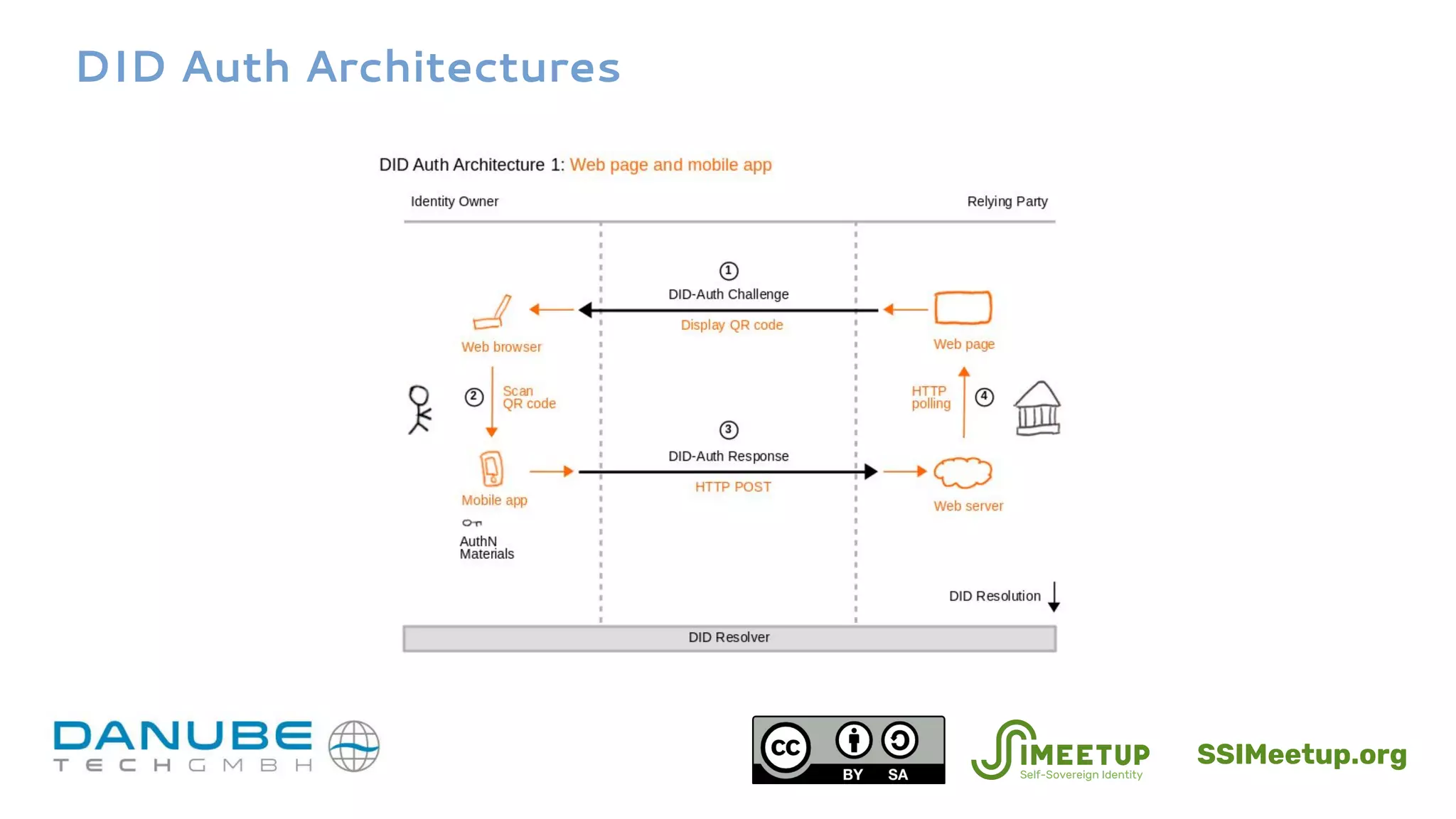
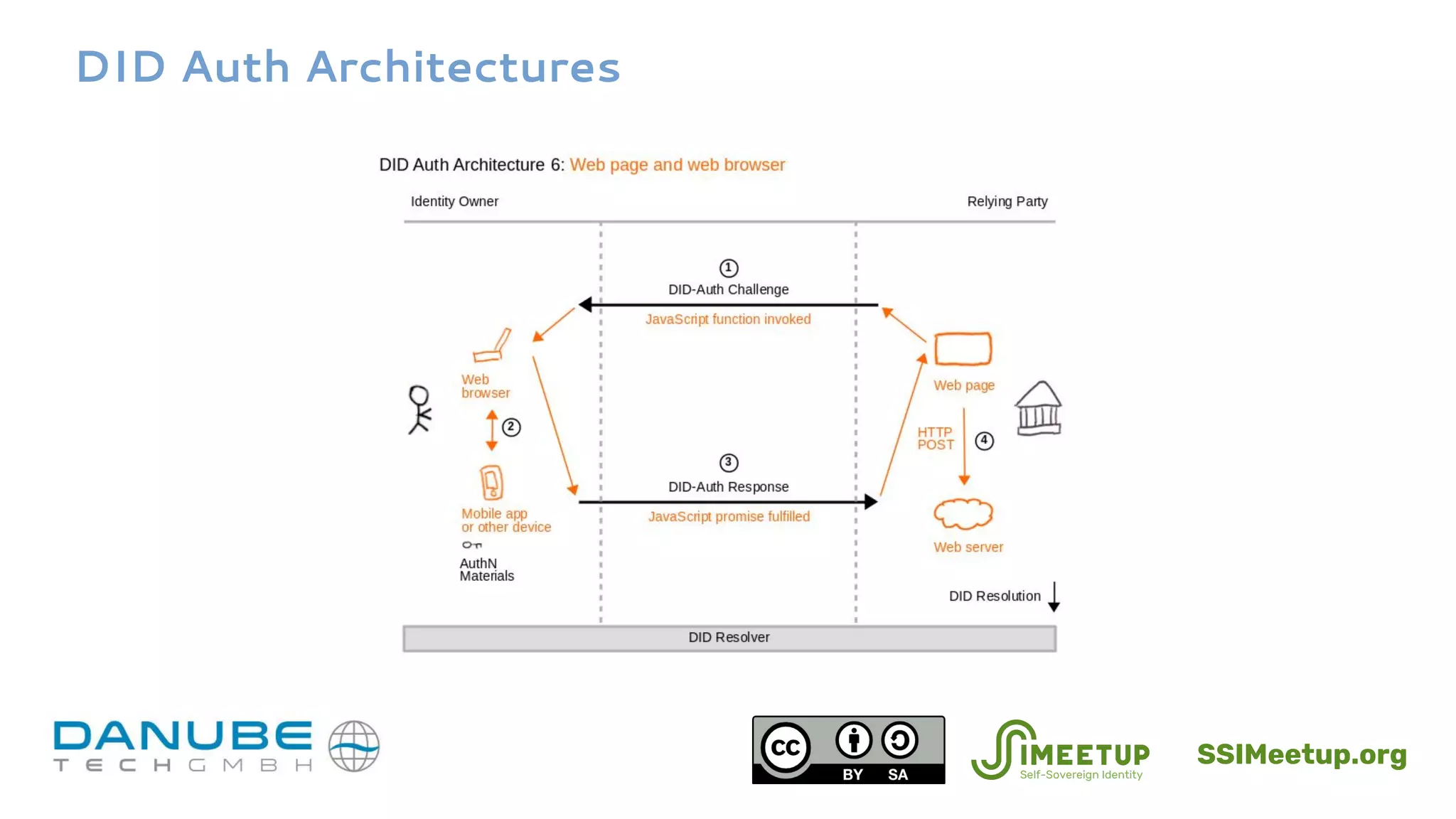
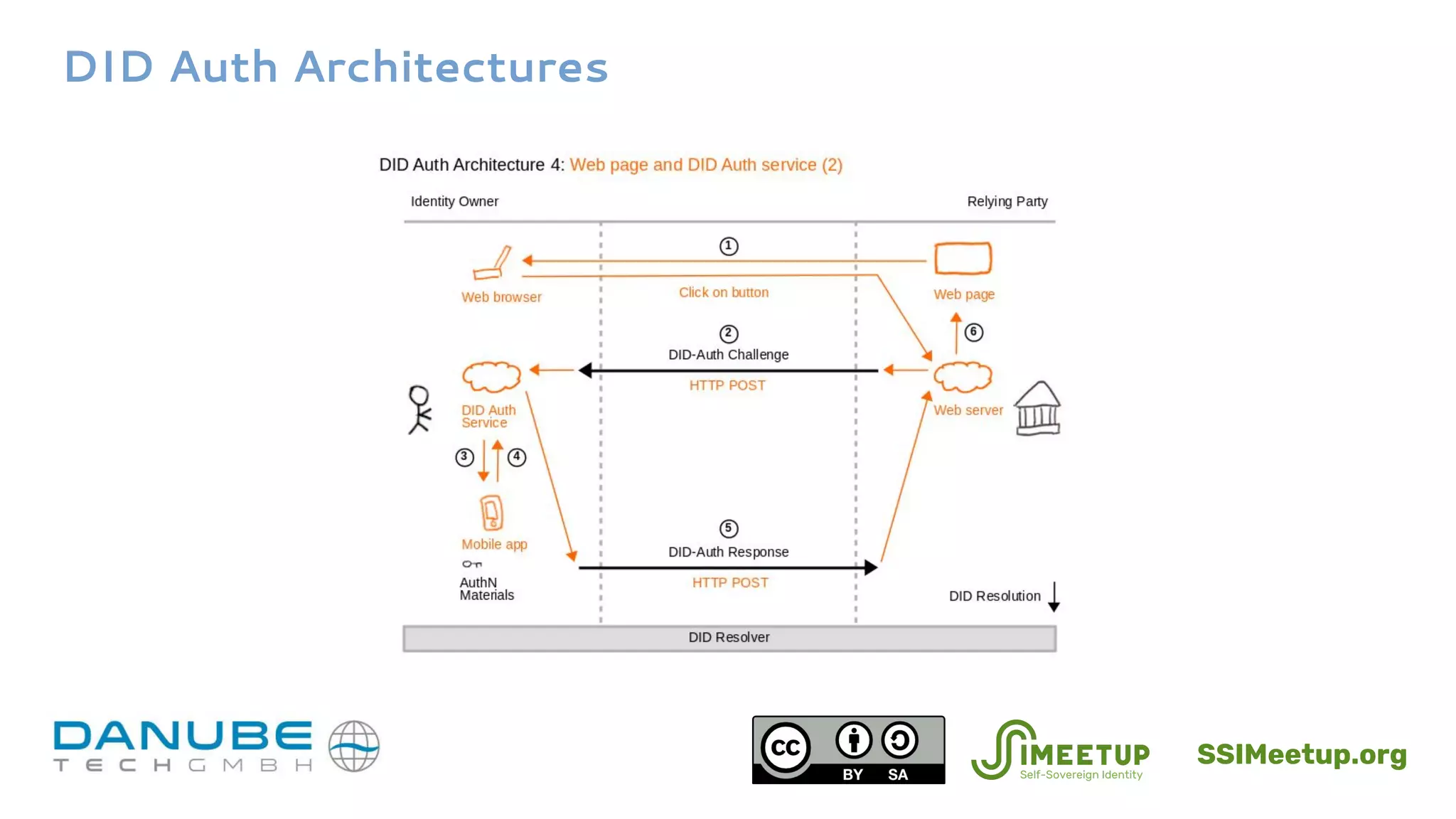
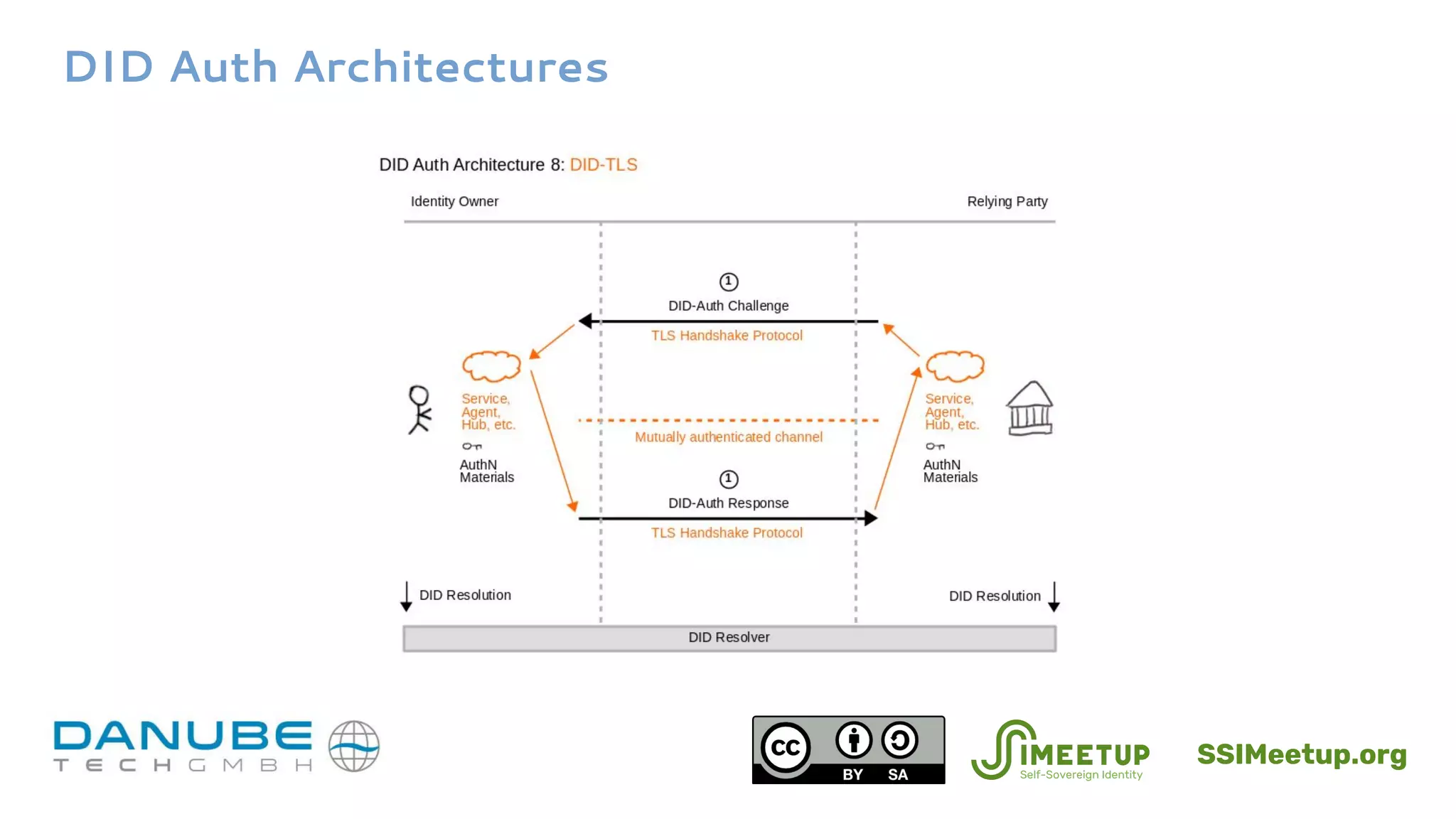
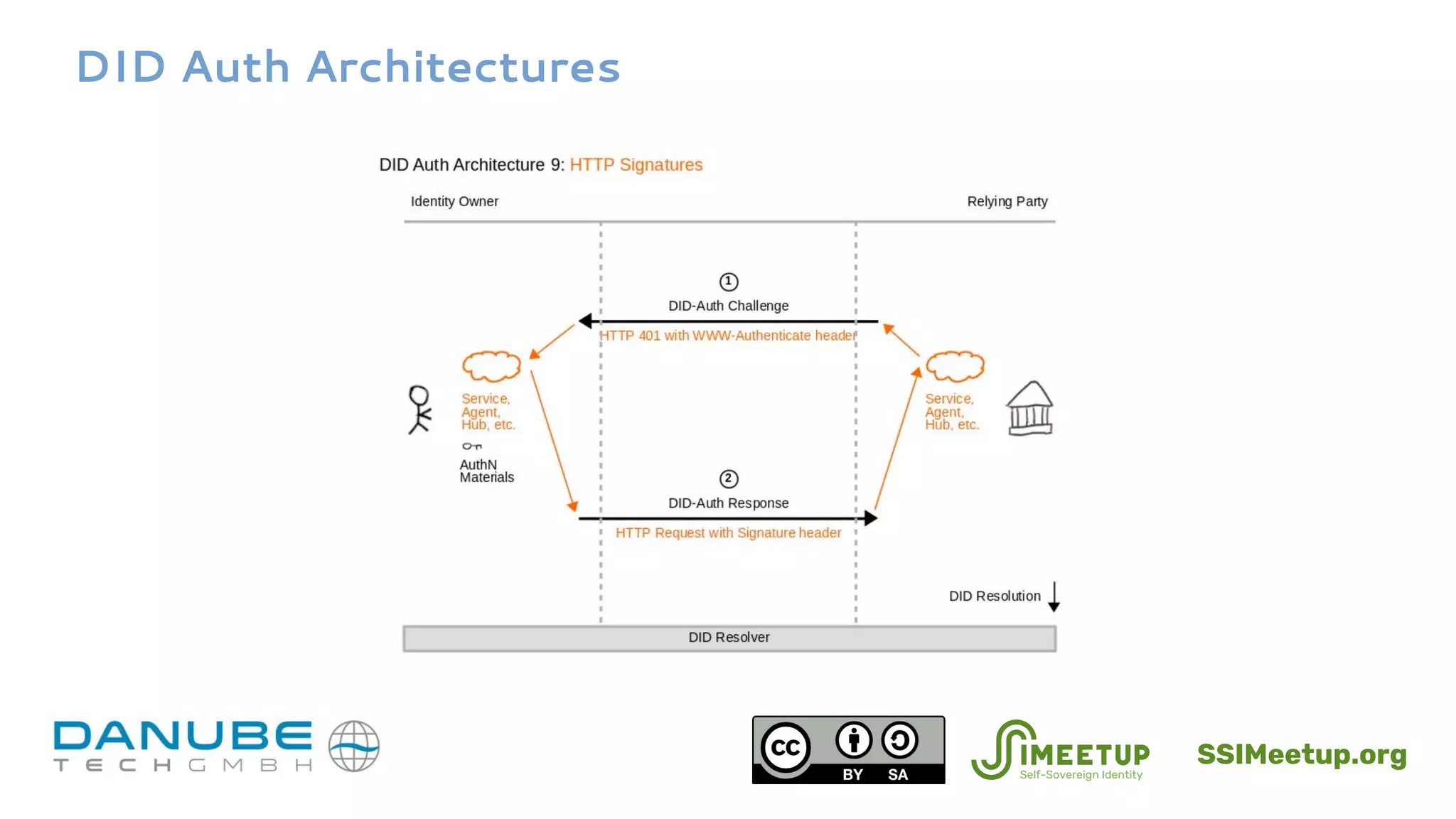
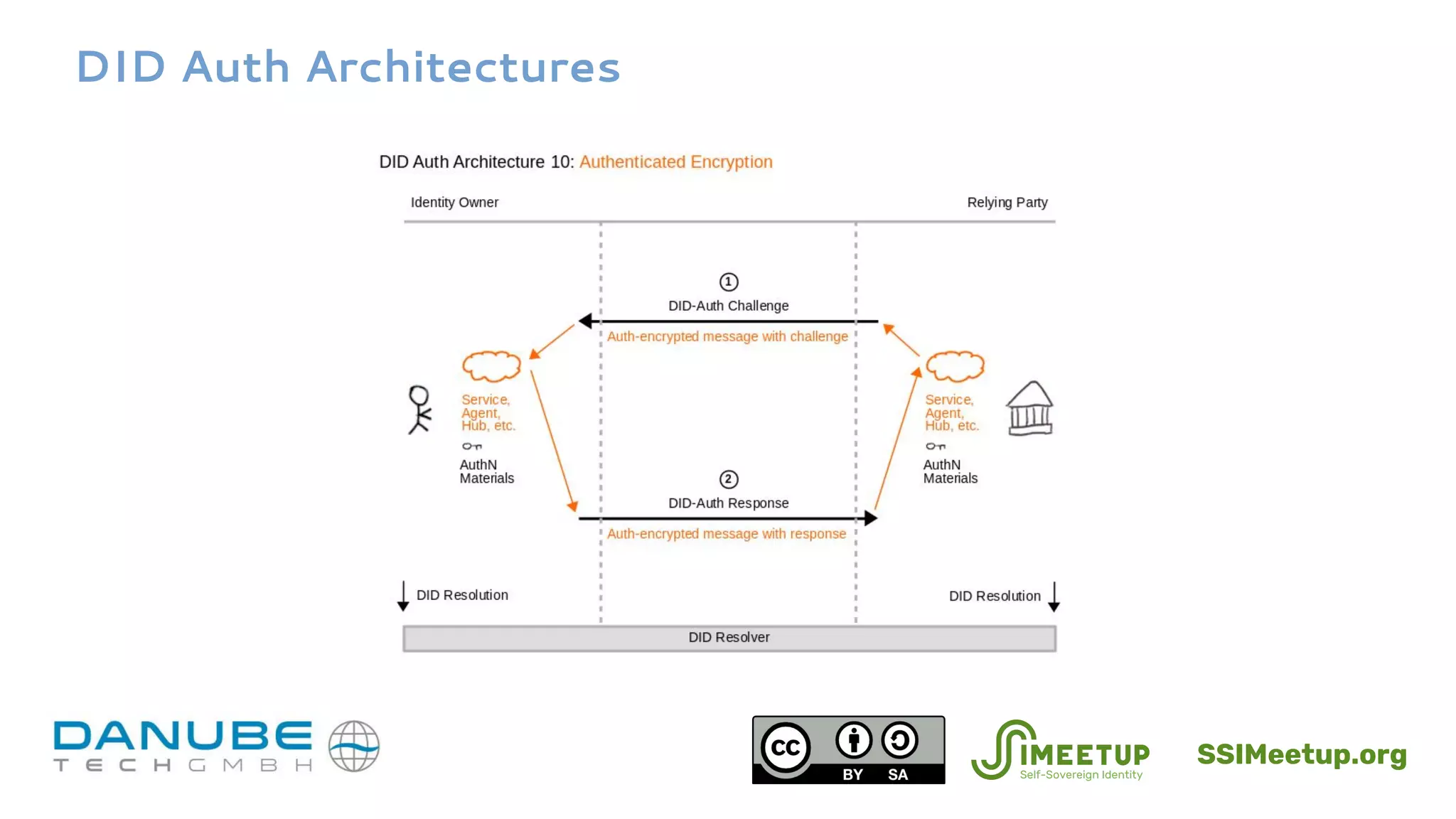
Challenges, Responses, Transports
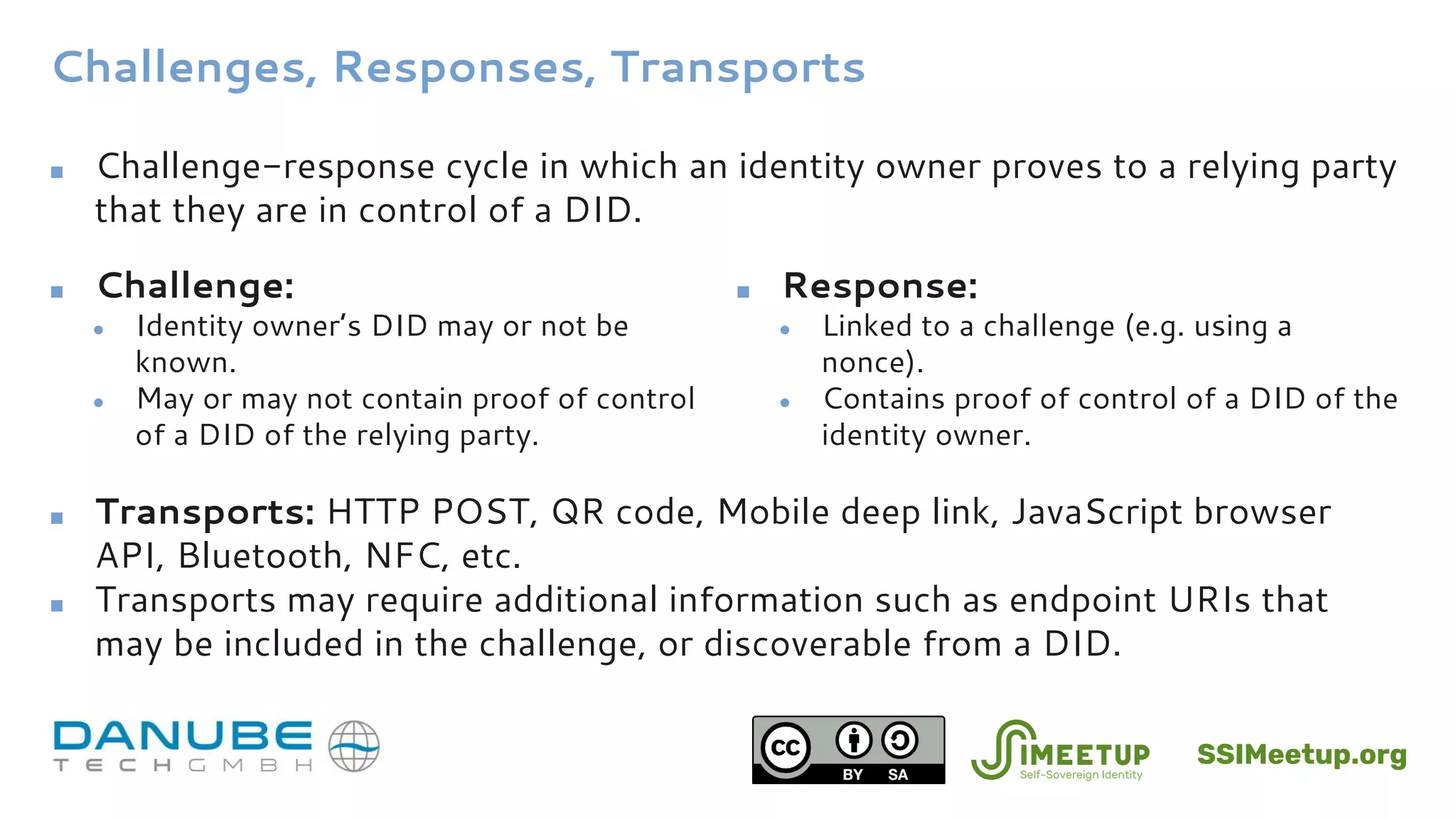
■ Challenge-response cycle in which an identity owner proves to a relying party
that they are in control of a DID.
■ Transports: HTTP POST, QR code, Mobile deep link, JavaScript browser
API, Bluetooth, NFC, etc.
■ Transports may require additional information such as endpoint URIs that
may be included in the challenge, or discoverable from a DID.
■ Challenge:
● Identity owner’s DID may or not be
known.
● May or may not contain proof of control
of a DID of the relying party.
■ Response:
● Linked to a challenge (e.g. using a
nonce).
● Contains proof of control of a DID of the
identity owner.
SSIMeetup.org
DID Auth Architectures
SSIMeetup.org
DID Auth Architectures
SSIMeetup.org
DID Auth Architectures
SSIMeetup.org
DID Auth Architectures
SSIMeetup.org
DID Auth Architectures
SSIMeetup.org
DID Auth Architectures
SSIMeetup.org
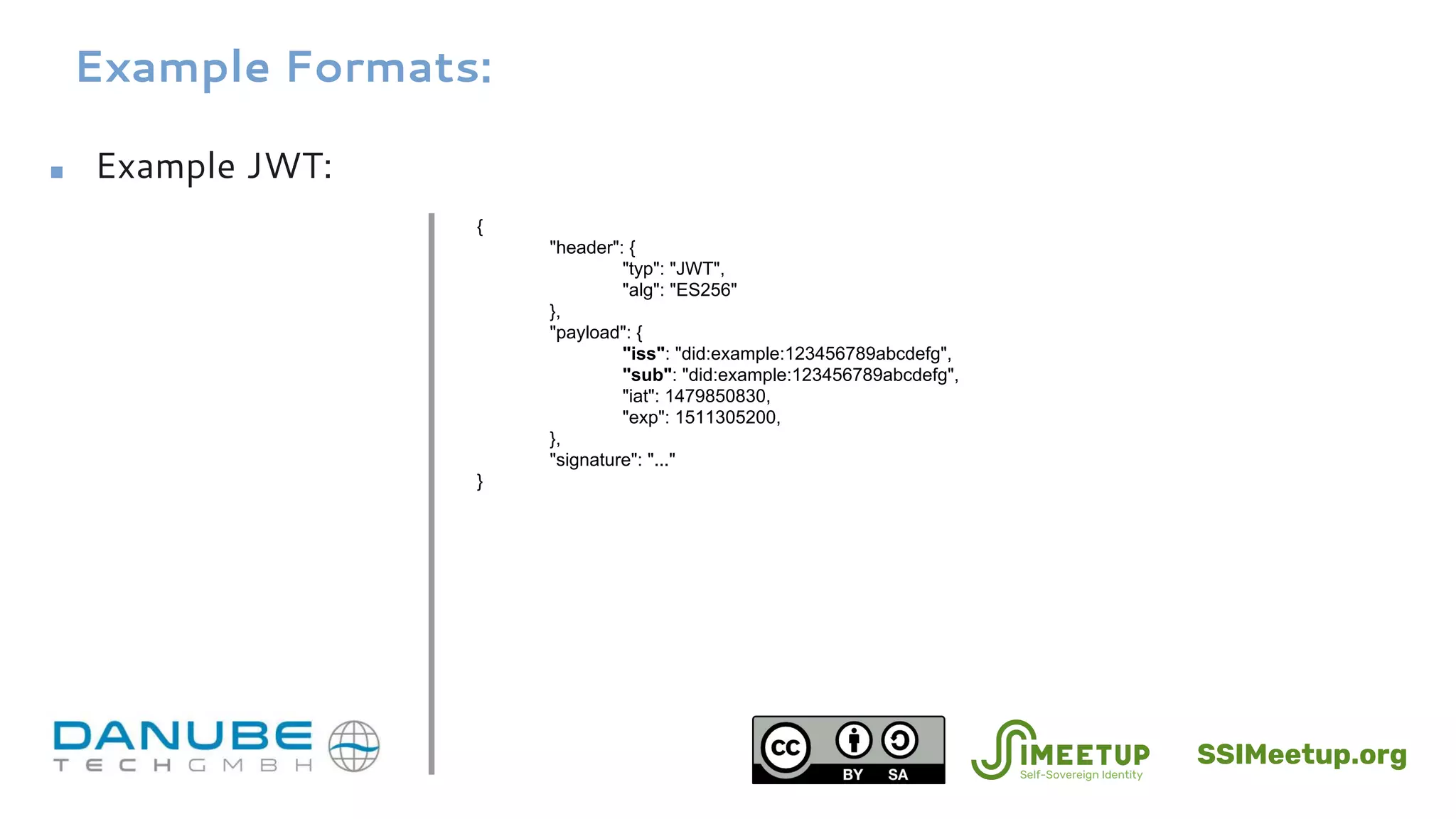
Example Formats:
■ Example JWT:
{
"header": {
"typ": "JWT",
"alg": "ES256"
},
"payload": {
"iss": "did:example:123456789abcdefg",
"sub": "did:example:123456789abcdefg",
"iat": 1479850830,
"exp": 1511305200,
},
"signature": "..."
}
SSIMeetup.org
Example Formats:
■ Example JSON-LD Verifiable Credential:
{
"type": ["Credential"],
"issuer": "did:example:123456789abcdefghi",
"issued": "2018-03-07",
"claim": {
"id": "did:example:123456789abcdefghi",
"publicKey": "did:example:123456789abcdefghi#keys-2"
},
"proof": {
"type": "Ed25519Signature2018",
"created": "2018-01-01T21:19:10Z",
"creator": "did:example:123456789abcdefghi#keys-2",
"nonce": "c0ae1c8e-c7e7-469f-b252-86e6a0e7387e",
"signatureValue": "..."
}
}
SSIMeetup.org
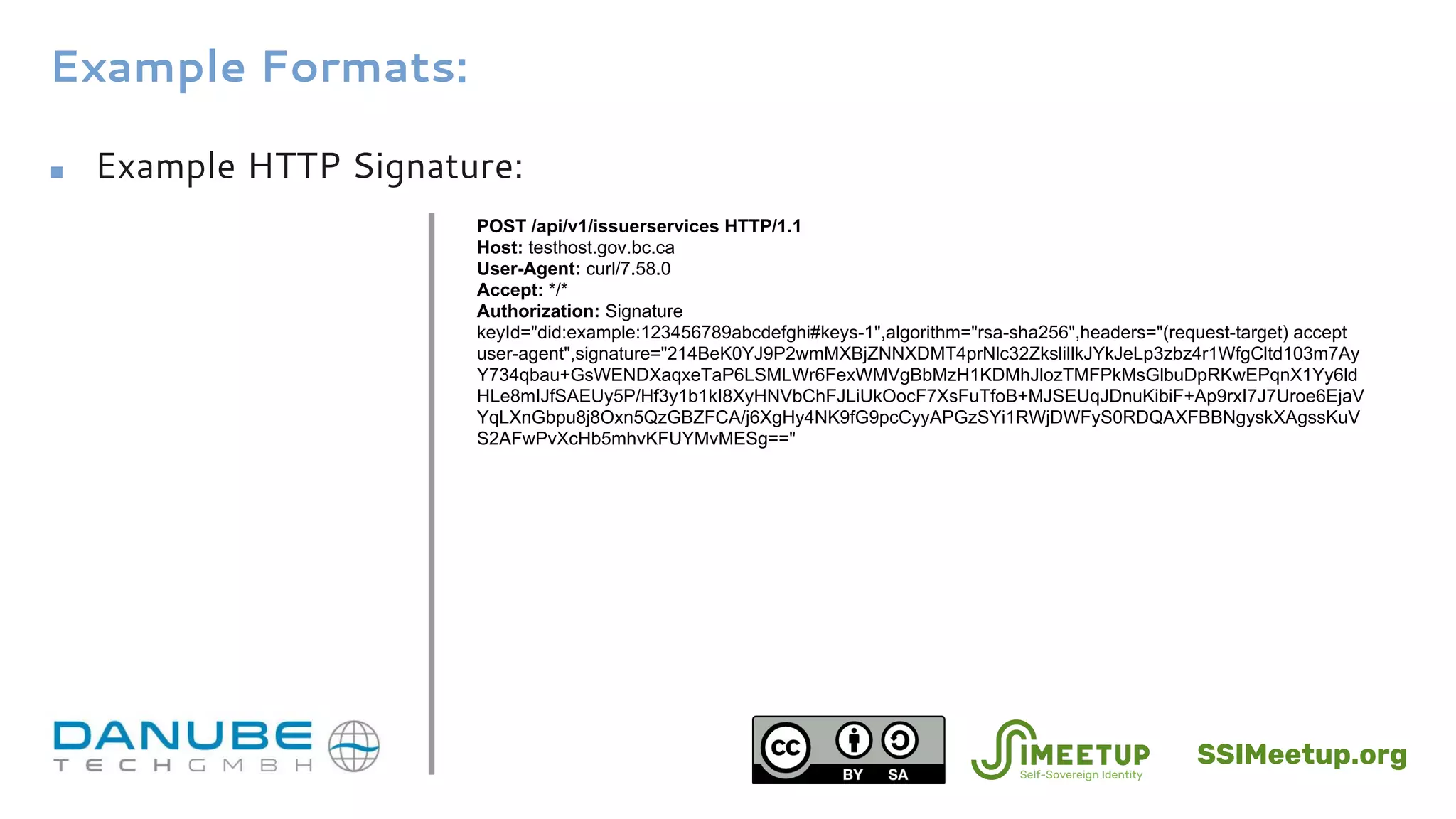
Example Formats:
■ Example HTTP Signature:
POST /api/v1/issuerservices HTTP/1.1
Host: testhost.gov.bc.ca
User-Agent: curl/7.58.0
Accept: */*
Authorization: Signature
keyId="did:example:123456789abcdefghi#keys-1",algorithm="rsa-sha256",headers="(request-target) accept
user-agent",signature="214BeK0YJ9P2wmMXBjZNNXDMT4prNlc32ZkslillkJYkJeLp3zbz4r1WfgCltd103m7Ay
Y734qbau+GsWENDXaqxeTaP6LSMLWr6FexWMVgBbMzH1KDMhJlozTMFPkMsGlbuDpRKwEPqnX1Yy6ld
HLe8mIJfSAEUy5P/Hf3y1b1kI8XyHNVbChFJLiUkOocF7XsFuTfoB+MJSEUqJDnuKibiF+Ap9rxI7J7Uroe6EjaV
YqLXnGbpu8j8Oxn5QzGBZFCA/j6XgHy4NK9fG9pcCyyAPGzSYi1RWjDWFyS0RDQAXFBBNgyskXAgssKuV
S2AFwPvXcHb5mhvKFUYMvMESg=="
SSIMeetup.org
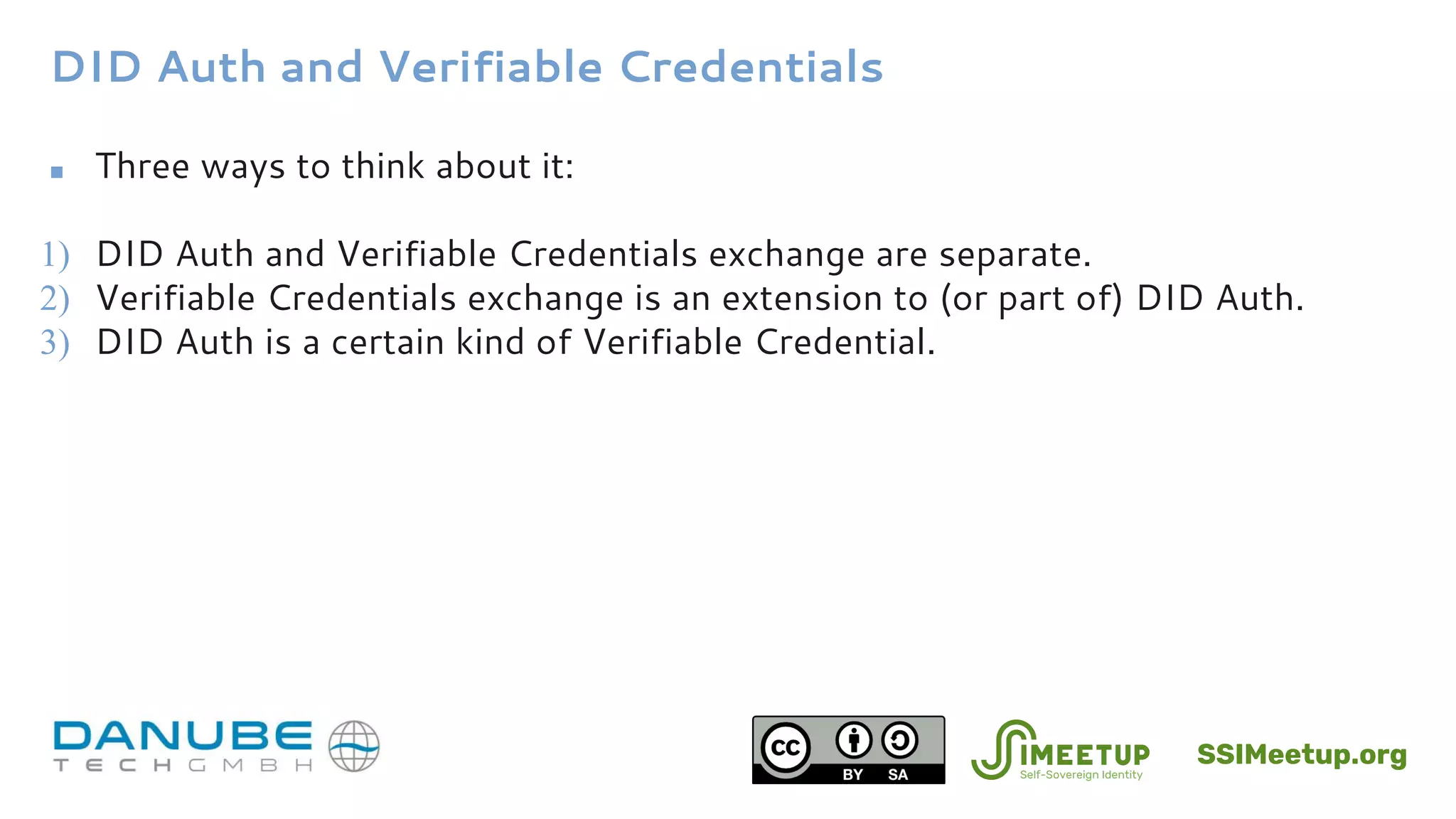
DID Auth and Verifiable Credentials
■ Three ways to think about it:
1) DID Auth and Verifiable Credentials exchange are separate.
2) Verifiable Credentials exchange is an extension to (or part of) DID Auth.
3) DID Auth is a certain kind of Verifiable Credential.
SSIMeetup.org
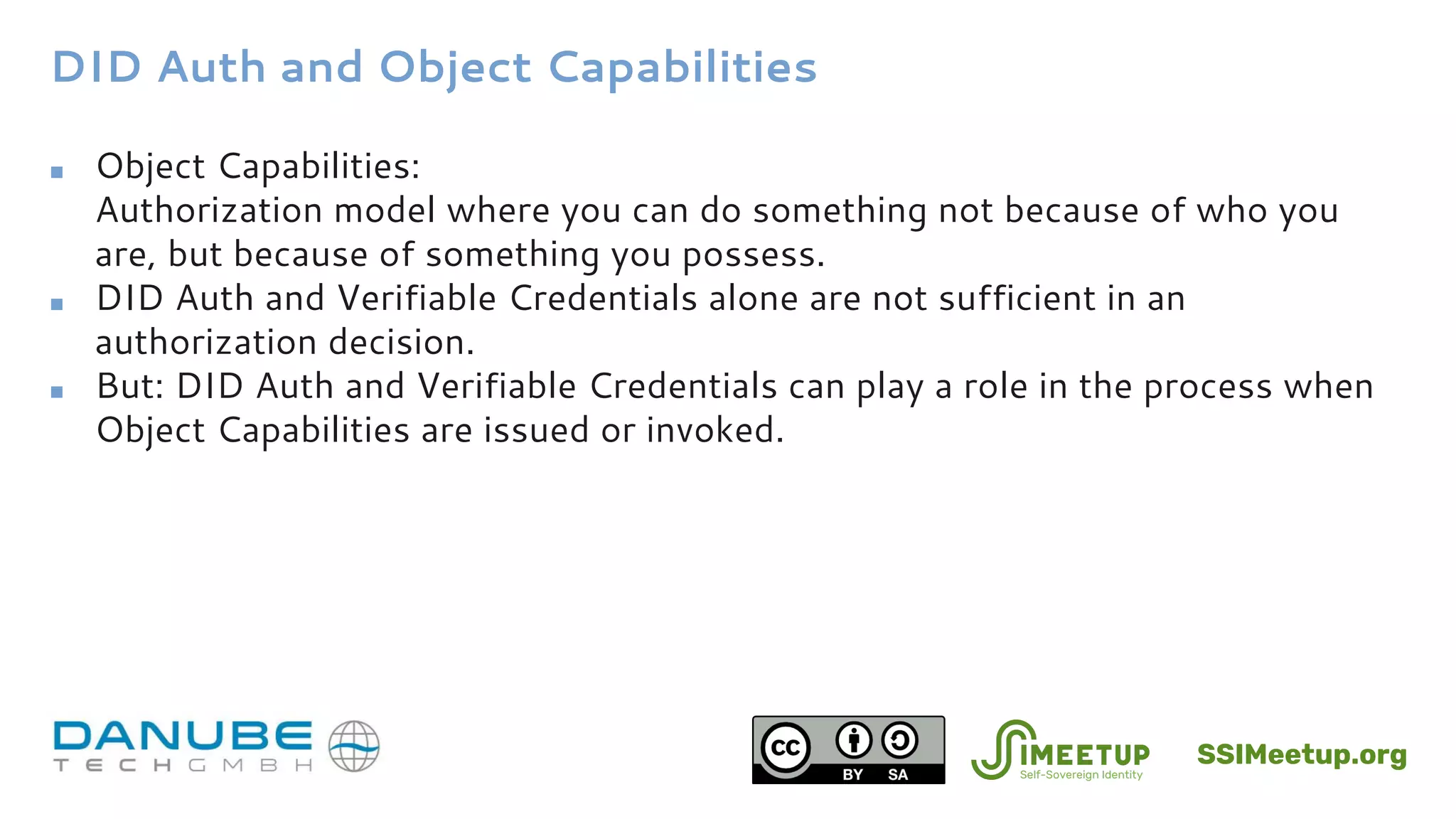
DID Auth and Object Capabilities
■ Object Capabilities:
Authorization model where you can do something not because of who you
are, but because of something you possess.
■ DID Auth and Verifiable Credentials alone are not sufficient in an
authorization decision.
■ But: DID Auth and Verifiable Credentials can play a role in the process when
Object Capabilities are issued or invoked.
SSIMeetup.org
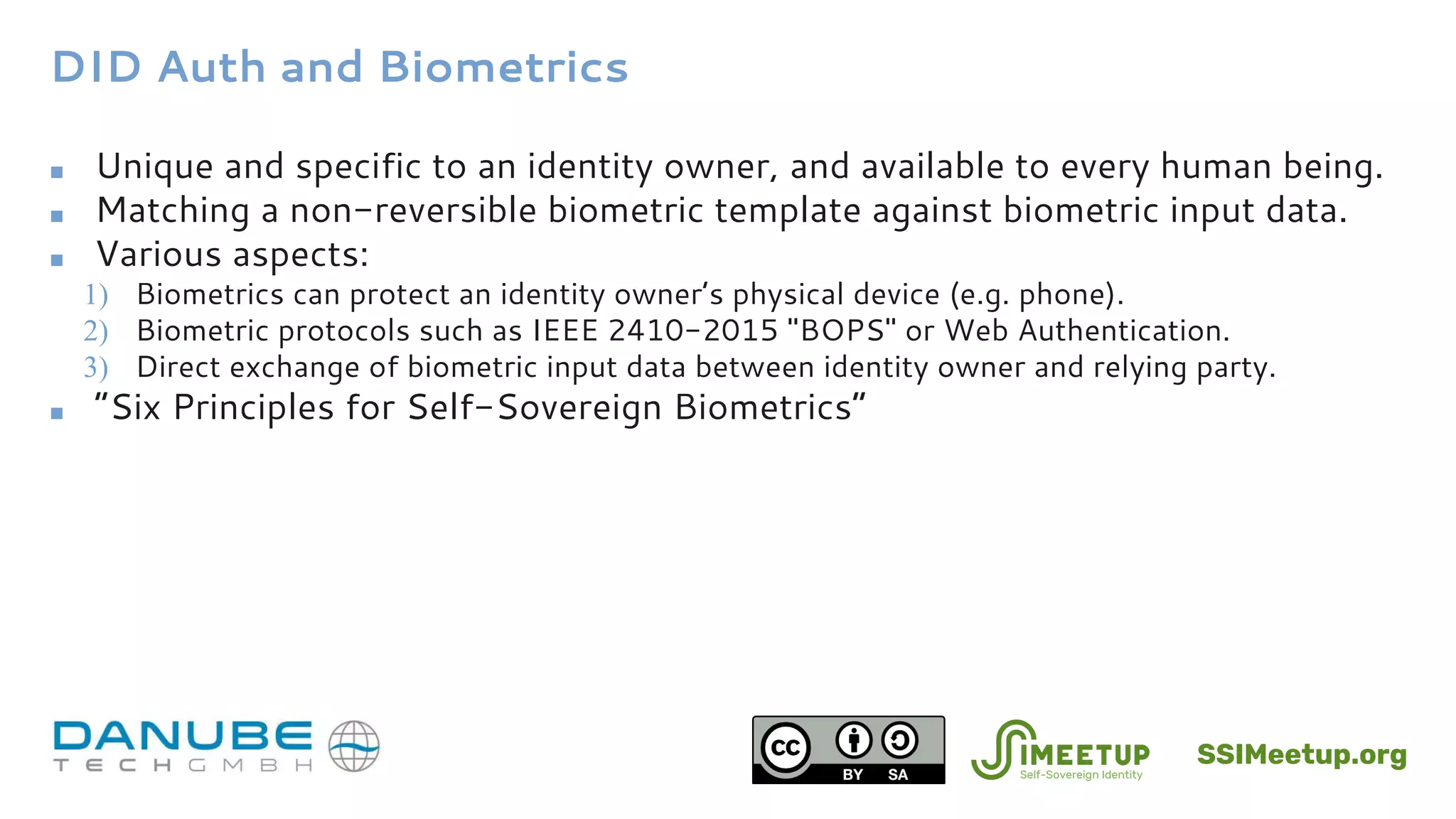
DID Auth and Biometrics
■ Unique and specific to an identity owner, and available to every human being.
■ Matching a non-reversible biometric template against biometric input data.
■ Various aspects:
1) Biometrics can protect an identity owner’s physical device (e.g. phone).
2) Biometric protocols such as IEEE 2410-2015 "BOPS" or Web Authentication.
3) Direct exchange of biometric input data between identity owner and relying party.
■ “Six Principles for Self-Sovereign Biometrics”
SSIMeetup.org
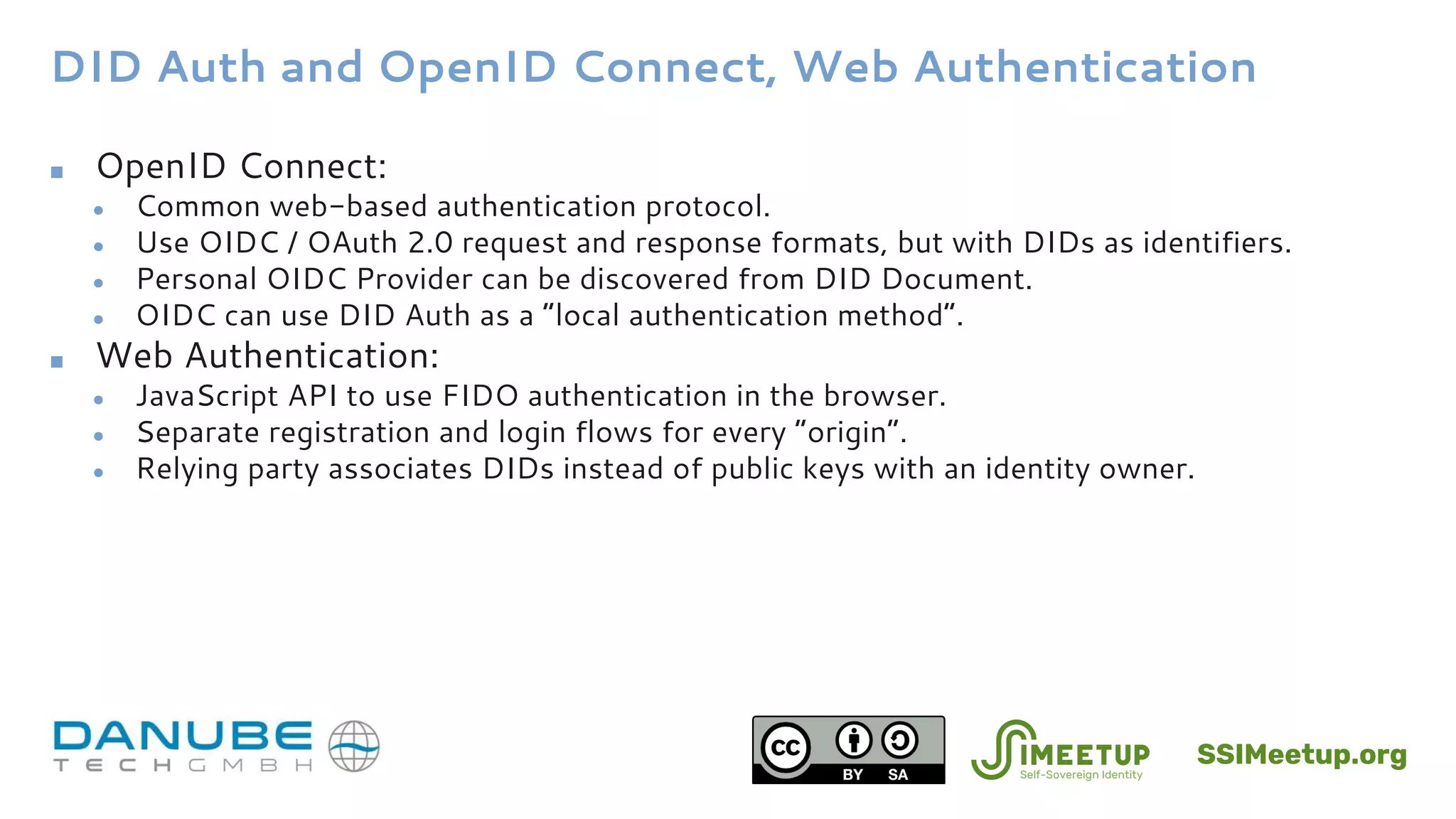
DID Auth and OpenID Connect, Web Authentication
■ OpenID Connect:
● Common web-based authentication protocol.
● Use OIDC / OAuth 2.0 request and response formats, but with DIDs as identifiers.
● Personal OIDC Provider can be discovered from DID Document.
● OIDC can use DID Auth as a “local authentication method”.
■ Web Authentication:
● JavaScript API to use FIDO authentication in the browser.
● Separate registration and login flows for every “origin”.
● Relying party associates DIDs instead of public keys with an identity owner.
SSIMeetup.org
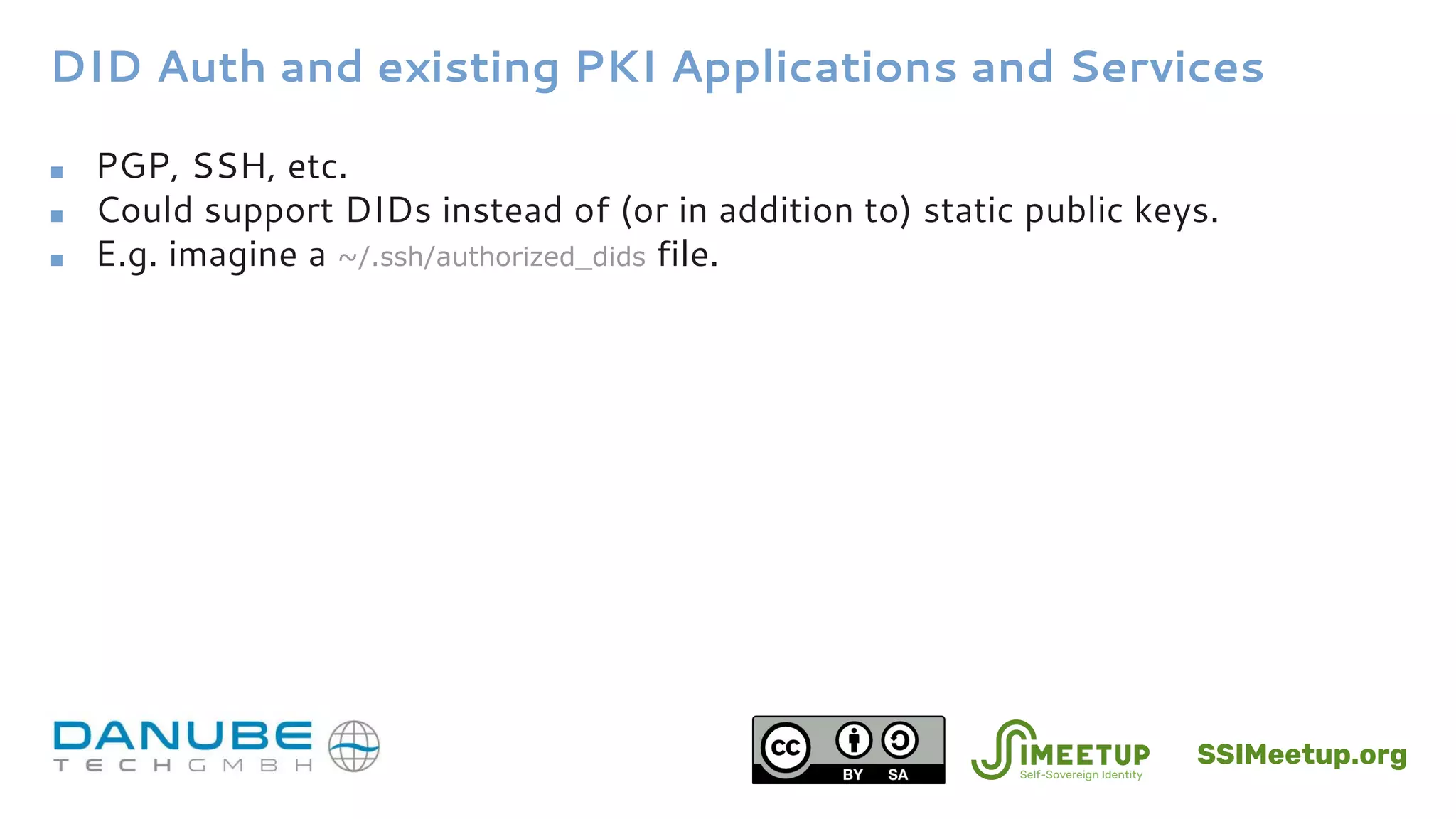
DID Auth and existing PKI Applications and Services
■ PGP, SSH, etc.
■ Could support DIDs instead of (or in addition to) static public keys.
■ E.g. imagine a ~/.ssh/authorized_dids file.
SSIMeetup.org
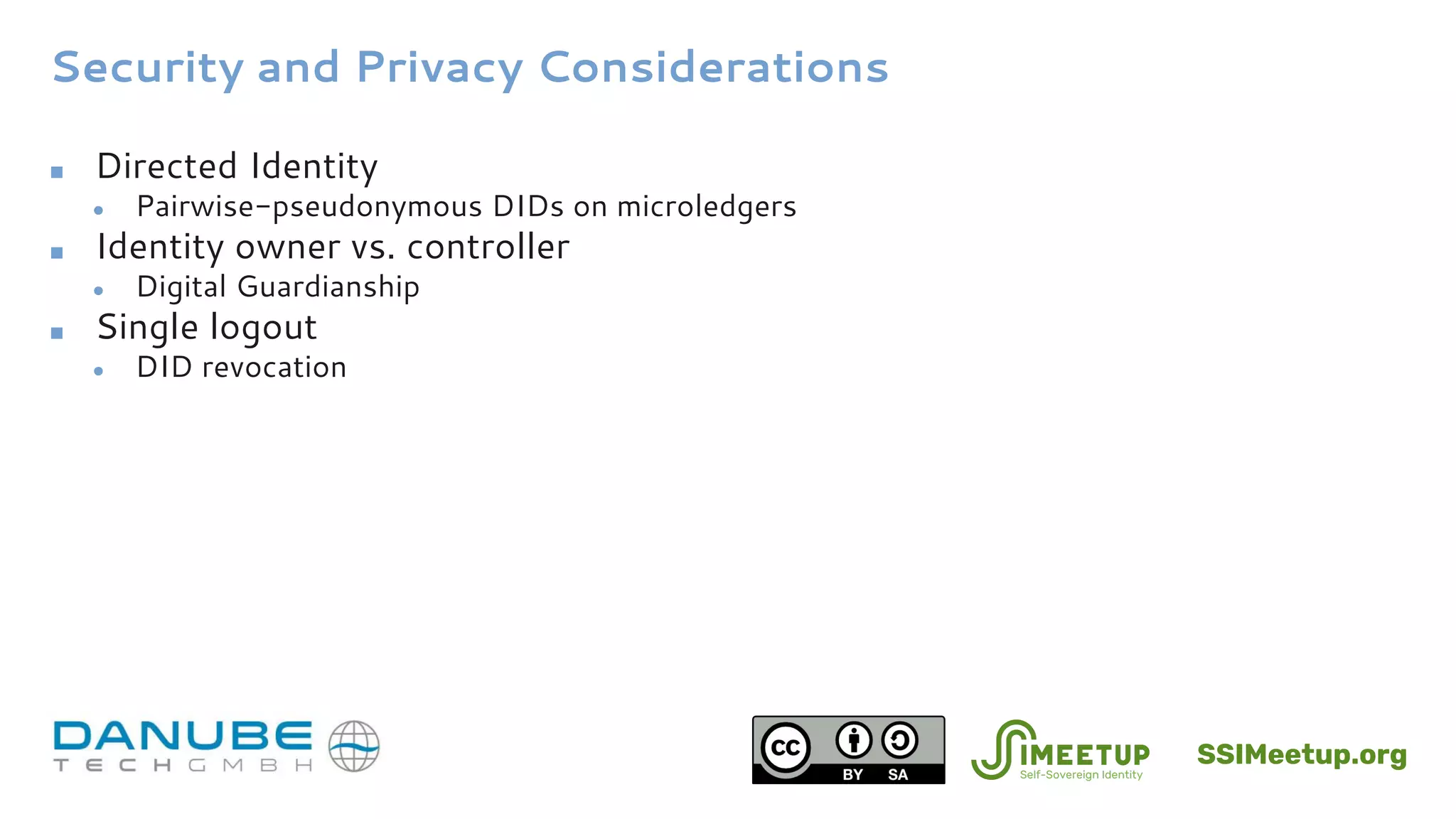
Security and Privacy Considerations
■ Directed Identity
● Pairwise-pseudonymous DIDs on microledgers
■ Identity owner vs. controller
● Digital Guardianship
■ Single logout
● DID revocation
SSIMeetup.org
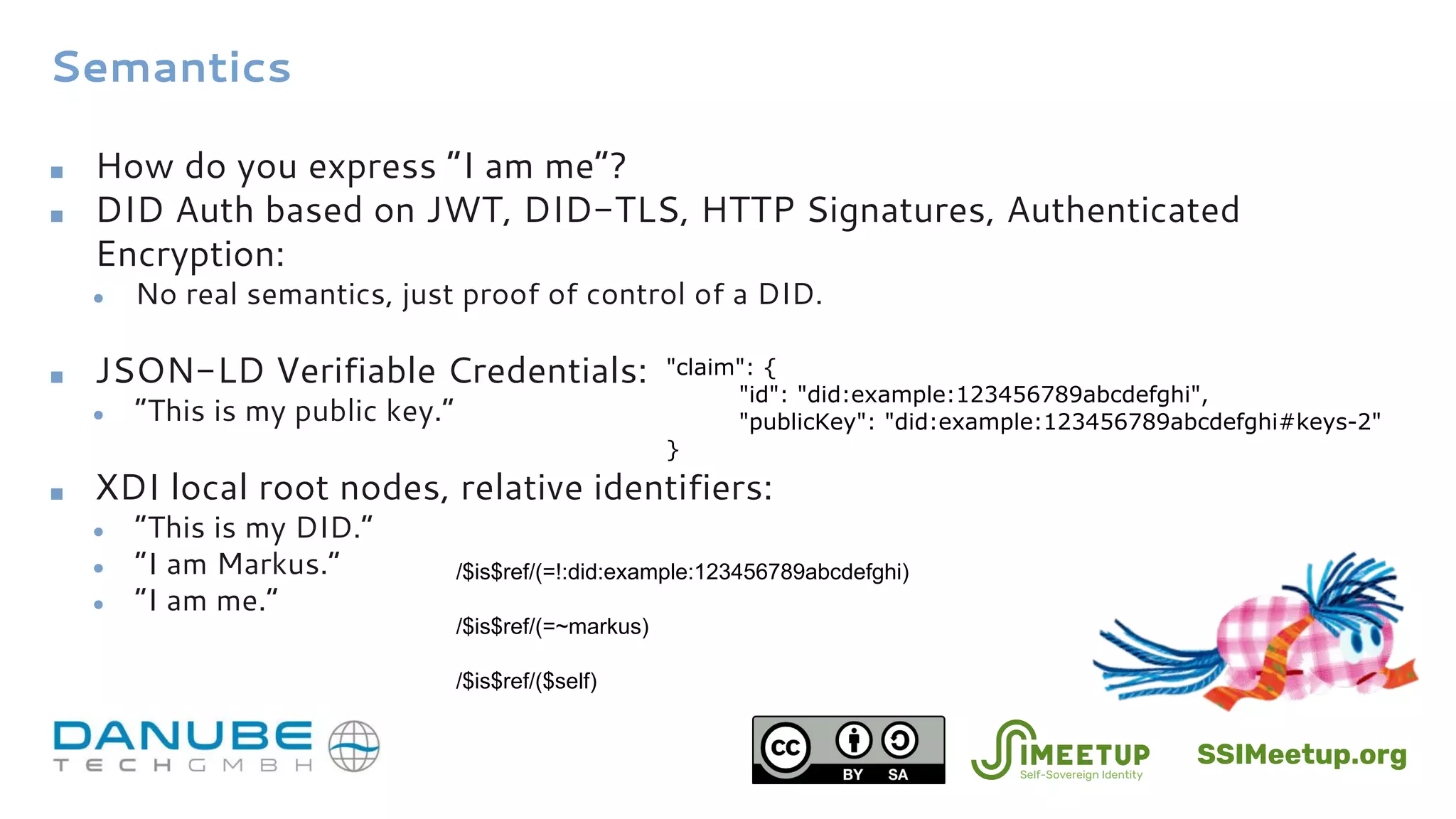
Semantics
■ How do you express “I am me”?
■ DID Auth based on JWT, DID-TLS, HTTP Signatures, Authenticated
Encryption:
● No real semantics, just proof of control of a DID.
■ JSON-LD Verifiable Credentials:
● ”This is my public key.”
■ XDI local root nodes, relative identifiers:
● “This is my DID.”
● “I am Markus.”
● ”I am me.”
/$is$ref/(=!:did:example:123456789abcdefghi)
"claim": {
"id": "did:example:123456789abcdefghi",
"publicKey": "did:example:123456789abcdefghi#keys-2"
}
/$is$ref/($self)
/$is$ref/(=~markus)
SSIMeetup.org
Introduction to DID Auth
Markus Sabadello
Danube Tech, Decentralized Identity Foundation,
Sovrin Foundation, W3C VCWG, W3C CCG, OASIS
XDI TC
In a self-sovereign world, how can I prove that “I am me” ?
11th
July 2018, markus@danubetech.com
https://creativecommons.org/licenses/by-sa/4.0/

Introduction to DID Auth for SSI with Markus Sabadello

  • 1.
    Introduction to DIDAuth Markus Sabadello Danube Tech, Decentralized Identity Foundation, Sovrin Foundation, W3C VCWG, W3C CCG, OASIS XDI TC In a self-sovereign world, how can I prove that “I am me” ? 11th July 2018, markus@danubetech.com https://creativecommons.org/licenses/by-sa/4.0/
  • 2.
    1. Empower globalSSI communities 2. Open to everyone interested in SSI 3. All content is shared with CC BY SA SSIMeetup.org Alex Preukschat @SSIMeetup @AlexPreukschat Coordinating Node SSIMeetup.org https://creativecommons.org/licenses/by-sa/4.0/ SSIMeetup objectives
  • 3.
  • 4.
  • 5.
  • 6.
    Introduction to DIDAuth ■ DIDs = Decentralized Identifiers ■ DID Auth = A concept, with different implementation ideas ■ 2018 RWoT paper: “Introduction to DID Auth” (Markus Sabadello, Kyle Den Hartog, Christian Lundkvist, Cedric Franz, Alberto Elias, Andrew Hughes, John Jordan, Dmitri Zagidulin) ■ ■ Core idea: Proving control of a DID SSIMeetup.org
  • 7.
    Introduction to DIDAuth ■ DID Document contains metadata for authenticating a DID ■ Example: { "@context": "https://w3id.org/did/v1", "id": "did:example:123456789abcdefghi", "authentication": [{ "type": "RsaSignatureAuthentication2018", "publicKey": "did:example:123456789abcdefghi#keys-1" }, { "type": "Ed25519SignatureAuthentication2018", "publicKey": "did:example:123456789abcdefghi#keys-2" }], "publicKey": [{ "id": "did:example:123456789abcdefghi#keys-1", "type": "RsaVerificationKey2018", "owner": "did:example:123456789abcdefghi", "publicKeyPem": "-----BEGIN PUBLIC KEY...END PUBLIC KEY-----rn" }, { "id": "did:example:123456789abcdefghi#keys-2", "type": "Ed25519VerificationKey2018", "owner": "did:example:123456789abcdefghi", "publicKeyBase58": "H3C2AVvLMv6gmMNam3uVAjZpfkcJCwDwnZn6z3wXmqPV" }], "service": { "type": "DidAuthService", "serviceEndpoint": "https://auth.example.com/did:example:123456789abcdefg" } } SSIMeetup.org
  • 8.
    Introduction to DIDAuth SSIMeetup.org
  • 9.
    Challenges, Responses, Transports ■Challenge-response cycle in which an identity owner proves to a relying party that they are in control of a DID. ■ Transports: HTTP POST, QR code, Mobile deep link, JavaScript browser API, Bluetooth, NFC, etc. ■ Transports may require additional information such as endpoint URIs that may be included in the challenge, or discoverable from a DID. ■ Challenge: ● Identity owner’s DID may or not be known. ● May or may not contain proof of control of a DID of the relying party. ■ Response: ● Linked to a challenge (e.g. using a nonce). ● Contains proof of control of a DID of the identity owner. SSIMeetup.org
  • 10.
  • 11.
  • 12.
  • 13.
  • 14.
  • 15.
  • 16.
    Example Formats: ■ ExampleJWT: { "header": { "typ": "JWT", "alg": "ES256" }, "payload": { "iss": "did:example:123456789abcdefg", "sub": "did:example:123456789abcdefg", "iat": 1479850830, "exp": 1511305200, }, "signature": "..." } SSIMeetup.org
  • 17.
    Example Formats: ■ ExampleJSON-LD Verifiable Credential: { "type": ["Credential"], "issuer": "did:example:123456789abcdefghi", "issued": "2018-03-07", "claim": { "id": "did:example:123456789abcdefghi", "publicKey": "did:example:123456789abcdefghi#keys-2" }, "proof": { "type": "Ed25519Signature2018", "created": "2018-01-01T21:19:10Z", "creator": "did:example:123456789abcdefghi#keys-2", "nonce": "c0ae1c8e-c7e7-469f-b252-86e6a0e7387e", "signatureValue": "..." } } SSIMeetup.org
  • 18.
    Example Formats: ■ ExampleHTTP Signature: POST /api/v1/issuerservices HTTP/1.1 Host: testhost.gov.bc.ca User-Agent: curl/7.58.0 Accept: */* Authorization: Signature keyId="did:example:123456789abcdefghi#keys-1",algorithm="rsa-sha256",headers="(request-target) accept user-agent",signature="214BeK0YJ9P2wmMXBjZNNXDMT4prNlc32ZkslillkJYkJeLp3zbz4r1WfgCltd103m7Ay Y734qbau+GsWENDXaqxeTaP6LSMLWr6FexWMVgBbMzH1KDMhJlozTMFPkMsGlbuDpRKwEPqnX1Yy6ld HLe8mIJfSAEUy5P/Hf3y1b1kI8XyHNVbChFJLiUkOocF7XsFuTfoB+MJSEUqJDnuKibiF+Ap9rxI7J7Uroe6EjaV YqLXnGbpu8j8Oxn5QzGBZFCA/j6XgHy4NK9fG9pcCyyAPGzSYi1RWjDWFyS0RDQAXFBBNgyskXAgssKuV S2AFwPvXcHb5mhvKFUYMvMESg==" SSIMeetup.org
  • 19.
    DID Auth andVerifiable Credentials ■ Three ways to think about it: 1) DID Auth and Verifiable Credentials exchange are separate. 2) Verifiable Credentials exchange is an extension to (or part of) DID Auth. 3) DID Auth is a certain kind of Verifiable Credential. SSIMeetup.org
  • 20.
    DID Auth andObject Capabilities ■ Object Capabilities: Authorization model where you can do something not because of who you are, but because of something you possess. ■ DID Auth and Verifiable Credentials alone are not sufficient in an authorization decision. ■ But: DID Auth and Verifiable Credentials can play a role in the process when Object Capabilities are issued or invoked. SSIMeetup.org
  • 21.
    DID Auth andBiometrics ■ Unique and specific to an identity owner, and available to every human being. ■ Matching a non-reversible biometric template against biometric input data. ■ Various aspects: 1) Biometrics can protect an identity owner’s physical device (e.g. phone). 2) Biometric protocols such as IEEE 2410-2015 "BOPS" or Web Authentication. 3) Direct exchange of biometric input data between identity owner and relying party. ■ “Six Principles for Self-Sovereign Biometrics” SSIMeetup.org
  • 22.
    DID Auth andOpenID Connect, Web Authentication ■ OpenID Connect: ● Common web-based authentication protocol. ● Use OIDC / OAuth 2.0 request and response formats, but with DIDs as identifiers. ● Personal OIDC Provider can be discovered from DID Document. ● OIDC can use DID Auth as a “local authentication method”. ■ Web Authentication: ● JavaScript API to use FIDO authentication in the browser. ● Separate registration and login flows for every “origin”. ● Relying party associates DIDs instead of public keys with an identity owner. SSIMeetup.org
  • 23.
    DID Auth andexisting PKI Applications and Services ■ PGP, SSH, etc. ■ Could support DIDs instead of (or in addition to) static public keys. ■ E.g. imagine a ~/.ssh/authorized_dids file. SSIMeetup.org
  • 24.
    Security and PrivacyConsiderations ■ Directed Identity ● Pairwise-pseudonymous DIDs on microledgers ■ Identity owner vs. controller ● Digital Guardianship ■ Single logout ● DID revocation SSIMeetup.org
  • 25.
    Semantics ■ How doyou express “I am me”? ■ DID Auth based on JWT, DID-TLS, HTTP Signatures, Authenticated Encryption: ● No real semantics, just proof of control of a DID. ■ JSON-LD Verifiable Credentials: ● ”This is my public key.” ■ XDI local root nodes, relative identifiers: ● “This is my DID.” ● “I am Markus.” ● ”I am me.” /$is$ref/(=!:did:example:123456789abcdefghi) "claim": { "id": "did:example:123456789abcdefghi", "publicKey": "did:example:123456789abcdefghi#keys-2" } /$is$ref/($self) /$is$ref/(=~markus) SSIMeetup.org
  • 26.
    Introduction to DIDAuth Markus Sabadello Danube Tech, Decentralized Identity Foundation, Sovrin Foundation, W3C VCWG, W3C CCG, OASIS XDI TC In a self-sovereign world, how can I prove that “I am me” ? 11th July 2018, markus@danubetech.com https://creativecommons.org/licenses/by-sa/4.0/