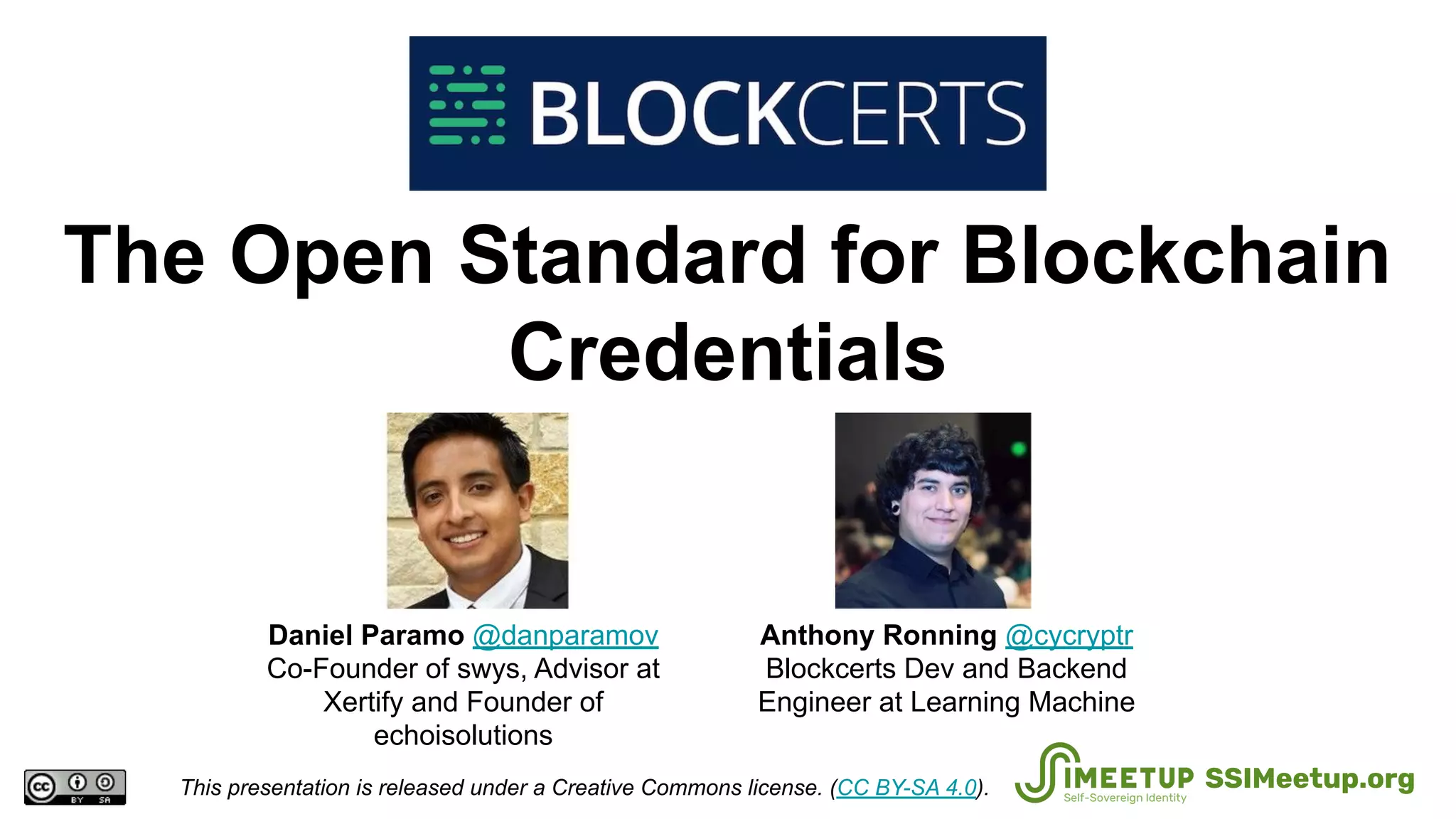
The Open Standard for Blockchain
Credentials
This presentation is released under a Creative Commons license. (CC BY-SA 4.0). SSIMeetup.org
Anthony Ronning @cycryptr
Blockcerts Dev and Backend
Engineer at Learning Machine
Daniel Paramo @danparamov
Co-Founder of swys, Advisor at
Xertify and Founder of
echoisolutions
1. Empower global SSI communities
2. Open to everyone interested in SSI
3. All content is shared with CC BY SA
SSIMeetup.org
Alex Preukschat @SSIMeetup @AlexPreukschat
Coordinating Node SSIMeetup.org
https://creativecommons.org/licenses/by-sa/4.0/
SSIMeetup objectives
Who are we?
This presentation is released under a Creative Commons license. (CC BY-SA 4.0). SSIMeetup.org
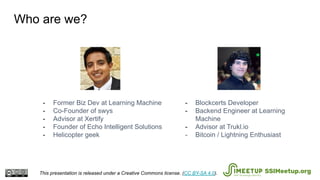
- Blockcerts Developer
- Backend Engineer at Learning
Machine
- Advisor at Trukl.io
- Bitcoin / Lightning Enthusiast
- Former Biz Dev at Learning Machine
- Co-Founder of swys
- Advisor at Xertify
- Founder of Echo Intelligent Solutions
- Helicopter geek
Blockcerts is an open standard for building apps that
issue and verify blockchain-based official records.
These may include certificates for civic records,
academic credentials, professional licenses, workforce
development, and more.
What is Blockcerts?
This presentation is released under a Creative Commons license. (CC BY-SA 4.0). SSIMeetup.org
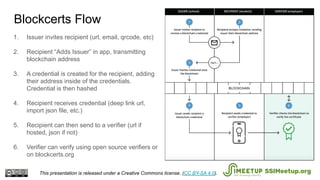
Blockcerts Flow
This presentation is released under a Creative Commons license. (CC BY-SA 4.0). SSIMeetup.org
1. Issuer invites recipient (url, email, qrcode, etc)
2. Recipient “Adds Issuer” in app, transmitting
blockchain address
3. A credential is created for the recipient, adding
their address inside of the credentials.
Credential is then hashed
4. Recipient receives credential (deep link url,
import json file, etc.)
5. Recipient can then send to a verifier (url if
hosted, json if not)
6. Verifier can verify using open source verifiers or
on blockcerts.org
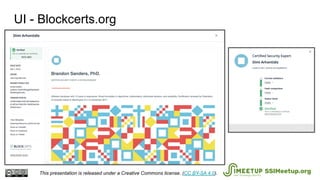
UI - Blockcerts.org
This presentation is released under a Creative Commons license. (CC BY-SA 4.0). SSIMeetup.org
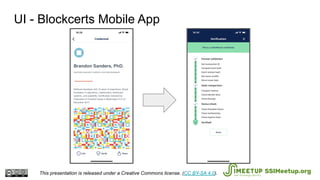
UI - Blockcerts Mobile App
This presentation is released under a Creative Commons license. (CC BY-SA 4.0). SSIMeetup.org
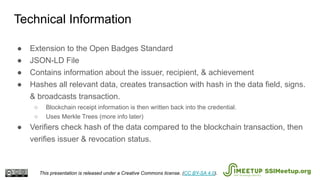
● Extension to the Open Badges Standard
● JSON-LD File
● Contains information about the issuer, recipient, & achievement
● Hashes all relevant data, creates transaction with hash in the data field, signs.
& broadcasts transaction.
○ Blockchain receipt information is then written back into the credential.
○ Uses Merkle Trees (more info later)
● Verifiers check hash of the data compared to the blockchain transaction, then
verifies issuer & revocation status.
Technical Information
This presentation is released under a Creative Commons license. (CC BY-SA 4.0). SSIMeetup.org
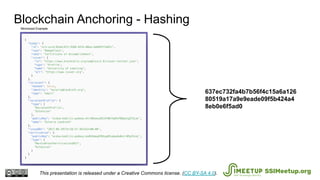
637ec732fa4b7b56f4c15a6a126
80519a17a9e9eade09f5b424a4
8eb0e6f5ad0
Blockchain Anchoring - Hashing
This presentation is released under a Creative Commons license. (CC BY-SA 4.0). SSIMeetup.org
Minimized Example
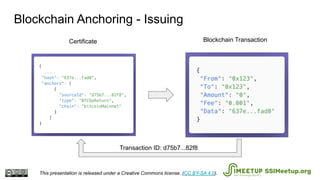
Blockchain TransactionCertificate
Transaction ID: d75b7...82f8
Blockchain Anchoring - Issuing
This presentation is released under a Creative Commons license. (CC BY-SA 4.0). SSIMeetup.org
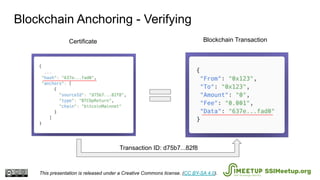
Blockchain TransactionCertificate
Transaction ID: d75b7...82f8
Blockchain Anchoring - Verifying
This presentation is released under a Creative Commons license. (CC BY-SA 4.0). SSIMeetup.org
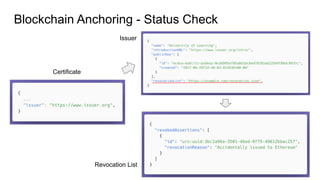
Certificate
Issuer
Revocation List
Blockchain Anchoring - Status Check
● Created with the object of being blockchain agnostic
● First Bitcoin, then Ethereum.
● Has implementations in Hyperledger
● Blockchain ”connectors” in Open Source
○ Trivial to add more, depends on difficulty of developing for a given blockchain.
Blockchain Agnostic
This presentation is released under a Creative Commons license. (CC BY-SA 4.0). SSIMeetup.org
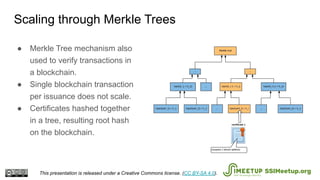
● Merkle Tree mechanism also
used to verify transactions in
a blockchain.
● Single blockchain transaction
per issuance does not scale.
● Certificates hashed together
in a tree, resulting root hash
on the blockchain.
Scaling through Merkle Trees
This presentation is released under a Creative Commons license. (CC BY-SA 4.0). SSIMeetup.org
● Blockcerts meant to be shared with verifiers
● Whole Blockcert is needed to verify
● Should not put more info than necessary
○ Example: Home Address in a Graduation Certificate
● Zero Knowledge Proofs can help mitigate PII, but not currently supported in
BlockcertsV2. More info later.
What data is safe to put in a Blockcerts?
This presentation is released under a Creative Commons license. (CC BY-SA 4.0). SSIMeetup.org
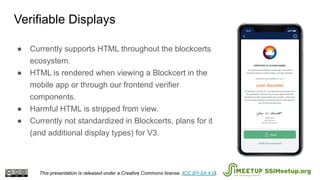
● Currently supports HTML throughout the blockcerts
ecosystem.
● HTML is rendered when viewing a Blockcert in the
mobile app or through our frontend verifier
components.
● Harmful HTML is stripped from view.
● Currently not standardized in Blockcerts, plans for it
(and additional display types) for V3.
Verifiable Displays
This presentation is released under a Creative Commons license. (CC BY-SA 4.0). SSIMeetup.org
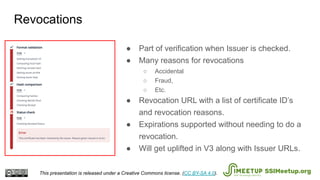
● Part of verification when Issuer is checked.
● Many reasons for revocations
○ Accidental
○ Fraud,
○ Etc.
● Revocation URL with a list of certificate ID’s
and revocation reasons.
● Expirations supported without needing to do a
revocation.
● Will get uplifted in V3 along with Issuer URLs.
Revocations
This presentation is released under a Creative Commons license. (CC BY-SA 4.0). SSIMeetup.org
What companies are building a solutions around
Blockcerts?
This presentation is released under a Creative Commons license. (CC BY-SA 4.0). SSIMeetup.org
Use Cases
This presentation is released under a Creative Commons license. (CC BY-SA 4.0). SSIMeetup.org
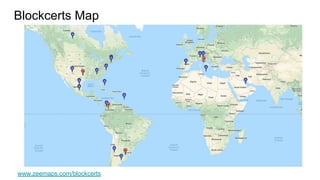
www.zeemaps.com/blockcerts
Blockcerts Map
Blockcerts allows individuals to own their own credentials and share them in a
way that allows verifiers to prove that the certificates are valid, have not been
tampered with, existed at a specific time, and were issued by correct issuer.
Pros Cons
● Open Source / Open Standard
● Recipient ownership & portable
● Existed at a specific point in time
● Vendor-independent verification
● Verifiable display
● Blockchain agnostic
● Scalable with Merkle Proofs
● Revocable
● Interoperable Standards (JSON-LD, OB,
VC’s, DIDs)
● Entire certificate data is needed to verify
○ no Zero-Knowledge Proofs yet
● Requires a blockchain transaction to issue a
batch (costs for public blockchains).
● Some certralized points of failures around
issuer/revocation URLs
○ mitigated w/ DIDs in V3
Why Blockcerts?
This presentation is released under a Creative Commons license. (CC BY-SA 4.0). SSIMeetup.org
● Version 3.0
○ Big focus on VC’s & DID’s
○ Coming out with a completed draft soon, seeking community feedback
● Learning Machine won a grant to align Blockcerts to the Verifiable Credentials
Standard & Decentralized Identifiers.
● Issuing and verification across additional blockchains, beyond Bitcoin and
Ethereum
Roadmap / Contributing
This presentation is released under a Creative Commons license. (CC BY-SA 4.0). SSIMeetup.org
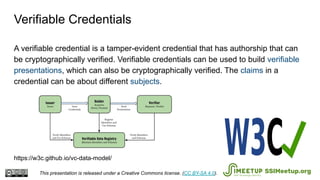
A verifiable credential is a tamper-evident credential that has authorship that can
be cryptographically verified. Verifiable credentials can be used to build verifiable
presentations, which can also be cryptographically verified. The claims in a
credential can be about different subjects.
https://w3c.github.io/vc-data-model/
Verifiable Credentials
This presentation is released under a Creative Commons license. (CC BY-SA 4.0). SSIMeetup.org
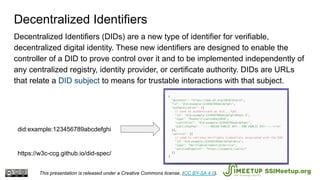
Decentralized Identifiers (DIDs) are a new type of identifier for verifiable,
decentralized digital identity. These new identifiers are designed to enable the
controller of a DID to prove control over it and to be implemented independently of
any centralized registry, identity provider, or certificate authority. DIDs are URLs
that relate a DID subject to means for trustable interactions with that subject.
https://w3c-ccg.github.io/did-spec/
did:example:123456789abcdefghi
Decentralized Identifiers
This presentation is released under a Creative Commons license. (CC BY-SA 4.0). SSIMeetup.org
Anthony Ronning - @cycryptr
Blockcerts Dev and Backend
Engineer at Learning Machine
Daniel Paramo - @danparamov
Co-Founder of swys, Advisor at
Xertify and Founder of
echoisolutions
Thank you!
This presentation is released under a Creative Commons license. (CC BY-SA 4.0). SSIMeetup.org

Blockcerts: The Open Standard for Blockchain Credentials

  • 1.
    The Open Standardfor Blockchain Credentials This presentation is released under a Creative Commons license. (CC BY-SA 4.0). SSIMeetup.org Anthony Ronning @cycryptr Blockcerts Dev and Backend Engineer at Learning Machine Daniel Paramo @danparamov Co-Founder of swys, Advisor at Xertify and Founder of echoisolutions
  • 2.
    1. Empower globalSSI communities 2. Open to everyone interested in SSI 3. All content is shared with CC BY SA SSIMeetup.org Alex Preukschat @SSIMeetup @AlexPreukschat Coordinating Node SSIMeetup.org https://creativecommons.org/licenses/by-sa/4.0/ SSIMeetup objectives
  • 3.
    Who are we? Thispresentation is released under a Creative Commons license. (CC BY-SA 4.0). SSIMeetup.org - Blockcerts Developer - Backend Engineer at Learning Machine - Advisor at Trukl.io - Bitcoin / Lightning Enthusiast - Former Biz Dev at Learning Machine - Co-Founder of swys - Advisor at Xertify - Founder of Echo Intelligent Solutions - Helicopter geek
  • 4.
    Blockcerts is anopen standard for building apps that issue and verify blockchain-based official records. These may include certificates for civic records, academic credentials, professional licenses, workforce development, and more. What is Blockcerts? This presentation is released under a Creative Commons license. (CC BY-SA 4.0). SSIMeetup.org
  • 5.
    Blockcerts Flow This presentationis released under a Creative Commons license. (CC BY-SA 4.0). SSIMeetup.org 1. Issuer invites recipient (url, email, qrcode, etc) 2. Recipient “Adds Issuer” in app, transmitting blockchain address 3. A credential is created for the recipient, adding their address inside of the credentials. Credential is then hashed 4. Recipient receives credential (deep link url, import json file, etc.) 5. Recipient can then send to a verifier (url if hosted, json if not) 6. Verifier can verify using open source verifiers or on blockcerts.org
  • 6.
    UI - Blockcerts.org Thispresentation is released under a Creative Commons license. (CC BY-SA 4.0). SSIMeetup.org
  • 7.
    UI - BlockcertsMobile App This presentation is released under a Creative Commons license. (CC BY-SA 4.0). SSIMeetup.org
  • 8.
    ● Extension tothe Open Badges Standard ● JSON-LD File ● Contains information about the issuer, recipient, & achievement ● Hashes all relevant data, creates transaction with hash in the data field, signs. & broadcasts transaction. ○ Blockchain receipt information is then written back into the credential. ○ Uses Merkle Trees (more info later) ● Verifiers check hash of the data compared to the blockchain transaction, then verifies issuer & revocation status. Technical Information This presentation is released under a Creative Commons license. (CC BY-SA 4.0). SSIMeetup.org
  • 9.
    637ec732fa4b7b56f4c15a6a126 80519a17a9e9eade09f5b424a4 8eb0e6f5ad0 Blockchain Anchoring -Hashing This presentation is released under a Creative Commons license. (CC BY-SA 4.0). SSIMeetup.org Minimized Example
  • 10.
    Blockchain TransactionCertificate Transaction ID:d75b7...82f8 Blockchain Anchoring - Issuing This presentation is released under a Creative Commons license. (CC BY-SA 4.0). SSIMeetup.org
  • 11.
    Blockchain TransactionCertificate Transaction ID:d75b7...82f8 Blockchain Anchoring - Verifying This presentation is released under a Creative Commons license. (CC BY-SA 4.0). SSIMeetup.org
  • 12.
  • 13.
    ● Created withthe object of being blockchain agnostic ● First Bitcoin, then Ethereum. ● Has implementations in Hyperledger ● Blockchain ”connectors” in Open Source ○ Trivial to add more, depends on difficulty of developing for a given blockchain. Blockchain Agnostic This presentation is released under a Creative Commons license. (CC BY-SA 4.0). SSIMeetup.org
  • 14.
    ● Merkle Treemechanism also used to verify transactions in a blockchain. ● Single blockchain transaction per issuance does not scale. ● Certificates hashed together in a tree, resulting root hash on the blockchain. Scaling through Merkle Trees This presentation is released under a Creative Commons license. (CC BY-SA 4.0). SSIMeetup.org
  • 15.
    ● Blockcerts meantto be shared with verifiers ● Whole Blockcert is needed to verify ● Should not put more info than necessary ○ Example: Home Address in a Graduation Certificate ● Zero Knowledge Proofs can help mitigate PII, but not currently supported in BlockcertsV2. More info later. What data is safe to put in a Blockcerts? This presentation is released under a Creative Commons license. (CC BY-SA 4.0). SSIMeetup.org
  • 16.
    ● Currently supportsHTML throughout the blockcerts ecosystem. ● HTML is rendered when viewing a Blockcert in the mobile app or through our frontend verifier components. ● Harmful HTML is stripped from view. ● Currently not standardized in Blockcerts, plans for it (and additional display types) for V3. Verifiable Displays This presentation is released under a Creative Commons license. (CC BY-SA 4.0). SSIMeetup.org
  • 17.
    ● Part ofverification when Issuer is checked. ● Many reasons for revocations ○ Accidental ○ Fraud, ○ Etc. ● Revocation URL with a list of certificate ID’s and revocation reasons. ● Expirations supported without needing to do a revocation. ● Will get uplifted in V3 along with Issuer URLs. Revocations This presentation is released under a Creative Commons license. (CC BY-SA 4.0). SSIMeetup.org
  • 18.
    What companies arebuilding a solutions around Blockcerts? This presentation is released under a Creative Commons license. (CC BY-SA 4.0). SSIMeetup.org
  • 19.
    Use Cases This presentationis released under a Creative Commons license. (CC BY-SA 4.0). SSIMeetup.org
  • 20.
  • 21.
    Blockcerts allows individualsto own their own credentials and share them in a way that allows verifiers to prove that the certificates are valid, have not been tampered with, existed at a specific time, and were issued by correct issuer. Pros Cons ● Open Source / Open Standard ● Recipient ownership & portable ● Existed at a specific point in time ● Vendor-independent verification ● Verifiable display ● Blockchain agnostic ● Scalable with Merkle Proofs ● Revocable ● Interoperable Standards (JSON-LD, OB, VC’s, DIDs) ● Entire certificate data is needed to verify ○ no Zero-Knowledge Proofs yet ● Requires a blockchain transaction to issue a batch (costs for public blockchains). ● Some certralized points of failures around issuer/revocation URLs ○ mitigated w/ DIDs in V3 Why Blockcerts? This presentation is released under a Creative Commons license. (CC BY-SA 4.0). SSIMeetup.org
  • 22.
    ● Version 3.0 ○Big focus on VC’s & DID’s ○ Coming out with a completed draft soon, seeking community feedback ● Learning Machine won a grant to align Blockcerts to the Verifiable Credentials Standard & Decentralized Identifiers. ● Issuing and verification across additional blockchains, beyond Bitcoin and Ethereum Roadmap / Contributing This presentation is released under a Creative Commons license. (CC BY-SA 4.0). SSIMeetup.org
  • 23.
    A verifiable credentialis a tamper-evident credential that has authorship that can be cryptographically verified. Verifiable credentials can be used to build verifiable presentations, which can also be cryptographically verified. The claims in a credential can be about different subjects. https://w3c.github.io/vc-data-model/ Verifiable Credentials This presentation is released under a Creative Commons license. (CC BY-SA 4.0). SSIMeetup.org
  • 24.
    Decentralized Identifiers (DIDs)are a new type of identifier for verifiable, decentralized digital identity. These new identifiers are designed to enable the controller of a DID to prove control over it and to be implemented independently of any centralized registry, identity provider, or certificate authority. DIDs are URLs that relate a DID subject to means for trustable interactions with that subject. https://w3c-ccg.github.io/did-spec/ did:example:123456789abcdefghi Decentralized Identifiers This presentation is released under a Creative Commons license. (CC BY-SA 4.0). SSIMeetup.org
  • 25.
    Anthony Ronning -@cycryptr Blockcerts Dev and Backend Engineer at Learning Machine Daniel Paramo - @danparamov Co-Founder of swys, Advisor at Xertify and Founder of echoisolutions Thank you! This presentation is released under a Creative Commons license. (CC BY-SA 4.0). SSIMeetup.org