Task 3.1 – Intelligent tree marking
Tree marking in selective cuts
Key operation in forestry affecting cost of harvest
operations, environment, ecology, etc.

Forest inventory integration

Kick-off Meeting
8-9/jan/2014
Task 3.1 – Intelligent tree marking
An optimal organization of work implies tree
marking after the definition of the hauling
direction (and the extraction system).

The forester should have access
to full information about the
forest and the harvesting system

-> one of the goal of SLOPE

Kick-off Meeting
8-9/jan/2014
Task 3.1 – Intelligent tree marking
Marks must be easy to recognize
Different systems can be used (debarking, colours)
The new marking will couple with traditional system

Kick-off Meeting
8-9/jan/2014
Task 3.1 – Intelligent tree marking
Participants:
- CNR
- MHG
- BOKU
- GREIFEMBERG
- TREMETRICS
- ITENE

Start M6, end M17 (May 2015)
Deliverables (both due in M17):
D3.01 Portable RFID tag reader/programmer
D3.02 RFID tag test

Interactions:
- WP3. direct interactions tasks 3.2, 3.3, 3.4;
- WP2. task 2.4 (3D modeling for harvesting planning) Virtual Forest Model which ideally will
be implemented in the marking phase (M8-15);
- WP5. task 5.1 (Database to support novel inventory data content) where a RFID code to
single entry indexing is envisaged (M8-17).

Kick-off Meeting
8-9/jan/2014
Task 3.1 – Intelligent tree marking
CNR, BOKU, GRE
high-precision GPS and rugged PC
• position of the planned cable-crane skyline
• the plot’s boundaries
• single trees already identified as candidates (WP2)
• visualize the related information
• potentially input new info in the database (species,
diameter, defects, wildlife, etc.)
Deadline M17, by M12 a interim delivery report
should be prepared

Kick-off Meeting
8-9/jan/2014
Task 3.1 – Intelligent tree marking
ITENE, MHG, TRE
RFID UHF tags, a programming/reading tool (possibly
the former rugged PC) and an inserting device
• effectively marking trees
• easy to place and to read
• robust and long-lasting
• definition of the most appropriate position in the
standing tree
• programmable blank tag or index association to
database for unique identity tags
• association of traditional marking (color, debarking)
with IT marking

Deadline M17, by M12 a interim delivery report should
be prepared
Kick-off Meeting
8-9/jan/2014
Task 3.1 – Intelligent tree marking

Many possible options
• nail shaped RFID tags
• mixed UHF and color/barcode tags
• others

Important is the interaction with the following steps
of felling, hauling and processing (tasks 3.2-3.4)
Kick-off Meeting
8-9/jan/2014
Task 3.1 – Intelligent tree marking
Different solutions for different work stages?

• edge shaped RFID tag
• butt position (only on felled trees or logs)
• potentially bridging in task 3.4

Kick-off Meeting
8-9/jan/2014
Task 3.1 – Intelligent tree marking
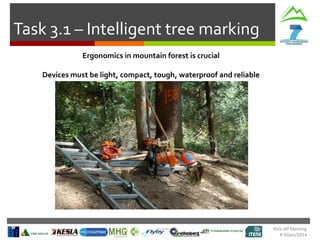
Ergonomics in mountain forest is crucial
Devices must be light, compact, tough, waterproof and reliable

Kick-off Meeting
8-9/jan/2014
Task 3.1 – Intelligent tree marking
Challenges
The chosen system will influence all the traceability
performance
A cumbersome or heavy system would not be accepted by
operators
The survival rate and reading success rate must be high and
secured over a reasonable span of time
Interaction among tags and machines as well as tag readers
and ERP is crucial

Kick-off Meeting
8-9/jan/2014
Task 3.1 – Intelligent tree marking
1
1

2

3

4

5

6

7

8

9

10

11

12

13

14

15

16

17

18

19

20

21

22

23

24

Definition of requirements and system analysis

1.1

Users and System requirements

1.2

Hardware and equipment definition

1.3

Human Machine Interface (HMI) definition

1.4

Mountainous Forest inventory data model definition

1.5

System architecture

2

Forest information collection

2.1

Remote sensing and multispectral analysis

2.2

UAV data acquisition and processing

2.3

On-field digital survey systems

2.4

3D Modelling for harvesting planning

2.5

Road and Logistic planning

3

Complex machine system

3.1

intelligent tree marking

3.2

intelligent tree felling/haulin

3.3

Intelligent Cable crane (improvement)

3.4

intelligent processor head

3.5

intelligent transport truck

3.6

data management back-up

4

X

X

Multi-Senror Model-based quality control of mountain

4.1

Data mining and model integration of stand quality indicators from

4.2

Evaluation of near infrared spectroscopy as a tool

4.3

Evaluation of hyperspectral imaging (HI) for the determination of

4.4

Data mining and model integration of log/biomass quality

4.5

Evaluation of cutting process (CP) for the determination of

4.6

Implementation of the log/biomass grading system

5

Forest information system development

5.1

Database to support novel inventory data content

5.2

Platform for near real time control of operations

5.3

Online purchasing/invoicing of industrial timber and biomass

5.4

Long term optimization; strategic planning

5.5

Mid-long term optimization; strategic and tactical planning

6

System Integration

6.1

Definition of the integration steps

6.2

First Integration – Forest inventory & harvesting systems

6.3

Second integration – Forest management

6.4

Third integration -System validation

7

Piloting the SLOPE demonstrator

7.1

Definition of evaluation methodology

7.2

Preparation and deployment of demonstrators

7.3

Trials Recommendations and validation cycle

7.4

Training

Kick-off Meeting
8-9/jan/2014

Task 3.1 intelligent tree marking (by cnr)

  • 1.
    Task 3.1 –Intelligent tree marking Tree marking in selective cuts Key operation in forestry affecting cost of harvest operations, environment, ecology, etc. Forest inventory integration Kick-off Meeting 8-9/jan/2014
  • 2.
    Task 3.1 –Intelligent tree marking An optimal organization of work implies tree marking after the definition of the hauling direction (and the extraction system). The forester should have access to full information about the forest and the harvesting system -> one of the goal of SLOPE Kick-off Meeting 8-9/jan/2014
  • 3.
    Task 3.1 –Intelligent tree marking Marks must be easy to recognize Different systems can be used (debarking, colours) The new marking will couple with traditional system Kick-off Meeting 8-9/jan/2014
  • 4.
    Task 3.1 –Intelligent tree marking Participants: - CNR - MHG - BOKU - GREIFEMBERG - TREMETRICS - ITENE Start M6, end M17 (May 2015) Deliverables (both due in M17): D3.01 Portable RFID tag reader/programmer D3.02 RFID tag test Interactions: - WP3. direct interactions tasks 3.2, 3.3, 3.4; - WP2. task 2.4 (3D modeling for harvesting planning) Virtual Forest Model which ideally will be implemented in the marking phase (M8-15); - WP5. task 5.1 (Database to support novel inventory data content) where a RFID code to single entry indexing is envisaged (M8-17). Kick-off Meeting 8-9/jan/2014
  • 5.
    Task 3.1 –Intelligent tree marking CNR, BOKU, GRE high-precision GPS and rugged PC • position of the planned cable-crane skyline • the plot’s boundaries • single trees already identified as candidates (WP2) • visualize the related information • potentially input new info in the database (species, diameter, defects, wildlife, etc.) Deadline M17, by M12 a interim delivery report should be prepared Kick-off Meeting 8-9/jan/2014
  • 6.
    Task 3.1 –Intelligent tree marking ITENE, MHG, TRE RFID UHF tags, a programming/reading tool (possibly the former rugged PC) and an inserting device • effectively marking trees • easy to place and to read • robust and long-lasting • definition of the most appropriate position in the standing tree • programmable blank tag or index association to database for unique identity tags • association of traditional marking (color, debarking) with IT marking Deadline M17, by M12 a interim delivery report should be prepared Kick-off Meeting 8-9/jan/2014
  • 7.
    Task 3.1 –Intelligent tree marking Many possible options • nail shaped RFID tags • mixed UHF and color/barcode tags • others Important is the interaction with the following steps of felling, hauling and processing (tasks 3.2-3.4) Kick-off Meeting 8-9/jan/2014
  • 8.
    Task 3.1 –Intelligent tree marking Different solutions for different work stages? • edge shaped RFID tag • butt position (only on felled trees or logs) • potentially bridging in task 3.4 Kick-off Meeting 8-9/jan/2014
  • 9.
    Task 3.1 –Intelligent tree marking Ergonomics in mountain forest is crucial Devices must be light, compact, tough, waterproof and reliable Kick-off Meeting 8-9/jan/2014
  • 10.
    Task 3.1 –Intelligent tree marking Challenges The chosen system will influence all the traceability performance A cumbersome or heavy system would not be accepted by operators The survival rate and reading success rate must be high and secured over a reasonable span of time Interaction among tags and machines as well as tag readers and ERP is crucial Kick-off Meeting 8-9/jan/2014
  • 11.
    Task 3.1 –Intelligent tree marking 1 1 2 3 4 5 6 7 8 9 10 11 12 13 14 15 16 17 18 19 20 21 22 23 24 Definition of requirements and system analysis 1.1 Users and System requirements 1.2 Hardware and equipment definition 1.3 Human Machine Interface (HMI) definition 1.4 Mountainous Forest inventory data model definition 1.5 System architecture 2 Forest information collection 2.1 Remote sensing and multispectral analysis 2.2 UAV data acquisition and processing 2.3 On-field digital survey systems 2.4 3D Modelling for harvesting planning 2.5 Road and Logistic planning 3 Complex machine system 3.1 intelligent tree marking 3.2 intelligent tree felling/haulin 3.3 Intelligent Cable crane (improvement) 3.4 intelligent processor head 3.5 intelligent transport truck 3.6 data management back-up 4 X X Multi-Senror Model-based quality control of mountain 4.1 Data mining and model integration of stand quality indicators from 4.2 Evaluation of near infrared spectroscopy as a tool 4.3 Evaluation of hyperspectral imaging (HI) for the determination of 4.4 Data mining and model integration of log/biomass quality 4.5 Evaluation of cutting process (CP) for the determination of 4.6 Implementation of the log/biomass grading system 5 Forest information system development 5.1 Database to support novel inventory data content 5.2 Platform for near real time control of operations 5.3 Online purchasing/invoicing of industrial timber and biomass 5.4 Long term optimization; strategic planning 5.5 Mid-long term optimization; strategic and tactical planning 6 System Integration 6.1 Definition of the integration steps 6.2 First Integration – Forest inventory & harvesting systems 6.3 Second integration – Forest management 6.4 Third integration -System validation 7 Piloting the SLOPE demonstrator 7.1 Definition of evaluation methodology 7.2 Preparation and deployment of demonstrators 7.3 Trials Recommendations and validation cycle 7.4 Training Kick-off Meeting 8-9/jan/2014