Private Aid and the Financing of
Development
Raj M. Desai
Georgetown University and
The Brookings Institution
Development Day, Stockholm, May 11, 2015
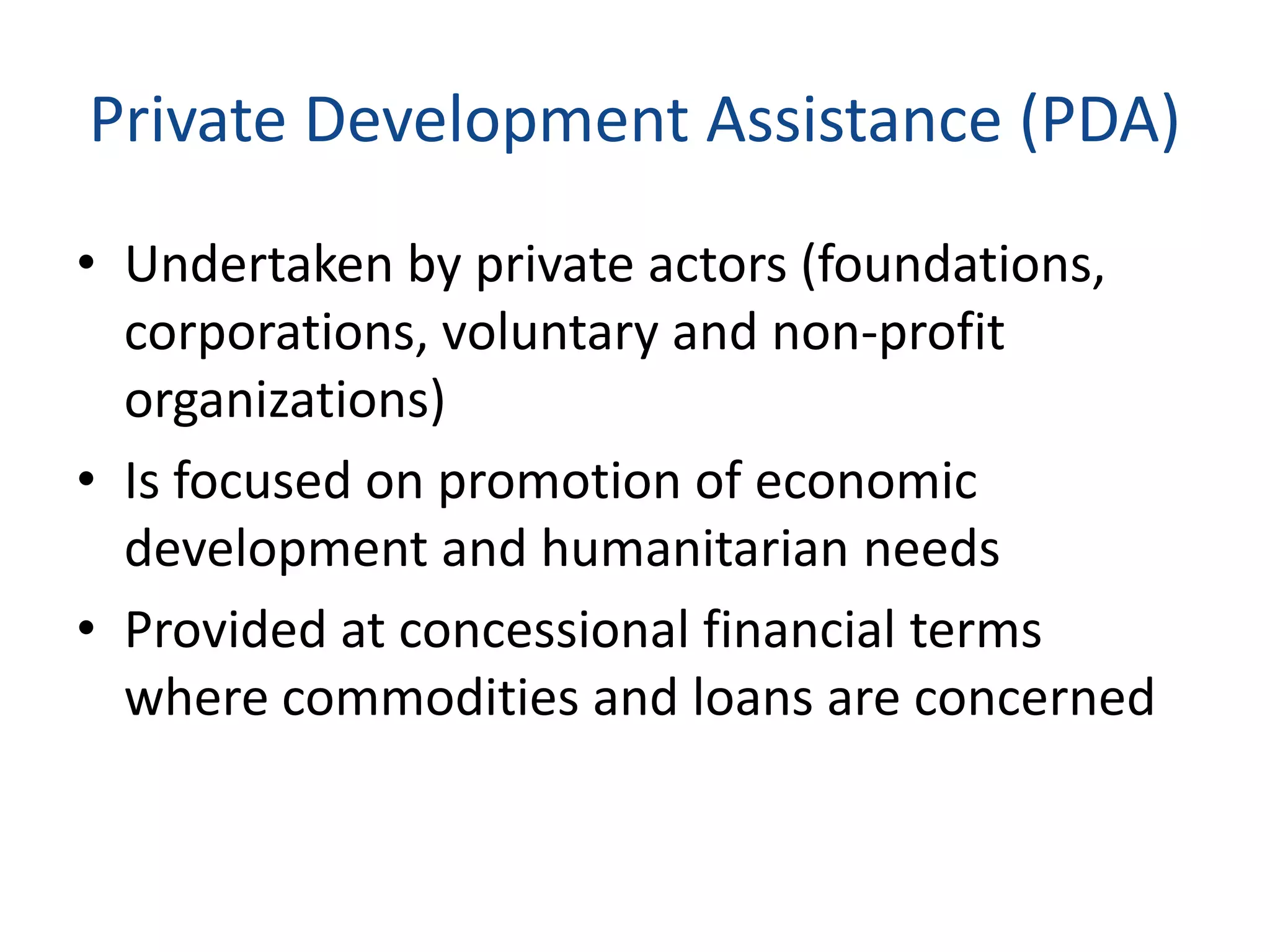
Private Development Assistance (PDA)
• Undertaken by private actors (foundations,
corporations, voluntary and non-profit
organizations)
• Is focused on promotion of economic
development and humanitarian needs
• Provided at concessional financial terms
where commodities and loans are concerned
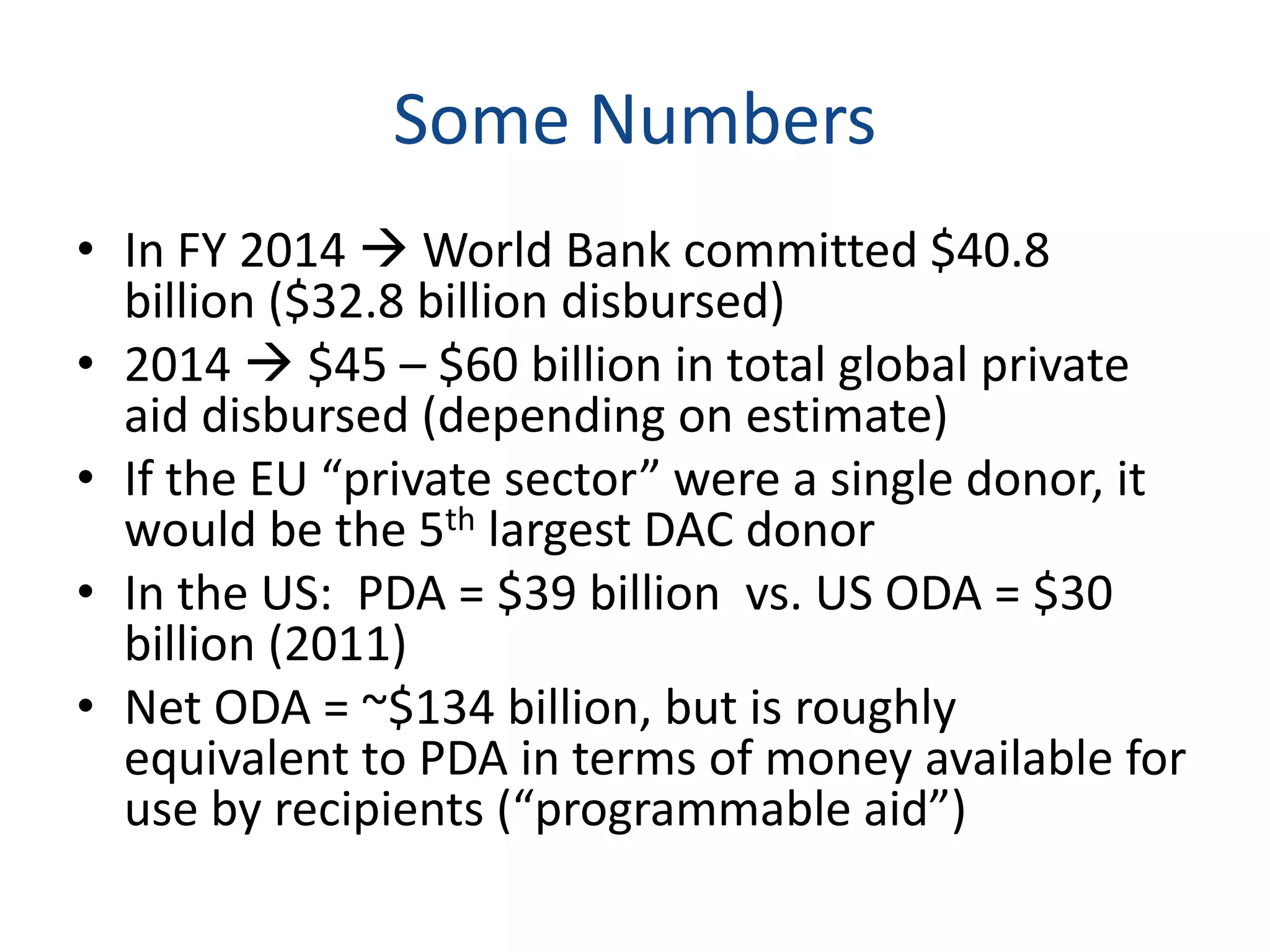
Some Numbers
• In FY 2014  World Bank committed $40.8
billion ($32.8 billion disbursed)
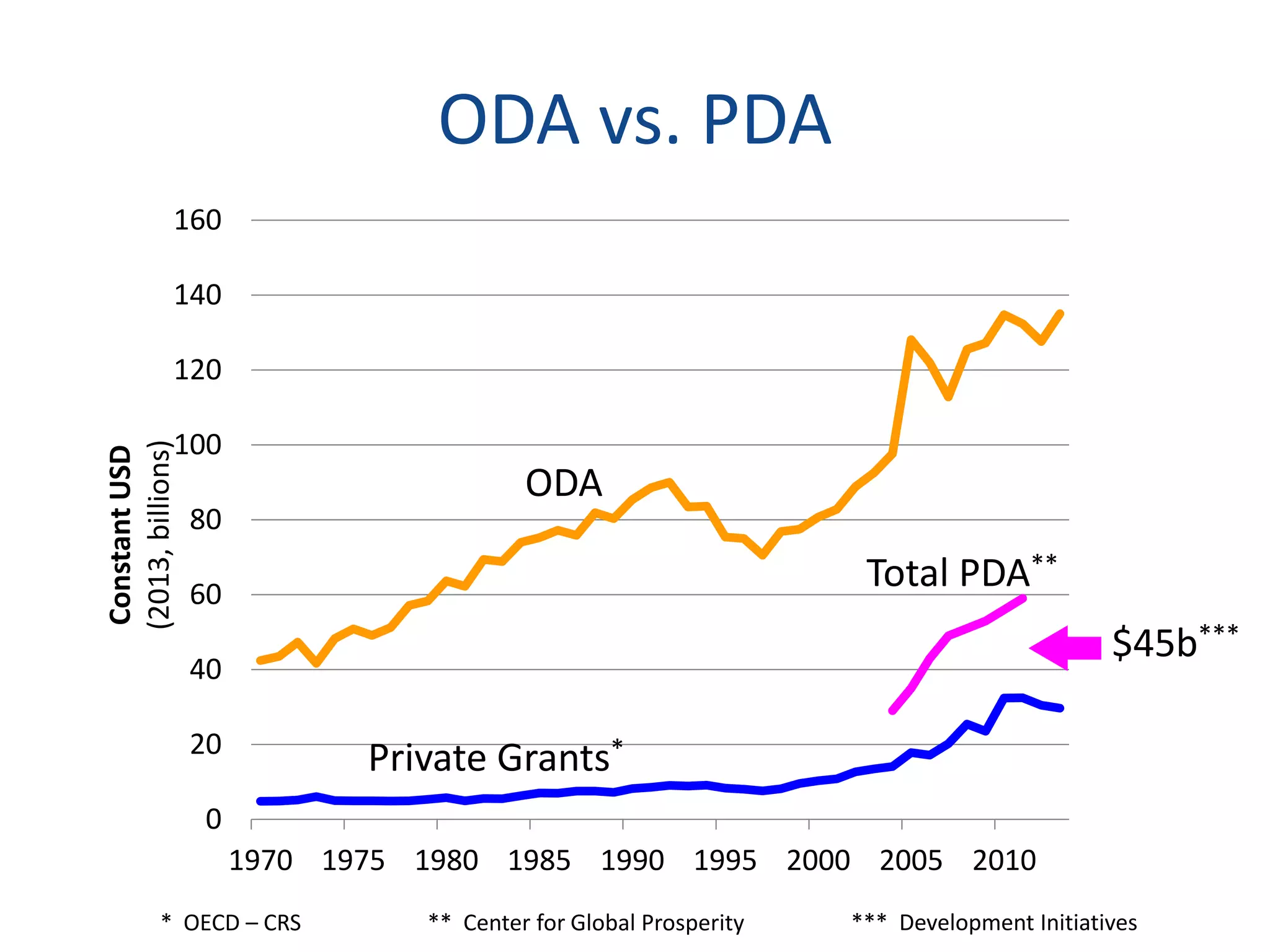
• 2014  $45 – $60 billion in total global private
aid disbursed (depending on estimate)
• If the EU “private sector” were a single donor, it
would be the 5th largest DAC donor
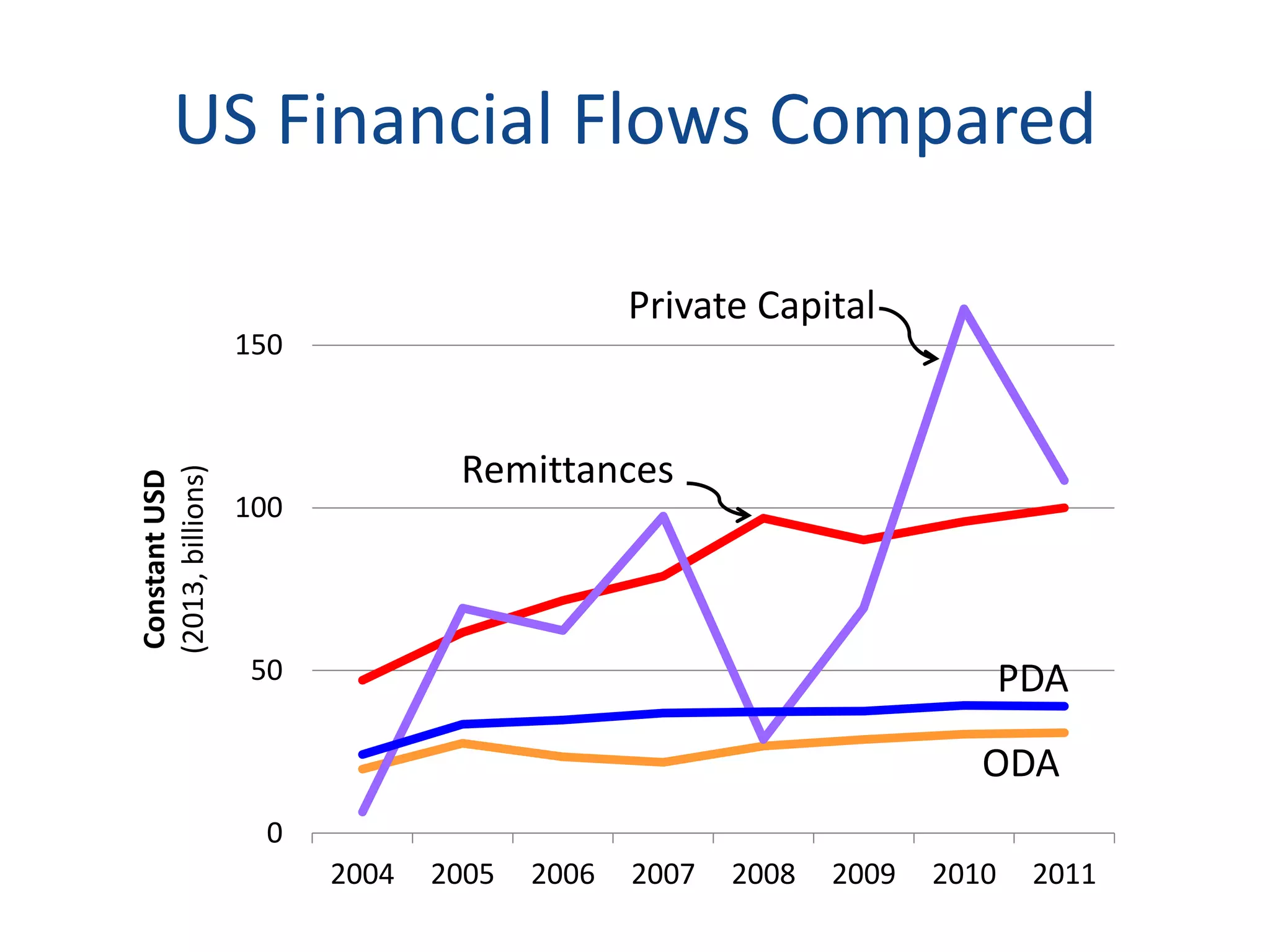
• In the US: PDA = $39 billion vs. US ODA = $30
billion (2011)
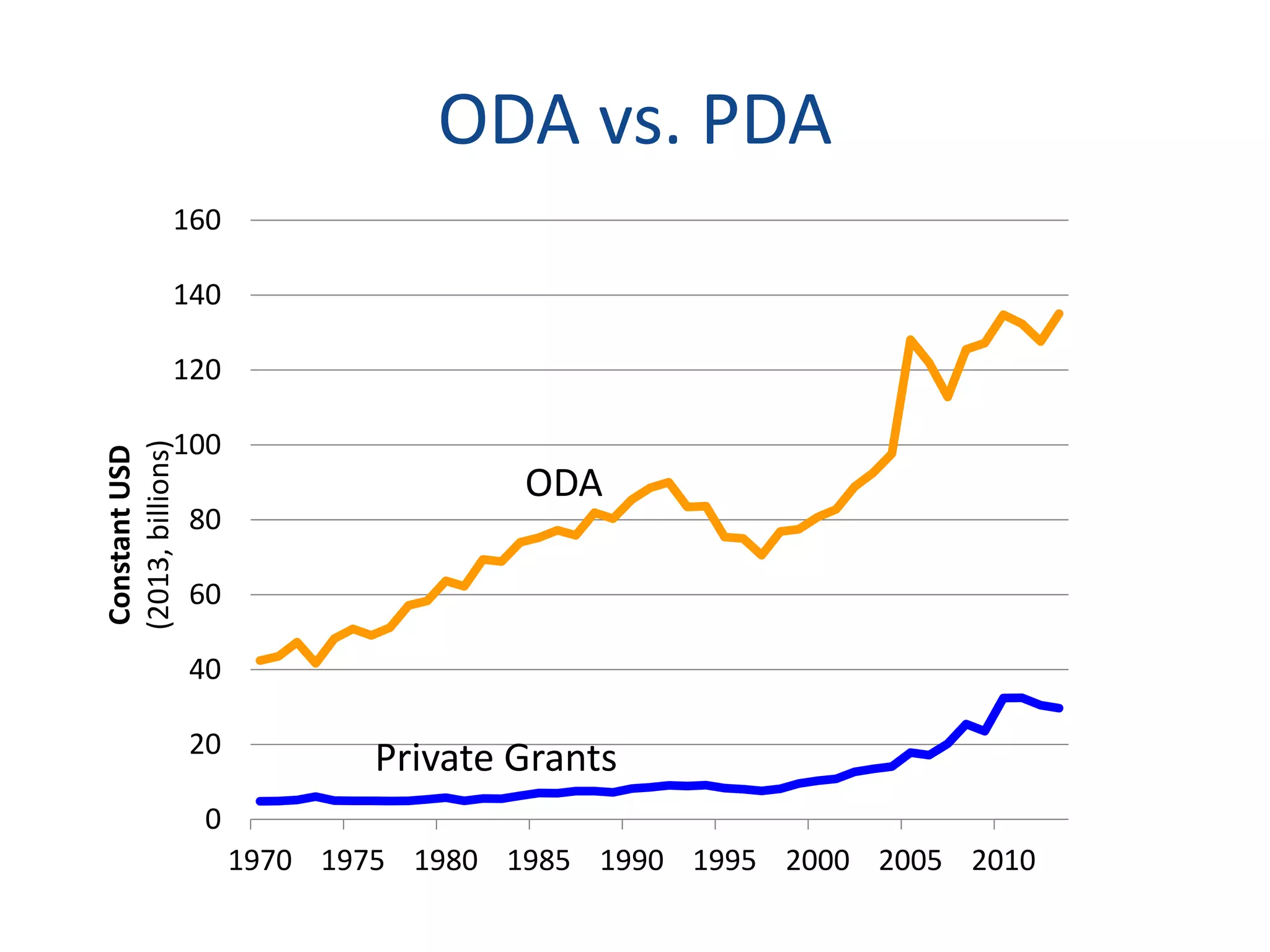
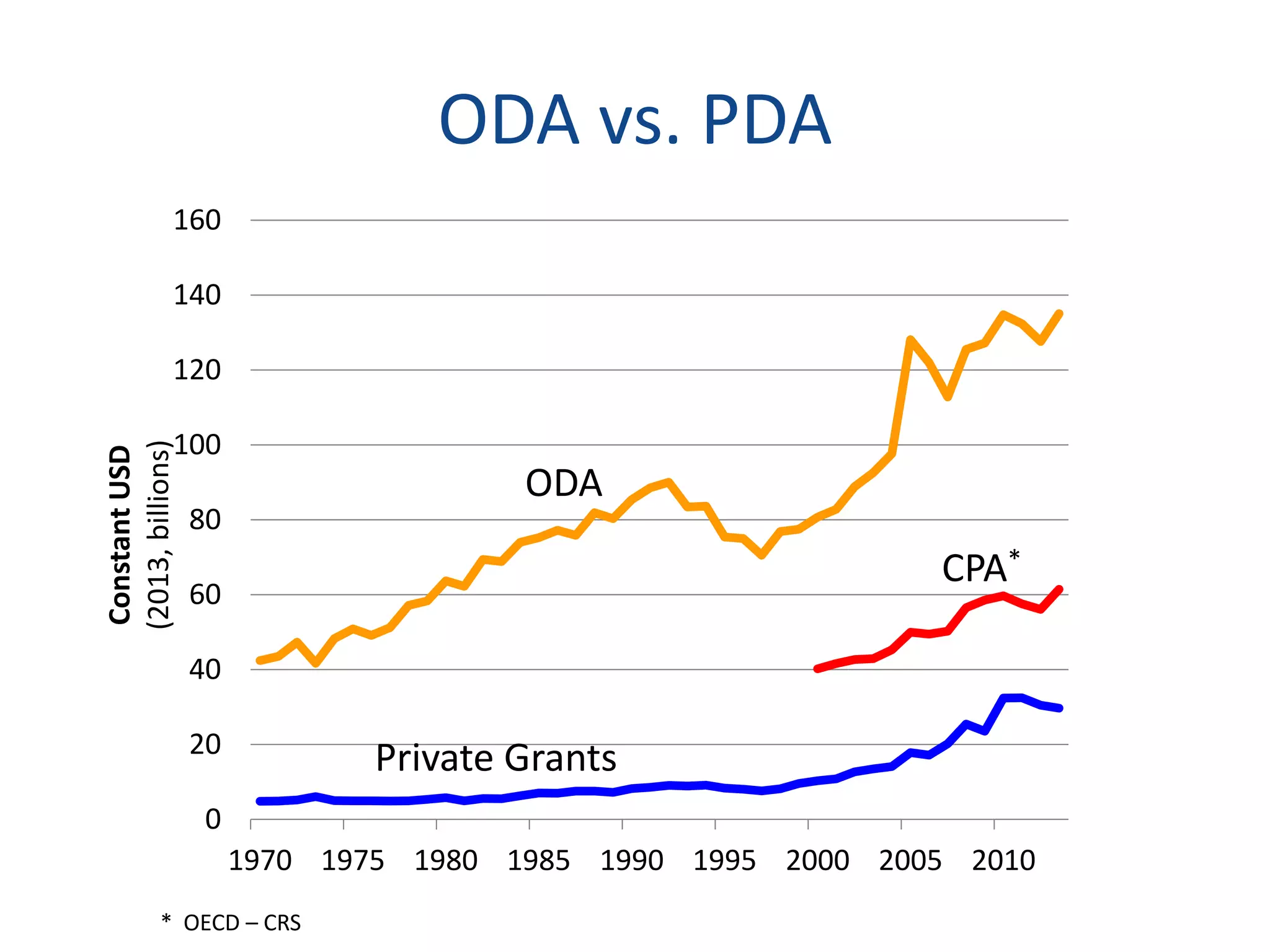
• Net ODA = ~$134 billion, but is roughly
equivalent to PDA in terms of money available for
use by recipients (“programmable aid”)
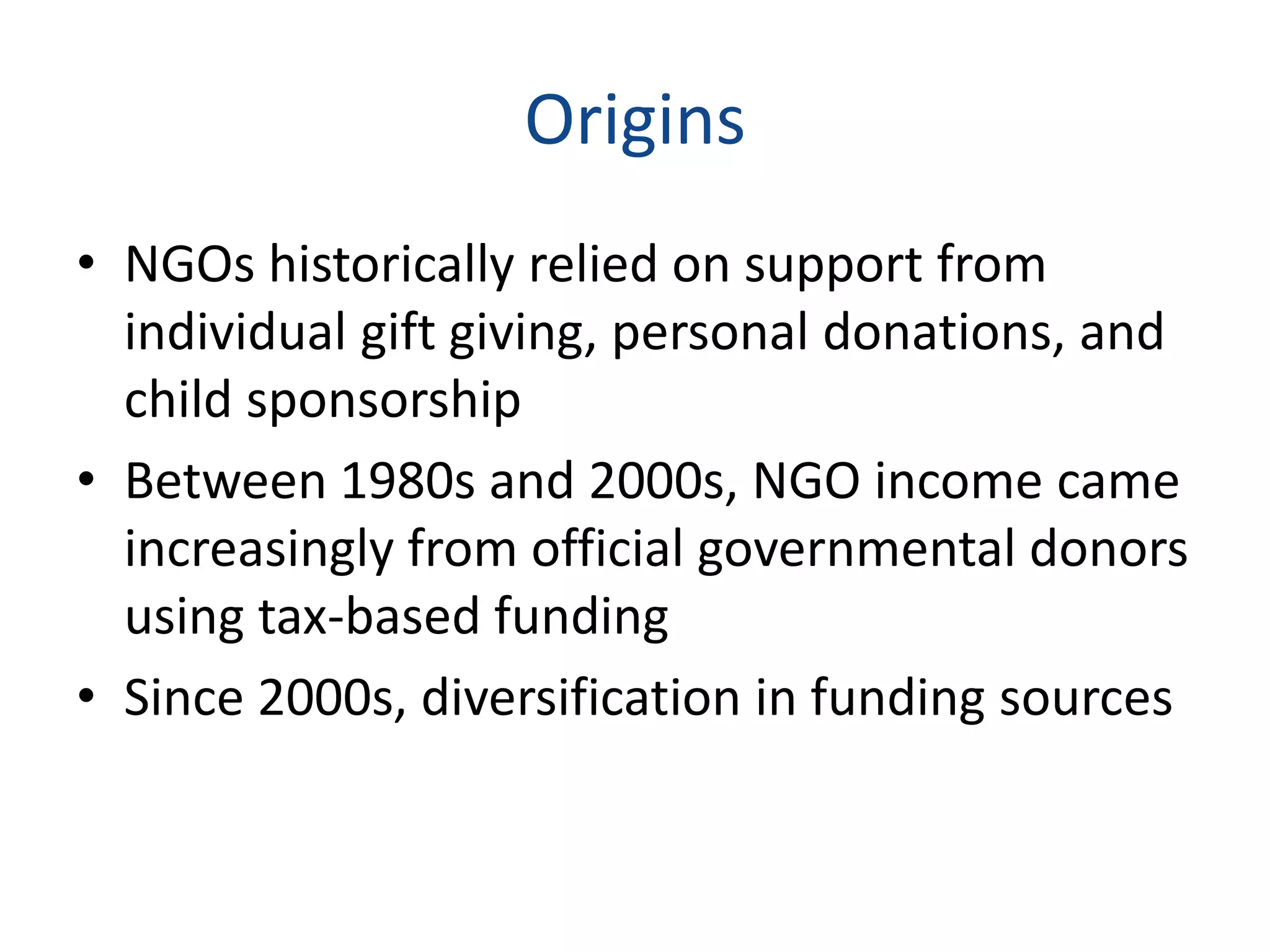
Origins
• NGOs historically relied on support from
individual gift giving, personal donations, and
child sponsorship
• Between 1980s and 2000s, NGO income came
increasingly from official governmental donors
using tax-based funding
• Since 2000s, diversification in funding sources
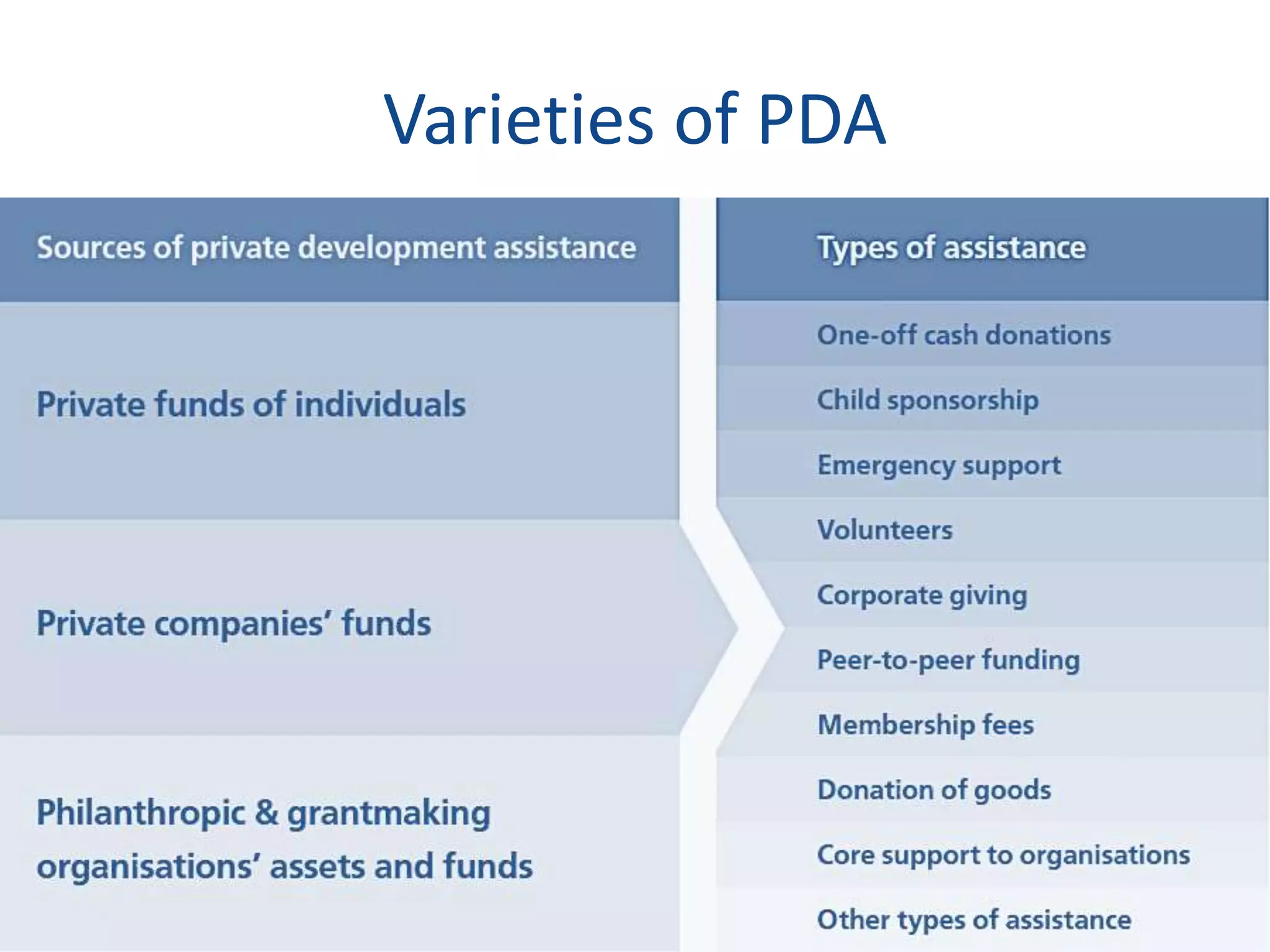
Varieties of PDA
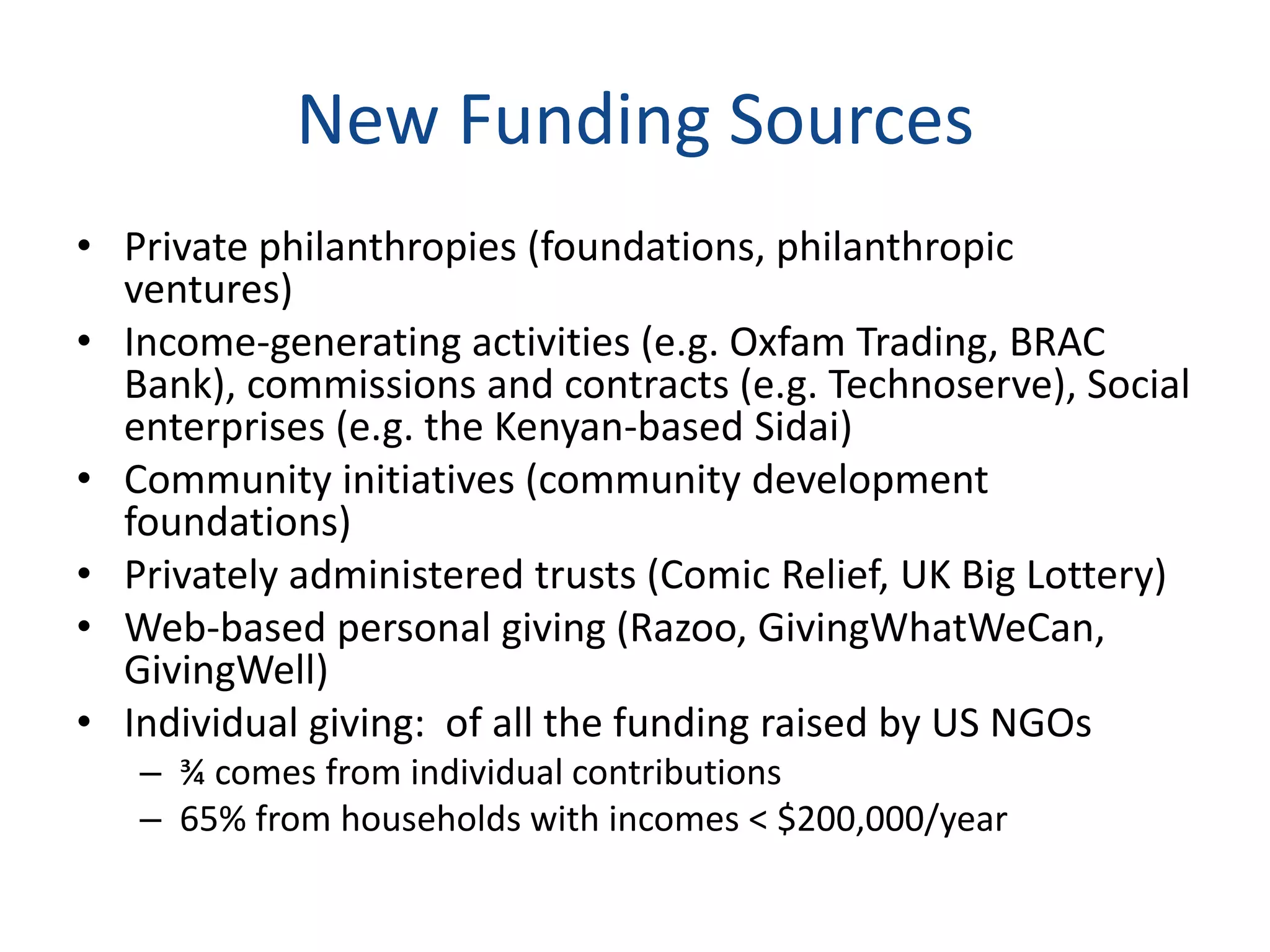
New Funding Sources
• Private philanthropies (foundations, philanthropic
ventures)
• Income-generating activities (e.g. Oxfam Trading, BRAC
Bank), commissions and contracts (e.g. Technoserve), Social
enterprises (e.g. the Kenyan-based Sidai)
• Community initiatives (community development
foundations)
• Privately administered trusts (Comic Relief, UK Big Lottery)
• Web-based personal giving (Razoo, GivingWhatWeCan,
GivingWell)
• Individual giving: of all the funding raised by US NGOs
– ¾ comes from individual contributions
– 65% from households with incomes < $200,000/year
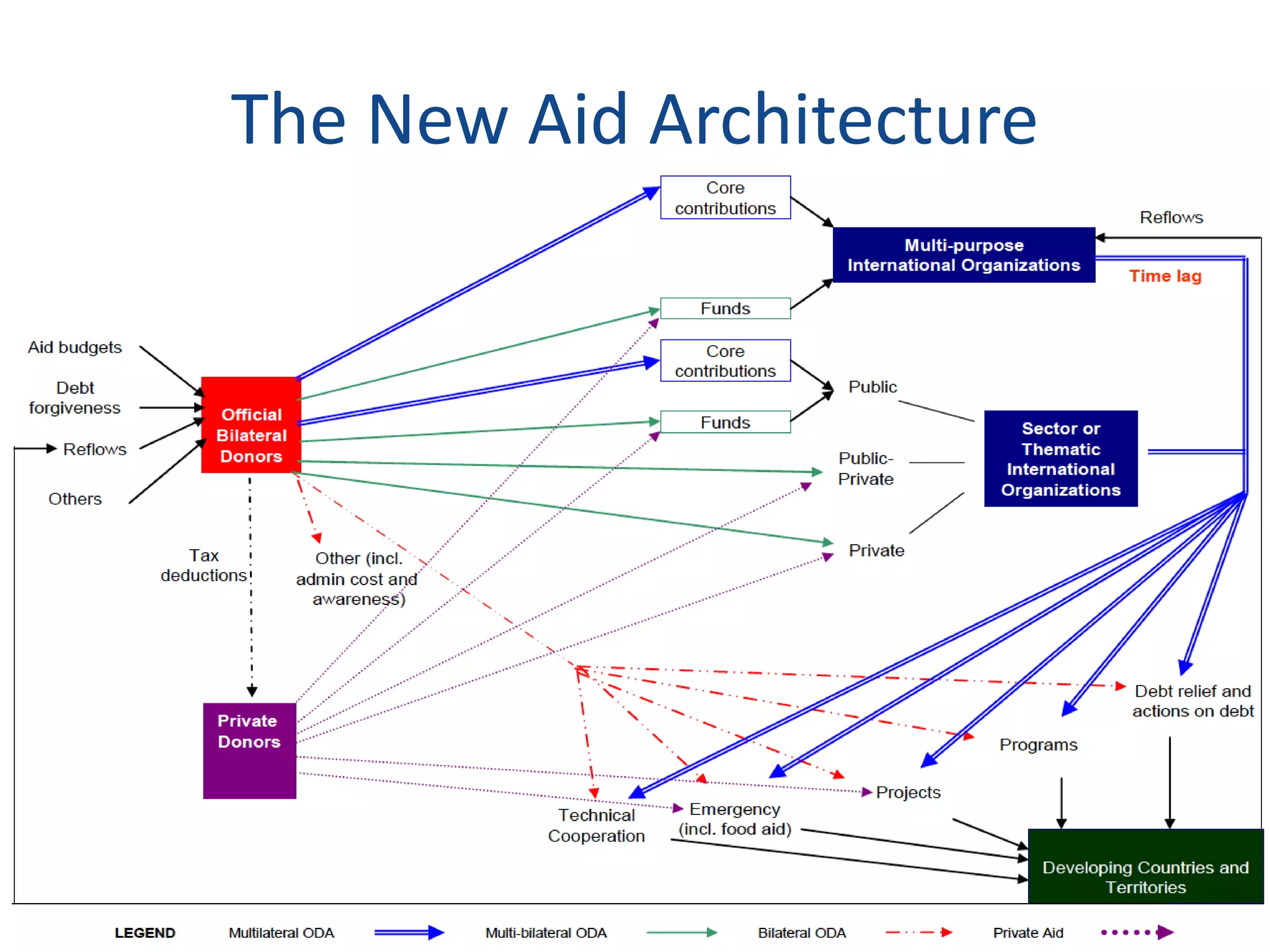
The New Aid Architecture
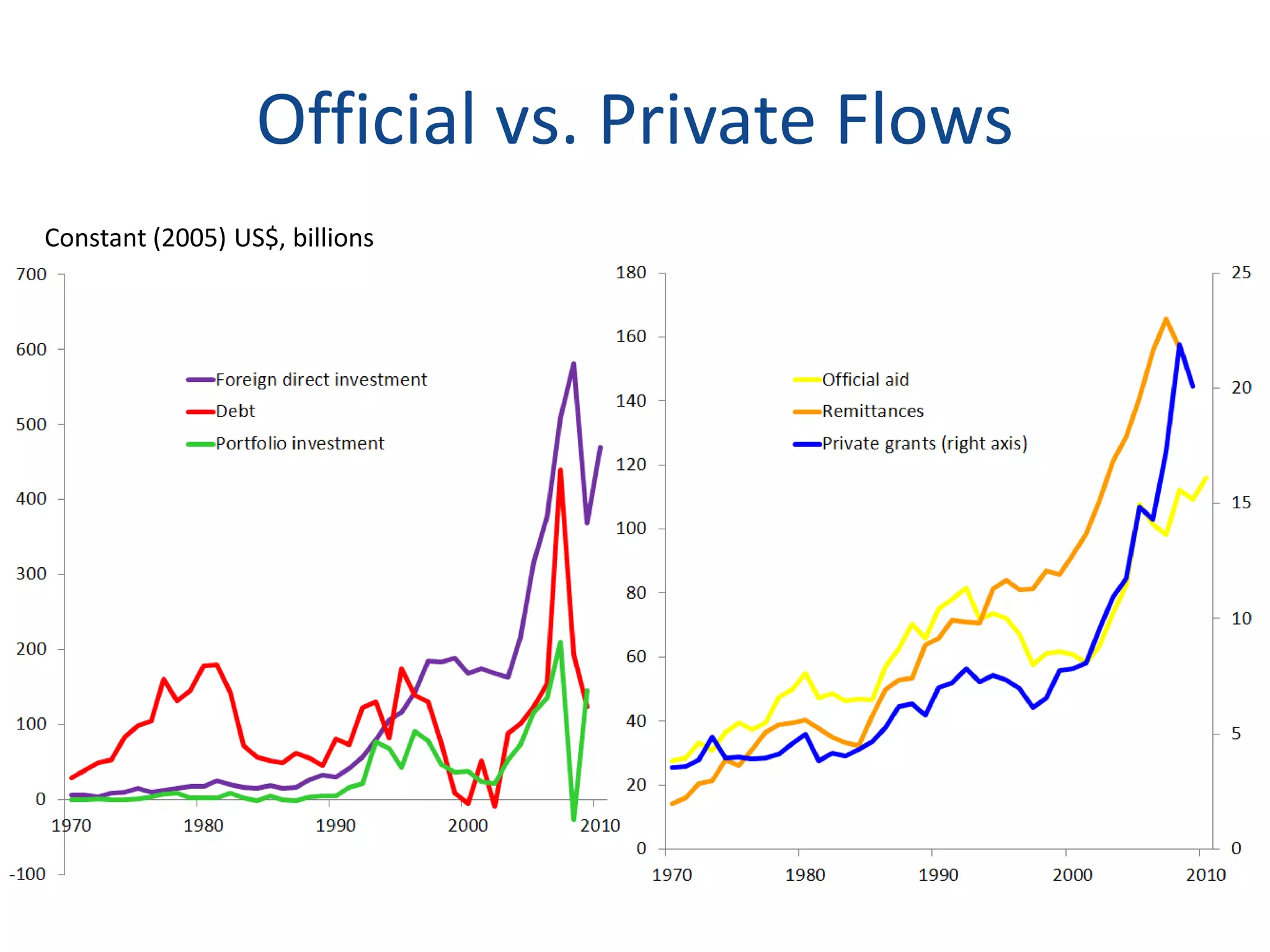
Official vs. Private Flows
Constant (2005) US$, billions
ODA vs. PDA
0
20
40
60
80
100
120
140
160
1970 1975 1980 1985 1990 1995 2000 2005 2010
ConstantUSD
(2013,billions)
ODA
Private Grants
ODA vs. PDA
0
20
40
60
80
100
120
140
160
1970 1975 1980 1985 1990 1995 2000 2005 2010
ConstantUSD
(2013,billions)
ODA
Private Grants*
Total PDA**
** Center for Global Prosperity* OECD – CRS *** Development Initiatives
$45b***
ODA vs. PDA
0
20
40
60
80
100
120
140
160
1970 1975 1980 1985 1990 1995 2000 2005 2010
ConstantUSD
(2013,billions)
ODA
Private Grants
CPA*
* OECD – CRS
US Financial Flows Compared
0
50
100
150
2004 2005 2006 2007 2008 2009 2010 2011
ConstantUSD
(2013,billions)
ODA
PDA
Remittances
Private Capital
The “California” Consensus
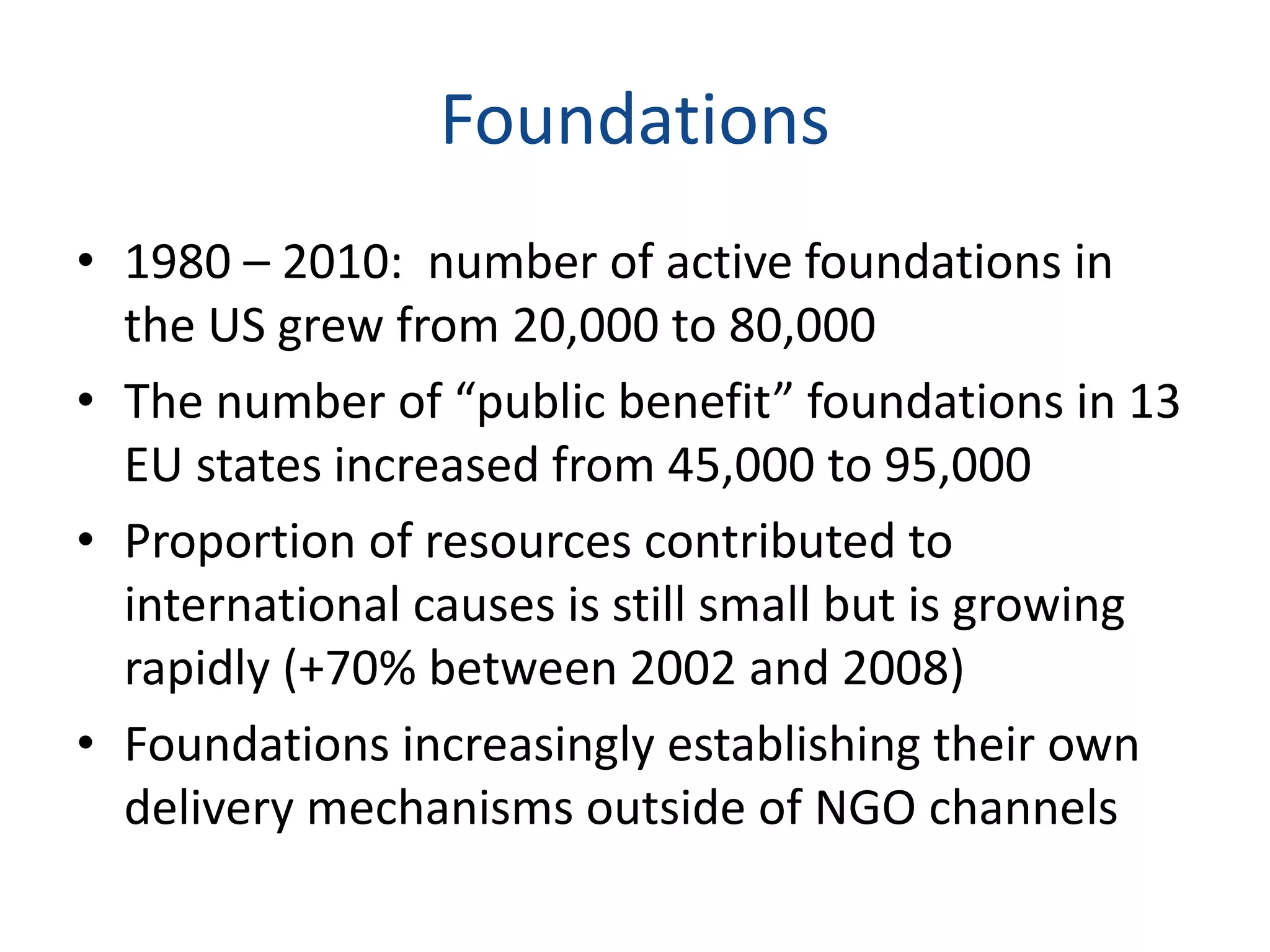
Foundations
• 1980 – 2010: number of active foundations in
the US grew from 20,000 to 80,000
• The number of “public benefit” foundations in 13
EU states increased from 45,000 to 95,000
• Proportion of resources contributed to
international causes is still small but is growing
rapidly (+70% between 2002 and 2008)
• Foundations increasingly establishing their own
delivery mechanisms outside of NGO channels
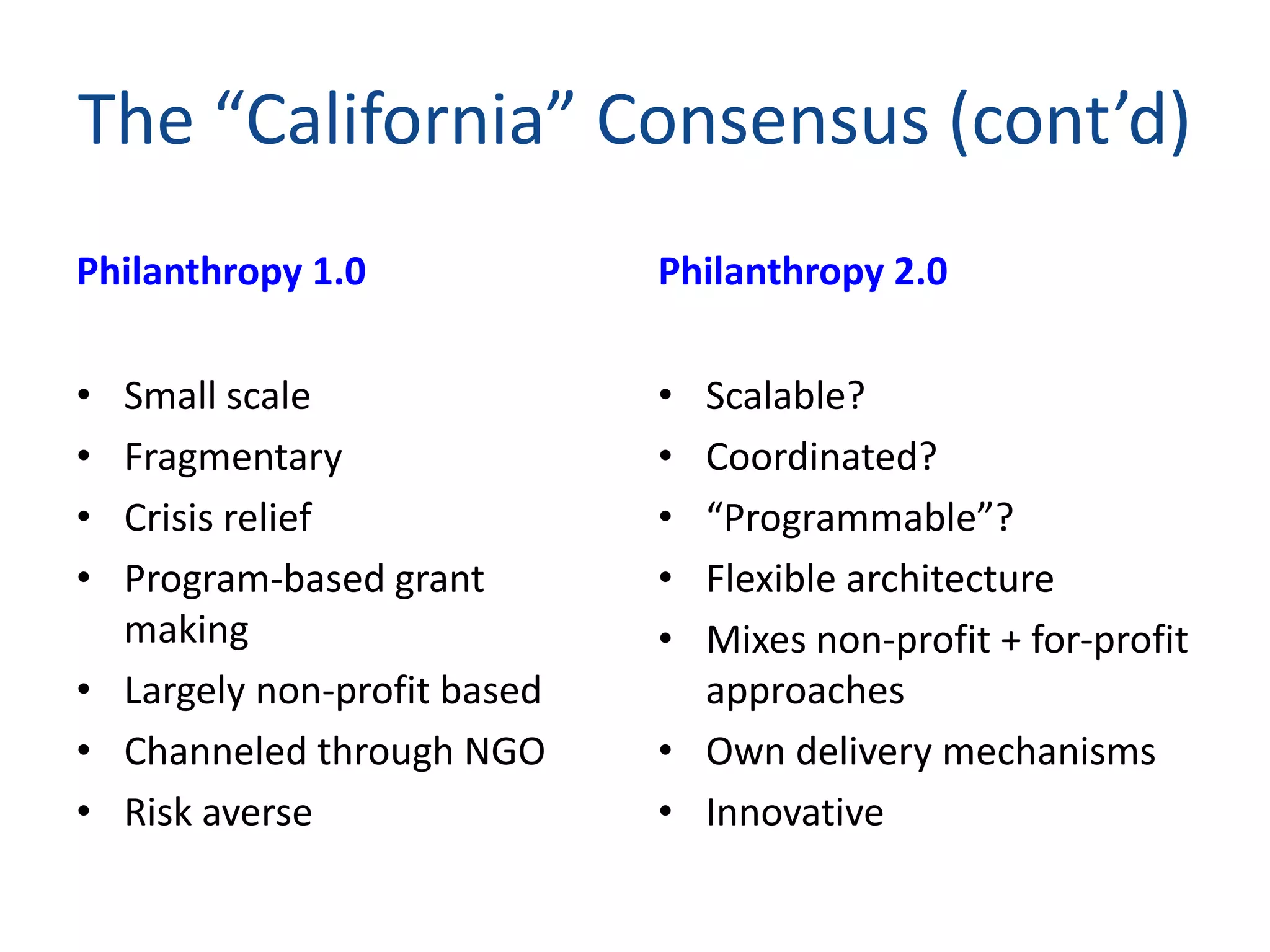
The “California” Consensus (cont’d)
Philanthropy 1.0
• Small scale
• Fragmentary
• Crisis relief
• Program-based grant
making
• Largely non-profit based
• Channeled through NGO
• Risk averse
Philanthropy 2.0
• Scalable?
• Coordinated?
• “Programmable”?
• Flexible architecture
• Mixes non-profit + for-profit
approaches
• Own delivery mechanisms
• Innovative
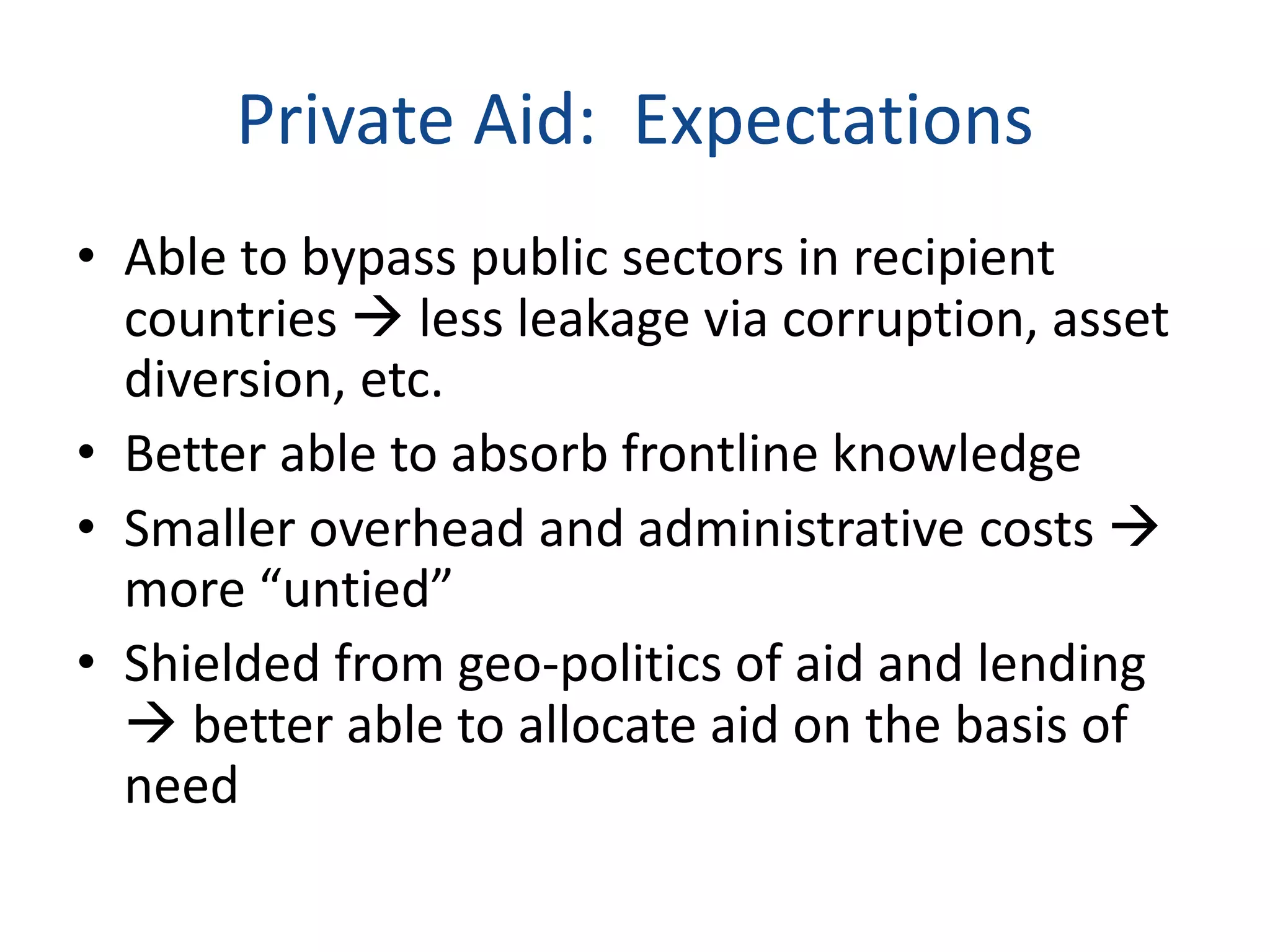
Private Aid: Expectations
• Able to bypass public sectors in recipient
countries  less leakage via corruption, asset
diversion, etc.
• Better able to absorb frontline knowledge
• Smaller overhead and administrative costs 
more “untied”
• Shielded from geo-politics of aid and lending
 better able to allocate aid on the basis of
need
Evidence
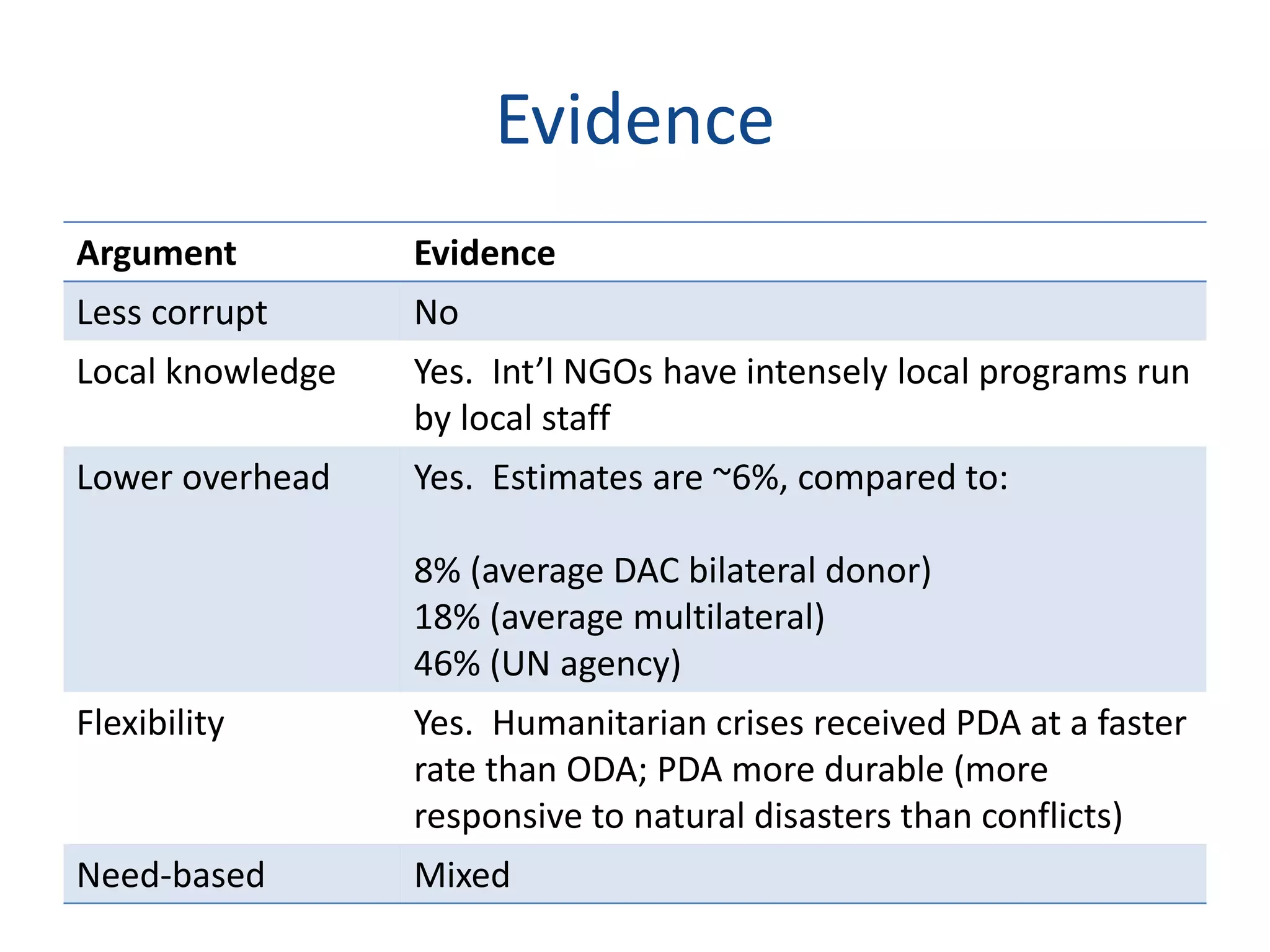
Argument Evidence
Less corrupt No
Local knowledge Yes. Int’l NGOs have intensely local programs run
by local staff
Lower overhead Yes. Estimates are ~6%, compared to:
8% (average DAC bilateral donor)
18% (average multilateral)
46% (UN agency)
Flexibility Yes. Humanitarian crises received PDA at a faster
rate than ODA; PDA more durable (more
responsive to natural disasters than conflicts)
Need-based Mixed
Allocation
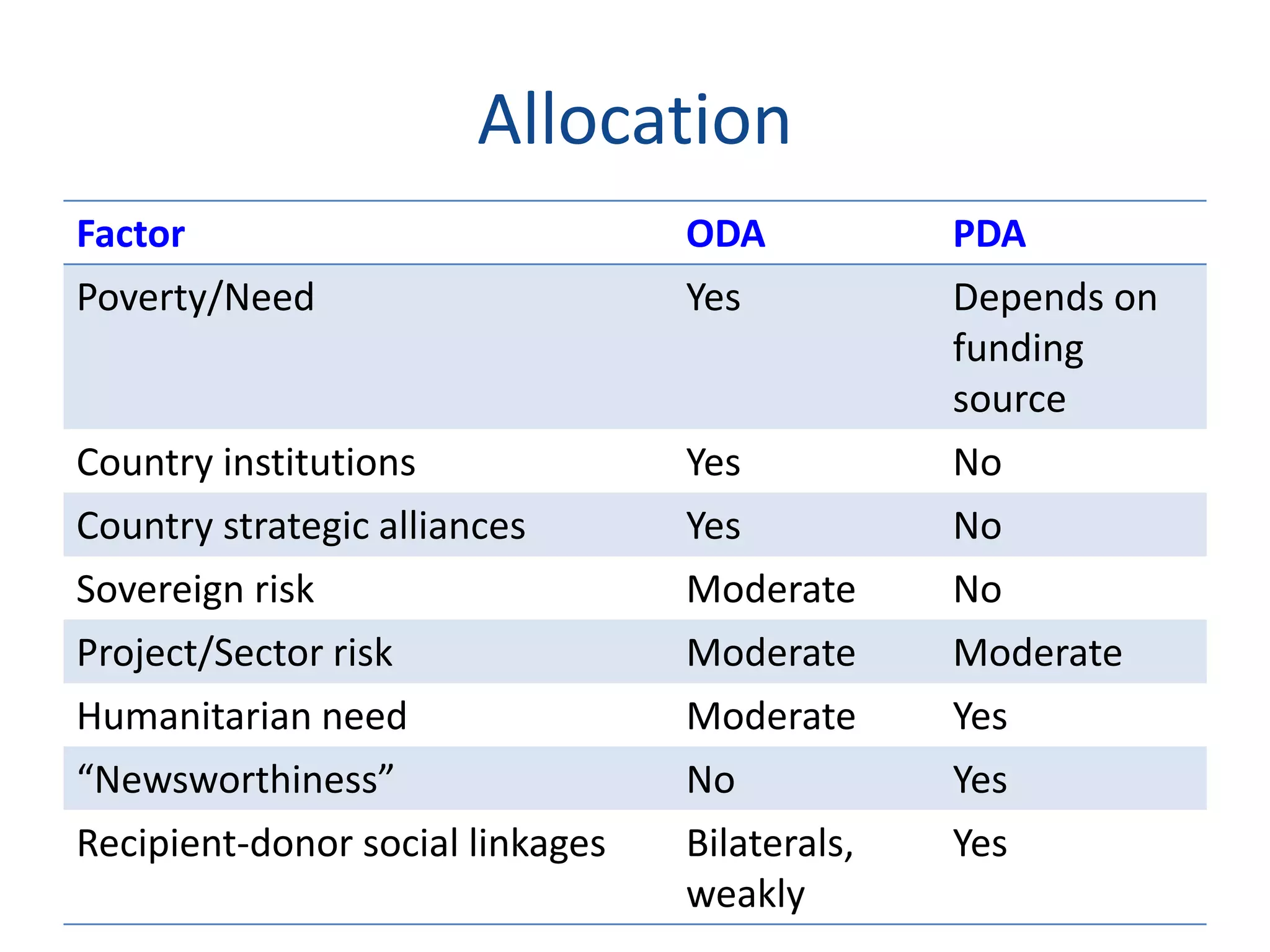
Factor ODA PDA
Poverty/Need Yes Depends on
funding
source
Country institutions Yes No
Country strategic alliances Yes No
Sovereign risk Moderate No
Project/Sector risk Moderate Moderate
Humanitarian need Moderate Yes
“Newsworthiness” No Yes
Recipient-donor social linkages Bilaterals,
weakly
Yes
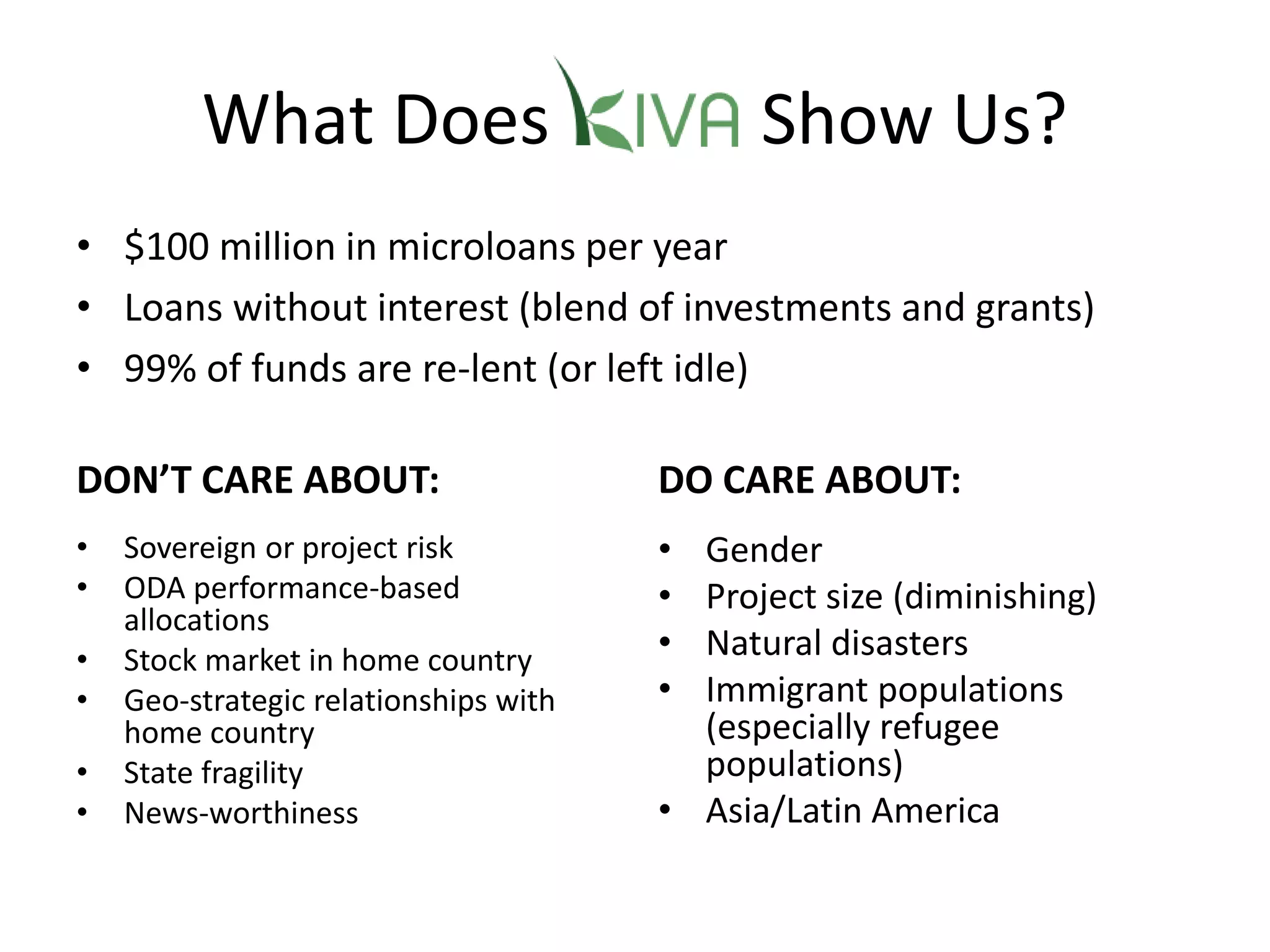
What Does Show Us?
DON’T CARE ABOUT:
• Sovereign or project risk
• ODA performance-based
allocations
• Stock market in home country
• Geo-strategic relationships with
home country
• State fragility
• News-worthiness
DO CARE ABOUT:
• Gender
• Project size (diminishing)
• Natural disasters
• Immigrant populations
(especially refugee
populations)
• Asia/Latin America
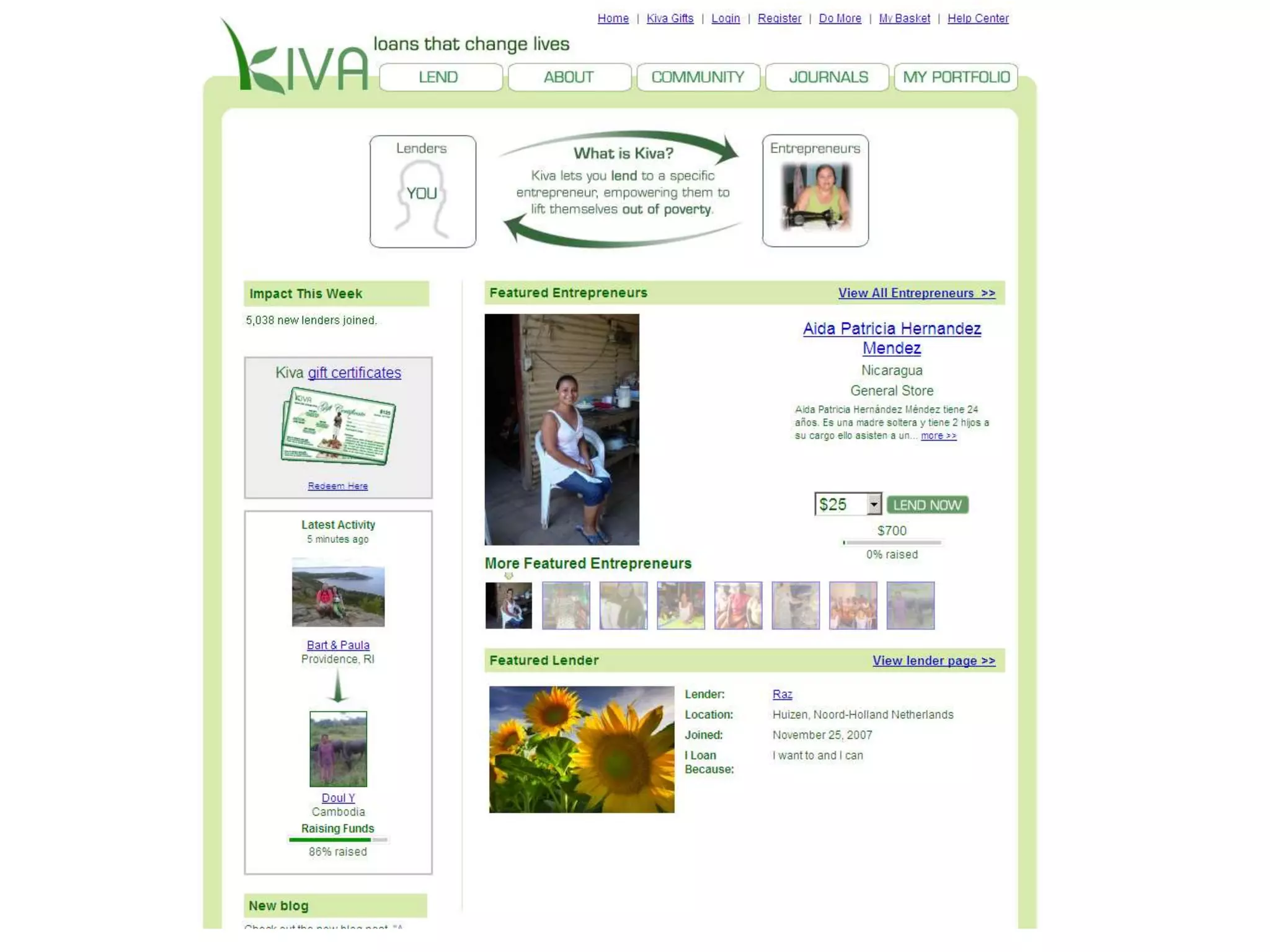
• $100 million in microloans per year
• Loans without interest (blend of investments and grants)
• 99% of funds are re-lent (or left idle)
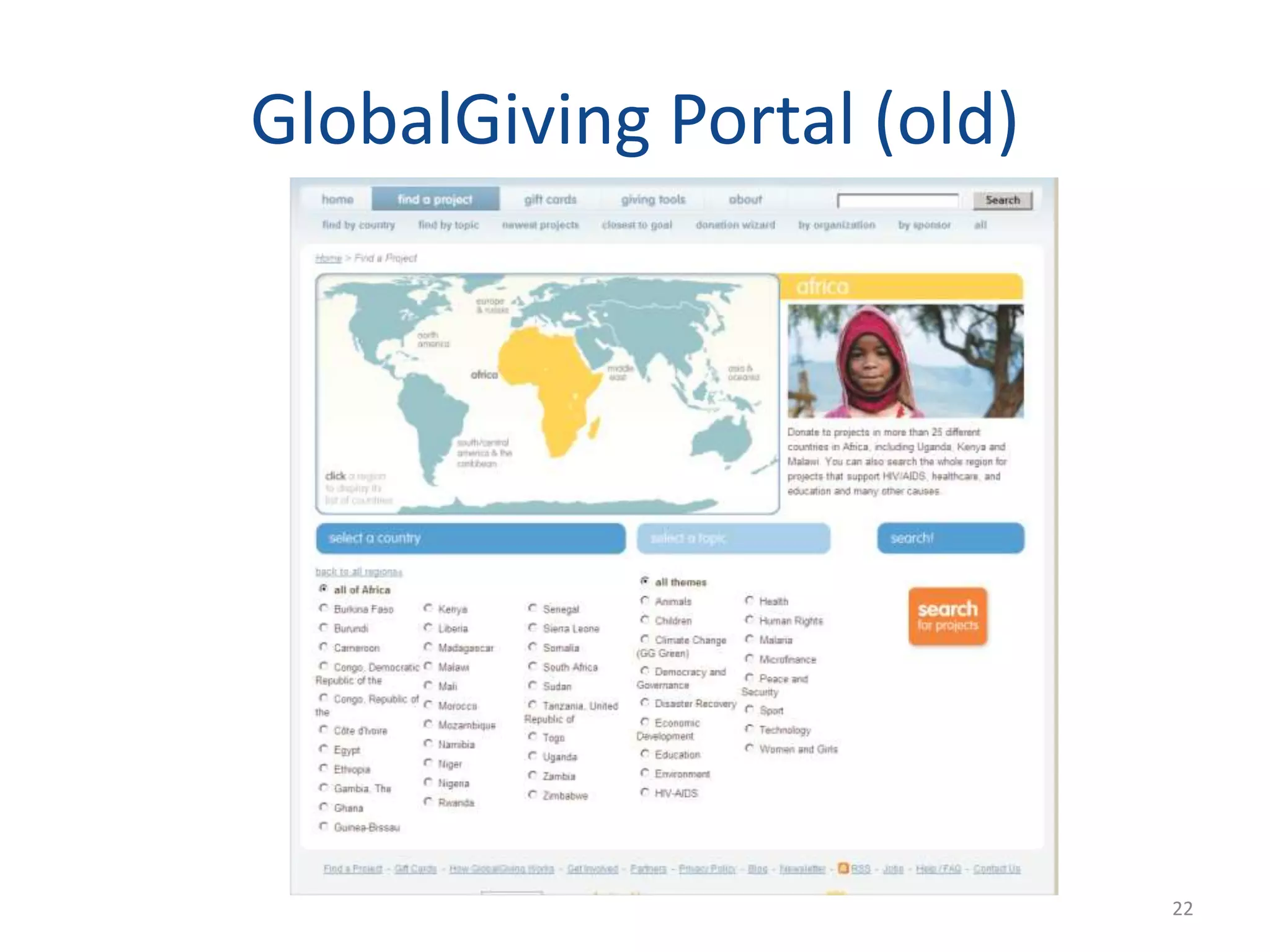
GlobalGiving Portal (old)
22
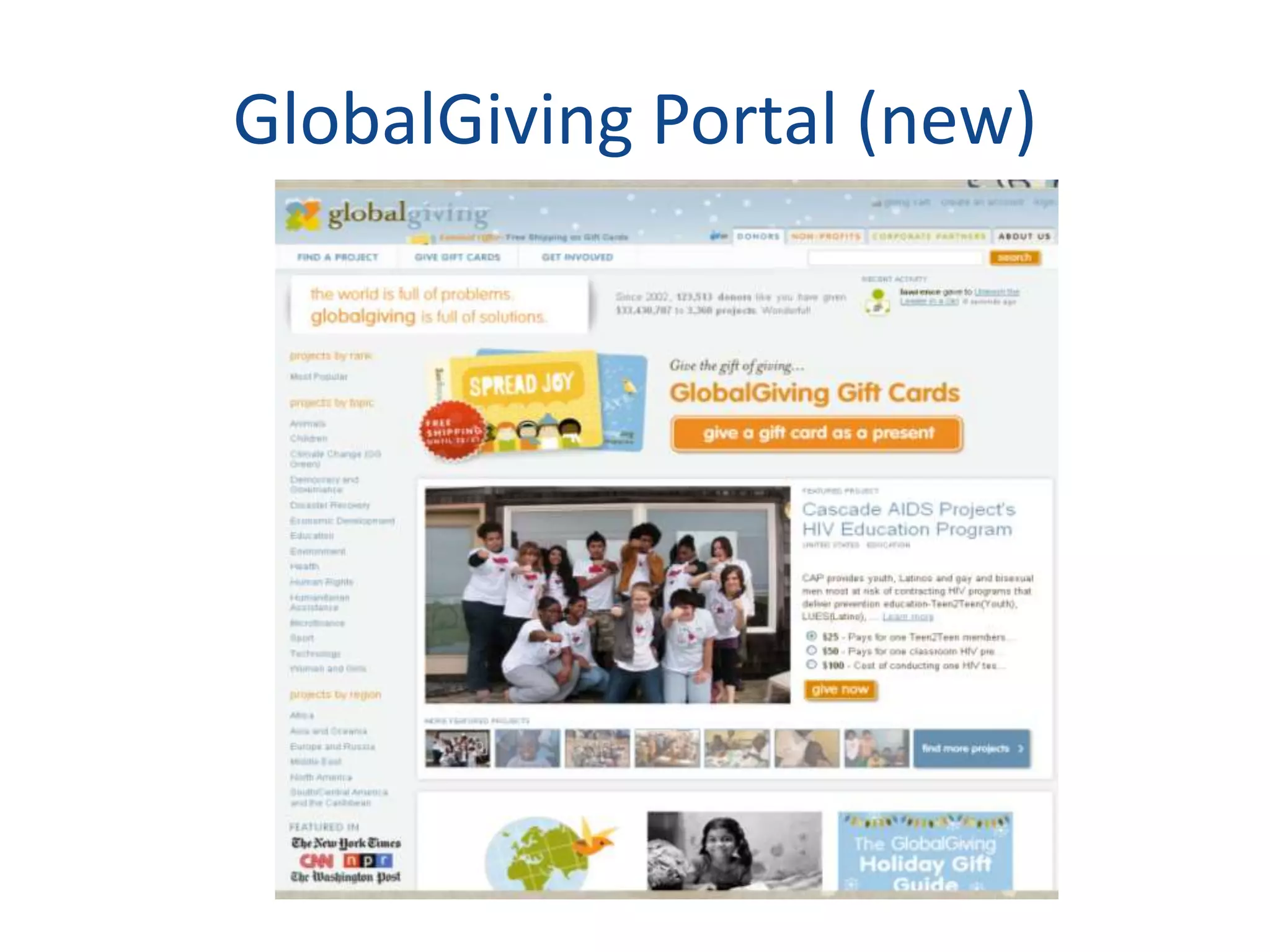
GlobalGiving Portal (new)
Challenges
• Coordination
• Concentration of resources
• Lack of data on volumes, allocations, impact
• Accountability is uneven
• Things PDA cannot do: e.g., infrastructure, legal
& policy reforms
• Imbalance between NGOs from rich vs. poor
countries
• Incentives to promote “good images” rather than
achieve results?
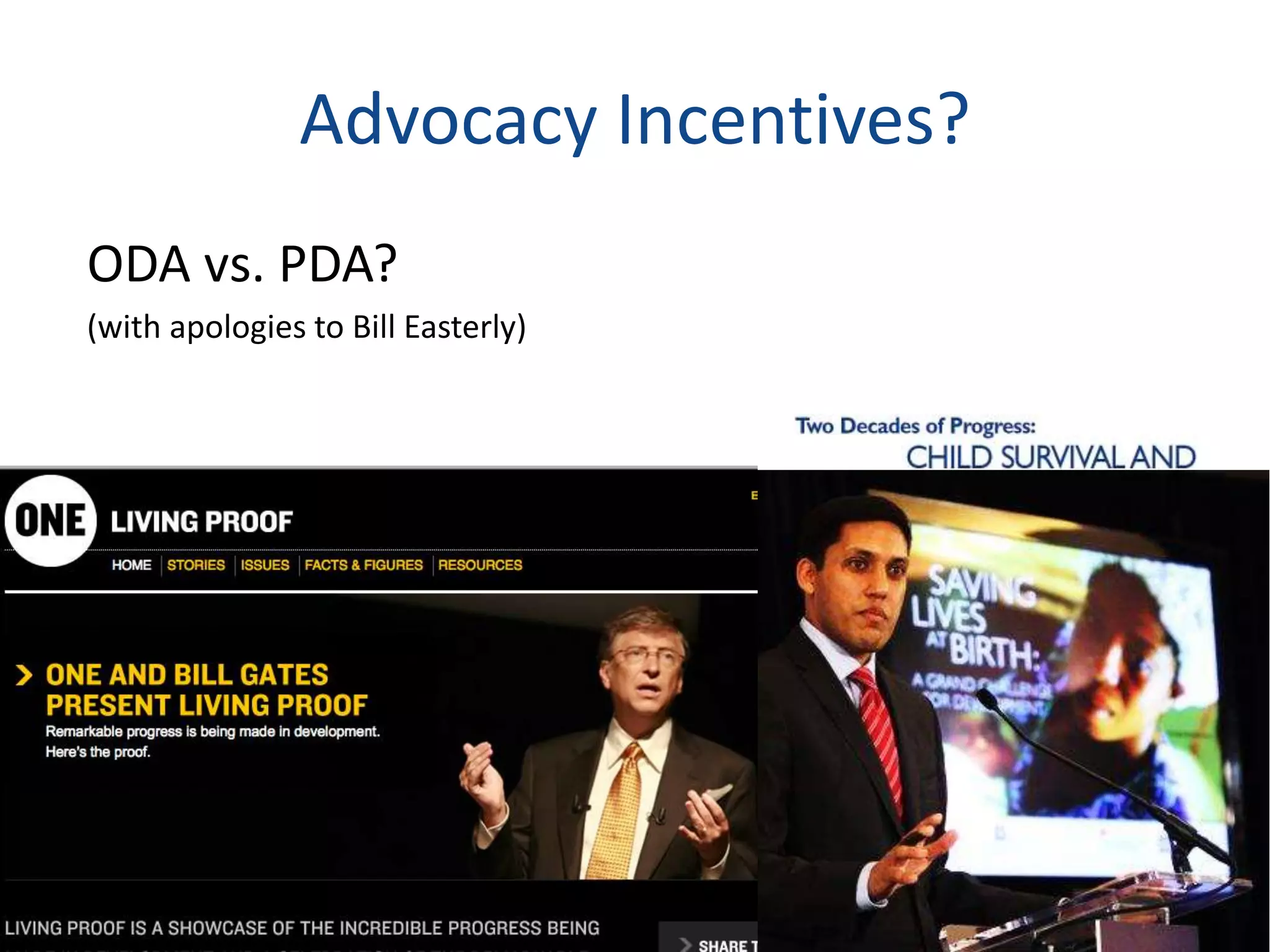
Advocacy Incentives?
ODA vs. PDA?
(with apologies to Bill Easterly)
PDA and the Post-2015 Agenda
• PDA community needs to develop its own agreements
on effectiveness, commitments, targets, indicators
• Global initiative to gather, analyze, and map private aid
flows and their impact
• Formal linkages between PDA & ODA institutions
– “Observer” seats from PDA donors & civil society at the
DAC)
– Include major PDA donors in donor-steering committees
– Create broader ODA-PDA groups based on technical
expertise
– Regular consultations with civil society in recipient
countries

Private Aid and the Financing of Development

  • 1.
    Private Aid andthe Financing of Development Raj M. Desai Georgetown University and The Brookings Institution Development Day, Stockholm, May 11, 2015
  • 2.
    Private Development Assistance(PDA) • Undertaken by private actors (foundations, corporations, voluntary and non-profit organizations) • Is focused on promotion of economic development and humanitarian needs • Provided at concessional financial terms where commodities and loans are concerned
  • 3.
    Some Numbers • InFY 2014  World Bank committed $40.8 billion ($32.8 billion disbursed) • 2014  $45 – $60 billion in total global private aid disbursed (depending on estimate) • If the EU “private sector” were a single donor, it would be the 5th largest DAC donor • In the US: PDA = $39 billion vs. US ODA = $30 billion (2011) • Net ODA = ~$134 billion, but is roughly equivalent to PDA in terms of money available for use by recipients (“programmable aid”)
  • 5.
    Origins • NGOs historicallyrelied on support from individual gift giving, personal donations, and child sponsorship • Between 1980s and 2000s, NGO income came increasingly from official governmental donors using tax-based funding • Since 2000s, diversification in funding sources
  • 6.
  • 7.
    New Funding Sources •Private philanthropies (foundations, philanthropic ventures) • Income-generating activities (e.g. Oxfam Trading, BRAC Bank), commissions and contracts (e.g. Technoserve), Social enterprises (e.g. the Kenyan-based Sidai) • Community initiatives (community development foundations) • Privately administered trusts (Comic Relief, UK Big Lottery) • Web-based personal giving (Razoo, GivingWhatWeCan, GivingWell) • Individual giving: of all the funding raised by US NGOs – ¾ comes from individual contributions – 65% from households with incomes < $200,000/year
  • 8.
    The New AidArchitecture
  • 9.
    Official vs. PrivateFlows Constant (2005) US$, billions
  • 10.
    ODA vs. PDA 0 20 40 60 80 100 120 140 160 19701975 1980 1985 1990 1995 2000 2005 2010 ConstantUSD (2013,billions) ODA Private Grants
  • 11.
    ODA vs. PDA 0 20 40 60 80 100 120 140 160 19701975 1980 1985 1990 1995 2000 2005 2010 ConstantUSD (2013,billions) ODA Private Grants* Total PDA** ** Center for Global Prosperity* OECD – CRS *** Development Initiatives $45b***
  • 12.
    ODA vs. PDA 0 20 40 60 80 100 120 140 160 19701975 1980 1985 1990 1995 2000 2005 2010 ConstantUSD (2013,billions) ODA Private Grants CPA* * OECD – CRS
  • 13.
    US Financial FlowsCompared 0 50 100 150 2004 2005 2006 2007 2008 2009 2010 2011 ConstantUSD (2013,billions) ODA PDA Remittances Private Capital
  • 14.
  • 15.
    Foundations • 1980 –2010: number of active foundations in the US grew from 20,000 to 80,000 • The number of “public benefit” foundations in 13 EU states increased from 45,000 to 95,000 • Proportion of resources contributed to international causes is still small but is growing rapidly (+70% between 2002 and 2008) • Foundations increasingly establishing their own delivery mechanisms outside of NGO channels
  • 16.
    The “California” Consensus(cont’d) Philanthropy 1.0 • Small scale • Fragmentary • Crisis relief • Program-based grant making • Largely non-profit based • Channeled through NGO • Risk averse Philanthropy 2.0 • Scalable? • Coordinated? • “Programmable”? • Flexible architecture • Mixes non-profit + for-profit approaches • Own delivery mechanisms • Innovative
  • 17.
    Private Aid: Expectations •Able to bypass public sectors in recipient countries  less leakage via corruption, asset diversion, etc. • Better able to absorb frontline knowledge • Smaller overhead and administrative costs  more “untied” • Shielded from geo-politics of aid and lending  better able to allocate aid on the basis of need
  • 18.
    Evidence Argument Evidence Less corruptNo Local knowledge Yes. Int’l NGOs have intensely local programs run by local staff Lower overhead Yes. Estimates are ~6%, compared to: 8% (average DAC bilateral donor) 18% (average multilateral) 46% (UN agency) Flexibility Yes. Humanitarian crises received PDA at a faster rate than ODA; PDA more durable (more responsive to natural disasters than conflicts) Need-based Mixed
  • 19.
    Allocation Factor ODA PDA Poverty/NeedYes Depends on funding source Country institutions Yes No Country strategic alliances Yes No Sovereign risk Moderate No Project/Sector risk Moderate Moderate Humanitarian need Moderate Yes “Newsworthiness” No Yes Recipient-donor social linkages Bilaterals, weakly Yes
  • 20.
    What Does ShowUs? DON’T CARE ABOUT: • Sovereign or project risk • ODA performance-based allocations • Stock market in home country • Geo-strategic relationships with home country • State fragility • News-worthiness DO CARE ABOUT: • Gender • Project size (diminishing) • Natural disasters • Immigrant populations (especially refugee populations) • Asia/Latin America • $100 million in microloans per year • Loans without interest (blend of investments and grants) • 99% of funds are re-lent (or left idle)
  • 22.
  • 23.
  • 24.
    Challenges • Coordination • Concentrationof resources • Lack of data on volumes, allocations, impact • Accountability is uneven • Things PDA cannot do: e.g., infrastructure, legal & policy reforms • Imbalance between NGOs from rich vs. poor countries • Incentives to promote “good images” rather than achieve results?
  • 25.
    Advocacy Incentives? ODA vs.PDA? (with apologies to Bill Easterly)
  • 26.
    PDA and thePost-2015 Agenda • PDA community needs to develop its own agreements on effectiveness, commitments, targets, indicators • Global initiative to gather, analyze, and map private aid flows and their impact • Formal linkages between PDA & ODA institutions – “Observer” seats from PDA donors & civil society at the DAC) – Include major PDA donors in donor-steering committees – Create broader ODA-PDA groups based on technical expertise – Regular consultations with civil society in recipient countries