Is Development Aid
Dead?
Prof. Dr. Johannes Jütting,
Executive Head PARIS21
June 2024
Passau Research Colloquium
Outline
1. Introduction
2. Development aid: key numbers
3. Aid effectiveness – what does the literature say?
4. Development co-operation from a practitioner’s perspective
5. Outlook
1. Introduction
Introduction
• Development aid is an important topic for development and international
cooperation
• Recent criticism of development aid in the media of donor countries; why
giving aid in austerity times?
• Changing geo-politics and “shifting wealth – rise of the rest”
• Increasing role of China and other non-DAC donors
• International co-operation is challenged – polycrisis phenomenon
Is development aid dead?
2. Development aid
Kick-off questions
1. Which country gives the most official development aid in 2020 (ODA)?
2. Which country received most aid in 2022?
3. Are in-donor refugee costs counted as ODA?
Financing for Development – ODA as % of
GNI
Source: OECD Sustainable Financing 2023
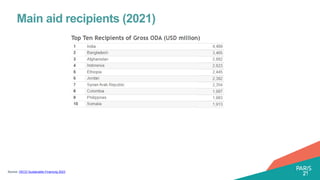
Main aid recipients (2021)
Source: OECD Sustainable Financing 2023
Origins of development aid – 1960 decade
• UN Development Decade
• Setting up of new institutions: OECD’s Development Assistance Committee
(DAC) and World Bank’s International Development Association (IDA)
• Development theories and strategies: Rostow Stage Model of Development;
Lewis Model and big push strategies
What is official development assistance (ODA)?
• Government and other “official” flows supporting development: Resources from
official agencies to promote and specifically target economic development and welfare in
developing countries; mean: grants and soft loans
• Multilateral or Bilateral Channels: Aid can be delivered directly from a donor country to a
recipient country (bilateral) or channeled through international organisations like the World
Bank (multilateral).
• Targeted Recipient List: Only flows directed towards countries and territories on the
OECD's specific ODA Recipient List qualify as ODA. This list is based on income levels
and updated every three years.
• “Gold standard” of measuring official aid flows
Source: https://www.oecd.org/dac/financing-sustainable-development/development-finance-standards/official-
development-assistance.htm
ODA recipient countries list
• Low-income
• Lower-middle income
• Upper-middle income
• High income
• Least developed countries (LDCs)
• Low-Income Countries Which Are Not LDCs
• Lower Middle-Income Countries and Territories Which
Are Not LDCs
• Upper Middle-Income Countries and Territories Which
Are Not LDCs
Source: DAC list of ODA recipients 2024/2025
Source: World Bank 2022/2023 Source: UN list of least developed countries
• UN classifies 45 countries as
LDCs
The criteria is based on 3 variables:
1) Income
2) A human assets index
3) An economic and environmental
vulnerability index
Beyond ODA – new aid measure
TOSSD – Total Official Support for Sustainable Development
Source: OECD 2015
Broader Scope: Loans, investments, and guarantees that
ODA does not cover.
Enhancing Accountability and Transparency: TOSSD aims
to increase transparency and rigor in reporting development
finance that goes beyond ODA.
Focus on Sustainable Development
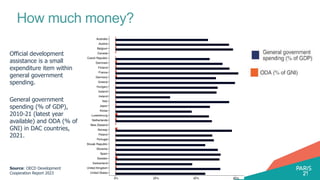
How much money?
Official development
assistance is a small
expenditure item within
general government
spending.
General government
spending (% of GDP),
2010-21 (latest year
available) and ODA (% of
GNI) in DAC countries,
2021.
Source: OECD Development
Cooperation Report 2023
Trends in Development Finance
Financing for Development – ODA figures
Source: OECD Sustainable Financing 2023
Financing for gender equality growing
Source: Press 2022_WEB.pdf (paris21.org)
In recent years,
financing for
gender equality has
steadily grown.
… yet financing for gender data declined
Source: Press 2022_WEB.pdf (paris21.org)
Yet, financing for
gender data has
not experienced the
same success. In
2020, funding for
gender data
dropped by 55%.
Who gives aid money?
Many different actors: Diverse array of governmental, multilateral and non-
state actors working in different ways
Governmental Sphere (OECD 2023):
• DAC members/associations
• South-to-South co-operation
• Triangular co-operation activities
• Global and regional development initiatives and funds
• Philanthropic donors
Source: OECD Development Co-Operation Report 2023
Development Co-operation Providers
New emerging donors: The rise of
Philanthropic Donors
Source: OECD Development Co-operation Profiles
• Bill and Melinda Gates Foundation has increased their donations from $2.9bn in 2011 to $4.3bn in 2021
Non-DAC donors: Saudi Arabia
Source: OECD Sustainable Financing 2023
• Saudi Arabia is one of the largest providers of official development assistance (ODA) in the Gulf region in terms of volume.
• Total ODA was $6bn in 2022, representing 0.74% of GNI
3. Aid effectiveness
Context
• Aid effectiveness debate as old as providing aid
• Cross-country panel regressions impact on development outcomes e.g. growth
• Project studies and (randomized) evaluations
• Qualitative methods
• DAC peer reviews and evaluation report
CNN: Dambisa Moyo & Jacqueline Novogratz debate the efficacy of foreign
aid (youtube.com)
Findings 1: Development aid works
• “Significant evidence of the effectiveness of foreign aid on poverty reduction”
(Mahembe and Odhiambo, 2019).
• Long-term “macroeconomic effects of aid are consistently positive” and that foreign
aid makes significant contributions to “achieving development objectives” (Arndt,
Jones and Tarp, 2016).
• Successful examples of foreign aid programmes (Sachs 2005):
• The green revolution for food production in Asia
• Vaccinations and treatment of anti-malarial diseases
Source: Sam Jones, Finn Tarp, Does foreign aid harm political institutions?, Journal of Development Economics, Volume 118,
2016, Pages 266-281, ISSN 0304-3878, https://doi.org/10.1016/j.jdeveco.2015.09.004.; Jeffrey Sachs, (2005). The End of Poverty:
Economic Possibilities for
our Time. New York: The Penguin Press; Edmore Mahembe & Nicholas Mbaya Odhiambo | Christian Nsiah (Reviewing editor)
(2019) Foreign aid, poverty and economic growth in developing countries: A dynamic panel data causality analysis, Cogent
Economics & Finance, 7:1, DOI: 10.1080/23322039.2019.1626321
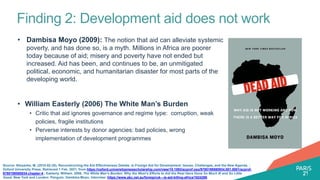
Finding 2: Development aid does not work
• Dambisa Moyo (2009): The notion that aid can alleviate systemic
poverty, and has done so, is a myth. Millions in Africa are poorer
today because of aid; misery and poverty have not ended but
increased. Aid has been, and continues to be, an unmitigated
political, economic, and humanitarian disaster for most parts of the
developing world.
• William Easterly (2006) The White Man’s Burden
• Critic that aid ignores governance and regime type: corruption, weak
policies, fragile institutions
• Perverse interests by donor agencies: bad policies, wrong
implementation of development programmes
Source: Nissanke, M. (2010-02-25). Reconstructing the Aid Effectiveness Debate. In Foreign Aid for Development: Issues, Challenges, and the New Agenda. :
Oxford University Press. Retrieved 1 Feb. 2021, from https://oxford.universitypressscholarship.com/view/10.1093/acprof:oso/9780199580934.001.0001/acprof-
9780199580934-chapter-4.; Easterly, William. 2006. The White Man's Burden: Why the West's Efforts to Aid the Rest Have Done So Much Ill and So Little
Good. New York and London: Penguin; Dambisa Moyo, Interview: https://www.abc.net.au/foreign/uk---is-aid-killing-africa/1624286
Inconclusive picture not surprising
• Different definitions: what type of aid and what development outcomes
• Methodological challenges: correlation versus causation; counter-factual;
endogeneity, replicability
• Data issues
What is the objective of the donor in the first place?
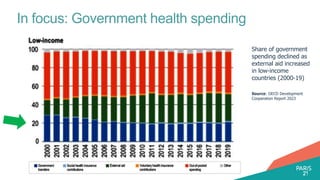
In focus: Government health spending
Share of government
spending declined as
external aid increased
in low-income
countries (2000-19)
Source: OECD Development
Cooperation Report 2023
4. Development co-operation from a
practitioner’s perspective
Data for development sector
• Interesting sector to look at from an aid perspective
• Important data is missing; so is statistical capacity in partner countries
• SDGs and Agenda 2030 LNOB game changer
• Classical aid challenges – co-ordination, silo thinking, focus on international
needs or national ones
About us
Partnership in Statistics for Development in the
21st Century – aid provider and aid receiver
Established in 1999 as a response to the need for accurate and reliable data to achieve and track
progress toward development goals.
21 Secretariat staff hosted at the OECD in Paris​.
60 Board members, who convene once a year at the Fall Meetings to advise on the
annual programme of work and budget.
Annual budget of EUR 5M funded entirely by voluntary contributions.
13 Executive Committee members, who meet three times a year to monitor and guide our
activities and strategy.
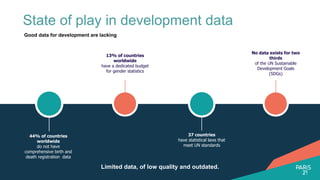
State of play in development data
44% of countries
worldwide
do not have
comprehensive birth and
death registration data
Good data for development are lacking
13% of countries
worldwide
have a dedicated budget
for gender statistics
37 countries
have statistical laws that
meet UN standards
No data exists for two
thirds
of the UN Sustainable
Development Goals
(SDGs)
Limited data, of low quality and outdated.
About us
Examples of work
Mobilising climate
change data for
effective climate
action in Belize
Building a statistical
system fit for the SDG
era in Paraguay
Turning citizen-
generated data into
official statistics in
Kenya
Improving service
delivery for women
and girls in the
Philippines
Building closer ties
between statisticians
and policymakers in
Vanuatu
About us
Our funding
Aid challenge: silo thinking
• Different donors, different interests
• Possibility of crowding out national capacities
• System strengthening versus sectorial focus
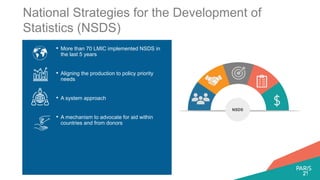
National Strategies for the Development of
Statistics (NSDS)
• More than 70 LMIC implemented NSDS in
the last 5 years
• Aligning the production to policy priority
needs
• A system approach
• A mechanism to advocate for aid within
countries and from donors
NSDS
Aid challenge 2: Financing “boring stuff”
• Investment in data critical but not very exciting
• Sustainability of funding
• Making country voices heard
Mobilizing funding for statistics
• Increasing pressure and demands on NSOs to
develiver data for the SDGs and other
development targets.
• Lots of funding for international data, very little
for national or regional
• NSOs must compete at a national level against
other line ministries such as education,
infrustructure, healthy and others, not to the data
collectors.
• PARIS21 advocates for more and better funding
for data and statistics through various initiatives.
Advocating for more and better funding to
gender statistics
• Only 46% of indicators are available to
monitor progress towards SDG 5
• Despite the pressing need for gender
data, donor funding for grants has
stagnated, leaving low-income
countries without the necessary
financial support.
• A small group of donors lead the way
in gender data financing, accounting
for close to two-thirds of support.
Without a more diverse set of donors,
financing for gender statistics remains
vulnerable to shocks.
Source: Clearinghouse (smartdatafinance.org)
Aid challenge 3: co-ordination
• “Everybody want to co-ordinate, no-body wants to be co-ordinated
• Stretching local partner capacities
• Waste of resources
Clearinghouse for financing
development data
A platform to connect financing supply and
demand
Clearinghouse (smartdatafinance.org)
Improving funding coordination
Aligning domestic and international priorities
Improving transparency and access to relevant information for donors
and data producers
Transparancy
How much funding going
from where to where and for
what?
How much is needed?
What are country/donor
priorities and what is
planned for the future?
What are the results and
lessons on what works?
Supply side of financing
Provider profile example
Demand side of financing
Recipient profile example
Development data and statistics sector
• International cooperation largely works
• Countries voices at the table and very engaged
• Increasing role of civil society and private sector
• Local dimension
• Technology and innovation – AI, digitalization
5. Outlook
Major successes in development
Source: OECD Development Cooperation Report 2023
HK 30) R 122
Child mortality has declined across all income levels from 1990-2000
A changing landscape
• Polycrisis (war, pandemic, climate change, inflation…).
• International co-operation and multilateralism challenged​.
• Poverty and hunger on the rise again in some parts of this world​.
• What comes after the SDGs and Agenda 2030​?
Is development aid dead?
It depends…
• Understood as in the “old way” yes
• Aid becomes fragmented, uncertain, further politicised
• Key remaining role: ODA funding public goods; stable resource in times of crisis e.g.
COVID; humanitarian aid
• Further reform needed to showcase results, provide a strong accessible narrative and
to be clear what aid can achieve or not
• Aid only very minor part in development
Focus on bigger picture e.g. climate financing, access to markets, global governance

Is Development Aid Dead? By Johannes Jütting, Executive Head, PARIS21

  • 1.
    Is Development Aid Dead? Prof.Dr. Johannes Jütting, Executive Head PARIS21 June 2024 Passau Research Colloquium
  • 2.
    Outline 1. Introduction 2. Developmentaid: key numbers 3. Aid effectiveness – what does the literature say? 4. Development co-operation from a practitioner’s perspective 5. Outlook
  • 3.
  • 4.
    Introduction • Development aidis an important topic for development and international cooperation • Recent criticism of development aid in the media of donor countries; why giving aid in austerity times? • Changing geo-politics and “shifting wealth – rise of the rest” • Increasing role of China and other non-DAC donors • International co-operation is challenged – polycrisis phenomenon Is development aid dead?
  • 5.
  • 6.
    Kick-off questions 1. Whichcountry gives the most official development aid in 2020 (ODA)? 2. Which country received most aid in 2022? 3. Are in-donor refugee costs counted as ODA?
  • 7.
    Financing for Development– ODA as % of GNI Source: OECD Sustainable Financing 2023
  • 8.
    Main aid recipients(2021) Source: OECD Sustainable Financing 2023
  • 9.
    Origins of developmentaid – 1960 decade • UN Development Decade • Setting up of new institutions: OECD’s Development Assistance Committee (DAC) and World Bank’s International Development Association (IDA) • Development theories and strategies: Rostow Stage Model of Development; Lewis Model and big push strategies
  • 10.
    What is officialdevelopment assistance (ODA)? • Government and other “official” flows supporting development: Resources from official agencies to promote and specifically target economic development and welfare in developing countries; mean: grants and soft loans • Multilateral or Bilateral Channels: Aid can be delivered directly from a donor country to a recipient country (bilateral) or channeled through international organisations like the World Bank (multilateral). • Targeted Recipient List: Only flows directed towards countries and territories on the OECD's specific ODA Recipient List qualify as ODA. This list is based on income levels and updated every three years. • “Gold standard” of measuring official aid flows Source: https://www.oecd.org/dac/financing-sustainable-development/development-finance-standards/official- development-assistance.htm
  • 11.
    ODA recipient countrieslist • Low-income • Lower-middle income • Upper-middle income • High income • Least developed countries (LDCs) • Low-Income Countries Which Are Not LDCs • Lower Middle-Income Countries and Territories Which Are Not LDCs • Upper Middle-Income Countries and Territories Which Are Not LDCs Source: DAC list of ODA recipients 2024/2025 Source: World Bank 2022/2023 Source: UN list of least developed countries • UN classifies 45 countries as LDCs The criteria is based on 3 variables: 1) Income 2) A human assets index 3) An economic and environmental vulnerability index
  • 12.
    Beyond ODA –new aid measure TOSSD – Total Official Support for Sustainable Development Source: OECD 2015 Broader Scope: Loans, investments, and guarantees that ODA does not cover. Enhancing Accountability and Transparency: TOSSD aims to increase transparency and rigor in reporting development finance that goes beyond ODA. Focus on Sustainable Development
  • 13.
    How much money? Officialdevelopment assistance is a small expenditure item within general government spending. General government spending (% of GDP), 2010-21 (latest year available) and ODA (% of GNI) in DAC countries, 2021. Source: OECD Development Cooperation Report 2023
  • 14.
  • 15.
    Financing for Development– ODA figures Source: OECD Sustainable Financing 2023
  • 16.
    Financing for genderequality growing Source: Press 2022_WEB.pdf (paris21.org) In recent years, financing for gender equality has steadily grown.
  • 17.
    … yet financingfor gender data declined Source: Press 2022_WEB.pdf (paris21.org) Yet, financing for gender data has not experienced the same success. In 2020, funding for gender data dropped by 55%.
  • 18.
    Who gives aidmoney? Many different actors: Diverse array of governmental, multilateral and non- state actors working in different ways Governmental Sphere (OECD 2023): • DAC members/associations • South-to-South co-operation • Triangular co-operation activities • Global and regional development initiatives and funds • Philanthropic donors Source: OECD Development Co-Operation Report 2023
  • 19.
  • 20.
    New emerging donors:The rise of Philanthropic Donors Source: OECD Development Co-operation Profiles • Bill and Melinda Gates Foundation has increased their donations from $2.9bn in 2011 to $4.3bn in 2021
  • 21.
    Non-DAC donors: SaudiArabia Source: OECD Sustainable Financing 2023 • Saudi Arabia is one of the largest providers of official development assistance (ODA) in the Gulf region in terms of volume. • Total ODA was $6bn in 2022, representing 0.74% of GNI
  • 22.
  • 23.
    Context • Aid effectivenessdebate as old as providing aid • Cross-country panel regressions impact on development outcomes e.g. growth • Project studies and (randomized) evaluations • Qualitative methods • DAC peer reviews and evaluation report CNN: Dambisa Moyo & Jacqueline Novogratz debate the efficacy of foreign aid (youtube.com)
  • 24.
    Findings 1: Developmentaid works • “Significant evidence of the effectiveness of foreign aid on poverty reduction” (Mahembe and Odhiambo, 2019). • Long-term “macroeconomic effects of aid are consistently positive” and that foreign aid makes significant contributions to “achieving development objectives” (Arndt, Jones and Tarp, 2016). • Successful examples of foreign aid programmes (Sachs 2005): • The green revolution for food production in Asia • Vaccinations and treatment of anti-malarial diseases Source: Sam Jones, Finn Tarp, Does foreign aid harm political institutions?, Journal of Development Economics, Volume 118, 2016, Pages 266-281, ISSN 0304-3878, https://doi.org/10.1016/j.jdeveco.2015.09.004.; Jeffrey Sachs, (2005). The End of Poverty: Economic Possibilities for our Time. New York: The Penguin Press; Edmore Mahembe & Nicholas Mbaya Odhiambo | Christian Nsiah (Reviewing editor) (2019) Foreign aid, poverty and economic growth in developing countries: A dynamic panel data causality analysis, Cogent Economics & Finance, 7:1, DOI: 10.1080/23322039.2019.1626321
  • 25.
    Finding 2: Developmentaid does not work • Dambisa Moyo (2009): The notion that aid can alleviate systemic poverty, and has done so, is a myth. Millions in Africa are poorer today because of aid; misery and poverty have not ended but increased. Aid has been, and continues to be, an unmitigated political, economic, and humanitarian disaster for most parts of the developing world. • William Easterly (2006) The White Man’s Burden • Critic that aid ignores governance and regime type: corruption, weak policies, fragile institutions • Perverse interests by donor agencies: bad policies, wrong implementation of development programmes Source: Nissanke, M. (2010-02-25). Reconstructing the Aid Effectiveness Debate. In Foreign Aid for Development: Issues, Challenges, and the New Agenda. : Oxford University Press. Retrieved 1 Feb. 2021, from https://oxford.universitypressscholarship.com/view/10.1093/acprof:oso/9780199580934.001.0001/acprof- 9780199580934-chapter-4.; Easterly, William. 2006. The White Man's Burden: Why the West's Efforts to Aid the Rest Have Done So Much Ill and So Little Good. New York and London: Penguin; Dambisa Moyo, Interview: https://www.abc.net.au/foreign/uk---is-aid-killing-africa/1624286
  • 26.
    Inconclusive picture notsurprising • Different definitions: what type of aid and what development outcomes • Methodological challenges: correlation versus causation; counter-factual; endogeneity, replicability • Data issues What is the objective of the donor in the first place?
  • 27.
    In focus: Governmenthealth spending Share of government spending declined as external aid increased in low-income countries (2000-19) Source: OECD Development Cooperation Report 2023
  • 28.
    4. Development co-operationfrom a practitioner’s perspective
  • 29.
    Data for developmentsector • Interesting sector to look at from an aid perspective • Important data is missing; so is statistical capacity in partner countries • SDGs and Agenda 2030 LNOB game changer • Classical aid challenges – co-ordination, silo thinking, focus on international needs or national ones
  • 30.
    About us Partnership inStatistics for Development in the 21st Century – aid provider and aid receiver Established in 1999 as a response to the need for accurate and reliable data to achieve and track progress toward development goals. 21 Secretariat staff hosted at the OECD in Paris​. 60 Board members, who convene once a year at the Fall Meetings to advise on the annual programme of work and budget. Annual budget of EUR 5M funded entirely by voluntary contributions. 13 Executive Committee members, who meet three times a year to monitor and guide our activities and strategy.
  • 31.
    State of playin development data 44% of countries worldwide do not have comprehensive birth and death registration data Good data for development are lacking 13% of countries worldwide have a dedicated budget for gender statistics 37 countries have statistical laws that meet UN standards No data exists for two thirds of the UN Sustainable Development Goals (SDGs) Limited data, of low quality and outdated.
  • 32.
    About us Examples ofwork Mobilising climate change data for effective climate action in Belize Building a statistical system fit for the SDG era in Paraguay Turning citizen- generated data into official statistics in Kenya Improving service delivery for women and girls in the Philippines Building closer ties between statisticians and policymakers in Vanuatu
  • 33.
  • 34.
    Aid challenge: silothinking • Different donors, different interests • Possibility of crowding out national capacities • System strengthening versus sectorial focus
  • 35.
    National Strategies forthe Development of Statistics (NSDS) • More than 70 LMIC implemented NSDS in the last 5 years • Aligning the production to policy priority needs • A system approach • A mechanism to advocate for aid within countries and from donors NSDS
  • 36.
    Aid challenge 2:Financing “boring stuff” • Investment in data critical but not very exciting • Sustainability of funding • Making country voices heard
  • 37.
    Mobilizing funding forstatistics • Increasing pressure and demands on NSOs to develiver data for the SDGs and other development targets. • Lots of funding for international data, very little for national or regional • NSOs must compete at a national level against other line ministries such as education, infrustructure, healthy and others, not to the data collectors. • PARIS21 advocates for more and better funding for data and statistics through various initiatives.
  • 38.
    Advocating for moreand better funding to gender statistics • Only 46% of indicators are available to monitor progress towards SDG 5 • Despite the pressing need for gender data, donor funding for grants has stagnated, leaving low-income countries without the necessary financial support. • A small group of donors lead the way in gender data financing, accounting for close to two-thirds of support. Without a more diverse set of donors, financing for gender statistics remains vulnerable to shocks. Source: Clearinghouse (smartdatafinance.org)
  • 39.
    Aid challenge 3:co-ordination • “Everybody want to co-ordinate, no-body wants to be co-ordinated • Stretching local partner capacities • Waste of resources
  • 40.
    Clearinghouse for financing developmentdata A platform to connect financing supply and demand Clearinghouse (smartdatafinance.org) Improving funding coordination Aligning domestic and international priorities Improving transparency and access to relevant information for donors and data producers
  • 41.
    Transparancy How much fundinggoing from where to where and for what? How much is needed? What are country/donor priorities and what is planned for the future? What are the results and lessons on what works?
  • 42.
    Supply side offinancing Provider profile example
  • 43.
    Demand side offinancing Recipient profile example
  • 44.
    Development data andstatistics sector • International cooperation largely works • Countries voices at the table and very engaged • Increasing role of civil society and private sector • Local dimension • Technology and innovation – AI, digitalization
  • 45.
  • 46.
    Major successes indevelopment Source: OECD Development Cooperation Report 2023 HK 30) R 122 Child mortality has declined across all income levels from 1990-2000
  • 47.
    A changing landscape •Polycrisis (war, pandemic, climate change, inflation…). • International co-operation and multilateralism challenged​. • Poverty and hunger on the rise again in some parts of this world​. • What comes after the SDGs and Agenda 2030​?
  • 48.
    Is development aiddead? It depends… • Understood as in the “old way” yes • Aid becomes fragmented, uncertain, further politicised • Key remaining role: ODA funding public goods; stable resource in times of crisis e.g. COVID; humanitarian aid • Further reform needed to showcase results, provide a strong accessible narrative and to be clear what aid can achieve or not • Aid only very minor part in development Focus on bigger picture e.g. climate financing, access to markets, global governance

Editor's Notes

  • #3 Development aid is a concept that is closely associated with the OECD’s Development Assistance Committee’s (DAC) approach to development and foreign aid. While the concept has been receiving critics since its emergence in the early 60s, today there is today a fundamental call into question if providing aid in its classical form still makes sense or if its counter-productive. The successful development and catch-up of the emerging economies, many based in South-East-Asia , the shift in geo-politics and wealth towards the Global South and the recent debate in DAC donor countries around priorities of public expenditure has fueled the debate. The lecture will briefly introduce the concept of development aid, discuss aspects of the changing environment and will provide a few thoughts on possible path-ways of future development aid with a specific focus on countries in SEA.  
  • #5 Development aid is a concept that is closely associated with the OECD’s Development Assistance Committee’s (DAC) approach to development and foreign aid. While the concept has been receiving critics since its emergence in the early 60s, today there is today a fundamental call into question if providing aid in its classical form still makes sense or if its counter-productive. The successful development and catch-up of the emerging economies, many based in South-East-Asia , the shift in geo-politics and wealth towards the Global South and the recent debate in DAC donor countries around priorities of public expenditure has fueled the debate. The lecture will briefly introduce the concept of development aid, discuss aspects of the changing environment and will provide a few thoughts on possible path-ways of future development aid with a specific focus on countries in SEA.  
  • #7 Development aid is a concept that is closely associated with the OECD’s Development Assistance Committee’s (DAC) approach to development and foreign aid. While the concept has been receiving critics since its emergence in the early 60s, today there is today a fundamental call into question if providing aid in its classical form still makes sense or if its counter-productive. The successful development and catch-up of the emerging economies, many based in South-East-Asia , the shift in geo-politics and wealth towards the Global South and the recent debate in DAC donor countries around priorities of public expenditure has fueled the debate. The lecture will briefly introduce the concept of development aid, discuss aspects of the changing environment and will provide a few thoughts on possible path-ways of future development aid with a specific focus on countries in SEA.  
  • #8 UN has target of ODA donation of 0.7% of GNI. Here is a graph of which countries exceed and don’t exceed. Clearly shows that ODA is under expected levels for many Western countries. Right graph shows which countries are the highest donators in the world.
  • #9 Latest OECD figures are from 2021 (updated April 2023)
  • #10 Origins of Development Aid: Focus on the 1960s Rise of Decolonization: Many former colonies gain independence, creating a new group of "developing countries." The "Development Decade" Takes Hold: The UN declares the 1960s as the "Development Decade," emphasizing international cooperation. Institutionalization of Development Aid: DAC Formation (1961): The OECD's Development Assistance Committee is created to coordinate aid efforts among Western countries. IDA Established (1960): The World Bank's International Development Association provides "soft loans" with lower interest rates for developing countries. USAID Founded (1961): The United States Agency for International Development centralizes American foreign aid efforts. Dominant Development Theory: Modernization Theory: Belief that developing nations can achieve rapid economic growth by following the path of Western industrialized countries. This approach emphasized large-scale infrastructure projects and industrialization. "Big Push" Model: Focus on providing substantial capital investments to developing countries to jumpstart their economies. Additional Points to Consider: The Cold War context: Development aid was also used by the US and USSR to influence newly independent nations. Shift towards technical assistance and education alongside economic aid. Early critiques of Modernization Theory and the "Big Push" model emerged in the later 1960s.
  • #11 India…$4.5bn (2021/22) India, Bangladesh, Afghanistan, Indonesia, Ethiopia Saudi Arabia…$6bn
  • #12 Both the World Bank and UN use separate classifications. World Bank is based on GNI, UN is based on 3 variables OECD uses a combination of the World Bank income classification and UN classification to group them into different categories
  • #13 TOSSD is not meant to replace ODA but to complement it. ODA remains the standard for measuring the effort of donor countries, particularly against the UN target of 0.7% of Gross National Income (GNI). TOSSD adds to this by capturing a fuller picture of all resources aimed at sustainable development. ODA focuses more narrowly on traditional forms of aid, TOSSD offers a broader, more inclusive measure of all resources directed towards sustainable development, capturing the evolving landscape of development finance.
  • #16 DAC members’ ODA amounted to USD 204 billion in 2022, an increase of 13.6% in real terms over 2021. This was one of the highest single-year growth rates recorded in the history of ODA. (left graph) The increase was primarily due to a sharp rise in spending on processing and hosting refugees within donor countries to USD 29.3 billion, or 14.4% of ODA, up from USD 12.8 billion in 2021. Excluding these “in-donor” refugee costs, 2022 ODA rose by 4.6% over 2021 in real terms. (right graph) Another factor behind the 2022 increase was a jump in aid to Ukraine following Russia’s invasion and ongoing war of aggression. ODA to Ukraine totalled USD 16.1 billion – up from just USD 918 million in 2021 – including USD 1.8 billion of humanitarian aid. (reason for increase)
  • #17 UN has target of ODA donation of 0.7% of GNI. Here is a graph of which countries exceed and don’t exceed. Clearly shows that ODA is under expected levels for many Western countries. Right graph shows which countries are the highest donators in the world.
  • #18 UN has target of ODA donation of 0.7% of GNI. Here is a graph of which countries exceed and don’t exceed. Clearly shows that ODA is under expected levels for many Western countries. Right graph shows which countries are the highest donators in the world.
  • #21 Bill and Melinda Gates Foundation are the largest private philanthropic donors in the world Bill and Melinda Gates Foundation have increased their donations from $2.9bn in 2011 to $4.3bn in 2021. An increase in almost 50% in 10years. PARIS21 PRESS 2023 figures show increase in private philanthropic donations for development data over the last few years (trend)
  • #22 Saudi Arabia's total official development assistance (ODA) in 2021 was $6.5bn In 2022 was $6bn, representing 0.74% of gross national income (GNI)
  • #28 Sub-Saharan Africa relies heavily on external funding for healthcare compared to other regions. In 2019, over 22% of health spending in Africa came from international donors, significantly exceeding other regions (0.5-14.4%). Malaria control exemplifies this reliance: over 79% of the $2.2 billion from international financiers in 2020 went to Africa. This dependence, despite African leaders' commitment to increased health funding two decades ago, raises concerns about the effectiveness of aid and domestic government accountability.
  • #33 Belize: PARIS21 is helping to strengthen the CCDE in Belize to activate the use of climate data for action Paraguay: PARIS21 has helped to modernise Paraguay’s data systems, contributing to close data gaps for SDG implementation and monitoring Kenya: Through an initiative supported by PARIS21 and other partners, Kenya is using data produced by CSOs to complement official statistics and make informed investments in education. Vanuatu: Through the PARIS21 Trust Initiative, the Vanuatu National Bureau of Statistics is building closer ties with policymakers to ensure that policies meet the needs of the most vulnerable.  Philippines: PARIS21’s trainings on how to collect and use gender data has helped to improve the delivery of services targeting women and girls in poor, hard-to-access environments.