Financing for development
Main Mechanisms
Focus on private Philantropy
Final presentation
Financing for development
World Bank MOOC 2015
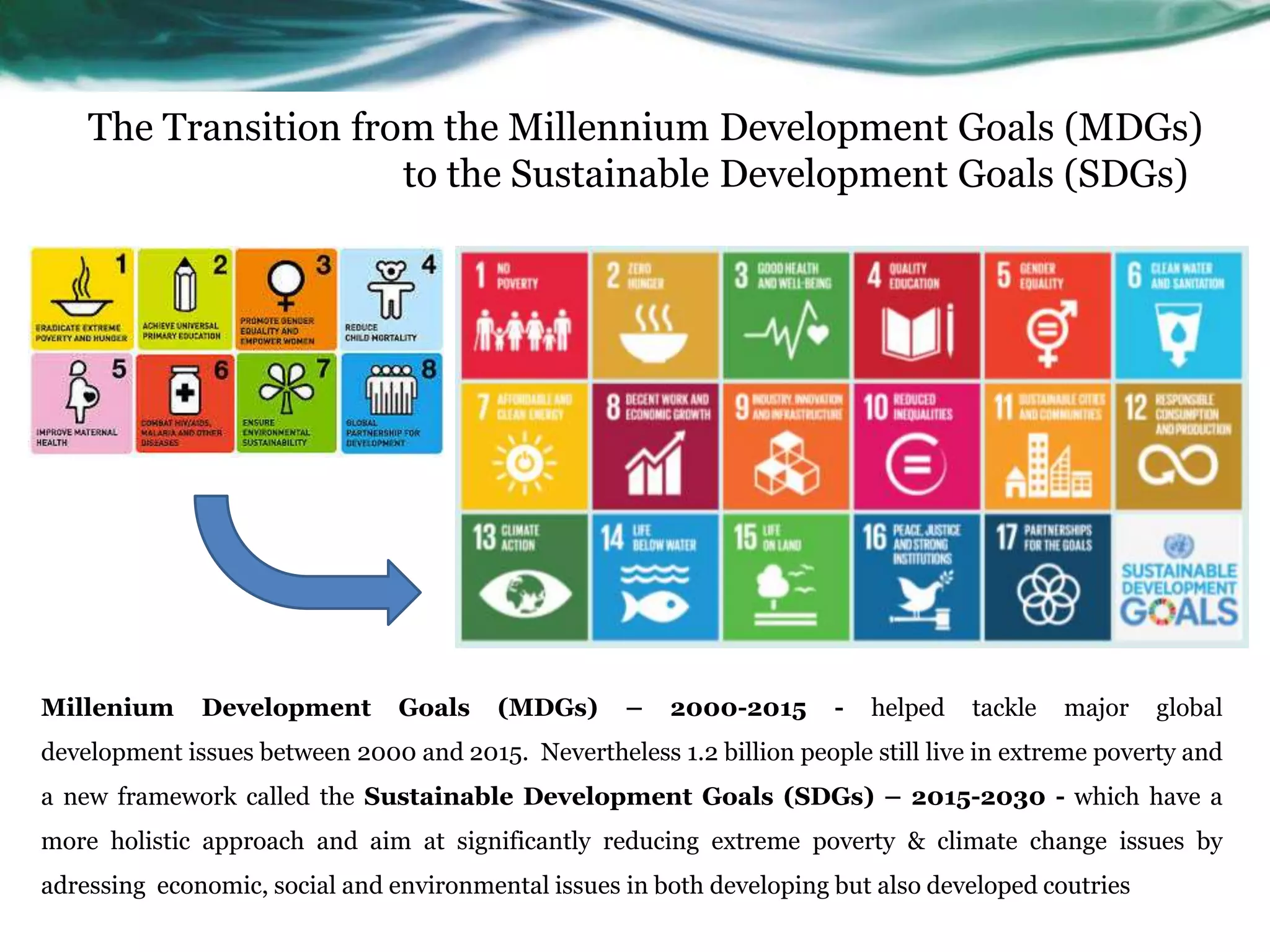
The Transition from the Millennium Development Goals (MDGs)
to the Sustainable Development Goals (SDGs)
Millenium Development Goals (MDGs) – 2000-2015 - helped tackle major global
development issues between 2000 and 2015. Nevertheless 1.2 billion people still live in extreme poverty and
a new framework called the Sustainable Development Goals (SDGs) – 2015-2030 - which have a
more holistic approach and aim at significantly reducing extreme poverty & climate change issues by
adressing economic, social and environmental issues in both developing but also developed coutries
Financing the SDGs : a huge challenge to adress
• As estimated by the WB n estimation of between 3 to
4 trillions US$ is needed for development annually
if the SDGs are to be adressed adequately (Estimated
by the World Bank).
• The total of public and private available capital both
from domestic origin or international origin represent
a massive amount which is nevertheless not
allocated to development project as it could be.
• Public and private financing support are required to
support the SDGs and we have to move from
Billions…to trillions.
Source : World bank website , MOOC videos and texts
Public Financing
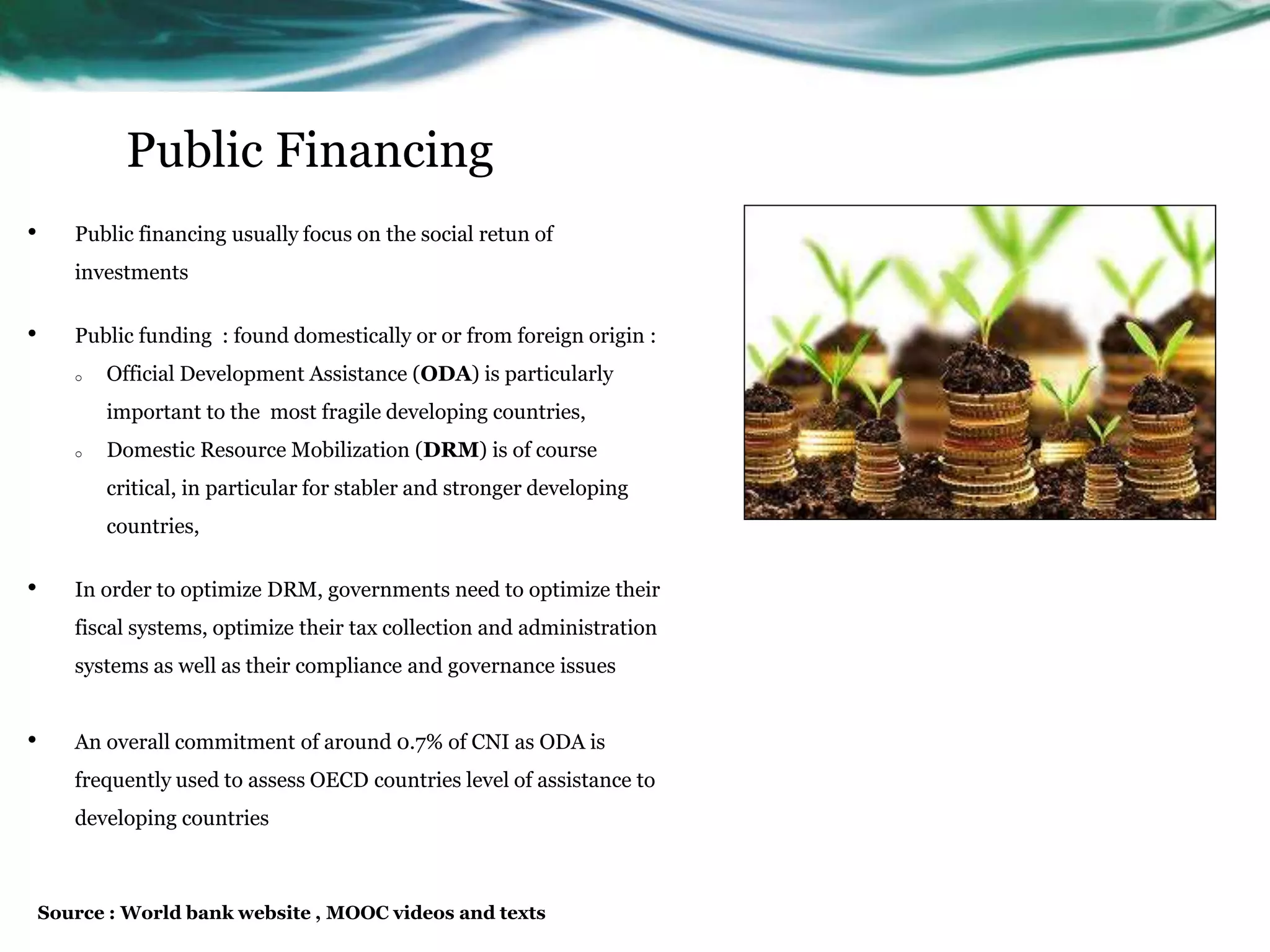
• Public financing usually focus on the social retun of
investments
• Public funding : found domestically or or from foreign origin :
o Official Development Assistance (ODA) is particularly
important to the most fragile developing countries,
o Domestic Resource Mobilization (DRM) is of course
critical, in particular for stabler and stronger developing
countries,
• In order to optimize DRM, governments need to optimize their
fiscal systems, optimize their tax collection and administration
systems as well as their compliance and governance issues
• An overall commitment of around 0.7% of CNI as ODA is
frequently used to assess OECD countries level of assistance to
developing countries
Source : World bank website , MOOC videos and texts
Private financing
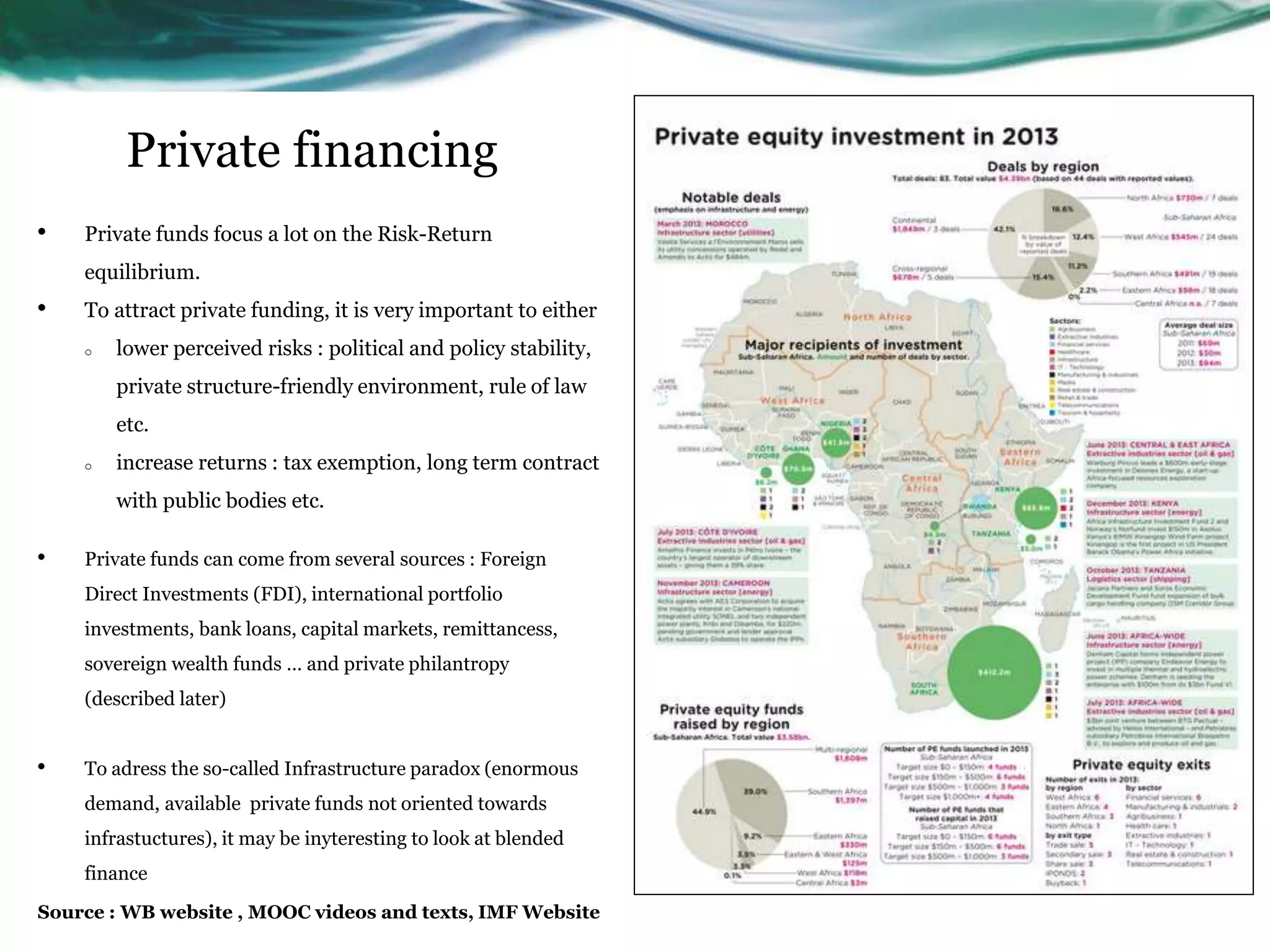
• Private funds focus a lot on the Risk-Return
equilibrium.
• To attract private funding, it is very important to either
o lower perceived risks : political and policy stability,
private structure-friendly environment, rule of law
etc.
o increase returns : tax exemption, long term contract
with public bodies etc.
• Private funds can come from several sources : Foreign
Direct Investments (FDI), international portfolio
investments, bank loans, capital markets, remittancess,
sovereign wealth funds … and private philantropy
(described later)
• To adress the so-called Infrastructure paradox (enormous
demand, available private funds not oriented towards
infrastuctures), it may be inyteresting to look at blended
finance
Source : WB website , MOOC videos and texts, IMF Website
Blended Finance
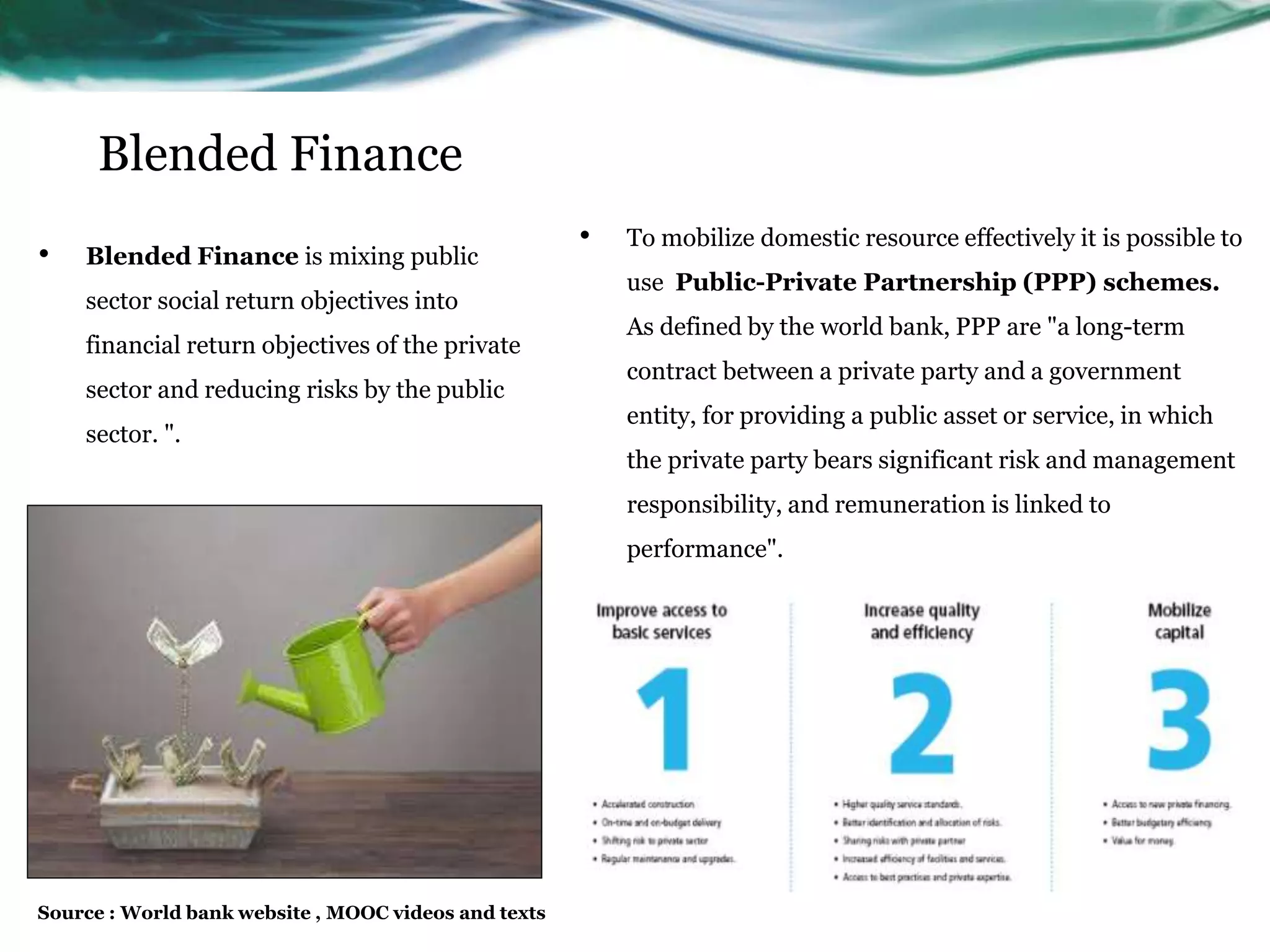
• Blended Finance is mixing public
sector social return objectives into
financial return objectives of the private
sector and reducing risks by the public
sector. ".
Source : World bank website , MOOC videos and texts
• To mobilize domestic resource effectively it is possible to
use Public-Private Partnership (PPP) schemes.
As defined by the world bank, PPP are "a long-term
contract between a private party and a government
entity, for providing a public asset or service, in which
the private party bears significant risk and management
responsibility, and remuneration is linked to
performance".
What place for Private Philantropy ?
• Private philantropy is usually targeting projects
that encompass technological & scientific risks .
Those risks can’t be easily supported neither by
traditional private investment for which the risk-
return ratio is often challenging nor by public
funding which are limited to a small number of
identified projetc
• As an example, the Giving Pledge is a
commitment by the world's wealthiest
individuals and families to dedicate the majority
of their wealth to philanthropy.
Source : World bank website , MOOC videos and texts, University of Kent
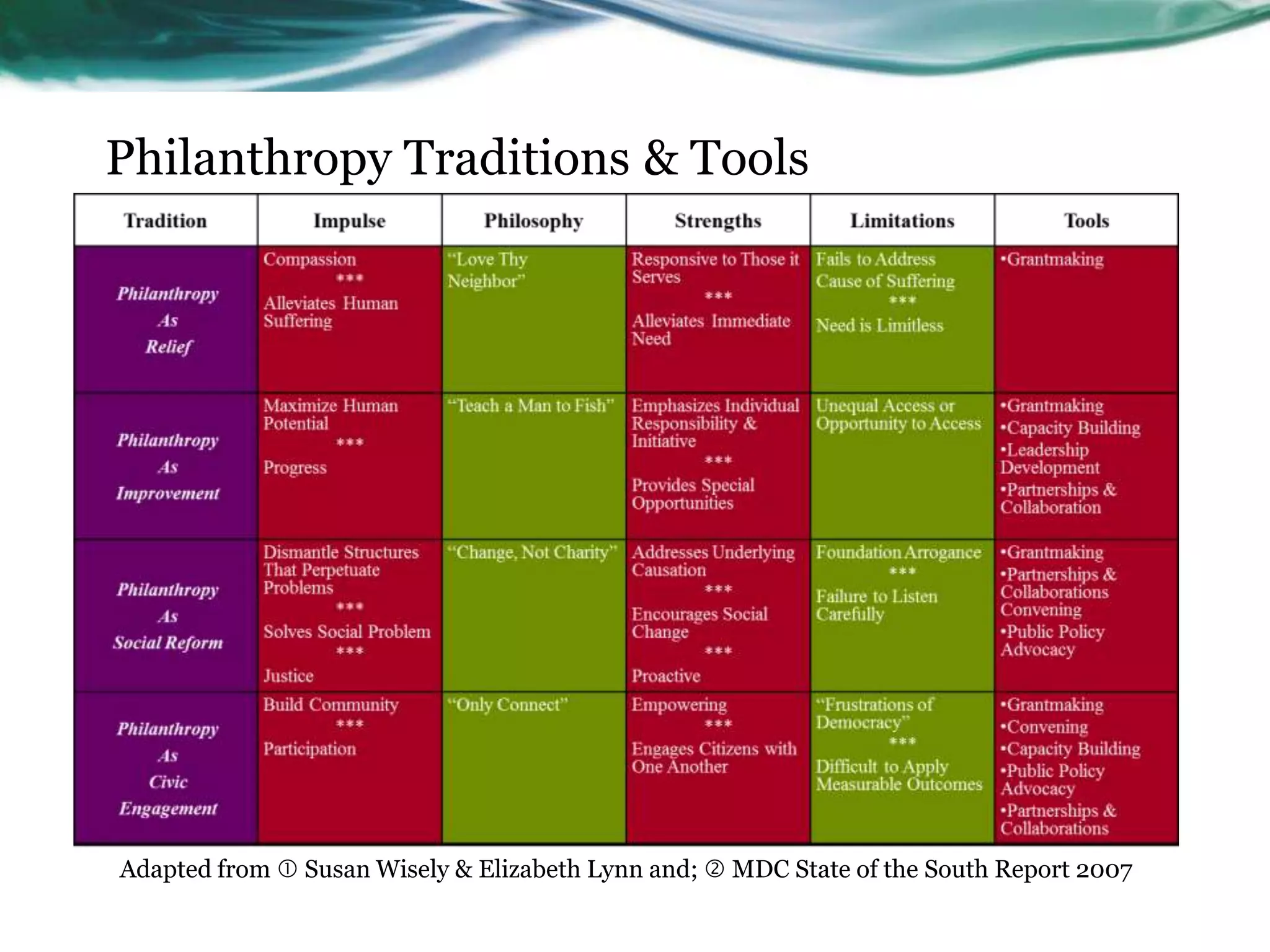
Adapted from  Susan Wisely & Elizabeth Lynn and;  MDC State of the South Report 2007
Philanthropy Traditions & Tools
• Of 1,223 billionaires (Forbes 2012) only
115 have signed the Giving Pledge.
• Major donors want their philanthropy to be:
o Transformative – to achieve something tangible that
wouldn’t otherwise have happened
o Personally engaging – with both the causes and the
organisations they support
o Integrated into their personal and family lives
o Enjoyable – they want their lives to be enriched as a
result of giving.
Philantropy : what is the situation today ?
This elements should be
evaluated for each
supported project to create a
track record and attract
more billionaires
Source : World bank website , MOOC videos and texts, University of Kent
“I have found that with money, the two happiest
times are first when you are making it and
second when you are giving it away.”
David Kirch

Financing for development & philanthropy

  • 1.
    Financing for development MainMechanisms Focus on private Philantropy Final presentation Financing for development World Bank MOOC 2015
  • 2.
    The Transition fromthe Millennium Development Goals (MDGs) to the Sustainable Development Goals (SDGs) Millenium Development Goals (MDGs) – 2000-2015 - helped tackle major global development issues between 2000 and 2015. Nevertheless 1.2 billion people still live in extreme poverty and a new framework called the Sustainable Development Goals (SDGs) – 2015-2030 - which have a more holistic approach and aim at significantly reducing extreme poverty & climate change issues by adressing economic, social and environmental issues in both developing but also developed coutries
  • 3.
    Financing the SDGs: a huge challenge to adress • As estimated by the WB n estimation of between 3 to 4 trillions US$ is needed for development annually if the SDGs are to be adressed adequately (Estimated by the World Bank). • The total of public and private available capital both from domestic origin or international origin represent a massive amount which is nevertheless not allocated to development project as it could be. • Public and private financing support are required to support the SDGs and we have to move from Billions…to trillions. Source : World bank website , MOOC videos and texts
  • 4.
    Public Financing • Publicfinancing usually focus on the social retun of investments • Public funding : found domestically or or from foreign origin : o Official Development Assistance (ODA) is particularly important to the most fragile developing countries, o Domestic Resource Mobilization (DRM) is of course critical, in particular for stabler and stronger developing countries, • In order to optimize DRM, governments need to optimize their fiscal systems, optimize their tax collection and administration systems as well as their compliance and governance issues • An overall commitment of around 0.7% of CNI as ODA is frequently used to assess OECD countries level of assistance to developing countries Source : World bank website , MOOC videos and texts
  • 5.
    Private financing • Privatefunds focus a lot on the Risk-Return equilibrium. • To attract private funding, it is very important to either o lower perceived risks : political and policy stability, private structure-friendly environment, rule of law etc. o increase returns : tax exemption, long term contract with public bodies etc. • Private funds can come from several sources : Foreign Direct Investments (FDI), international portfolio investments, bank loans, capital markets, remittancess, sovereign wealth funds … and private philantropy (described later) • To adress the so-called Infrastructure paradox (enormous demand, available private funds not oriented towards infrastuctures), it may be inyteresting to look at blended finance Source : WB website , MOOC videos and texts, IMF Website
  • 6.
    Blended Finance • BlendedFinance is mixing public sector social return objectives into financial return objectives of the private sector and reducing risks by the public sector. ". Source : World bank website , MOOC videos and texts • To mobilize domestic resource effectively it is possible to use Public-Private Partnership (PPP) schemes. As defined by the world bank, PPP are "a long-term contract between a private party and a government entity, for providing a public asset or service, in which the private party bears significant risk and management responsibility, and remuneration is linked to performance".
  • 7.
    What place forPrivate Philantropy ? • Private philantropy is usually targeting projects that encompass technological & scientific risks . Those risks can’t be easily supported neither by traditional private investment for which the risk- return ratio is often challenging nor by public funding which are limited to a small number of identified projetc • As an example, the Giving Pledge is a commitment by the world's wealthiest individuals and families to dedicate the majority of their wealth to philanthropy. Source : World bank website , MOOC videos and texts, University of Kent
  • 8.
    Adapted from Susan Wisely & Elizabeth Lynn and;  MDC State of the South Report 2007 Philanthropy Traditions & Tools
  • 9.
    • Of 1,223billionaires (Forbes 2012) only 115 have signed the Giving Pledge. • Major donors want their philanthropy to be: o Transformative – to achieve something tangible that wouldn’t otherwise have happened o Personally engaging – with both the causes and the organisations they support o Integrated into their personal and family lives o Enjoyable – they want their lives to be enriched as a result of giving. Philantropy : what is the situation today ? This elements should be evaluated for each supported project to create a track record and attract more billionaires Source : World bank website , MOOC videos and texts, University of Kent
  • 10.
    “I have foundthat with money, the two happiest times are first when you are making it and second when you are giving it away.” David Kirch