Sheba M
Chaitali K
Nikhil k
Pooja S
Nawaz Ashahar
201830
201816
201846
201829
201832
HUMA
N
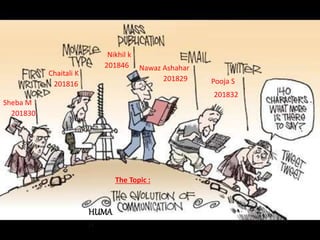
The Topic :
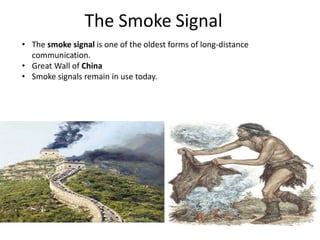
The Smoke Signal
• The smoke signal is one of the oldest forms of long-distance
communication.
• Great Wall of China
• Smoke signals remain in use today.
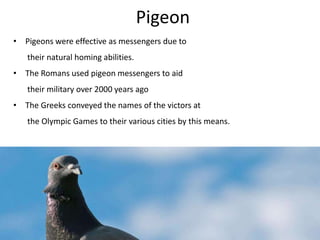
• Pigeons were effective as messengers due to
their natural homing abilities.
• The Romans used pigeon messengers to aid
their military over 2000 years ago
• The Greeks conveyed the names of the victors at
the Olympic Games to their various cities by this means.
Pigeon
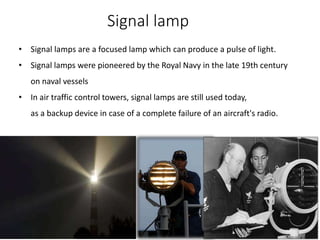
• Signal lamps are a focused lamp which can produce a pulse of light.
• Signal lamps were pioneered by the Royal Navy in the late 19th century
on naval vessels
• In air traffic control towers, signal lamps are still used today,
as a backup device in case of a complete failure of an aircraft's radio.
Signal lamp
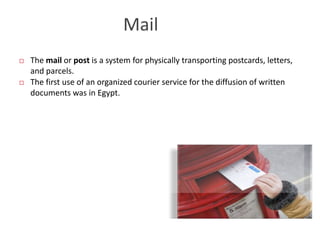
Mail
 The mail or post is a system for physically transporting postcards, letters,
and parcels.
 The first use of an organized courier service for the diffusion of written
documents was in Egypt.
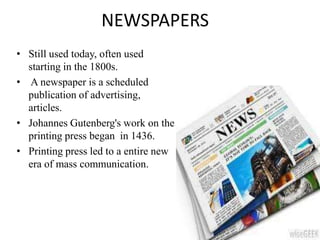
NEWSPAPERS
• Still used today, often used
starting in the 1800s.
• A newspaper is a scheduled
publication of advertising,
articles.
• Johannes Gutenberg's work on the
printing press began in 1436.
• Printing press led to a entire new
era of mass communication.
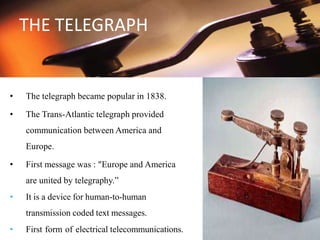
THE TELEGRAPH
• The telegraph became popular in 1838.
• The Trans-Atlantic telegraph provided
communication between America and
Europe.
• First message was : "Europe and America
are united by telegraphy.”
• It is a device for human-to-human
transmission coded text messages.
• First form of electrical telecommunications.
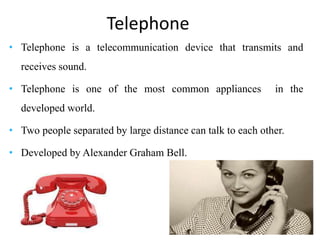
Telephone
• Telephone is a telecommunication device that transmits and
receives sound.
• Telephone is one of the most common appliances in the
developed world.
• Two people separated by large distance can talk to each other.
• Developed by Alexander Graham Bell.
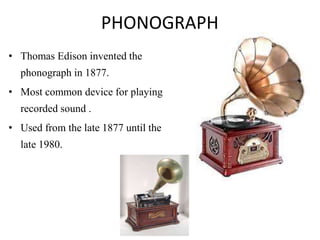
PHONOGRAPH
• Thomas Edison invented the
phonograph in 1877.
• Most common device for playing
recorded sound .
• Used from the late 1877 until the
late 1980.
• Invented around 1896AROUND 1896,
• The transmission of electromagnetic waves through free space
• Frequency range from about 3 kHz to 300 GHz called as radio waves.
• Electromagnetic radiation travels by means of oscillating electromagnetic
fields that pass through the air & the vacuum of space.
Radio
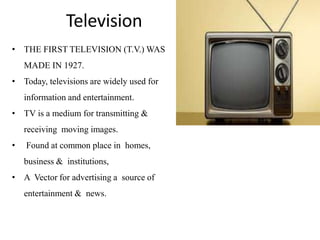
• THE FIRST TELEVISION (T.V.) WAS
MADE IN 1927.
• Today, televisions are widely used for
information and entertainment.
• TV is a medium for transmitting &
receiving moving images.
• Found at common place in homes,
business & institutions,
• A Vector for advertising a source of
entertainment & news.
Television
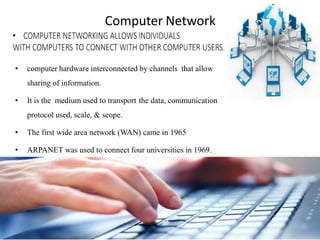
Computer Network
• computer hardware interconnected by channels that allow
sharing of information.
• It is the medium used to transport the data, communication
protocol used, scale, & scope.
• The first wide area network (WAN) came in 1965
• ARPANET was used to connect four universities in 1969.
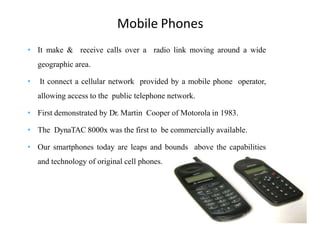
Mobile Phones
• It make & receive calls over a radio link moving around a wide
geographic area.
• It connect a cellular network provided by a mobile phone operator,
allowing access to the public telephone network.
• First demonstrated by Dr. Martin Cooper of Motorola in 1983.
• The DynaTAC 8000x was the first to be commercially available.
• Our smartphones today are leaps and bounds above the capabilities
and technology of original cell phones.
Internet
 It is a network of netwoks.
 Vast range
 Internet security
OPTICAL FIBERS
Introduces
Flexible fiber
Drawing glass (Silica) or plastic
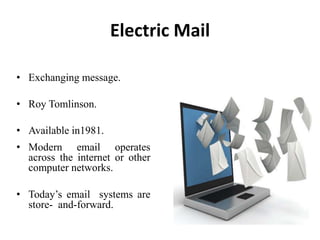
• Exchanging message.
• Roy Tomlinson.
• Available in1981.
Electric Mail
• Modern email operates
across the internet or other
computer networks.
• Today’s email systems are
store- and-forward.
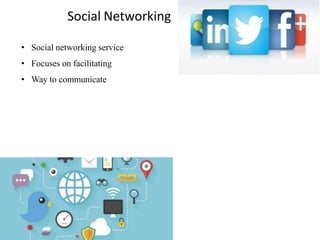
Social Networking
• Social networking service
• Focuses on facilitating
• Way to communicate
Conclusion
.
• The communication revolution has brought around many
positive effects.
• It helps to make important decisions without having to travels
hundreds of miles or meet face to face.
• It breaks down social and worldwide barriers, allowing people
interact across the globe, different races, cultures, backgrounds
and statuses interact.
Evolution of human communication

Evolution of human communication

  • 1.
    Sheba M Chaitali K Nikhilk Pooja S Nawaz Ashahar 201830 201816 201846 201829 201832 HUMA N The Topic :
  • 2.
    The Smoke Signal •The smoke signal is one of the oldest forms of long-distance communication. • Great Wall of China • Smoke signals remain in use today.
  • 3.
    • Pigeons wereeffective as messengers due to their natural homing abilities. • The Romans used pigeon messengers to aid their military over 2000 years ago • The Greeks conveyed the names of the victors at the Olympic Games to their various cities by this means. Pigeon
  • 4.
    • Signal lampsare a focused lamp which can produce a pulse of light. • Signal lamps were pioneered by the Royal Navy in the late 19th century on naval vessels • In air traffic control towers, signal lamps are still used today, as a backup device in case of a complete failure of an aircraft's radio. Signal lamp
  • 5.
    Mail  The mailor post is a system for physically transporting postcards, letters, and parcels.  The first use of an organized courier service for the diffusion of written documents was in Egypt.
  • 6.
    NEWSPAPERS • Still usedtoday, often used starting in the 1800s. • A newspaper is a scheduled publication of advertising, articles. • Johannes Gutenberg's work on the printing press began in 1436. • Printing press led to a entire new era of mass communication.
  • 7.
    THE TELEGRAPH • Thetelegraph became popular in 1838. • The Trans-Atlantic telegraph provided communication between America and Europe. • First message was : "Europe and America are united by telegraphy.” • It is a device for human-to-human transmission coded text messages. • First form of electrical telecommunications.
  • 8.
    Telephone • Telephone isa telecommunication device that transmits and receives sound. • Telephone is one of the most common appliances in the developed world. • Two people separated by large distance can talk to each other. • Developed by Alexander Graham Bell.
  • 9.
    PHONOGRAPH • Thomas Edisoninvented the phonograph in 1877. • Most common device for playing recorded sound . • Used from the late 1877 until the late 1980.
  • 10.
    • Invented around1896AROUND 1896, • The transmission of electromagnetic waves through free space • Frequency range from about 3 kHz to 300 GHz called as radio waves. • Electromagnetic radiation travels by means of oscillating electromagnetic fields that pass through the air & the vacuum of space. Radio
  • 11.
    • THE FIRSTTELEVISION (T.V.) WAS MADE IN 1927. • Today, televisions are widely used for information and entertainment. • TV is a medium for transmitting & receiving moving images. • Found at common place in homes, business & institutions, • A Vector for advertising a source of entertainment & news. Television
  • 12.
    Computer Network • computerhardware interconnected by channels that allow sharing of information. • It is the medium used to transport the data, communication protocol used, scale, & scope. • The first wide area network (WAN) came in 1965 • ARPANET was used to connect four universities in 1969.
  • 13.
    Mobile Phones • Itmake & receive calls over a radio link moving around a wide geographic area. • It connect a cellular network provided by a mobile phone operator, allowing access to the public telephone network. • First demonstrated by Dr. Martin Cooper of Motorola in 1983. • The DynaTAC 8000x was the first to be commercially available. • Our smartphones today are leaps and bounds above the capabilities and technology of original cell phones.
  • 14.
    Internet  It isa network of netwoks.  Vast range  Internet security
  • 15.
  • 16.
    • Exchanging message. •Roy Tomlinson. • Available in1981. Electric Mail • Modern email operates across the internet or other computer networks. • Today’s email systems are store- and-forward.
  • 17.
    Social Networking • Socialnetworking service • Focuses on facilitating • Way to communicate
  • 18.
    Conclusion . • The communicationrevolution has brought around many positive effects. • It helps to make important decisions without having to travels hundreds of miles or meet face to face. • It breaks down social and worldwide barriers, allowing people interact across the globe, different races, cultures, backgrounds and statuses interact.