The document discusses the trends and strategies for resource efficiency in response to growing global demand, highlighting the importance of substitution, waste reduction, recycling, optimization, and virtualization. It outlines historical shifts from traditional power sources to modern industry practices, emphasizing the role of technology and innovation in improving productivity and sustainability. Future forecasts include advancements in materials science and processes that will replace scarce resources with more abundant alternatives, along with a shift towards more efficient, virtual interactions in various sectors.
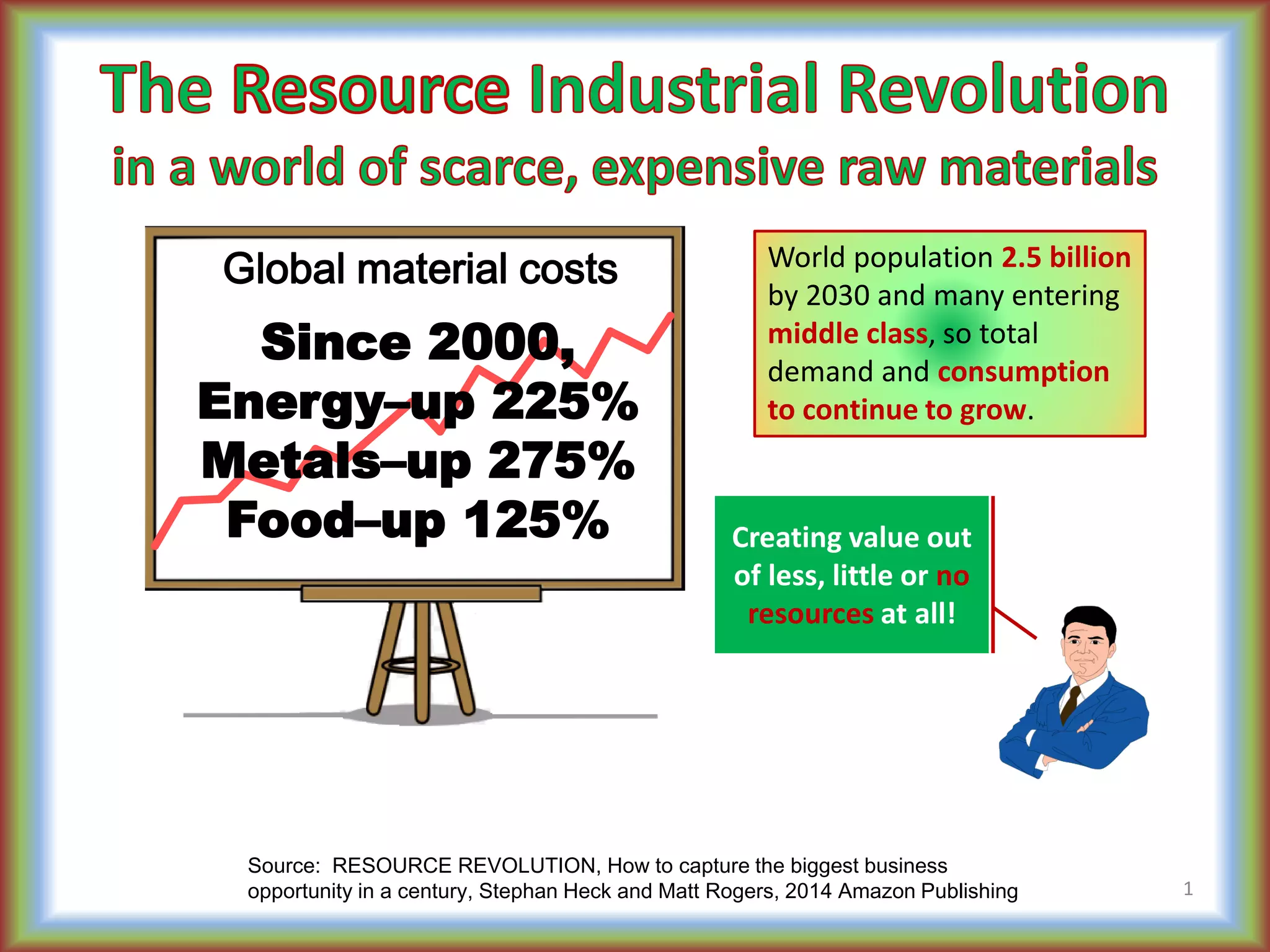
World population 2.5billion
by 2030 and many entering
middle class, so total
demand and consumption
to continue to grow.
1
Source: RESOURCE REVOLUTION, How to capture the biggest business
opportunity in a century, Stephan Heck and Matt Rogers, 2014 Amazon Publishing
Since 2000,
Energy–up 225%
Metals–up 275%
Food–up 125%
Global material costs
Creating value out
of less, little or no
resources at all!
2.
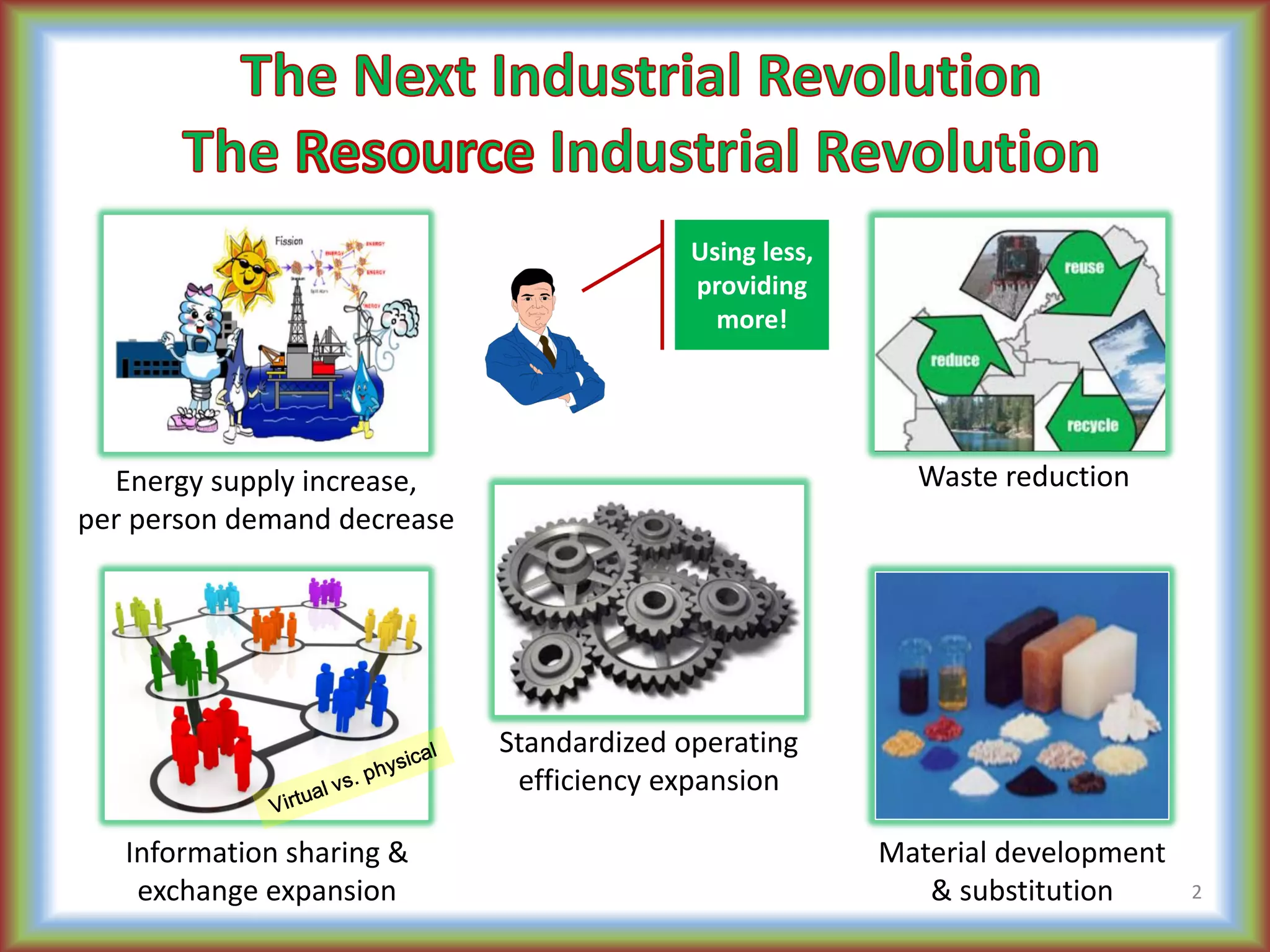
Using less,
providing
more!
Waste reductionEnergysupply increase,
per person demand decrease
Standardized operating
efficiency expansion
Information sharing &
exchange expansion
Material development
& substitution 2
3.
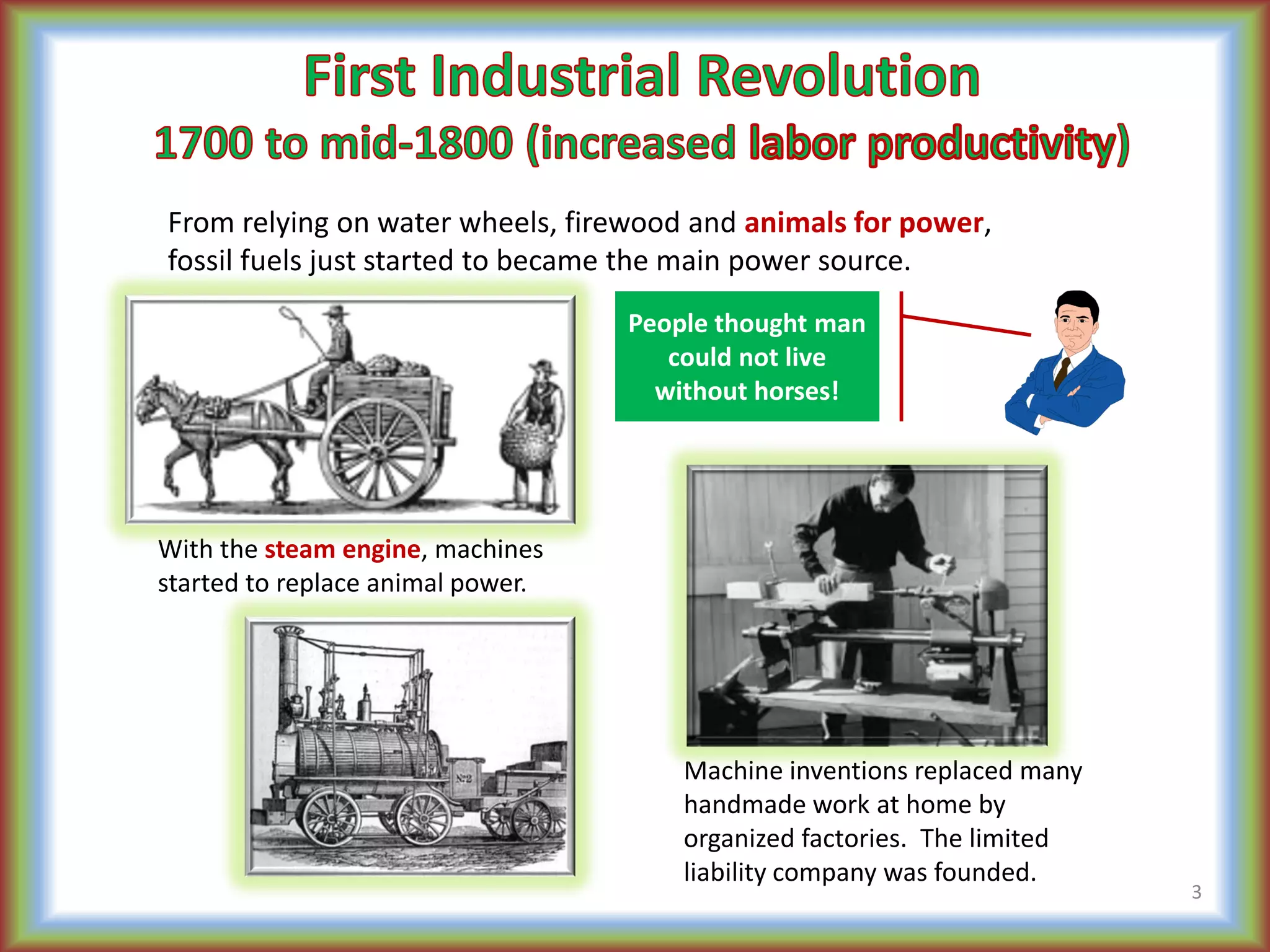
From relying onwater wheels, firewood and animals for power,
fossil fuels just started to became the main power source.
Machine inventions replaced many
handmade work at home by
organized factories. The limited
liability company was founded.
With the steam engine, machines
started to replace animal power.
3
People thought man
could not live
without horses!
4.
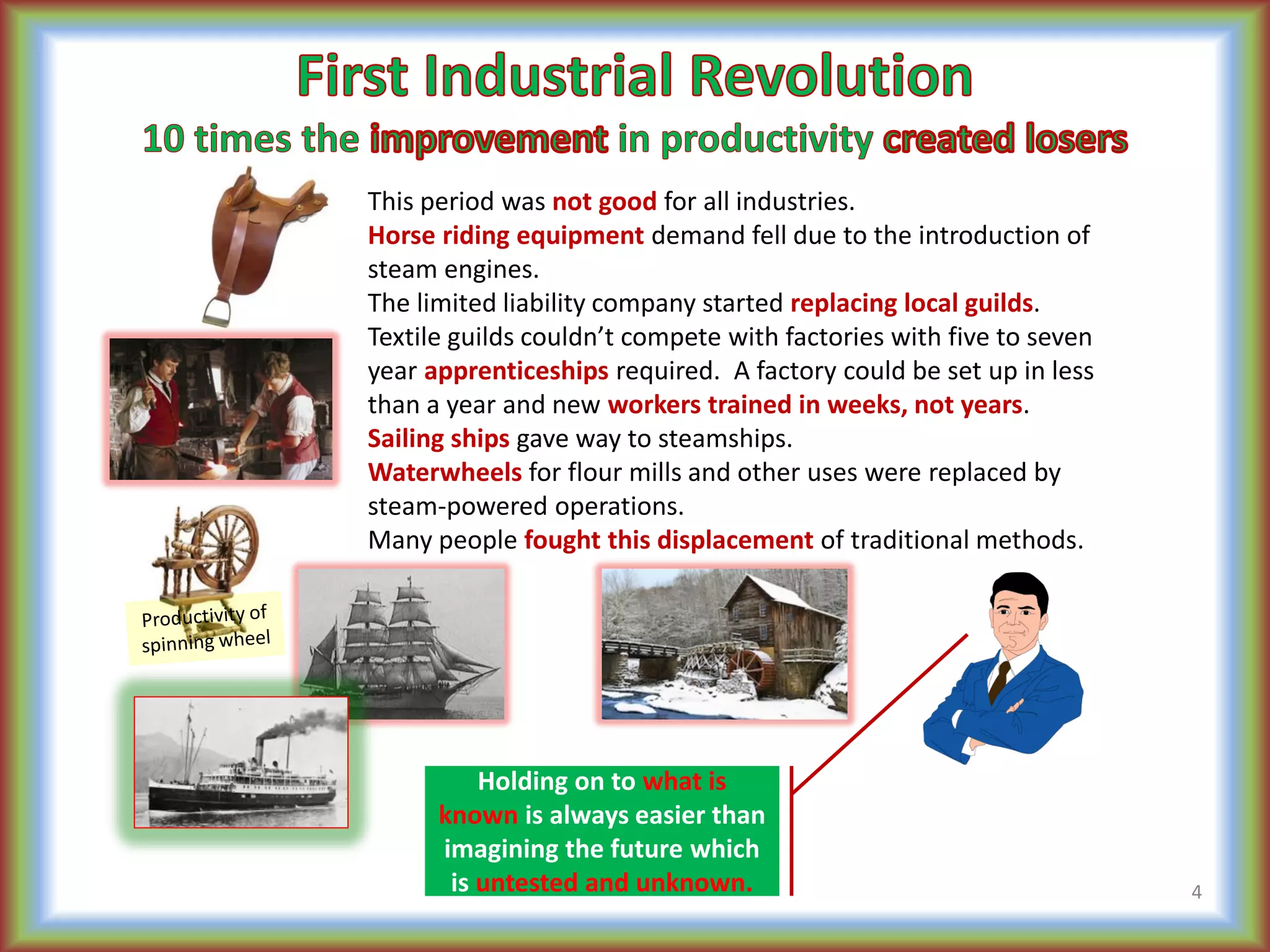
This period wasnot good for all industries.
Horse riding equipment demand fell due to the introduction of
steam engines.
The limited liability company started replacing local guilds.
Textile guilds couldn’t compete with factories with five to seven
year apprenticeships required. A factory could be set up in less
than a year and new workers trained in weeks, not years.
Sailing ships gave way to steamships.
Waterwheels for flour mills and other uses were replaced by
steam-powered operations.
Many people fought this displacement of traditional methods.
4
Holding on to what is
known is always easier than
imagining the future which
is untested and unknown.
5.
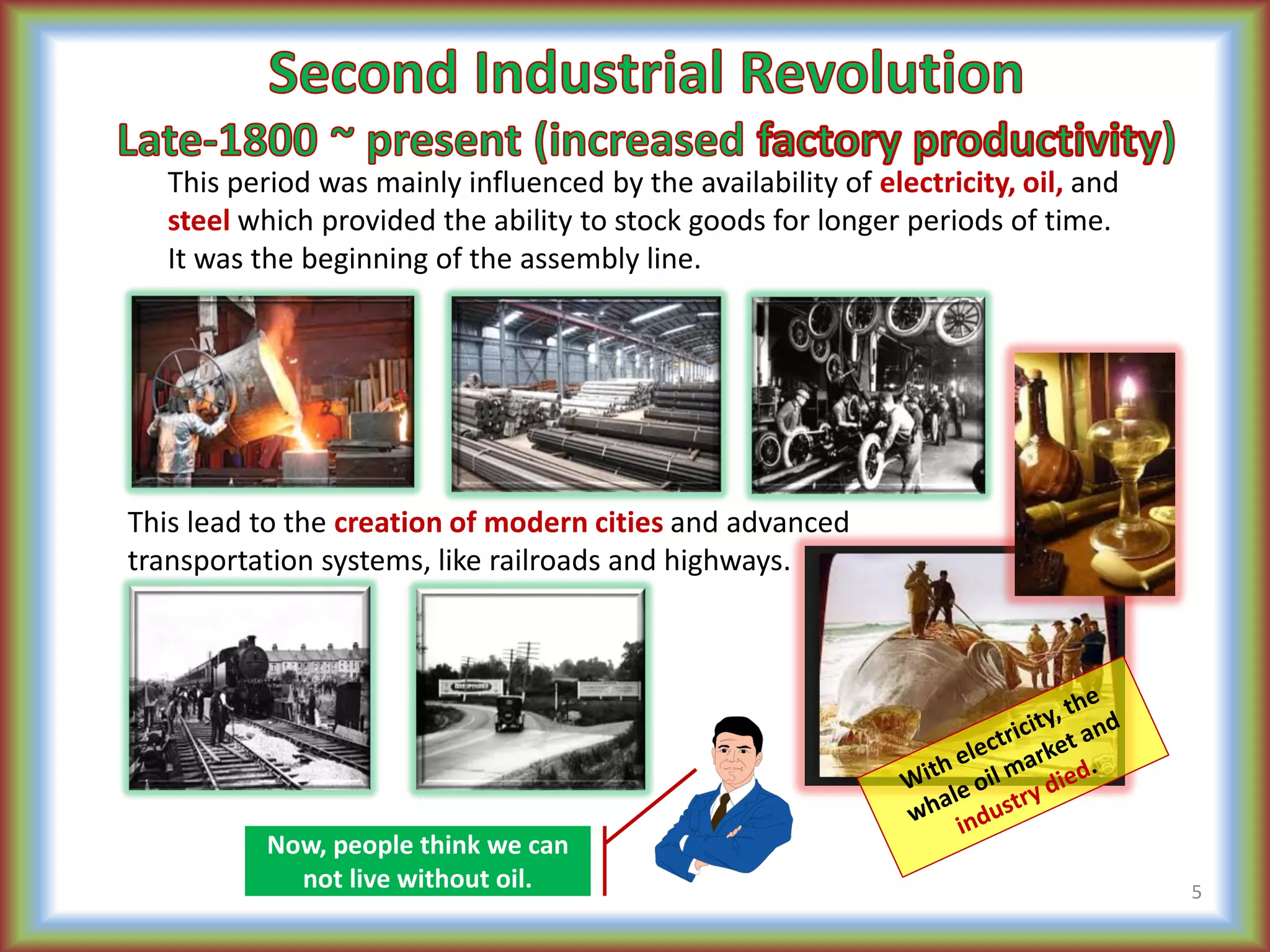
This period wasmainly influenced by the availability of electricity, oil, and
steel which provided the ability to stock goods for longer periods of time.
It was the beginning of the assembly line.
This lead to the creation of modern cities and advanced
transportation systems, like railroads and highways.
5
Now, people think we can
not live without oil.
6.
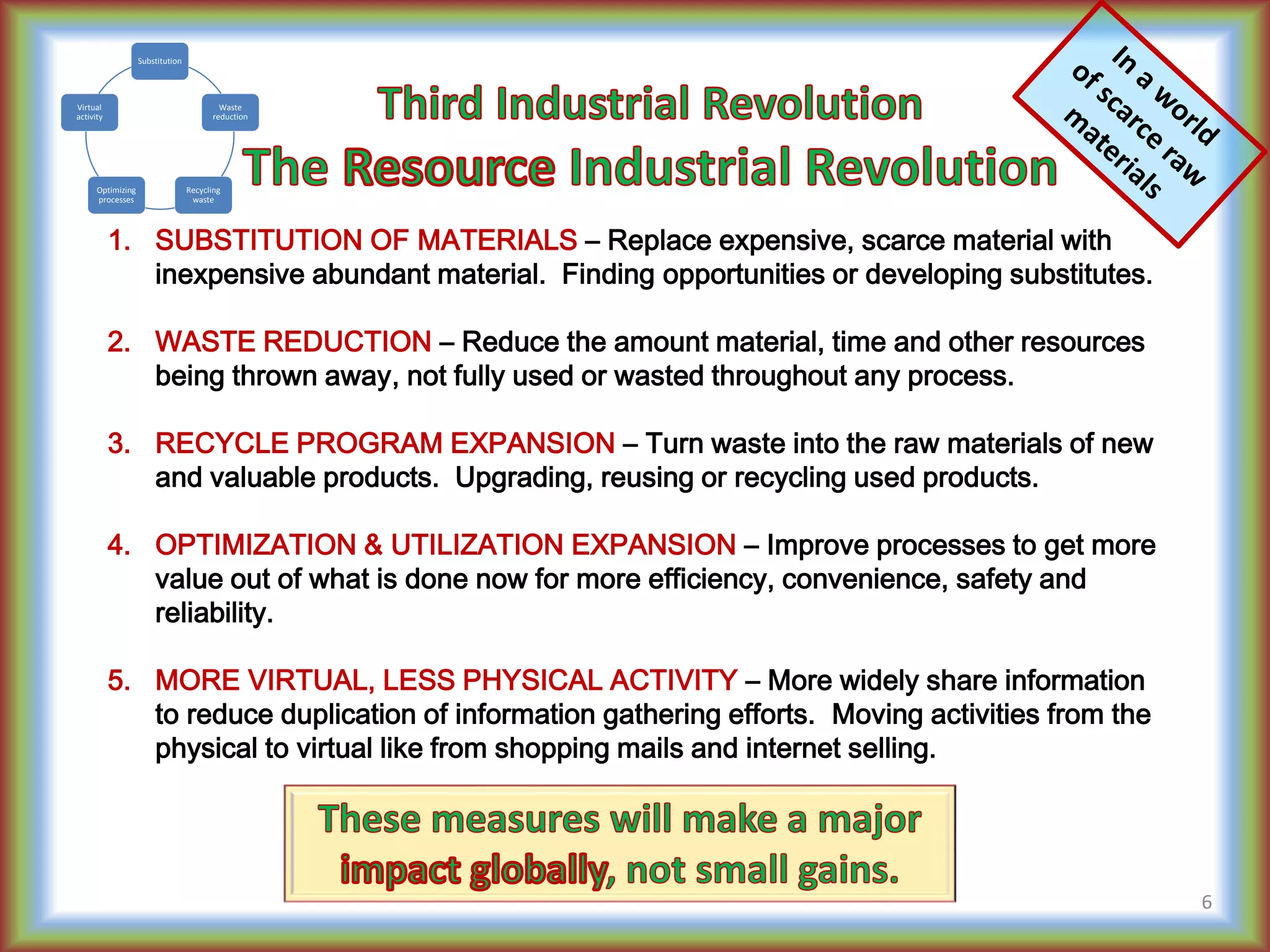
1. SUBSTITUTION OFMATERIALS – Replace expensive, scarce material with
inexpensive abundant material. Finding opportunities or developing substitutes.
2. WASTE REDUCTION – Reduce the amount material, time and other resources
being thrown away, not fully used or wasted throughout any process.
3. RECYCLE PROGRAM EXPANSION – Turn waste into the raw materials of new
and valuable products. Upgrading, reusing or recycling used products.
4. OPTIMIZATION & UTILIZATION EXPANSION – Improve processes to get more
value out of what is done now for more efficiency, convenience, safety and
reliability.
5. MORE VIRTUAL, LESS PHYSICAL ACTIVITY – More widely share information
to reduce duplication of information gathering efforts. Moving activities from the
physical to virtual like from shopping mails and internet selling.
6
Substitution
Waste
reduction
Recycling
waste
Optimizing
processes
Virtual
activity
7.
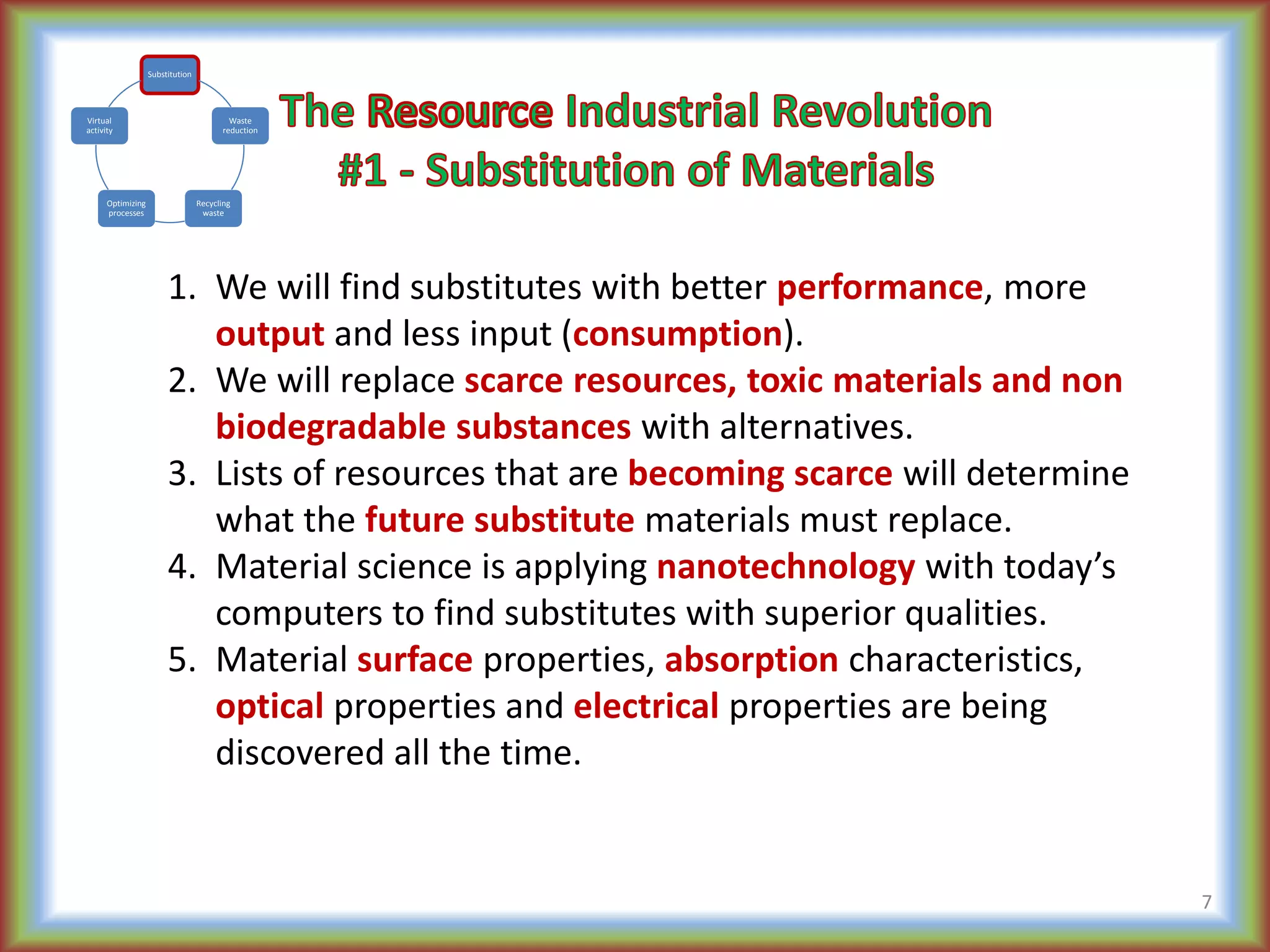
1. We willfind substitutes with better performance, more
output and less input (consumption).
2. We will replace scarce resources, toxic materials and non
biodegradable substances with alternatives.
3. Lists of resources that are becoming scarce will determine
what the future substitute materials must replace.
4. Material science is applying nanotechnology with today’s
computers to find substitutes with superior qualities.
5. Material surface properties, absorption characteristics,
optical properties and electrical properties are being
discovered all the time.
7
Substitution
Waste
reduction
Recycling
waste
Optimizing
processes
Virtual
activity
8.
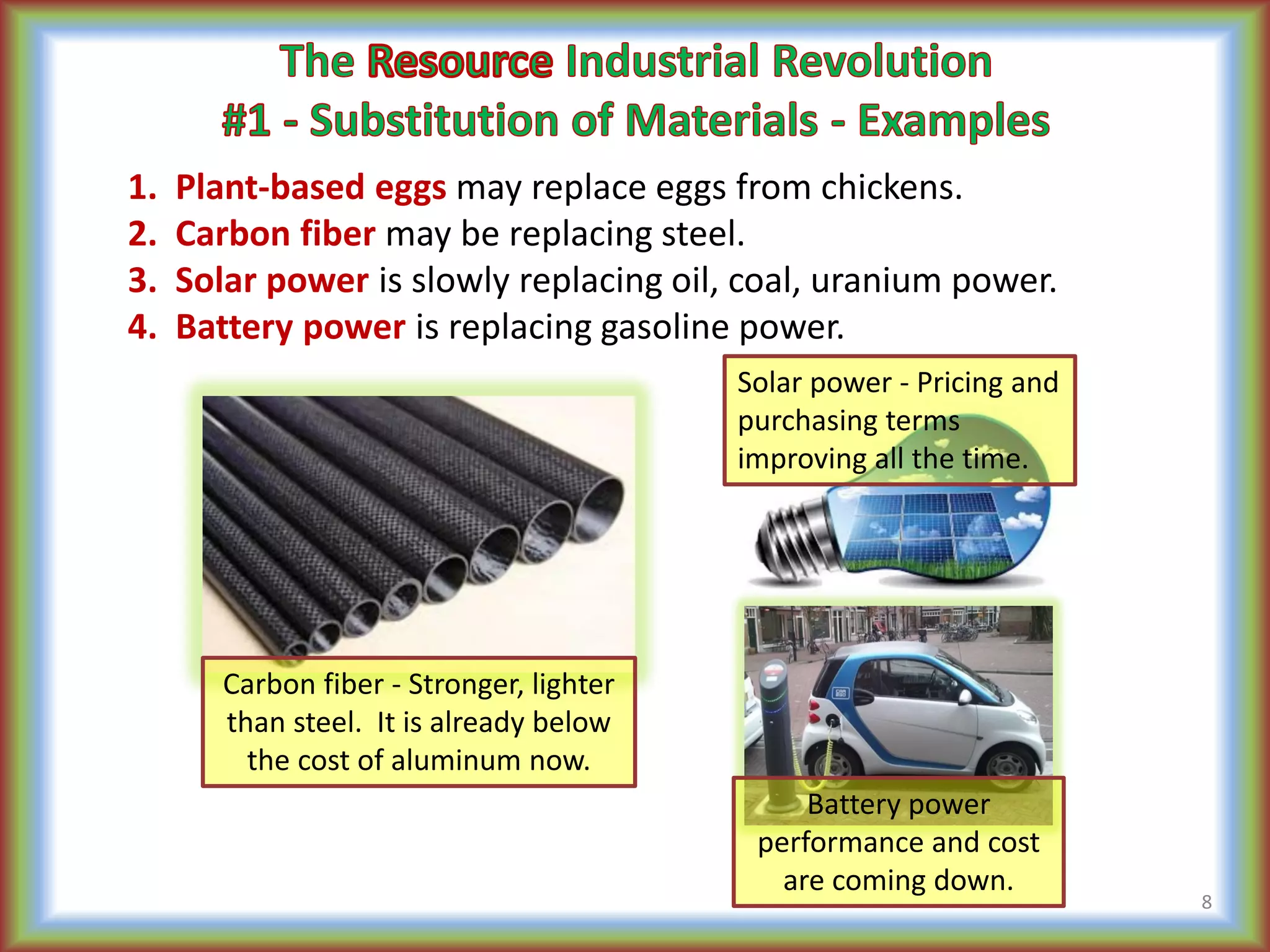
1. Plant-based eggsmay replace eggs from chickens.
2. Carbon fiber may be replacing steel.
3. Solar power is slowly replacing oil, coal, uranium power.
4. Battery power is replacing gasoline power.
Carbon fiber - Stronger, lighter
than steel. It is already below
the cost of aluminum now.
Battery power
performance and cost
are coming down.
Solar power - Pricing and
purchasing terms
improving all the time.
8
9.
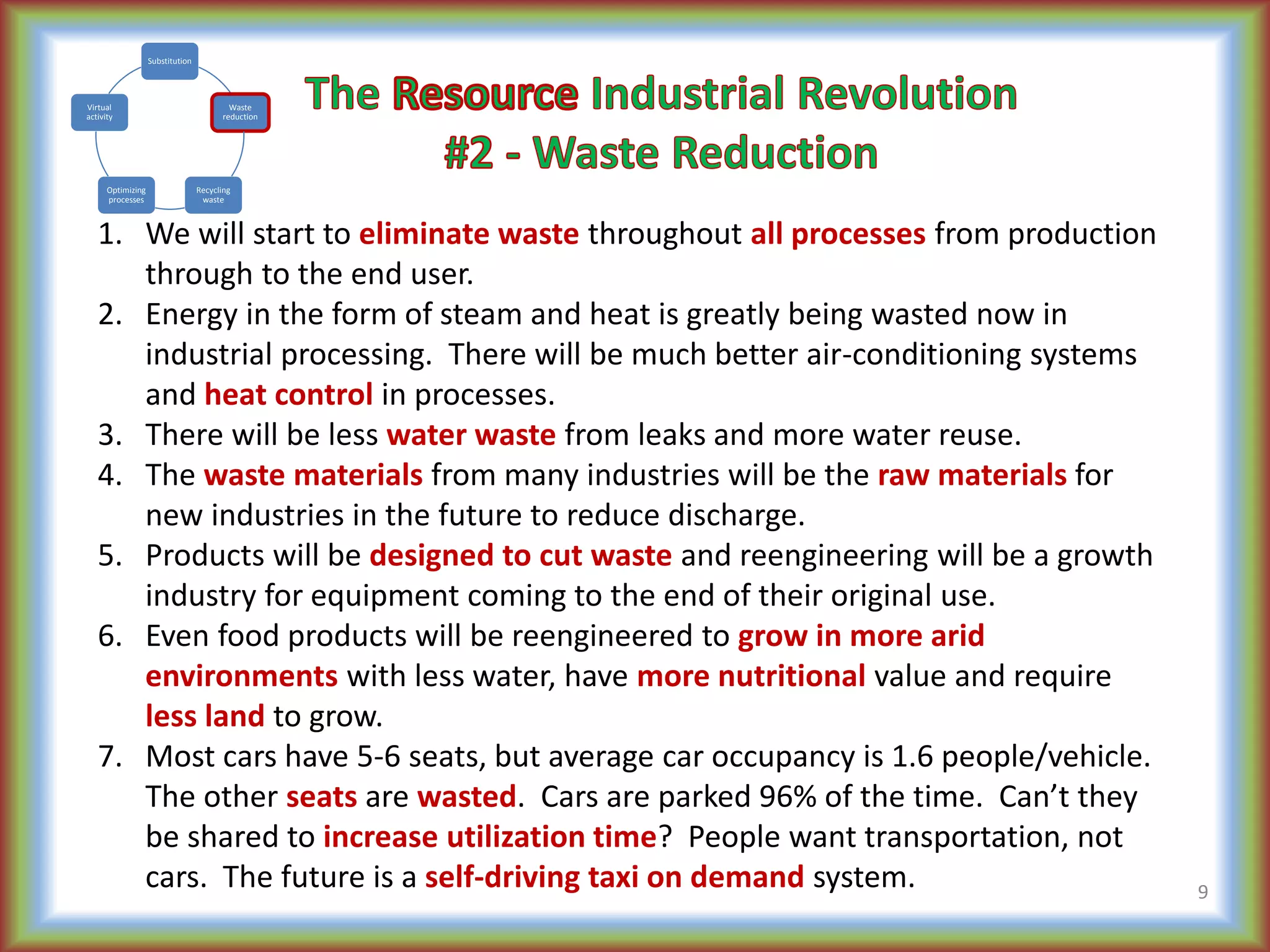
1. We willstart to eliminate waste throughout all processes from production
through to the end user.
2. Energy in the form of steam and heat is greatly being wasted now in
industrial processing. There will be much better air-conditioning systems
and heat control in processes.
3. There will be less water waste from leaks and more water reuse.
4. The waste materials from many industries will be the raw materials for
new industries in the future to reduce discharge.
5. Products will be designed to cut waste and reengineering will be a growth
industry for equipment coming to the end of their original use.
6. Even food products will be reengineered to grow in more arid
environments with less water, have more nutritional value and require
less land to grow.
7. Most cars have 5-6 seats, but average car occupancy is 1.6 people/vehicle.
The other seats are wasted. Cars are parked 96% of the time. Can’t they
be shared to increase utilization time? People want transportation, not
cars. The future is a self-driving taxi on demand system. 9
Substitution
Waste
reduction
Recycling
waste
Optimizing
processes
Virtual
activity
10.
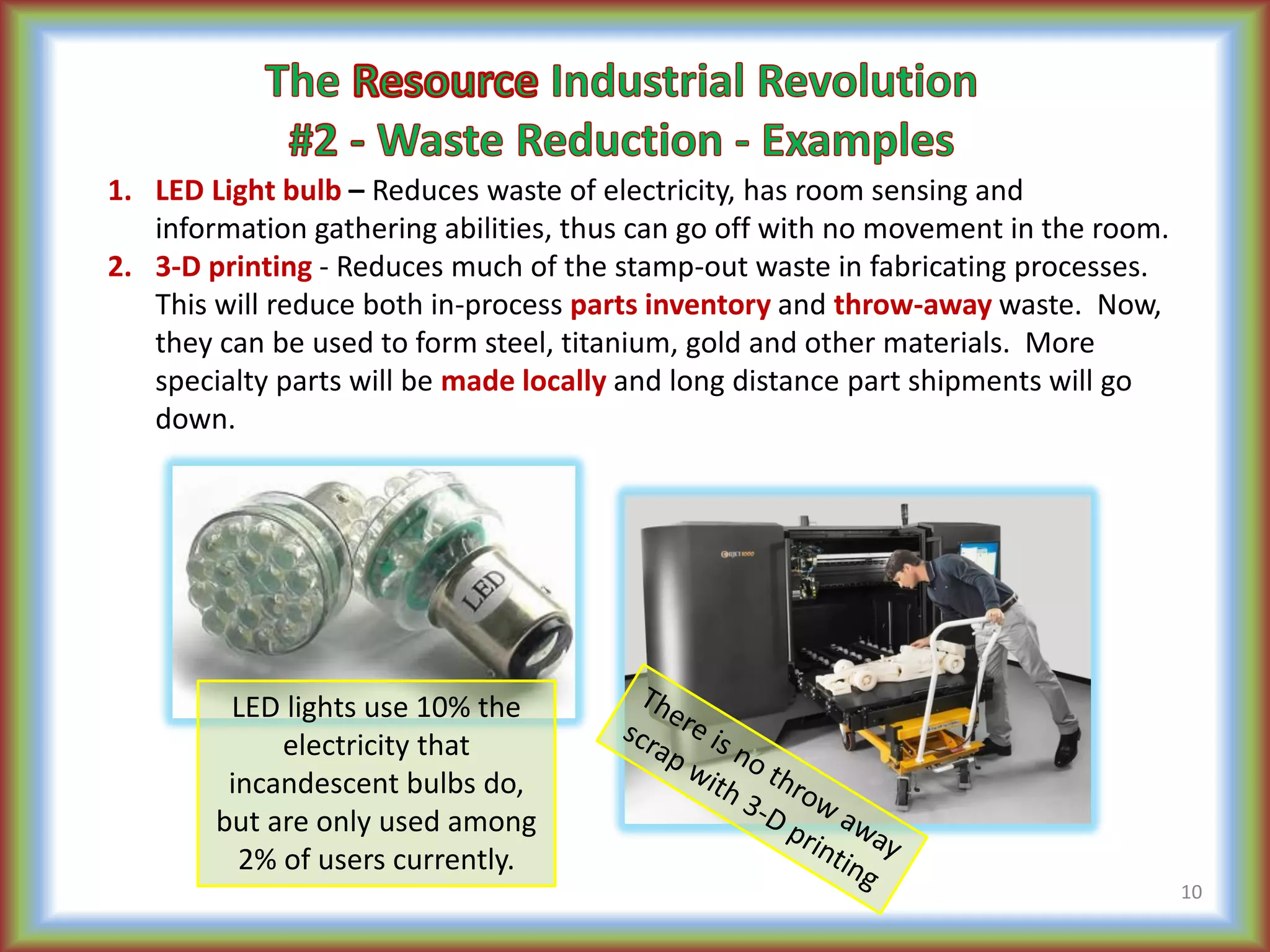
1. LED Lightbulb – Reduces waste of electricity, has room sensing and
information gathering abilities, thus can go off with no movement in the room.
2. 3-D printing - Reduces much of the stamp-out waste in fabricating processes.
This will reduce both in-process parts inventory and throw-away waste. Now,
they can be used to form steel, titanium, gold and other materials. More
specialty parts will be made locally and long distance part shipments will go
down.
10
LED lights use 10% the
electricity that
incandescent bulbs do,
but are only used among
2% of users currently.
11.
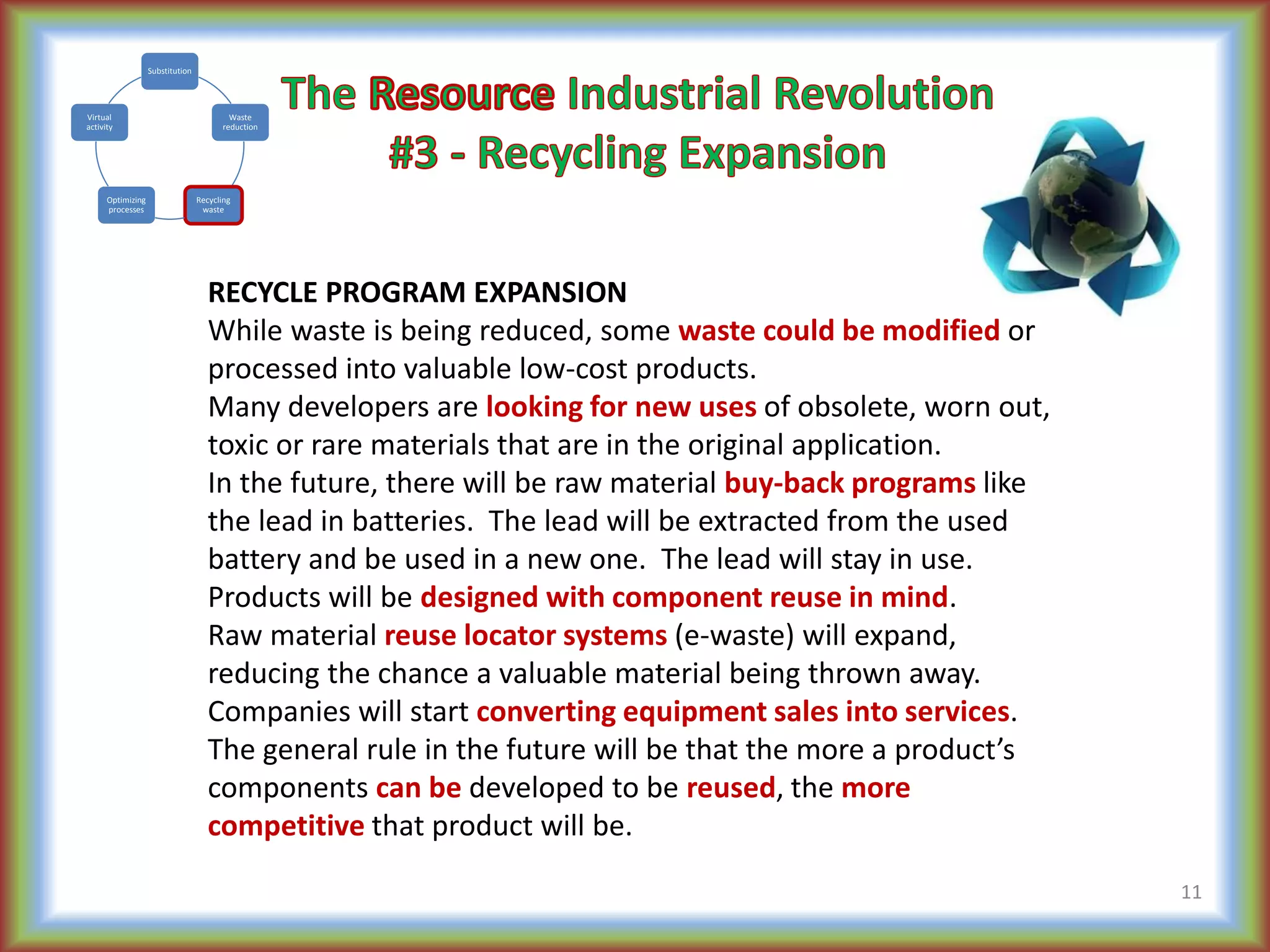
RECYCLE PROGRAM EXPANSION
Whilewaste is being reduced, some waste could be modified or
processed into valuable low-cost products.
Many developers are looking for new uses of obsolete, worn out,
toxic or rare materials that are in the original application.
In the future, there will be raw material buy-back programs like
the lead in batteries. The lead will be extracted from the used
battery and be used in a new one. The lead will stay in use.
Products will be designed with component reuse in mind.
Raw material reuse locator systems (e-waste) will expand,
reducing the chance a valuable material being thrown away.
Companies will start converting equipment sales into services.
The general rule in the future will be that the more a product’s
components can be developed to be reused, the more
competitive that product will be.
11
Substitution
Waste
reduction
Recycling
waste
Optimizing
processes
Virtual
activity
12.
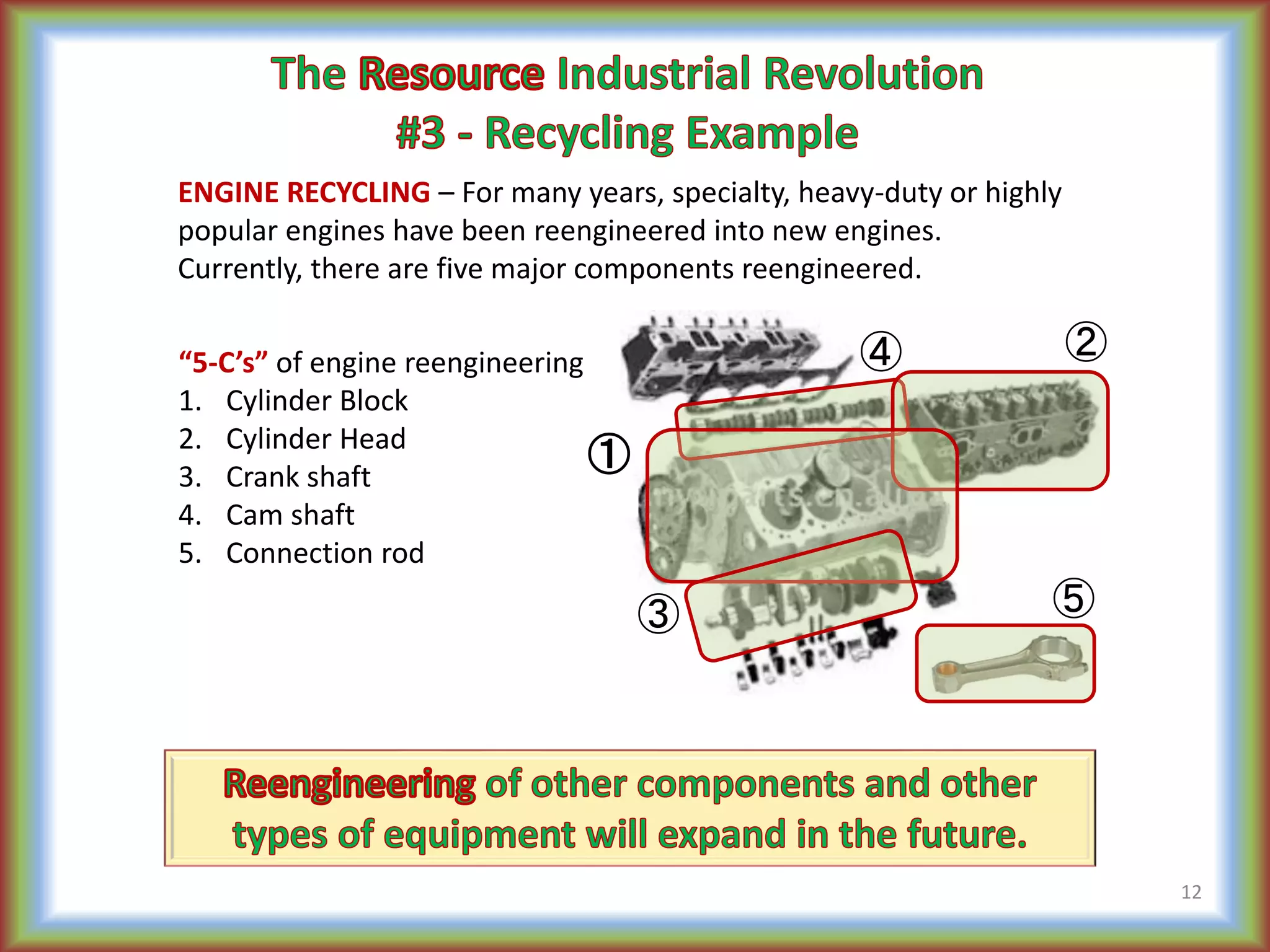
ENGINE RECYCLING –For many years, specialty, heavy-duty or highly
popular engines have been reengineered into new engines.
Currently, there are five major components reengineered.
12
“5-C’s” of engine reengineering
1. Cylinder Block
2. Cylinder Head
3. Crank shaft
4. Cam shaft
5. Connection rod
①
②
③
④
⑤
13.
RECYCLE PROGRAM EXPANSION
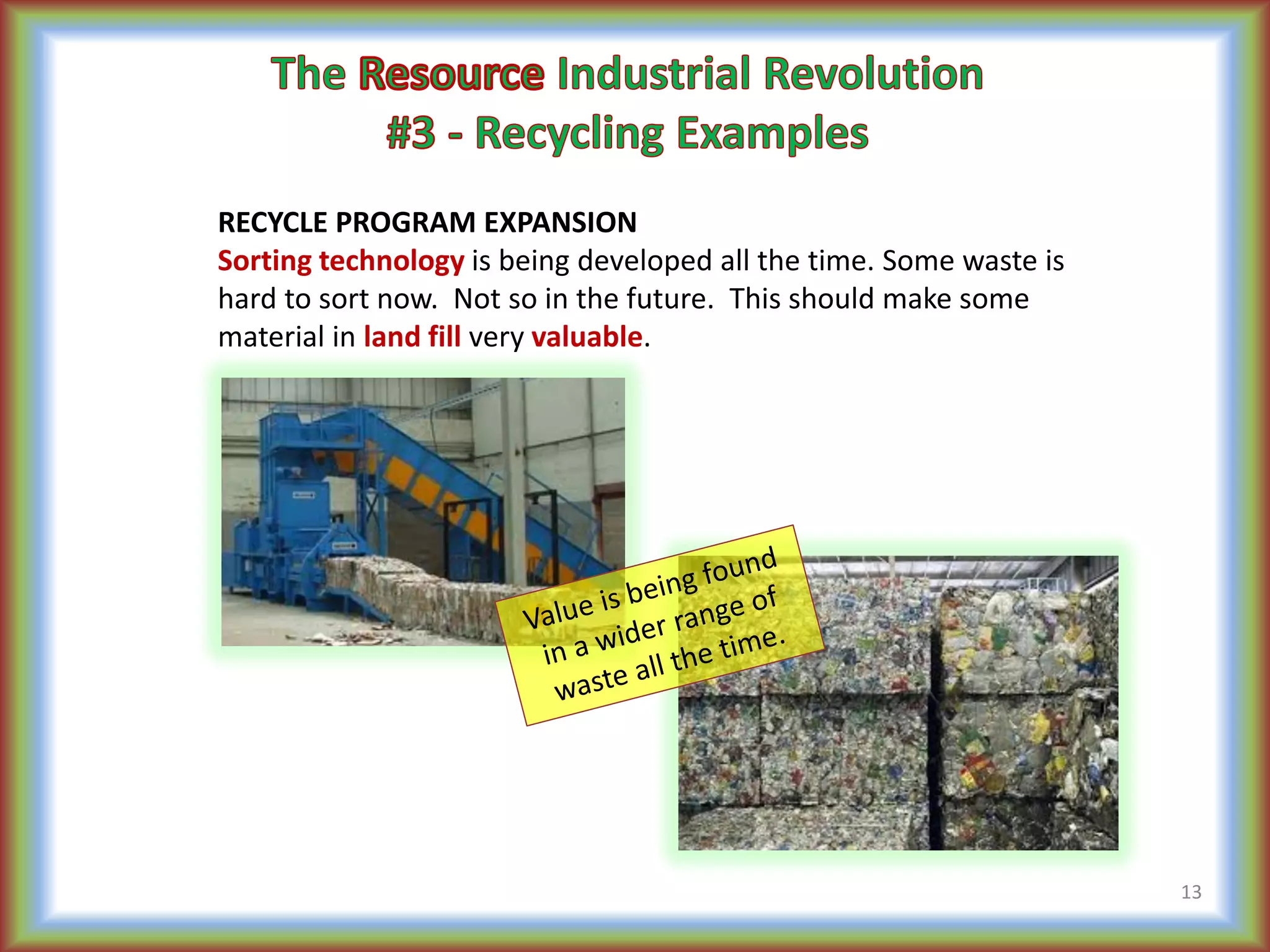
Sortingtechnology is being developed all the time. Some waste is
hard to sort now. Not so in the future. This should make some
material in land fill very valuable.
13
14.
For many processes,there will be optimization for efficiency, convenience, safety
and reliability.
Along and throughout all supply chains more in depth, timely and valuable
information will be shared to reduce bottlenecks, inventories and processing time.
Items that are only partially used will be rented, leased or shared on an hourly basis,
weekly basis or project basis to increase utilization.
With more information sharing, product standardization will streamline many
operations. What is a special-made expensive product now will be an inexpensive
standardized product with more flexible production equipment.
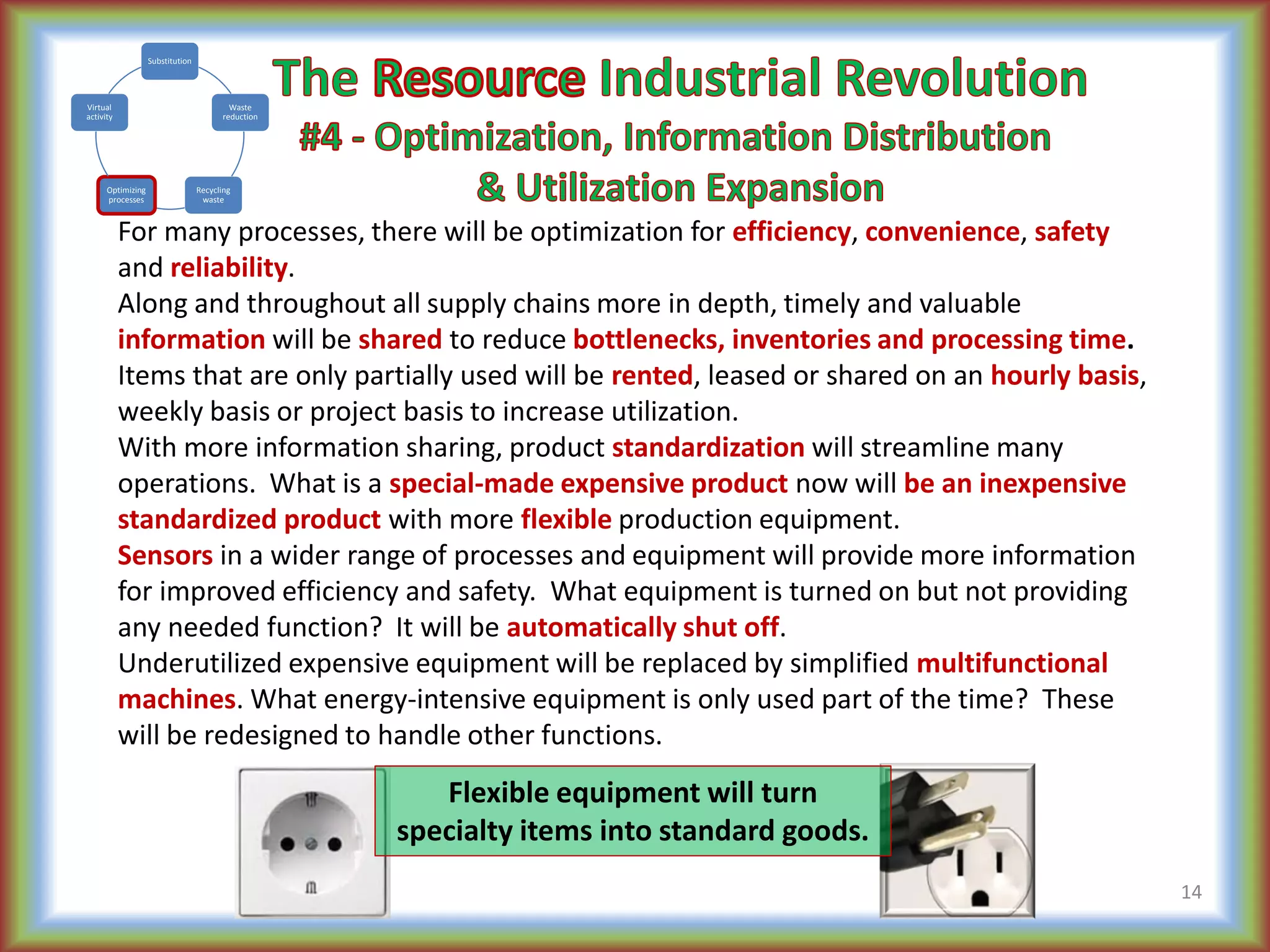
Sensors in a wider range of processes and equipment will provide more information
for improved efficiency and safety. What equipment is turned on but not providing
any needed function? It will be automatically shut off.
Underutilized expensive equipment will be replaced by simplified multifunctional
machines. What energy-intensive equipment is only used part of the time? These
will be redesigned to handle other functions.
14
Flexible equipment will turn
specialty items into standard goods.
Substitution
Waste
reduction
Recycling
waste
Optimizing
processes
Virtual
activity
15.
15
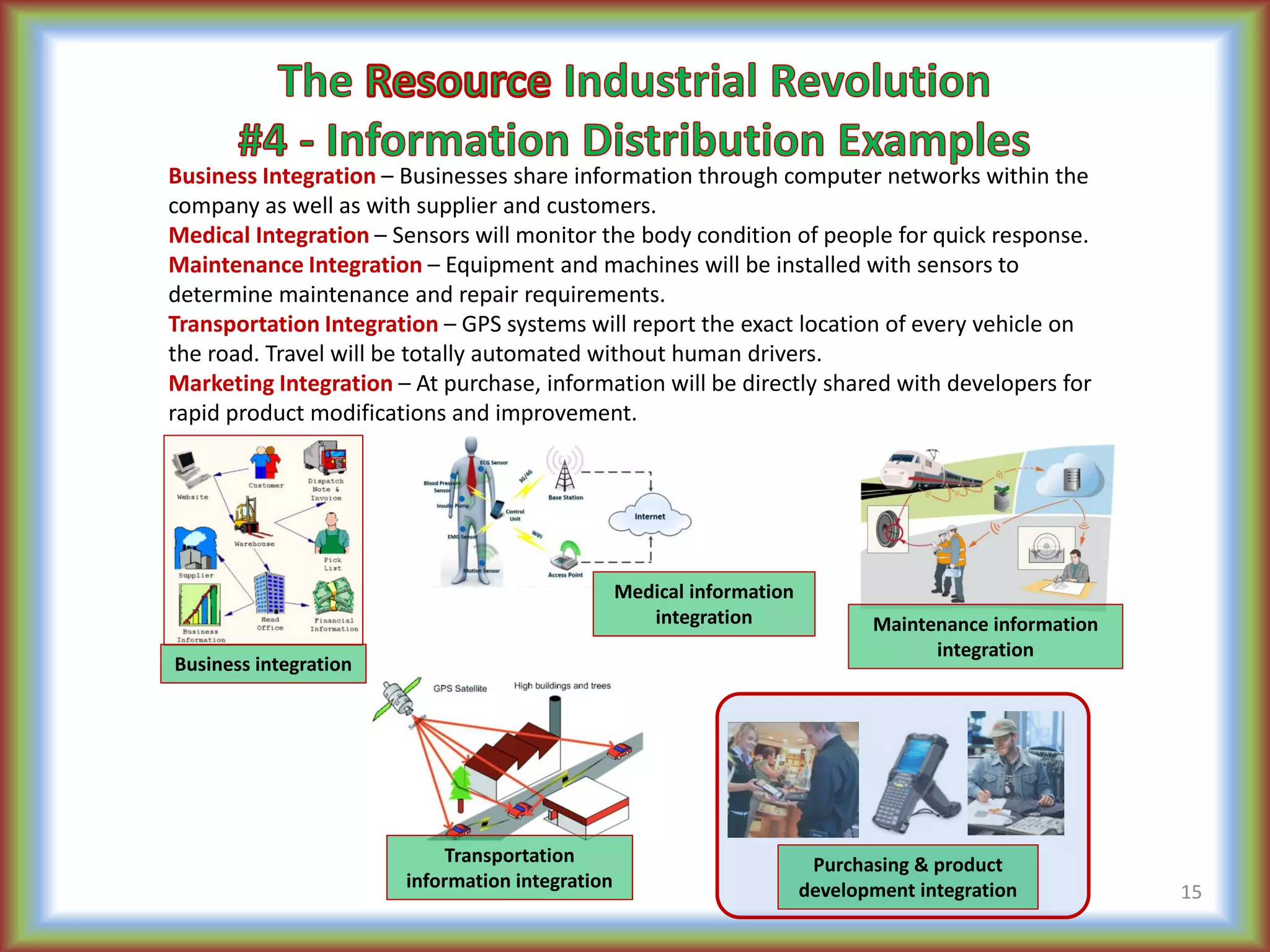
Business integration
Medical information
integration
Transportation
informationintegration
Maintenance information
integration
Purchasing & product
development integration
Business Integration – Businesses share information through computer networks within the
company as well as with supplier and customers.
Medical Integration – Sensors will monitor the body condition of people for quick response.
Maintenance Integration – Equipment and machines will be installed with sensors to
determine maintenance and repair requirements.
Transportation Integration – GPS systems will report the exact location of every vehicle on
the road. Travel will be totally automated without human drivers.
Marketing Integration – At purchase, information will be directly shared with developers for
rapid product modifications and improvement.
16.
INFORMATION INTERACTION EXPANSION
Withmore information sharing and technical advances, many activities
and process that are done by people will be automated and be
accomplished when no one is around.
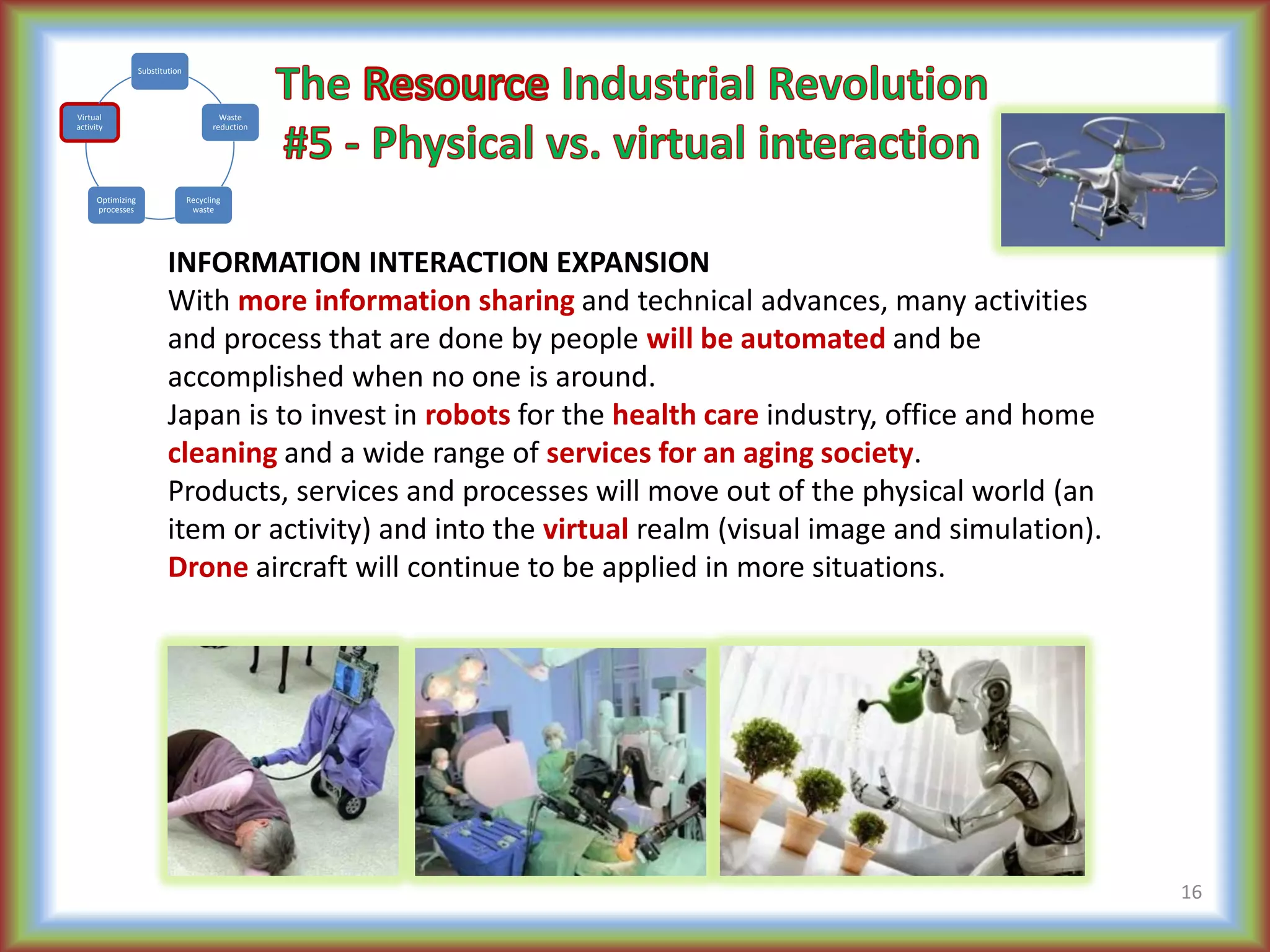
Japan is to invest in robots for the health care industry, office and home
cleaning and a wide range of services for an aging society.
Products, services and processes will move out of the physical world (an
item or activity) and into the virtual realm (visual image and simulation).
Drone aircraft will continue to be applied in more situations.
16
Substitution
Waste
reduction
Recycling
waste
Optimizing
processes
Virtual
activity
17.
17
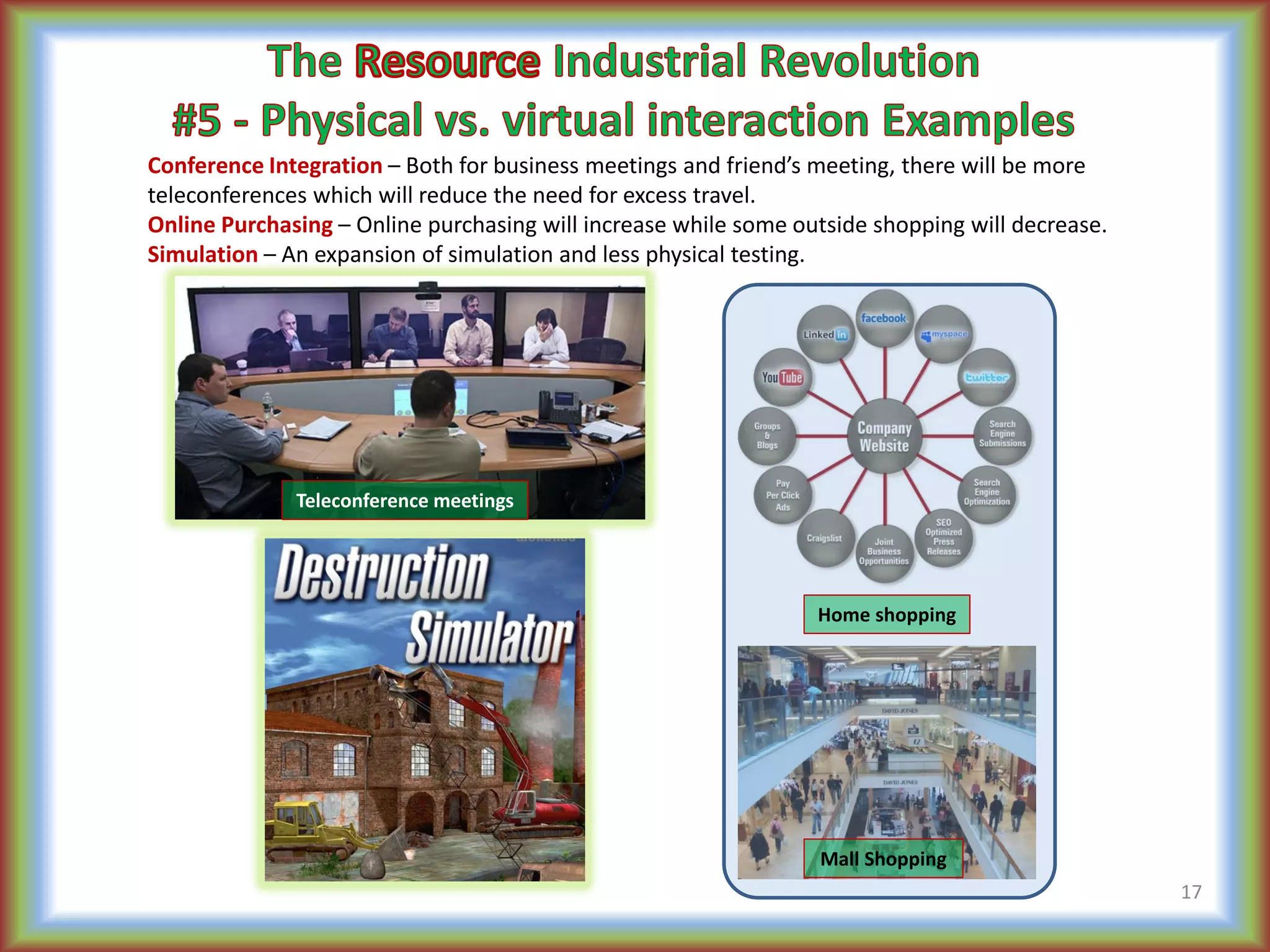
Conference Integration –Both for business meetings and friend’s meeting, there will be more
teleconferences which will reduce the need for excess travel.
Online Purchasing – Online purchasing will increase while some outside shopping will decrease.
Simulation – An expansion of simulation and less physical testing.
Home shopping
Mall Shopping
Teleconference meetings
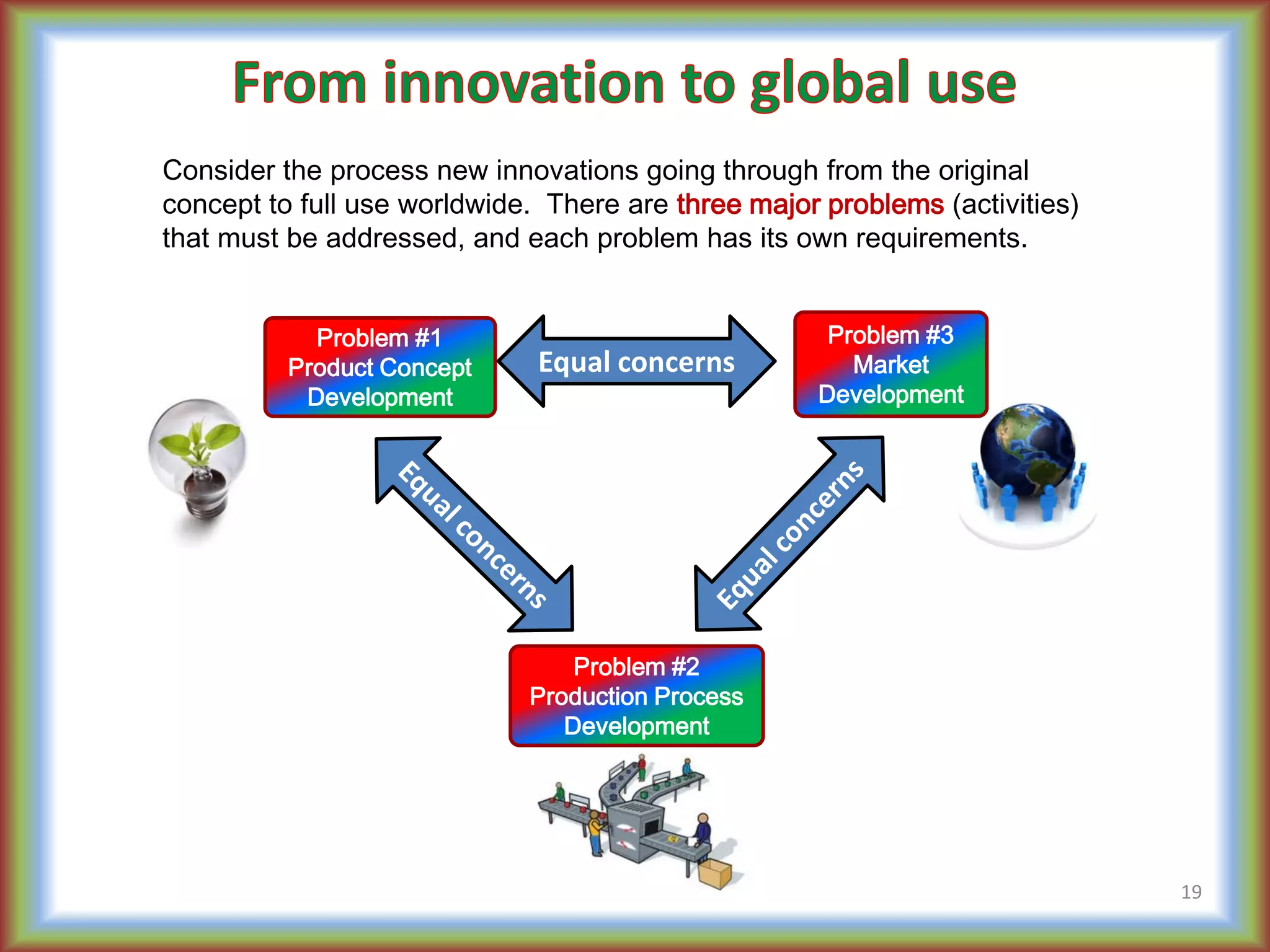
Problem #1
Product Concept
Development
Problem#2
Production Process
Development
Problem #3
Market
Development
19
Consider the process new innovations going through from the original
concept to full use worldwide. There are three major problems (activities)
that must be addressed, and each problem has its own requirements.
Equal concerns
20.
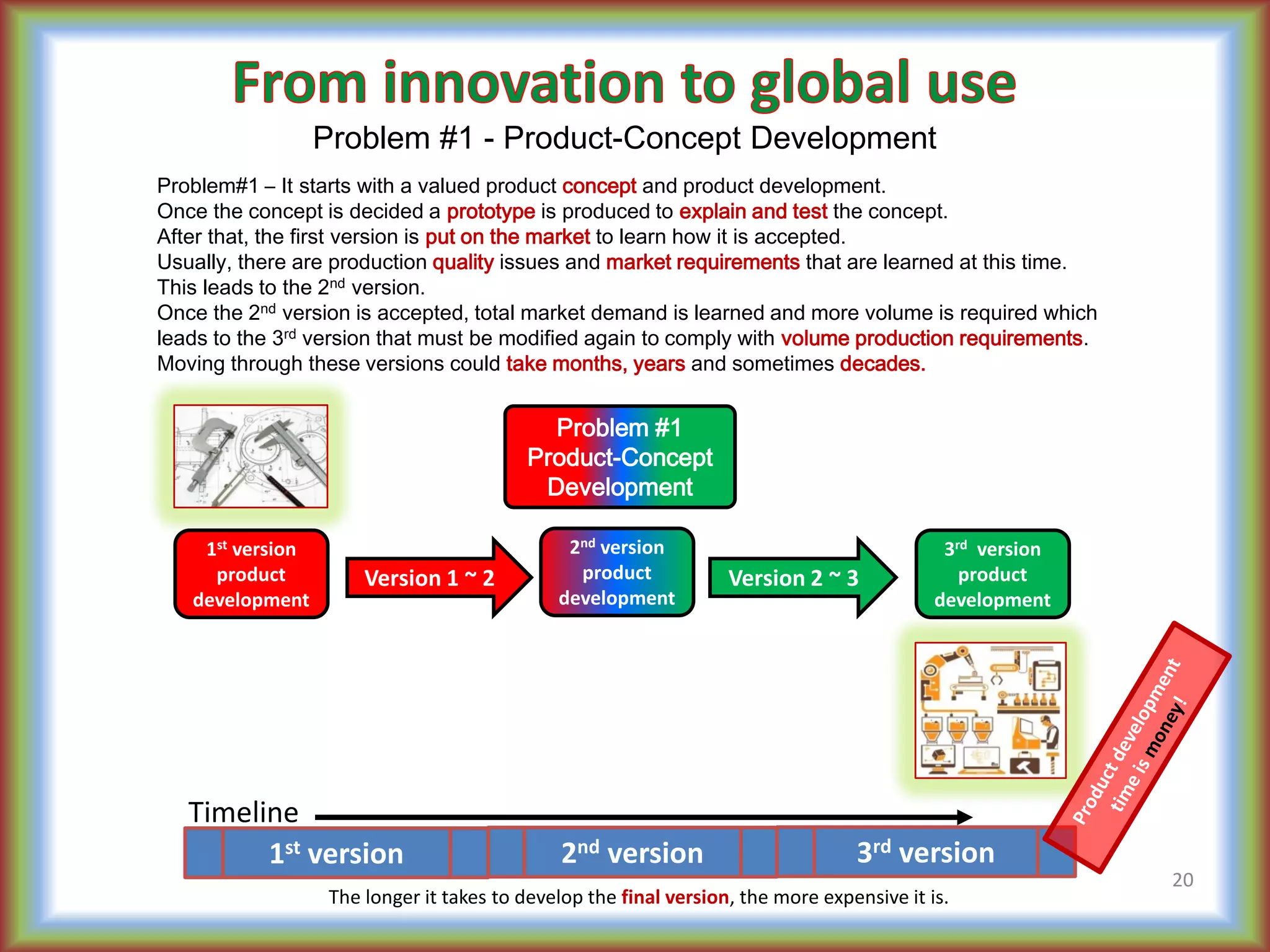
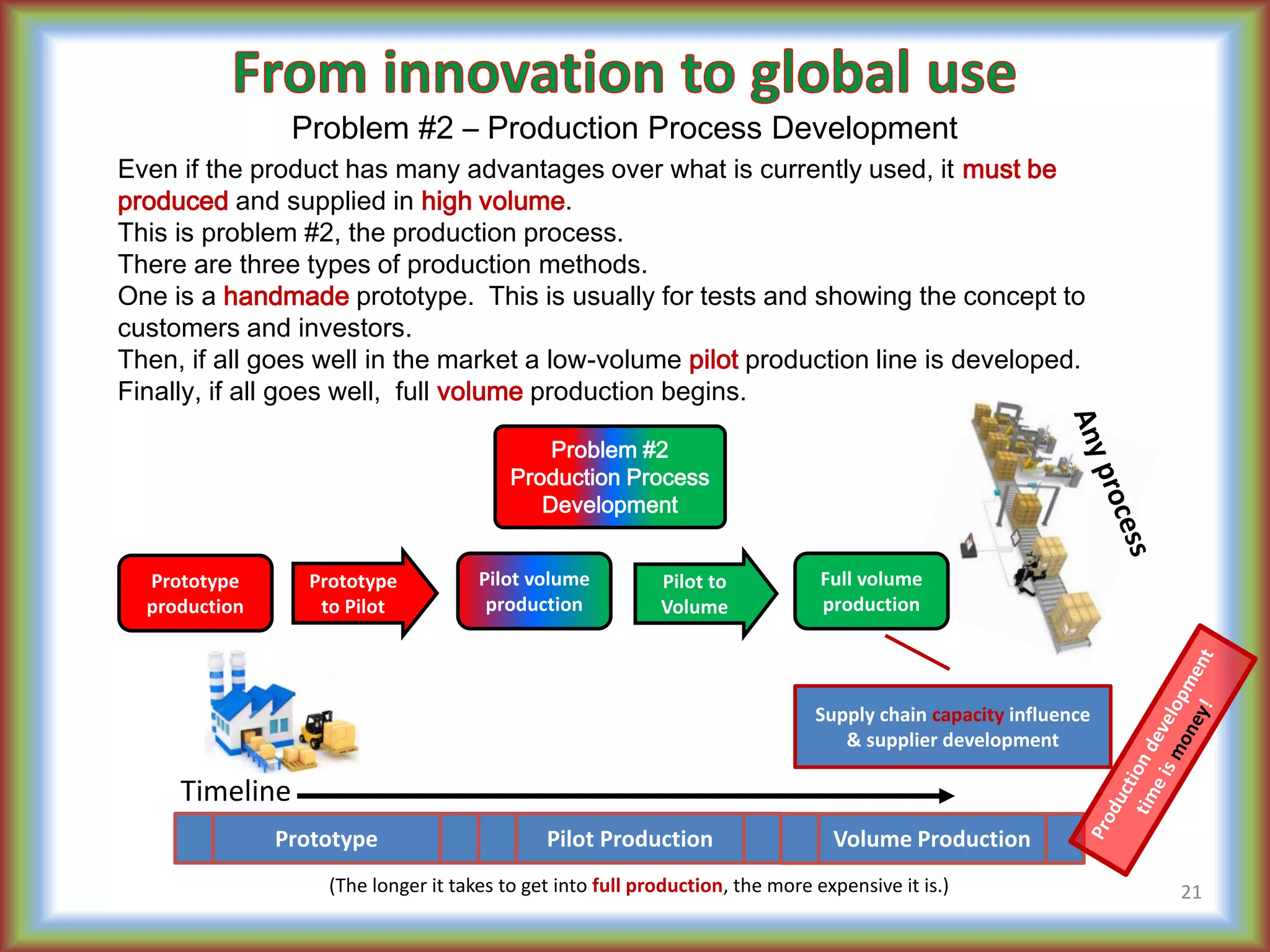
The longer ittakes to develop the final version, the more expensive it is.
Problem #1 - Product-Concept Development
20
Problem#1 – It starts with a valued product concept and product development.
Once the concept is decided a prototype is produced to explain and test the concept.
After that, the first version is put on the market to learn how it is accepted.
Usually, there are production quality issues and market requirements that are learned at this time.
This leads to the 2nd version.
Once the 2nd version is accepted, total market demand is learned and more volume is required which
leads to the 3rd version that must be modified again to comply with volume production requirements.
Moving through these versions could take months, years and sometimes decades.
1st version
product
development
3rd version
product
development
2nd version
product
development
2nd version1st version 3rd version
Version 2 ~ 3Version 1 ~ 2
Problem #1
Product-Concept
Development
Timeline
21.
(The longer ittakes to get into full production, the more expensive it is.)
Problem #2 – Production Process Development
21
Even if the product has many advantages over what is currently used, it must be
produced and supplied in high volume.
This is problem #2, the production process.
There are three types of production methods.
One is a handmade prototype. This is usually for tests and showing the concept to
customers and investors.
Then, if all goes well in the market a low-volume pilot production line is developed.
Finally, if all goes well, full volume production begins.
Supply chain capacity influence
& supplier development
Pilot ProductionPrototype Volume Production
Timeline
Problem #2
Production Process
Development
Prototype
production
Full volume
production
Pilot volume
production
Pilot to
Volume
Prototype
to Pilot
22.
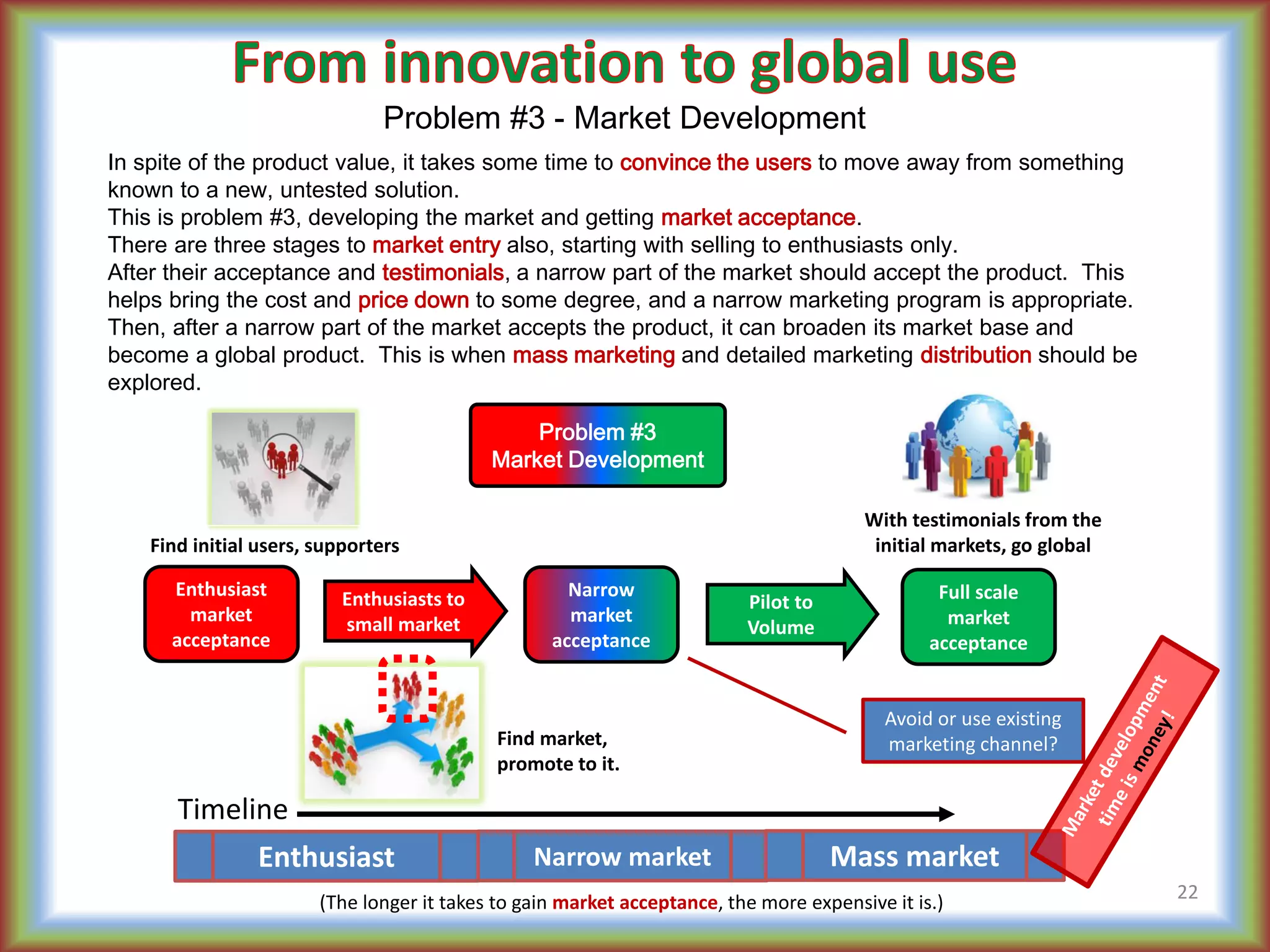
(The longer ittakes to gain market acceptance, the more expensive it is.)
Problem #3 - Market Development
22
In spite of the product value, it takes some time to convince the users to move away from something
known to a new, untested solution.
This is problem #3, developing the market and getting market acceptance.
There are three stages to market entry also, starting with selling to enthusiasts only.
After their acceptance and testimonials, a narrow part of the market should accept the product. This
helps bring the cost and price down to some degree, and a narrow marketing program is appropriate.
Then, after a narrow part of the market accepts the product, it can broaden its market base and
become a global product. This is when mass marketing and detailed marketing distribution should be
explored.
Avoid or use existing
marketing channel?
Find initial users, supporters
Find market,
promote to it.
With testimonials from the
initial markets, go global
Problem #3
Market Development
Enthusiast
market
acceptance
Full scale
market
acceptance
Narrow
market
acceptance
Pilot to
Volume
Enthusiasts to
small market
Narrow marketEnthusiast Mass market
Timeline
23.
Problem #2
Production Process
Development
23
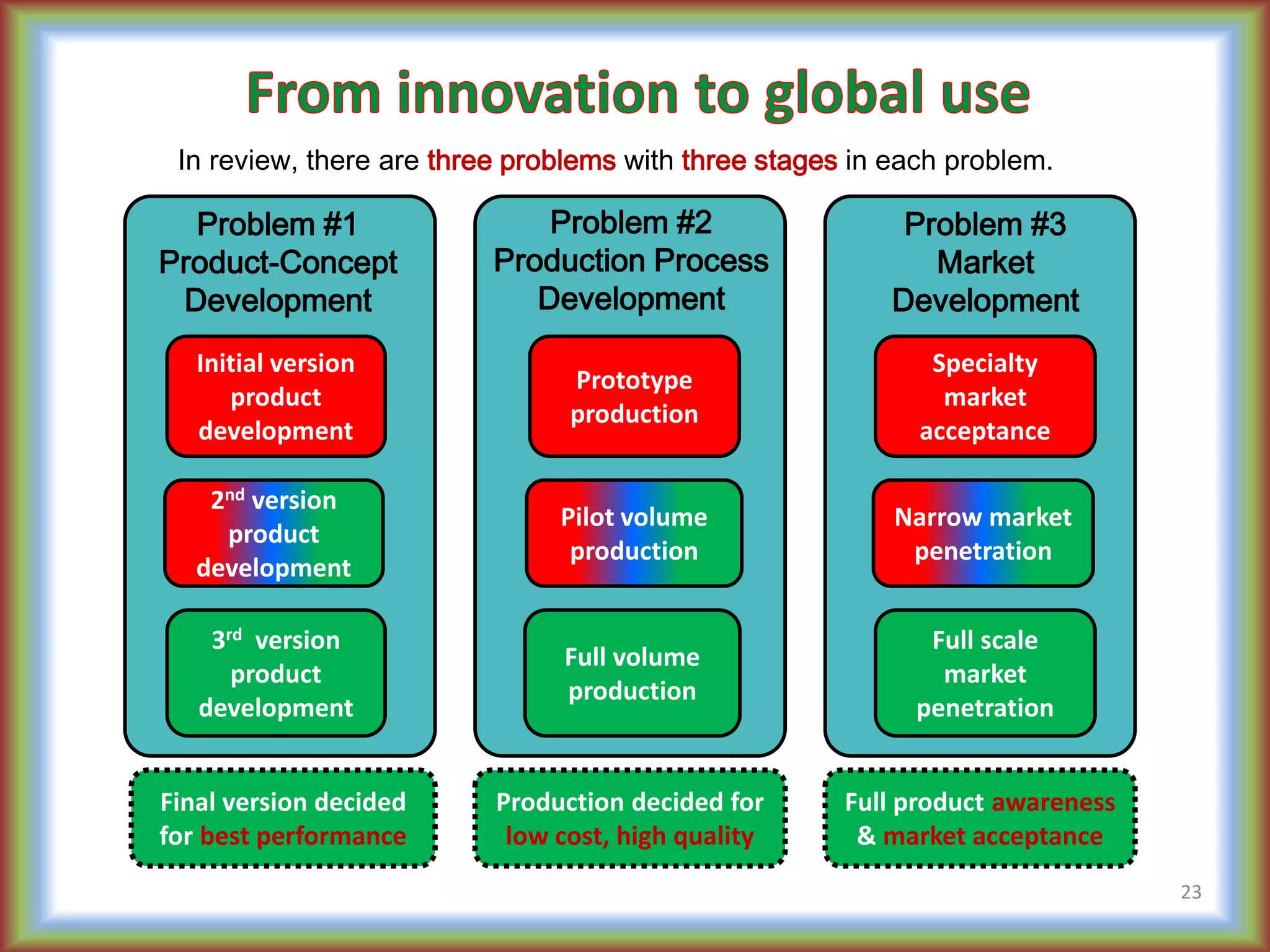
Inreview, there are three problems with three stages in each problem.
Specialty
market
acceptance
Full scale
market
penetration
Narrow market
penetration
Initial version
product
development
3rd version
product
development
2nd version
product
development
Prototype
production
Full volume
production
Pilot volume
production
Problem #3
Market
Development
Problem #1
Product-Concept
Development
Production decided for
low cost, high quality
Full product awareness
& market acceptance
Final version decided
for best performance
24.
24
Stage #1 Stage#2 Stage #3
Product
Development
Initial version 2nd version
improvements
3rd version improvements
Production
Development
Prototype Pilot Production Volume Production
Market
Development
Specialty enthusiasts Narrow market
acceptance
Wide market acceptance
Funding
sources
1. Inventor’s personal
funds
2. Government
subsidies
3. Non-profits &
donations
4. Venture capital
5. Small sales income
1. Venture capital
2. Inventor’s
personal funds
3. Sales income
4. Government
subsidies
5. Non-profits &
donations
1. Public funding
(shares)
2. Sales income
3. Venture capital
4. Inventor’s personal
funds
5. Non-profits &
donations
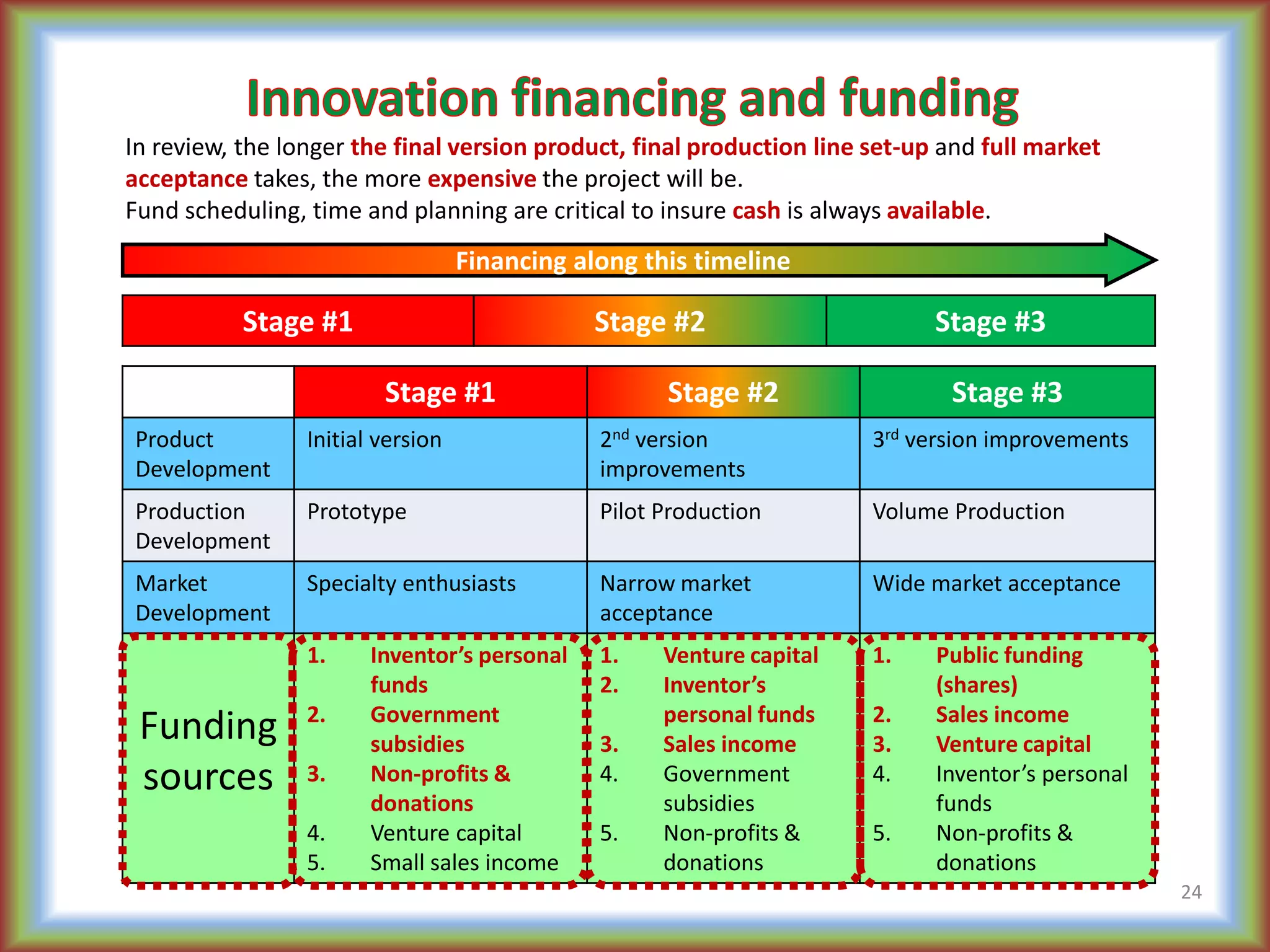
In review, the longer the final version product, final production line set-up and full market
acceptance takes, the more expensive the project will be.
Fund scheduling, time and planning are critical to insure cash is always available.
Financing along this timeline
Stage #1 Stage #2 Stage #3
25.
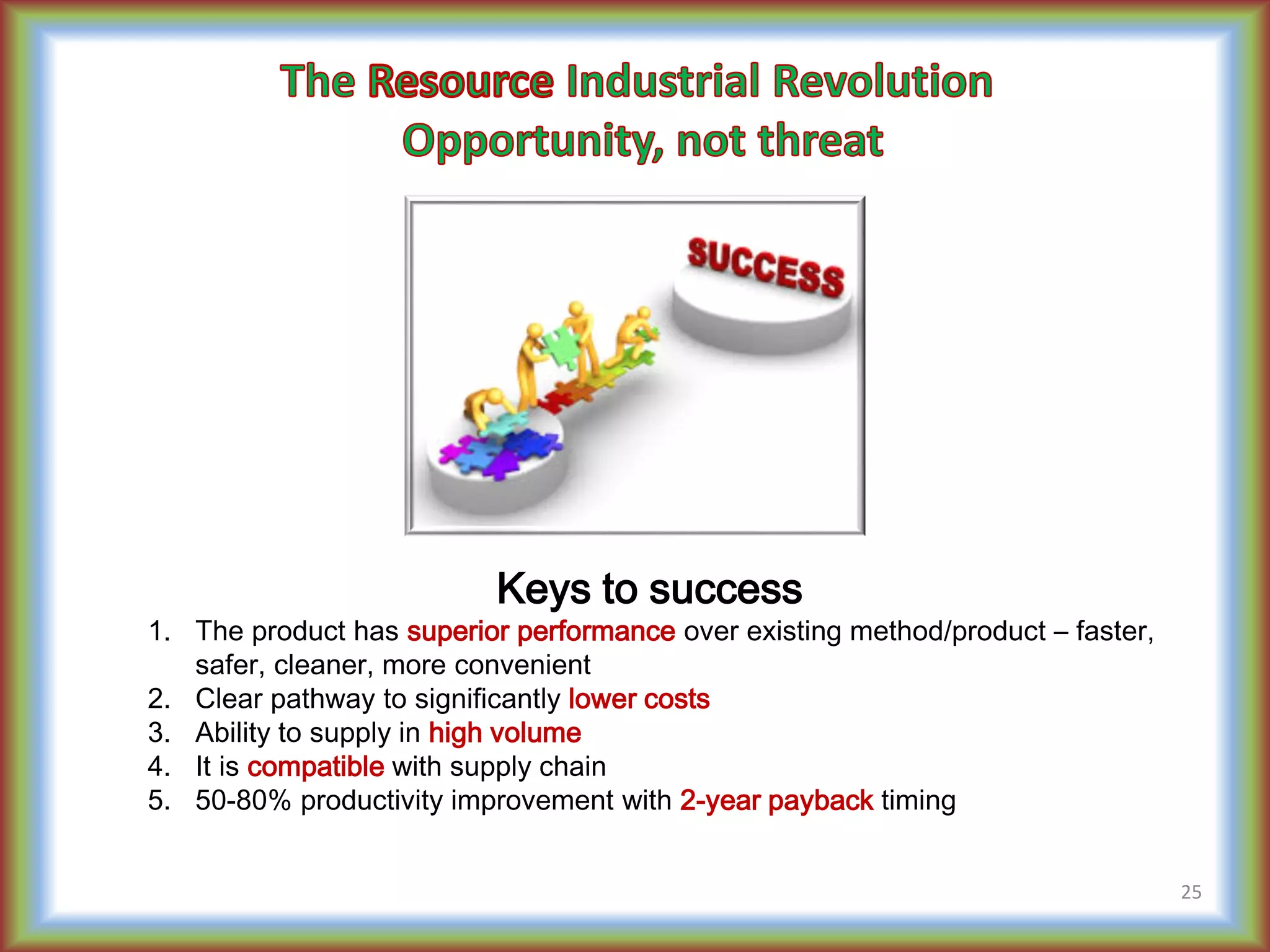
Keys to success
1.The product has superior performance over existing method/product – faster,
safer, cleaner, more convenient
2. Clear pathway to significantly lower costs
3. Ability to supply in high volume
4. It is compatible with supply chain
5. 50-80% productivity improvement with 2-year payback timing
25
26.
Components for success
1.Interchangeable parts – Parts with many application and high utilization rate
2. Systems integration – Wide network of computer to computer
communication and interaction
3. Embedded software for instant monitoring
4. Remotely upgradable software to insure improving performance
5. Nanotechnology and biological methods delivering new discoveries
6. Simulation - Computer aided testing for rapid reliability confirmation
7. Rapid 3-D printer prototype creation for rapid product development
26
27.
Resource oriented organizationalstructure
1. Standardized, written execution operating system
2. Information sharing oriented network
3. Committed personnel to resource productivity
4. Talent and high productivity resources available
5. Freelance innovation promotion and crowd sourcing
6. Management measures return on energy/resources used.
27
28.
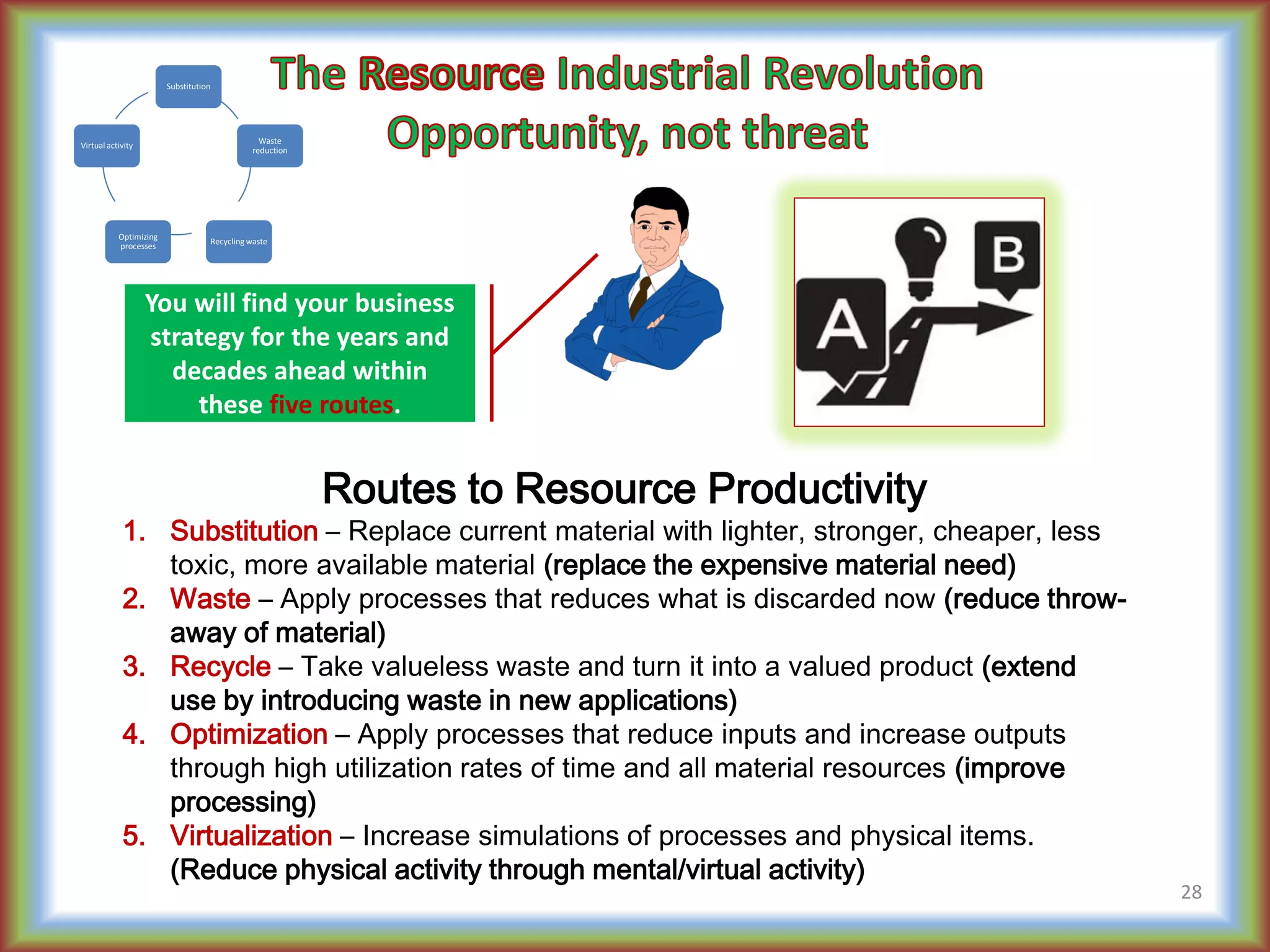
Routes to ResourceProductivity
1. Substitution – Replace current material with lighter, stronger, cheaper, less
toxic, more available material (replace the expensive material need)
2. Waste – Apply processes that reduces what is discarded now (reduce throw-
away of material)
3. Recycle – Take valueless waste and turn it into a valued product (extend
use by introducing waste in new applications)
4. Optimization – Apply processes that reduce inputs and increase outputs
through high utilization rates of time and all material resources (improve
processing)
5. Virtualization – Increase simulations of processes and physical items.
(Reduce physical activity through mental/virtual activity)
You will find your business
strategy for the years and
decades ahead within
these five routes.
28
Substitution
Waste
reduction
Recycling waste
Optimizing
processes
Virtual activity
29.
29
Source: RESOURCE REVOLUTION,How to capture the biggest business
opportunity in a century, Stephan Heck and Matt Rogers, 2014 Amazon Publishing
Our memories of tradition are always stronger than our
imagination of how things will be.