Organization
Prepared by
Rajveer Bhaskar,
Assistant Professor,
RCPIPER, Shirpur, M.S.
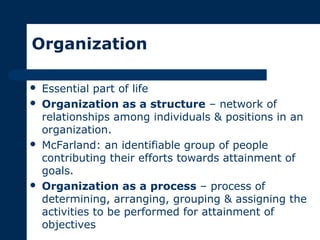
Organization
 Essential part of life
 Organization as a structure – network of
relationships among individuals & positions in an
organization.
 McFarland: an identifiable group of people
contributing their efforts towards attainment of
goals.
 Organization as a process – process of
determining, arranging, grouping & assigning the
activities to be performed for attainment of
objectives
Nature of organization
 Common purpose
 Division of labor
 Authority structure
 People
 Communication
 Coordination
 Environment
 Rules & regulation
Steps in organizing process
 Identification of activities
 Grouping activities
 Assigning duties
 Delegation of authority
Need & significance of organization
structure
 Facilitates administration
 Facilitates growth & diversification
 Optimum use of technological improvements
 Encourage human beings
 Stimulate creativity
Principle/features of organizing
structure
 Unity of objectives
 Division of work
 Span of control
 Scalar principle
 Functional definition
 Exception principle
 Unity of command
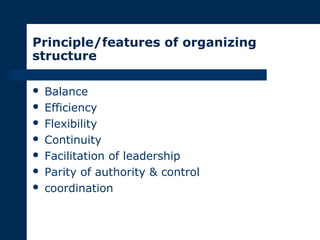
Principle/features of organizing
structure
 Balance
 Efficiency
 Flexibility
 Continuity
 Facilitation of leadership
 Parity of authority & control
 coordination
Types of organization
 Formal –deliberately created by management
 Informal – pattern of activities, interactions
and human relationships which emerge
spontaneously due to social & psychological
forces operating at workplace.
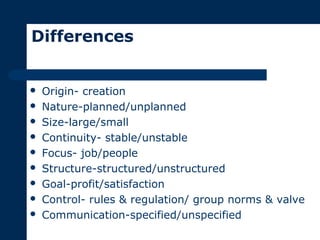
Differences
 Origin- creation
 Nature-planned/unplanned
 Size-large/small
 Continuity- stable/unstable
 Focus- job/people
 Structure-structured/unstructured
 Goal-profit/satisfaction
 Control- rules & regulation/ group norms & valve
 Communication-specified/unspecified
Reasons of informal organization
 Socialize
 Job satisfaction
 Source of protection
 Communication device
 Training & development
 Coordination & control
 Overcoming managerial limitation
Organization structure
 Concerned with allocation of task & delegation of
authority
1. Line organization – military/scalar
2. Functional organization – specialization/functional
3. Line & staff organization
4. Project organization – division according to
projects
5. Matrix organization – project + functional
6. Committee organization – committee
Line & staff organization
 Combination of line & functional structure
 Advantages
1. Expert advice
2. Reduced workload
3. Training of personal
4. Quality decision
5. Flexibility
Line & staff organization
 Disadvantages
1. Line staff conflicts
2. Confusion
3. Ineffective staff
4. Expensive
Organization
Organization
Organization
Organization
Organization
Organization
Organization

Organization

  • 1.
    Organization Prepared by Rajveer Bhaskar, AssistantProfessor, RCPIPER, Shirpur, M.S.
  • 2.
    Organization  Essential partof life  Organization as a structure – network of relationships among individuals & positions in an organization.  McFarland: an identifiable group of people contributing their efforts towards attainment of goals.  Organization as a process – process of determining, arranging, grouping & assigning the activities to be performed for attainment of objectives
  • 3.
    Nature of organization Common purpose  Division of labor  Authority structure  People  Communication  Coordination  Environment  Rules & regulation
  • 4.
    Steps in organizingprocess  Identification of activities  Grouping activities  Assigning duties  Delegation of authority
  • 5.
    Need & significanceof organization structure  Facilitates administration  Facilitates growth & diversification  Optimum use of technological improvements  Encourage human beings  Stimulate creativity
  • 6.
    Principle/features of organizing structure Unity of objectives  Division of work  Span of control  Scalar principle  Functional definition  Exception principle  Unity of command
  • 7.
    Principle/features of organizing structure Balance  Efficiency  Flexibility  Continuity  Facilitation of leadership  Parity of authority & control  coordination
  • 8.
    Types of organization Formal –deliberately created by management  Informal – pattern of activities, interactions and human relationships which emerge spontaneously due to social & psychological forces operating at workplace.
  • 9.
    Differences  Origin- creation Nature-planned/unplanned  Size-large/small  Continuity- stable/unstable  Focus- job/people  Structure-structured/unstructured  Goal-profit/satisfaction  Control- rules & regulation/ group norms & valve  Communication-specified/unspecified
  • 10.
    Reasons of informalorganization  Socialize  Job satisfaction  Source of protection  Communication device  Training & development  Coordination & control  Overcoming managerial limitation
  • 11.
    Organization structure  Concernedwith allocation of task & delegation of authority 1. Line organization – military/scalar 2. Functional organization – specialization/functional 3. Line & staff organization 4. Project organization – division according to projects 5. Matrix organization – project + functional 6. Committee organization – committee
  • 12.
    Line & stafforganization  Combination of line & functional structure  Advantages 1. Expert advice 2. Reduced workload 3. Training of personal 4. Quality decision 5. Flexibility
  • 13.
    Line & stafforganization  Disadvantages 1. Line staff conflicts 2. Confusion 3. Ineffective staff 4. Expensive