Forms of Business Ownership
 Sole Proprietorship
 Partnership
 Private Limited company
 Limited Liability Partnership (LLP)
 Public Limited company
Financial Planning
 How much money is required ?
 Where will the money come from?
 When does the money need to be available?
Method of estimation :
Money required for fixed
assets, deposits, advances, Terms of receivables etc.
Plus
Money required for running expenditure like
rent, salary, EB, conveyance, other amenities for next
10 months
Source and Forms of Capital
 Sources of Capital :
 Internal – life savings, loan from family and friends
 External – Banks, institutions , angel investors, venture
capital, suppliers.
 Forms of capital :
 Fixed capital for long term fund requirement.
 Working capital for short term operational fund
requirement.
Capital Structure
 Debt and Equity .
 High Debt is preferred when the business is highly
profitable and is in growth phase.
 Low Debt is preferred when the business is slow and
making losses.
Optimum capital structure is :
 Lowest cost of fund for the highest return on investment.
 Debt within repaying capacity of the firm.
 It should not dilute the control.
Factors Determining Capital Structure
 Nature of the business :
Highly fluctuating revenue – Low debt
Highly seasonal – Low debt
 Size of the enterprise :
Smaller the firm lower the debt portion.
 Rate of return :
Higher the rate of return – Higher the debt
 Cash Flow :
Higher cash flow - more debt.
 Use of funds :
Revenue generating investment – debt
Measure of Capitalization
 Historical cost :
Sum total of all fixed and other setting up cost plus
working capital.
 Earnings based :
The expected earning ( as per the industrial average).
Example : Industrial average return is 10%, and the
actual revenue projection is Rs. 100,000/- the rate of
capitalization ( or the required capital ) should be
1,000,000/-
Term Funds
 Long term Funds - repayment > 5 years
For creating fixed assets.
• Sources of Long term funds- bank loans, public
deposits, Debenture, Retained income.
 Short term Finance -repayment < 1 year
For day –to- day operational needs
 Sources of Short Term funds – OD, Cash
Credit, Packing Credit, Bill Discounting , Customer -
advances.
Venture Capital
 Funding for a new, high risk technology backed
ventures, with a very high return potential. (This is a
historical view.)
VCs in India :
Seek 20% to 40% stake.
Prefer to have say.
Once revenue has started.
When people, system are in place.
Tend to push their views on management.
Angel Financing
 Investing more for social needs and personal passion.
 Invest in small amount without much concern about
the return.
 Offer business venture advice and guidance.
 Quit when the goings get good.
 Chennai Funds is one of the Angel Investors.
Export Finance
Financing at the pre-shipment and post shipment
stages.
 Pre-shipment Finance - to purchase raw material, to
pay for the conversion cost and packing cost.
 Facilities :
Packing credit
Advances against incentives
Advance against duty drawback.
Note : 7.5% interest ( with subventions from time to
time) and to maximum of 6 months.
Export Finance
Post-shipment Finance –
Financing from the date of shipment till the date of
actual realization of the bill amount.
 Note : Finance , 6 months and the rate of interest <
8.5% ( with some subvention).
Crowd Funding
 Through Social Media the “crowd” will be asked to
finance the project.
 An agreement will be made that the participants will
be paid proportionately from the net revenue.
 Many creative ventures are started with “crowd
funding” format.
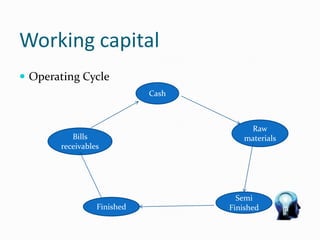
Working capital
 Operating Cycle
Cash
Raw
materials
Semi
FinishedFinished
Bills
receivables
Working Capital
Need for working capital :
 To buy raw material and components
 To convert semi and finished products -
power, fuel, salary, wages, rent.
 To finance the terms of the customers – selling on
credit
Working capital
 Management of Working capital :
Management of Cash : Excess cash results in loss of
opportunity revenue. Deficit in cash creates road block
to the smooth functioning of the organization.
Management of Inventory - Raw material, work-in-
progress, and finished goods :
Excess inventory increases the cost – like carrying cost,
interest on the money locked up etc. Deficit in
inventory results in reordering cost, production
stoppage, high prices etc.
Working Capital Management
Management of Accounts Receivable (AR):
 AR should not exceed more than 15% of the total sales.
 Excess AR involves capital cost, default, collection cost
etc.
Management of Accounts Payable (AP) : Credit
purchase.
 Excess AP will reduce the credibility of the
organization, consequently buying power.
 But it provides interest free funds!!!
Working Capital- The Sources
 Personal savings
 Personal borrowings
 Trade credit
 Bill discount
 Bank loans, over draft, cash credits
Working Capital - Assessment
Factors that determine the Working Capital
requirements :
 Length of Operating Cycle.
 Nature of business – manufacturing, trading Vs
restaurants and hospitals.
 Terms of credit to customers and from suppliers.
 Seasonality of the business.
 Production process – labor intensive Vs technology
intensive
Working Capital - Assessment
 Cost of raw material, labor, rent etc.
 Length of credit period allowed to customers
 Length of credit period allowed by suppliers
 Length of time involved to pay wages and
overheads.
 Total operating expenses.
 Seasonality of the raw material availability.
Significance of Working Capital Management :
 To keep the operations going till the realization
of sales proceeds.
 Balancing between outflow of funds with inflow funds
to sustain the operations.
 To buy materials and components at a competitive
price and terms.
Institutional Finance
 Industrial Development Bank of India ( IDBI)
 Industrial Finance Corporation of India Ltd. ( IFCI)
 Industrial Credit and Investment Corporation India
(ICICI).
 State Financial Corporations ( SFC) –TIIC ( TN
Industrial Investment Corporation)
 State Industrial Development Corporations – ( Tidco)
 Small Industries Development Bank of India ( SIDBI)
 Export Import bank ( EXIM)
Lease Financing and Hire Purchase
 Leasing : Right to use the asset for a period of time for
payment of certain sum of money as rentals.
Ownership is not transferred.
 Hire Purchase : The ownership is transferred, while
payment is made in a deferred way.
Tax Benefits
 Incentives and Concessions for small scale and Tiny Industries :
Up to 1 Crore sale no excise duty.
Capital subsidy of 12% to invest in technology.
Royalty and Patents charges are Tax deductible.
20% IT deduction , for the units in Backward and Rural Areas.
Total deductions for the Scientific Research expenses.
25% of the investment in machinery is given as “Investment
allowance”
Additional shift allowance is given apart from Depreciation in the
Income Tax.
Negotiation
 Be clear about your break point and be ready to walk
away if that is reached.
 Ask for extra to sweeten the deal; something valuable to
you but does not cost them.
 Always take something in return, when you are giving
something.
 Open the dialogue with the room for maneuvering.
 Never feel rushed; be deliberately slow.
 Know your worth.
 Go to negotiation with a professional assistance.
Negotiation with Financiers
 Do not start to negotiate when you are desperate for
money.
 Start with areas of agreement.
 Be clear about what you want - money, management
expertise, market access and so on.
 Know the financier – what is their previous record,
what is their expected rate of return, how long they
want to stay invested, are they active mentor type or
just investor and so on.
 Be clear about main goal of the negotiation.

Financial management for Entrepreneurs 101

  • 3.
    Forms of BusinessOwnership  Sole Proprietorship  Partnership  Private Limited company  Limited Liability Partnership (LLP)  Public Limited company
  • 4.
    Financial Planning  Howmuch money is required ?  Where will the money come from?  When does the money need to be available? Method of estimation : Money required for fixed assets, deposits, advances, Terms of receivables etc. Plus Money required for running expenditure like rent, salary, EB, conveyance, other amenities for next 10 months
  • 5.
    Source and Formsof Capital  Sources of Capital :  Internal – life savings, loan from family and friends  External – Banks, institutions , angel investors, venture capital, suppliers.  Forms of capital :  Fixed capital for long term fund requirement.  Working capital for short term operational fund requirement.
  • 6.
    Capital Structure  Debtand Equity .  High Debt is preferred when the business is highly profitable and is in growth phase.  Low Debt is preferred when the business is slow and making losses. Optimum capital structure is :  Lowest cost of fund for the highest return on investment.  Debt within repaying capacity of the firm.  It should not dilute the control.
  • 7.
    Factors Determining CapitalStructure  Nature of the business : Highly fluctuating revenue – Low debt Highly seasonal – Low debt  Size of the enterprise : Smaller the firm lower the debt portion.  Rate of return : Higher the rate of return – Higher the debt  Cash Flow : Higher cash flow - more debt.  Use of funds : Revenue generating investment – debt
  • 8.
    Measure of Capitalization Historical cost : Sum total of all fixed and other setting up cost plus working capital.  Earnings based : The expected earning ( as per the industrial average). Example : Industrial average return is 10%, and the actual revenue projection is Rs. 100,000/- the rate of capitalization ( or the required capital ) should be 1,000,000/-
  • 9.
    Term Funds  Longterm Funds - repayment > 5 years For creating fixed assets. • Sources of Long term funds- bank loans, public deposits, Debenture, Retained income.  Short term Finance -repayment < 1 year For day –to- day operational needs  Sources of Short Term funds – OD, Cash Credit, Packing Credit, Bill Discounting , Customer - advances.
  • 10.
    Venture Capital  Fundingfor a new, high risk technology backed ventures, with a very high return potential. (This is a historical view.) VCs in India : Seek 20% to 40% stake. Prefer to have say. Once revenue has started. When people, system are in place. Tend to push their views on management.
  • 11.
    Angel Financing  Investingmore for social needs and personal passion.  Invest in small amount without much concern about the return.  Offer business venture advice and guidance.  Quit when the goings get good.  Chennai Funds is one of the Angel Investors.
  • 12.
    Export Finance Financing atthe pre-shipment and post shipment stages.  Pre-shipment Finance - to purchase raw material, to pay for the conversion cost and packing cost.  Facilities : Packing credit Advances against incentives Advance against duty drawback. Note : 7.5% interest ( with subventions from time to time) and to maximum of 6 months.
  • 13.
    Export Finance Post-shipment Finance– Financing from the date of shipment till the date of actual realization of the bill amount.  Note : Finance , 6 months and the rate of interest < 8.5% ( with some subvention).
  • 14.
    Crowd Funding  ThroughSocial Media the “crowd” will be asked to finance the project.  An agreement will be made that the participants will be paid proportionately from the net revenue.  Many creative ventures are started with “crowd funding” format.
  • 15.
    Working capital  OperatingCycle Cash Raw materials Semi FinishedFinished Bills receivables
  • 16.
    Working Capital Need forworking capital :  To buy raw material and components  To convert semi and finished products - power, fuel, salary, wages, rent.  To finance the terms of the customers – selling on credit
  • 17.
    Working capital  Managementof Working capital : Management of Cash : Excess cash results in loss of opportunity revenue. Deficit in cash creates road block to the smooth functioning of the organization. Management of Inventory - Raw material, work-in- progress, and finished goods : Excess inventory increases the cost – like carrying cost, interest on the money locked up etc. Deficit in inventory results in reordering cost, production stoppage, high prices etc.
  • 18.
    Working Capital Management Managementof Accounts Receivable (AR):  AR should not exceed more than 15% of the total sales.  Excess AR involves capital cost, default, collection cost etc. Management of Accounts Payable (AP) : Credit purchase.  Excess AP will reduce the credibility of the organization, consequently buying power.  But it provides interest free funds!!!
  • 19.
    Working Capital- TheSources  Personal savings  Personal borrowings  Trade credit  Bill discount  Bank loans, over draft, cash credits
  • 20.
    Working Capital -Assessment Factors that determine the Working Capital requirements :  Length of Operating Cycle.  Nature of business – manufacturing, trading Vs restaurants and hospitals.  Terms of credit to customers and from suppliers.  Seasonality of the business.  Production process – labor intensive Vs technology intensive
  • 21.
    Working Capital -Assessment  Cost of raw material, labor, rent etc.  Length of credit period allowed to customers  Length of credit period allowed by suppliers  Length of time involved to pay wages and overheads.  Total operating expenses.  Seasonality of the raw material availability.
  • 22.
    Significance of WorkingCapital Management :  To keep the operations going till the realization of sales proceeds.  Balancing between outflow of funds with inflow funds to sustain the operations.  To buy materials and components at a competitive price and terms.
  • 23.
    Institutional Finance  IndustrialDevelopment Bank of India ( IDBI)  Industrial Finance Corporation of India Ltd. ( IFCI)  Industrial Credit and Investment Corporation India (ICICI).  State Financial Corporations ( SFC) –TIIC ( TN Industrial Investment Corporation)  State Industrial Development Corporations – ( Tidco)  Small Industries Development Bank of India ( SIDBI)  Export Import bank ( EXIM)
  • 24.
    Lease Financing andHire Purchase  Leasing : Right to use the asset for a period of time for payment of certain sum of money as rentals. Ownership is not transferred.  Hire Purchase : The ownership is transferred, while payment is made in a deferred way.
  • 25.
    Tax Benefits  Incentivesand Concessions for small scale and Tiny Industries : Up to 1 Crore sale no excise duty. Capital subsidy of 12% to invest in technology. Royalty and Patents charges are Tax deductible. 20% IT deduction , for the units in Backward and Rural Areas. Total deductions for the Scientific Research expenses. 25% of the investment in machinery is given as “Investment allowance” Additional shift allowance is given apart from Depreciation in the Income Tax.
  • 26.
    Negotiation  Be clearabout your break point and be ready to walk away if that is reached.  Ask for extra to sweeten the deal; something valuable to you but does not cost them.  Always take something in return, when you are giving something.  Open the dialogue with the room for maneuvering.  Never feel rushed; be deliberately slow.  Know your worth.  Go to negotiation with a professional assistance.
  • 27.
    Negotiation with Financiers Do not start to negotiate when you are desperate for money.  Start with areas of agreement.  Be clear about what you want - money, management expertise, market access and so on.  Know the financier – what is their previous record, what is their expected rate of return, how long they want to stay invested, are they active mentor type or just investor and so on.  Be clear about main goal of the negotiation.