True Experimental Study
Design
Prepared by:
Prayas Gautam
Email:prayas.gautam007@gmail.com
Introduction
• A true experiment is a type of experimental design and is thought to
be the most accurate type of experimental research.
• True experiment supports or refutes a hypothesis using statistical
analysis.
• A true experiment is also thought to be the only experimental design
that can establish cause and effect relationships
Criteria that must be met in a true
experiment
• Control group and experimental group
• Researcher-manipulated variable
• Randomization
Control Group and Experimental Group
• True experiments must have a control group, which is a group of
research participants that resemble the experimental group but do
not receive the experimental treatment.
• The experimental group is the group of research participants who
receive the experimental treatment.
• True experiments must have at least one control group and one
experimental group, though it is possible to have more than one
experimental group.
Researcher-Manipulated Variable
• In true experiments, the researcher has to change or manipulate the
variable that is hypothesized to affect the outcome variable that is
being studied.
• The variable that the researcher has control over is called
the independent variable.
• The outcome or effect that the research is studying is called
the dependent variable. The dependent variable is also called
the outcome variable .
• The researcher does not manipulate the dependent variable.
Randomization
• Each research participant must have an equal chance of being
assigned to each sample group.
• Research participants have to be randomly assigned to either the
control or experimental group.
Example of true experimental study
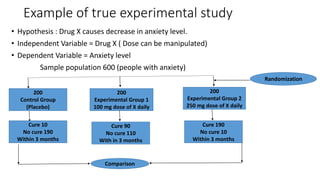
• Hypothesis : Drug X causes decrease in anxiety level.
• Independent Variable = Drug X ( Dose can be manipulated)
• Dependent Variable = Anxiety level
Sample population 600 (people with anxiety)
200
Control Group
(Placebo)
200
Experimental Group 2
250 mg dose of X daily
200
Experimental Group 1
100 mg dose of X daily
Randomization
Cure 10
No cure 190
Within 3 months
Cure 90
No cure 110
With in 3 months
Cure 190
No cure 10
Within 3 months
Comparison
Types of True experimental study
• Post test only design
• Pre-test- Post-test design
• Solomon four group design
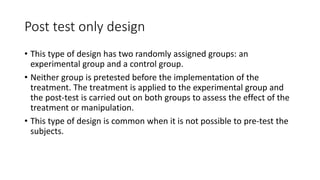
Post test only design
• This type of design has two randomly assigned groups: an
experimental group and a control group.
• Neither group is pretested before the implementation of the
treatment. The treatment is applied to the experimental group and
the post-test is carried out on both groups to assess the effect of the
treatment or manipulation.
• This type of design is common when it is not possible to pre-test the
subjects.
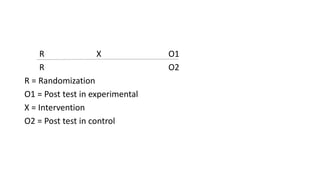
R X O1
R O2
R = Randomization
O1 = Post test in experimental
X = Intervention
O2 = Post test in control
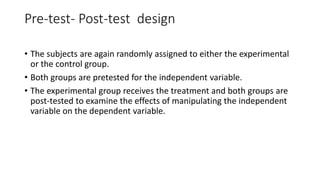
Pre-test- Post-test design
• The subjects are again randomly assigned to either the experimental
or the control group.
• Both groups are pretested for the independent variable.
• The experimental group receives the treatment and both groups are
post-tested to examine the effects of manipulating the independent
variable on the dependent variable.
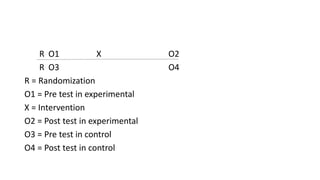
R O1 X O2
R O3 O4
R = Randomization
O1 = Pre test in experimental
X = Intervention
O2 = Post test in experimental
O3 = Pre test in control
O4 = Post test in control
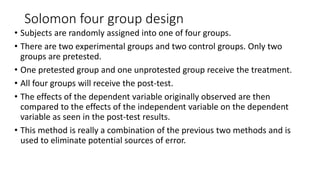
Solomon four group design
• Subjects are randomly assigned into one of four groups.
• There are two experimental groups and two control groups. Only two
groups are pretested.
• One pretested group and one unprotested group receive the treatment.
• All four groups will receive the post-test.
• The effects of the dependent variable originally observed are then
compared to the effects of the independent variable on the dependent
variable as seen in the post-test results.
• This method is really a combination of the previous two methods and is
used to eliminate potential sources of error.
References
• http://study.com/academy/lesson/true-experiment-definition-
examples.html
• https://cirt.gcu.edu/research/developmentresources/research_ready
/experimental/design_types
• A text book of epidemiology ; Rajesh Karki, Rajan Poudel

True experimental study design

  • 1.
    True Experimental Study Design Preparedby: Prayas Gautam Email:prayas.gautam007@gmail.com
  • 2.
    Introduction • A trueexperiment is a type of experimental design and is thought to be the most accurate type of experimental research. • True experiment supports or refutes a hypothesis using statistical analysis. • A true experiment is also thought to be the only experimental design that can establish cause and effect relationships
  • 3.
    Criteria that mustbe met in a true experiment • Control group and experimental group • Researcher-manipulated variable • Randomization
  • 4.
    Control Group andExperimental Group • True experiments must have a control group, which is a group of research participants that resemble the experimental group but do not receive the experimental treatment. • The experimental group is the group of research participants who receive the experimental treatment. • True experiments must have at least one control group and one experimental group, though it is possible to have more than one experimental group.
  • 5.
    Researcher-Manipulated Variable • Intrue experiments, the researcher has to change or manipulate the variable that is hypothesized to affect the outcome variable that is being studied. • The variable that the researcher has control over is called the independent variable. • The outcome or effect that the research is studying is called the dependent variable. The dependent variable is also called the outcome variable . • The researcher does not manipulate the dependent variable.
  • 6.
    Randomization • Each researchparticipant must have an equal chance of being assigned to each sample group. • Research participants have to be randomly assigned to either the control or experimental group.
  • 7.
    Example of trueexperimental study • Hypothesis : Drug X causes decrease in anxiety level. • Independent Variable = Drug X ( Dose can be manipulated) • Dependent Variable = Anxiety level Sample population 600 (people with anxiety) 200 Control Group (Placebo) 200 Experimental Group 2 250 mg dose of X daily 200 Experimental Group 1 100 mg dose of X daily Randomization Cure 10 No cure 190 Within 3 months Cure 90 No cure 110 With in 3 months Cure 190 No cure 10 Within 3 months Comparison
  • 8.
    Types of Trueexperimental study • Post test only design • Pre-test- Post-test design • Solomon four group design
  • 9.
    Post test onlydesign • This type of design has two randomly assigned groups: an experimental group and a control group. • Neither group is pretested before the implementation of the treatment. The treatment is applied to the experimental group and the post-test is carried out on both groups to assess the effect of the treatment or manipulation. • This type of design is common when it is not possible to pre-test the subjects.
  • 10.
    R X O1 RO2 R = Randomization O1 = Post test in experimental X = Intervention O2 = Post test in control
  • 11.
    Pre-test- Post-test design •The subjects are again randomly assigned to either the experimental or the control group. • Both groups are pretested for the independent variable. • The experimental group receives the treatment and both groups are post-tested to examine the effects of manipulating the independent variable on the dependent variable.
  • 12.
    R O1 XO2 R O3 O4 R = Randomization O1 = Pre test in experimental X = Intervention O2 = Post test in experimental O3 = Pre test in control O4 = Post test in control
  • 13.
    Solomon four groupdesign • Subjects are randomly assigned into one of four groups. • There are two experimental groups and two control groups. Only two groups are pretested. • One pretested group and one unprotested group receive the treatment. • All four groups will receive the post-test. • The effects of the dependent variable originally observed are then compared to the effects of the independent variable on the dependent variable as seen in the post-test results. • This method is really a combination of the previous two methods and is used to eliminate potential sources of error.
  • 14.