FINANCIAL
RATIOS
THE MOST IMPORTANT FINANCIAL RATIOS
FOR YOUR BUSINESS
Copyright © 1995-2015 PlanMagic Corporation
All rights reserved
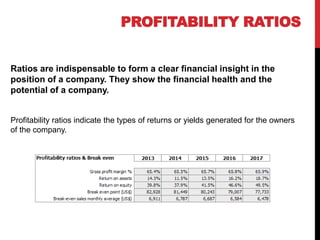
Ratios are indispensable to form a clear financial insight in the
position of a company. They show the financial health and the
potential of a company.
Profitability ratios indicate the types of returns or yields generated for the owners
of the company.
PROFITABILITY RATIOS
Gross profit margin = gross profit / net sales
Gross and Net Profit Margin
Your gross profit ratio tells you how much of each sales dollar you can expect to use to cover your
operating expenses and profit. In other words, it measures the difference between what it costs to produce
a product and what you're selling it for. While some ratios uncover trends by looking at the past, the gross
profit margin is a tool you can use to chart your company's future.
Gross profit margin = gross profit / net sales
Gross profit margin % = (gross profit / net sales) x 100% = ____%
A gross profit margin of 0.25 means that for every dollar in sales, you have 25 cents to cover your basic
operating costs and profit. Some business owners will use an anticipated gross profit margin to help them
price their products. While other factors, such as competition and demand, may play into pricing decisions,
a gross profit margin is a good starting point for product pricing. For example, if a product costs $8 to
produce, and your gross profit margin is 20 percent, you can calculate your pricing by dividing your cost by
(1-.0.2). In this case, $8 divided by .8 would yield a price of $10.
You can also use your gross profit margin ratio to help you set and monitor sales goals for your company.
Because costs for raw materials, labor and manufacturing expenses all play into your profit margin ratio, a
change in this ratio over time could mean it's time to look for new suppliers or review your pricing
structure.
Net profit margin % = (net income / net sales) x 100% = ____%
PROFITABILITY RATIOS
Return on assets (ROA)
This is an indicator of how much profit an enterprise's total assets generated.
Return on assets = net operating profit after tax / total assets
The return on assets ratio measures how well a company's management team is doing its job. A
comparison of net income and average total assets, the ROA ratio reveals how much income
management has been able to squeeze from each dollar's worth of a company's assets. Investors and
potential investors use this ratio to evaluate a company's leadership.
Many companies, particularly those involved in manufacturing and selling seasonal goods, experience
wide swings in assets during the course of a year. To accommodate for these swings and produce a
more accurate ratio, the total assets figure used to calculate the ROA should be an average of a firm's
assets at the beginning and end of the statement period.
The formula: Net income divided by average total assets
A return on assets ratio of 0.07:1 would mean the company is pulling in seven cents for each dollar of
assets.
Like most business ratios, you can learn the most from this one when you compare it to your ROA
ratios from previous years and with the industry norms.
Return on equity (ROE)
ROE is an index of how much profit has been generated using the stockholders' capital.
Return on equity = net income / equity (average of the equity amounts at the beginning
and end of the period)
OR
Return on equity = one year's earnings / shareholder equity
Return on equity encompasses the three main "levers" by which management can steer the enterprise
- profitability, asset management and financial leverage. By perceiving return on equity as a composite
that represents the executive team's ability to balance these three pillars of corporate management,
investors can not only get an excellent sense of whether they will receive a decent return on equity but
also assess management's ability to get the job done.
Return on equity is calculated by taking a year's worth of earnings and dividing them by the average
shareholders' equity for that year. The earnings can be taken directly from the Consolidated Statement
of Earnings in the company's last annual filing with the Securities Exchange Commission (SEC), or
they can be taken as the sum of the last four quarters worth of earnings. They can also be calculated
using the average of the last five or ten year's earnings, or they can be annualized based on the last
quarter's results. Investors should not annualize the results of a seasonal business where all of the
profit is booked in one or two quarters.
PROFITABILITY RATIOS
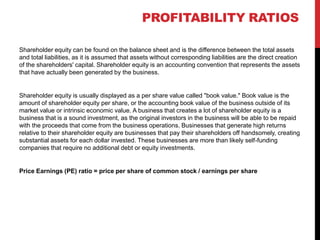
Shareholder equity can be found on the balance sheet and is the difference between the total assets
and total liabilities, as it is assumed that assets without corresponding liabilities are the direct creation
of the shareholders' capital. Shareholder equity is an accounting convention that represents the assets
that have actually been generated by the business.
Shareholder equity is usually displayed as a per share value called "book value." Book value is the
amount of shareholder equity per share, or the accounting book value of the business outside of its
market value or intrinsic economic value. A business that creates a lot of shareholder equity is a
business that is a sound investment, as the original investors in the business will be able to be repaid
with the proceeds that come from the business operations. Businesses that generate high returns
relative to their shareholder equity are businesses that pay their shareholders off handsomely, creating
substantial assets for each dollar invested. These businesses are more than likely self-funding
companies that require no additional debt or equity investments.
Price Earnings (PE) ratio = price per share of common stock / earnings per share
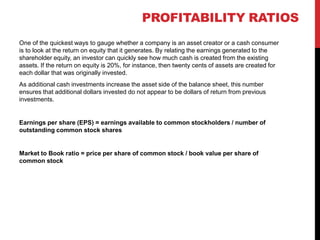
One of the quickest ways to gauge whether a company is an asset creator or a cash consumer
is to look at the return on equity that it generates. By relating the earnings generated to the
shareholder equity, an investor can quickly see how much cash is created from the existing
assets. If the return on equity is 20%, for instance, then twenty cents of assets are created for
each dollar that was originally invested.
As additional cash investments increase the asset side of the balance sheet, this number
ensures that additional dollars invested do not appear to be dollars of return from previous
investments.
Earnings per share (EPS) = earnings available to common stockholders / number of
outstanding common stock shares
Market to Book ratio = price per share of common stock / book value per share of
common stock
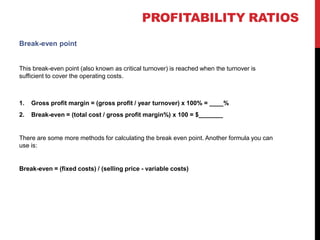
Break-even point
This break-even point (also known as critical turnover) is reached when the turnover is
sufficient to cover the operating costs.
1. Gross profit margin = (gross profit / year turnover) x 100% = ____%
2. Break-even = (total cost / gross profit margin%) x 100 = $_______
There are some more methods for calculating the break even point. Another formula you can
use is:
Break-even = (fixed costs) / (selling price - variable costs)
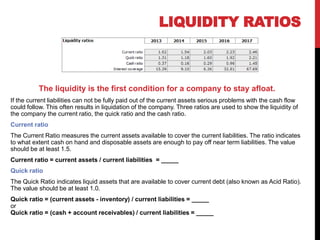
The liquidity is the first condition for a company to stay afloat.
If the current liabilities can not be fully paid out of the current assets serious problems with the cash flow
could follow. This often results in liquidation of the company. Three ratios are used to show the liquidity of
the company the current ratio, the quick ratio and the cash ratio.
Current ratio
The Current Ratio measures the current assets available to cover the current liabilities. The ratio indicates
to what extent cash on hand and disposable assets are enough to pay off near term liabilities. The value
should be at least 1.5.
Current ratio = current assets / current liabilities = _____
Quick ratio
The Quick Ratio indicates liquid assets that are available to cover current debt (also known as Acid Ratio).
The value should be at least 1.0.
Quick ratio = (current assets - inventory) / current liabilities = _____
or
Quick ratio = (cash + account receivables) / current liabilities = _____
LIQUIDITY RATIOS
Cash ratio
Cash ratio = cash / current liabilities = _____ (should be at least 0.5)
Interest coverage ratio
The interest coverage ratio is a measurement of the number of times a company could make its interest
payments with its earnings before interest and taxes. Or a calculation of a company's ability to meet its
interest payments on outstanding debt. The lower the ratio, the higher the company’s debt burden.
To calculate the interest coverage ratio, divide EBIT (Earnings Before Interest and Taxes) by the total
interest expense.
Interest coverage ratio = EBIT / interest expense = _____ (should be at least 1.5)
As a general rule of thumb, investors should not own stock that has an interest coverage ratio under 1.5.
An interest coverage ratio below 1.0 indicates the business is having difficulties generating the cash
necessary to pay its interest obligations. The more consistent a company’s earnings, the lower the interest
coverage ratio will be. A more conservative investor would take EBI (Earnings Before Interest) and divide it
by the interest expense. This would provide a more accurate picture of safety. Taxes are not included in
the equation.
Interest coverage ratio = EBI / interest expense = _____
Net working capital to total assets ratio
Net working capital to Total Assets ratio = current assets - inventory / total assets
LIQUIDITY RATIOS
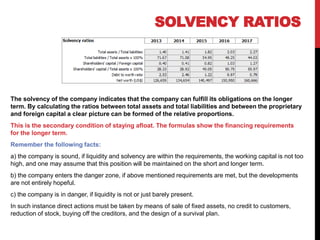
The solvency of the company indicates that the company can fulfill its obligations on the longer
term. By calculating the ratios between total assets and total liabilities and between the proprietary
and foreign capital a clear picture can be formed of the relative proportions.
This is the secondary condition of staying afloat. The formulas show the financing requirements
for the longer term.
Remember the following facts:
a) the company is sound, if liquidity and solvency are within the requirements, the working capital is not too
high, and one may assume that this position will be maintained on the short and longer term.
b) the company enters the danger zone, if above mentioned requirements are met, but the developments
are not entirely hopeful.
c) the company is in danger, if liquidity is not or just barely present.
In such instance direct actions must be taken by means of sale of fixed assets, no credit to customers,
reduction of stock, buying off the creditors, and the design of a survival plan.
SOLVENCY RATIOS
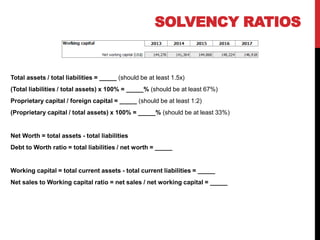
Total assets / total liabilities = _____ (should be at least 1.5x)
(Total liabilities / total assets) x 100% = _____% (should be at least 67%)
Proprietary capital / foreign capital = _____ (should be at least 1:2)
(Proprietary capital / total assets) x 100% = _____% (should be at least 33%)
Net Worth = total assets - total liabilities
Debt to Worth ratio = total liabilities / net worth = _____
Working capital = total current assets - total current liabilities = _____
Net sales to Working capital ratio = net sales / net working capital = _____
SOLVENCY RATIOS
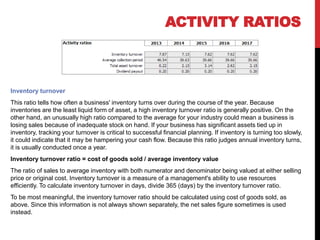
Inventory turnover
This ratio tells how often a business' inventory turns over during the course of the year. Because
inventories are the least liquid form of asset, a high inventory turnover ratio is generally positive. On the
other hand, an unusually high ratio compared to the average for your industry could mean a business is
losing sales because of inadequate stock on hand. If your business has significant assets tied up in
inventory, tracking your turnover is critical to successful financial planning. If inventory is turning too slowly,
it could indicate that it may be hampering your cash flow. Because this ratio judges annual inventory turns,
it is usually conducted once a year.
Inventory turnover ratio = cost of goods sold / average inventory value
The ratio of sales to average inventory with both numerator and denominator being valued at either selling
price or original cost. Inventory turnover is a measure of a management's ability to use resources
efficiently. To calculate inventory turnover in days, divide 365 (days) by the inventory turnover ratio.
To be most meaningful, the inventory turnover ratio should be calculated using cost of goods sold, as
above. Since this information is not always shown separately, the net sales figure sometimes is used
instead.
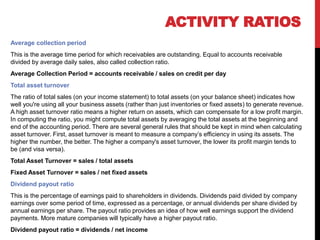
ACTIVITY RATIOS
Average collection period
This is the average time period for which receivables are outstanding. Equal to accounts receivable
divided by average daily sales, also called collection ratio.
Average Collection Period = accounts receivable / sales on credit per day
Total asset turnover
The ratio of total sales (on your income statement) to total assets (on your balance sheet) indicates how
well you're using all your business assets (rather than just inventories or fixed assets) to generate revenue.
A high asset turnover ratio means a higher return on assets, which can compensate for a low profit margin.
In computing the ratio, you might compute total assets by averaging the total assets at the beginning and
end of the accounting period. There are several general rules that should be kept in mind when calculating
asset turnover. First, asset turnover is meant to measure a company’s efficiency in using its assets. The
higher the number, the better. The higher a company's asset turnover, the lower its profit margin tends to
be (and visa versa).
Total Asset Turnover = sales / total assets
Fixed Asset Turnover = sales / net fixed assets
Dividend payout ratio
This is the percentage of earnings paid to shareholders in dividends. Dividends paid divided by company
earnings over some period of time, expressed as a percentage, or annual dividends per share divided by
annual earnings per share. The payout ratio provides an idea of how well earnings support the dividend
payments. More mature companies will typically have a higher payout ratio.
Dividend payout ratio = dividends / net income
ACTIVITY RATIOS
FINANCIAL RATIOS PART 1
For more financial ratios see
PlanMagic Financial Ratios Part 2
Visit the PlanMagic Website
for more about
BUSINESS PLANNING, MARKETING PLANNING, MEDIA PLANNING,
PERSONAL BUDGETING, AND MORE
Copyright © 1995-2015 PlanMagic Corporation
All rights reserved

Financial ratios Part 1

  • 1.
    FINANCIAL RATIOS THE MOST IMPORTANTFINANCIAL RATIOS FOR YOUR BUSINESS Copyright © 1995-2015 PlanMagic Corporation All rights reserved
  • 2.
    Ratios are indispensableto form a clear financial insight in the position of a company. They show the financial health and the potential of a company. Profitability ratios indicate the types of returns or yields generated for the owners of the company. PROFITABILITY RATIOS
  • 3.
    PROFITABILITY RATIOS Gross profitmargin = gross profit / net sales Gross and Net Profit Margin Your gross profit ratio tells you how much of each sales dollar you can expect to use to cover your operating expenses and profit. In other words, it measures the difference between what it costs to produce a product and what you're selling it for. While some ratios uncover trends by looking at the past, the gross profit margin is a tool you can use to chart your company's future. Gross profit margin = gross profit / net sales Gross profit margin % = (gross profit / net sales) x 100% = ____% A gross profit margin of 0.25 means that for every dollar in sales, you have 25 cents to cover your basic operating costs and profit. Some business owners will use an anticipated gross profit margin to help them price their products. While other factors, such as competition and demand, may play into pricing decisions, a gross profit margin is a good starting point for product pricing. For example, if a product costs $8 to produce, and your gross profit margin is 20 percent, you can calculate your pricing by dividing your cost by (1-.0.2). In this case, $8 divided by .8 would yield a price of $10. You can also use your gross profit margin ratio to help you set and monitor sales goals for your company. Because costs for raw materials, labor and manufacturing expenses all play into your profit margin ratio, a change in this ratio over time could mean it's time to look for new suppliers or review your pricing structure. Net profit margin % = (net income / net sales) x 100% = ____%
  • 4.
    PROFITABILITY RATIOS Return onassets (ROA) This is an indicator of how much profit an enterprise's total assets generated. Return on assets = net operating profit after tax / total assets The return on assets ratio measures how well a company's management team is doing its job. A comparison of net income and average total assets, the ROA ratio reveals how much income management has been able to squeeze from each dollar's worth of a company's assets. Investors and potential investors use this ratio to evaluate a company's leadership. Many companies, particularly those involved in manufacturing and selling seasonal goods, experience wide swings in assets during the course of a year. To accommodate for these swings and produce a more accurate ratio, the total assets figure used to calculate the ROA should be an average of a firm's assets at the beginning and end of the statement period. The formula: Net income divided by average total assets A return on assets ratio of 0.07:1 would mean the company is pulling in seven cents for each dollar of assets. Like most business ratios, you can learn the most from this one when you compare it to your ROA ratios from previous years and with the industry norms.
  • 5.
    Return on equity(ROE) ROE is an index of how much profit has been generated using the stockholders' capital. Return on equity = net income / equity (average of the equity amounts at the beginning and end of the period) OR Return on equity = one year's earnings / shareholder equity Return on equity encompasses the three main "levers" by which management can steer the enterprise - profitability, asset management and financial leverage. By perceiving return on equity as a composite that represents the executive team's ability to balance these three pillars of corporate management, investors can not only get an excellent sense of whether they will receive a decent return on equity but also assess management's ability to get the job done. Return on equity is calculated by taking a year's worth of earnings and dividing them by the average shareholders' equity for that year. The earnings can be taken directly from the Consolidated Statement of Earnings in the company's last annual filing with the Securities Exchange Commission (SEC), or they can be taken as the sum of the last four quarters worth of earnings. They can also be calculated using the average of the last five or ten year's earnings, or they can be annualized based on the last quarter's results. Investors should not annualize the results of a seasonal business where all of the profit is booked in one or two quarters. PROFITABILITY RATIOS
  • 6.
    Shareholder equity canbe found on the balance sheet and is the difference between the total assets and total liabilities, as it is assumed that assets without corresponding liabilities are the direct creation of the shareholders' capital. Shareholder equity is an accounting convention that represents the assets that have actually been generated by the business. Shareholder equity is usually displayed as a per share value called "book value." Book value is the amount of shareholder equity per share, or the accounting book value of the business outside of its market value or intrinsic economic value. A business that creates a lot of shareholder equity is a business that is a sound investment, as the original investors in the business will be able to be repaid with the proceeds that come from the business operations. Businesses that generate high returns relative to their shareholder equity are businesses that pay their shareholders off handsomely, creating substantial assets for each dollar invested. These businesses are more than likely self-funding companies that require no additional debt or equity investments. Price Earnings (PE) ratio = price per share of common stock / earnings per share
  • 7.
    One of thequickest ways to gauge whether a company is an asset creator or a cash consumer is to look at the return on equity that it generates. By relating the earnings generated to the shareholder equity, an investor can quickly see how much cash is created from the existing assets. If the return on equity is 20%, for instance, then twenty cents of assets are created for each dollar that was originally invested. As additional cash investments increase the asset side of the balance sheet, this number ensures that additional dollars invested do not appear to be dollars of return from previous investments. Earnings per share (EPS) = earnings available to common stockholders / number of outstanding common stock shares Market to Book ratio = price per share of common stock / book value per share of common stock
  • 8.
    Break-even point This break-evenpoint (also known as critical turnover) is reached when the turnover is sufficient to cover the operating costs. 1. Gross profit margin = (gross profit / year turnover) x 100% = ____% 2. Break-even = (total cost / gross profit margin%) x 100 = $_______ There are some more methods for calculating the break even point. Another formula you can use is: Break-even = (fixed costs) / (selling price - variable costs)
  • 9.
    The liquidity isthe first condition for a company to stay afloat. If the current liabilities can not be fully paid out of the current assets serious problems with the cash flow could follow. This often results in liquidation of the company. Three ratios are used to show the liquidity of the company the current ratio, the quick ratio and the cash ratio. Current ratio The Current Ratio measures the current assets available to cover the current liabilities. The ratio indicates to what extent cash on hand and disposable assets are enough to pay off near term liabilities. The value should be at least 1.5. Current ratio = current assets / current liabilities = _____ Quick ratio The Quick Ratio indicates liquid assets that are available to cover current debt (also known as Acid Ratio). The value should be at least 1.0. Quick ratio = (current assets - inventory) / current liabilities = _____ or Quick ratio = (cash + account receivables) / current liabilities = _____ LIQUIDITY RATIOS
  • 10.
    Cash ratio Cash ratio= cash / current liabilities = _____ (should be at least 0.5) Interest coverage ratio The interest coverage ratio is a measurement of the number of times a company could make its interest payments with its earnings before interest and taxes. Or a calculation of a company's ability to meet its interest payments on outstanding debt. The lower the ratio, the higher the company’s debt burden. To calculate the interest coverage ratio, divide EBIT (Earnings Before Interest and Taxes) by the total interest expense. Interest coverage ratio = EBIT / interest expense = _____ (should be at least 1.5) As a general rule of thumb, investors should not own stock that has an interest coverage ratio under 1.5. An interest coverage ratio below 1.0 indicates the business is having difficulties generating the cash necessary to pay its interest obligations. The more consistent a company’s earnings, the lower the interest coverage ratio will be. A more conservative investor would take EBI (Earnings Before Interest) and divide it by the interest expense. This would provide a more accurate picture of safety. Taxes are not included in the equation. Interest coverage ratio = EBI / interest expense = _____ Net working capital to total assets ratio Net working capital to Total Assets ratio = current assets - inventory / total assets LIQUIDITY RATIOS
  • 11.
    The solvency ofthe company indicates that the company can fulfill its obligations on the longer term. By calculating the ratios between total assets and total liabilities and between the proprietary and foreign capital a clear picture can be formed of the relative proportions. This is the secondary condition of staying afloat. The formulas show the financing requirements for the longer term. Remember the following facts: a) the company is sound, if liquidity and solvency are within the requirements, the working capital is not too high, and one may assume that this position will be maintained on the short and longer term. b) the company enters the danger zone, if above mentioned requirements are met, but the developments are not entirely hopeful. c) the company is in danger, if liquidity is not or just barely present. In such instance direct actions must be taken by means of sale of fixed assets, no credit to customers, reduction of stock, buying off the creditors, and the design of a survival plan. SOLVENCY RATIOS
  • 12.
    Total assets /total liabilities = _____ (should be at least 1.5x) (Total liabilities / total assets) x 100% = _____% (should be at least 67%) Proprietary capital / foreign capital = _____ (should be at least 1:2) (Proprietary capital / total assets) x 100% = _____% (should be at least 33%) Net Worth = total assets - total liabilities Debt to Worth ratio = total liabilities / net worth = _____ Working capital = total current assets - total current liabilities = _____ Net sales to Working capital ratio = net sales / net working capital = _____ SOLVENCY RATIOS
  • 13.
    Inventory turnover This ratiotells how often a business' inventory turns over during the course of the year. Because inventories are the least liquid form of asset, a high inventory turnover ratio is generally positive. On the other hand, an unusually high ratio compared to the average for your industry could mean a business is losing sales because of inadequate stock on hand. If your business has significant assets tied up in inventory, tracking your turnover is critical to successful financial planning. If inventory is turning too slowly, it could indicate that it may be hampering your cash flow. Because this ratio judges annual inventory turns, it is usually conducted once a year. Inventory turnover ratio = cost of goods sold / average inventory value The ratio of sales to average inventory with both numerator and denominator being valued at either selling price or original cost. Inventory turnover is a measure of a management's ability to use resources efficiently. To calculate inventory turnover in days, divide 365 (days) by the inventory turnover ratio. To be most meaningful, the inventory turnover ratio should be calculated using cost of goods sold, as above. Since this information is not always shown separately, the net sales figure sometimes is used instead. ACTIVITY RATIOS
  • 14.
    Average collection period Thisis the average time period for which receivables are outstanding. Equal to accounts receivable divided by average daily sales, also called collection ratio. Average Collection Period = accounts receivable / sales on credit per day Total asset turnover The ratio of total sales (on your income statement) to total assets (on your balance sheet) indicates how well you're using all your business assets (rather than just inventories or fixed assets) to generate revenue. A high asset turnover ratio means a higher return on assets, which can compensate for a low profit margin. In computing the ratio, you might compute total assets by averaging the total assets at the beginning and end of the accounting period. There are several general rules that should be kept in mind when calculating asset turnover. First, asset turnover is meant to measure a company’s efficiency in using its assets. The higher the number, the better. The higher a company's asset turnover, the lower its profit margin tends to be (and visa versa). Total Asset Turnover = sales / total assets Fixed Asset Turnover = sales / net fixed assets Dividend payout ratio This is the percentage of earnings paid to shareholders in dividends. Dividends paid divided by company earnings over some period of time, expressed as a percentage, or annual dividends per share divided by annual earnings per share. The payout ratio provides an idea of how well earnings support the dividend payments. More mature companies will typically have a higher payout ratio. Dividend payout ratio = dividends / net income ACTIVITY RATIOS
  • 15.
    FINANCIAL RATIOS PART1 For more financial ratios see PlanMagic Financial Ratios Part 2 Visit the PlanMagic Website for more about BUSINESS PLANNING, MARKETING PLANNING, MEDIA PLANNING, PERSONAL BUDGETING, AND MORE Copyright © 1995-2015 PlanMagic Corporation All rights reserved