
Results of survey on the role of:
Portfolio Business Analyst

www.pi3.co.za | +27 21 7955 130 | spike@pi3.co.za
Why this survey?
 A number of organisations have appointed fulltime portfolio

analysts to support the business in developing the business case,
modelling benefits, and tracking benefits realisation
 The skills and competencies required for this role have not

been fully mapped, though a number of professional bodies
including:
IPMA (project management)
IIBA (business analysis)
ACMP (change management)
make reference to such skills and competencies in their
competency models.
Sources for survey design
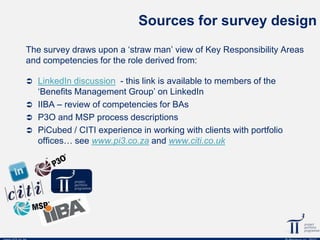
The survey draws upon a ‘straw man’ view of Key Responsibility Areas
and competencies for the role derived from:
 LinkedIn discussion - this link is available to members of the

‘Benefits Management Group’ on LinkedIn
 IIBA – review of competencies for BAs
 P3O and MSP process descriptions
 PiCubed / CITI experience in working with clients with portfolio
offices… see www.pi3.co.za and www.citi.co.uk
Terms used
 The role name was stated as:

Portfolio business analyst
(It’s clear from discussion on LinkedIn that there are a number of
different names for this role…)
 The purpose of the role was stated as:

To elicit, model, and document the benefits, costs and risks in a format
which allows the evaluation of likely ROI, and to assist the planning and
follow-through of benefits realisation activities.
Who took part?
 20 respondents from South Africa, UK, Ireland, Canada

and Australia
 Named job titles of people who took part

(not a mandatory field – so not always completed. Useful in
showing who was interested in this topic)
•
•
•
•
•
•
•
•
•
•

Consultant
Project portfolio business analyst
Value engineering/analyst
Project manager
Executive: planning and direction
Continuous improvement specialist (senior)
Benefits facilitator / management consultant
Managing director
Business analyst
Benefits and business case consultant
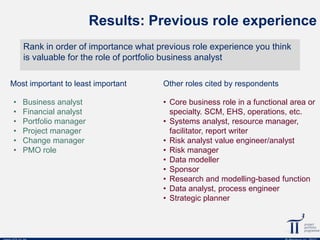
Results: Previous role experience
Rank in order of importance what previous role experience you think
is valuable for the role of portfolio business analyst
Most important to least important
•
•
•
•
•
•

Business analyst
Financial analyst
Portfolio manager
Project manager
Change manager
PMO role

Other roles cited by respondents
• Core business role in a functional area or
specialty. SCM, EHS, operations, etc.
• Systems analyst, resource manager,
facilitator, report writer
• Risk analyst value engineer/analyst
• Risk manager
• Data modeller
• Sponsor
• Research and modelling-based function
• Data analyst, process engineer
• Strategic planner
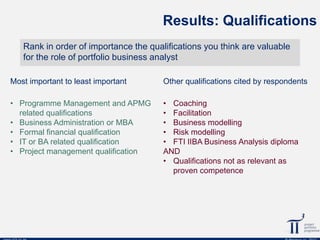
Results: Qualifications
Rank in order of importance the qualifications you think are valuable
for the role of portfolio business analyst
Most important to least important

Other qualifications cited by respondents

• Programme Management and APMG
related qualifications
• Business Administration or MBA
• Formal financial qualification
• IT or BA related qualification
• Project management qualification

• Coaching
• Facilitation
• Business modelling
• Risk modelling
• FTI IIBA Business Analysis diploma
AND
• Qualifications not as relevant as
proven competence
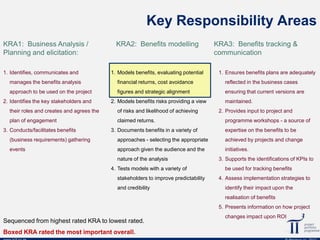
Key Responsibility Areas
KRA1: Business Analysis /
Planning and elicitation:
1. Identifies, communicates and

KRA2: Benefits modelling

1. Models benefits, evaluating potential

KRA3: Benefits tracking &
communication
1. Ensures benefits plans are adequately

manages the benefits analysis

financial returns, cost avoidance

reflected in the business cases

approach to be used on the project

figures and strategic alignment

ensuring that current versions are

2. Identifies the key stakeholders and

2. Models benefits risks providing a view

their roles and creates and agrees the

of risks and likelihood of achieving

plan of engagement

claimed returns.

3. Conducts/facilitates benefits

3. Documents benefits in a variety of

maintained.
2. Provides input to project and
programme workshops - a source of
expertise on the benefits to be

(business requirements) gathering

approaches - selecting the appropriate

achieved by projects and change

events

approach given the audience and the

initiatives.

nature of the analysis
4. Tests models with a variety of
stakeholders to improve predictability
and credibility

3. Supports the identifications of KPIs to
be used for tracking benefits
4. Assess implementation strategies to
identify their impact upon the
realisation of benefits
5. Presents information on how project

Sequenced from highest rated KRA to lowest rated.
Boxed KRA rated the most important overall.

changes impact upon ROI
Competencies
Competency area 1:
Business / analytical

Competency area 2:
Interpersonal

1.Conceptual thinking: 'Joins the dots'
between business ideas. Takes
information from different areas and
integrates them into a holistic
perspective.

1.Communication: Able to present ideas
and write benefits cases taking into
account the needs of the audiences.
Uses clear unambiguous
communications style.

2.Strategic and industry knowledge:
Good appreciation of business strategy.
Able to relate intentions to overall
business strategy.

2.Influencing: Confident in approach able to take even the most doubting
stakeholder on the journey towards
understanding and chasing down ROI.

3.Business understanding: Strong
financial appreciation. Understands
financial modelling principles and able
to apply this understanding in a useful
and coherent way to the analysis of
benefits.

3.Facilitation & negotiation: Identifies
the need to broker agreement between
stakeholders. Seeks out approaches to
surfacing and resolving different
agendas.

4.Problem solving: Works
systematically to identify 'root causes' to
problems & critically questions
information.
5.Planning & organising: Plans out the
analysis work ensuring that
stakeholders know what is expected of
them and when.

Competency area 3: Personal
1.Integrity & trustworthiness: Is an
honest broker. Listens and captures
various perspectives without being seen
to take up any particular agenda.
2.Clarity of thinking / attention to
detail: Champions clarity in thinking.
Hunts down the 'facts & figures' - does
not put up with assumptions when real
information can be practically found.
3.Determination/ drive for results: Is
not easily diverted even when
stakeholders are unhelpful. Will seek
out other sources of information or find
different approaches to getting
information.

4.Working effectively with others:
Clearly identifies need for further
information and guides information
providing groups on how best they can
contribute.

Sequenced from highest rated competency to lowest rated.
Boxed competency was rated the most important overall

What does a Portfolio Business Analyst look like?

  • 1.
    Results of surveyon the role of: Portfolio Business Analyst www.pi3.co.za | +27 21 7955 130 | spike@pi3.co.za
  • 2.
    Why this survey? A number of organisations have appointed fulltime portfolio analysts to support the business in developing the business case, modelling benefits, and tracking benefits realisation  The skills and competencies required for this role have not been fully mapped, though a number of professional bodies including: IPMA (project management) IIBA (business analysis) ACMP (change management) make reference to such skills and competencies in their competency models.
  • 3.
    Sources for surveydesign The survey draws upon a ‘straw man’ view of Key Responsibility Areas and competencies for the role derived from:  LinkedIn discussion - this link is available to members of the ‘Benefits Management Group’ on LinkedIn  IIBA – review of competencies for BAs  P3O and MSP process descriptions  PiCubed / CITI experience in working with clients with portfolio offices… see www.pi3.co.za and www.citi.co.uk
  • 4.
    Terms used  Therole name was stated as: Portfolio business analyst (It’s clear from discussion on LinkedIn that there are a number of different names for this role…)  The purpose of the role was stated as: To elicit, model, and document the benefits, costs and risks in a format which allows the evaluation of likely ROI, and to assist the planning and follow-through of benefits realisation activities.
  • 5.
    Who took part? 20 respondents from South Africa, UK, Ireland, Canada and Australia  Named job titles of people who took part (not a mandatory field – so not always completed. Useful in showing who was interested in this topic) • • • • • • • • • • Consultant Project portfolio business analyst Value engineering/analyst Project manager Executive: planning and direction Continuous improvement specialist (senior) Benefits facilitator / management consultant Managing director Business analyst Benefits and business case consultant
  • 6.
    Results: Previous roleexperience Rank in order of importance what previous role experience you think is valuable for the role of portfolio business analyst Most important to least important • • • • • • Business analyst Financial analyst Portfolio manager Project manager Change manager PMO role Other roles cited by respondents • Core business role in a functional area or specialty. SCM, EHS, operations, etc. • Systems analyst, resource manager, facilitator, report writer • Risk analyst value engineer/analyst • Risk manager • Data modeller • Sponsor • Research and modelling-based function • Data analyst, process engineer • Strategic planner
  • 7.
    Results: Qualifications Rank inorder of importance the qualifications you think are valuable for the role of portfolio business analyst Most important to least important Other qualifications cited by respondents • Programme Management and APMG related qualifications • Business Administration or MBA • Formal financial qualification • IT or BA related qualification • Project management qualification • Coaching • Facilitation • Business modelling • Risk modelling • FTI IIBA Business Analysis diploma AND • Qualifications not as relevant as proven competence
  • 8.
    Key Responsibility Areas KRA1:Business Analysis / Planning and elicitation: 1. Identifies, communicates and KRA2: Benefits modelling 1. Models benefits, evaluating potential KRA3: Benefits tracking & communication 1. Ensures benefits plans are adequately manages the benefits analysis financial returns, cost avoidance reflected in the business cases approach to be used on the project figures and strategic alignment ensuring that current versions are 2. Identifies the key stakeholders and 2. Models benefits risks providing a view their roles and creates and agrees the of risks and likelihood of achieving plan of engagement claimed returns. 3. Conducts/facilitates benefits 3. Documents benefits in a variety of maintained. 2. Provides input to project and programme workshops - a source of expertise on the benefits to be (business requirements) gathering approaches - selecting the appropriate achieved by projects and change events approach given the audience and the initiatives. nature of the analysis 4. Tests models with a variety of stakeholders to improve predictability and credibility 3. Supports the identifications of KPIs to be used for tracking benefits 4. Assess implementation strategies to identify their impact upon the realisation of benefits 5. Presents information on how project Sequenced from highest rated KRA to lowest rated. Boxed KRA rated the most important overall. changes impact upon ROI
  • 9.
    Competencies Competency area 1: Business/ analytical Competency area 2: Interpersonal 1.Conceptual thinking: 'Joins the dots' between business ideas. Takes information from different areas and integrates them into a holistic perspective. 1.Communication: Able to present ideas and write benefits cases taking into account the needs of the audiences. Uses clear unambiguous communications style. 2.Strategic and industry knowledge: Good appreciation of business strategy. Able to relate intentions to overall business strategy. 2.Influencing: Confident in approach able to take even the most doubting stakeholder on the journey towards understanding and chasing down ROI. 3.Business understanding: Strong financial appreciation. Understands financial modelling principles and able to apply this understanding in a useful and coherent way to the analysis of benefits. 3.Facilitation & negotiation: Identifies the need to broker agreement between stakeholders. Seeks out approaches to surfacing and resolving different agendas. 4.Problem solving: Works systematically to identify 'root causes' to problems & critically questions information. 5.Planning & organising: Plans out the analysis work ensuring that stakeholders know what is expected of them and when. Competency area 3: Personal 1.Integrity & trustworthiness: Is an honest broker. Listens and captures various perspectives without being seen to take up any particular agenda. 2.Clarity of thinking / attention to detail: Champions clarity in thinking. Hunts down the 'facts & figures' - does not put up with assumptions when real information can be practically found. 3.Determination/ drive for results: Is not easily diverted even when stakeholders are unhelpful. Will seek out other sources of information or find different approaches to getting information. 4.Working effectively with others: Clearly identifies need for further information and guides information providing groups on how best they can contribute. Sequenced from highest rated competency to lowest rated. Boxed competency was rated the most important overall