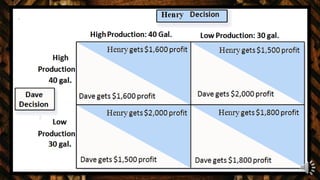
The document discusses game theory, particularly the prisoner's dilemma, highlighting its evolution from the 1950s to its relevance in various fields like economics and biology. It explains the dynamics of decision-making among participants where acting in self-interest can lead to suboptimal outcomes, using examples of fictional brokers and friends. Ultimately, it illustrates how cooperation may yield better results than competing strategies, exemplified by both parties inevitably choosing guilty pleas despite potential for lesser sentences.